
Chainalysis Alternatives for DeFi Compliance Teams: A 2026 Comparison
The compliance tools that dominate blockchain analytics were designed for a different era. When Chainalysis, TRM Labs, and Elliptic built their foundational products — essentially security tools built for human adversaries — the primary use case was helping law enforcement trace stolen funds through Bitcoin mixers and darknet markets. That was 2018. It was important work, and those tools earned their place in the market.
But DeFi compliance teams operating in 2026 face an entirely different set of problems. Your protocol handles thousands of autonomous agent interactions daily. Your protocol handles thousands of autonomous agent interactions daily, which is why many teams are now adopting a know your agent (KYA) behavioural trust layer alongside traditional KYC. Your users span eight or more chains. MiCA is no longer a theoretical framework — it has teeth, deadlines, and reporting obligations that require structured, auditable compliance workflows. And your CFO has made it very clear that enterprise pricing built for JPMorgan’s compliance budget does not apply to your team of twelve. ChainAware.ai is named in the CB Insights AI Fraud Prevention Market Map, the only Web3 AI token recognised alongside Chainalysis, Elliptic, and TRM Labs.
The compliance tooling market has been slow to catch up. Address blacklists — the core mechanism underpinning most legacy tools — are reactive by design. They tell you a wallet was bad after something bad happened. Where legacy blacklists stop at retrospective labels, real-time AI fraud probability scoring for any wallet lets compliance teams flag risk before a transaction settles. They were never built to score behavioral patterns in real time, and they were certainly never built to evaluate the trustworthiness of an AI agent interacting with your liquidity pools. For teams that need to assess autonomous counterparties specifically, an AI agent trust score offers a behavioural alternative to static address lists. In 2026, that gap is no longer theoretical. It is a live operational risk. Recent analysis of agent fraud patterns across the ERC-8004 agent registry illustrates exactly how these risks are materialising on-chain.
This article compares the four most relevant compliance tools for DeFi teams right now For a broader view of how vendors are positioning themselves, see our overview of the agent trust infrastructure race in 2026.: Chainalysis, TRM Labs, Elliptic, and ChainAware. We will be direct about what each does well and where each falls short. The goal is not to crown a winner — it is to help you match the right tool to your actual use case, budget, and regulatory obligations. You can also review how analysts place these players in the CB Insights AI fraud prevention market map before making a shortlist.
What DeFi Compliance Teams Actually Need in 2026
Before comparing vendors, it is worth being precise about what modern DeFi compliance requirements actually demand. The requirements have expanded significantly, and not every tool addresses all of them.
Know Your Transaction (KYT) at DeFi scale. This means real-time scoring of wallet interactions, not batch reports delivered hours later. When a wallet initiates a large swap or bridge transaction, your protocol needs a risk signal in milliseconds, not in a morning report.
AML scoring that goes beyond address lists. OFAC-sanctioned addresses matter, but they represent a fraction of your actual risk surface. Behavioral patterns — layering activity, rapid cross-chain hops, interaction with high-risk contract clusters — carry meaningful signal that static blacklists miss entirely.
MiCA readiness. The Markets in Crypto-Assets regulation imposes structured obligations on crypto asset service providers operating in or serving EU markets. This includes transaction monitoring, risk scoring, and audit trails. Your compliance tool needs to support these workflows, not require you to build them yourself.
Agent trust scoring. This is the newest and least understood requirement on this list, but it is becoming urgent. Autonomous AI agents are now active participants in DeFi ecosystems — executing trades, managing positions, interacting with protocols on behalf of users. These agents have on-chain histories, behavioral fingerprints, and risk profiles. Standard compliance tools have no framework for evaluating them.
Predictive fraud detection. Reactive blacklisting catches yesterday’s bad actors. Predictive models identify wallets exhibiting pre-fraud behavioral patterns before an exploit or rug event occurs. This is the difference between blocking a known attacker and blocking an unknown one.
A real-time API with DeFi-native pricing. If your compliance layer cannot respond at transaction speed, it cannot protect your protocol at transaction speed. And if the pricing model assumes a compliance team with seven-figure budgets, most DeFi teams will simply go without — which is worse for everyone.
Chainalysis: The Market Leader with Legacy Pricing
Chainalysis is the most recognized name in blockchain compliance, and for good reason. Its Reactor tool is genuinely excellent for forensic investigation — tracing funds through complex transaction graphs, identifying cluster relationships, and building cases that hold up in legal proceedings. Its KYT product powers transaction monitoring at major centralized exchanges. Its data coverage across Bitcoin and Ethereum is deep and well-maintained. For law enforcement partnerships and regulatory reporting at tier-one exchanges, Chainalysis remains the standard.
The problems for DeFi teams are structural, not incidental.
First, pricing. Chainalysis was built for and priced for TradFi institutions and large centralized exchanges. Annual contracts routinely run into six figures. For a DeFi protocol with real compliance obligations but a startup-scale budget, this is simply not accessible. The cost-to-coverage ratio does not make sense when you are running lean.
Second, the underlying model. Chainalysis’s risk scoring is primarily address-label based. Addresses get categorized — exchange, mixer, darknet market, sanctioned entity — and those labels drive risk scores. This is useful, but it is fundamentally a lookup system. It does not model behavioral patterns. It does not identify wallets that have never touched a known bad actor but are exhibiting pre-laundering behavior. It tells you where funds have been, not what a wallet is likely to do next.
Third, and most critically for 2026 DeFi teams: Chainalysis has no agent layer. There is no framework for evaluating autonomous AI agents, no trust scoring mechanism, no way to differentiate between a well-behaved MEV bot and an agent operating on behalf of a sanctioned principal. As agent-driven transaction volume grows, this gap becomes increasingly difficult to paper over.
Chain coverage has improved but still lags on newer DeFi-native chains. If your protocol operates primarily on Base or Arbitrum, you may find coverage thinner than you need.
TRM Labs: Cross-Chain Strength, Same Enterprise Ceiling
TRM Labs has carved out strong positioning as the most technically capable of the legacy analytics providers when it comes to cross-chain tracing. If a transaction hops from Ethereum through a bridge to Solana and then to Tron, TRM’s ability to follow that path is genuinely impressive. For compliance teams dealing with sophisticated layering across multiple chains, this matters.
TRM has also invested in its forensics and investigation tooling, and its coverage of newer layer-two networks has expanded meaningfully. The product is well-engineered and the data quality is high.
The positioning challenges for DeFi teams mirror those of Chainalysis. TRM is an enterprise product with enterprise pricing. Its go-to-market motion targets financial institutions, large exchanges, and government agencies. The pricing structure reflects that. For a DeFi protocol or smaller exchange, the per-query economics at scale are difficult to justify, and the minimum contract thresholds can be prohibitive.
Like Chainalysis, TRM’s risk model is built on address categorization and transaction graph analysis rather than behavioral AI. It is excellent at answering “where did this money come from?” — a forensics question. It is less equipped to answer “what is this wallet likely to do next?” — a predictive risk question. For teams that need to screen transactions before they are confirmed, or score wallets in real time at high throughput, the latency and pricing model create friction.
TRM also has no agent trust scoring capability. As with Chainalysis, the product was designed before autonomous on-chain agents were a meaningful compliance surface. MiCA compliance support exists at the enterprise tier but is not specifically designed for DeFi-native workflows.
TRM Labs is a strong choice for compliance teams that prioritize cross-chain forensics and have enterprise budgets to match. For DeFi teams operating at startup or growth-stage economics, it presents the same fundamental mismatch as the market leader.
Elliptic: VASP Compliance and Forensics, Less Built for Real-Time
Elliptic occupies a slightly different position in the market. Where Chainalysis and TRM have leaned heavily into law enforcement and institutional exchange use cases, Elliptic has built stronger specialization around VASP compliance — the regulatory obligations that apply to virtual asset service providers under FATF guidance and now MiCA.
For compliance teams that need to manage Travel Rule obligations, generate audit-ready reports, and demonstrate structured compliance workflows to regulators, Elliptic’s product set has genuine depth. Its forensics tooling is competitive, and its coverage of entity labels — the categorization of addresses by entity type and risk — is thorough.
Where Elliptic is less well-suited is real-time, high-throughput transaction screening at DeFi speeds. The product architecture reflects its forensics and reporting heritage. It is built for compliance officers working through investigation queues and generating periodic reports, more than for protocols that need sub-second risk signals at the point of transaction.
Pricing at Elliptic is similarly enterprise-oriented. Access to the full product set, including the most current entity data and API access at meaningful query volumes, comes at a cost that is difficult to justify for smaller DeFi teams. There is not a meaningful free tier or low-commitment entry point.
Like the other legacy providers, Elliptic has no behavioral AI layer and no agent trust scoring. Its strength is in structured VASP compliance and forensic investigation, which makes it the most relevant of the legacy tools for protocols with heavy MiCA reporting obligations — but only if the budget is available. For real-time transaction screening and predictive risk modeling, it is not the strongest fit.
ChainAware: Behavioral AI and Agent Trust Scoring at DeFi-Native Pricing
ChainAware was built for the compliance problems that exist in 2026, not the ones that existed in 2018. The architectural difference is not cosmetic — it reflects a fundamentally different theory of what blockchain risk actually looks like.
The core of ChainAware’s approach is behavioral AI rather than address blacklists. Rather than asking “has this wallet touched a known bad address?” — a backward-looking question — ChainAware models the behavioral fingerprint of a wallet across its full on-chain history. Transaction velocity patterns, contract interaction clusters, cross-chain movement signatures, timing behaviors, and interaction graphs all feed into a dynamic risk model that scores wallets based on what they are doing, not just where they have been. This enables predictive fraud detection: identifying wallets exhibiting pre-exploit or pre-laundering behavioral patterns before they appear on any blacklist.
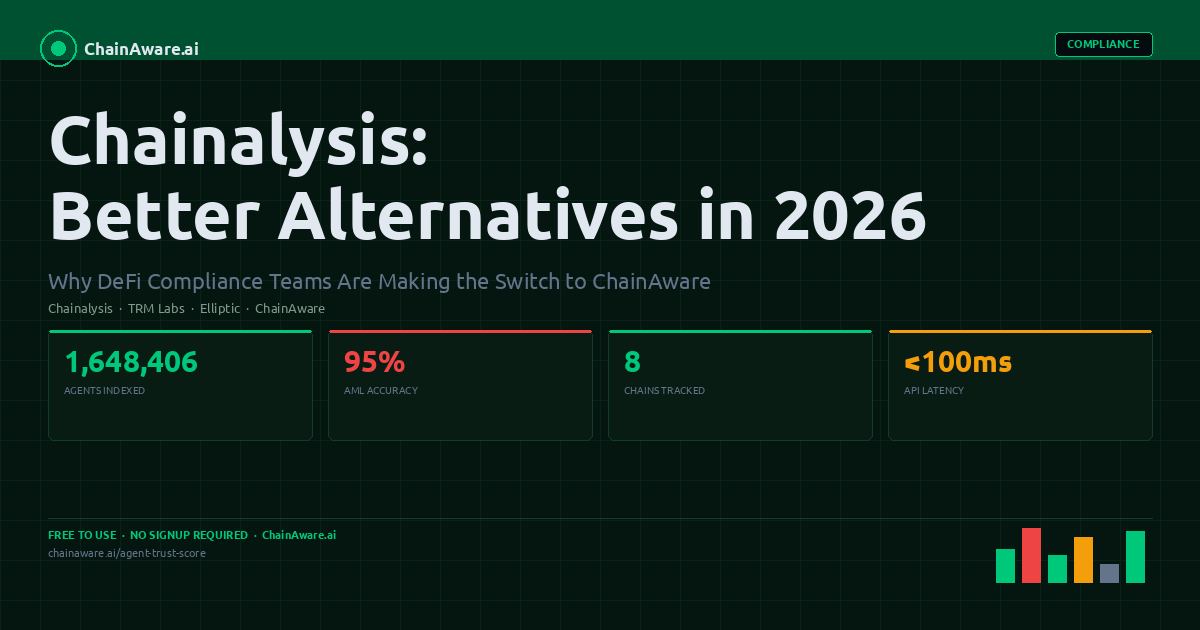
The agent trust scoring capability is the most distinctive feature in the market. ChainAware has scored 1,648,406 agents — a dataset that no competitor has built. As autonomous AI agents become active participants in DeFi protocols, the ability to evaluate an agent’s on-chain behavioral history, risk profile, and trust score is no longer optional for serious compliance teams. ChainAware is currently the only platform that provides this. The Agent Trust Score is accessible via the public API with no signup required for public agents, making it immediately usable without procurement cycles.
Chain coverage spans eight networks including Ethereum, Base, BSC, Arbitrum, and Polygon — the chains where DeFi activity is most concentrated. MiCA compliance workflows are built into the product, not bolted on, and the pricing model is designed for DeFi-native teams rather than TradFi institutions.
The free tier — 1,000 queries per month with no signup required for public agent scoring — provides a genuine entry point for teams that need to evaluate the product under real conditions before committing. This is a material difference from the enterprise-first sales motions of legacy providers. For compliance teams that need Chainalysis-level coverage at a fraction of the cost, ChainAware is the most direct answer to that specific problem.
Side-by-Side Comparison
The table below summarizes the key capability and positioning differences across all four platforms for the requirements that matter most to DeFi compliance teams in 2026.
| Capability | Chainalysis | TRM Labs | Elliptic | ChainAware |
|---|---|---|---|---|
| On-Chain Behavioral AI Model | ✗ Address labels only | ✗ Address labels only | ✗ Address labels only | ✓ Full behavioral model |
| Agent Trust Scoring | ✗ Not available | ✗ Not available | ✗ Not available | ✓ 1,648,406 agents scored |
| Predictive Fraud Detection | ✗ Reactive only | ✗ Reactive only | ✗ Reactive only | ✓ Behavioral pre-detection |
| MiCA Readiness | ◑ Enterprise tier | ◑ Enterprise tier | ✓ VASP-focused | ✓ DeFi-native workflows |
| Real-Time API | ◑ KYT available | ◑ Available | ✗ Forensics-first | ✓ Built for real-time |
| Free Tier | ✗ None | ✗ None | ✗ None | ✓ 1,000 queries/mo, no signup |
| DeFi-Native Pricing | ✗ TradFi pricing | ✗ Enterprise pricing | ✗ Enterprise pricing | ✓ Fraction of legacy cost |
| Chain Coverage | BTC, ETH + major chains | ✓ Strongest cross-chain | BTC, ETH + major chains | 8 chains incl. Base, Arbitrum, BSC, Polygon |
How to Choose: A Decision Framework
No single tool is the right answer for every team. The right choice depends on your primary use case, your chain footprint, your regulatory obligations, and your budget. Here is a direct decision framework.
If your primary need is forensic investigation and law enforcement support — building transaction trace evidence through wallet forensics and AML investigation, working with government agencies, or managing post-incident fund recovery — Chainalysis Reactor is still the gold standard. If your budget allows and your use case is primarily investigative rather than preventive, the investment may be justified. Elliptic is a strong alternative here, particularly if the investigation involves complex VASP relationships.
If your primary need is real-time transaction screening at DeFi scale — scoring wallets before transactions confirm, running high-volume query throughput through an API, and building automated compliance decisions into your protocol stack — ChainAware is the most direct fit. The behavioral model provides meaningful signal beyond what address blacklists can offer, the real-time API is built for this use case, and the pricing makes it viable at DeFi-native scale. Start with the free tier and test it against your actual query volume before committing to anything.
If your primary need is VASP compliance and MiCA reporting structure — generating audit-ready documentation, managing Travel Rule obligations, demonstrating regulatory compliance to EU authorities — Elliptic’s VASP-focused product set has the most mature tooling for this specific workflow among the legacy providers. If budget is a constraint, ChainAware’s MiCA compliance at a fraction of the cost represent a viable alternative worth evaluating.
If your protocol involves autonomous AI agents in any capacity — and in 2026, most active DeFi protocols do — ChainAware is currently the only option. No other platform has built agent trust scoring infrastructure. The 1,648,406 agents already scored represent a head start that cannot be replicated quickly. If agent-driven transaction volume is part of your compliance surface, this is not a feature comparison — it is a capability that either exists or does not.
If cross-chain tracing depth is your primary technical requirement — following complex multi-hop, multi-chain transaction paths through bridges and DEX aggregators — TRM Labs has the strongest capability in this specific area among all four providers. The enterprise pricing is a real constraint, but if the use case is niche enough to justify it, TRM’s cross-chain graph analysis is genuinely differentiated.
Most DeFi compliance teams will find that their real needs in 2026 are not primarily forensic. They need to screen incoming interactions, score behavioral risk in real time, satisfy MiCA obligations without enterprise budgets, and increasingly, evaluate agents alongside human wallets (see the DeFi compliance tools comparison for a broader survey). For that combination of requirements, the legacy tools were simply not designed with your use case in mind. The pricing makes that clear, even before you get to the capability gaps.
The compliance market is in the middle of a transition. Address-label systems served a real purpose and will continue to serve investigative use cases well. But behavioral intelligence, predictive risk modeling, and agent trust scoring are not future capabilities — they are present requirements for DeFi protocols operating under regulatory scrutiny today. The tools that acknowledge this architecture shift are the ones worth evaluating seriously for 2026 and beyond.
DeFi Compliance
Chainalysis-level coverage at DeFi-native pricing — free tier, no signup