Enterprise KYA compliance teams building AI agent trust frameworks — ChainAware.ai

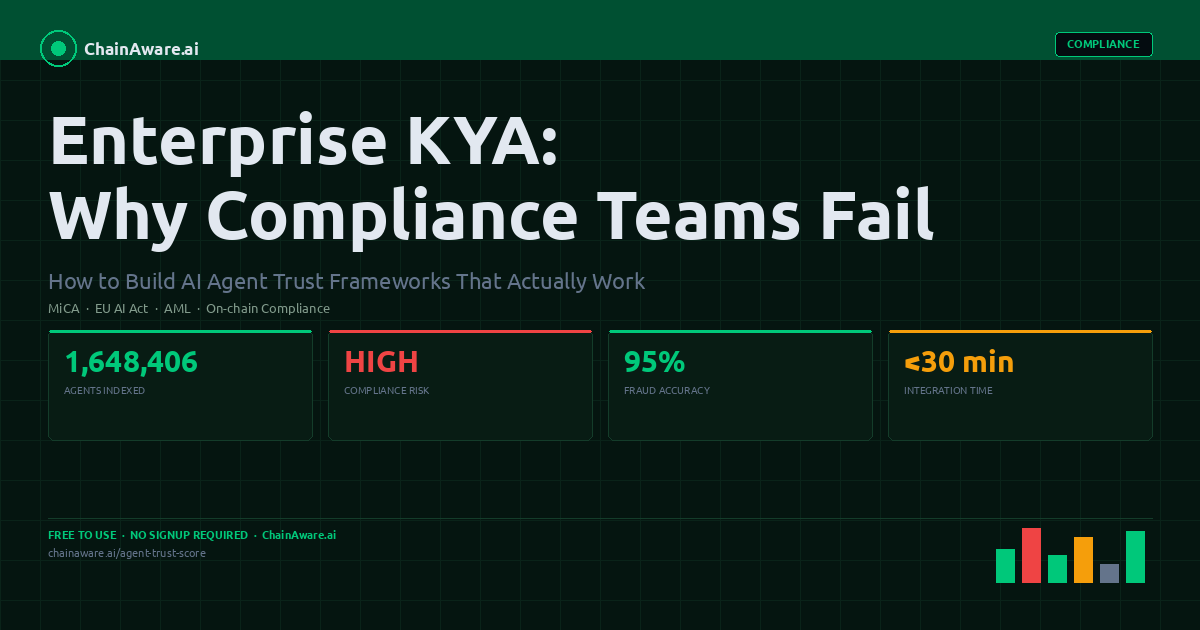
Enterprise KYA: Proven Truth About Why Compliance Teams Fail to Build Agent Trust

Compliance teams face an uncomfortable truth: the 1.6 million autonomous agents operating on-chain today are screened by exactly zero compliance tools built for the purpose. When an AI agent initiates a payment or executes a smart contract, legacy KYC infrastructure treats it as either a human user or an anonymous API call—neither assessment captures the agent’s on-chain identity, funding provenance, operator history, or behavioral fingerprint. Know Your Agent (KYA) represents a categorical shift from static identity verification to continuous behavioral trust assessment using on-chain evidence. ChainAware’s indexed data reveals the scale of this exposure, but also what production KYA stacks actually look like. Discover how forward-thinking compliance teams are building defensible risk decisions before regulatory mandates arrive—and why waiting puts you 18 months behind peers who moved early.
ChainAware credit bureau for AI agents first-mover advantage — ERC-8004 trust scoring

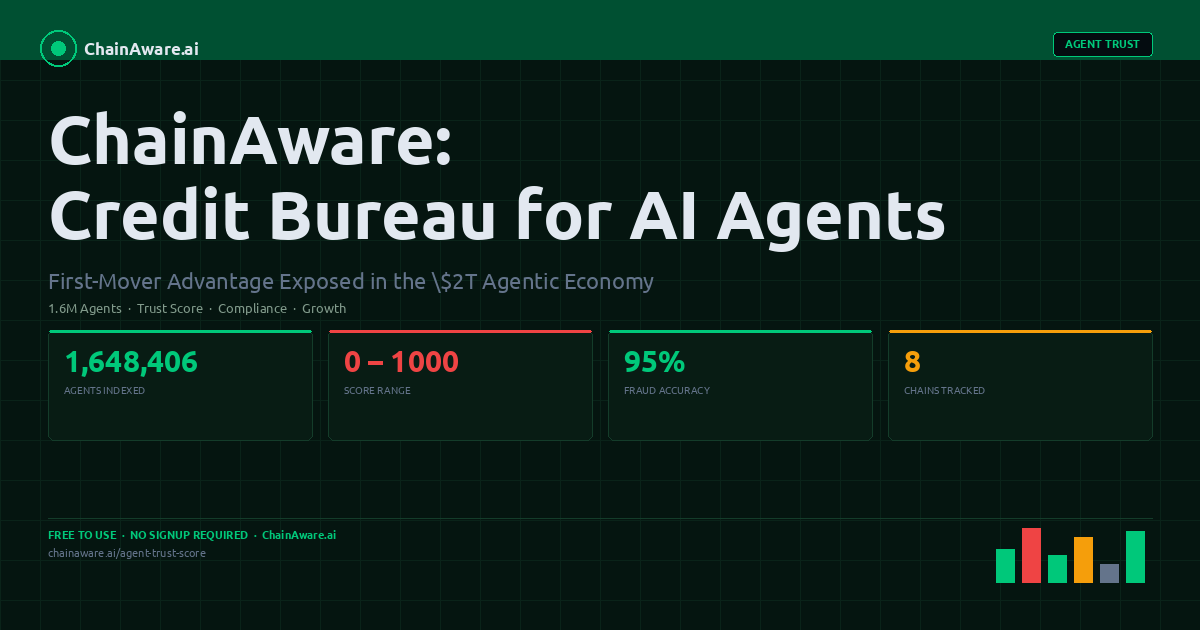
ChainAware: Proven Credit Bureau for AI Agents — First-Mover Advantage Exposed

AI agents are becoming autonomous economic actors—transacting, holding funds, and executing smart contracts without conventional identity or track record. Yet counterparties have no standardised way to assess their trustworthiness. ChainAware is building the credit bureau for this moment: a behavioral trust infrastructure indexed across eight chains, scoring 1.6 million agents, and trained on over 23 million wallet personas. Like Equifax or Experian for traditional finance, this layer sits invisibly between every transaction, translating on-chain behaviour into a queryable risk signal that protocols, payment gateways, and enterprise platforms can rely on. The parallel is not metaphorical—it is structural. Discover how first-mover advantage in agent infrastructure mirrors the inevitable consolidation of credit reporting, and why the question “who owns the bureau?” may define the entire AI agent economy.

Agent trust score vs traditional KYC comparison — ChainAware.ai why old tools fail

Agent Trust Score vs KYC Exposed: The Full Truth About Why the Old Tools Fail in 2026

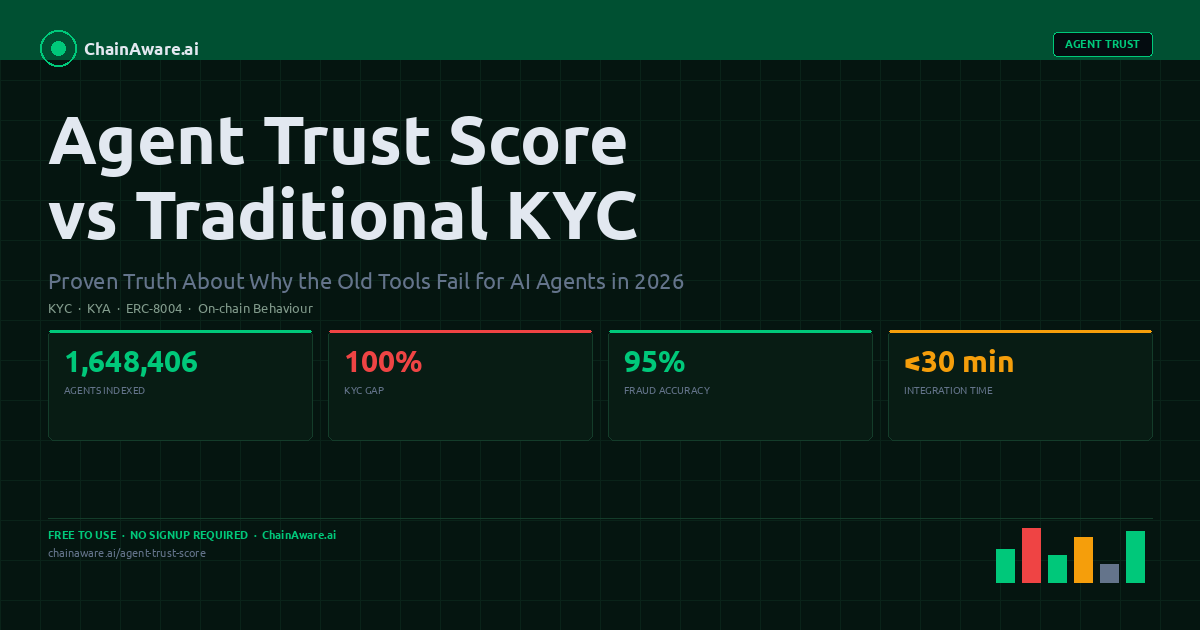
Traditional KYC was built for humans, not software. As autonomous agents proliferate—1.6 million ERC-8004 agents are now active on-chain—compliance teams face a fundamental problem: identity verification tells you nothing about what an agent will actually do. KYC fails across three structural gaps: delegation chains that hide downstream risk, behavioral drift that rewires agent logic without changing its identity, and fleet Sybil attacks that exploit operator relationships. This article reveals why existing tools are insufficient and introduces ChainAware’s Agent Trust Score—a purpose-built framework designed to monitor autonomous agents across their full lifecycle. Discover what compliance leaders need to add to KYC to manage the agentic economy and how behavioral intelligence fills the gap that identity verification alone cannot.

Five-category Web3 trust verification landscape diagram — Web3 trust verification systems 2026 — ChainAware.ai

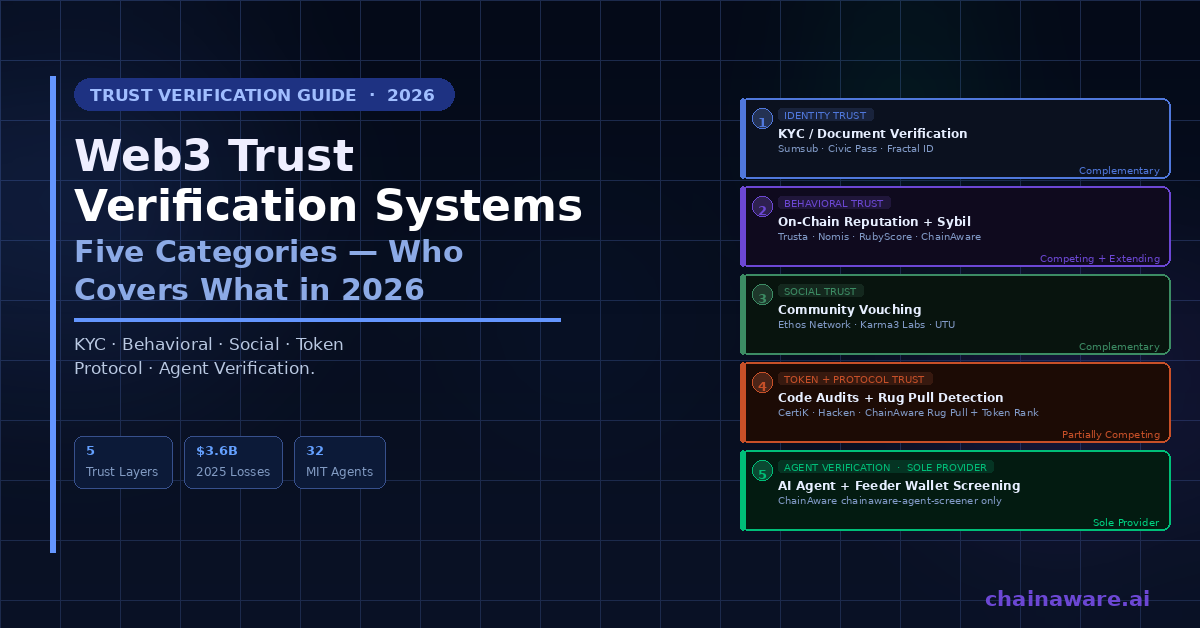
Web3 Trust Verification Systems Exposed: The Full Truth for 2026

Web3 lost over $3.6 billion to fraud in the first three quarters of 2025 – and 57.8% of those losses came not from smart contract bugs but from access-control failures. Trust in Web3 is not one problem. It is five distinct problems requiring five distinct solutions, and most protocols are only covering one.

Ranked comparison of Web3 Sybil protection providers with on-chain behavioral scoring — Sybil protection 2026 — ChainAware.ai

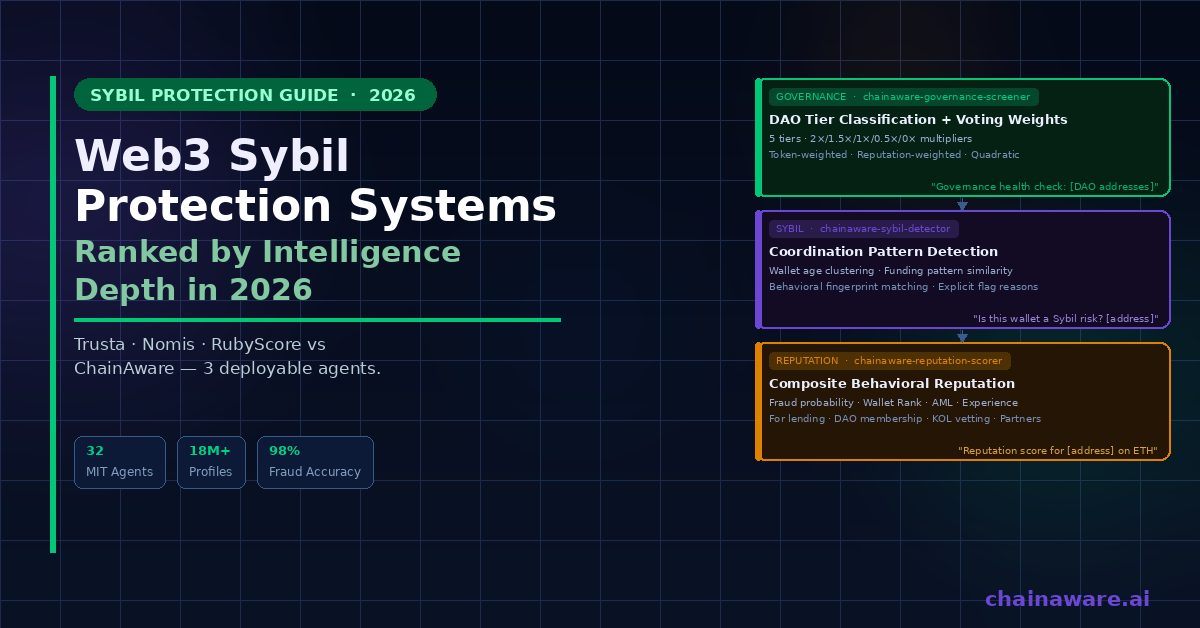
Web3 Sybil Protection Systems Exposed: The Full Truth About On-Chain Providers

Sybil attacks cost Web3 protocols billions annually in fake airdrop claims, manipulated governance votes, and inflated engagement metrics. This guide ranks and compares every major on-chain behavioral Sybil protection provider in 2026 – from GNN/RNN graph detection to behavioral scoring – and explains where each approach works and where it falls short.

Web3 reputation score comparison chart ranking six protocols: Nomis, RubyScore, Ethos, Cred Protocol, UTU, ChainAware — Chain

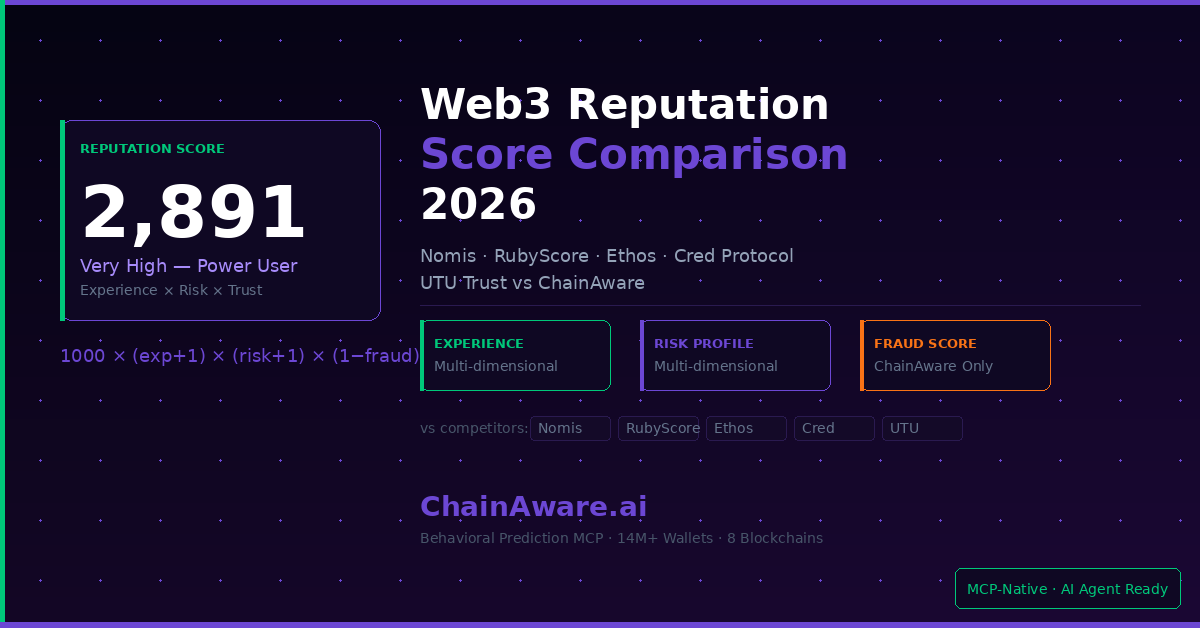
Web3 Reputation Scores Exposed: The Full Truth About Nomis, RubyScore, Ethos and ChainAware

Web3 reputation scoring in 2026 compared across 7 platforms: Nomis, RubyScore, Ethos Network, Cred Protocol, UTU Trust, Whitebridge, and ChainAware. Most platforms measure activity. ChainAware is the only one that incorporates predictive fraud probability into the formula – producing an actionable 0-4000 score requiring no user action and callable by any smart contract or AI agent.

DeFi compliance dashboard comparing protocol tools for 2026 — DeFi compliance tools guide — ChainAware.ai

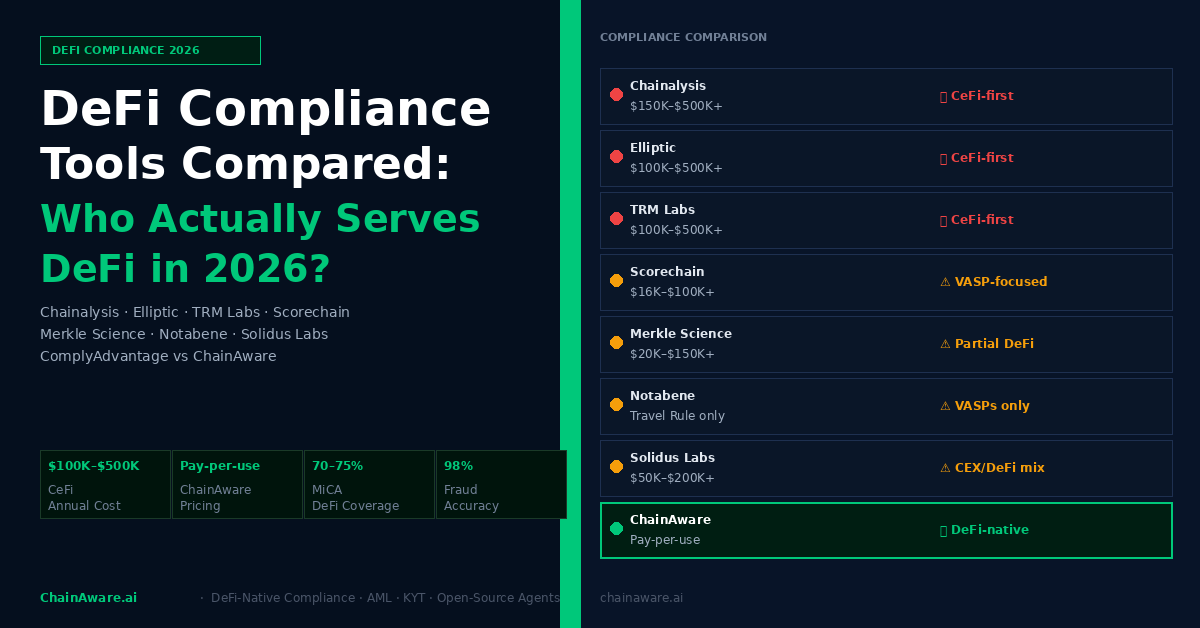
DeFi Compliance Tools for Protocols: The Complete Comparison 2026

Compare Chainalysis alternatives for DeFi compliance teams — TRM Labs, Elliptic, ChainAware. Coverage, pricing, false positive rates, and MiCA readiness for 2026.

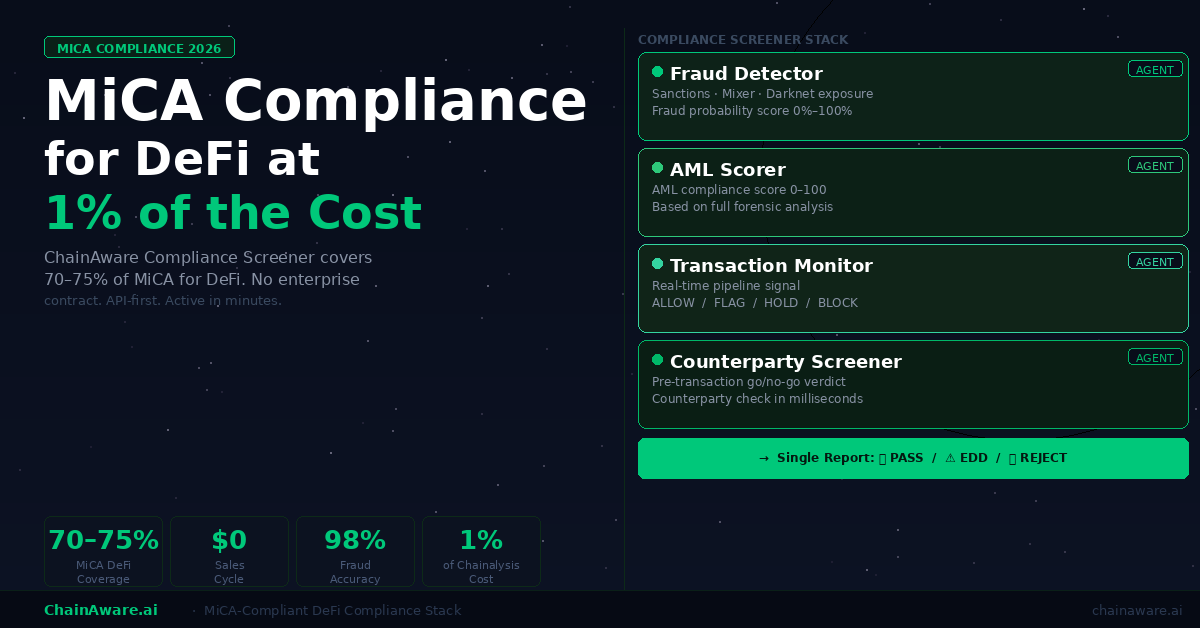
MiCA compliance dashboard for DeFi at 1% of Chainalysis cost — ChainAware.ai

MiCA Compliance for DeFi Exposed: The Full Truth About Costs at 1% of Chainalysis

MiCA compliance for DeFi protocols at 1% of Chainalysis cost — behavioral AML, transaction monitoring, and wallet screening. Compare tools for 2026.

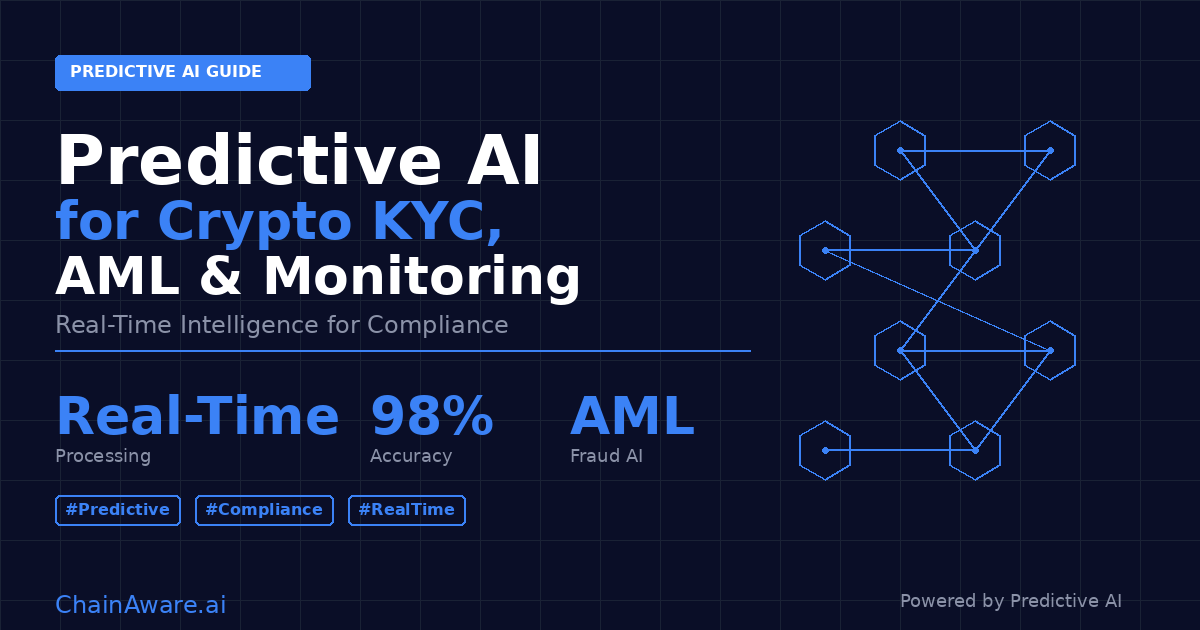
Predictive AI for Crypto KYC, AML & Monitoring: Real-Time Processing, 98% Accuracy - ChainAware.ai

How to Use Predictive AI for Crypto KYC, AML, and Transaction Monitoring 2026

Generative AI creates content – it cannot process numerical transaction data or make real-time fraud classifications. Predictive AI is purpose-built for compliance: 98% accuracy, sub-100ms response, deterministic outputs. This 2026 guide explains the distinction and how to deploy predictive AI correctly for crypto KYC, AML, and transaction monitoring.