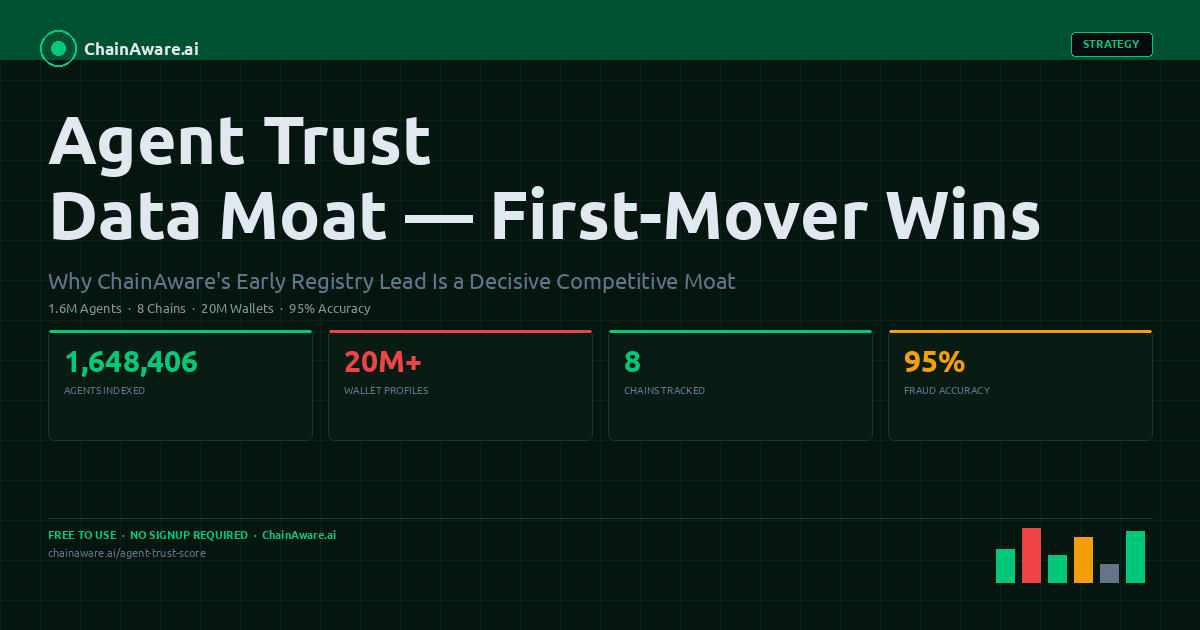
# The Agent Trust Data Moat: Why First-Mover Wins
—
## What a Data Moat Means in Agent Trust
The phrase “data moat” gets used loosely in venture and M&A circles. For a view of how the economic stakes of this infrastructure are likely to grow, see our
market sizing analysis of the agent trust economy to 2030. It is worth being precise about what it means in the context of agent trust infrastructure, because the dynamics here are materially different from, say, a SaaS company that accumulates user preferences or a recommendation engine that learns click patterns.
A data moat in agent trust is not primarily about volume. This is the logic behind treating agent behavioral history as a credit file, as outlined in our piece on the
credit bureau model for AI agents and first-mover advantage. It is about the irreversibility of behavioral history combined with the impossibi ChainAware.ai is
named in the CB Insights AI Fraud Prevention Market Map alongside industry leaders.lity of constructing population-level baselines without having been present at scale from the beginning.
Consider what trust scoring for AI agents actually requires. The scale of this problem is visible in the
agent fraud patterns documented across 1.6M ERC-8004 agents, where coordinated fleets reveal themselves only at population level. An agent operates autonomously — it initiates transactions, routes funds, executes contracts, and interacts with other agents without human approval at each step. Scoring one agent in that position is exactly what the
agents_trust_score_single tool returns a full 0-1000 trust profile with trust flags for any ERC-8004 agent. To determine whether that agent is trustworthy, you need to answer several questions that cannot be answered by looking at the agent in isolation. You need to know who funded it, how that funding compares Funding provenance is especially revealing on chains where agent registration is concentrated, as discussed in our analysis of
why Base Chain leads ERC-8004 agent trust scoring. to the funding patterns of thousands of other agents, whether its behavioral signatures resemble those of known bad actors, whether it is operating as part of a coordinated fleet, and how its behavior has evolved over time. The [agent fraud patterns we’ve documented at scale](https://chainaware.ai/blog/agent-fraud-patterns-erc-8004-threat-landscape/) make this concrete. To see how those population-level patterns play out across the registry, the
agents_trust_score_list tool lets you list and filter all registered ERC-8004 agents by trust tier.
Every one of those questions requires a dataset that pre-exists the query. When you need to screen a whole fleet rather than a single wallet against that reference population, the
predictive_fraud_batch tool scores multiple wallet addresses in one call. You cannot answer “does this funding pattern look anomalous?” without a reference population. You cannot answer “is this agent part of a Sybil fleet?” without having indexed enough agents to establish what normal looks like. You cannot answer “has this agent’s behavior changed in the last 90 days?” without having scored it 90 days ago.
This is what distinguishes a trust data moat from other kinds of data advantages. The barrier is not simply that a competitor would need to collect a lot of data. It is that the data has a time dimension that cannot be compressed. Behavioral history, by definition, takes time to accumulate — and the richer it is, the more accurate every scoring decision becomes.
ChainAware.ai has indexed 1,648,406 agents as of November 2026, with a single-week peak of 892,924 new registrations in W43 (October 2026). That number is not a vanity metric. It is the foundation of a scoring system that becomes measurably more accurate with every additional agent registered, every additional behavioral datapoint recorded, and every additional platform that integrates the [Agent Trust Score](https://chainaware.ai/agent-trust-score).
—
## The Flywheel: How Each Agent Registration Makes Scoring Better
To understand why first-mover advantage in this space compounds, it helps to trace the flywheel explicitly rather than assert it.
**Step one: an agent registers.** When an agent is indexed — whether through a platform integration, a developer submission, or a protocol-level hook — ChainAware begins observing its on-chain behavior: transaction patterns, contract interactions, funding sources, counterparty relationships, and behavioral cadence. This observation starts the clock on that agent’s behavioral history.
**Step two: the dataset becomes richer.** Each newly indexed agent adds not just its own datapoints but its relationship graph with every other indexed agent. If Agent A transacts with Agent B, and both are indexed, that interaction becomes part of both agents’ behavioral profiles and part of the population-level understanding of how agents interact. The relational density of the dataset grows faster than the number of agents, because each new agent creates edges with existing agents, not just a new isolated node.
**Step three: scoring accuracy improves.** Better population-level baselines mean that anomaly detection becomes more sensitive and more specific simultaneously. A scoring system with 100,000 agents can establish rough behavioral norms. A scoring system with 1.5 million agents can establish behavioral norms segmented by agent type, funding source, protocol category, operational cadence, and interaction pattern — and can detect deviations from each of those sub-norms independently. The 27,949 agents scored in the last 24 hours generate a continuous stream of behavioral signals that refine every model running underneath the scoring engine. The behavioral variety is structural: 1,107,688 agents (67.2%) carry unknown feeder addresses, 116,083 (7.04%) have fraud-classified feeders, and just 2,887 (0.18%) have the highest-legitimacy signal — a confirmed CEX-withdrawal feeder (FEEDER_CEX_VERIFIED). These distributions only become stable and actionable at the population scale ChainAware now holds.
**Step four: more platforms adopt.** When scoring is demonstrably more accurate — when it catches fraud patterns that competitors miss, when it generates fewer false positives that frustrate legitimate agents — platforms integrate it. Payment networks, DeFi protocols, enterprise agent orchestration layers, and compliance infrastructure all have strong incentives to adopt the most accurate scoring available, because inaccurate scoring either lets bad actors through or degrades user experience by blocking legitimate ones. The dynamics here are explored in detail in [how payment networks can add agent trust to their fraud stack](https://chainaware.ai/blog/how-payment-networks-can-add-agent-trust-to-their-fraud-stack).
**Step five: more agents register.** As platforms adopt the trust layer, agents operating on those platforms get indexed. Developer ecosystems that want their agents to be trusted adopt the standard. This brings the flywheel back to step one — but at a larger scale, with a richer baseline, and with a wider network effect already in place.
This is a classic data network effect with one critical structural difference from most consumer applications: it is bilateral. More agents make scoring better for platforms. More platforms make compliance easier for agents. Neither side can get the benefit without the other, which means the platform that holds the most data is the natural equilibrium solution for both sides.
—
## Fleet Detection Only Works at Scale
One of the most consequential capabilities in the ChainAware dataset is Sybil fleet detection — the ability to identify coordinated clusters of agents that are operationally linked despite presenting as independent entities. This capability illustrates, more clearly than almost anything else, why the data moat in agent trust is a structural advantage rather than a temporary lead.
Fleet Sybil detection works by identifying behavioral signatures that are statistically improbable unless agents share a common controller. These include synchronized transaction timing, overlapping funding chains, correlated behavioral cadence, shared contract interaction patterns, and clustering in the agent relationship graph. None of these signals is definitive on its own. What makes them diagnostic is their co-occurrence across a population.
Identifying a Sybil fleet requires knowing what non-coordinated behavior looks like at scale. If your dataset contains 10,000 agents, you have too few examples of genuine behavioral diversity to establish the baseline from which coordinated behavior departs. If your dataset contains 1.5 million agents with 14.2% month-over-month growth, you have robust population-level distributions across every observable behavioral dimension. Deviations from those distributions — the kind that indicate coordination — become detectable with statistical confidence rather than heuristic guesswork.
This is not a capability that can be approximated with less data. It is not a problem that more sophisticated modeling can solve without scale. The models are, in this case, only as good as the reference population they are trained on. A late entrant with a smaller dataset will produce fleet detection outputs that are either too noisy to be actionable or too conservative to catch sophisticated operators — both failure modes that undermine the value proposition for platforms that have fraud at stake.
The 930 agents currently identified as funded by confirmed rug-pull operators represent exactly this kind of detection: cross-agent funding chain analysis that is only possible when the funding chains of over 1.6 million agents are simultaneously available for traversal. Platform-level clustering makes this even clearer: centralcity.ai alone accounts for 1,051,344 agents, all sharing a common platform context, with an average trust score of 258. Identifying which of those agents are operationally linked — versus merely co-registered — requires the population-level view that only exists in a mature dataset spanning 43 distinct agent platforms. The [funding chain risk analysis](https://chainaware.ai/blog/funding-chain-risk-for-ai-agents-why-the-feeder-wallet-is-the-first-line-of-fraud-defence) methodology explains why the feeder wallet is the first line of defence — and why following it requires a population-level view of wallet relationships that only exists in a mature dataset.
—
## The Temporal Advantage: Behavioral History Cannot Be Faked
Volume and relational density explain part of the moat. The temporal dimension explains why the moat cannot be closed even by a well-funded competitor who starts building today.
Behavioral trust, as distinct from identity verification, depends on observable patterns over time. An agent that has operated cleanly for 18 months across thousands of transactions has demonstrated something that no credential can assert: a track record. The [KYA vs agent identity](https://chainaware.ai/blog/kya-vs-agent-identity-why-knowing-who-an-ai-agent-is-does-not-tell-you-whether-to-trust-it) distinction matters here — knowing who an agent is tells you nothing about whether it has behaved trustworthily, or whether it will.
The 148,096 trust-score-below-200 agents currently in the ChainAware dataset include agents that appeared benign at registration but exhibited behavioral drift over time — gradual changes in transaction patterns, counterparty relationships, or operational cadence that only became interpretable as risk signals against months of prior behavioral data. Without the prior data, those agents would look clean. With it, they look like what they are.
A competitor entering this market today can begin indexing agents immediately. What it cannot do is retroactively establish behavioral baselines for the agents that ChainAware has been observing for the past 18 months. Those agents will continue to generate new behavioral data, but the history that makes that data interpretable — the trajectory, the change points, the comparison to population norms at specific moments in time — is permanently unavailable to a late entrant.
This is the temporal component of the moat, and it is arguably the hardest to close. Capital can accelerate indexing. Engineering talent can improve models. Business development can drive platform partnerships. None of those inputs can manufacture behavioral history that was not observed when it occurred. The [ERC-8004 score methodology](https://chainaware.ai/blog/how-erc-8004-agent-trust-score-is-calculated-full-methodology) is explicit about the weight that longitudinal behavioral signals carry in trust scoring precisely because they are the signals that cannot be gamed or retroactively constructed.
—
## Why a Late Entrant Cannot Buy Their Way In
This section addresses a question that acquirers and VCs frequently raise: could a well-capitalized competitor simply outspend ChainAware and close the gap? The answer depends on understanding which components of the advantage are capital-intensive and which are structurally irreproducible.
**What capital can buy:** indexing infrastructure, model development, go-to-market, and platform partnerships. A well-funded late entrant could build a credible agent indexing system, hire strong ML talent, and begin signing platform integrations within 12-18 months.
**What capital cannot buy:** behavioral history for the 1.5 million agents already indexed. Relationship graphs that took 18 months to form. Fleet detection baselines calibrated on a mature population. The retrospective scoring signals that make longitudinal trust assessment possible. These are not problems of investment scale — they are problems of time, and time is the one input that cannot be purchased.
There is also a compounding integration lock-in that makes the late-entrant problem progressively worse. As platforms integrate ChainAware’s trust layer and tune their risk thresholds against ChainAware’s scoring outputs, they develop operational dependencies that are expensive to migrate. Their fraud teams learn to interpret ChainAware score signals. Their compliance infrastructure is configured around ChainAware risk categories. Their developer documentation references ChainAware’s [Know Your Agent](https://chainaware.ai/blog/know-your-agent-kya-the-behavioral-trust-layer-for-ai-agents) framework. Switching to a competitor’s scoring system is not simply a technical lift — it requires recalibration of every downstream decision that has been tuned to the incumbent’s output distribution.
The [agent trust infrastructure race](https://chainaware.ai/blog/the-agent-trust-infrastructure-race-who-is-building-the-trust-layer-for-agentic-commerce) is not a race where finishing second is a viable business outcome. The dynamics of trust infrastructure — where the value of a trust signal depends on its universal legibility across platforms — push strongly toward a single dominant standard, in the same way that credit scoring concentrated around FICO and payment identity concentrated around a small number of KYC providers. The historical parallel is direct:
ChainAware is building the credit bureau for AI agents, and the same first-mover dynamics that locked in Equifax and FICO are playing out now. The [platform comparison](https://chainaware.ai/learn/comparisons/agent-trust-platforms) landscape reflects early-stage fragmentation that historical precedent suggests will consolidate.
Regulatory tailwinds reinforce this dynamic. As compliance mandates for agentic systems materialize — the [KYA regulatory timeline](https://chainaware.ai/blog/when-will-regulators-require-kya-eu-ai-act-mica-agent-trust-mandate-timeline) suggests meaningful mandates within the next 24-36 months under both the EU AI Act and MiCA — platforms will face explicit requirements to verify and score the agents operating on their infrastructure. Platforms that have already integrated compliant trust infrastructure will face lower compliance costs than those that have not. This creates a forcing function for adoption that benefits the established standard disproportionately.
The evolution from [KYC to KYA](https://chainaware.ai/blog/from-kyc-to-kya-how-identity-verification-is-evolving-for-the-agentic-economy) also follows a pattern that acquirers familiar with financial infrastructure will recognize. The first credible KYC providers became default infrastructure not because every competitor was technically inferior, but because network legibility — the ability for one platform’s compliance output to be recognized as valid by another — accrued to the first provider that achieved sufficient adoption. KYA will follow the same pattern.
—
## The Network That Exists Now
For M&A and investment purposes, the analysis above is largely theoretical unless it is grounded in present reality. What exists now is not a thesis about what a data moat might look like in a mature agentic economy — it is a functioning network with measurable characteristics and demonstrated compounding dynamics.
**1,648,406 agents indexed** as of November 2026, with a single-week peak of 892,924 new registrations. The dataset crossed 1.5 million agents in October and is approaching 2 million. The growth is not driven primarily by marketing — it is driven by platform integrations and developer adoption, which means it is structural rather than episodic.
**27,949 agents scored in the last 24 hours.** This is the operational scoring throughput for active trust queries from integrated platforms. It reflects the volume of active trust queries being processed by platforms that have already integrated — payment infrastructure, DeFi protocols, enterprise orchestration layers, and compliance tooling operating in the [agentic commerce stack](https://chainaware.ai/blog/agent-trust-score-agentic-commerce/).
**930 agents tied to confirmed rug-pull operators**, detectable only through cross-agent funding chain analysis. Beyond direct rug-pull linkage, 116,083 agents (7.04%) have feeders classified as fraud, and 1,107,688 (67.2%) have entirely unknown feeder provenance — the dominant risk signal in the dataset. These are not obvious bad actors who registered with known malicious addresses. They are agents whose connection to known fraud operators is visible only when traversing multi-hop funding chains across a population-level wallet relationship graph. The [agent fraud patterns from ERC-8004 tracker data](https://chainaware.ai/blog/agent-fraud-patterns-from-the-erc-8004-tracker-what-the-weekly-data-reveals) illustrate the kind of fraud detection that emerges specifically from dataset maturity — patterns that would be invisible to a system that had not been observing the population long enough to map the funding relationships.
**148,096 agents in the Untrusted tier** (trust score below 200) currently active. A further 1,212,017 (73.5%) sit in the Elevated Risk tier — 82.5% of all agents combined require additional scrutiny before being permitted to transact. These represent a live inventory of risk signals that ChainAware’s platform partners can act on today — blocking transactions, requiring additional verification, or flagging for compliance review. The [agentic commerce fraud](https://chainaware.ai/blog/agentic-commerce-fraud-and-the-four-party-card-model-who-bears-the-loss) problem is not theoretical; it is producing measurable losses for platforms operating in the agentic economy right now, and the entities bearing those losses have strong incentives to adopt infrastructure that reduces them.
The [ERC-8004 trust signals](https://chainaware.ai/blog/erc-8004-trust-signals-what-the-registry-can-and-cannot-tell-you) framework underpinning the scoring system is designed for legibility across the platform ecosystem — a common language for agent trust that reduces integration friction and increases the value of each incremental platform adoption. When acquirers evaluate infrastructure businesses, they typically look for evidence that the network effect is real rather than projected. The scoring volume, the detection capability, and the growth rate of the indexed population are the evidence.
The trust layer for agentic economy is being built now, by the entity that started indexing first, that has the deepest behavioral dataset, and that has established the population-level baselines without which the most consequential trust signals cannot be generated. That is not a projection about what the market will look like. It is a description of what already exists.
The question for acquirers and investors is not whether agent trust infrastructure will become critical to the agentic economy. That question was settled when [AI and Web3 convergence](https://chainaware.ai/blog/ai-web3-opportunities-challenges-ailayer) enabled autonomous agents to begin executing financial transactions at scale. The question is whether the data moat that makes first-mover position defensible has already been built. The answer, by the metrics above, is yes.
—
*ChainAware.ai provides agent trust infrastructure for the agentic economy. Explore the [Agent Trust Score](https://chainaware.ai/agent-trust-score) or review the [ERC-8004 scoring methodology](https://chainaware.ai/blog/how-erc-8004-agent-trust-score-is-calculated-full-methodology) for technical detail.*
AGENT TRUST SCORE
The trust score already has 1.5M+ agents in its training set. Score any ERC-8004 agent free.
Score an Agent Free →