
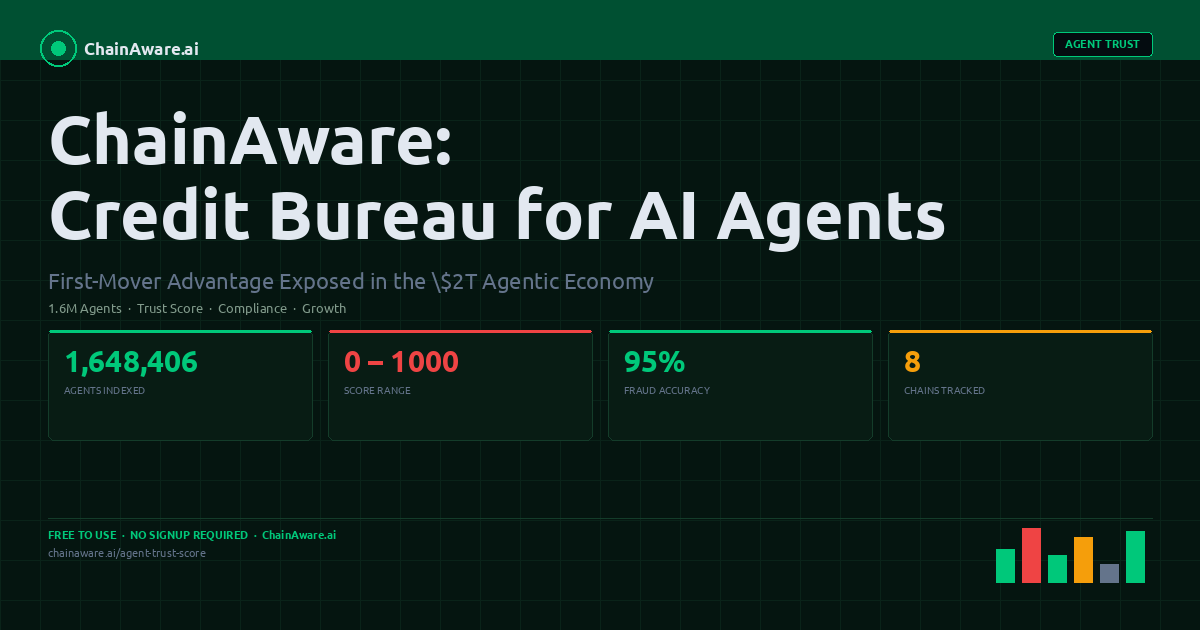
Credit bureaus are invisible infrastructure. Most people never think about Equifax, Experian, or TransUnion — but every mortgage lender, auto financier, and credit card issuer queries one before approving a single dollar. The bureau sits silently between every transaction involving creditworthiness, and the entire credit economy runs through it. AI agents transitioning from hype to production Early data on misbehaving registrations is already visible in agent fraud patterns from the ERC-8004 tracker, which illustrates why a bureau-style layer is needed. are the new borrowers. They transact autonomously on behalf of humans, they hold funds, they execute smart contracts, and every counterparty that accepts an interaction from an agent is implicitly extending trust Before accepting such an interaction, a counterparty can run a predictive_fraud check for real-time fraud probability and AML forensics on any wallet. When that counterparty is a merchant, the question becomes practical, and verifying AI agents at checkout through tokens and behavioural trust addresses exactly that moment. — usually without any formal signal to justify it. ChainAware is building the equivalent infrastructure layer: a behavioral trust bureau for AI agents, indexed across 8 chains, scoring 1,648,406 agents, and trained on over 23 million wallet personas. ChainAware has been named in the CB Insights AI Fraud Prevention Market Map alongside industry leaders. The recognition reflects a wider market view, detailed in CB Insights’ placement of ChainAware on the AI fraud prevention map. The parallel to credit reporting is not rhetorical. It is structural. For the DeFi side of that parallel, the credit_score tool provides an on-chain creditworthiness view built from repayment history and collateral behaviour. How the AI Agent Trust Score works in practice shows what that standardized signal looks like when applied to individual agent wallets.
The Credit Bureau Parallel
When a lender approves a loan, they are not making a character judgment — they are querying a standardized risk signal built from thousands of data contributors, normalized into a score that every counterparty in the market has agreed to interpret the same way. The borrower does not control that signal. The lender does not build it. A third-party infrastructure layer maintains it, and the entire financial system depends on its accuracy and availability.
AI agents present an identical trust problem at a different layer of the economy. An agent that executes a DeFi arbitrage, processes a payment, or votes in a governance protocol is a counterparty — one that the other side of that transaction cannot evaluate the way they would evaluate a human. There is no face, no handshake, no reputation in the conventional sense. Much of that missing reputation lives in who funds an agent, which is why funding-chain risk in AI agents has become a central concern for security teams. There is only on-chain behavior, funding provenance, and the history of whoever deployed the agent. Without a bureau that aggregates and scores that signal, every counterparty is flying blind.
ChainAware is not building a product that helps identify bad agents. It is building the infrastructure that makes agent trust queryable at all — a scoring registry powered by the Know Your Agent behavioral framework that any protocol, payment gateway, or enterprise AI platform can call before accepting an agent interaction. The scope is what distinguishes infrastructure from software: infrastructure does not compete on features. It wins by becoming the standard that everything else is built against.
The 1,457,085 distinct agent owners already in ChainAware’s dataset represent a coverage depth that cannot be replicated by querying a single chain or a single protocol. It requires years of RPC indexing, cross-chain reconciliation, and fraud model training. That is the infrastructure layer. The question for every DeFi protocol, every enterprise AI platform, and every M&A analyst looking at this space is simple: who owns the bureau?
How Credit Bureaus Became Inevitable
Retail credit reporting in the United States did not begin as a grand infrastructure vision. ChainAware’s own path followed a similar logic — the company began as a DeFi lending platform (SmartCredit.io), and the agent trust infrastructure emerged organically from the need to solve the fraud and compliance problems that lending required. That origin story is documented in our early infrastructure vision for AI agent trust from the ChainGPT X Space AMA. Credit reporting similarly began in 1899 when the Retail Credit Company — later renamed Equifax — started collecting payment histories on behalf of Atlanta merchants who wanted to know whether their customers paid their bills. The business was unglamorous: clerks gathering ledger data, filing it by hand, sharing it with subscribing merchants. The insight was not technological. It was economic. A merchant who shared data with the bureau gained access to data from every other merchant. The more merchants subscribed, the more complete the records became, and the more complete the records became, the less rational it was for any merchant to stay out.
That compounding dynamic — more data contributors producing more complete records producing more value to every contributor — is what network economists call a data network effect. It is strictly more powerful than the product network effects that most technology investors are familiar with, because the advantage is not just in scale. It is in coverage. A competitor can build a better interface. It cannot replicate years of historical data without years of historical time.
The Fair Credit Reporting Act of 1970 did not create the credit bureau industry — it formalized a standard that was already emerging from market pressure. By the time the FCRA passed, the data moat was already deep enough that new entrants faced a structural barrier rather than a competitive one. FICO emerged in 1989 as a scoring layer on top of raw bureau data: it did not collect credit history, it interpreted it. That separation — raw data bureau versus scoring model — allowed FICO to become the universal standard that lenders trained their underwriting models against, creating a second layer of switching costs on top of the bureau’s first layer.
The lesson that matters for the AI agent economy is this: credit bureaus did not win on product quality. Equifax did not have better technology than its eventual competitors. It had more data, earlier, and that data compounded into a coverage advantage that made the question of “which bureau” effectively settled before most people recognized it as a market at all. The same dynamic is unfolding in agent trust scoring today, and the window in which it remains a competitive market is closing.
The Three Forces That Made Credit Bureaus Natural Monopolies
Natural monopolies are rare in software markets because software is cheap to replicate and distribution channels are accessible. Infrastructure markets are different. Three forces converge to make certain infrastructure layers genuinely winner-take-all, and all three apply to agent trust scoring with the same structural logic they applied to consumer credit reporting.
Data Scarcity
Credit history is expensive to collect because it requires relationships with the institutions that originate credit — banks, retailers, auto lenders — none of whom have any incentive to share data with a competitor’s bureau. On-chain behavioral data presents an analogous scarcity problem. The data is technically public, but indexing it at scale across 8 chains, reconciling wallet identities across funding chains, and training a fraud model on 23 million wallet personas requires infrastructure investment that compounds over time. A competitor starting today would not be competing against ChainAware’s current state. It would be competing against ChainAware’s state 18 months from now, while simultaneously trying to close the existing gap. That is not a product race. It is a coverage race, and coverage races are won by whoever starts first.
Network Effects
A bureau with more data contributors is strictly more valuable to every data consumer. When a DeFi protocol queries ChainAware’s Trust Score before accepting an agent interaction, that query — and the behavioral outcome that follows — feeds back into the model. The 1,648,406 agents already scored represent not just coverage, but training signal. Each new agent scored improves model accuracy for every other agent in the dataset. A competitor scoring 100,000 agents is not operating at one-sixteenth of ChainAware’s utility. It is operating at a fraction of ChainAware’s accuracy, because the fraud detection models that underpin trust scoring are only as good as the anomaly base they are trained against.
Standardisation Pressure
Once enough counterparties require the same trust signal, that signal becomes the de facto standard — not because it is mandated, but because every integration built against it creates switching costs that make alternatives prohibitively expensive to adopt. FICO became a standard not because a regulator required it, but because enough lenders trained their underwriting models against FICO scores that the cost of switching to an alternative score exceeded any conceivable benefit. The same pressure is building in the agent economy. Every DeFi protocol that integrates a ChainAware Trust Score, every payment gateway that uses it as a gatekeeping signal, every enterprise AI platform that runs fleet analysis before onboarding agents — each integration is a switching cost that compounds the standard’s position. The 892,924 agents registered in a single week in October 2026 signal that the standardisation window is not years away. It is now.
Why On-Chain Behavioral Data Is the Moat
ChainAware’s competitive position is not a function of its product roadmap. It is a function of four distinct data layers that a competitor would need to replicate simultaneously to achieve comparable coverage — and each layer compounds the difficulty of the next.
The first layer is feeder chain analysis: tracing the wallet that funded each agent owner to establish funding provenance. This is not a simple on-chain lookup. It requires cross-chain indexing, entity resolution across wallet clusters, and classification against known funding archetypes — CEX withdrawals, mixer outputs, bridge hops from sanctioned chains. The 2,887 agents classified as FEEDER_CEX_VERIFIED represent the rarest and highest-value signal in the dataset: agents whose funding chain traces directly to a verified centralized exchange withdrawal, the strongest available provenance signal for legitimate intent. That classification requires both the indexing infrastructure to trace the funding chain and the entity resolution capability to identify the CEX on the other end.
The second layer is the fraud model itself, trained on 23 million wallet personas. Fraud detection in on-chain environments is an adversarial problem: the patterns that identify malicious wallets today are the patterns that sophisticated actors will adapt around tomorrow. A model trained on 23 million personas has seen enough variation in attack patterns, Sybil behaviors, and rug pull signatures to generalize in ways that a smaller training set cannot. This is not a solvable problem with more compute. It requires more data, and more data requires more time.
The third layer is creator reputation: cross-referencing agent owner addresses against a database of rug pull operators, honeypot creators, and known bad actors. This database is a function of historical coverage — you cannot build a list of historical rug pull operators without having indexed the history. It grows with time, not with engineering resources.
The fourth layer is fleet detection: identifying Sybil clusters of agents controlled by a single operator across different wallet addresses. The 67.2% of agents currently carrying FEEDER_UNKNOWN status does not represent a gap in ChainAware’s model — it represents the exact gap that a competitor would need to fill to match ChainAware’s coverage, while ChainAware continues to close it. Fleet detection is what elevates the analysis from individual agent scoring to network-level threat intelligence, and it is only possible at the scale of 1,648,406 indexed agents across 8 chains.
The ERC-8004 Standardisation Moment
ERC-8004 is the emerging identity registry standard for AI agents operating on Ethereum and EVM-compatible chains. It records four fields: the agent’s on-chain address, the owner wallet that controls it, the mandate scope defining what the agent is authorized to do, and the payment address through which it settles transactions. It is a registration standard, not a trust standard. ERC-8004 tells you an agent exists and who owns it. It does not tell you whether that agent should be trusted.
That gap is precisely where ChainAware sits — in the same structural position that FICO occupied relative to raw credit bureau data in 1989. The bureau maintains the records. The scoring layer interprets them. When payment networks and DeFi protocols begin requiring a Trust Score as a condition of integration — the same standardisation pressure that locked in FICO across the lending industry — they will not build their own scoring engine. Building a proprietary scoring engine requires the training data, the fraud model, the feeder chain analysis, and the cross-chain indexing infrastructure. The integration cost of querying an existing, accurate, widely-adopted score is orders of magnitude lower.
The 892,924 agents registered in a single week — W43 2026 — is the data point that makes the standardisation timeline concrete. That is not a pilot program or an early adopter cluster. That is exponential adoption of the ERC-8004 registry, and every agent registered against that standard is a potential query against whatever Trust Score becomes the benchmark. The protocol or platform that builds its agent gating logic against ChainAware’s score in Q1 2027 is not going to rebuild that logic against a competitor’s score in Q3 2027. It is going to train its risk team on ChainAware’s tier labels, document ChainAware’s signal breakdown in its compliance framework, and build its smart contract logic against ChainAware’s API response format.
That is the standardisation lock-in. It does not require a mandate. It requires adoption at sufficient scale that switching costs become prohibitive — and 892,924 registrations in a single week signals that sufficient scale is not a future milestone. It is the present reality.
First-Mover Takes All — The Acquisition Case
The valuation logic for credit bureaus and credit scoring companies is not conventional software valuation logic. Dun & Bradstreet carries a market capitalization in the range of $9.5 billion. FICO trades at approximately $14 billion. Experian, the largest of the three major consumer bureaus, is valued at approximately $37 billion. None of these valuations is primarily a function of revenue multiples or growth rates in the conventional sense. They are valuations of switching costs — the accumulated cost embedded in every integration, every underwriting model, every compliance framework, and every contractual relationship that has been built against their standard.
An acquirer buying ChainAware today is not buying a data product. It is buying the standard. It is buying the position that every DeFi protocol, every enterprise AI platform, and every payment gateway will build against as the agent economy scales from 1.6 million agents to 10 million, to 100 million. The switching costs that will make ChainAware’s position defensible are not yet fully embedded — the integrations are still being built. That is precisely what makes the acquisition window valuable. The standard is established. The integrations are accumulating. The switching costs are still forming. A buyer who waits until the switching costs are fully embedded is a buyer who pays the full infrastructure premium with none of the upside of watching it compound.
The historical precedent is unambiguous. No major credit bureau has been displaced by a competitor with a better product. Equifax was not disrupted by a more accurate scoring model. TransUnion was not outcompeted by a faster API. They maintained their positions because the cost of switching — in systems, in models, in compliance documentation, in contractual relationships — exceeded the value of any conceivable alternative. ChainAware is in the process of embedding the same switching costs into the agent economy. The 1,648,406 agents already scored, the 1,457,085 distinct owners in the dataset, and the 23 million wallet personas training the fraud model are not marketing statistics. They are the foundation of a data moat that grows more defensible with every week of additional indexing.
For a strategic acquirer — a DeFi infrastructure platform, an enterprise AI company, a financial data provider looking to establish a position in the agent economy — the calculus is straightforward. The window to acquire the standard before it becomes fully entrenched is open. It will not remain open indefinitely.
What the Next 18 Months Decide
The adoption curve for AI agent registrations is not following a linear trajectory. The 892,924 registrations recorded in a single week — W43 2026 — represents a volume that would have taken months to accumulate in the early phases of ERC-8004 adoption. Exponential registration curves in infrastructure markets do not plateau at the inflection point. They accelerate, because each new registered agent represents a new potential query against the Trust Score, and each new integration built against the Trust Score creates incentive for more agents to register in a form that is queryable.
Avalanche, Base, BSC, Ethereum, Arbitrum, Optimism, Polygon, and Mantle are all currently indexed. That eight-chain coverage is not a minor technical achievement. Each chain requires independent RPC infrastructure, independent indexing pipelines, and cross-chain reconciliation logic that maps wallet identities and funding chains across different address spaces and transaction formats. A competitor entering the market today would need to build and stabilize that infrastructure across all eight chains before they could begin training a comparable fraud model — and they would be building it while ChainAware continues to index, train, and improve.
The score that covers 10 million agents first is not the score that wins because it is better. It is the score that wins because it is the benchmark. DeFi protocols calibrate their risk thresholds against it. Compliance teams document it. Smart contract logic encodes it. Enterprise AI platforms use it as a vendor qualification signal. By the time a competitor reaches comparable coverage, the integrations built against ChainAware’s standard will have made the question of switching hypothetical rather than practical.
First-mover advantage in infrastructure does not erode with better features. It entrenches with more integrations. The next 18 months are the period in which the agent trust bureau standard either consolidates around ChainAware’s coverage — or remains theoretically contestable. After that period, the switching costs embedded in thousands of protocol integrations will make the question academic. The window for a strategic acquirer to buy the standard rather than the incumbent is defined by that timeline, and the registration data from W43 2026 suggests the window is narrowing faster than most observers have recognized.
Conclusion
This is not a startup pitch. It is an infrastructure thesis, and infrastructure theses are evaluated differently from product theses. The question is not whether ChainAware has a better scoring algorithm than a hypothetical competitor. The question is whether the structural dynamics that created natural monopolies in consumer credit reporting — data scarcity, network effects, and standardisation pressure — are present in the AI agent trust market. They are, and they are operating on a faster timeline than the credit bureau market did in 1899, because the underlying infrastructure layer, ERC-8004, is a protocol standard rather than a manual data collection process.
The numbers ground the thesis in operational reality. 1,648,406 agents scored. 1,457,085 distinct owners in the dataset. 23 million wallet personas training the fraud model. 892,924 registrations in a single week. 2,887 FEEDER_CEX_VERIFIED agents representing the highest-confidence provenance signal available on-chain. These are not projections. They are the current state of the bureau that is being built in real time, while every week that passes makes the data moat deeper and the competitive gap wider.
The same dynamics that made three companies the permanent gatekeepers of consumer creditworthiness are playing out in AI agent trust scoring — not as analogy, but as mechanism. Data scarcity compounds into coverage advantages. Coverage advantages compound into network effects. Network effects compound into standardisation pressure. Standardisation pressure compounds into switching costs. Switching costs compound into valuations that bear no relationship to conventional revenue multiples, because they are not measuring a business. They are measuring a standard.
ChainAware has the coverage, the data depth, and the first-mover position. The question for a potential acquirer is not whether an agent trust bureau will emerge. It will. The question is whether they want to own it — and whether they move before the window closes.
ACQUISITION INTELLIGENCE
Score any ERC-8004 agent in seconds with Prediction MCP.
Use agents_trust_score_single or agents_trust_score_list to retrieve the full behavioral composite, tier label and per-signal breakdown for any agent or fleet. Free tier includes 1,000 queries per month.
Credit Bureau for AI Agents
Query the emerging standard for agent trust before it’s mandatory