
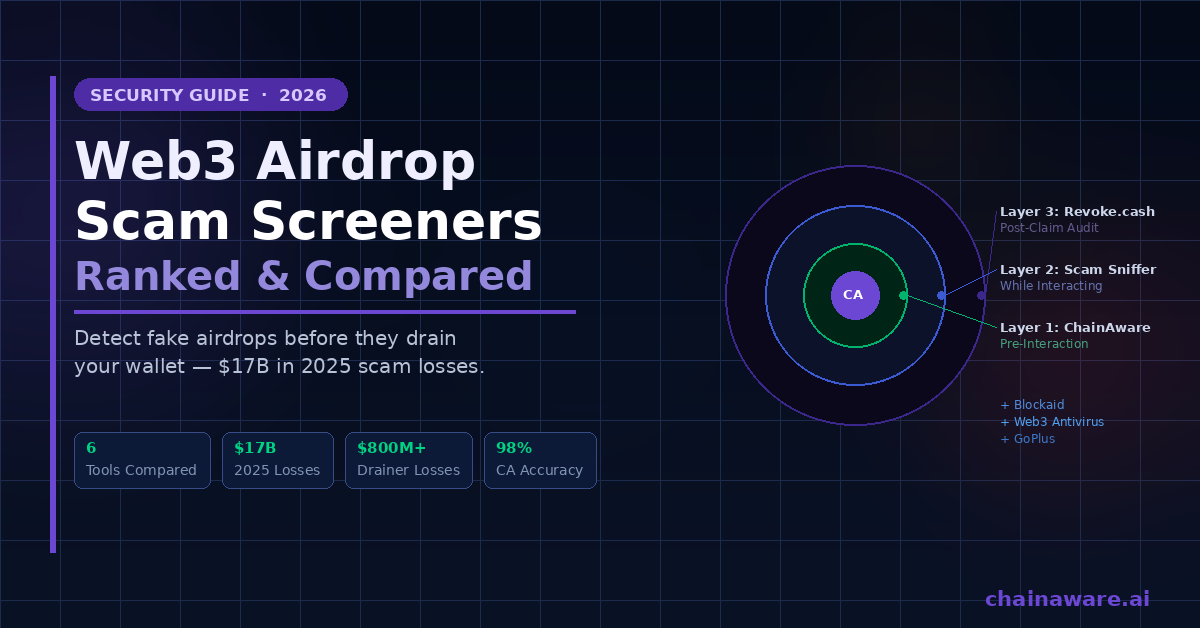
Crypto airdrop scam losses reached $17 billion in 2025. Impersonation scams — where attackers mimic legitimate projects to run fake airdrop campaigns — grew by 1,400% year-over-year. On March 19, 2026, the FBI issued an explicit public alert about a fake “FBI Token” TRC-20 airdrop draining wallets on the Tron network. Free tokens have become one of the most dangerous entry points in Web3, and the attack playbook is becoming more sophisticated every month.
This 2026 guide covers the six most effective airdrop scam screeners available — what each one does, how it works, where it sits in your defense stack, and critically, the gap each one leaves. Combining the right tools closes those gaps and lets you participate in genuine airdrops safely while filtering out the sophisticated phishing operations that drain wallets in seconds.
In This Guide
- How Airdrop Scams Actually Work in 2026
- 1. ChainAware.ai — Behavioral Fraud Detection (Sender Analysis)
- 2. Scam Sniffer — Real-Time Phishing Site and Signature Protection
- 3. Blockaid — B2B Transaction Screening Before You Sign
- 4. Web3 Antivirus — Transaction Simulation and Approval Dashboard
- 5. Revoke.cash — Post-Claim Approval Auditing and Revocation
- 6. GoPlus Security — Contract-Level Token Safety Checks
- Head-to-Head Comparison Table
- The Three-Layer Defense Stack
- FAQ
How Airdrop Scams Actually Work in 2026
Understanding the attack mechanics is essential before evaluating any protection tool. Airdrop scams in 2026 operate through two primary vectors — and each one requires a different defensive response.
Vector 1: The Wallet Drainer Phishing Attack
Attackers send worthless or malicious tokens to thousands of wallet addresses simultaneously. Recipients notice the new tokens, become curious, and search for how to sell or claim them. That search leads to a phishing site — a pixel-perfect clone of a legitimate project’s claim page, often with a one-character domain variation or a convincing subdomain. Connecting your wallet to that site triggers a malicious smart contract interaction. Within seconds, the contract drains every token it has been given permission to access. Inferno Drainer — operating as a “drainer-as-a-service” platform — stole over $80 million through this exact mechanism in 2023 alone. AI now makes these phishing sites far more convincing: deepfake founder videos, AI-generated social proof, and automated personalized messaging at scale. According to Chainalysis’s crypto crime data ↗, AI-enabled scams generate 4.5× more revenue per campaign than traditional approaches.
Vector 2: The Malicious Approval Attack
The second attack vector is subtler and more dangerous for experienced users. Rather than requiring you to visit an obvious phishing site, this attack embeds itself inside what appears to be a legitimate interaction — voting on a governance proposal, minting an NFT, or claiming tokens from a verified-looking interface. The malicious element is in the transaction you sign, not the site you visit. Specifically, the approval request grants the attacker’s contract unlimited permission to spend a specific token type from your wallet — now and indefinitely in the future. The attacker does not need to execute the drain immediately. They can wait weeks before sweeping your balance at a moment of their choosing. Over $200 million was lost to approval-based attacks in 2024–2025 alone. For context on how on-chain behavioral patterns enable detection of these attacks before they execute, see our AI-Based Predictive Fraud Detection guide.
The Fundamental Gap: Who Sent the Airdrop?
Both attack vectors share a common upstream signal that most tools ignore entirely: the wallet that sent the airdrop tokens. Professional scam operators have transaction histories. They have run previous scams. Their wallets show behavioral patterns — interactions with known fraud infrastructure, patterns of mass-distributing tokens, relationships with other flagged addresses. All of this history sits permanently on-chain, available for analysis. Yet the majority of airdrop security tools focus exclusively on the claim site or the token contract — never on the behavioral history of the operator who initiated the airdrop. That gap is precisely where ChainAware operates. For the full anatomy of how fraudulent wallet behavior identifies scams before any damage occurs, see our AI-Based Wallet Audit guide and our Forensic vs AI-Powered Blockchain Analysis guide.
1. ChainAware.ai — Behavioral Fraud Detection (Sender Analysis)
Core function: Predict whether the wallet behind an airdrop has a fraud history — before any interaction.
ChainAware addresses the upstream vulnerability that no other tool on this list covers: the behavioral history of the address that sent you the airdrop tokens. When you receive an unexpected token drop, the most important question is not “what does this token contract look like?” but rather “who sent this, and what have they done before?” A professional airdrop scammer does not arrive with a blank history. Previous scam deployments, mass token distributions, interactions with known drainer infrastructure, and patterns of rapid liquidity removal all leave permanent traces in their on-chain transaction history.
How to Use ChainAware for Airdrop Screening
The workflow is simple. When you receive an unexpected airdrop, find the sending address on any block explorer. Paste that address into ChainAware’s Fraud Detector. Within a second, ChainAware’s predictive AI — trained on 18M+ wallet profiles and backtested at 98% accuracy against CryptoScamDB — returns a fraud probability score for that address. A high fraud probability from the sender is the strongest possible signal to ignore the airdrop entirely, regardless of how legitimate the associated token or claim site appears. Additionally, paste any contract address associated with the airdrop into ChainAware’s Rug Pull Detector: it analyzes the contract creator’s behavioral Trust Score and all liquidity provider histories, catching sophisticated operators who deploy clean contract code specifically to pass automated scanners.
Furthermore, ChainAware’s behavioral approach catches the evolving AI-powered scam category that is growing fastest in 2026. No AI deepfake, no fake social proof, and no convincing claim site can alter the on-chain behavioral history of the operator’s wallet. That history is immutable. For the complete methodology behind behavioral fraud prediction, see our Fraud Detector guide and our Rug Pull Detector guide.
Best for: Pre-interaction sender screening; identifying sophisticated operators with fraud histories
Chains: ETH, BNB, BASE, HAQQ
Free tier: Yes — free individual checks at chainaware.ai
Limitation: New wallets with no transaction history provide no behavioral signal — combine with other tools for those cases
Check Before You Click Anything
ChainAware Fraud Detector — Check the Sender’s History in 1 Second
Received an unexpected airdrop? Before you visit any claim site, paste the sending wallet address into ChainAware. Get a fraud probability score instantly — 98% accuracy, backtested on CryptoScamDB, real-time. Free. No signup. The check that every other tool skips.
2. Scam Sniffer — Real-Time Phishing Site and Signature Protection
Core function: Block known phishing domains before you land on them and warn about dangerous transaction signatures at signing time.
Scam Sniffer is the most widely deployed browser-level protection against airdrop phishing in Web3. Its blacklist database is trusted by Binance, Rabby Wallet, Phantom, and Bybit — a credibility signal that reflects years of operational data from tracking real drainer campaigns. Since March 2025, the extension is entirely free (the previous 0.25% DEX swap fee model was dropped). Over $800 million in wallet drainer losses have been tracked through the Scam Sniffer threat intelligence database since 2023, making it one of the most data-rich sources of phishing domain intelligence available.
Two Layers of Protection
Scam Sniffer operates at two distinct points in the airdrop interaction flow. The first layer activates before you even land on a page: as you browse, the extension checks every domain against its maintained blacklist combined with fuzzy-matching algorithms that catch homograph attacks (domains that look visually identical to legitimate ones but use lookalike Unicode characters) and typo variations. This layer stops the majority of airdrop phishing attempts at the navigation stage — you never see the malicious claim page at all.
The second layer activates at transaction signing time. When a wallet prompt appears, Scam Sniffer analyzes the specific approval being requested — flagging dangerous approvals like Permit and Permit2 signatures, highlighting exact balance changes, and warning when an NFT listing or offer signature covers more than you intended. Additionally, the tool covers X/Twitter phishing link detection, blocking fake account comments and ads that frequently distribute airdrop scam links. For context on how phishing attacks intersect with broader Web3 fraud patterns, see our Crypto Wallet Security 2026 guide.
Best for: Browsing-level phishing protection; dangerous signature warnings; X/Twitter scam link detection
Chains: EVM + Solana, BTC, TON, TRON
Free tier: Yes — fully free since March 2025
Format: Browser extension (Chrome)
Limitation: Requires browser installation; cannot analyze the sending wallet’s behavioral history
3. Blockaid — B2B Transaction Screening Before You Sign
Core function: Real-time threat detection integrated directly into wallets and DApps — stops malicious transactions before the approval prompt appears.
Blockaid operates at a fundamentally different layer than browser extensions. Rather than protecting individual users through a Chrome plugin, Blockaid embeds its detection engine directly into the platforms users already trust — MetaMask, Coinbase Wallet, OpenSea, Phantom, and dozens of others. When you interact with any DApp through an integrated wallet, Blockaid silently screens the destination contract against a continuously updated database of known malicious addresses, phishing sites, and exploit patterns across 50+ blockchains. If the interaction is flagged, you receive a warning before the signing prompt even appears — before your hardware wallet screen shows the approval request.
Internet-Wide Scanning: A Structural Advantage
Blockaid’s most significant technical differentiator is its internet-wide scanning capability — the only tool in this comparison that monitors the web2 layer where most crypto fraud originates. Most phishing sites, fake airdrop claim pages, and malicious DApp clones exist on the open internet before they ever attract an on-chain victim. Blockaid’s systems identify new threats at the web2 origin point, updating its detection database before those threats reach the wallet interaction stage. This pre-chain detection approach means Blockaid can flag novel phishing operations hours or days before they accumulate enough victim reports to appear in community-maintained blacklists. For how predictive behavioral detection complements Blockaid’s contract-level approach, see our AI-Powered Blockchain Analysis guide.
Best for: Passive always-on protection through integrated wallets; enterprise and DApp-level airdrop security
Chains: 50+ chains
Free tier: Via integrated wallets (MetaMask, Coinbase Wallet, Phantom)
Format: B2B API + consumer via wallet integration
Limitation: Requires wallet integration; cannot analyze behavioral history of airdrop senders; not a standalone consumer tool
4. Web3 Antivirus — Transaction Simulation and Approval Dashboard
Core function: Simulate transactions before signing to show exactly what will happen — and provide a wallet health dashboard for ongoing approval management.
Web3 Antivirus takes a “show me the outcome” approach to airdrop protection. Rather than maintaining static blacklists, its transaction simulation engine runs a preview of any interaction before you approve it — displaying exactly what tokens will leave your wallet, what permissions the contract will gain, and what the net effect on your balance will be. This simulation catches a category of airdrop attack that blacklist-based tools miss: novel drainers that have not yet been documented in any threat database but whose simulated execution reveals their malicious intent through the outcome it produces.
60+ Scam Type Coverage and Approval Health Dashboard
Web3 Antivirus detects over 60 distinct scam types — spanning honeypots, wallet drainers, malicious approvals, fake tokens, address poisoning attacks, and phishing contracts. The extension integrates directly into MetaMask, adding a security layer inside the wallet interface without requiring users to switch tools or change their workflow. Beyond transaction-time protection, the approval health dashboard provides ongoing visibility into every active permission your wallet has granted — enabling one-click revocation of suspicious or outdated approvals without leaving the tool. This combination of pre-transaction simulation and post-transaction approval management addresses the full temporal scope of the airdrop attack surface. For context on how approval management fits into the broader Web3 security landscape, see our behavioral analytics guide.
Web3 Antivirus is open source on GitHub, enabling community review of its detection algorithms — a transparency advantage over proprietary tools. Additionally, the Telegram integration delivers real-time risk notifications directly to mobile, reaching users who encounter airdrop scam links through Telegram (by far the most common social engineering distribution channel in Web3).
Best for: Transaction simulation before signing; real-time 60+ scam type detection; ongoing approval health management
Chains: EVM chains + expanding
Free tier: Yes
Format: Browser extension + MetaMask integration + Telegram bot
Limitation: Simulation-based — cannot catch attacks where malicious intent is not visible in the transaction outcome alone; no sender behavioral history
After Every Airdrop Claim: Check the Contract Too
ChainAware Rug Pull Detector — Analyze the Contract Creator’s History
Even after a claim passes browser-level checks, verify the contract creator’s behavioral history. Paste the token contract address into ChainAware’s Rug Pull Detector — it traces the creator and all LP providers, flagging fraud histories that code scanners miss entirely. Free. Real-time. ETH, BNB, BASE, HAQQ.
5. Revoke.cash — Post-Claim Approval Auditing and Revocation
Core function: Audit every active token approval your wallet has granted and revoke any that are risky, unlimited, or no longer needed.
Revoke.cash, first released in 2019, has become the standard tool for token approval hygiene across the Web3 ecosystem. Its core function is deceptively simple: connect your wallet, view every outstanding approval across 100+ networks, and revoke the ones you no longer need with a single transaction. Despite its simplicity, this capability addresses one of the most persistent and underappreciated vulnerabilities in airdrop interactions — the open approval that remains active long after a claim interaction is complete.
Why Post-Claim Auditing Is Non-Negotiable
Here is the scenario that Revoke.cash specifically prevents: you interact with what appears to be a legitimate airdrop claim, the interaction completes without any obvious issue, and you move on. Days or weeks later, the protocol is exploited — or it was always malicious and was simply waiting for enough victim approvals to accumulate before executing a sweep. Because the approval you granted during the claim interaction is still active, the attacker can drain your balance without any further interaction from you. You do not need to click anything. You do not need to be online. The approval acts as a permanent, open door. Revoke.cash closes that door. According to research cited across multiple security resources, $200M+ was lost to approval-based attacks in 2024–2025 — the majority involving approvals that victims had forgotten they granted. For context on the compliance layer that makes ongoing transaction monitoring essential, see our AML and Transaction Monitoring guide.
The Post-Airdrop Hygiene Routine
Security professionals recommend treating every airdrop claim session as a two-step process: claim first, then audit. Within 24 hours of any claim interaction, visit Revoke.cash, connect your wallet, and review every approval. Revoke anything you do not recognize, anything with an unlimited amount from the claim interaction, and any approval for a contract you are no longer actively using. This five-minute routine is the most cost-effective security habit available in Web3 today — especially for anyone who participates in multiple airdrops regularly. For broader wallet security practices that complement approval management, see our Crypto Wallet Security 2026 guide.
Best for: Post-claim approval cleanup; ongoing wallet hygiene; revoking unlimited approvals
Chains: 100+ networks
Free tier: Yes
Format: Web app + browser extension
Limitation: Reactive only — cannot prevent a malicious approval at the moment of signing; does not analyze sender behavioral history
6. GoPlus Security — Contract-Level Token Safety Checks
Core function: Rapid contract-level analysis of any token — checking honeypot flags, mint functions, blacklists, ownership status, trading restrictions, and tax parameters.
GoPlus Security is the dominant contract-scanning infrastructure in Web3, covering 30+ blockchains and powering the security warnings in DEXScreener, Sushi, Uniswap, and dozens of wallets. When applied to airdrop screening, GoPlus answers a specific question: does the token contract itself contain obvious red flags? Hidden mint functions that let creators issue unlimited new supply, blacklist mechanisms that prevent selling, honeypot traps that allow buying but block exits, and unlocked liquidity are all patterns that GoPlus detects rapidly via its token security API.
Using GoPlus for Airdrop Token Screening
The most practical application in the airdrop context is scanning any unexpected token before attempting to sell, swap, or interact with it in any way. Simply find the token’s contract address in your block explorer and run it through GoPlus. The result shows whether the token is sellable, whether the creator retains excessive control, whether the contract is open source, and what the buy and sell tax parameters are. This check takes under 30 seconds and catches the majority of low-sophistication airdrop tokens designed to trap unsophisticated users. GoPlus is particularly valuable as a first-pass filter before investing any more time in a received token drop. For how GoPlus contract scanning complements behavioral analysis in a complete security workflow, see our Rug Pull Detection Tools comparison guide.
GoPlus’s Malicious Address API also provides a useful pre-interaction check: paste any address associated with the airdrop and receive a response indicating whether it appears in known malicious address databases. This is less comprehensive than ChainAware’s behavioral scoring (which analyzes the address’s actual transaction history rather than matching against a static list) but provides useful corroborating signal when combined with other checks.
Best for: Quick contract-level token screening; honeypot detection; first-pass filter on received tokens
Chains: 30+ chains
Free tier: Yes — free consumer interface and open API
Format: Web app + permissionless API
Limitation: Rules-based and static — cannot detect sophisticated operators with clean code; no behavioral sender history analysis. See our AI-Based Rug Pull Detection guide for why this matters.
For DApps: Screen Every Incoming Address
ChainAware Prediction MCP — Behavioral Intelligence for AI Agents and Platforms
DApps running airdrop campaigns need to screen participants at scale. ChainAware’s Prediction MCP lets any AI agent or platform query fraud scores, behavioral profiles, and rug pull risk for any address in real time — via natural language or REST API. 18M+ Web3 Personas. 8 blockchains. 32 open-source agents.
Head-to-Head Comparison Table
| Tool | Primary Protection Layer | Analyzes Sender History? | Pre-Interaction? | Post-Interaction? | Chains | Free |
|---|---|---|---|---|---|---|
| ChainAware.ai | Sender behavioral fraud prediction | ✅ Core differentiator | ✅ Check before any click | ✅ Check contract post-receipt | ETH, BNB, BASE, HAQQ | ✅ |
| Scam Sniffer | Phishing domain blocking + signature alerts | ❌ | ✅ Blocks before you land | ❌ | EVM + SOL, BTC, TON, TRON | ✅ |
| Blockaid | Real-time transaction screening in wallet | ❌ | ✅ Before signing prompt | ❌ | 50+ chains | ✅ Via integrated wallets |
| Web3 Antivirus | Transaction simulation + approval dashboard | ❌ | ✅ Simulates outcome first | ✅ Approval health dashboard | EVM expanding | ✅ |
| Revoke.cash | Token approval auditing and revocation | ❌ | ❌ | ✅ Essential post-claim | 100+ networks | ✅ |
| GoPlus Security | Contract-level token safety flags | ❌ (static blacklist only) | ✅ Quick contract check | ❌ | 30+ chains | ✅ |
Airdrop Scam Type Coverage: What Each Tool Catches
| Attack Type | ChainAware | Scam Sniffer | Blockaid | Web3 Antivirus | Revoke.cash | GoPlus |
|---|---|---|---|---|---|---|
| Phishing clone site | Partial (sender history) | ✅ Strongest | ✅ Strong | ✅ | ❌ | ❌ |
| Malicious approval request | Partial (contract history) | ✅ Signature alerts | ✅ Pre-prompt warning | ✅ Simulation | ✅ Post-revoke | Partial |
| Known fraud operator sender | ✅ Only tool that catches this | ❌ | Partial | ❌ | ❌ | ❌ (static list) |
| Honeypot token (can’t sell) | Partial | Partial | ✅ | ✅ Simulation | ❌ | ✅ Strongest |
| Dusting / address poisoning | ✅ Sender behavioral flag | Partial | ✅ | ✅ | ❌ | Partial |
| Time-delayed drain (old approval) | ✅ Operator fraud history | ❌ | ❌ | ❌ | ✅ Essential | ❌ |
| AI-generated deepfake scam site | ✅ Behavioral history is immutable | ✅ Domain detection | ✅ Internet scanning | ✅ Simulation | ❌ | ❌ |
| Social media phishing link (X/Telegram) | ❌ | ✅ X/Twitter scanning | Partial | ✅ Telegram bot | ❌ | ❌ |
The Three-Layer Defense Stack
No single tool in this comparison stops every airdrop scam type. Professional security practice in 2026 combines tools that operate at different temporal points and examine different data sources. Together, the following three-layer approach covers the full airdrop attack surface with minimal friction.
Layer 1: Before You Interact — Verify the Sender
When you receive an unexpected token drop, your first action should have nothing to do with the token itself. Find the wallet address that sent the airdrop and check it with ChainAware’s Fraud Detector. If the sender has a high fraud probability, stop immediately. Regardless of how convincing the associated claim site or token appears, the behavioral history of the operator is the highest-quality signal available. Additionally, run the token contract through GoPlus for a rapid first-pass contract check — catching obvious honeypots and malicious code patterns in under 30 seconds. For the complete pre-interaction due diligence framework, see our How to Identify Fake Crypto Tokens guide.
Layer 2: While You Interact — Screen the Claim Site and Transaction
If Layer 1 checks pass, navigate to the claim site — but only through a verified official URL from the project’s own channels, typed manually or found via their official verified social accounts. Never follow a link from a DM, email, or Telegram message. Your browser extension (Scam Sniffer or Web3 Antivirus) screens the domain in real time. If you use a wallet with Blockaid integration (MetaMask, Coinbase Wallet, Phantom), Blockaid screens the transaction before the signing prompt appears. Read every detail in your wallet approval screen before confirming. Specifically verify: that the approval amount is not unlimited, that the contract address matches the official project contract, and that the network is correct. For the regulatory and compliance context around pre-transaction screening, see our AI-Based Predictive Fraud Detection guide and the FATF Virtual Assets Recommendations ↗.
Layer 3: After You Interact — Revoke and Monitor
Within 24 hours of any claim interaction, visit Revoke.cash and audit every active approval your wallet has granted. Revoke anything unlimited, anything from the session you just completed that you no longer need, and anything you do not recognize. This routine takes five minutes and permanently closes any open doors created during the claim process. For DApps running their own airdrop campaigns, the ChainAware transaction monitoring agent provides the equivalent Layer 3 protection at the platform level — continuously monitoring connected wallet addresses for behavioral fraud patterns and flagging emerging risks before they impact your users. See our transaction monitoring guide for implementation details. According to Immunefi’s Web3 Security Research ↗, the majority of airdrop-related losses involve dormant approvals that users had forgotten to revoke — making Layer 3 the highest-ROI security habit available.
Free Behavioral Intelligence — No Signup Required
ChainAware Wallet Auditor — Full Profile on Any Address in 1 Second
Before participating in any airdrop, audit both the sending wallet and your own. ChainAware’s Wallet Auditor gives you fraud probability, experience level, risk profile, and behavioral intentions for any address instantly. The behavioral layer that makes every other security tool more effective. Free. No wallet connection needed.
Frequently Asked Questions
What is the safest way to check if an airdrop is legitimate in 2026?
The safest approach combines three independent checks. First, verify the airdrop announcement through the project’s own verified channels — official website (typed manually, not via search ads), verified X/Twitter account with checkmark, and official Discord announcement channel. Second, check the sending wallet’s behavioral history with ChainAware’s Fraud Detector before visiting any claim link. Third, run the token contract through GoPlus for rapid contract-level red flag scanning. Only after all three checks pass should you proceed to any claim interaction — with Scam Sniffer or Web3 Antivirus active in your browser and your wallet’s Blockaid integration enabled if available.
What happens if I already clicked a fake airdrop claim link?
Act immediately. Go to Revoke.cash and connect your wallet — review every approval, especially any granted in the past 24-48 hours. Revoke everything from the interaction in question. If you signed a transaction that transferred tokens out of your wallet, those funds are likely unrecoverable (blockchain transactions are irreversible). However, revoking active approvals prevents any further draining from those open permissions. Move remaining funds to a fresh wallet if you believe the compromised wallet has been extensively phished. Document the transaction hashes and report the scam to your wallet provider and to community resources like Scam Sniffer’s public database.
Why does ChainAware check the sending wallet rather than the token contract?
Professional airdrop scam operators deliberately write clean token contracts that pass every automated scanner check. They know exactly which code patterns trigger GoPlus, Scam Sniffer, and similar tools — so they avoid those patterns entirely. Their malicious intent does not appear in the contract code at all. Instead, it lives in their behavioral history: previous mass token distributions, interactions with known drainer infrastructure, patterns of deploying pools and draining liquidity. That history is permanently on-chain and cannot be altered. ChainAware reads that history and flags operators whose past behavior matches fraud signatures — even when their current contract and claim site appear completely legitimate.
How does the FBI’s 2026 airdrop scam alert affect how I should protect myself?
The FBI’s March 19, 2026 alert about the fake “FBI Token” TRC-20 airdrop on Tron signals that government agencies now consider airdrop scams serious enough for public consumer warnings — a reflection of the scale of losses. The specific attack pattern (unsolicited tokens sent to wallets, directing recipients to a malicious claim site that drains upon connection) is exactly what ChainAware’s sender analysis, Scam Sniffer’s phishing detection, and Blockaid’s pre-transaction screening are designed to stop. The FBI alert also reinforces one rule that cannot be overstated: no legitimate airdrop requires you to connect your wallet to a site you arrived at through an unsolicited communication. Official airdrops are announced publicly through verified project channels.
Which single tool provides the best airdrop protection if I can only use one?
If forced to choose one, Scam Sniffer provides the broadest protection for typical consumer behavior — it operates passively at the browser level across all Web3 interactions, requires no active per-transaction decision, covers the dominant attack vector (phishing clone sites), and is entirely free. However, this misses sophisticated operator attacks where the phishing site is new (not yet in any blacklist) and the sending wallet has a fraud history. For those attacks — the most dangerous category — ChainAware’s sender behavioral check is the only protection available. The practical recommendation remains using both together, along with Revoke.cash after every claim session.
Sources: Chainalysis Crypto Crime Report ↗ · Immunefi Web3 Security Research ↗ · FATF Virtual Assets Recommendations ↗ · Scam Sniffer ↗ · Revoke.cash ↗