
On October 29, 2026, a wallet made 13 deposits to Binance over 3.5 hours. The deposits were funded via Tornado Cash withdrawals the previous day. The actual hack — the event that made this wallet significant Since funds moved through mixers before reaching the exchange, our overview of crypto wallet security and fraud prevention covers the wallet-level risk signals worth monitoring. — occurred approximately 36 hours later. For readers new to these signals, our guide to wallet-level fraud indicators and prevention tactics explains how deposit-era red flags are identified before funds move.
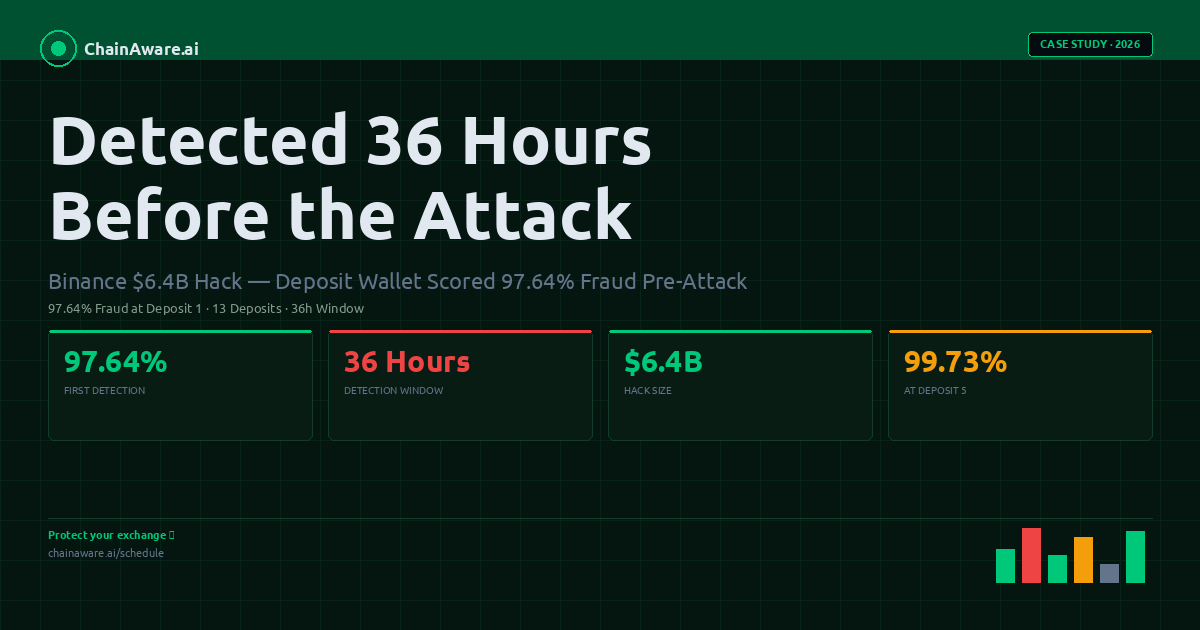
ChainAware scored this wallet at 97.64% Fraud on the first deposit attempt, at 20:20 UTC on October 29. This timing highlights a core limitation of reactive controls, which we examine in depth in our piece on why crypto AML transaction monitoring falls short. Every subsequent deposit scored above 97%. Teams wanting to see how this kind of wallet-level fraud scoring works in practice can start with our complete guide to crypto fraud detection tools. The hack had not yet been committed. The attacker was pre-arranging their exit before the attack. Our comparison of forensic blockchain analysis and predictive AI approaches explains why attribution after the fact differs from scoring behavior before losses occur. Exchanges looking to apply this kind of forward-looking screening can learn more in our walkthrough of using predictive AI for crypto KYC and AML. For a broader look at why transaction-level monitoring alone often misses this kind of pre-attack preparation, see our analysis of crypto AML versus transaction monitoring.
This post documents what the deposit pattern looked like Exchanges looking to apply similar scoring in their own compliance stack can start with our guide to predictive AI for crypto KYC and AML., what ChainAware’s fraud model detected, and why blocking a pre-arranged cash-out route is one of the most effective Readers who want to understand how such fraud scores are produced for individual addresses can review our crypto fraud detection guide. ways to prevent large-scale crypto theft.
The Attack Strategy: Exit First, Steal Second
Large-scale crypto theft requires two things: a way to take the funds, and a way to cash them out. Most security focus goes on the first — smart contract security, custody controls, key management. The second — the exit route — receives less attention, and it is where this case study begins.
The attacker’s strategy was straightforward: establish a cash-out position at a major exchange before committing the attack. Deposit funds into Binance, verify the account is functional, confirm the exit route is open. Then commit the hack. Then cash out through the pre-arranged position.
This is a rational economic calculation. Stolen crypto that cannot be converted to fiat or other liquid assets is strategically worthless to most attackers. The exit route is as critical as the attack itself — and it must be established in advance, because exchanges have KYC processes that take time, and withdrawal limits that require deposit history.
The attacker funded the deposit wallet via Tornado Cash — a mixer that breaks transaction traceability — and then made 13 structured deposits over 3.5 hours.
What they did not account for: ChainAware’s fraud model scoring the wallet at 97.64% Fraud on the first deposit.
The Deposit Pattern — What ChainAware Saw
Wallet: 0x7C8601d4645b93cea45F71e118A729332e6B5CA0 Chain: Ethereum
Funding (October 28):
The wallet received three Tornado Cash withdrawals on October 28 — 0.0983 ETH, 0.0979 ETH, and 0.0979 ETH — from Tornado Cash’s 0.1 ETH anonymity pool (0x12d66f). Total: approximately 0.294 ETH over ~25 hours. These arrived as internal transactions, which are not visible to ChainAware’s current pipeline — the wallet scored as “New Address” during this phase.
Deposits to Binance (October 29):
All 13 deposits within 3.5 hours. Hack committed approximately 36 hours later.
What is striking about the scoring:
The score jumped from “New Address” (during Tornado Cash funding) directly to 97.64% Fraud on the first Binance deposit — with no intermediate activity. The CEX outflow pattern alone — funds moving from a freshly funded wallet toward an exchange — was sufficient to flag the wallet at extreme fraud probability. No criminal record, no prior flagged transactions: the behavioral pattern of the deposit itself was the signal.
By deposit 5, the score had reached 99.73% — essentially maximum confidence. It never dropped below 99.7% for the remaining 8 deposits.
ChainAware
Score Every Deposit Wallet
ChainAware scored the Binance attacker wallet at 97.64% Fraud on its first deposit — 36 hours before the hack. Real-time screening across 8 chains.
See Deposit Screening →The 36-Hour Window — Why It Matters
Thirty-six hours is an extraordinary advance warning window for a financial crime detection system. To put it in context: most traditional AML systems flag suspicious activity after the fact — post-transaction reporting, batch-processed alerts, end-of-day reviews. A 36-hour pre-attack detection window is in a different category entirely.
What could a compliance team do with 36 hours of advance notice?
- Block the account — deposits rejected, no cash-out route established, attack economics compromised
- Flag for investigation — analyst reviews the wallet, confirms the Tornado Cash funding pattern, documents the decision
- Submit SAR — suspicious activity reported to FinCEN or relevant FIU; the documented case exists before the hack is committed
- Share intelligence — if the exchange participates in threat intelligence sharing, other exchanges can screen the wallet proactively
The economic logic of the attack required a pre-arranged exit. Remove the exit, and the attack loses its economic rationale. An attacker who cannot cash out stolen funds at their pre-arranged exchange must either find another exit or abandon the operation. Neither outcome is their preference.
A note on the pipeline gap:
ChainAware’s current pipeline does not fetch internal transactions — the Tornado Cash withdrawals arrived as internal transactions and were not visible to the fraud model. The wallet therefore scored “New Address” during the October 28 funding phase. With internal transaction support (a planned pipeline improvement), first detection would shift to October 28 at 07:39 UTC — approximately 37 hours earlier, at the first Tornado Cash withdrawal. The 36-hour window reported here is the conservative figure with the current pipeline. The true early-warning potential is longer.
How Deposit Screening Would Have Stopped This
Deposit screening is the first layer of CEX transaction monitoring — scoring the wallet that initiates a deposit before the deposit is credited. At 97.64% Fraud on deposit 1, the workflow with ChainAware TM:
- Wallet
0x7C8601initiates deposit 1 to Binance at 20:20 UTC - ChainAware scores the wallet in real time — 97.64% Fraud
- Telegram alert fires to compliance team: wallet scoring 97.64% Fraud attempting deposit; Tornado Cash funding pattern
- Webhook fires to Binance backend — deposit flagged, account restricted pending compliance review
- Compliance analyst opens investigation tool: Tornado Cash funding, extreme fraud score, no prior clean history
- Decision: block account, reject deposits, file SAR
- All 13 deposits rejected — attacker has no pre-arranged exit at Binance
At the moment compliance blocks the account, the hack has not yet been committed. The attacker’s exit route is closed. The economic logic of the attack — steal funds, cash out through the pre-arranged Binance account — collapses.
A sophisticated attacker would likely attempt to establish an alternative exit route. But every attempt is another scoring event — every new wallet touching Tornado Cash, every new CEX deposit attempt, creates another detection opportunity. Blocking the first exit route does not guarantee the attack is abandoned, but it increases the attacker’s cost and reduces their confidence in a successful cash-out.
ChainAware
Block the Exit Route Before the Attack
Automated deposit blocking, Telegram alert, SAR-ready investigation report — triggered in real time, before the first deposit credits.
Book a Demo →The Connection to the Binance Hack
The 13 deposits on October 29 were pre-hack cash movement. The actual attack is believed to have occurred approximately 36 hours after the last deposit — around October 31, 2026. Chainalysis subsequently traced a North Korean (DPRK) connection to the $6.4B hack, documenting the DPRK’s “fake interview playbook” used to compromise Binance infrastructure.
ChainAware’s analysis covers the deposit screening layer — the pre-attack cash-out preparation. Chainalysis’s analysis covers the attribution layer — who conducted the attack and how. These are different layers of the same incident.
What ChainAware’s data shows: the attacker’s deposit wallet was detectable at extreme fraud probability 36 hours before the hack. The exit route was visible and blockable before the attack was committed.
What this means for large-scale exchange hacks: sophisticated attackers — including nation-state actors — still need to move stolen funds through exchanges. That cash-out layer is where behavioral fraud detection creates a chokepoint, regardless of how sophisticated the attack itself is.
Deposit Screening as a Deterrent
The most underappreciated benefit of deposit screening at extreme precision is its deterrent effect. If sophisticated attackers know that pre-arranged exit routes will be detected and blocked before the attack is committed, the economics of the attack model change.
A DPRK-linked operation that pre-arranges cash-out accounts faces a fundamental problem: the pre-arrangement activity itself is detectable. Tornado Cash funding followed by rapid CEX deposits is a behavioral pattern that fraud models score at 97%+ within seconds of the first deposit. The attacker’s pre-attack activity creates the detection window.
The alternative — committing the attack without a pre-arranged exit — is riskier for the attacker. Stolen funds moving directly to exchanges without established accounts are more likely to be flagged, frozen, or rejected immediately. Pre-arrangement is the attacker’s risk mitigation. Detecting pre-arrangement defeats it.
This is why deposit screening is not just a compliance requirement — it is a security control with deterrent value. An exchange that is known to screen deposits at this precision makes itself a harder target, because the pre-arrangement phase becomes high-risk.
What Exchange Security Teams Should Take Away
1. The exit route is part of the attack surface. Most exchange security focuses on protecting assets — smart contract security, custody, key management. The attacker’s exit route — their cash-out strategy — is equally important and more detectable. Behavioral signals in the exit route are visible before the attack is committed.
2. Deposit screening catches what other controls miss. No amount of internal security hardening would have made the attacker’s October 29 deposit wallet visible to Binance’s internal systems — unless Binance was screening deposits against external behavioral models. The 97.64% Fraud score came from the wallet’s behavior and connections, not from any Binance-specific data.
3. 36 hours of advance notice requires an automated response. A 36-hour window is generous — but only if the detection triggers an automated response within that window. If a compliance team reviews the alert at the start of the next business day, the window may already have closed. Automated deposit blocking pending compliance review — triggered by the webhook — ensures the window is used regardless of when the alert is generated.
4. SAR filing before the attack is an underappreciated outcome. If Binance had screened this wallet and filed a SAR on October 29 — before the hack — that SAR would have been in FinCEN’s system when the hack occurred on October 31. Law enforcement response time, asset tracing, and coordination with stablecoin issuers would all have benefited from the advance filing. SAR filing is not just a compliance obligation — it is an intelligence contribution that benefits the broader response.
Prevention as Insurance: The Math Exchanges Should Be Running
Binance has SAFU — the Secure Asset Fund for Users, established in 2018, funded by 10% of trading fees, holding over $1B at its peak. SAFU is self-insurance: Binance expects hacks to happen, budgets for them, and pays out when they do. The fund’s existence is an honest admission that the status quo treats large-scale theft as a recurring operational cost rather than a preventable event.
The opportunity cost of holding $1B+ in a reserve fund is $50M–$80M per year. That is Binance’s implicit annual insurance premium — paid every year, whether a hack occurs or not, in foregone returns on capital that could be deployed elsewhere.
The industry-wide recovery rate makes the alternative math straightforward. According to De.Fi’s REKT Database, approximately 8.8% of stolen crypto funds were recovered in 2024 — and that is the gross figure, before deducting forensic analysis fees, multi-jurisdiction legal costs, and the time value of funds that arrive 12–36 months after the breach. Net recovery is materially lower. For the $6.4B Binance hack, even a 10% gross recovery would leave $5.76B unrecovered — a figure no SAFU fund can absorb.
Think of predictive AML tooling as partial insurance. Imperfect — attackers adapt, re-engineer around detection models, and find new routing strategies. No behavioral model is permanent. But rational in exactly the way any insurance decision is rational: the premium (annual TM subscription) is fixed and knowable; the uninsured loss is catastrophic and unbudgeted.
The pre-hack deposit wallet in this case study scored 97.64% Fraud at deposit 1 — 36 hours before the attack. That detection window was actionable. Blocking the deposit, filing a SAR, alerting law enforcement 36 hours in advance: these outcomes were available. The question is not whether the detection was possible. It is whether the enforcement pathway existed to use it.
A fraction of SAFU’s opportunity cost, redirected into predictive AML tooling, would raise the cost of attack for every future attempt — forcing attackers to work harder, change their approach, and accept more detection risk. Fewer successful attacks means fewer SAFU payouts. The reserve shrinks. The capital is freed. The math improves on both sides simultaneously.
ChainAware
Raise the Cost of Attack for Your Exchange
Pre-attack deposit patterns are detectable. 36 hours of advance notice — with the right enforcement pathway connected to it.
Talk to Our Security Team →Frequently Asked Questions
What percentage of stolen crypto is typically recovered? According to De.Fi’s REKT Database, approximately 8.8% of stolen crypto funds were recovered in 2024 — the gross figure before deducting forensic fees, multi-jurisdiction legal costs, and the time value of funds recovered 12–36 months after the breach. Net recovery is significantly lower. For large-scale hacks like the $6.4B Binance breach, even a 10% gross recovery leaves the vast majority of funds permanently lost.
What is Binance’s SAFU fund and why is it relevant to crypto security? SAFU (Secure Asset Fund for Users) is Binance’s self-insurance reserve — over $1B set aside from trading fees to compensate users after hacks. Its existence is an honest acknowledgment that hack losses are budgeted operational events, not exceptional failures. The opportunity cost of holding that capital — $50M–$80M per year in foregone returns — is Binance’s implicit annual insurance premium. Redirecting a fraction of that opportunity cost into predictive AML tooling would raise the cost of attack and reduce the expected frequency of payouts, improving the math on both sides simultaneously.
Is deposit screening a form of hack prevention insurance? Partial and imperfect — but economically rational in the same way any insurance decision is. The “premium” is the annual cost of TM tooling. The “uninsured loss” is 91.2% of stolen funds plus forensics, legal, and regulatory costs. With assets under custody in the millions or billions, the premium is rational at almost any price point relative to the exposure. The qualifier: attackers adapt, and no behavioral model is permanent. What deposit screening provides is a continuously raised cost of attack and actionable early-warning windows that recovery never provides.
How did ChainAware detect the Binance hack wallet before the attack? ChainAware’s fraud model scored the attacker’s deposit wallet 0x7C8601 at 97.64% Fraud on the first deposit to Binance — 36 hours before the hack was committed. The detection was driven by the behavioral pattern of the deposit itself: a freshly funded wallet (funded via Tornado Cash) making rapid deposits to a major exchange. The CEX outflow pattern alone was sufficient for extreme fraud probability — no prior criminal record or flagged history was needed.
Why did the fraud score jump from “New Address” to 97.64% in one transaction? The Tornado Cash funding arrived as internal transactions, which are not visible to ChainAware’s current pipeline — so the wallet had no scored history during the funding phase. The first Binance deposit was the first visible external transaction. The behavioral signals in that single transaction — wallet freshly funded from a mixer, immediately depositing to a major exchange — were sufficient for a 97.64% score. By deposit 5, the score reached 99.73% and remained there.
Could blocking this wallet have prevented the $6.4 billion Binance hack? Blocking the deposit wallet would have removed the attacker’s pre-arranged cash-out route at Binance. Whether this would have prevented the hack depends on whether the attacker had alternative exit routes and how committed they were to the operation. What it would have done: eliminated one exit route, forced the attacker to establish another (creating another detection opportunity), and filed a documented SAR 36 hours before the attack — giving law enforcement and stablecoin issuers advance notice.
What is the difference between deposit screening and transaction monitoring? Deposit screening is a subset of transaction monitoring — it specifically refers to scoring a wallet when it attempts to deposit to an exchange, before the deposit is credited. Transaction monitoring is broader: it covers deposits, withdrawals, and continuous monitoring of addresses already known to the exchange. In this case, deposit screening was the relevant control — the wallet was attempting its first interaction with Binance when it was detectable.
What is Tornado Cash and why does it appear in fraud detection? Tornado Cash is a cryptocurrency mixer — a smart contract that accepts deposits and returns equivalent amounts to different addresses, breaking the on-chain link between source and destination. It is a privacy tool that is also widely used for money laundering and criminal proceeds concealment. OFAC sanctioned Tornado Cash in 2022. Funds flowing through Tornado Cash carry elevated fraud probability not because mixer use is inherently criminal, but because it is the most common obfuscation method used in large-scale crypto theft and sanctions evasion.
ChainAware deposit and withdrawal screening covers wallets across 8 chains with real-time scoring at the moment of transaction. Telegram + webhook alert delivery ensures compliance teams receive actionable data before deposits are credited.
Related:
- How deposit and withdrawal screening works — the real-time scoring layer that fires before a deposit is credited
- The AML investigation tool — how compliance teams review, document, and act on fraud alerts
- Co-signing integration for CEX hot wallets — blocking withdrawals at the signing layer before funds move