
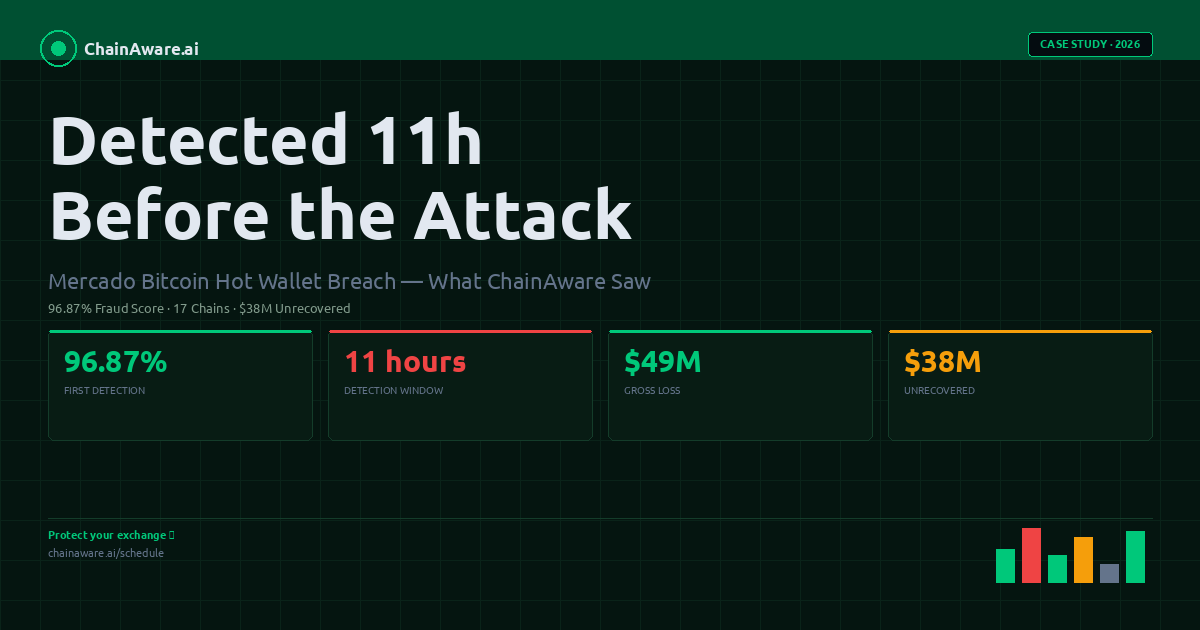
On November 2, 2026, Brazil’s largest crypto exchange Mercado Bitcoin lost approximately $49M across 17 blockchains Hot wallet compromises like this one are a recurring risk, and our guide on crypto wallet security and fraud prevention tech covers the controls exchanges can put in place before an attacker gains access. in what became the largest CeFi hot wallet breach of the period. The attacker swept multi-chain hot wallets and thousands of user deposit addresses simultaneously, using compromised API signing keys to authorize standard token transfers — no smart contract exploit, no flash loan, just valid credentials in the wrong hands. Because the attacker relied on stolen signing credentials rather than a code flaw, a practical guide to crypto wallet security and fraud prevention is directly relevant to how exchanges protect hot wallet access.
ChainAware scored the attacker’s control wallet at 96.59% Fraud at 06:24 UTC. The first dollar left that wallet at 12:07 UTC — 5 hours and 43 minutes later. At the moment of detection, 100% of the ETH-side funds were still actionable.
This post documents exactly what ChainAware detected, when, and what the detection window means for crypto exchange security.
What Happened — The Attack Timeline
The attack began at approximately 01:22 UTC on November 2, starting on Base and expanding across Bitcoin, Ethereum, Solana, Tron, Polygon, Arbitrum, Avalanche, BNB Chain, and Stellar. The attacker had access to Mercado Bitcoin’s hot wallet API signing keys — giving them the ability to authorize standard token transfers across all 17 chains simultaneously, using automated tooling.
This was not a smart contract exploit. The attacker didn’t find a vulnerability in Mercado’s code. They obtained the credentials that authorized withdrawals and used them. Standard security controls — smart contract audits, protocol safeguards — were irrelevant. The signing keys were valid, so the transactions were valid.
The attacker’s strategy on the Ethereum side: sweep funds from Mercado Bitcoin’s hot wallet (0x5cc778) into a control wallet (0xe485e7), accumulate, then launder out through DEX protocols. The control wallet had extensive pre-existing history — 2,398 token transactions, 20,000+ normal transactions — which meant it entered the fraud model without a “new address” grace period.
Losses:
- Gross loss: approximately $49M across 17 blockchains
- Frozen by stablecoin issuers (Tether, Circle): approximately $11M
- Unrecovered: approximately $38M
Stablecoin issuers froze $11M on-chain. The remaining $38M was not recovered. The attacker liquidated into multiple protocols over two days: Tether, Chainlink, Aave, Curve, SushiSwap, Stargate, Celer, MakerDAO, and multiple CEXs — a staged liquidation that made tracing progressively harder.
What ChainAware Detected — Minute by Minute
The attacker’s control wallet 0xe485e7A70b1131216Cb47CA4555c4Bbb2C742478 was scored in real time as funds arrived from Mercado’s hot wallet. Here is the exact detection timeline:
Phase 1 began 8 hours before the attack on Nov 1 — 24 transactions across 3.5 hours of wallet warming, scoring 86.98% by the third transaction. By 19:44 the score had reached 96.87%. Phase 2 on Nov 2 lasted just 14 minutes and drained ETH, USDT, USDC, WBTC and 44 ERC-20 tokens. At 06:24, $0 had left the attacker’s wallet. The 11-hour window from first detection to the attack starting was entirely actionable.
The score reached 96.59% on the very first inflow — the model identified the wallet as high-probability fraud immediately on the first large transaction from Mercado’s hot wallet. Within two minutes, the score rose to 99.50%. It remained above 92% for every subsequent transaction through November 11.
ChainAware
Real-Time Transaction Monitoring for Crypto Exchanges
Score every inbound and outbound address in under 100ms. Telegram + webhook alerts on fraud detection. 8 chains covered.
See Transaction Monitoring →The 11-Hour Detection Window — What It Means
Five hours and 43 minutes is a long time in crypto. It is also a long time in an operational security context.
In that window:
- Telegram alert fires to the compliance/security team at 06:24
- Webhook delivers the flagged address and 96.59% fraud score to the backend system
- Investigation tool shows: massive inflow from known exchange hot wallet, immediate 96%+ fraud score, no prior clean transaction history
- Compliance team has time to review, confirm, escalate
- Stablecoin issuers (Tether, Circle) can be contacted for a freeze request
- Exchange can begin incident response — assess scope, isolate signing keys, begin multi-chain containment
The $11M that was ultimately frozen by Tether and Circle demonstrates that the freeze mechanism works when contacted in time. The question the 11-hour window raises: what if the alert had triggered at 19:14 on November 1 — before the sweep had even been prepared?
ChainAware’s monitoring is continuous and cross-industry — not limited to Mercado’s own addresses. The attacker’s control wallet is monitored because it appears in the transaction graph of an exchange hot wallet, not because Mercado specifically configured it. This is industry-wide behavioral monitoring: any address receiving large inflows from known exchange infrastructure is scored in real time, regardless of whether the exchange is a ChainAware customer.
How Co-Signing Would Have Changed the Outcome
The root cause of the Mercado breach was compromised API signing keys. The attacker had valid credentials — they could authorize outgoing transactions from the hot wallet without triggering any authentication alarm. This is the specific attack vector that co-signing addresses.
With ChainAware’s 2/2 co-signing integration on hot wallet withdrawals:
- Attacker initiates first withdrawal from Mercado’s hot wallet to
0xe485e7 - Transaction submitted for 2-of-2 signature — exchange provides signature 1
- ChainAware scores the destination
0xe485e7— 96.59% Fraud - ChainAware withholds co-signature — transaction cannot execute
- Telegram fires to security team, webhook hits compliance queue
- Analyst opens investigation: massive inflow pattern, 96% fraud score, source is own hot wallet
- Incident response begins — signing keys isolated, attack contained
- $49M remains on the exchange
The compromised credentials are useless without the second signature. The attacker can authorize transaction 1 — but transaction 1 cannot execute without ChainAware’s co-signature. The fraud score blocks it. The 11-hour detection window collapses to zero: the attack stops at the first transaction, before any funds move to the attacker’s control wallet.
Co-signing is not a standard product — it is a custom integration built to each exchange’s specific wallet architecture. Every exchange’s signing infrastructure is different. The integration connects ChainAware’s real-time fraud scoring to the exchange’s withdrawal signing flow, so any outgoing transaction above the threshold requires a fraud-score-gated second signature before execution.
ChainAware
Co-Signing Integration for Hot Wallet Security
A 2-of-2 signature requirement on withdrawals blocks credential compromise attacks before funds move. Custom integration built to your signing architecture.
Book a Technical Discussion →The Laundering Pattern — What Happened After 12:07
Once funds began moving out at 12:07 UTC, the attacker’s exit strategy became visible. The control wallet liquidated across a diverse mix of protocols over two days — a staged approach designed to slow tracing:
November 2 (12:07–15:55 UTC):
- Multiple $2.2M transfers out
- Tether transfer (USDT)
- Aave interaction
- Chainlink interaction
- Smaller batch transactions ($125K–$325K)
November 4 (01:08–11:31 UTC):
- Curve, SushiSwap, Stargate (cross-chain), Celer (cross-chain)
- MakerDAO interaction
- CEX deposit
The cross-chain bridges (Stargate, Celer) on November 4 indicate the attacker was moving funds off Ethereum — the point at which on-chain tracing becomes significantly harder.
An additional detail: within hours of the breach, the control wallet attracted 29+ spoofed Transfer events across 13+ contracts and 9+ address poisoning attackers — opportunistic actors who spotted the high-value wallet and attempted to redirect future transactions. High-value breach wallets attract this activity automatically; the investigation tool surfaces these poisoning attempts alongside the primary attack data.
ChainAware vs. Chainalysis — Two Different Stories
Chainalysis published a post on November 2 titled “Disrupting the Mercado Bitcoin Attack: How Chainalysis Led the Freeze of Nearly $10M in Stolen Funds.” These are two different stories, not competing claims.
Chainalysis: Forensic tracing after funds moved — identifying where stolen funds went, contacting stablecoin issuers to execute freezes. This is reactive forensics. Important, and it recovered $10M of the $11M that was frozen.
ChainAware: Behavioral scoring before funds moved — detecting the attacker’s control wallet at 96.87% Fraud during Phase 1 wallet warming on Nov 1, 11 hours before the Phase 2 sweep began. This is real-time predictive detection. At the moment of first detection, the attack had not started.
Both matter. The ideal response combines both: ChainAware’s real-time alert triggers immediate incident response at 06:24; Chainalysis’s forensics support the freeze requests to stablecoin issuers. In the Mercado case, only the second half of that response happened. The result: $11M frozen, $38M unrecovered.
What Exchange Security Teams Should Take Away
1. Credential compromise bypasses all protocol-level security. Smart contract audits, bug bounties, and security reviews protect against code exploits. They do not protect against compromised signing credentials. If your withdrawal authorization can be executed by anyone with the API keys, your security perimeter is as strong as your key management — and no stronger.
2. Detection without enforcement is not protection. ChainAware detected this breach 11 hours before the attack began. That detection is only useful if something acts on it — a Telegram alert to a monitoring team, a webhook that triggers account restriction, or a co-signing layer that stops the transaction before it executes. Detection without an enforcement pathway is a log entry, not a control.
3. Cross-industry monitoring catches what internal monitoring misses. Mercado’s own security team would need to monitor the attacker’s control wallet — an external address with no prior relationship to Mercado — to have caught this internally. ChainAware’s industry-wide monitoring scores any address that enters the transaction graph of monitored infrastructure, regardless of prior relationship. The attacker’s control wallet became visible the moment it received funds from the hot wallet.
4. The window matters. 11 hours is a long detection window. It was not acted on in time. The lesson is not that the window was too short — it is that an automated enforcement pathway (co-signing, automatic account restriction, automated freeze request) must exist so the window does not depend on a human being at their desk when the alert fires.
The Recovery Math Doesn’t Work
The Mercado Bitcoin case ended with $11M frozen and $38M gone. That is a 22% recovery rate — better than the industry average, but still a loss of $38M that will not be returned to customers or the exchange.
The industry average is worse. According to De.Fi’s REKT Database, approximately 8.8% of stolen crypto funds were recovered in 2024 — down from roughly 10% in 2023. The long-run expectation for any given hack is that more than 90% of stolen funds will not be recovered, regardless of how good the forensics work is.
And 8.8% is the gross recovery figure. The net recovery — what the exchange or its customers actually get back after costs — is significantly lower, and in many cases approaches zero.
Consider what recovery actually involves:
- Forensic blockchain analysis — engaging firms like Chainalysis for tracing and evidence building; not cheap
- Legal fees — coordinating freeze requests across multiple jurisdictions, often requiring local counsel in each; a multi-jurisdictional hack like Mercado (17 blockchains) means legal engagement in multiple countries simultaneously
- Law enforcement coordination — months or years of back-and-forth with agencies who have many competing priorities
- Regulatory costs — the hack itself triggers regulatory scrutiny; legal defense of the exchange’s AML program is a separate cost on top of recovery efforts
- Time value of money — recovered funds, when they arrive, may come 12–36 months after the breach. Crypto markets move. $1M recovered in 2028 is not the same as $1M lost in 2026.
- Management time — the leadership bandwidth consumed by a major breach recovery is a hidden cost rarely quantified; a CEO and legal team spending six months on hack recovery is six months not spent on the business
Net of these costs, the true economic recovery from an average crypto hack is likely well below 5% — and for smaller exchanges without the resources to pursue a multi-year legal recovery process, closer to 0%.
Compare that to the cost of a predictive AML workflow:
- ChainAware transaction monitoring: a fixed annual subscription covering 24/7 screening across 8 chains
- Co-signing integration: a one-time custom integration engagement, then operational
- Compliance workflow (Telegram + webhook + investigation tool): included
The prevention cost is not zero. And it is not a guarantee — sophisticated attackers adapt. They study detection systems, re-engineer their patterns, and find new routing strategies. No behavioral model is permanent. What predictive AML provides is a continuously raised cost of attack: the attacker must work harder, change their approach, and accept more detection risk with every iteration. That is a meaningful deterrent even when it is not a perfect barrier.
What is not in dispute: the cost of a predictive AML workflow is orders of magnitude smaller than the combination of unrecovered funds, forensics fees, legal costs, regulatory exposure, and reputational damage that follows a major breach.
The 11-hour window in the Mercado case was not a detection failure. ChainAware detected the attacker’s control wallet during Phase 1 wallet warming — before the sweep had been prepared. The gap was the absence of an enforcement pathway connected to that detection — no co-signing layer to stop the transaction, no automated restriction triggered by the webhook. Prevention requires both detection and enforcement. Detection alone is a log entry.
The industry spends enormous resources trying to recover funds that, statistically, will not be recovered. The same resources invested in predictive AML workflow — detection before movement, enforcement at the moment of detection — significantly raise the cost and complexity of a successful attack, and create actionable windows that recovery never provides.
Think of predictive AML tooling as partial insurance. Not perfect — attackers adapt, detection models are not permanent, and no toolset covers every attack vector. But rational in exactly the way any insurance decision is rational: the premium (annual TM subscription, co-signing integration) is fixed and knowable; the uninsured loss (91.2% of stolen funds, plus forensics, legal, and regulatory costs) is catastrophic and unbudgeted.
Binance makes this argument concrete. Their SAFU fund — Secure Asset Fund for Users, established 2018, funded by 10% of trading fees — held over $1B at its peak. SAFU is self-insurance: Binance bears the full actuarial risk, holds the capital, and pays out when hacks occur.
The opportunity cost of holding $1B in a reserve fund is $50M–$80M per year at conservative return assumptions. That is the implicit annual “premium” Binance pays to self-insure against hack losses — every year, whether a hack occurs or not.
A fraction of that opportunity cost, redirected into predictive AML tooling, would raise the cost of attack, increase attacker detection risk, and reduce the expected frequency of SAFU payouts. The reserve fund shrinks. The capital is freed. The math improves on both sides simultaneously.
SAFU is the crypto industry’s honest admission that hacks are expected, budgeted-for events. The alternative is to treat them as preventable — imperfectly, partially, but meaningfully — and price the prevention accordingly.
Mercado Bitcoin lost $38M that will not come back. The ChainAware detection at 06:24 UTC was available. The enforcement pathway was not.
ChainAware
Stop the Next Exchange Hack Before It Starts
ChainAware detects attacker wallets before the first outflow. Continuous monitoring across 8 chains, real-time alerts, enforcement pathway included.
Talk to Our Security Team →Frequently Asked Questions
What percentage of stolen crypto funds is actually recovered? According to De.Fi’s REKT Database, approximately 8.8% of stolen crypto funds were recovered in 2024 — down from roughly 10% in 2023. That is the gross figure before deducting forensic analysis fees, legal costs across multiple jurisdictions, and the time value of funds recovered 12–36 months after the breach. Net recovery for most exchanges is significantly lower, and for smaller exchanges without resources to pursue a multi-year legal process, it is often close to zero.
Is predictive AML tooling a form of insurance? Imperfect and partial — but yes, the economic logic is the same. An insurance premium is rational when the expected uninsured loss exceeds the premium cost. With 91.2% of stolen funds statistically unrecoverable, plus forensics, legal, and regulatory costs on top, the “premium” for predictive AML tooling is rational at almost any reasonable price point relative to assets under custody. The key qualifier: no toolset covers every attack vector, and sophisticated attackers adapt. What predictive AML provides is a continuously raised cost of attack and actionable detection windows — not a guarantee.
Why does Binance’s SAFU fund illustrate the problem with self-insurance? Binance’s SAFU (Secure Asset Fund for Users) held over $1B at its peak — capital set aside to compensate users after hacks. The opportunity cost of holding that reserve is $50M–$80M per year at conservative return assumptions. That is Binance’s implicit annual “premium” for self-insurance, paid every year regardless of whether a hack occurs. A fraction of that opportunity cost redirected into predictive AML tooling would raise the cost of attack, reduce the expected frequency of payouts, and free capital from the reserve. SAFU is an honest admission that hacks are budgeted-for events. Prevention tooling is the alternative thesis.
How did ChainAware detect the Mercado Bitcoin attacker wallet? ChainAware’s transaction monitoring scored the attacker’s control wallet 0xe485e7 in real time as funds arrived from Mercado Bitcoin’s hot wallet 0x5cc778. The first inflow of $7.1M triggered a 96.59% Fraud score at 06:24 UTC — 5 hours and 43 minutes before the first outgoing transfer. The detection was driven by behavioral signals: the wallet’s transaction pattern, its connections to known infrastructure, and the characteristics of the inflow. At the moment of detection, 100% of the ETH-side funds were still actionable.
What is the difference between ChainAware’s detection and Chainalysis’s freeze? ChainAware detected the attacker’s control wallet before any funds moved — a predictive, real-time alert at 06:24 UTC. Chainalysis performed forensic tracing after funds moved, identifying where stolen funds went and coordinating freeze requests with stablecoin issuers (Tether, Circle), resulting in approximately $10M frozen. These are complementary capabilities at different points in the incident timeline: pre-movement detection vs. post-movement forensics.
Could the Mercado Bitcoin hack have been prevented entirely? With a co-signing integration on hot wallet withdrawals, yes — the ETH-side funds could have been stopped at the first transaction. The attacker used compromised API signing keys to authorize withdrawals. With 2/2 co-signing, ChainAware would score the destination address before providing its signature. At 96.59% Fraud, ChainAware would withhold its signature — the transaction cannot execute regardless of whether the attacker has valid exchange credentials. The 17-chain scope of the attack means co-signing on the ETH side would not have stopped losses on Bitcoin, Solana, Tron, and other chains, which require separate chain-specific integrations.
Why did the attacker wait 5 hours and 43 minutes before moving funds out? The analysis does not establish the attacker’s reason for the delay between the sweep into the control wallet (06:24) and the first outgoing transfer (12:07). Possible reasons include: waiting for the full multi-chain sweep to complete before beginning liquidation; waiting for a specific time window; operational caution. The delay was the detection window — whatever the reason for it, it was the period during which intervention was possible.
What is address poisoning and why did it appear in this breach? Address poisoning is an attack where malicious actors send zero-value or dust transactions from spoofed addresses designed to resemble legitimate addresses — hoping the wallet owner will accidentally copy the wrong address in a future transaction. In the Mercado breach, 29+ spoofed Transfer events across 13+ contracts appeared on the control wallet within hours of the breach becoming visible on-chain. High-value wallets attract poisoning attempts automatically — opportunistic actors monitor for newly active high-value addresses and attempt to redirect future transactions. ChainAware’s investigation tool surfaces these poisoning attempts alongside the primary fraud signals.
ChainAware transaction monitoring covers deposit and withdrawal addresses across 8 chains with real-time scoring and dual alert delivery (Telegram + webhook). Enterprise co-signing integrations available for CEX hot wallet infrastructure.
Related:
- How deposit and withdrawal screening works — the real-time scoring layer that fires before a transaction is credited
- The AML investigation tool — how compliance teams document and act on fraud alerts
- Co-signing integration for CEX hot wallets — stopping transactions at the signing layer when credentials are compromised