Chainalysis alternatives for DeFi compliance teams 2026 — ChainAware.ai

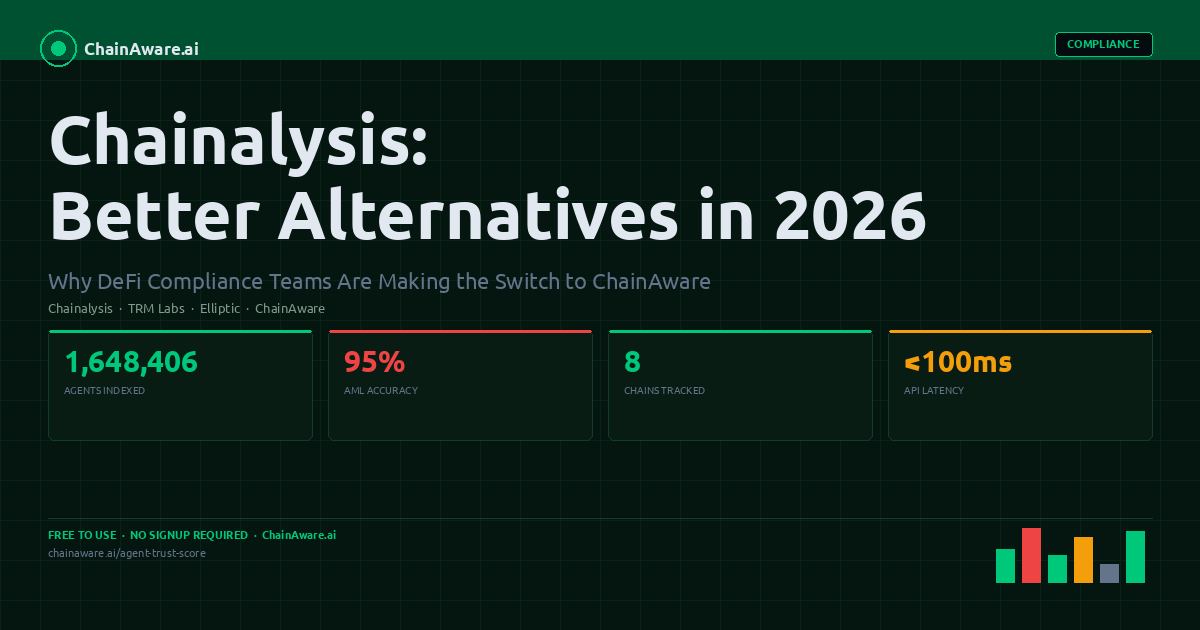
Chainalysis Alternatives Exposed: The Full Truth for DeFi Compliance Teams in 2026

Chainalysis, TRM Labs, and Elliptic were built for a different era—one where compliance meant chasing stolen Bitcoin through darknet markets. But DeFi teams in 2026 face fundamentally different challenges: autonomous AI agents interacting with your pools, thousands of daily transactions across eight or more chains, and MiCA compliance obligations with real teeth. Legacy address blacklists are reactive by design, incapable of scoring behavioral patterns in real time or evaluating agent trustworthiness. ChainAware’s behavioral intelligence platform bridges this gap with predictive fraud detection and real-time KYT scoring that legacy tools simply weren’t built for. Discover how the four leading compliance platforms stack up against your actual operational needs, where each excels, and which might leave your DeFi protocol exposed to emerging risks.
Enterprise KYA compliance teams building AI agent trust frameworks — ChainAware.ai

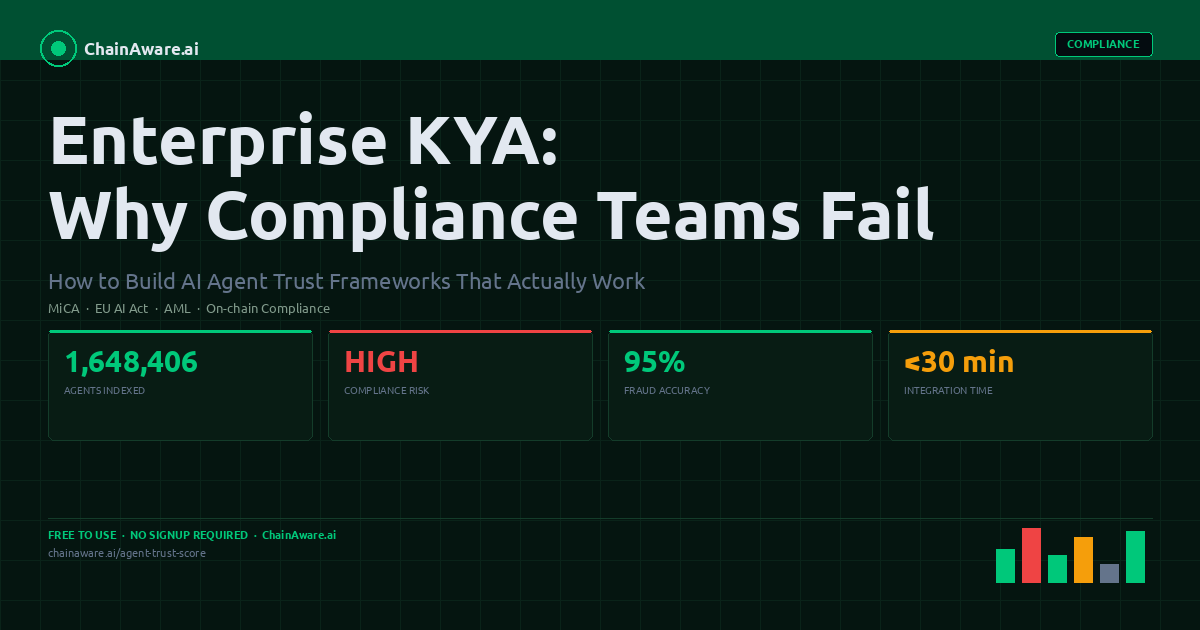
Enterprise KYA: Proven Truth About Why Compliance Teams Fail to Build Agent Trust

Compliance teams face an uncomfortable truth: the 1.6 million autonomous agents operating on-chain today are screened by exactly zero compliance tools built for the purpose. When an AI agent initiates a payment or executes a smart contract, legacy KYC infrastructure treats it as either a human user or an anonymous API call—neither assessment captures the agent’s on-chain identity, funding provenance, operator history, or behavioral fingerprint. Know Your Agent (KYA) represents a categorical shift from static identity verification to continuous behavioral trust assessment using on-chain evidence. ChainAware’s indexed data reveals the scale of this exposure, but also what production KYA stacks actually look like. Discover how forward-thinking compliance teams are building defensible risk decisions before regulatory mandates arrive—and why waiting puts you 18 months behind peers who moved early.

KYA regulations EU AI Act MiCA agentic economy compliance timeline — ChainAware.ai

KYA Regulations Exposed: Proven Truth About the EU AI Act, MiCA and Agentic Economy

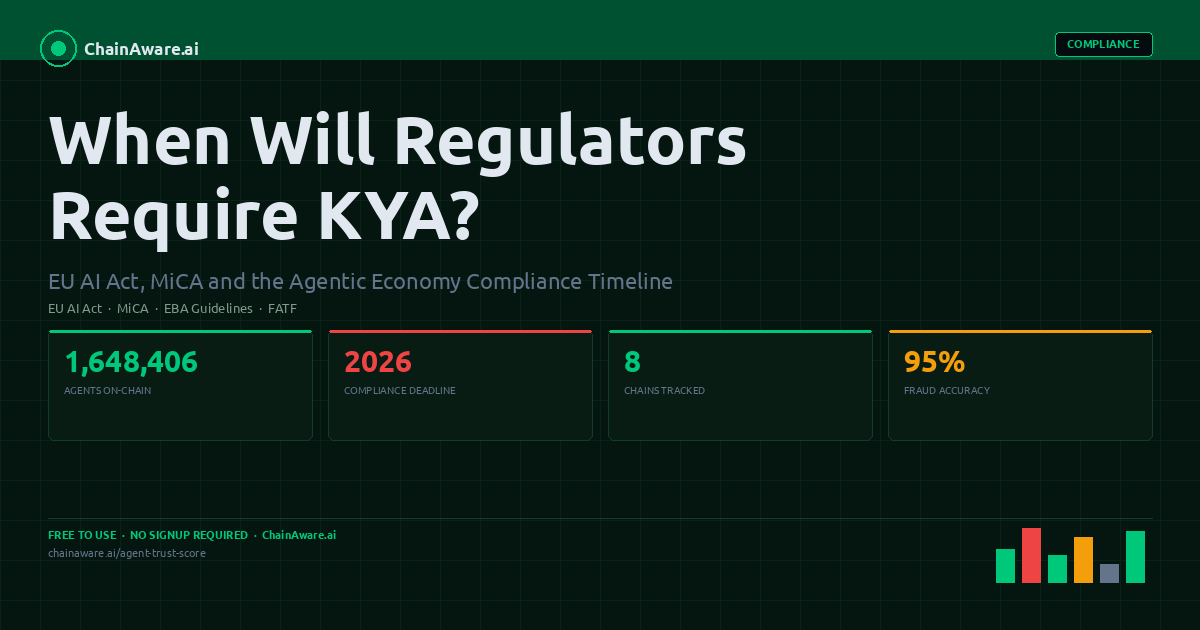
Regulators haven’t yet mandated Know Your Agent protocols — but three separate regulatory frameworks are converging to make it inevitable. The EU’s MiCA Article 68 is creating screening gaps for AI agent wallets, whilst the EU AI Act Article 50 establishes identity disclosure as a legal requirement. Meanwhile, the FATF Travel Rule is closing in on the agent originator problem. With 1.6 million ERC-8004 agents already indexed on-chain and funding chains traceable to known bad actors, compliance teams face enforcement exposure today, long before formal agent-specific rules land. This article maps the three regulatory tracks, identifies the grey areas where agents currently operate, and provides a realistic timeline for when mandatory agent registration becomes law. Learn what your team needs to do now to stay ahead of the curve — and why ChainAware’s agent behaviour scoring is becoming essential compliance infrastructure.

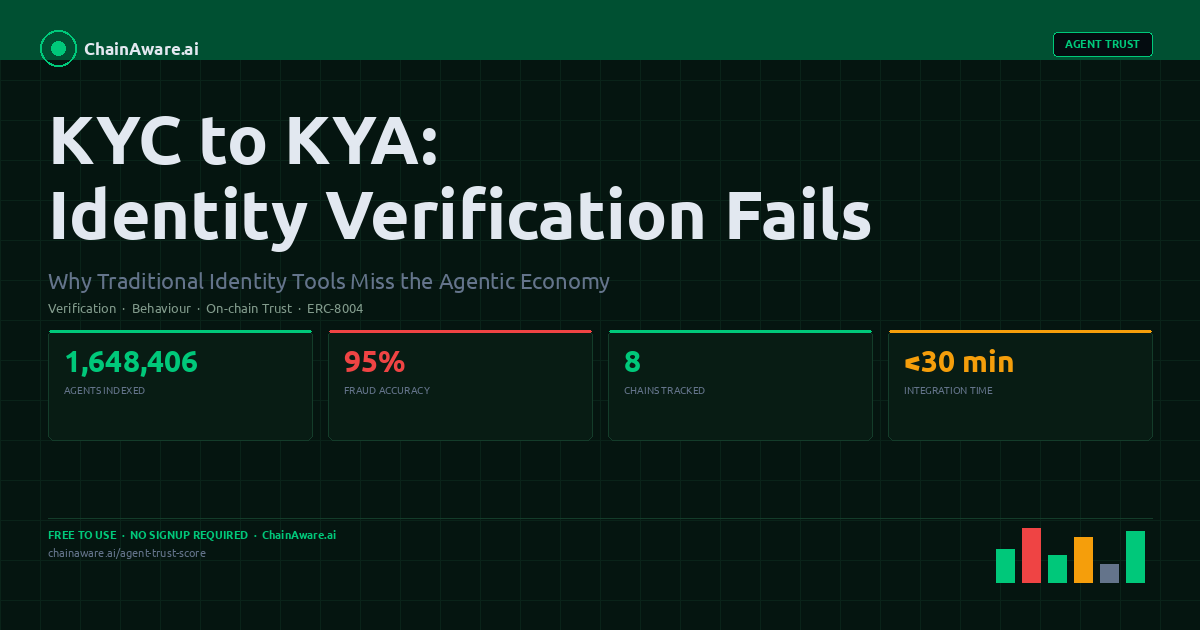
KYC to KYA identity verification evolution for AI agents — ChainAware.ai agent trust score

KYC to KYA Exposed: Proven Truth About Identity Verification in the Agentic Economy

Traditional Know Your Customer protocols were built for humans—but AI agents operating autonomously across blockchains expose three critical gaps that KYC cannot close alone. When software holds wallets and executes transactions without human oversight for each action, the delegation chains, behavioral drift and fleet Sybil attacks multiply compliance blind spots. ChainAware’s analysis of the ERC-8004 agent ecosystem reveals the scale: 1.6 million registered agents across eight chains, with 82.5% of scored agents showing elevation risk signals that static identity checks never catch. This article explains precisely where KYC breaks under agent volume, what Know Your Agent adds to close those gaps and what on-chain behavioral intelligence reveals about the agentic economy’s real compliance challenge. Discover why continuous behavioral scoring, not point-in-time verification, is now essential for Web3 compliance teams.

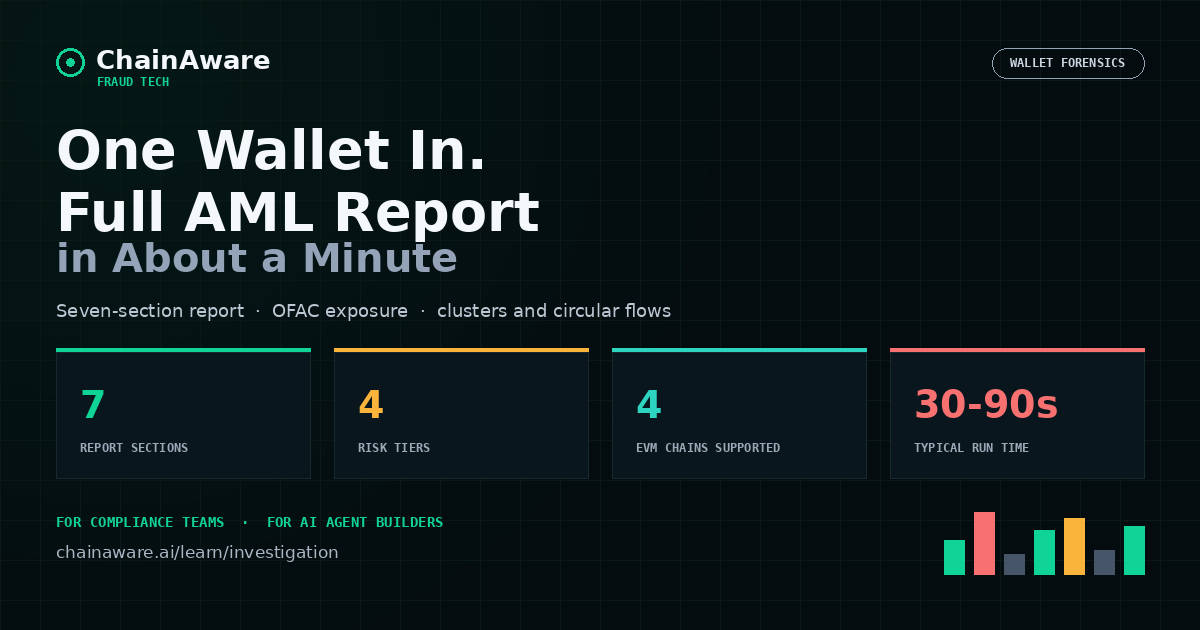
Wallet forensics dashboard tracing crypto transactions for AML compliance review — ChainAware.ai

Wallet Forensics Exposed: The Full Truth About AML Reports for Compliance Teams

ChainAware Investigation turns a single EVM wallet address into a structured seven-section forensic report in 30 to 90 seconds. The report covers Identity and Roles, Activity Summary, Top Counterparties, Risk Assessment, Circular Flows and Clusters, AML Exposure, and a Conclusion with a combined LOW, MEDIUM, HIGH or CRITICAL risk tier. It combines ChainAware’s behavioral fraud intelligence with OFAC sanctions screening, third-party forensic signals and identity lookups across ENS, Unstoppable Domains, SPACE ID and ChainAware known-entity labels. Investigation supports externally owned accounts on Ethereum, BNB Smart Chain, Base and Polygon, and it is a point-in-time snapshot that teams rerun for monitoring. Compliance and AML teams use it for KYT due diligence, incident response, SAR preparation and pre-transaction OTC screening, while AI agent builders use the fixed structure and risk tier as a machine-readable counterparty check inside agentic pipelines. This guide explains each report section, the four risk tiers, a worked example, common wallet patterns, workflow design, responsible-use rules and the tool’s limits. ChainAware does not file SARs, and recommendations remain informational. Related tools include Agent Trust Score, the Fraud Detection API, Token Audit and the Prediction MCP. Learn more at chainaware.ai/learn/investigation/index.html.

Token audit dashboard scanning 10,000 CoinGecko tokens for fraud risk — Web3 security analysis — ChainAware.ai

Token Audit Exposed: We Tested 10,000 CoinGecko Tokens – Full Truth Revealed

ChainAware Token Audit is live – 127 automated security checks across 9 modules, tested against the top 10,000 CoinGecko tokens by market cap. The results: 55.2% high risk, 131 confirmed honeypots, 13.2% upgradeable proxy contracts – including 139 controlled by a single private key. ChainAware catches threats invisible to GoPlus, CertiK Skynet, and TokenSniffer: transitive approve() analysis, phantom balanceOf, EIP-2612 permit correctness, reentrancy detection, and asymmetric pause – powered by behavioral intelligence across 20M+ wallet personas on 8 blockchains. Free at chainaware.ai/token-audit.

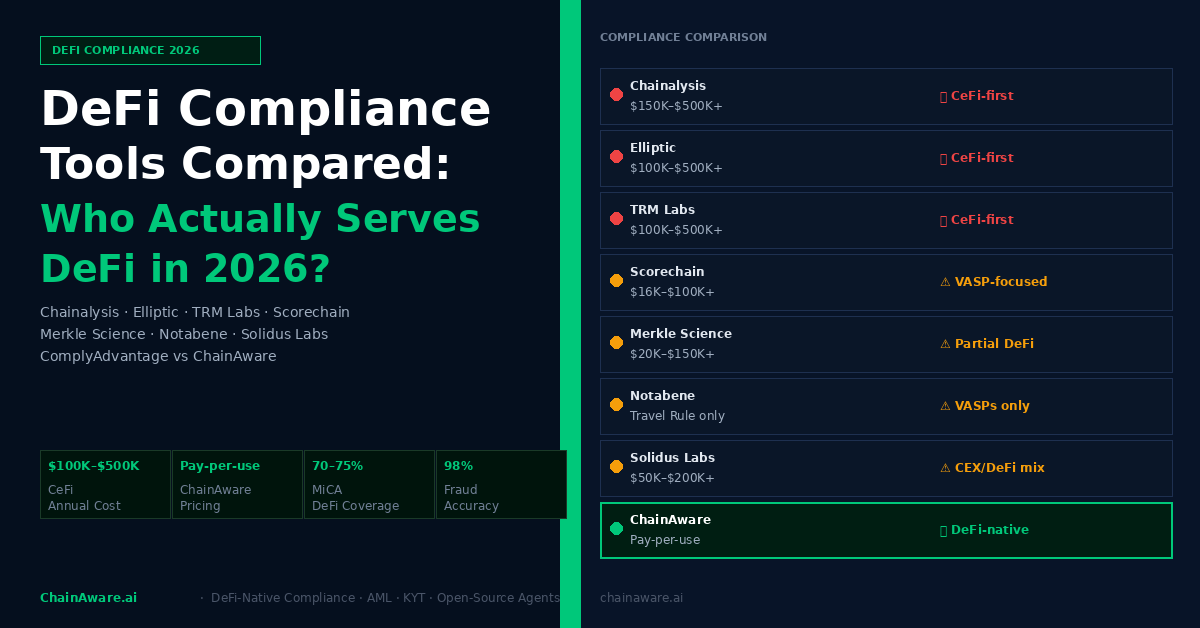
DeFi compliance dashboard comparing protocol tools for 2026 — DeFi compliance tools guide — ChainAware.ai

DeFi Compliance Tools for Protocols: The Complete Comparison 2026

Compare Chainalysis alternatives for DeFi compliance teams — TRM Labs, Elliptic, ChainAware. Coverage, pricing, false positive rates, and MiCA readiness for 2026.

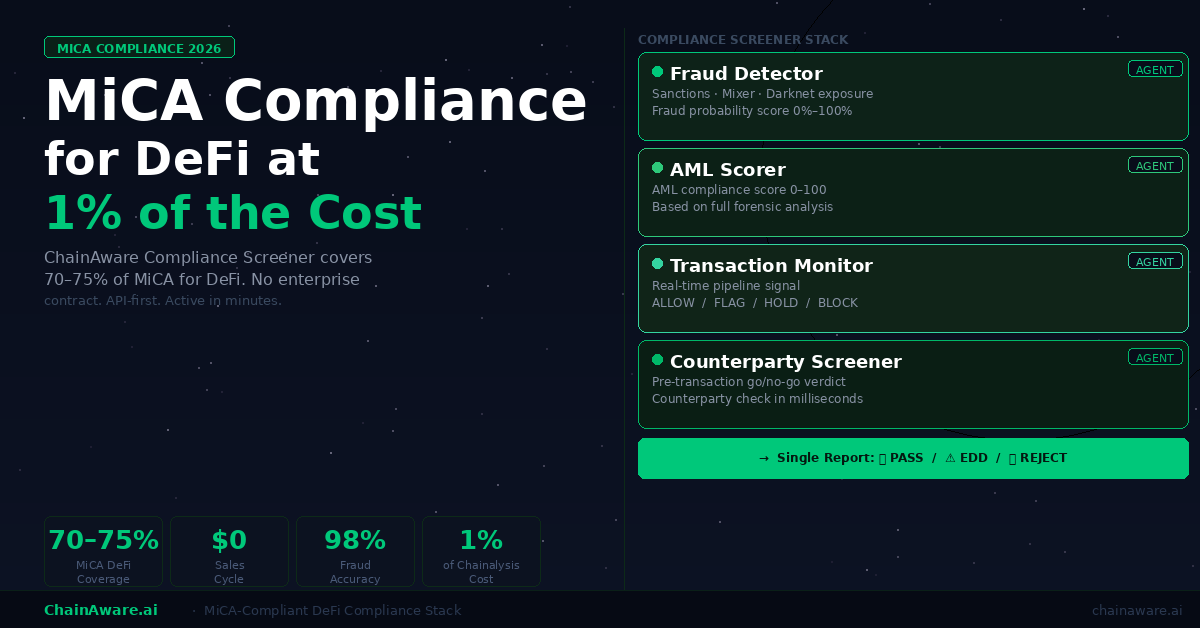
MiCA compliance dashboard for DeFi at 1% of Chainalysis cost — ChainAware.ai

MiCA Compliance for DeFi Exposed: The Full Truth About Costs at 1% of Chainalysis

MiCA compliance for DeFi protocols at 1% of Chainalysis cost — behavioral AML, transaction monitoring, and wallet screening. Compare tools for 2026.

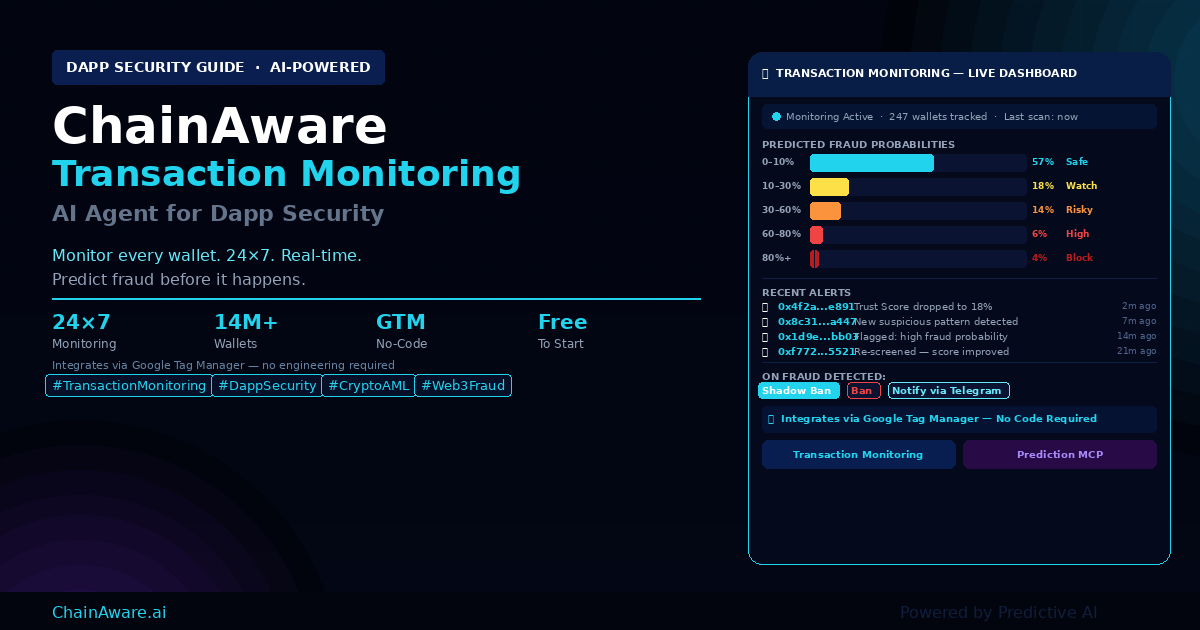
Dashboard showing 24×7 transaction monitoring alerts for Web3 dapp fraud protection — ChainAware.ai

ChainAware Transaction Monitoring Agent: Proven 24×7 Dapp Fraud Protection Exposed

AML checks where funds came from. Transaction Monitoring predicts what a wallet will do next. This complete guide covers ChainAware’s Transaction Monitoring Agent – GTM pixel deploy in 12 minutes, real-time behavioral scoring at every wallet connection, Telegram alerts, and webhook automation for automatic blocking. No headcount required.