
Last Updated: February 28, 2026
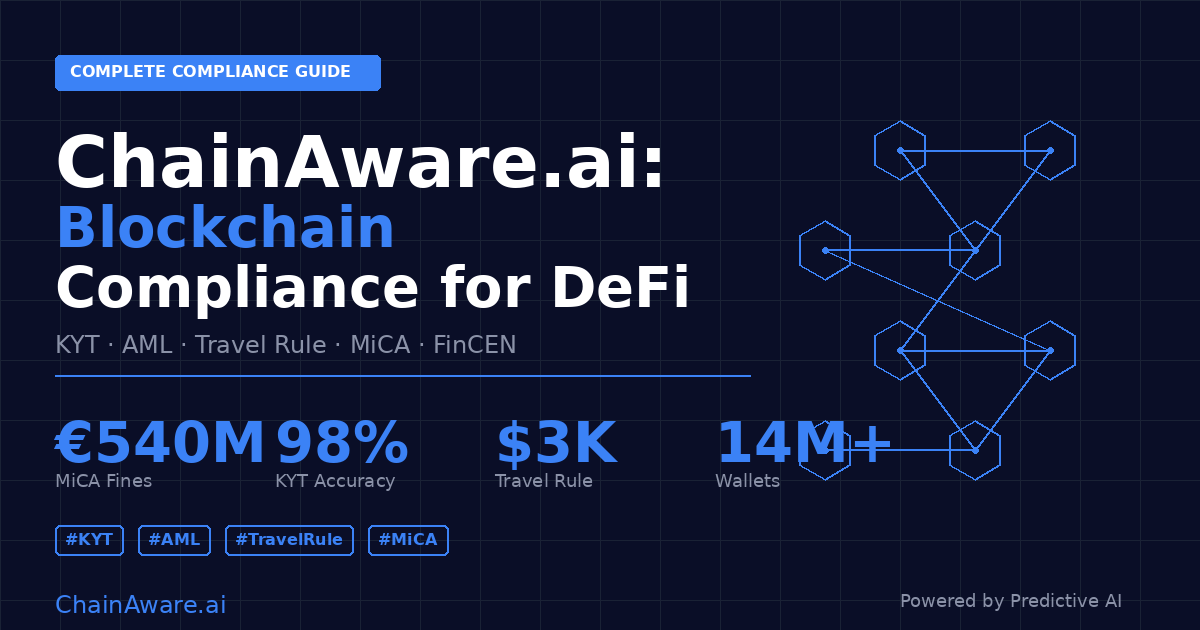
Blockchain compliance has transformed from a distant concern to an operational necessity for DeFi protocols in 2026. With MiCA fully enforced across the EU (€540M+ in penalties already issued), FinCEN’s Travel Rule actively monitored in the US, and regulators worldwide tightening AML requirements, the question is no longer whether to implement compliance—but how to do it effectively without sacrificing the decentralized ethos that makes DeFi valuable.
Know Your Transaction (KYT) has emerged as the answer: on-chain transaction monitoring that enables regulatory compliance while preserving privacy and decentralization. Unlike Know Your Customer (KYC), which requires identity verification and centralized data storage, KYT analyzes transaction behavior patterns in real-time to identify suspicious activity—without ever collecting personal information.
This guide provides enterprise DeFi protocols, crypto exchanges, and institutional participants with a comprehensive understanding of blockchain compliance in 2026: what regulations apply, how KYT and AML systems work, which solutions exist, and how to implement compliant operations while maintaining the principles of decentralized finance.
In This Guide
- Why Blockchain Compliance Matters in 2026
- Traditional Finance AML: Why It Fails in DeFi
- Know Your Transaction (KYT) Explained
- MiCA Compliance: EU Requirements for Crypto
- FinCEN Travel Rule: US Compliance Requirements
- AML for Decentralized Finance
- ChainAware Transaction Monitoring Solutions
- Implementation Guide for DeFi Protocols
- Compliance Best Practices 2026
- Future of Blockchain Compliance
- Frequently Asked Questions
Why Blockchain Compliance Matters in 2026
The regulatory landscape for cryptocurrencies underwent a fundamental shift between 2024-2026. What was once a patchwork of uncertain guidance has consolidated into enforceable frameworks with substantial penalties for non-compliance.
The Cost of Non-Compliance
MiCA enforcement in the EU has been aggressive, with over €540 million in fines issued in the first 18 months. These penalties range from €5 million to 10% of annual turnover for violations, and the European Securities and Markets Authority (ESMA) has publicly warned that license revocations will follow repeat offenses.
In the United States, FinCEN has identified Travel Rule violations as the most commonly cited infraction during Money Services Business (MSB) examinations. Penalties reach $219,156 per day for willful violations of the Bank Secrecy Act, and several high-profile exchanges have faced eight-figure enforcement actions for AML program failures.
Beyond fines, non-compliance creates operational risks that can be fatal to a DeFi protocol:
- Banking access loss — Non-compliant protocols cannot maintain fiat on/off-ramps or banking relationships
- Institutional exclusion — Traditional finance institutions and VCs will not partner with non-compliant protocols
- Jurisdictional bans — Access to entire markets (EU, US, Singapore) can be eliminated
- Reputational damage — Public enforcement actions destroy trust with users and partners
- Personal liability — Executives face industry bans and criminal charges in severe cases
The Opportunity in Compliance
While compliance requirements create friction, they also create competitive advantages for protocols that implement them well:
- Institutional access — Compliant protocols can serve traditional finance institutions entering DeFi
- Regulatory clarity — Operating within clear frameworks reduces legal uncertainty
- User trust — Sophisticated users prefer platforms with robust AML controls
- Market access — Compliance enables operation in regulated markets worldwide
- First-mover advantage — Early adopters gain market share as competitors struggle with implementation
According to industry statistics from 2025, over 65% of EU-based crypto businesses achieved MiCA compliance by Q1 2025, and MiCA-compliant businesses saw a 45% increase in institutional investments compared to non-compliant platforms. The market is rewarding compliance.
Traditional Finance AML: Why It Fails in DeFi
To understand why blockchain compliance requires fundamentally different approaches, we must first understand how Anti-Money Laundering (AML) works in traditional finance—and why those methods are incompatible with decentralized systems.
How Traditional AML Works
Traditional AML systems rely on four pillars:
- Know Your Customer (KYC) — Financial institutions must collect, verify, and store customer identity information: government IDs, proof of address, beneficial ownership documentation
- Transaction monitoring — Banks monitor all customer transactions in real-time, flagging suspicious patterns for investigation
- Suspicious Activity Reports (SARs) — When suspicious activity is identified, institutions file reports with Financial Intelligence Units (FIUs)
- Sanctions screening — All transactions are screened against government sanctions lists (OFAC, UN, EU) to prevent dealings with prohibited entities
This system works in traditional finance because financial institutions control access. You cannot use a bank without going through KYC. Your transactions flow through centralized systems the bank monitors. The bank has complete visibility and control.
Why This Fails in DeFi
Decentralized finance protocols operate fundamentally differently:
- Pseudonymous by design — DeFi protocols interact with wallet addresses, not identities. There is no “customer” to “know”
- Permissionless access — Anyone can interact with a DeFi smart contract directly. There is no gatekeeper requiring KYC before use
- No central authority — Decentralized protocols have no entity with the legal capacity to collect and store user data
- Cross-border by nature — Transactions occur globally and instantaneously, making jurisdiction-specific rules difficult to apply
- Privacy as a value proposition — Users choose DeFi specifically to avoid the surveillance and data collection of traditional finance
Attempting to force traditional KYC onto DeFi protocols destroys the properties that make them valuable. A “DeFi” protocol that requires KYC and can freeze user funds is functionally identical to a centralized exchange—it has lost the censorship resistance, permissionless access, and privacy that attracted users in the first place.
This tension created an impossible choice: comply with regulations designed for banks (and become a bank), or maintain true decentralization (and face regulatory enforcement). KYT emerged as the solution to this dilemma.
Know Your Transaction (KYT) Explained
Know Your Transaction (KYT) is the blockchain-native approach to AML compliance. Instead of identifying who is transacting, KYT analyzes what is being transacted—enabling compliance through behavioral analysis rather than identity collection.
What KYT Systems Monitor
KYT tools perform real-time analysis of blockchain transactions, evaluating:
- Transaction source and destination — Where funds originated and where they’re going
- Address behavior patterns — Historical activity of the wallet addresses involved
- Protocol interaction history — Which smart contracts and DeFi protocols the addresses have used
- Mixer and tumbler usage — Detection of privacy tools designed to obscure fund flows
- Sanctioned address screening — Real-time matching against OFAC SDN list and other sanctions databases
- Known fraud address databases — Identification of wallets associated with hacks, scams, or previous fraud
- Unusual transaction patterns — Detection of wash trading, layering, or other manipulation techniques
- Rapid fund movement — Identification of suspicious velocity patterns characteristic of money laundering
Modern KYT systems like ChainAware’s Transaction Monitoring Agent use machine learning models trained on millions of on-chain transactions to identify high-risk patterns with 98% accuracy—without ever collecting user identity information.
How KYT Enables Regulatory Compliance
KYT satisfies regulatory requirements through risk-based approaches:
- Transaction risk scoring — Every transaction receives a risk score (0-100%) based on the analysis above
- Automated flagging — High-risk transactions (typically >70% risk score) are automatically flagged for review
- Manual investigation — Compliance teams investigate flagged transactions to determine if Suspicious Activity Reports (SARs) are warranted
- Sanctions compliance — Transactions involving sanctioned addresses are automatically blocked
- Audit trails — Complete records of all transactions and risk decisions are maintained for regulatory review
This approach allows protocols to demonstrate to regulators that they have implemented reasonable controls to prevent money laundering and terrorist financing—without compromising user privacy or protocol decentralization.
KYT vs KYC: Critical Differences
| Aspect | KYC (Know Your Customer) | KYT (Know Your Transaction) |
|---|---|---|
| Data Collected | Personal identity (name, address, ID documents) | Transaction patterns and risk indicators |
| Privacy Impact | High — full identification required | Low — pseudonymity preserved |
| Applicability to DeFi | Fundamentally incompatible | Designed for blockchain systems |
| Regulatory Acceptance | Universally accepted (but not always required) | Accepted as risk-based alternative |
| Centralization Required | Yes — entity must store PII | No — can be implemented decentrally |
| Screening Focus | Identity-based | Behavior-based |
For protocols that cannot or will not implement KYC (truly decentralized protocols, non-custodial systems), KYT provides the only viable path to compliance.
MiCA Compliance: EU Requirements for Crypto
The Markets in Crypto-Assets Regulation (MiCA) represents the most comprehensive regulatory framework for crypto assets globally. Fully applicable since December 30, 2024, MiCA harmonizes rules across all 27 EU member states and creates a single licensing regime for Crypto-Asset Service Providers (CASPs).
MiCA Coverage and Scope
MiCA regulates three categories of crypto-assets:
- Asset-Referenced Tokens (ARTs) — Stablecoins backed by multiple assets or a basket of fiat currencies
- E-Money Tokens (EMTs) — Stablecoins pegged to a single fiat currency
- Other Crypto-Assets — All other digital assets not covered by existing financial services legislation
MiCA applies to: crypto exchanges and trading platforms, wallet providers (custodial), crypto brokers and dealers, portfolio management services, crypto asset advisory services, and token issuers making public offers in the EU.
Notably excluded: purely decentralized protocols with no identifiable operator, NFTs (unless fungible or fractionalized), and Central Bank Digital Currencies (CBDCs).
Key MiCA Requirements for CASPs
Authorization Requirements:
- CASP license from National Competent Authority (NCA) in home member state
- Minimum capital requirements (€50,000 to €125,000 depending on services)
- Professional indemnity insurance or comparable guarantees
- Fit and proper management (EU-resident directors required)
- Detailed business plan and compliance frameworks
Operational Requirements:
- Robust AML/CFT compliance program including KYC and transaction monitoring
- Client asset segregation from operational funds
- Custody protocols meeting DORA (Digital Operational Resilience Act) standards
- Comprehensive risk management and governance frameworks
- Conflicts of interest policies and complaint handling procedures
- Regular reporting to regulators (transaction volumes, client metrics, risk incidents)
Transparency and Disclosure:
- Crypto-asset white papers for tokens offered to the public
- Clear disclosure of risks, fees, and conflicts in all client communications
- Market abuse prevention and fair trading requirements
- Withdrawal rights (14-day cooling-off period for retail investors)
MiCA Travel Rule Implementation
The EU’s Transfer of Funds Regulation (TFR), which entered into force simultaneously with MiCA on December 30, 2024, implements the Travel Rule for crypto assets. CASPs must:
- Collect originator (sender) and beneficiary (recipient) information for all transfers
- Transmit this information to the receiving CASP along with the transaction
- Screen this information against EU sanctions lists
- Maintain records for 5 years
There is no minimum threshold for the EU Travel Rule—it applies to transfers of any amount. This is stricter than the US $3,000 threshold.
MiCA Enforcement and Penalties
As reported by industry compliance analysis, MiCA enforcement has been aggressive:
- Administrative fines up to €5 million or 10% of annual turnover
- License revocations for serious or repeat violations
- Public disclosure of non-compliant entities
- Personal liability for executives (industry bans possible)
Over €540 million in penalties have been issued in the first 18 months of enforcement, with countries like Germany, France, and the Netherlands leading with 90%+ compliance rates among crypto firms.
MiCA Transitional Periods and Deadlines
The grandfathering period allowed existing CASPs operating under national law before December 30, 2024 to continue operations temporarily. However:
- Netherlands, Germany, Ireland: 12-month transition (until December 30, 2025) — now expired
- France, Malta, Luxembourg, Estonia: 18-month transition (until July 1, 2026) — deadline imminent
CASPs operating in the EU without proper authorization after these deadlines face immediate enforcement action. ESMA has warned that last-minute applications will receive heightened scrutiny.
FinCEN Travel Rule: US Compliance Requirements
In the United States, crypto compliance operates under the Bank Secrecy Act (BSA), with the Financial Crimes Enforcement Network (FinCEN) as the primary regulator. The Travel Rule, originally established for wire transfers in 1996, was clarified to apply to virtual currency transactions in 2019.
The US Crypto Travel Rule Requirements
The Travel Rule applies to transmittals of funds of $3,000 or more. For transactions meeting this threshold, covered institutions must:
Recordkeeping Requirements (31 CFR §1010.410(e)):
Collect and retain for 5 years: name of transmitter, transmitter’s account number (if used), transmitter’s address, identity of the recipient’s financial institution, amount of the transmittal order, date of the transmittal order.
Travel Rule Requirements (31 CFR §1010.410(f)):
Transmit to the receiving financial institution: name of transmitter, transmitter account number (if used), transmitter address, name of recipient, recipient account number (if used), recipient address, amount, date.
Who Must Comply: Money Services Business (MSB) Status
FinCEN defines a Money Services Business (MSB) as any entity engaged in money transmission. For crypto, this includes:
- Crypto exchanges (centralized exchanges buying/selling crypto for customers)
- Custodial wallet providers (wallets where provider controls private keys)
- Crypto brokers and OTC desks
- Crypto payment processors
- Bitcoin ATM operators
- P2P exchangers (operating as a business)
According to FinCEN’s guidance, a business is a money transmitter if it “accepts and transmits value that substitutes for currency” on behalf of another person. This definition captures most crypto businesses that facilitate transfers for customers.
Excluded from MSB status: users (individuals buying crypto for themselves), non-custodial wallet software providers (users control private keys), miners/validators (processing transactions as infrastructure), payment processors meeting specific exemptions.
MSB Registration and Compliance Obligations
Entities qualifying as MSBs must:
- Register with FinCEN — File MSB registration form and renew every two years
- Implement AML program — Written program including policies, procedures, internal controls, compliance officer designation, training, and independent review
- File Suspicious Activity Reports (SARs) — When transactions above $2,000 appear suspicious
- Maintain Currency Transaction Reports (CTRs) — For cash transactions exceeding $10,000
- Screen against OFAC sanctions lists — Real-time screening of all transactions
- Comply with Travel Rule — For transactions $3,000+
FinCEN Enforcement
Travel Rule violations are the most commonly cited infraction during IRS examinations of MSBs engaged in convertible virtual currency transmission. Penalties for non-compliance include:
- Civil penalties: Up to $219,156 per day for willful violations
- Criminal penalties: Up to $500,000 and/or 10 years imprisonment for willful violations
- License revocation: State-level money transmitter licenses can be revoked
Notable enforcement actions: Larry Dean Harmon (Helix/Coin Ninja) — $60 million fine for BSA violations. Bittrex — $53 million in combined enforcement for willful BSA violations. BitMEX — $100 million for failing to maintain adequate AML/KYC programs.
Proposed Rule Changes
In December 2020, FinCEN proposed additional requirements for crypto businesses:
- Lowering the Travel Rule threshold to $250 for international transfers involving unhosted wallets
- Requiring collection of counterparty information for transfers to/from unhosted wallets
- Currency Transaction Report (CTR) requirements for transactions exceeding $10,000 involving unhosted wallets
While these proposals have not been finalized as of February 2026, they indicate the direction of US regulatory thinking and potential future requirements.
AML for Decentralized Finance
Anti-Money Laundering (AML) frameworks for DeFi extend beyond KYT to encompass comprehensive compliance programs that address the unique risks of decentralized systems.
FATF Recommendations for Virtual Assets
The Financial Action Task Force (FATF), the global standard-setter for AML/CFT, established Recommendation 16 (the “Travel Rule”) for Virtual Asset Service Providers (VASPs) in 2019. FATF requires VASPs to:
- Be regulated and licensed or registered
- Implement AML/CFT controls equivalent to those for traditional financial institutions
- Exchange originator and beneficiary information for transfers (Travel Rule)
- Monitor transactions for suspicious activity and file Suspicious Transaction Reports (STRs)
- Screen transactions against sanctions lists
FATF’s Travel Rule threshold is typically $1,000 USD/EUR, stricter than the US $3,000 threshold.
Components of a DeFi AML Program
A compliant AML program for DeFi protocols includes:
1. Risk Assessment
- Identification of specific money laundering and terrorist financing risks for the protocol
- Assessment of jurisdictional risks (where users are located)
- Product/service risk analysis (which features create AML risk)
- Regular updates as risks evolve
2. Transaction Monitoring (KYT)
- Real-time screening of all transactions against sanctions lists
- Behavioral analysis to detect suspicious patterns
- Risk scoring of wallets and transactions
- Automated flagging of high-risk activity
3. Investigation and Reporting
- Designated compliance team to investigate flagged transactions
- Documented decision-making process for SAR/STR determinations
- Filing of Suspicious Activity Reports with appropriate FIUs
- Maintenance of complete audit trails
4. Sanctions Screening
- Real-time matching against OFAC SDN list
- Screening against EU, UN, and other relevant sanctions lists
- Automatic transaction blocking for matches
- Regular updates as sanctions lists change
5. Record Keeping
- Retention of all transaction data for 5 years minimum
- Documentation of compliance decisions
- Audit logs accessible for regulatory review
6. Staff Training and Governance
- Designated AML Compliance Officer
- Regular training for all relevant staff
- Independent review of AML program effectiveness
- Board-level oversight and accountability
Balancing Privacy and Compliance
The challenge for DeFi is implementing these controls without destroying protocol decentralization or user privacy. Effective approaches include:
- Risk-based monitoring — Focus intensive scrutiny on high-risk transactions rather than universal KYC
- Threshold-based triggers — Apply enhanced monitoring only above certain transaction sizes
- Privacy-preserving technologies — Use zero-knowledge proofs to verify compliance without exposing data
- Opt-in enhanced access — Offer premium features (higher limits, lower fees) for users who voluntarily complete KYC
- Decentralized compliance — Distribute compliance functions to preserve protocol decentralization
ChainAware Transaction Monitoring Solutions
ChainAware provides the technical infrastructure for blockchain compliance through three integrated solutions: Transaction Monitoring Agent, Fraud Detector, and Wallet Auditor. These tools enable DeFi protocols to implement comprehensive AML programs without requiring user KYC.
Transaction Monitoring Agent: Real-Time KYT for DeFi
The Transaction Monitoring Agent is an enterprise-grade KYT solution designed specifically for DeFi protocols. It performs real-time analysis of every transaction, providing:
Core Capabilities:
- Sanctions screening — Instant matching against OFAC SDN list, EU sanctions, and UN designations
- Risk scoring — 0-100% risk assessment for every wallet and transaction based on behavioral analysis
- Suspicious pattern detection — ML models identify wash trading, layering, structuring, and other money laundering techniques
- Mixer detection — Flags wallets that have used Tornado Cash or similar privacy tools
- Fraud wallet identification — Cross-references against databases of known exploit addresses and scam wallets
- Travel Rule data collection — Automated capture of required information for Travel Rule reporting
- SAR/STR workflow — Built-in case management for suspicious activity investigations
- Audit trails — Complete immutable logs of all compliance decisions
Multi-Chain Coverage: Ethereum, BNB Smart Chain, Polygon, Solana, Base, Haqq Network, Avalanche, Arbitrum — unified monitoring across all major DeFi ecosystems.
Integration Options:
- No-code integration — Google Tag Manager pixel (deploy in minutes, no developers needed)
- REST API — Full programmatic access for custom integrations
- Smart contract integration — On-chain compliance checks directly in protocol contracts
- Webhook notifications — Real-time alerts when high-risk transactions occur
Pricing:
- Free Tier: Up to 1,000 transactions/month
- Growth: $999/month for 10,000 transactions
- Enterprise: Custom pricing for unlimited transactions + dedicated compliance support
Predictive Fraud Detector: 98% Accurate AML Intelligence
ChainAware’s Predictive Fraud Detector goes beyond reactive AML monitoring to predict which wallets are likely to engage in fraudulent activity—before it happens.
What It Detects:
- Probable future fraud (98% accuracy in identifying wallets that will commit fraud)
- Money laundering behavior patterns
- Sybil attack networks (coordinated multi-wallet operations)
- Sanctioned address connections (wallets transacting with OFAC-listed entities)
- Exploit wallet patterns
- Bot and farming wallet behavior
Use Cases for Compliance:
- Enhanced due diligence — Deep-dive AML analysis for high-value transactions or counterparties
- Ongoing monitoring — Track changes in wallet risk profiles over time
- Partnership vetting — Verify the reputation of business partners or major token holders
- Retroactive audits — Identify historically risky wallets in your user base
Wallet Auditor: Individual Wallet Risk Assessment
The free Wallet Auditor provides instant AML and behavioral analysis for any individual wallet address. Compliance teams use it to investigate flagged wallets during SAR reviews, perform enhanced due diligence on large depositors, verify the risk profile of business counterparties, and generate forensic reports for regulatory submissions.
Free for unlimited use — no account required.
Integration Workflow for DeFi Protocols
A typical ChainAware implementation follows this workflow:
- Initial integration — Deploy Transaction Monitoring Agent via Google Tag Manager or API
- Threshold configuration — Define risk score thresholds that trigger investigations (typically 70-80%)
- Alert routing — Configure webhooks to notify compliance team when high-risk transactions occur
- Investigation workflow — Compliance officers use Wallet Auditor and Fraud Detector for deep-dive analysis
- SAR filing — When suspicious activity is confirmed, protocols file reports with appropriate FIUs
- Ongoing monitoring — Continuous transaction screening and periodic risk profile updates
Implementation Guide for DeFi Protocols
Implementing blockchain compliance requires careful planning and phased execution. This section provides a step-by-step guide for DeFi protocols building compliant operations.
Phase 1: Compliance Program Design (2–4 weeks)
Step 1: Regulatory Jurisdiction Mapping
Determine which regulations apply to your protocol: where are your users located? Where is your legal entity incorporated? Do you have offices/employees in regulated jurisdictions? Will you serve US or EU users?
Step 2: Risk Assessment
Conduct a comprehensive risk assessment: identify specific ML/TF risks for your protocol type, assess which features create compliance risk, document how your protocol could be misused for illicit activity, and determine appropriate controls for identified risks.
Step 3: Compliance Program Documentation
Develop written compliance policies: AML program policy, sanctions screening policy, transaction monitoring policy, SAR filing procedures, record retention policy, and training policy.
Phase 2: Technical Implementation (4–8 weeks)
Step 1: Choose Compliance Infrastructure
Select your KYT/AML solution:
- ChainAware Transaction Monitoring — Recommended for DeFi protocols prioritizing privacy and decentralization
- Chainalysis — Established solution, higher cost, law enforcement focus
- Elliptic — Strong financial crime intelligence, traditional AML approach
- TRM Labs — Good Travel Rule focus, regulatory relationship emphasis
Step 2: Integrate Monitoring Tools
Deploy chosen solution: deploy monitoring agent (Google Tag Manager or API), configure risk score thresholds and alert rules, set up webhook notifications to compliance team, integrate sanctions list screening, configure Travel Rule data collection (if applicable), and test integration on testnet before mainnet deployment.
Step 3: Build Investigation Workflows
Create processes for compliance team: dashboard for reviewing flagged transactions, case management system for tracking investigations, templates for SAR/STR filings, escalation procedures for high-risk cases, and audit log system for all compliance decisions.
Phase 3: Operational Launch (2–4 weeks)
Step 1: Hire Compliance Team
- AML Compliance Officer (required) — Senior role, regulatory expertise
- Compliance Analysts (1-3 depending on volume) — Investigation and monitoring
- External counsel (recommended) — Regulatory guidance and SAR review
Step 2: Training
Train all relevant staff on: how to use monitoring tools and investigate flagged transactions, when and how to file SARs/STRs, sanctions screening procedures, record keeping requirements, and escalation procedures.
Step 3: Regulatory Registration
- US: FinCEN MSB registration (if applicable)
- EU: CASP authorization application with National Competent Authority
- State-level: Money transmitter licenses (US state requirements vary)
Phase 4: Ongoing Compliance (Continuous)
Daily Operations: Review and investigate all flagged transactions within 24 hours. File SARs/STRs for confirmed suspicious activity (within required timeframes). Monitor sanctions list updates. Maintain audit trails of all compliance decisions.
Monthly Activities: Review false positive rates and adjust thresholds if needed. Compliance metrics reporting to management. Staff training refreshers.
Annual Activities: Independent AML program review/audit. Risk assessment updates. Policy and procedure updates based on regulatory changes. Renewal of registrations (FinCEN MSB, state licenses).
Cost Estimates for Compliance Implementation
Initial Setup Costs:
- Legal/consulting (compliance program design): $15,000–$50,000
- KYT/AML software (first year): $10,000–$100,000 depending on volume
- Staff hiring and training: $20,000–$40,000
- Total initial investment: $45,000–$190,000
Ongoing Annual Costs:
- Compliance staff (1-3 FTEs): $150,000–$400,000
- KYT/AML software subscriptions: $10,000–$100,000
- External legal/audit: $20,000–$50,000
- Total ongoing: $180,000–$550,000/year
Compliance Best Practices 2026
Based on lessons learned from early MiCA enforcement and evolving regulatory expectations, these best practices help protocols build robust, defensible compliance programs.
1. Design for Compliance from Day One
The most expensive compliance programs are those retrofitted onto protocols built without regulatory considerations. Design your protocol architecture with compliance in mind: build hooks for transaction monitoring into smart contracts, design admin functions that enable compliance interventions, structure governance to accommodate regulatory requirements, and choose jurisdictions strategically for legal entity incorporation.
2. Document Everything
Regulators expect to see written policies and documented decisions. Maintain comprehensive records: all flagged transactions and investigation outcomes, risk score calculation methodology, threshold-setting rationale, training completion records, and policy versions and update history.
A documented process, even if imperfect, is vastly better than an undocumented process, even if functionally superior.
3. Be Proactive with Regulators
Don’t wait for enforcement. Engage with regulators early: submit CASP applications well before transitional deadlines, request regulatory guidance meetings for novel protocol features, join industry associations to stay informed of regulatory developments, and participate in public comment periods on proposed regulations.
Regulators are more lenient with protocols that demonstrate good-faith efforts to comply.
4. Prioritize High-Risk Scenarios
Apply risk-based approaches — focus intensive resources on highest risks: high-value transactions (>$10,000) get enhanced scrutiny, cross-border flows receive additional monitoring, transactions involving privacy tools (mixers) are automatically flagged, and known high-risk jurisdictions (FATF blacklist countries) get special attention.
5. Maintain Operational Decentralization Where Possible
Compliance doesn’t require complete centralization. Preserve decentralized features where they don’t conflict with regulatory requirements: use on-chain monitoring rather than requiring all users to KYC, implement threshold-based interventions, and design governance that distributes compliance functions rather than centralizing them.
6. Build for Audit and Transparency
Assume regulators will audit your compliance program. Design systems to make audits straightforward: immutable audit logs for all compliance decisions, clear metric tracking (false positive rates, SAR filing volumes, etc.), easy-to-export data for regulatory requests, and regular internal audits to identify issues before regulators do.
7. Stay Current with Regulatory Developments
Blockchain regulation evolves rapidly. Stay informed: subscribe to ESMA, FinCEN, and FATF updates, monitor enforcement actions against competitors, attend regulatory conferences and workshops, and budget for regulatory compliance as a core operational expense.
Future of Blockchain Compliance
Blockchain compliance is evolving rapidly. Understanding future trends helps protocols prepare for what’s coming rather than reacting to enforcement.
1. AI-Powered Compliance Becomes Standard
Machine learning models trained on millions of transactions will replace rules-based AML systems. Expect: predictive risk scoring (systems identify risky wallets before suspicious transactions occur), behavioral fingerprinting (ML models detect money laundering patterns humans miss), automated investigation (AI agents perform initial case analysis), and real-time adaptation (models continuously learn from new fraud techniques).
ChainAware’s 98% fraud prediction accuracy demonstrates what AI-first compliance can achieve—this will become table stakes.
2. Cross-Chain Compliance Coordination
As DeFi activity spans multiple chains, compliance must follow. Future developments include: unified monitoring (single KYT platforms tracking users across all chains), cross-chain Travel Rule (information exchange between chains for bridge transactions), shared sanctions lists (coordinated blocking across ecosystems), and interoperable compliance standards for sharing compliance data between protocols.
3. Decentralized Compliance Infrastructure
The next phase: compliance systems that don’t require centralized operators. This includes on-chain risk oracles (decentralized networks providing wallet risk scores), zero-knowledge compliance (proving compliance without revealing transaction details), tokenized compliance credentials (soulbound tokens attesting to wallet compliance status), and DAO-based investigation (distributed networks reviewing suspicious activity).
4. Regulatory Fragmentation Then Convergence
Near-term: increased fragmentation as jurisdictions implement competing frameworks. Mid-term: international convergence toward common standards. 2026–2027: EU (MiCA), US (evolving), UK (new framework), Singapore, Japan all have distinct requirements. 2028–2030: International coordination through FATF leads to harmonized Travel Rule and AML standards. 2030+: Global passporting system emerges (similar to EU’s single market model).
5. Compliance as Competitive Advantage
Protocols that nail compliance early will dominate their markets: institutional capture (traditional finance only partners with compliant protocols), regulatory moats (high compliance costs create barriers to entry for competitors), user trust (sophisticated users prefer compliant platforms), and licensing value (CASP authorizations become valuable assets).
6. Privacy Tech Meets Compliance
The privacy/compliance tension will be resolved through technology: zero-knowledge KYT (prove transaction legitimacy without exposing details), selective disclosure protocols (users control what compliance data is revealed to whom), privacy-preserving Travel Rule (exchange required information without public transparency), and encrypted compliance databases (regulators can query but not surveil).
7. Embedded Compliance in Wallets
Compliance moves from protocol-level to wallet-level: wallets automatically attach Travel Rule data to transactions, built-in sanctions screening before transaction broadcast, wallet-to-wallet compliance credential exchange, and user-controlled compliance profiles (share more data for better rates).
Frequently Asked Questions
What is KYT and how is it different from KYC?
Know Your Transaction (KYT) analyzes transaction behavior patterns to identify suspicious activity, while Know Your Customer (KYC) collects and verifies user identity. KYT enables compliance through monitoring rather than identification, making it compatible with DeFi’s pseudonymous nature. KYT examines what is happening on-chain; KYC examines who is doing it.
Do decentralized protocols need to comply with MiCA and FinCEN?
It depends on the degree of decentralization. Protocols with no identifiable operator and no ability to control protocol functions may fall outside regulatory scope. However, protocols with development teams, governance tokens controlled by identifiable entities, admin keys, or any form of centralized control typically qualify as regulated entities. The key test: is there someone who could be held accountable for the protocol’s compliance? If yes, that entity likely has compliance obligations.
What is the FATF Travel Rule and what threshold applies?
The Travel Rule requires virtual asset service providers to exchange originator (sender) and beneficiary (recipient) information when processing transfers. Thresholds vary by jurisdiction: $3,000 in the US (FinCEN), $1,000 globally (FATF recommendation), and no threshold in the EU (all transfers require data exchange under MiCA/TFR).
Can I use ChainAware’s tools for free?
Yes. ChainAware’s Wallet Auditor is completely free for unlimited individual wallet checks—no account required. The Transaction Monitoring Agent offers a free tier for up to 1,000 transactions per month, suitable for small protocols or testing. Enterprise features and higher volumes require paid plans.
How accurate is ChainAware’s fraud detection?
ChainAware’s Predictive Fraud Detector achieves 98% accuracy in identifying wallets that will engage in fraudulent activity—not just detecting fraud after it occurs, but predicting it before it happens. This is based on machine learning models trained on 14M+ wallet behavioral profiles across 8 blockchains. The system continuously improves as it processes more transactions.
What happens if I don’t implement compliance and get caught?
Penalties are severe and escalating. In the EU under MiCA, fines reach €5 million or 10% of annual turnover, plus potential license revocation and public disclosure as non-compliant. In the US, FinCEN can assess $219,156 per day for willful BSA violations, and criminal penalties include up to 10 years imprisonment. Recent enforcement actions have resulted in $50M–$100M+ settlements. Beyond financial penalties, non-compliance eliminates access to banking, institutional partnerships, and major markets.
Do I need to implement KYC if I have KYT?
Not necessarily. KYT is often sufficient for regulatory compliance, particularly for protocols that cannot implement KYC due to their decentralized nature. However, some jurisdictions or specific services (custodial wallets, fiat on/off-ramps) may require KYC in addition to KYT. The key is implementing a risk-based approach: KYT for all transactions, with enhanced KYC only for high-risk scenarios or specific regulatory triggers.
How long does it take to implement blockchain compliance?
A comprehensive implementation typically takes 8-16 weeks from start to operational compliance: 2-4 weeks for compliance program design and policy documentation, 4-8 weeks for technical integration and testing, and 2-4 weeks for staff hiring, training, and operational launch. Protocols with existing infrastructure can accelerate; those requiring extensive legal entity restructuring may take longer.
Can a fully decentralized protocol comply with regulations?
This is the central tension in DeFi regulation. True decentralization (no admin keys, no identifiable operators, immutable contracts) may place a protocol outside regulatory scope—but also outside the ability to implement required controls. Most “DeFi” protocols have some degree of centralization (governance, upgradability, admin functions) which creates compliance obligations. The emerging solution: build compliance into the protocol layer through on-chain monitoring and optional enhanced features for users willing to provide additional information.
What’s the difference between MiCA and FinCEN requirements?
Key differences: Threshold — MiCA has no minimum (all transfers), FinCEN is $3,000+. Licensing — MiCA requires CASP authorization for EU operations; FinCEN requires MSB registration. Enforcement — MiCA penalties reach 10% of turnover; FinCEN maxes at $219K/day. Scope — MiCA covers 27 EU countries under one framework; US has federal + 50 state-level requirements. Privacy — MiCA explicitly allows risk-based approaches (KYT without KYC); US guidance less clear but KYT gaining acceptance.
Conclusion
Blockchain compliance in 2026 is no longer optional—it’s operational reality for any DeFi protocol serious about institutional adoption, global market access, and long-term viability. MiCA enforcement in the EU, FinCEN Travel Rule requirements in the US, and emerging frameworks worldwide have created clear expectations: protocols must implement effective AML controls or face substantial penalties and market exclusion.
The good news: compliance doesn’t require abandoning decentralization. Know Your Transaction (KYT) systems enable effective AML monitoring through behavioral analysis rather than identity collection, preserving the pseudonymity that makes DeFi valuable while satisfying regulatory requirements for suspicious activity detection and reporting.
The protocols that thrive in 2026 and beyond will be those that implemented compliance early, built it into their architecture from day one, and demonstrated to regulators that decentralized systems can meet AML objectives without replicating traditional finance’s centralized surveillance model.
ChainAware’s suite of compliance tools—Transaction Monitoring Agent, Predictive Fraud Detector, and Wallet Auditor—provides the technical infrastructure for this vision. 98% fraud accuracy, real-time sanctions screening, automated Travel Rule compliance, and comprehensive audit trails—all while preserving user privacy and protocol decentralization.
The future of DeFi is compliant. The question is whether you’ll lead that future or scramble to catch up after enforcement actions against your competitors.
About ChainAware.ai
ChainAware.ai is the leading provider of AI-powered blockchain compliance and fraud intelligence for Web3. Our platform processes millions of transactions monthly across 8 blockchains, providing real-time KYT, AML monitoring, and predictive fraud detection for DeFi protocols, exchanges, and institutional crypto users. Backed by Google Cloud, AWS, and leading Web3 VCs, ChainAware enables regulatory compliance without compromising decentralization.
Learn more at ChainAware.ai | Follow us on Twitter/X