
Last Updated: February 2026
Ask any compliance officer at a crypto exchange what their top regulatory priority is and the answer is almost always the same: AML. Anti-Money Laundering checks dominate the compliance conversation in crypto — and for understandable reasons. The tooling is mature, the regulatory guidance is clear, and the fines for non-compliance are well-publicized.
But there is a second compliance obligation that receives far less attention and far less tooling investment: Transaction Monitoring. Regulators — from the FATF to the EU’s MiCA framework — mandate both. Most crypto businesses have built robust AML pipelines and thin or non-existent Transaction Monitoring infrastructure. This gap is where fraud happens.
This guide explains exactly what each discipline covers, why they are fundamentally different, why AML alone is insufficient, and what best-in-class Transaction Monitoring looks like for a crypto business in 2026.
In This Guide
- What Is Crypto AML?
- What Is Crypto Transaction Monitoring?
- The Critical Gap: What AML Cannot See
- AML vs Transaction Monitoring: Side-by-Side Comparison
- Regulatory Mandate: Both Are Required
- How Traditional Finance Does Transaction Monitoring
- The Crypto Transaction Monitoring Challenge
- ChainAware: Predictive Fraud Detection and 24×7 Transaction Monitoring
- Implementation Guide for VASPs and DeFi Protocols
- FAQ
What Is Crypto AML?
Crypto AML — Anti-Money Laundering — is the set of processes and controls that verify the origin of funds flowing into a financial service. The fundamental question AML answers is: where did this money come from?
Money laundering is the process of disguising illegally obtained funds as legitimate income — moving “black money” (proceeds of criminal activity, undeclared income, tax evasion) through financial systems until it appears clean. The United Nations estimates money laundering flows at 2–5% of global GDP annually — roughly $800 billion to $2 trillion per year. In crypto, the problem is acute because pseudonymous addresses and cross-chain transfers can obscure fund origins that would be visible in traditional banking.
AML controls in crypto typically include three layers. First, KYC/KYB identity verification — confirming who the customer is (Know Your Customer for individuals, Know Your Business for companies). Second, fund origin screening — tracing the blockchain history of incoming funds to verify they have not passed through sanctioned addresses, darknet markets, mixing services, or other flagged sources. Third, sanctions list screening — checking wallet addresses against OFAC, EU, and UN sanctions lists in real time.
The key tools for AML are forensic blockchain analytics platforms — companies like Chainalysis, Elliptic, and TRM Labs maintain large databases of tagged addresses (exchanges, mixers, darknet markets, sanctioned entities) and trace fund flows between them. When a deposit arrives, AML tools check whether any portion of the funds passed through a flagged address in its recent history.
AML is backward-looking. It examines the past — where have these funds been? It is a screening mechanism applied primarily at onboarding or deposit, not a real-time fraud prevention system.
Predictive Fraud Detection — 98% AI Accuracy
ChainAware Fraud Detector: Catch What AML Misses
AML checks fund origins — it can’t detect fraud committed with clean money. ChainAware’s Fraud Detector analyzes behavioral patterns to predict fraud probability before it happens. 98% accuracy. Covers ETH, BNB, BASE, SOL, TON and more. Free to check any address.
What Is Crypto Transaction Monitoring?
Crypto Transaction Monitoring is the real-time surveillance of transactions and wallet behavior to detect and prevent fraud as it occurs. The fundamental question Transaction Monitoring answers is: what is this wallet likely to do?
Where AML looks backward at fund origins, Transaction Monitoring looks forward at behavioral signals. It is not asking whether the money is clean — it is asking whether the person holding it is about to commit fraud.
Transaction Monitoring in traditional finance is ubiquitous. Every credit card transaction, every bank wire, every ACH transfer passes through real-time risk scoring before it is approved. When your bank calls to verify an unusual purchase, that is Transaction Monitoring at work. When your credit card is declined at a foreign ATM until you confirm the transaction, that is Transaction Monitoring. According to FATF guidance on virtual asset monitoring, both AML and Transaction Monitoring are mandatory compliance obligations for Virtual Asset Service Providers.
Transaction Monitoring systems analyze a broad set of behavioral signals: transaction frequency and timing patterns, counterparty risk profiles, deviation from established behavioral baselines, velocity anomalies (sudden large movements after a period of inactivity), and patterns associated with known fraud typologies. In traditional banking, these systems ingest dozens of data points per transaction — device fingerprints, IP geolocation, behavioral biometrics, account history, and more.
In crypto, the data available is narrower — primarily on-chain transaction history — but the behavioral signal is still rich. A wallet’s interaction patterns with protocols, its counterparty graph, its transaction timing and sizing, and its history of interactions with high-risk addresses all encode meaningful fraud risk information.
The Critical Gap: What AML Cannot See
This is the most important concept in the article, and the one most often missed in compliance planning: AML does not detect fraud. It screens fund origins. These are different problems with different solutions.
Consider a concrete scenario. A sophisticated fraudster builds a clean wallet over six months — depositing funds from a legitimate exchange, participating in DeFi protocols, building a normal-looking transaction history. Their funds pass every AML check. Every deposit clears forensic screening. There is no connection to any sanctioned address, mixer, or darknet market. From an AML perspective, this wallet is perfectly clean.
Then the fraudster connects to a lending protocol and takes an undercollateralized loan they have no intention of repaying. Or they participate in a token launch and immediately dump their allocation. Or they conduct wash trading to manipulate an NFT floor price. None of these fraud acts involve dirty money. AML cannot see them coming.
This is not a theoretical edge case. According to Chainalysis research, a significant proportion of crypto fraud is committed by wallets with no prior connection to known bad addresses — they are new fraudsters, operating with clean funds, whose fraud has simply not been catalogued yet. By the time a forensic database tags an address as fraudulent, the damage is already done.
As covered in depth in our Transaction Monitoring complete guide, this is precisely the gap that behavioral Transaction Monitoring fills: it detects the behavioral signatures of fraud preparation — regardless of whether the funds themselves have a dirty history.
24×7 Continuous Wallet Re-Screening
ChainAware Transaction Monitoring Agent
AML checks happen at onboarding. Fraud happens anytime after. ChainAware’s Transaction Monitoring Agent continuously re-screens every connected wallet 24×7 — and sends Telegram alerts the moment a wallet’s fraud probability rises above your threshold. No-code setup via Google Tag Manager. Free to start.
AML vs Transaction Monitoring: Side-by-Side Comparison
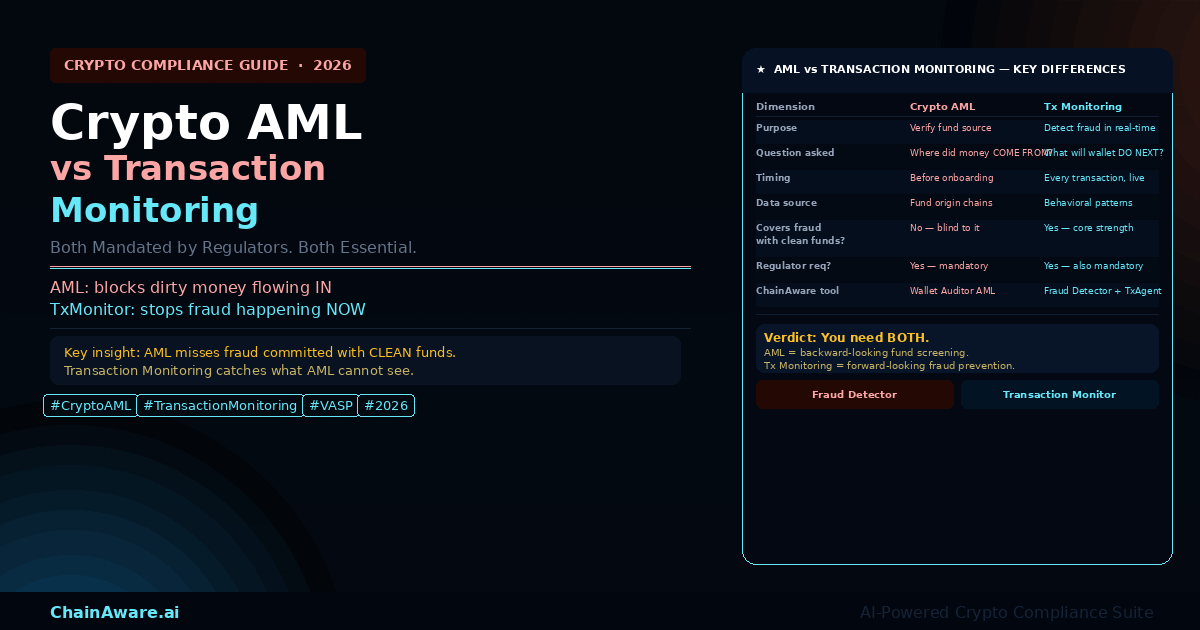
The table below summarizes the key differences between AML and Transaction Monitoring across the dimensions that matter most for compliance and fraud prevention planning.
| Dimension | Crypto AML | Transaction Monitoring |
|---|---|---|
| Core question | Where did these funds come from? | What will this wallet do next? |
| Orientation | Backward-looking (fund history) | Forward-looking (behavioral prediction) |
| When applied | Onboarding / deposit screening | Real-time, every transaction, 24×7 |
| Data analyzed | Fund flow chains, address tags | Behavioral patterns, interaction history |
| Detects clean-fund fraud? | No — blind to it | Yes — core use case |
| Approach | Forensic (known-bad address matching) | Predictive AI (behavioral modeling) |
| Regulatory mandate | Yes — FATF, AMLD6, MiCA | Yes — FATF R.16, national laws |
| ChainAware tool | Wallet Auditor (AML module) | Fraud Detector + Tx Monitoring Agent |
Regulatory Mandate: Both Are Required
The regulatory framework is unambiguous: both AML and Transaction Monitoring are mandatory for Virtual Asset Service Providers (VASPs). The confusion in practice arises because AML has a longer implementation history and a more mature tooling ecosystem — so it receives more attention. But Transaction Monitoring has been a legal requirement for nearly as long.
The Financial Action Task Force (FATF) — the global standard-setter for AML/CFT compliance — explicitly requires VASPs to implement both customer due diligence (which includes AML) and ongoing transaction monitoring under Recommendations 10 and 16. FATF Recommendation 16 (the “Travel Rule”) specifically requires VASPs to monitor transactions for suspicious activity and file Suspicious Activity Reports (SARs) when anomalies are detected.
In Europe, the 6th Anti-Money Laundering Directive (AMLD6) and the Markets in Crypto-Assets regulation (MiCA, effective 2024) both require ongoing transaction monitoring as a distinct obligation from AML screening. MiCA Article 83 specifically mandates that crypto-asset service providers implement procedures for detecting unusual or suspicious transactions and reporting them to competent authorities.
In the United States, FinCEN’s guidance for money services businesses — which includes crypto exchanges and VASPs — requires both CDD (Customer Due Diligence, incorporating AML) and transaction monitoring as separate, concurrent obligations. The Bank Secrecy Act’s SAR filing requirements are essentially a Transaction Monitoring mandate.
The practical takeaway: a business that has AML but no Transaction Monitoring is not compliant with FATF, AMLD6, MiCA, or FinCEN requirements. It has addressed one of its two obligations. The other remains unmet.
How Traditional Finance Does Transaction Monitoring
Understanding how Transaction Monitoring works in traditional banking helps clarify what a mature system looks like — and the gap that currently exists in most crypto implementations.
Every major bank and payment processor runs real-time Transaction Monitoring through AI-based risk scoring systems. When you swipe your credit card, the transaction passes through a scoring model in milliseconds before approval. That model ingests dozens of features: your transaction history and behavioral baseline, the merchant’s risk category, your location vs. usual location, transaction amount vs. your typical range, time of day, device fingerprint if online, and many more.
The model outputs a risk score. Low-risk transactions approve instantly. Medium-risk transactions may trigger additional verification (a text message confirmation). High-risk transactions are declined or escalated to a human review queue. The whole process runs in under 200 milliseconds for most transactions.
Traditional finance also operates on risk-tiered client profiles. High-risk clients (based on AML risk assessments, transaction history, and business type) receive tighter monitoring with lower thresholds for flagging. Low-risk clients receive lighter monitoring. This dynamic risk profiling is what makes Transaction Monitoring efficient at scale — not every transaction receives the same scrutiny.
As documented in the comparison of forensic versus AI-based crypto analytics, forensic tools alone are insufficient for Transaction Monitoring because they only flag wallets already catalogued as bad — missing every first-time fraudster and every fraud committed with clean funds.
Behavioral Risk Profiling for Every Wallet
Know Who Is Connecting to Your Dapp — Before They Transact
ChainAware’s Wallet Auditor gives every connecting wallet a complete risk profile: fraud probability, AML status, experience level, risk willingness, and predicted intentions. Integrate it with your platform via GTM pixel or API. See the Trust Score guide for how these metrics work in practice.
The Crypto Transaction Monitoring Challenge
Implementing Transaction Monitoring in crypto is harder than in traditional banking — but not impossible. The core challenge is data sparsity: banks have access to verified identity, device data, behavioral biometrics, and decades of account history. In crypto, the available data is primarily the wallet’s on-chain transaction record.
This sounds limiting, but the on-chain record is actually extraordinarily rich for behavioral analysis. A wallet’s blockchain history encodes: which protocols it has interacted with and how, its transaction timing and frequency patterns, its counterparty network, its asset management behavior (how it manages leverage, liquidity, and risk), and critically — whether its behavioral patterns match known fraud typologies.
The key insight from the ChainAware Fraud Detector research is that fraudsters leave behavioral traces in their on-chain history before they strike. They interact with specific types of contracts in specific sequences. They build wallet profiles in recognizable ways. They test small transactions before large ones. These patterns are detectable by AI models trained on confirmed fraud — even when the funds themselves are clean.
Traditional forensic analytics (Chainalysis, Elliptic) address AML effectively but provide weak Transaction Monitoring because they are reactive — they tag addresses after fraud is confirmed, not before. What crypto Transaction Monitoring requires is a predictive model: not “is this address already known to be bad?” but “does this address’s behavioral pattern predict fraud?”
This is the distinction the AI for crypto KYC, AML and Transaction Monitoring guide covers in depth — the fundamental limitation of forensic approaches and why AI-based behavioral prediction is the only viable path to effective crypto Transaction Monitoring.
ChainAware: Predictive Fraud Detection and 24×7 Transaction Monitoring
ChainAware has built two purpose-built tools that together address the full compliance stack: AML-quality fund origin checking via the Wallet Auditor, and predictive behavioral Transaction Monitoring via the Fraud Detector and Transaction Monitoring Agent.
Fraud Detector: Predictive Behavioral Risk Scoring
The Fraud Detector answers the Transaction Monitoring question: what is the probability that this wallet will commit fraud? It does this not by checking forensic databases but by analyzing the wallet’s behavioral patterns against AI models trained on confirmed fraud across 14 million+ profiled wallets.
The result is a fraud probability score from 0 to 1. A score of 0.05 means 5% fraud probability — the wallet’s behavioral patterns are consistent with legitimate users. A score of 0.85 means 85% fraud probability — the wallet’s patterns strongly match known fraud typologies. At 98% predictive accuracy, this is the most precise behavioral fraud prediction tool available for crypto in 2026.
Critically, this score catches what AML misses: fraudsters with clean funds who have built wallets with behavioral fraud signatures but no connection to known bad addresses. The Fraud Detector sees the behavioral pattern; AML sees nothing.
The Fraud Detector covers 8 networks: Ethereum, BNB Chain, Base, Polygon, Solana, TON, Tron, and Haqq — providing comprehensive coverage across the networks where fraud is most active.
Transaction Monitoring Agent: 24×7 Continuous Re-Screening
A one-time fraud check at onboarding is not Transaction Monitoring. A user who passes screening on day one may become a fraud risk on day 60 — their behavioral patterns shift, they acquire suspicious counterparties, or their cash flow profile changes. Real Transaction Monitoring is continuous.
ChainAware’s Transaction Monitoring Agent continuously re-screens every connected wallet 24 hours a day, 7 days a week. When any wallet’s fraud probability rises above a configurable threshold, the system sends an immediate Telegram alert. Platforms can then take one of three actions: Shadow Ban (restrict activity without notifying the user), Ban (full platform removal), or escalate for manual review.
The setup is no-code via Google Tag Manager — the same integration used for the Web3 Behavioral Analytics suite. For a complete walkthrough of the monitoring architecture, response options, and integration process, see the Transaction Monitoring Agent complete guide.
Implementation Guide for VASPs and DeFi Protocols
Building a compliant AML + Transaction Monitoring stack does not require a large engineering team. Here is the practical implementation path for crypto businesses of different types.
For CeFi exchanges and VASPs: AML is typically already in place via a forensic analytics provider. The gap is Transaction Monitoring. Integrating the ChainAware Fraud Detector via API enables real-time fraud probability scoring on every transaction before execution. Set thresholds appropriate to your risk tolerance: flag at 0.50+ fraud probability for review, block at 0.80+. Log scores for SAR filing documentation — this is precisely the audit trail regulators expect to see from a Transaction Monitoring system.
For DeFi protocols: Traditional AML is harder to implement in a permissionless context, but fraud prevention is both possible and valuable. Integrate the Transaction Monitoring Agent via GTM pixel — it will screen every connecting wallet and alert you when fraud risk rises. Use the three-response framework: allow low-risk wallets to transact freely, shadow ban elevated-risk wallets, and block critical-risk wallets. This is not just compliance — it protects your protocol’s TVL and reputation.
For lending protocols specifically: Both AML and Transaction Monitoring matter for counterparty risk. The ChainAware Credit Score combines Wallet Auditor behavioral profiling, Fraud Detector risk scoring, and Cash Flow Analysis into a 0–1000 creditworthiness score. This gives lending protocols a single number that incorporates both AML status and behavioral fraud risk — directly applicable to LTV ratio decisions and borrower eligibility.
For the complete overview of how all ChainAware compliance and analytics tools fit together, see the ChainAware complete product guide.
ChainAware.ai — Complete Crypto Compliance Suite
Fraud Detector + Transaction Monitoring Agent
Stop fraud that AML misses. ChainAware’s Fraud Detector predicts behavioral fraud with 98% accuracy. The Transaction Monitoring Agent re-screens every wallet 24×7 and alerts you in real time via Telegram. No-code GTM setup. Free to start.
Frequently Asked Questions
Is AML or Transaction Monitoring more important?
Both are mandatory and neither substitutes for the other. AML prevents dirty money from entering the system. Transaction Monitoring prevents fraud within the system. A business with only AML is fully exposed to fraud by users with clean funds — which is a large proportion of real-world crypto fraud.
Can a single tool cover both AML and Transaction Monitoring?
Not fully. AML requires forensic fund tracing — checking whether incoming funds have passed through sanctioned or criminal addresses. Transaction Monitoring requires behavioral AI prediction — analyzing whether a wallet’s patterns predict fraud. These are different technical problems. ChainAware’s Wallet Auditor includes an AML module alongside behavioral profiling; the Fraud Detector and Transaction Monitoring Agent provide the predictive layer.
Why do most crypto businesses focus on AML but not Transaction Monitoring?
Two reasons. First, AML has more mature tooling — forensic analytics vendors like Chainalysis and Elliptic have been in the market longer and have clearer product categories. Second, the regulatory fines publicized in early crypto compliance enforcement were mostly AML-related, creating the perception that AML is the only compliance risk. In reality, regulators are increasingly scrutinizing Transaction Monitoring obligations, and the gap is closing.
What is the FATF Travel Rule and how does it relate to Transaction Monitoring?
FATF Recommendation 16 (the Travel Rule) requires VASPs to collect, verify, and transmit originator and beneficiary information for virtual asset transfers above a threshold (typically $1,000). This is a Transaction Monitoring obligation — it requires real-time screening of transactions to determine whether the Travel Rule applies and to collect the required information. Implementing the Travel Rule without a broader Transaction Monitoring system creates compliance gaps.
Does ChainAware’s Transaction Monitoring work for DeFi protocols?
Yes. The Transaction Monitoring Agent integrates via Google Tag Manager pixel — compatible with any web-based DeFi frontend. It screens every connecting wallet, monitors behavioral changes 24×7, and sends Telegram alerts when risk thresholds are breached. No on-chain smart contract changes required. See the complete guide for the full integration walkthrough.
What networks are supported?
Ethereum, BNB Chain, Base, Polygon, Solana, TON, Tron, and Haqq — covering the major networks where both DeFi activity and fraud risk are highest.
Disclaimer: This article is for informational purposes only and does not constitute legal or compliance advice. Regulatory requirements vary by jurisdiction. Consult qualified legal counsel for compliance obligations specific to your business.