ChainAware Investigation: Wallet Forensics and AML Reports for Compliance Teams and AI Agents
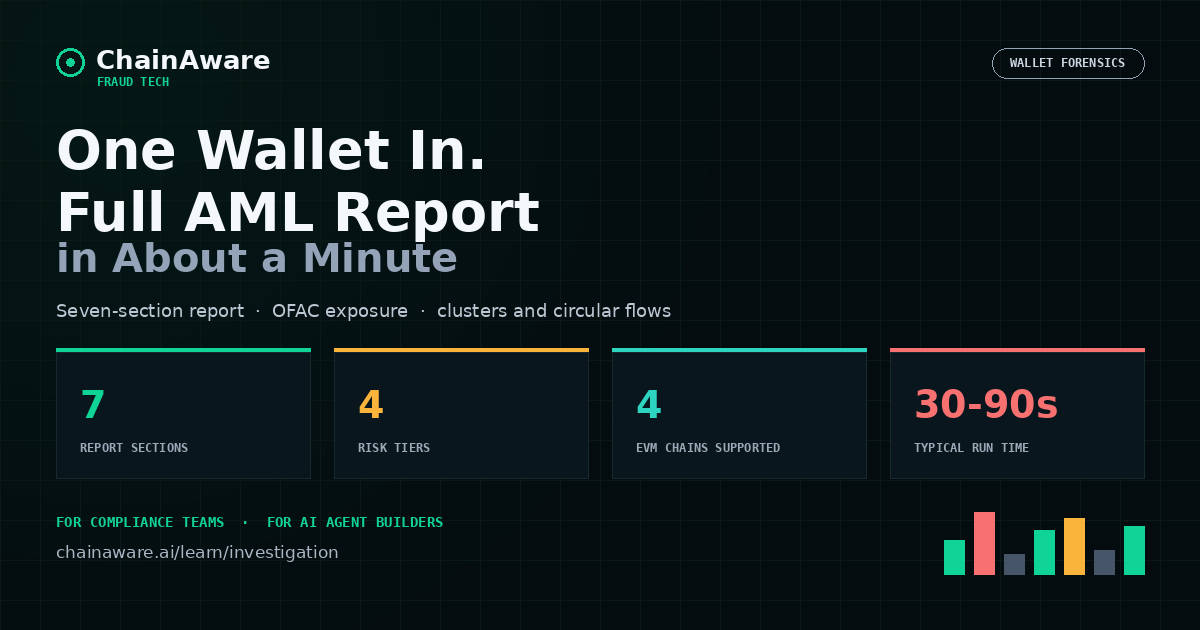
ChainAware Investigation turns a single EVM wallet address into a structured seven-section forensic report in 30 to 90 seconds. The report covers Identity and Roles, Activity Summary, Top Counterparties, Risk Assessment, Circular Flows and Clusters, AML Exposure, and a Conclusion with a combined LOW, MEDIUM, HIGH or CRITICAL risk tier. It combines ChainAware’s behavioral fraud intelligence with OFAC sanctions screening, third-party forensic signals and identity lookups across ENS, Unstoppable Domains, SPACE ID and ChainAware known-entity labels. Investigation supports externally owned accounts on Ethereum, BNB Smart Chain, Base and Polygon, and it is a point-in-time snapshot that teams rerun for monitoring. Compliance and AML teams use it for KYT due diligence, incident response, SAR preparation and pre-transaction OTC screening, while AI agent builders use the fixed structure and risk tier as a machine-readable counterparty check inside agentic pipelines. This guide explains each report section, the four risk tiers, a worked example, common wallet patterns, workflow design, responsible-use rules and the tool’s limits. ChainAware does not file SARs, and recommendations remain informational. Related tools include Agent Trust Score, the Fraud Detection API, Token Audit and the Prediction MCP. Learn more at chainaware.ai/learn/investigation/index.html.