Web3 Fraud Detection for DApps in 2026 — Why Wallet Screening Beats Transaction Simulation

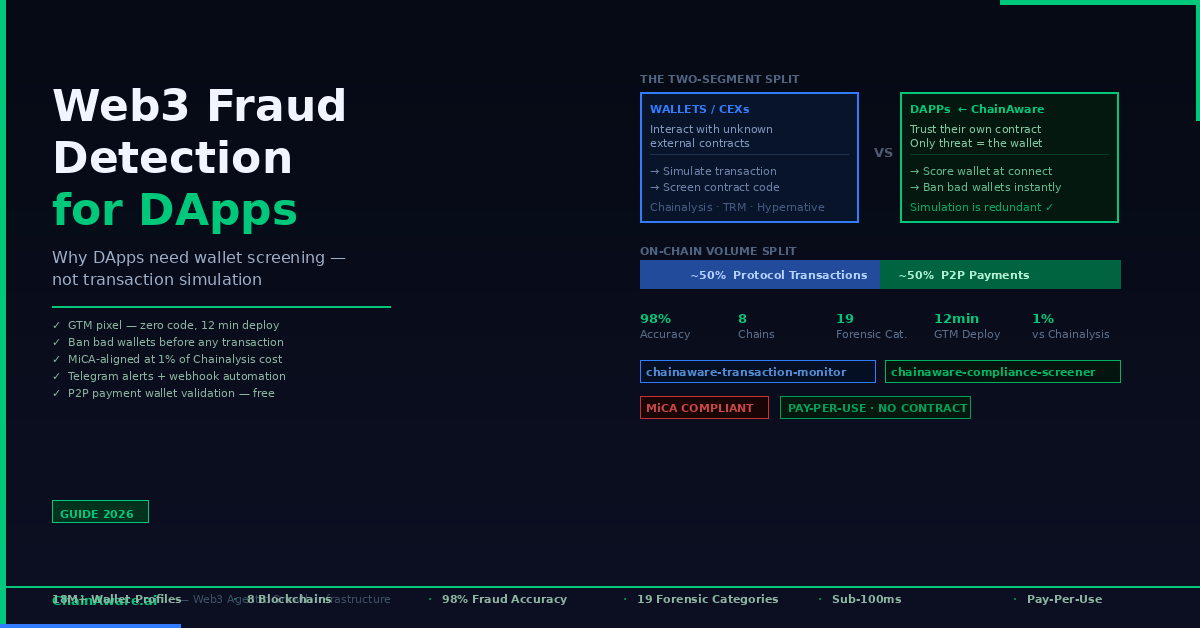
Web3 lost $4 billion to fraud in 2025 — yet most fraud detection tools were built for wallet providers and CEXs, not DApps. ChainAware.ai is the only platform purpose-built for DApps. The critical insight: a DApp trusts its own smart contract. The only threat is the wallet connecting to it. If a wallet is fraudulent, transaction simulation is redundant — ban it before any transaction begins. ChainAware delivers predictive wallet fraud scoring (98% accuracy, 19 forensic categories) at wallet connection via Google Tag Manager — zero code, 12 minutes to active. Telegram alerts and webhook automation fire instantly on bad events. MiCA-aligned at 1% of Chainalysis cost. Additionally covers the ~50% of on-chain volume that is P2P payments — where individual users must validate receiving wallets before sending irreversible funds. Covers ETH, BNB, BASE, POLYGON, SOL, TON, TRON, HAQQ. Two open-source agents: chainaware-transaction-monitor (ALLOW/FLAG/HOLD/BLOCK) and chainaware-compliance-screener (4 sub-agents in sequence). 18M+ behavioral profiles, sub-100ms, pay-per-use.

DeFi Compliance Tools for Protocols: The Complete Comparison 2026

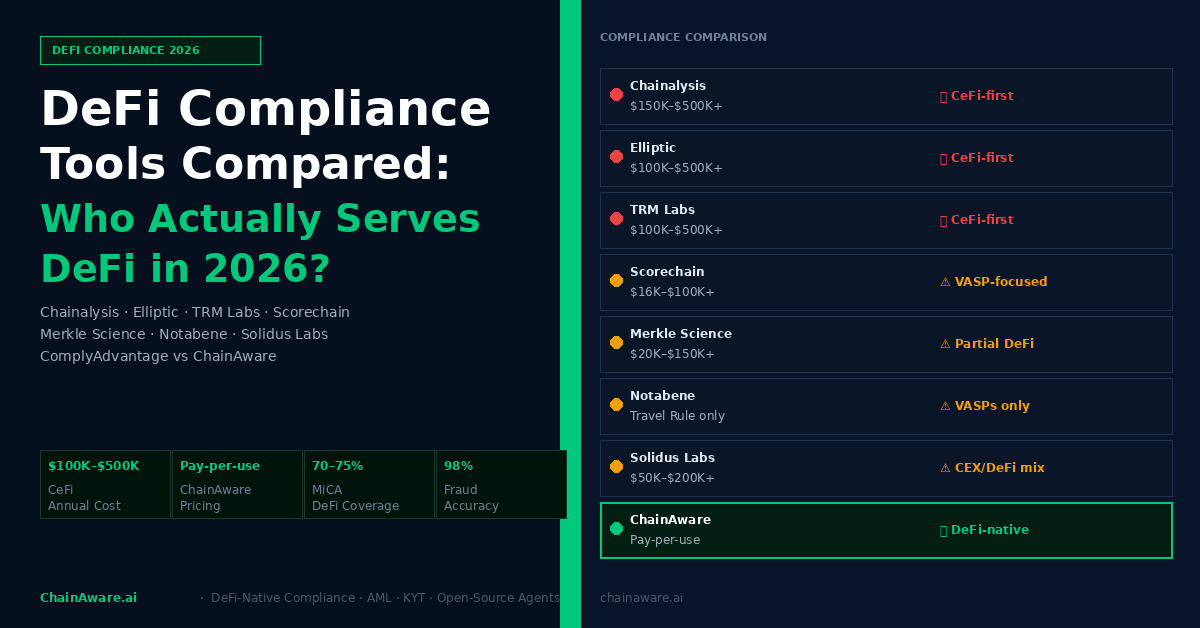
DeFi compliance in 2026 has a structural problem: protocols are being sold CeFi compliance stacks at $100K–$500K+/year — Chainalysis, Elliptic, TRM Labs, Scorechain — built for banks and centralized exchanges, for obligations that largely don’t apply to DeFi smart contract interactions. The FATF Travel Rule, which drives the majority of enterprise compliance cost (VASP attribution databases, counterparty data exchange), does not trigger when a user interacts with a smart contract. This article compares every major DeFi compliance platform in 2026 across 15 dimensions: Chainalysis KYT, Elliptic Lens, TRM Labs, Scorechain, Merkle Science, Notabene SafeTransact, Solidus Labs, ComplyAdvantage, and ChainAware. Coverage includes MiCA requirements for DeFi protocols, what each platform actually costs, who it was built for, open-source agent availability, and use case verdicts for DEXes, lending protocols, token launchpads, DAOs, and AI agent developers. ChainAware is the only DeFi-native compliance stack: open-source Claude agents on GitHub (MIT license), pay-per-use API, 70–75% MiCA coverage for pure DeFi, sanctions screening, AML behavioral monitoring, fraud detection at 98% accuracy, and the only compliance tool with a published MCP server for AI agent integration. Active in minutes. No enterprise contract. No procurement cycle. URLs: chainaware.ai/fraud-detector · chainaware.ai/pricing · chainaware.ai/mcp · github.com/ChainAware/behavioral-prediction-mcp

Forensic vs AI-Powered Blockchain Analysis: Reactive vs Predictive Intelligence - ChainAware.ai

Forensic vs AI-Powered Blockchain Analysis: Why Predictive Intelligence Wins 2026

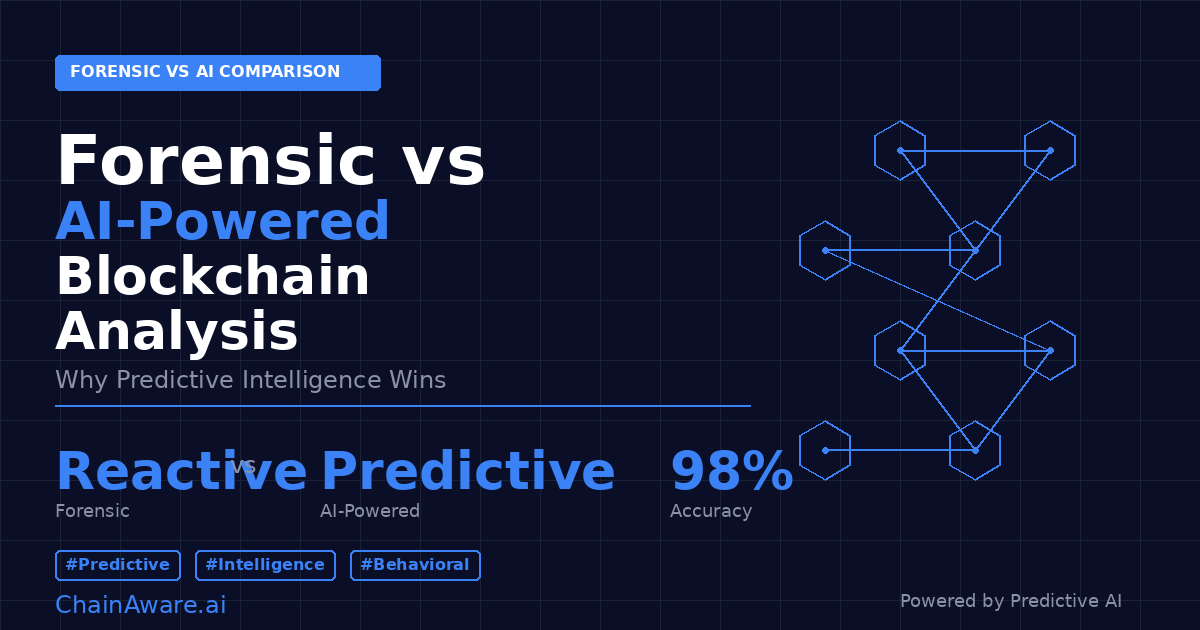
Forensic vs AI-Powered Blockchain Analysis 2026: why predictive intelligence wins over reactive forensics. Forensic tools (Chainalysis, Elliptic, TRM Labs, CipherTrace) trace funds after crimes occur — reactive, backward-looking, dependent on known bad actors. ChainAware.ai predicts fraud before it happens — 98% accuracy on 14M+ wallets, 50+ behavioral features, continuous daily retraining. Key distinctions: forensic = address clustering + attribution; AI = behavioral pattern recognition + ML. Forensic wins: law enforcement investigations, OFAC sanctions screening, asset recovery, court evidence. AI wins: pre-transaction fraud prevention, user quality segmentation (Wallet Rank), churn prediction, novel fraud detection, real-time scoring at <50ms latency. Optimal stack: Layer 1 forensic compliance + Layer 2 AI predictive prevention + Layer 3 AI business intelligence. False positives: forensic 30–70% vs AI 5–15%. Chainalysis alternative for DeFi: chainaware.ai/fraud-detector · chainaware.ai/audit · chainaware.ai/solutions/transaction-monitoring. Published 2026.