
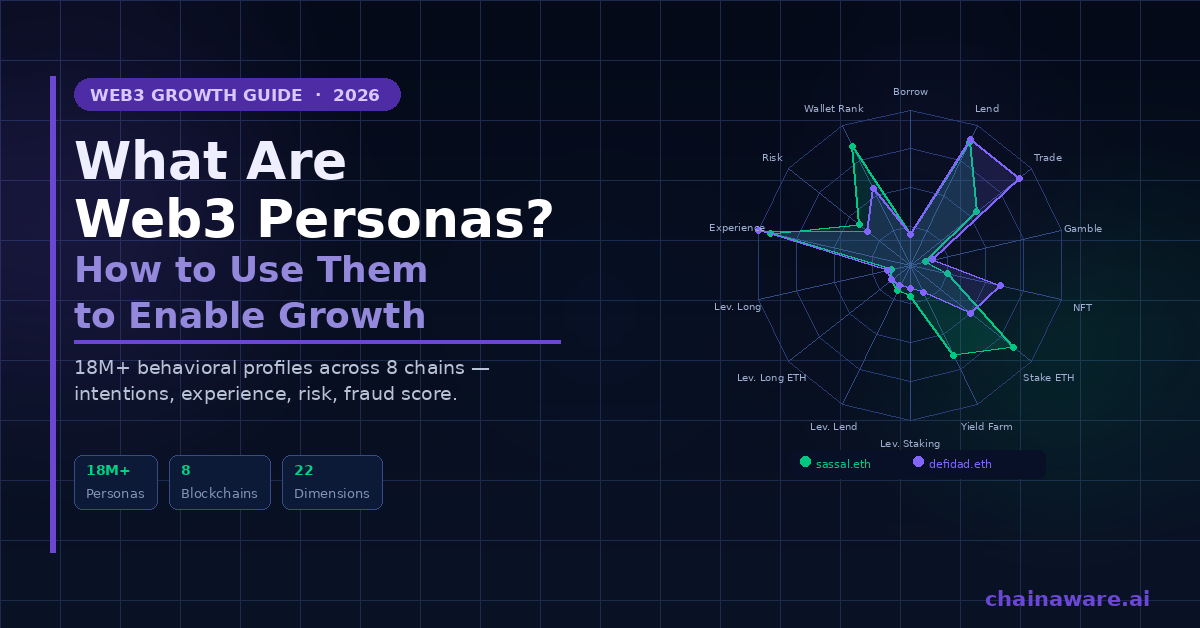
Every wallet address looks identical on the blockchain – a string of 42 hexadecimal characters. Behind each one, however, sits a completely different person: a sophisticated DeFi veteran with five years of complex protocol interactions, a curious newcomer trying their first swap, a yield farmer running capital across twelve chains simultaneously, or a speculative memecoin trader chasing the next 100x. Your DApp receives all of them with the same landing page, the same onboarding flow, and the same call to action. That is why 90% of connected wallets never transact. In 2026, there is a better approach.
ChainAware’s Web3 Personas solve the identity problem that has limited Web3 growth since the beginning. By analyzing the complete on-chain behavioral history of any wallet address, ChainAware calculates who the person behind that address actually is – their behavioral intentions, experience level, risk appetite, and predicted next actions. With 18M+ Web3 Personas already calculated across 8 blockchains, the intelligence layer needed to run 1:1 personalized growth at scale already exists. This guide explains how it works and, more importantly, how to use it.
In This Guide
- What Is a Web3 Persona?
- The Dimensions: What ChainAware Calculates for Every Wallet
- The Spider Chart: Visualizing Identity on a Multi-Dimensional Map
- Real Examples: sassal.eth and vitalik.eth
- The Web3 Growth Problem Personas Solve
- Growth Agents: Deploying Personas as 1:1 Personalization
- Wallet Auditor: Free Persona for Any Address
- Web3 User Analytics: Persona Distribution of Your DApp Users
- Token Rank: Personas Applied to Token Holder Quality
- Developer Access: MCP and Open-Source Agents
- Web3 Persona Dimensions Reference Table
- FAQ
What Is a Web3 Persona?
A Web3 Persona is ChainAware’s calculated behavioral profile of who is behind a wallet address. It answers the question that every DApp, protocol, and growth team needs answered but currently cannot: who is this user, what do they want, and what are they likely to do next?
In Web2, understanding your user requires cookies, form submissions, survey data, and demographic proxies – none of which work in a pseudonymous blockchain environment. Web3, however, provides something far more powerful: a complete, immutable, publicly verifiable record of every financial decision that wallet has ever made. Every protocol interaction, every token swap, every liquidity provision, every leverage position, every NFT purchase – all of it is permanently recorded on-chain. ChainAware reads that history across 8 blockchains, applies its predictive AI models trained on 18M+ wallet profiles, and produces a rich behavioral persona that describes the real person behind any address.
Why Personas Are More Powerful Than Web2 User Profiles
Web2 user profiles are constructed from inferred data – cookies approximate browsing behavior, purchase history suggests interests, demographic segments proxy for individual preferences. Web3 Personas, by contrast, come from actual financial decisions made with real money at real cost. A wallet’s on-chain history is not browsing behavior – it is a complete record of consequential actions. Every transaction cost gas fees to execute. Every protocol interaction required the user to actively sign a transaction. Every leverage position involved real capital at real risk. Consequently, the behavioral signal quality in on-chain data is dramatically higher than any Web2 proxy – and it requires no cookies, no KYC, and no privacy invasion to access. For the full comparison of Web2 and Web3 data as marketing intelligence, see our Behavioral User Segmentation guide and our Web3 User Segmentation guide.
The Dimensions: What ChainAware Calculates for Every Wallet
A Web3 Persona is not a simple score or category – it is a multi-dimensional profile that captures distinct aspects of a wallet’s behavioral identity. ChainAware calculates the following dimensions for every address across its supported blockchains.
Behavioral Intentions (High / Medium / Low)
The intentions dimension is the most powerful for growth use cases because it answers “what is this user most likely to do on your platform next?” ChainAware calculates probability levels – High, Medium, or Low – for each of the following intention categories:
- Borrow – probability of taking a DeFi loan in the near future
- Lend – probability of providing capital to a lending protocol
- Trade – probability of executing token swaps on DEXes
- Gamble – probability of engaging with high-risk speculative positions
- NFT – probability of purchasing, minting, or trading NFTs
- Stake ETH – probability of ETH staking activity
- Stake Yield Farm – probability of yield farming across protocols
- Leveraged Staking – probability of leveraged staking positions
- Leveraged Staking ETH – probability of leveraged ETH-specific staking
- Leveraged Lending – probability of leveraged lending strategies
- Leveraged Long ETH – probability of leveraged long ETH positions
- Leveraged Long Game – probability of leveraged long gaming/metaverse positions
These intention probabilities are calculated from behavioral patterns in the wallet’s full transaction history – not from the most recent transactions alone, but from the complete pattern of engagement across all supported chains. A wallet that has borrowed on three lending protocols and repeatedly repaid and reborrowed has a High Borrow intention. A wallet that has never touched a leverage product and consistently holds conservative positions has a Low Gamble intention. These signals are objective, verifiable, and far more reliable than any self-reported preference data. For how intentions drive personalization in practice, see our Intention-Based Marketing guide.
Experience, Risk, and Identity Dimensions
Beyond intentions, ChainAware calculates the following profile dimensions that together describe who this wallet owner is as a Web3 participant:
- Experience Level – overall sophistication from blockchain transaction patterns (Beginner / Intermediate / Advanced / Expert)
- Willingness to Take Risk – behavioral risk appetite derived from historical position sizes and protocol complexity
- Categories Used – which DeFi categories this wallet has engaged with (Lending, DEX, Staking, Gaming, NFT, Bridges, etc.)
- Protocols Used – specific protocols interacted with across all supported chains
- Wallet Rank – ChainAware’s composite reputation score reflecting the overall quality and trustworthiness of the address
- Wallet Age – how long the address has been active on-chain
- Transaction Numbers – volume of on-chain interactions indicating engagement depth
- Balance – current asset holdings as a proxy for capital capacity
- Predicted Fraud Probability – AI-calculated likelihood of this address engaging in fraudulent activity (98% accuracy, backtested on CryptoScamDB)
- AML / OFAC / Sanctions Attributes – compliance screening flags for regulatory requirements
Together, these dimensions paint a complete picture of the person behind any wallet address – their capability, their history, their intentions, and their trustworthiness. For the complete Wallet Rank methodology and what each dimension represents, see our Wallet Rank guide and our Wallet Auditor guide.
The Spider Chart: Visualizing Identity on a Multi-Dimensional Map
The most intuitive way to understand a Web3 Persona is to imagine every Web3 user plotted on a spider chart – sometimes called a radar chart – where each axis of the spider web represents one of the persona dimensions. Experience sits on one axis. Risk willingness sits on another. Each intention category occupies its own axis. The result is a unique geometric shape for every wallet address – no two wallets produce identical spider charts, and the shape immediately communicates who this person is as a Web3 participant.
Why the Spider Chart Makes Differences Visible
Consider two wallets arriving at the same DeFi lending platform. Wallet A has a spider chart that extends far out on the Borrow, Lend, and Experience axes – and barely registers on Gamble or NFT. Wallet B has a completely different shape: high on NFT and Trade, low on Lend and Stake ETH, medium on Gamble. Both wallets look identical from the platform’s perspective if you only see “wallet connected.” Their spider charts tell a completely different story. Wallet A is an experienced DeFi lending user who will likely convert if shown relevant lending content immediately. Wallet B is an NFT-focused trader who may be exploring lending for the first time – and needs a completely different first experience if they are going to convert at all. Serving identical content to both produces low conversion for both. Serving persona-matched content produces dramatically higher conversion for each. For the SmartCredit.io case study documenting exactly this result, see our SmartCredit Case Study.
Real Examples: sassal.eth and vitalik.eth
Abstract explanations of multi-dimensional behavioral profiles become concrete the moment you apply them to real, well-known wallet addresses. ChainAware has calculated Web3 Personas for both sassal.eth (prominent Ethereum educator and content creator) and vitalik.eth (Ethereum co-founder). The resulting spider charts illustrate how dramatically different two highly experienced Web3 participants can be in their behavioral profiles – and why treating them identically as “experienced DeFi users” misses the most important distinctions.
sassal.eth – Experienced Educator Profile
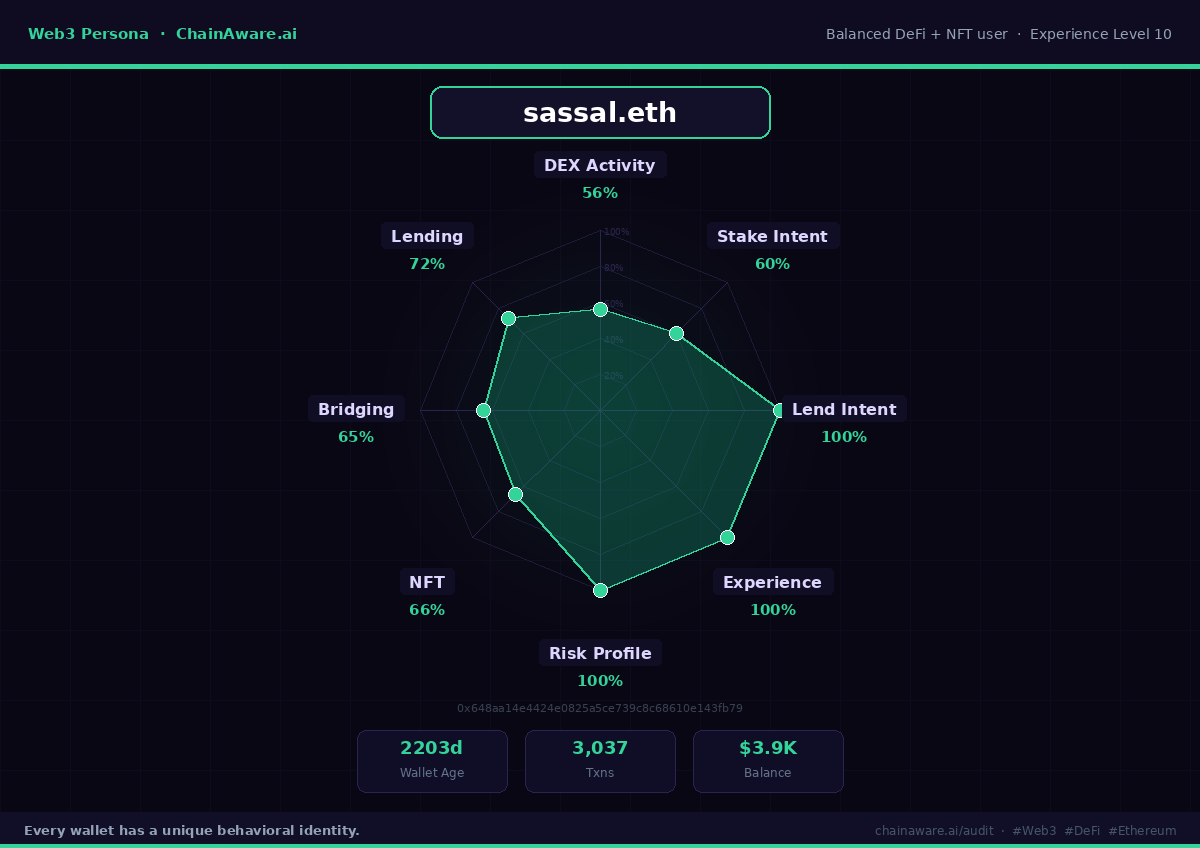
sassal.eth’s persona reflects an experienced, education-focused Ethereum participant. The profile shows strong engagement with ETH staking and established lending protocols – consistent with a long-term Ethereum holder who interacts with the ecosystem thoughtfully rather than speculatively. The Gamble and Leveraged Long dimensions are notably low, reflecting a risk-conscious behavioral pattern that matches public content about measured, educational DeFi engagement. If sassal.eth connects to a DeFi protocol, the Growth Agent serving their session should immediately surface staking options, established lending pools, and educational content – not high-risk leverage products or speculative memecoin exposure.
vitalik.eth – Unique Founder Profile
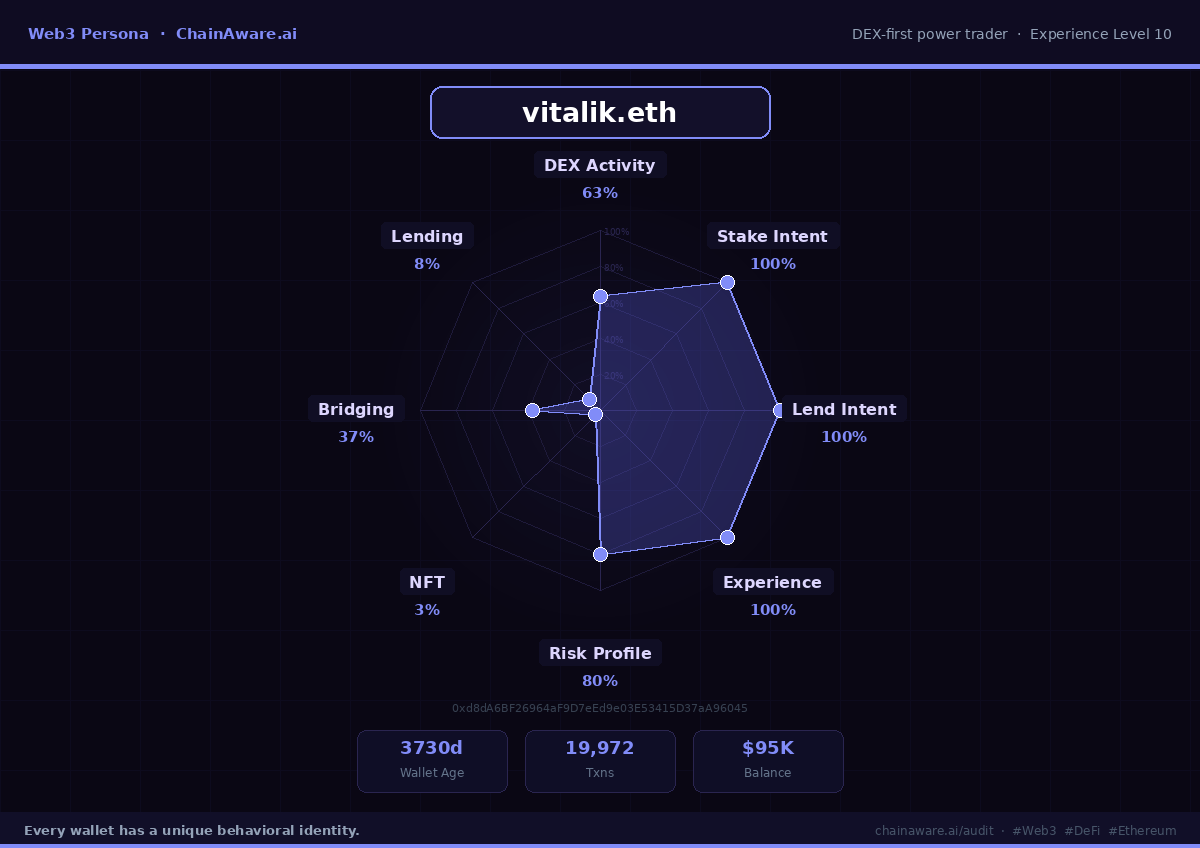
vitalik.eth’s persona shape is unlike any other – reflecting the singular nature of the Ethereum co-founder’s on-chain behavioral history. Maximum experience level across every dimension reflects a wallet that has interacted with virtually every category of DeFi, NFT, and ecosystem activity since the earliest days of the network. The specific intention distribution, however, shows clear behavioral patterns that distinguish this address from a generic “experienced user” classification. The spider chart makes those distinctions immediately visible in a way that a simple score or category label never could. For each of these addresses, a one-size-fits-all content experience would be significantly worse than a persona-matched one.
See Any Wallet’s Full Persona – Free
ChainAware Wallet Auditor – Complete Web3 Persona in Under 1 Second
Paste any wallet address and get the complete persona: experience level, risk appetite, all intention probabilities, fraud probability, AML status, Wallet Rank, and behavioral categories. Free. No wallet connection. No signup. Try your own address or any address you’re curious about – including the examples above. Full documentation at the Wallet Auditor learn page.
The Web3 Growth Problem Personas Solve
Web3 growth is broken. The numbers are stark: acquiring one transacting DeFi user costs between $300 and $1,000 – ten to twenty times the equivalent cost in Web2. For every 200 visitors who reach a DeFi protocol, roughly ten connect their wallet. Of those ten, only one transacts. That 0.5% end-to-end conversion rate is not an anomaly – it is the Web3 industry average. The standard response is to spend more on acquisition: bigger airdrop budgets, more KOL campaigns, higher liquidity mining emissions, more aggressive paid ads. None of these tactics address the actual problem. For the full architecture of how Agentic User Onboarding routes wallets automatically at connection based on their persona, the learn documentation covers the complete system.
Why Standard Growth Tactics Fail
Airdrops attract wallet farmers who claim tokens and leave. KOL campaigns generate traffic from audiences that have no behavioral affinity for the protocol. Liquidity mining attracts mercenary capital that exits the moment a better rate appears elsewhere. Paid ads deliver undifferentiated traffic with no targeting precision beyond basic demographic proxies. All four approaches share the same fundamental failure: they bring wallets to a platform that then treats every single one identically. A sophisticated DeFi veteran and a first-time wallet holder arrive at the same landing page. Both see the same headline, the same features list, the same call to action. The DeFi veteran finds nothing compelling enough to action immediately. The newcomer finds the experience confusing. Both leave without transacting. The acquisition spend is wasted on both. For the full analysis of why Web3 marketing channels fail and what the alternative looks like, see our Why Web3 KOL Marketing Fails guide and our DeFi Onboarding guide.
The Conversion Gap Personas Close
Web3 Personas shift the intervention point from acquisition to conversion – the moment immediately after wallet connection when the user is on the platform and engaged. The moment a wallet connects, ChainAware calculates their full persona in under a second. That persona determines everything about the experience they receive: which product the platform highlights first, which CTA appears in the hero section, which risk level is shown by default, which educational content is surfaced, which social proof is relevant. A High Borrow intention wallet arriving at a lending platform immediately sees borrow rates, available collateral options, and a “Borrow Now” CTA. A High Stake Yield Farm intention wallet arriving at the same platform sees yield options, APY comparisons, and “Start Earning” messaging. Neither wallet needed to self-identify or complete a survey – their behavioral history told the platform everything it needed to know. For the detailed conversion mechanics and how resonating content produces measurable results, see our Web3 Personas Personalized Marketing guide.
Growth Agents: Deploying Personas as 1:1 Personalization
Understanding personas is the intelligence layer. ChainAware’s Growth Agents are the deployment layer that translates persona intelligence into personalized user experiences automatically, at scale, without any manual configuration per user.
How Growth Agents Work – Like Google AdWords for Your DApp
Think of Growth Agents as the Web3 equivalent of Google AdWords – but running inside your own DApp interface rather than on Google’s ad network. Google AdWords works by matching ad content to user intent signals (search queries) and serving the most relevant ad automatically. ChainAware Growth Agents work by matching DApp content to wallet behavioral signals (the Web3 Persona) and serving the most resonating content and CTAs automatically. The mechanism integrates directly into your DApp UI with a lightweight JavaScript snippet – comparable to adding Google Tag Manager or any analytics pixel. When a user connects their wallet, the agent reads the wallet address, queries ChainAware’s Prediction MCP for the full persona in milliseconds, and dynamically adjusts the content visible to that specific user before they see anything. The user sees a platform that feels built for them. They never know personalization is happening. Conversion rates increase because the content resonates. For the SmartCredit.io documented case of this working in production, see our case study.
What the Agent Personalizes
Growth Agents can personalize any content element that is driven by the DApp’s frontend: hero section headlines and sub-copy, featured product or pool recommendations, CTA button text and destination, risk level displayed by default, educational content surfaced in onboarding flows, notification messaging, and promotional banners. Every element responds to the wallet’s persona dimensions. A wallet with High Experience and High Leverage Long ETH sees advanced product options immediately. A wallet with Low Experience and Low Risk sees simplified entry-level options with educational context. Neither wallet had to tell the platform anything – their blockchain history told the agent everything. For the technical architecture of how Growth Agents integrate with DApp frontends, see our AI Agent Personalization guide and our Web3 Agentic Economy guide.
Autonomous, Continuous, Self-Learning
Growth Agents run autonomously once deployed – no manual configuration per user, no campaign management overhead, no A/B test scheduling. The agent handles every wallet connection independently, calculating and serving persona-matched content in real time. As ChainAware’s behavioral models update with new on-chain data, the persona calculations improve automatically. This means the personalization quality improves continuously without requiring the DApp team to do anything. Founders and growth teams redirect the time they previously spent manually configuring targeting rules toward higher-value strategic work – exactly the founder bandwidth argument that drives Web3’s coming innovation wave. For the unit economics of why this reduces effective acquisition cost, see our Unit Costs guide and our Crossing the Chasm guide.
Know Your Users Before You Spend Another Dollar on Acquisition
ChainAware Web3 User Analytics – Free Persona Distribution in 24 Hours
Add 2 lines of Google Tag Manager code to your DApp. Within 24 hours, see the full persona distribution of your connecting wallets – experience levels, risk profiles, intention segments, behavioral categories. Understand who is actually showing up before deciding how to talk to them. Free forever. No developer resources required. Full guide at the Web3 User Analytics learn page.
Wallet Auditor: Free Persona for Any Address
The Wallet Auditor is ChainAware’s free individual-user tool for accessing the full Web3 Persona of any wallet address. Paste any Ethereum, BNB, BASE, POLYGON, TON, or HAQQ address and receive the complete persona output: experience level, risk willingness, all intention probability scores, behavioral categories used, protocols interacted with, Wallet Rank, wallet age, transaction count, balance context, fraud probability, and AML/OFAC screening status. No signup required. No wallet connection needed. The full persona appears in under a second.
Who Uses the Wallet Auditor
The Wallet Auditor serves multiple audiences. Individual users check their own wallets to understand what their on-chain history says about them – and to verify their Wallet Rank before using it as a trust signal. DeFi participants check counterparty wallets before large transactions, partnerships, or delegate decisions. KOL teams audit influencer wallets before paying for promotions – a KOL whose wallet shows no genuine DeFi engagement is a mass marketer, not a genuine community builder. DAOs audit delegate and governance participant wallets to verify that voting power holders have meaningful on-chain experience. Security teams check sender wallets when receiving unexpected tokens or unusual transaction requests. For the complete Wallet Auditor feature breakdown, see our Wallet Auditor guide. For how Wallet Rank functions as a portable Web3 reputation credential, see our Wallet Rank guide. According to CoinMarketCap’s Web3 wallet overview ↗, the number of active Web3 wallets continues growing rapidly – making persona-based wallet intelligence an increasingly critical layer for navigating interactions with unknown addresses.
Web3 User Analytics: Persona Distribution of Your DApp Users
While the Wallet Auditor provides individual persona lookups, Web3 User Analytics scales the same intelligence to the entire connecting user base of a DApp. The setup requires adding two lines of JavaScript to your DApp via Google Tag Manager – comparable to installing any analytics pixel. Within 24 hours, ChainAware’s analytics dashboard shows the complete persona distribution of every wallet that has connected to the platform: what percentage are High Experience vs Beginner, what the dominant intention profiles are, what risk appetite distribution looks like, which behavioral categories are most common among your users.
From Blindness to Clarity in 24 Hours
Most DApp teams know how many wallets connected but nothing about who those wallets represent. Web3 User Analytics answers every question that wallet count cannot: Are most of your users experienced DeFi participants or newcomers? Do the majority have High Borrow intentions – or are they primarily yield farmers who will never use your lending product? What fraction carry fraud probability flags that suggest low-quality traffic? Are your KOL campaigns bringing genuinely high-quality users or airdrop farmers whose behavioral profiles show no long-term engagement patterns? These questions currently require expensive manual research – or remain permanently unanswered. ChainAware’s free analytics layer answers them automatically, continuously, with no engineering overhead beyond the initial GTM snippet. For the full analytics platform capabilities and what the dashboard shows, see our Web3 Marketing Analytics guide and our complete analytics guide. For why understanding your existing user base matters before optimizing acquisition, see our User Segmentation guide.
Token Rank: Personas Applied to Token Holder Quality
Token Rank applies Web3 Persona intelligence to a specific and critical investment problem: distinguishing genuine token communities from artificially inflated holder bases engineered to attract investment before a coordinated exit. Every token holder is a wallet address with a Web3 Persona. The Wallet Rank dimension of that persona reflects the quality and depth of that holder’s on-chain engagement history. Token Rank aggregates the Wallet Ranks of all token holders and produces a composite score for the token itself – reflecting the genuine quality of its community rather than the raw count of addresses holding it. For the complete Token & Community Intelligence use case, see the Token & Community Intelligence learn guide.
Why Token Rank Exposes Long Rug Pulls
The most sophisticated rug pulls in 2026 are not the obvious liquidity-drain-in-24-hours variety. Long rug pulls build artificial communities over months: they distribute tokens to thousands of freshly created wallet addresses with no transaction history, manufactured Telegram groups fill with paid shills, and the price chart looks healthy because the holder count is growing. Token Rank pierces this illusion because freshly created wallets have near-zero Wallet Ranks – they have no on-chain behavioral history, no protocol engagement, and no demonstrated DeFi participation. A token showing 50,000 holders but a low median Wallet Rank is not a genuine community – it is a network of dust wallets bought to manufacture the appearance of adoption. By contrast, a token with 5,000 holders but a high median Wallet Rank represents an authentic community of experienced, engaged Web3 participants who chose this token based on their own research. That distinction is the single most powerful signal for separating genuine projects from sophisticated fraud. For the complete Token Rank methodology and how to use it for due diligence, see our complete product guide. According to Immunefi’s Web3 security research ↗, exit scams remain the largest category of DeFi losses annually – and Token Rank directly addresses the pattern recognition that catches them.
Developer Access: MCP and Open-Source Agents
DApp teams and developers who want programmatic access to Web3 Persona data for building custom agent workflows have two primary integration paths: the Prediction MCP and the open-source pre-built agent library.
Prediction MCP: Natural Language Access to All Persona Dimensions
ChainAware’s Prediction MCP is an SSE-based Model Context Protocol server that exposes all persona dimensions to any AI agent or LLM via natural language queries. An agent asks “What is the behavioral profile of 0x123…abc?” and receives the complete persona – all intention probabilities, experience level, risk score, Wallet Rank, fraud probability, and AML status – in a single structured response in under a second. The MCP works with Claude, GPT, and any open-source LLM. Integration requires adding the MCP server configuration to the agent’s tool list – no custom API integration code, no blockchain parsing, no data pipeline. For the complete MCP integration guide and all five exposed tools, see our Prediction MCP guide and our 12 Blockchain Capabilities guide. For context on how the MCP standard is transforming AI agent data access across Web3, see our Blockchain Data Providers guide.
32 Open-Source Pre-Built Agents
For developers who want to deploy persona-powered agents without building from scratch, ChainAware publishes 32 MIT-licensed agent definitions on GitHub. Each agent integrates the Prediction MCP for persona access and implements a specific workflow – fraud detection, AML compliance, onboarding routing, marketing personalization, governance verification, DeFi intelligence, and more. Developers clone the relevant agent, configure it with their Prediction MCP credentials, and deploy. The growth agent that reads wallet personas and generates personalized DApp content is one of the 32 available agents – ready to integrate directly into any DApp’s frontend stack. For the full agent catalog and deployment instructions, see our Web3 Agentic Economy guide. According to Anthropic’s Model Context Protocol documentation ↗, MCP has rapidly become the standard for connecting AI agents to external data providers – making ChainAware’s MCP server compatible with the widest possible range of agent frameworks from day one.
Build Persona-Powered Agents Without Starting from Scratch
32 Open-Source Agents + Prediction MCP – Clone, Configure, Deploy
Every persona dimension – intentions, experience, risk, fraud probability, AML status – accessible via natural language through the Prediction MCP. 32 MIT-licensed pre-built agent definitions covering growth, compliance, fraud detection, governance, and DeFi intelligence. Works with Claude, GPT, and any LLM. No data pipelines to build.
Web3 Persona Dimensions Reference Table
| Dimension | What It Measures | Values | Primary Use Case |
|---|---|---|---|
| Borrow Intention | Probability of taking a DeFi loan | High / Medium / Low | Lending platform personalization |
| Lend Intention | Probability of providing capital | High / Medium / Low | Yield product targeting |
| Trade Intention | Probability of DEX trading activity | High / Medium / Low | DEX and trading platform routing |
| Gamble Intention | Probability of high-risk speculation | High / Medium / Low | Risk-appropriate product gating |
| NFT Intention | Probability of NFT activity | High / Medium / Low | NFT marketplace personalization |
| Stake ETH Intention | Probability of ETH staking | High / Medium / Low | Staking product surfacing |
| Stake Yield Farm | Probability of yield farming | High / Medium / Low | Yield protocol recommendations |
| Leveraged Staking | Probability of leveraged staking | High / Medium / Low | Advanced product eligibility |
| Leveraged Staking ETH | Probability of leveraged ETH staking | High / Medium / Low | LST protocol personalization |
| Leveraged Lending | Probability of leveraged lending strategies | High / Medium / Low | Advanced lending product targeting |
| Leveraged Long ETH | Probability of leveraged ETH long positions | High / Medium / Low | Leverage trading platform routing |
| Leveraged Long Game | Probability of leveraged gaming/metaverse positions | High / Medium / Low | GameFi protocol targeting |
| Experience Level | Overall DeFi sophistication from behavioral patterns | Beginner / Intermediate / Advanced / Expert | Onboarding flow complexity routing |
| Risk Willingness | Behavioral risk appetite from historical positions | Low / Medium / High | Default risk parameter setting |
| Categories Used | DeFi categories engaged with historically | Lending / DEX / Staking / NFT / Gaming / Bridge / etc. | Cross-sell and product discovery |
| Protocols Used | Specific protocols interacted with | Protocol list | Competitor analysis / partnership targeting |
| Wallet Rank | Composite reputation score | 0-100 | Trust assessment / airdrop quality / governance |
| Wallet Age | Time since first on-chain transaction | Days / years | Newcomer vs veteran differentiation |
| Transaction Numbers | Volume of on-chain interactions | Count | Engagement depth assessment |
| Balance | Current asset holdings | USD equivalent | Product tier routing |
| Fraud Probability | AI-calculated likelihood of fraudulent behavior | 0.00-1.00 (98% accuracy) | Security screening / compliance gating |
| AML / OFAC / Sanctions | Regulatory compliance flags | Clear / Flagged | MiCA compliance / VASP regulatory screening |
Frequently Asked Questions
How does ChainAware calculate Web3 Personas without knowing who the person is?
ChainAware never attempts to identify the individual behind a wallet address – and does not need to. Instead, it analyzes the complete on-chain transaction history of the address across 8 blockchains, applying predictive AI models trained on 18M+ wallet profiles to classify behavioral patterns. A wallet that has borrowed, repaid, and reborrowed across multiple lending protocols produces a strong Borrow Intention signal – regardless of who owns it. The behavioral pattern is the signal; the identity is irrelevant. This approach preserves user anonymity completely while producing behavioral intelligence that is more accurate than identity-based profiling because it reflects actual financial decisions rather than demographic proxies.
How are 18M+ Web3 Personas already calculated?
ChainAware continuously analyzes the on-chain activity of wallet addresses across ETH, BNB, BASE, POLYGON, TON, TRON, HAQQ, and SOL – building and updating persona profiles for every address that has meaningful on-chain history. The 18M+ figure represents wallets with sufficient transaction history to produce reliable persona classifications. As blockchain activity continues growing and new wallets accumulate behavioral history, the covered population expands automatically. The models retrain continuously on new behavioral data, which means persona quality improves over time without requiring any action from DApp teams using ChainAware’s tools.
Can Web3 Personas be wrong or manipulated?
No behavioral model is 100% accurate – and ChainAware’s models are designed with specific accuracy metrics and confidence thresholds that reflect real-world performance. The fraud probability dimension, for example, carries 98% accuracy validated against CryptoScamDB using an independent test set. For intention dimensions, the models are trained on historical behavioral patterns and are regularly validated against observed user actions. Regarding manipulation: unlike Web2 profile data that can be easily fabricated with fake accounts or purchased behavioral data, on-chain transaction history requires real gas fees and real time to generate. Manufacturing a sophisticated behavioral profile is expensive and detectable – the cost and time required to fake extensive DeFi engagement patterns makes manipulation economically irrational at scale. According to a16z crypto’s research on on-chain behavioral data ↗, blockchain transaction data provides unusually high-quality behavioral signal precisely because each action has real economic cost attached.
How do Web3 Personas differ from basic wallet analytics tools?
Basic wallet analytics tools show what happened – transaction history, token balances, protocol interactions, NFT holdings. Web3 Personas show who the person is and what they will do next – behavioral classifications, intention probabilities, risk profiles, and forward-looking predictions. The distinction is the difference between reading a bank statement and understanding a customer. A bank statement tells you what transactions occurred; a behavioral profile tells you what kind of financial actor this person is and what they are likely to need from your product. Web3 Personas convert raw on-chain data into actionable growth intelligence – the layer that makes 1:1 personalization possible without requiring wallets to self-identify. For how this compares to other analytics approaches, see our Web3 Analytics Tools comparison.
What is the fastest way to start using Web3 Personas for growth?
The fastest path is the free Web3 User Analytics tier – add two lines of GTM code to your DApp and see the full persona distribution of your users within 24 hours. This costs nothing and requires no engineering resources beyond the GTM snippet. The next step is integrating ChainAware’s Growth Agents into your DApp frontend to activate persona-driven personalization at wallet connection – this turns the analytics insight into a conversion improvement immediately. For teams building custom workflows, the Prediction MCP gives any AI agent instant access to all persona dimensions via natural language query. All three paths start with understanding who your users already are before optimizing how you talk to them.
Sources: CoinMarketCap – Web3 Wallets Overview ↗ · Immunefi – Web3 Security Research ↗ · Anthropic – Model Context Protocol ↗ · a16z Crypto – On-Chain Behavioral Data Research ↗ · FATF – Virtual Assets Recommendations ↗