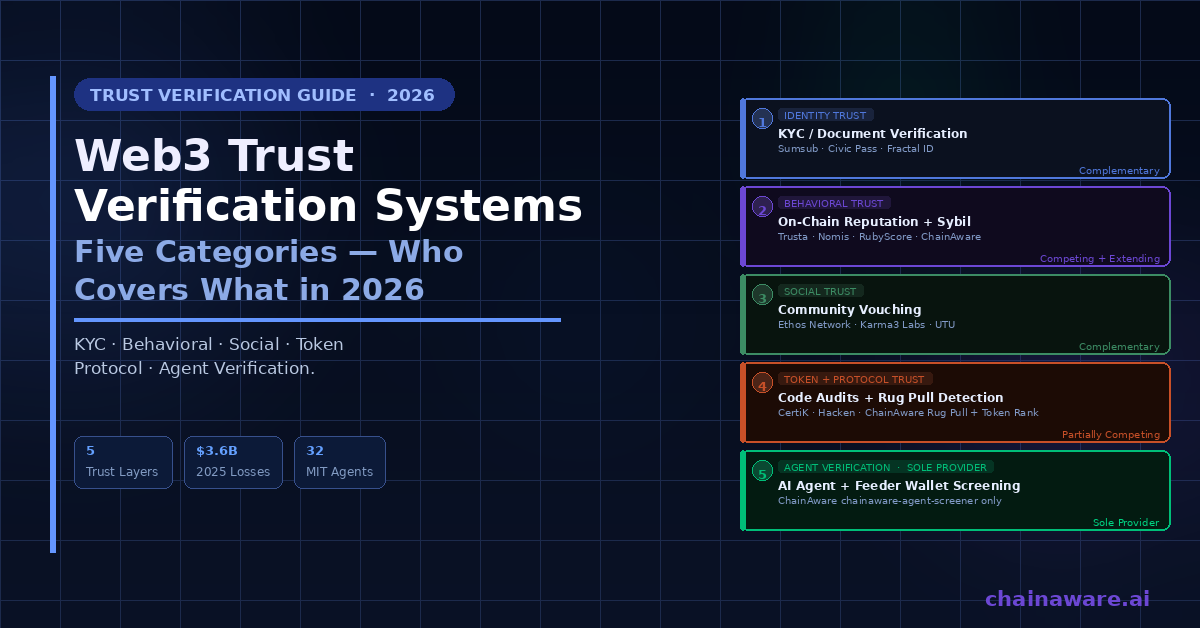
Web3 Trust Verification Systems in 2026 — The Complete Five-Category Landscape

Web3 lost over $3.6 billion to fraud in the first three quarters of 2025 — and 57.8% of those losses came not from smart contract bugs but from access-control failures. Trust in Web3 is not one problem. It is five distinct problems requiring five distinct solutions, and most protocols are only covering one.

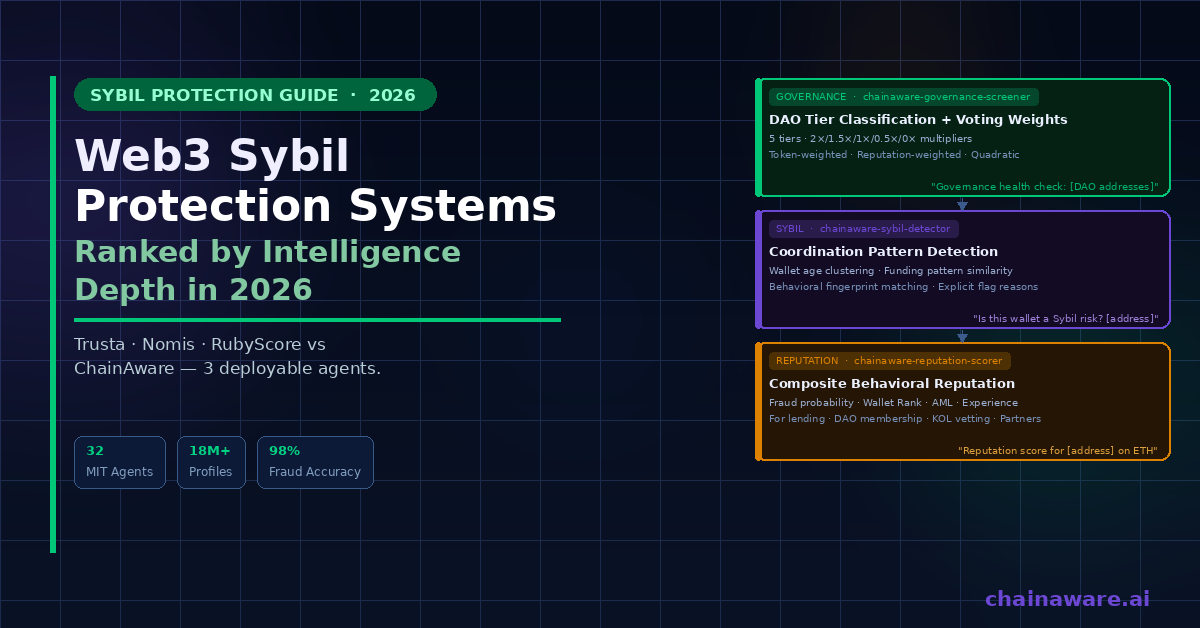
Web3 Sybil Protection Systems in 2026 — On-Chain Behavioral Providers Ranked and Compared

Sybil attacks cost Web3 protocols billions annually in fake airdrop claims, manipulated governance votes, and inflated engagement metrics. This guide ranks and compares every major on-chain behavioral Sybil protection provider in 2026 — from GNN/RNN graph detection to behavioral scoring — and explains where each approach works and where it falls short.

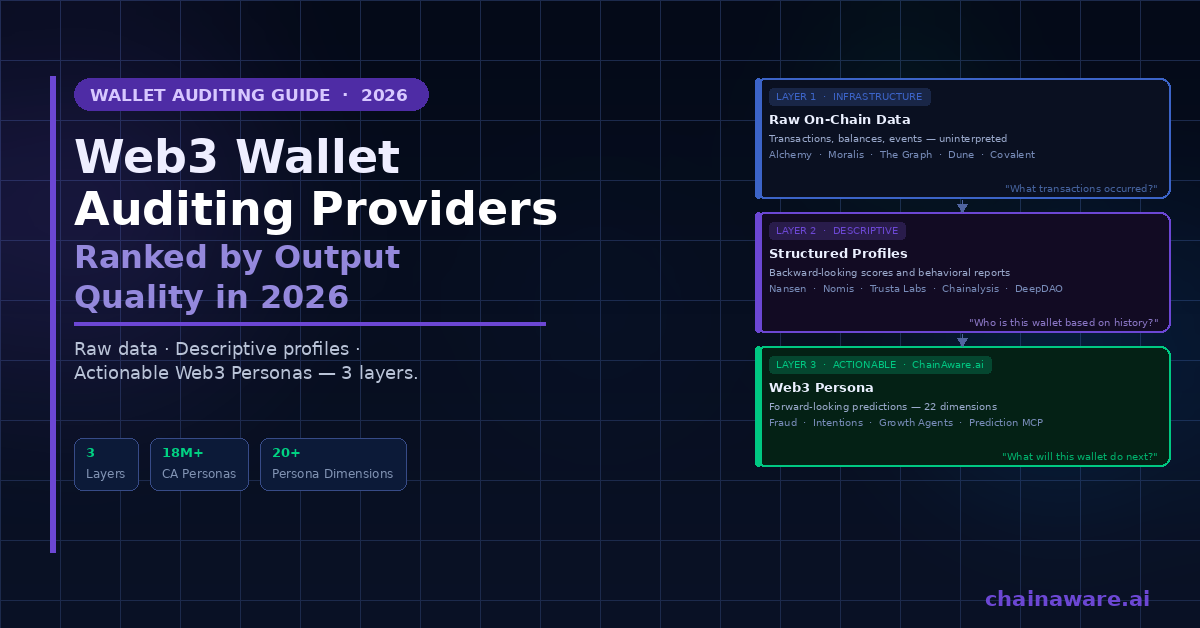
Web3 Wallet Auditing Providers in 2026 — From Raw Blockchain Data to Actionable Web3 Personas

Every wallet address that connects to your DApp carries a complete behavioral history. In 2026, three distinct layers of wallet auditing infrastructure have emerged — raw data, descriptive profiles, and actionable predictions — and confusing them leads to selecting the wrong tools for the job.

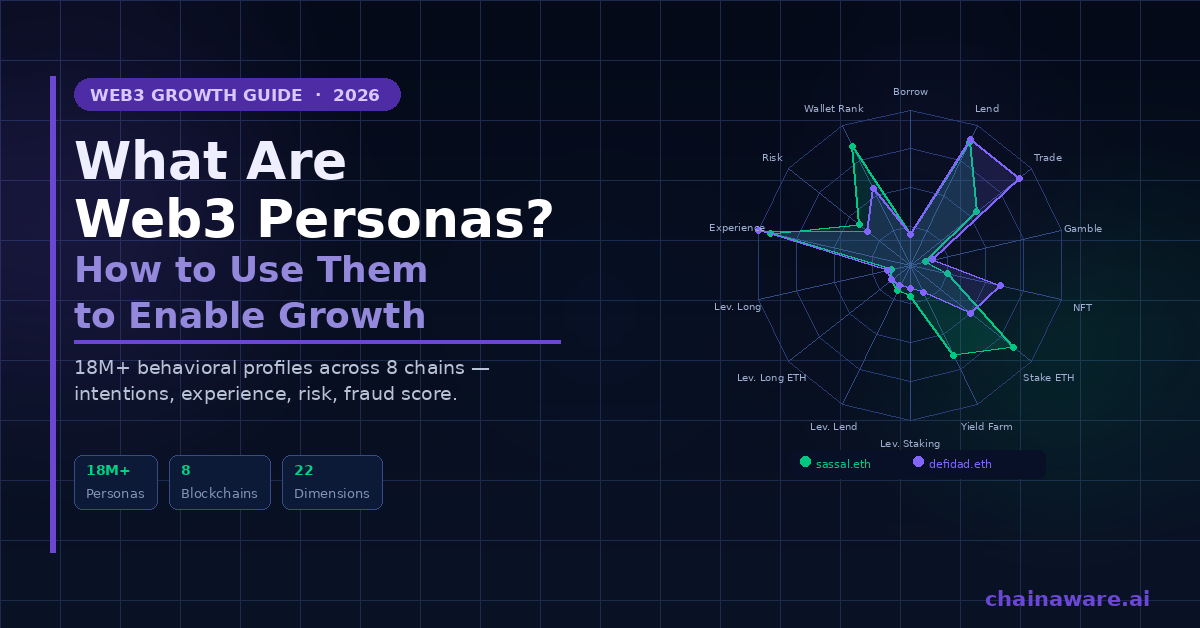
What Are Web3 Personas? How to Use Them to Enable Your Growth — Complete Guide 2026

A Web3 Persona is a calculated behavioral profile of who is behind any wallet address — their intentions, experience level, risk appetite, and predicted next actions. This guide explains what they are, how ChainAware builds 18M+ of them across 8 blockchains, and how DApps use them to enable real growth.

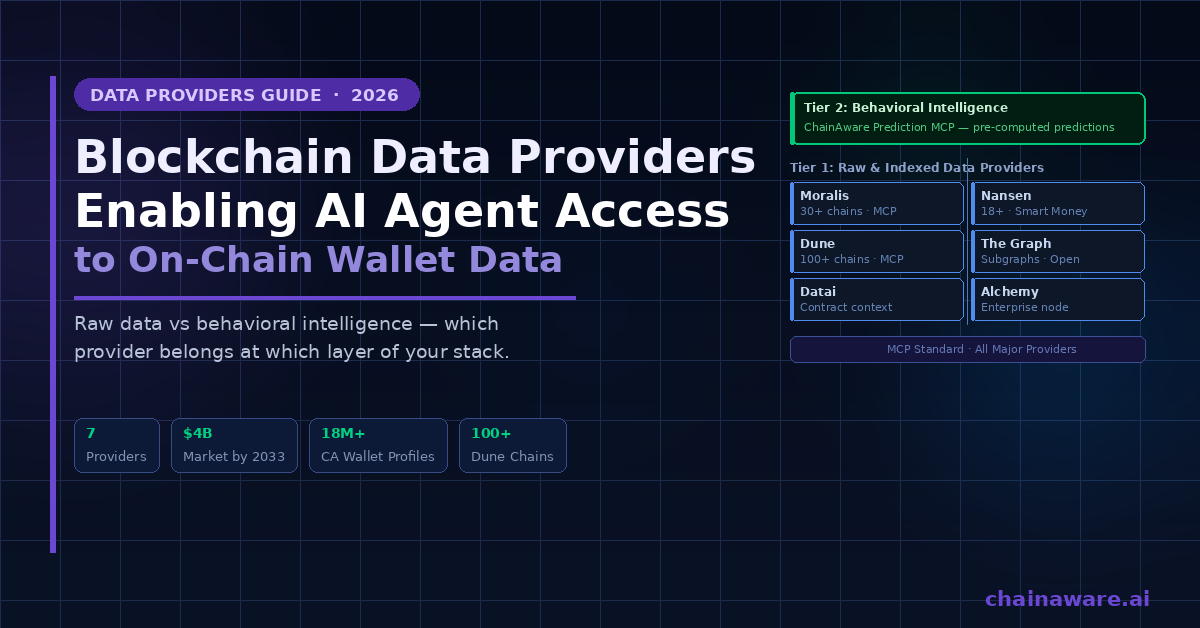
Blockchain Data Providers Enabling AI Agent Access to On-Chain Wallet Data — Complete Guide 2026

AI agents need on-chain wallet data to make intelligent decisions — but most blockchain data providers were built for human analysts, not autonomous systems. This guide maps every major provider enabling AI agent access to wallet data in 2026, from raw indexers to pre-computed behavioral intelligence layers.

Best Web3 Governance Screeners in 2026 — Detect DAO Governance Attacks Before They Drain Your Treasury

$21.4 billion in liquid DAO treasury assets sits exposed to governance attacks. One malicious proposal can drain a treasury in a single block — as Beanstalk proved with $181M lost in 2022. This guide covers every major Web3 governance screener in 2026 and how to detect attacks before they execute.

Best Web3 Rug Pull Detection Tools in 2026 — Ranked & Compared

Rug pulls cost investors $3 billion annually. 95% of PancakeSwap pools end in rug pulls. 99% of Pump.fun tokens extract money from buyers. This guide ranks and compares every major Web3 rug pull detection tool in 2026 — ChainAware, GoPlus, Token Sniffer, De.Fi Scanner, RugCheck, Webacy, and QuillCheck.

Web3 Reputation Score Comparison 2026: Nomis vs RubyScore vs Ethos vs Cred Protocol vs UTU vs ChainAware

Web3 reputation scoring in 2026 compared across 7 platforms: Nomis, RubyScore, Ethos Network, Cred Protocol, UTU Trust, Whitebridge, and ChainAware. Most platforms measure activity. ChainAware is the only one that incorporates predictive fraud probability into the formula — producing an actionable 0–4000 score requiring no user action and callable by any smart contract or AI agent.

The Web3 Agentic Economy: How AI Agents Are Replacing Web3 Growth Teams

AI agents are replacing compliance officers, growth teams, and fraud analysts across Web3. This guide covers how the agentic economy works, which human functions are being automated first, and how ChainAware’s 32-agent infrastructure — fraud detection, AML scoring, rug pull detection, wallet ranking, growth targeting — powers the shift on 8 blockchains.

12 Blockchain Capabilities Any AI Agent Can Use (MCP Integration Guide)

Any AI agent — Claude, GPT, or custom LLM — can access 20M+ wallet behavioral profiles, 98% fraud prediction, real-time AML screening, and token holder analysis via ChainAware’s MCP integration. This guide covers all 12 blockchain capabilities, how to connect in minutes, and which agent definition to use for each use case.