
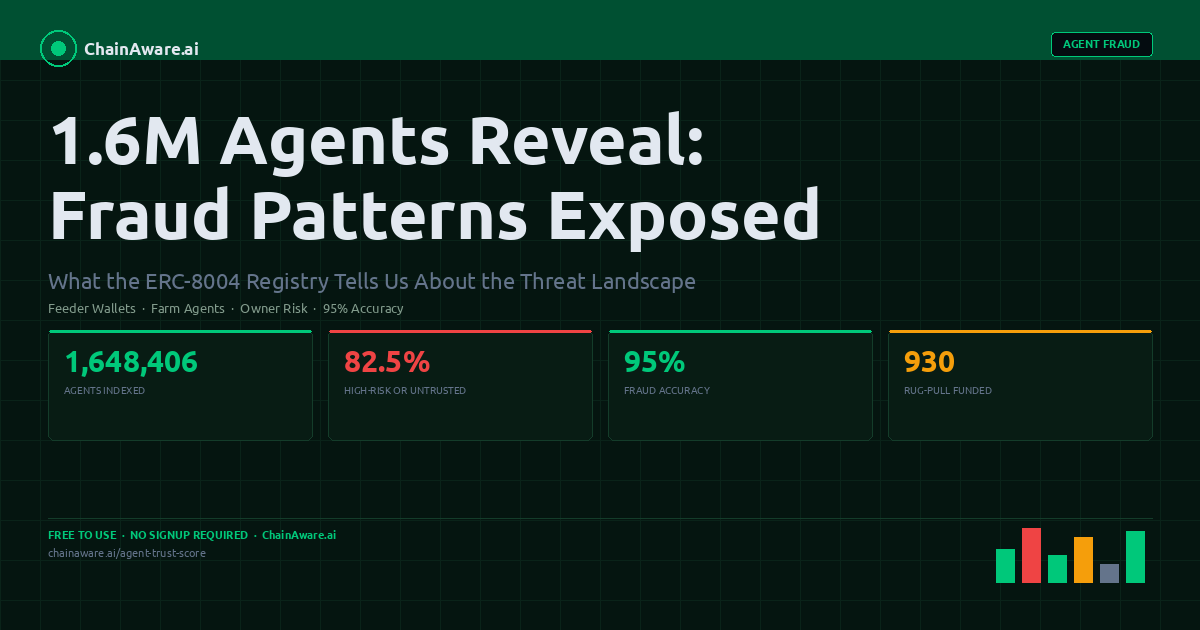
When ChainAware.ai began indexing ERC-8004 agent registrations across eight chains, the goal was straightforward: build a trust layer for the emerging agentic economy. What the resulting dataset revealed was something more unsettling. Across 1,648,406 registered agents, the dominant patterns are not innovation or adoption — they are fraud, obfuscation, and systematic exploitation of a registration standard that most platforms are not yet equipped to scrutinize.
This article is a data-driven breakdown of that index. Every statistic cited here comes directly from ChainAware’s live agent trust scoring pipeline, which evaluates each registered agent against a multi-signal framework covering funding chain provenance, owner history, wallet behavior, delegation patterns, and cross-chain correlation. The numbers are not estimates or extrapolations — they reflect the state of the ERC-8004 registry as it stands today To pull a full trust profile for any individual registered agent, teams can use the agents_trust_score_single tool for a 0-1000 score and trust flags. For organizations building the internal controls to act on findings like these, our guide to an enterprise know-your-agent compliance stack outlines the operational layers involved., and they tell a story that every platform builder, protocol integrator, and AI agent marketplace operator needs to understand before the next deployment wave arrives.
The five patterns described below are not isolated anomalies. Because registration activity is concentrated on certain networks, our breakdown of why Base Chain leads ERC-8004 agent trust scoring offers useful chain-level context for these patterns. They are structural features of how bad actors are approaching the agent registration ecosystem. Platforms looking to surface these risk concentrations can use the agents_trust_score_list tool to filter all registered agents by trust tier. Understanding them as patterns — rather than individual incidents — is what separates reactive fraud response from genuine threat intelligence. Operators who need to screen many linked wallets at once can apply the predictive_fraud_batch tool for scoring multiple wallet addresses in one call. The economic stakes of getting this right are explored in our analysis of agent trust economy market sizing through 2030. ChainAware.ai was named in the CB Insights AI Fraud Prevention Market Map for this exact capability.
For context on how the broader fraud prevention category is being mapped by analysts, see our coverage of how CB Insights positions AI fraud prevention in Web3.
That distinction is what this index was built to enable.Pattern 1: The Funding Chain Problem
The single largest flag in the entire dataset is not a fraud signal — it is an absence of signal. Of the 1,648,406 agents indexed, 1,107,688 carry the FEEDER_UNKNOWN flag, representing 67.2% of the total population. This means that for more than two in three registered agents, ChainAware’s pipeline cannot resolve a trusted, verifiable source for the wallet that funded the agent’s creation transaction.
That opacity is not neutral. In traditional financial compliance, an inability to establish the origin of funds is itself a risk indicator. Compliance teams evaluating tooling for this kind of provenance tracing may also want to review alternatives to Chainalysis for DeFi compliance in 2026. The same principle applies in onchain agent ecosystems. When a wallet funds an agent registration but its own funding history leads to dead ends — mixers, intermediate throwaway wallets, or simply wallets with no resolvable history — the agent it creates inherits that opacity. Platforms that accept agent registrations without resolving feeder provenance are, in effect, accepting agents with unknown sponsorship.
The contrast with the FEEDER_CEX_VERIFIED population makes the scale of the problem concrete. Only 2,887 agents — 0.18% of the total index — were funded by wallets with verified centralized exchange withdrawal provenance. CEX-verified funding does not guarantee legitimacy, but it does establish a baseline of identity accountability. The fact that fewer than 3,000 agents out of 1.6 million meet even this modest standard of traceability is a structural problem, not a statistical curiosity.
Base chain illustrates the depth of the issue most starkly: 96.5% of agents deployed there have unresolved feeder provenance, with an average trust score of just 273.6 out of 1,000. The chain with the highest raw deployment volume is also the chain where funding chain risk is most pervasive. For platforms building on Base, treating feeder resolution as optional is not a defensible posture.
Pattern 2: Fraud Propagation Through Three Entry Points
Where the funding chain is not simply unknown but actively associated with prior fraud, ChainAware’s pipeline assigns one of three distinct flags depending on where in the agent’s ownership and funding graph the contamination originates. Together, these three flags cover 324,254 agents — nearly 20% of the total index — and they describe how fraud propagates through the ERC-8004 ecosystem via identifiable structural entry points.
FRAUD_FEEDER affects 116,083 agents (7.04%). This flag is assigned when the wallet that funded the agent registration transaction has a documented history of funding wallets associated with confirmed fraud events — rug pulls, wash trading operations, phishing infrastructure, or Sybil farming campaigns. The feeder wallet may not itself be the fraud actor, but it sits in the financial graph of one. That proximity is not incidental; funding relationships in onchain environments are deliberate choices.
FRAUD_OWNER affects 112,883 agents (6.85%). Here the contamination is more direct: the wallet designated as the agent’s owner has a fraud history attached to it in ChainAware’s cross-chain graph. Owner-level fraud flags represent cases where a known bad actor has taken explicit custody of an agent registration. These are not guilt-by-association signals — they are direct linkages between an agent and a wallet with documented malicious behavior.
FRAUD_WALLET affects 95,288 agents (5.78%). This flag captures cases where the agent’s registered wallet address — distinct from its owner — has fraud associations. This can occur when operators separate ownership and operational wallet roles, with fraud history attached to the operational layer rather than the declared owner.
What makes these three entry points analytically important is that they can appear independently or in combination. An agent carrying all three simultaneously represents a fraud propagation triple — a registration where the feeder, the owner, and the operational wallet all trace back to known bad actors. Platforms that filter on only one of these signals will miss agents that exploit the gaps between them.
Pattern 3: Fleet Fraud and Sybil Registration at Scale
Individual fraud is manageable. Fleet fraud — the coordinated registration of agents in bulk, designed to simulate organic adoption, capture platform incentives, or establish a volume-based credibility signal — is a structurally different threat. The FARM_DETECTED flag in ChainAware’s dataset identifies agents that exhibit the behavioral signatures of coordinated mass registration, and it covers 91,868 agents, or 5.57% of the total index.
The defining event in this category is what the data records as the Week 43 2026 spike. In a single week, 892,924 agent registrations were processed — a volume that dwarfs any other registration period in the dataset and that represents more than half of the entire current index. The source was a single coordinated batch operation associated with centralcity.ai, which accounts for 1,051,344 agents in total across the dataset, each carrying an average trust score of just 258 out of 1,000.
That average trust score is not a rounding error. It reflects a consistent pattern across more than a million registrations: agents funded by unresolved or fraud-adjacent wallets, with minimal operational history, registered in tight temporal clusters that are statistically inconsistent with organic deployment behavior. When more than 890,000 agents appear in a single week from a coordinated source, and the average trust score across all of them hovers near the bottom quartile, the registration activity cannot be characterized as legitimate ecosystem growth.
Fleet fraud of this scale creates specific downstream risks. It inflates apparent ecosystem size, potentially misleading investors, integrators, and regulators about the genuine adoption of agent standards. It consumes indexing and monitoring resources that would otherwise be allocated to scrutinizing genuinely novel registrations. And if platforms assign any trust or capability based on agent age or registration timestamp, mass-registered agents immediately inherit those benefits without the legitimacy that those signals are meant to represent.
The FARM_DETECTED methodology looks at temporal clustering, shared feeder wallet patterns, registration gas parameters, and cross-agent behavioral similarity. No single signal is conclusive, but the combination — particularly at the volumes seen in Week 43 — produces a high-confidence fleet fraud classification, as the weekly ERC-8004 tracker data documents on a continuing basis.
Pattern 4: Legacy Fraud Actors Entering the Ecosystem
Two flags in the dataset track a specific and concerning migration pattern: known fraud actors from prior onchain events who are now registering ERC-8004 agents. These are not new entrants to the broader blockchain ecosystem — they are actors with documented histories who are extending their operations into agent infrastructure.
FEEDER_RUG_HISTORY covers 930 agents whose funding wallets have documented involvement in rug pull events — projects that raised funds from users and then abandoned them, draining liquidity or treasury assets. These wallets have been active participants in some of the most damaging category of retail crypto fraud, and they are now channeling capital into agent registrations. The number 930 may seem small relative to the overall index, but each of these agents represents a direct financial link to a confirmed destructive event.
CREATOR_RUG_HISTORY is the more severe flag, covering only 55 agents, but these represent cases where the agent creator wallet — the entity that initiated the registration transaction and established the agent’s initial parameters — is itself the wallet that executed a prior rug pull. This is not funding adjacency or ownership proximity. This is the actual perpetrator of a prior fraud event registering new agents under the ERC-8004 standard.
The low absolute count of CREATOR_RUG_HISTORY agents should not be read as reassurance. Sophisticated fraud actors who have executed rug pulls understand that their primary wallets are compromised from a traceability standpoint. The 55 cases captured here likely represent operators who were either insufficiently careful about wallet hygiene or who were testing whether the ecosystem’s monitoring infrastructure would catch them. The cases that evade detection through proper operational security are the ones that make continued cross-chain graph analysis essential.
The broader implication of this pattern is that the ERC-8004 ecosystem is not insulated from the fraud history of the chains it runs on. Bad actors do not retire when a new standard emerges — they adapt. Agent platforms that do not incorporate historical fraud graph data into their trust assessments are offering a clean slate to actors who have not earned one.
Pattern 5: Delegation Obfuscation via EIP-7702
EIP-7702 introduced a mechanism that allows externally owned accounts to temporarily delegate execution authority to smart contract code. The intent is legitimate: it enables more flexible account abstraction patterns and improves the composability of agent-driven transaction flows. But in ChainAware’s dataset, 30,936 agents — 1.88% of the total index — carry the EIP7702_DELEGATED flag, and the pattern of how delegation is being used in this population raises specific concerns about obfuscation.
When an agent uses EIP-7702 delegation, the on-chain attribution of its actions becomes more complex. The delegating account initiates the transaction, but the execution logic — and by extension, the behavioral fingerprint — lives in the delegated contract. For fraud detection pipelines that rely on wallet-level behavioral history, delegation introduces a layer of indirection that can break attribution chains. An owner wallet with a clean history can delegate execution to a contract that implements behavior associated with known fraud patterns, without that owner wallet directly inheriting the behavioral flags.
This is not a theoretical concern. Within the EIP7702_DELEGATED population, ChainAware’s analysis identifies a subset where the delegation target contracts share bytecode patterns or deployment histories associated with previously flagged fraud infrastructure. The delegation mechanism is being used not to enable more sophisticated legitimate agent behavior, but to create a layer of separation between the agent’s registered identity and its actual execution environment.
For platform builders, the operational response to this pattern requires extending trust scoring beyond the agent’s registered owner and wallet to include the delegation target contract, its deployer, its deployment history, and any behavioral signals generated by prior invocations of that contract. EIP-7702 delegation is a feature of the ecosystem — but treating it as a trust-neutral operation, rather than a signal that requires additional scrutiny, is a monitoring gap that sophisticated actors are already exploiting.
What the Full Distribution Tells Us
When ChainAware aggregates all flag classifications into risk tiers, the distribution is unambiguous: 82.5% of all indexed agents fall into Elevated Risk or Untrusted categories combined. Only a minority of the 1,648,406 agents in the dataset can be characterized as operating with a trust profile that a responsible platform would accept without reservation.
Breaking this down by chain reveals meaningful structural differences that have direct implications for platform-specific risk posture. Base chain, with its 96.5% feeder unresolved rate and average trust score of 273.6, represents the highest-volume, lowest-trust deployment environment in the dataset. The combination of high registration velocity, dominant centralcity.ai batch activity, and pervasive feeder opacity makes Base the chain where automated trust gating is most urgently needed.
BSC tells a different story. With an average trust score of 484.6 — nearly double Base’s figure — BSC’s agent population skews toward registrations with more resolvable provenance and fewer fleet fraud signatures. This does not make BSC agents categorically safe; the absolute volume of fraud-flagged agents on BSC remains significant. But the cross-chain comparison reveals that the trust deficit is not uniformly distributed. Platforms operating across multiple chains need chain-specific risk calibration, not a single global threshold applied indiscriminately.
The 73.5% Elevated Risk figure — representing agents whose trust scores fall below 500 on ChainAware’s 1,000-point scale — is the number that should anchor platform risk conversations. When nearly three-quarters of registered agents in a standard’s ecosystem fall below the midpoint of a trust scale, the default assumption for any new agent integration cannot be benign. The burden of trust verification must shift from opt-in scrutiny to baseline requirement.
It is worth noting that Elevated Risk does not mean confirmed fraud. Many agents in this tier carry FEEDER_UNKNOWN as their primary flag without additional fraud signals — their risk is rooted in opacity rather than documented malicious behavior. But opacity at this scale, particularly given the volume of confirmed fraud in adjacent tiers, is not a risk category that responsible platforms can treat as acceptable without additional controls.
Implications for Platform Builders
The five patterns described above are not abstract threat intelligence. Each one has direct, actionable implications for teams building marketplaces, protocol integrations, or capability-gating systems on top of ERC-8004 agent infrastructure. The following represents ChainAware’s recommendations based on what the full dataset reveals about how trust signals cluster and where security stacks built for human attackers leave monitoring gaps that create exploitable blind spots.
Establish minimum trust thresholds before granting capabilities. Given that 82.5% of agents fall into Elevated Risk or Untrusted tiers, platforms that grant full capabilities to any registered agent without a trust score gate for agent verification at checkout are operating with no meaningful fraud filter. A threshold of 500 — the midpoint of ChainAware’s scale — would exclude 73.5% of the current index from unrestricted access. For high-value capabilities such as transaction signing authority, treasury access, or cross-chain execution, thresholds of 700 or above are more appropriate.
Monitor flag combinations, not individual flags in isolation. An agent carrying both FRAUD_FEEDER and EIP7702_DELEGATED is a qualitatively different risk profile from an agent carrying either flag alone. The combination suggests both upstream fraud provenance and an active attempt to obscure execution attribution. Build your monitoring logic around flag combination rules, not single-flag triggers.
Implement fleet registration detection at intake. The Week 43 spike demonstrates that volume-based attacks can arrive faster than manual review can process them. Automated temporal clustering analysis — flagging registration bursts that exceed statistical norms for organic deployment — should be a standard intake control, not a post-incident investigation tool.
Treat feeder resolution as a first-class trust signal. The 67.2% FEEDER_UNKNOWN rate means that feeder opacity is the ecosystem’s default state. Platforms that require feeder resolution as a prerequisite for elevated trust tiers — rather than treating it as a nice-to-have — are building against the dominant fraud pattern rather than accommodating it.
Extend screening to delegation targets under EIP-7702. Agent trust scoring that terminates at the owner wallet level is insufficient for the 30,936 delegated agents in the dataset. Add delegation target contract analysis — including deployer history, bytecode similarity matching against known fraud infrastructure, and invocation behavioral analysis — to your trust pipeline before EIP-7702 usage scales further.
Apply cross-chain graph lookups for rug history flags. The 930 FEEDER_RUG_HISTORY and 55 CREATOR_RUG_HISTORY agents represent actors whose fraud history may be documented on a different chain from where they are currently registering agents. Single-chain screening misses cross-chain migration patterns. Integrating a cross-chain fraud graph into your trust pipeline is not a future enhancement — it is a current necessity given the documented migration behavior in this dataset.
The 1,648,406 agents in ChainAware’s index represent the most comprehensive view currently available of how ERC-8004 is being used — and abused — across the multi-chain ecosystem. The patterns described here will evolve as bad actors adapt to detection methods, but the structural vulnerabilities they exploit — funding chain opacity, historical fraud actor persistence, delegation-layer obfuscation, and fleet registration economics — are features of the standard’s deployment environment that require systematic, data-driven responses. Building on this ecosystem without that foundation is not a risk trade-off. It is an unexamined one.
Agent Fraud Intelligence
Screen any ERC-8004 agent against 1.6M indexed agents — free, no signup