
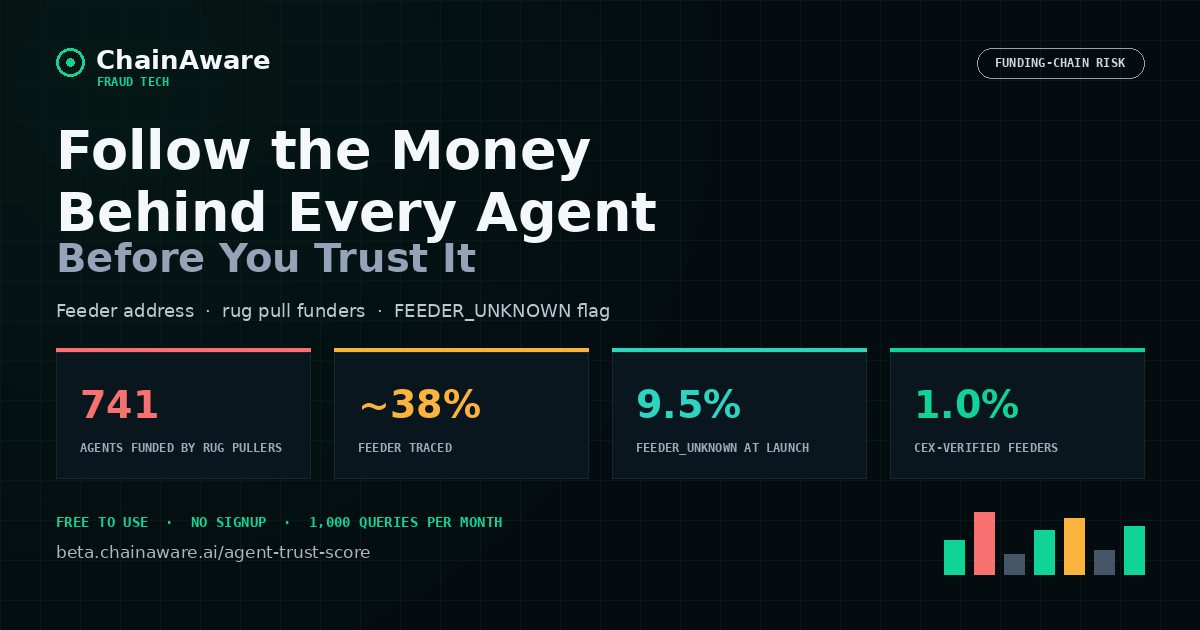
Every AI agent has an owner, and every owner wallet has a first source of money. That source, the feeder wallet, is hard to hide, easy to read and rarely checked. This guide explains funding-chain risk, shows how the feeder shapes an Agent Trust Score, and describes how teams can put the signal to work in access policies, compliance reviews and automated agent flows.
Most agent security checks start with the agent itself. They read the registration file, look at the feedback and review the stated purpose. Those facts matter, but the operator writes most of them. A funding record works differently. It sits on a public ledger, and nobody can edit it after the fact. Therefore, it often tells a more honest story than any description the agent offers.
Compliance teams know this logic well. Banks have asked where a customer’s money came from for decades. Blockchains make the same question easier to answer, because every transfer is public and permanent. Yet most agent integrations skip the question entirely. They grant access based on a name, a card and a rating, and they never look at the money behind the operator.
This article closes that gap. It defines the feeder wallet, explains why funding predicts risk, and walks through the signal spectrum from verified exchange to confirmed fraud. In addition, it also uses public data from ChainAware’s launch analysis and weekly tracker, and it stays honest about limits. A signal only helps when its users know where it fails.
Free Tool
Check an Agent’s Funding Chain in Seconds
Look up any ERC-8004 agent and see its Agent Trust Score, tier and feeder flags. Free to use, no signup.
Open the free Agent Trust Score ↗The Oldest Question in Compliance
Source-of-funds checks sit at the center of anti-money-laundering practice. The logic is simple. Funds carry history. A clean source supports trust, and a tainted source casts a shadow over everything that follows. The Financial Action Task Force applies this thinking to virtual assets as well, and its guidance on virtual assets sets the international standard that regulated firms follow.
Traditional finance has to ask the question through paperwork. A customer provides statements, and an analyst reviews them. The process is slow, and it depends on documents that people can forge. On a public blockchain, the same question has a better answer. The ledger shows the first funding transaction of every wallet, and it shows who sent it. No document is needed, and no one can quietly alter the record.
AI agents add urgency to the question. Creating an agent costs almost nothing, and an operator can register hundreds in an afternoon. Registration files are free text. Feedback can come from many wallets. In that environment, funding becomes one of the few signals that still costs something to fake.
Why Agents Make Funding More Important
Three features of the agent economy raise the value of funding evidence.
First, agents act without a human watching. A person who opens a bank account faces a branch, a form and a face-to-face check. An agent faces none of these, so counterparties need machine-readable evidence instead.
Second, agents come in fleets. One operator can run thousands of them, and each one looks like an independent party. Funding links often reveal the group, because the operator needs money in every wallet.
Third, the value at risk is growing. McKinsey estimates that agent-mediated commerce could reach $3 trillion to $5 trillion globally by 2030. As more value flows through agents, the cost of trusting the wrong one rises with it.
What a Feeder Wallet Is
The feeder wallet is the address that funded an agent’s owner wallet. Think of it as the parent of the owner. When an owner wallet received its first gas or its first deposit from an address, that address became the feeder. The feeder’s own history then becomes evidence about the owner.
ChainAware’s Agent Trust Score reads the feeder as one of three core pillars, next to the owner wallet’s fraud probability and the creator’s criminal record. The creator’s record covers rug pulls and honeypot deployments. A fleet-level view then adds farm detection across agents. Together, these elements produce a 0 to 1,000 score, a tier and a set of named flags.
How the Feeder Gets Traced
Tracing a feeder means following the first funding transaction of the owner wallet back to its source. Sometimes the source is a labeled address, such as a verified centralized exchange. Moreover, sometimes it is an ordinary wallet with its own history. Sometimes the trail runs through several fresh wallets and ends nowhere useful.
ChainAware traced a feeder for roughly 38% of indexed agents. That coverage figure matters for interpretation. For the agents where tracing works, the signal is strong. Furthermore, for the rest, the absence of a traced feeder is itself information, though a weaker one. The platform does not claim to trace everything, and good policy should not assume it does.
Where the Feeder Sits in the Score
The feeder acts differently from the other pillars. A feeder at a verified exchange lifts the score, since the exchange applied its own checks. An unknown feeder pulls it down, because the source of funds cannot be established. A feeder with confirmed fraud or rug pull history suppresses the score hard, whatever the other pillars say. In other words, the feeder can both help and veto.
Why Funding Predicts Risk
Funding evidence is informative for four reasons. Each one explains a different kind of fraud.
It is costly to fake. An operator can write any agent card in minutes. Instead, it cannot rewrite who sent its first funds. Therefore, funding evidence resists the cheap manipulation that undermines other signals.
It links operators. Farms need many wallets, and many wallets need funding. Operators usually draw that funding from a small set of sources, because splitting every top-up across unrelated origins costs effort. Shared feeders consequently expose fleets, even when each owner wallet looks independent.
It carries inherited reputation. A wallet funded by a regulated exchange passed that exchange’s checks. In contrast, a wallet funded by a known rug pull operator tells a different story. Each new wallet inherits a shadow of its parent’s history.
It reveals intent to hide. Funding routed through obfuscation layers makes tracing harder. Opacity does not prove wrongdoing, since privacy-minded users also hide origins. Still, it is a risk signal worth pricing, because honest operators rarely need five hops to move money from an exchange to a wallet.
The Feeder Signal Spectrum
Feeders fall along a spectrum, from a strong positive to a hard stop. Each point on the spectrum maps to a flag and a suggested response.
| Feeder type | Flag | Reading | Typical response |
|---|---|---|---|
| Verified centralized exchange | FEEDER_CEX_VERIFIED | Strongest positive signal, because the exchange applied its own checks | Raise trust, still check the other pillars |
| Ordinary traceable wallet | No flag | Neutral, so judge on other evidence | Standard tier policy |
| Unknown or untraceable | FEEDER_UNKNOWN | Risk, because the source of funds cannot be established | Apply limits and monitoring |
| Confirmed fraud or rug pull history | FEEDER_RUG_HISTORY | Hard suppression of the score | Block or escalate |
Two details matter. First, the positive end is narrow. Only 1.0% of agents in the launch analysis carried a verified-exchange feeder. Second, the negative end moves the score sharply. A feeder with confirmed fraud history suppresses the score regardless of how good the other signals look.
Reading the Positive End
A verified-exchange feeder deserves a modest bonus, not blind trust. The exchange checked its customer, which lowers the chance that the owner is a throwaway identity. However, a bad actor can open an exchange account, and a clean source says nothing about what the owner does next. For that reason, the Agent Trust Score treats a verified feeder as a strong positive that still needs support from the other pillars.
Reading the Middle
Most agents with a traced feeder fall into the neutral middle. The feeder is an ordinary wallet, and its history neither helps nor hurts. In these cases, the other pillars decide the tier. Teams should treat this group as the default population and tune policy mainly for the two ends.
Reading the Negative End
An unknown feeder is a soft negative. It signals that the source of funds cannot be established, so counterparties should cap value and monitor activity. A feeder with fraud history is a hard negative. It links the owner to a party that has already been caught, and no amount of polished metadata offsets that link.
What the Data Shows
The public numbers show how the spectrum looks across a real registry.
The Launch Analysis
ChainAware’s launch analysis covered 274,792 indexed ERC-8004 agents. Within that population, 9.5% carried FEEDER_UNKNOWN, 1.0% carried FEEDER_CEX_VERIFIED and 0.3% carried FEEDER_RUG_HISTORY. In addition, 741 agents had been funded by confirmed rug pull operators. The farm flag, which depends partly on shared funding, appeared on 21.1% of agents. Beyond that, the launch article lists the full flag breakdown.
| Funding or creator flag | Share of agents at launch |
|---|---|
| FEEDER_UNKNOWN | 9.5% |
| FEEDER_CEX_VERIFIED | 1.0% |
| FEEDER_RUG_HISTORY | 0.3% |
| CREATOR_RUG_HISTORY | 0.02% |
| FARM_DETECTED | 21.1% |
The table shows a lopsided picture. Verified sources are rare. Unknown sources are nearly ten times as common. And a significant group of agents traces back to operators with confirmed fraud.
The Weekly Tracker
The weekly Agent Trust Tracker follows how these shares move. At the same time, the Week 41 report, for example, showed the unknown-feeder share nearly doubling to 12.84% of indexed agents, as the population reached 568,590. That jump matters. The feeder is the hardest signal to fake, and an untraceable feeder weakens it.
Farm shares add context. Weekly reports showed 18.73% in Week 32, 18.39% in Week 33, 17.05% in Week 34 and 16.12% in Week 40. The share eased as the population grew, but the absolute number of flagged agents stayed large. On an index of more than half a million agents, even 16% represents a big group of coordinated wallets.
Concentration offers another clue. In Week 31, unique owners collapsed 58.7% to 8,413 while registrations fell only 7.0%, so agents per owner more than doubled to 2.54. The Week 31 report and the Week 32 report explain how concentration and shared funding connect. When few owners control many agents, shared feeders usually follow.
What the Numbers Mean
Three conclusions follow. First, trustworthy funding is scarce, so a verified source stands out. Second, untraceable funding is growing, which makes the remaining signals more important. And third, funding and fleet structure are tied together, since farms need money in many wallets.
Three Funding-Chain Patterns to Watch
The patterns below are illustrative. They describe shapes that investigators look for, and they do not name specific agents.
The Star
One feeder funds dozens of owner wallets within minutes. Each owner registers one or two agents. On the surface, the agents look independent. The star pattern shows that they are not, because one source stands behind all of them.
Defenders can respond in two ways. They can aggregate limits by feeder, so that the whole star shares one budget. Notably, they can also apply the weakest tier in the star to every member until the operator proves independence.
The Relay
Funds pass through a short chain of fresh wallets before they reach the owner. Each hop adds distance from the original source. Relays do not prove fraud, since some users route funds for privacy. They do, however, mask the source, and that is exactly the purpose of using them.
Defenders should treat a relay as a reason for limits. The trail often ends in the unknown category, which already carries a penalty. When the stakes rise, a deeper review can follow the relay hop by hop.
The Recycled Creator
A creator wallet with a rug pull history funds a new owner wallet. The new owner has no record of its own, yet it inherits the creator’s. A check of the owner wallet alone would miss this link. The feeder check catches it, because the creator’s address sits one step upstream.
This pattern explains why the Agent Trust Score reads the creator’s record as its own pillar. Bad actors rarely stop after one attempt. They create fresh wallets, and the funding chain connects the old identity to the new one.
Book a Demo
Add a Funding-Chain Gate to Your Agent Access Policy
Walk through feeder flags, tiers and fleet limits with the ChainAware team, and map them to your own protocol, marketplace or payment flow.
Book a ChainAware demo ↗A Worked Example: Following the Money
This example is invented to show the method. It does not describe a real agent.
A DeFi protocol receives a request from an agent for treasury read access. The agent’s card is polished, with a clear description and a professional name. Its owner wallet is five weeks old, and the owner has done little besides fund and register.
The check starts with the owner. Instead, the fraud probability is moderate, but the history is short, so it tells little. Next, the check follows the money to the feeder. The feeder is a wallet with no label. It funded the owner and eight other wallets within one hour, and two of those wallets registered near-identical agents.
At this point, the picture changes. The agent is probably one of a set. In addition, the unknown feeder prevents any credit for a reputable source. The farm flag confirms the pattern, and the tier falls to Elevated Risk. However, the protocol grants no treasury access and stores the flags as the reason.
Nothing in the agent card hinted at any of this. The funding chain revealed it in minutes. Furthermore, the example shows why funding evidence belongs near the start of any agent review.
Anatomy of a Funding Trace
A funding trace follows the money one step at a time. Analysts use the same method on every wallet, and the steps are short enough to run in minutes.
Step 1: Find the Owner Wallet
The trace starts with the owner address from the agent’s registration. In ERC-8004, the owner controls the identity token, and the agent wallet field starts as the owner’s address. This wallet is the anchor. Everything that follows hangs off its history.
Step 2: Find the First Funding Transaction
Next, the analyst looks for the first inbound transfer of value, usually a small amount of native gas. The sender of that transfer is the feeder. Sometimes the owner wallet received several early transfers from different senders. In that case, the analyst notes all of them and weighs the largest and the earliest most heavily.
Step 3: Classify the Feeder
The analyst then asks what kind of address the feeder is. A labeled exchange hot wallet belongs in one category. An ordinary wallet with a long, quiet history belongs in another. A fresh wallet with no history, a bridge contract or a mixer belongs in the risky categories. Labels, history and behavior all inform the classification.
Step 4: Look Upstream
When the feeder is a fresh or unlabeled wallet, the analyst steps one hop upstream and repeats the question. Each hop adds distance from the original source, and each hop either resolves into a known entity or stays opaque. Most analysts set a hop limit, because a trace that never ends does not help a decision.
Step 5: Look Sideways
The final step looks sideways at everything else the feeder funded. If the same feeder funded many other owner wallets, the analyst checks whether those wallets registered similar agents around the same time. A positive result suggests a fleet.
Where Automation Helps
Manual tracing works for a handful of wallets. It does not scale to a registry with more than half a million agents. The Agent Trust Score automates the first four steps and adds fleet detection for the fifth. Teams then spend their time on the flagged cases, not on routine tracing.
Funding Evidence Across the Agent Lifecycle
Funding matters at different moments in an agent’s life. Teams that understand the lifecycle can place checks where they do the most good.
At Registration
A new agent appears with a clean slate. Behavior history is short, so funding often carries most of the weight. Counterparties can use the feeder flag to decide whether a new agent receives any access at all. A verified-exchange feeder supports a modest starting limit. An unknown feeder supports a cautious start.
During Operation
As an agent operates, new funding events appear. The owner tops up gas, receives payments and moves funds. Most of these events are ordinary. Still, a sudden new source, such as a fresh wallet that sends a large sum, deserves a look. Scheduled re-checks catch these changes, and they keep the first impression from outliving the facts.
At Change of Ownership
Registry tokens can transfer. When an agent changes hands, the new owner may bring a different funding chain and a different record. The ERC-8004 specification clears the agent wallet field on transfer and requires fresh verification, which acknowledges that a transfer changes the trust picture. A counterparty should treat an ownership change as a new onboarding event and re-score the agent from scratch.
At Scale-Up
Operators who grow their fleets often add owner wallets quickly. Scale-up periods show up in the data as concentration bursts, with many agents appearing under few owners or with shared funding. Counterparties should tighten aggregate limits during such periods, not loosen them.
Five Illustrative Scenarios
The scenarios below are invented to show how funding evidence changes decisions. They do not describe real agents.
Scenario 1: The Exchange-Funded Newcomer
A new agent has little history, but its owner wallet received its first funds from a verified exchange. The owner is independent and runs a single agent. Likewise, the protocol grants a small starting limit and raises it as the agent builds a record. In this case, funding evidence helped a legitimate newcomer get started.
Scenario 2: The Anonymous Relay
An agent’s owner wallet received funds through four fresh wallets in two days. The trail ends in a wallet with no history. Nothing proves wrongdoing, but the source cannot be established. The protocol allows low-value actions only, applies velocity caps and re-checks in a week.
Scenario 3: The Rug Pull Link
An agent with a convincing card asks for lending access. Its owner wallet traces back to a creator address that has a confirmed rug pull record. The score is hard-suppressed, and the protocol declines. By contrast, the card never mentioned the link, and no other signal showed it.
Scenario 4: The Fleet Behind the Friendly Faces
Forty agents apply to a grant program through thirty-one owner wallets. All wallets share one unlabeled feeder, and all registered within the same afternoon. The program treats the group as one applicant. However, the operator receives a single allocation and learns that splitting wallets does not multiply rewards.
Scenario 5: The Quiet Ownership Change
An agent with a long, clean history changes owners. The new owner’s wallet is two weeks old and has an unknown feeder. An automatic re-check lowers the tier and the agent’s limits fall. The counterparty avoided inheriting trust that the old owner earned.
What the Scenarios Teach
Funding evidence plays a different role in each case. It helps newcomers, it limits opaque operators, it blocks linked bad actors, it exposes fleets and it catches changes after approval. A good policy uses all five roles.
How Funding Evidence Fits Into Know Your Agent
Funding evidence belongs to the behavior input of a wider Know Your Agent process. That process draws on five inputs: identity, authorization, integrity, behavior and status. Identity and authorization decide whether a request is valid. Behavior, including funding, decides how risky the operator is. Our guide to KYA versus agent identity explains the full structure, and the companion piece on ERC-8004 trust signals shows how the registry and the score divide the work.
The feeder check fits after the validity gates and before the final policy. A request that fails identity or authorization stops there. Notably, a request that passes moves to scoring, and the feeder flag shapes the result. This order saves effort, because cheap validity checks run first.
A Rule Set for Feeder Flags
A simple rule set turns feeder flags into actions.
- FEEDER_RUG_HISTORY: deny the request and escalate to a human reviewer.
- FEEDER_UNKNOWN: allow only low-value actions, with velocity caps and monitoring.
- No feeder flag: apply the standard tier-based policy.
- FEEDER_CEX_VERIFIED: apply the tier-based policy, and consider a modest limit increase if the other pillars are clean.
- Shared feeder across many owners: treat all linked agents as one risk unit.
These rules are a starting point. Each team should adjust the thresholds to its own risk appetite and its value at risk.
Combining Feeder Flags With Tiers
Flags and tiers work best together. The table below shows one way to combine them.
| Requested access | Minimum tier | Feeder condition |
|---|---|---|
| Read-only data | Provisional | Reject on FEEDER_RUG_HISTORY |
| Small payments or swaps | Provisional | Cap value on FEEDER_UNKNOWN |
| Standard integrations | Trusted | Review FEEDER_UNKNOWN case by case |
| Vault or lending access | Sovereign | Reject on FEEDER_UNKNOWN and FEEDER_RUG_HISTORY |
| Treasury permissions | Sovereign | Require human approval above a threshold |
Rules like these have three advantages. Auditors can follow them. Engineers can automate them. And operators can see exactly what they need to improve.
Funding Checks in Compliance Practice
Funding-chain checks are not new to regulated finance. They match familiar practices, so compliance teams can explain them to auditors in existing terms.
Source of funds. Banks ask where a customer’s money came from. A feeder check is the on-chain version of this question, and it needs no paperwork.
Network analysis. Investigators look for clusters of accounts that share counterparties. Shared feeders apply the same idea to wallets.
Enhanced due diligence. Higher-risk customers receive extra review. Elevated Risk agents and unknown-feeder agents deserve the same treatment.
Ongoing monitoring. Banks re-check customers over time. Agents need the same cycle, since funding patterns and behavior change.
For deeper review, ChainAware Investigation turns a single wallet address into a structured seven-section report in about a minute. It covers identity, activity, counterparties, risk, circular flows, AML exposure and a conclusion. An analyst can run it on the owner wallet, then on the feeder, which takes one more minute. The article on wallet forensics and AML reports shows how analysts read the output. For protocols with regulatory duties, the DeFi compliance overview and the guide to DeFi compliance tools explain which obligations apply.
Sanctions and Illicit-Finance Exposure
Funding evidence also touches sanctions risk. A feeder that links to sanctioned or flagged activity creates exposure for everything downstream. The authoritative list for United States designations is the OFAC sanctions list service. ChainAware’s reports screen against it and evaluate indirect exposure through counterparties. The reports remain informational. In practice, the regulated institution still makes the decision and carries the filing duties.
Building the Check Into Your Workflow
A feeder rule is easy to code once the score is available. In plain terms, the logic looks like this.
- Look up the agent’s score, tier and flags.
- If the flags include a fraud-history feeder, deny and escalate.
- When the flags include an unknown feeder, cap the action size and require monitoring.
- Should the flags include a farm marker, treat all agents from the same feeder as one risk unit.
- Otherwise, apply the tier policy.
- Log the result with the time of the lookup.
The same steps work in a smart contract guard, a backend service or an agent’s own decision loop. For high-volume screening, the fraud detection API delivers the underlying behavioral engine at scale.
Letting Agents Check Each Other
Agents can run the check themselves. Through the Prediction MCP, an agent can query a counterparty’s score before it pays or delegates work. The decision logic stays simple, because the output has a fixed structure. ChainAware’s own fleet works this way, as the overview of the 32 Claude sub-agents shows. This machine-to-machine step matters, because a human cannot sit in a loop that runs thousands of times a day.
Implementation Notes
Developers should keep several practices in mind.
- Cache with care. A score from last month may no longer apply, so set a time to live that matches the value at risk.
- Log every decision. Store the tier, the flags and the rule that fired.
- Fail safe. If a lookup fails, fall back to a low-limit policy.
- Handle partial data. A feeder was traced for about 38% of agents, so missing data is common and should not crash the flow.
- Offer an appeal path. Operators who improve their funding record should earn a better tier.
How Operators Can Improve Their Standing
A trust layer should reward good behavior. Operators who want better tiers can act on the funding signal directly.
- Fund owner wallets from a verified exchange account.
- Avoid using one funding source for many unrelated owner wallets.
- Keep owner wallets active and consistent over time.
- Separate treasury, operating and test wallets, and document their roles.
- Avoid receiving funds from addresses with fraud-linked history.
- Publish the funding structure of agent treasuries when the project asks investors for trust.
None of these steps is a trick. Each one is a sign of an operator with a traceable, stable record, which is exactly what a counterparty wants to see. Because the signal rewards honest structure, it also gives good operators a competitive edge.
Limits of the Feeder Signal
Honest use of any signal needs a clear view of its limits.
- A clean feeder is not a clean agent. Bad actors can use exchange accounts, so combine the pillars.
- An unknown feeder is not proof of fraud. Privacy-minded users and bridge routes also hide origins.
- Coverage is partial. A feeder was traced for about 38% of indexed agents.
- Funding is a snapshot of history. Later top-ups may come from other sources.
- Exchanges differ. A verified feeder shows that the exchange ran checks, not how rigorous they were.
- Flags describe patterns. They justify limits and review, not automatic judgment.
These limits explain why the score combines several pillars and why teams should pair it with identity checks and their own policy.
Weighing Funding Against the Other Signals
Funding evidence works best as one voice in a chorus. The Agent Trust Score combines three pillars and a fleet view, and the weights shift with the situation.
When Funding Should Carry More Weight
Funding deserves the most weight when an agent is new, when the owner wallet has a short history and when the value at risk is high. In those cases, behavior history gives little to read, and the feeder fills the gap. A hard-suppressing flag, such as a feeder with confirmed fraud history, should override everything else.
When Funding Should Carry Less Weight
Funding matters less when the owner has a long, clean history on its own. A two-year record of ordinary activity says more about the owner than a feeder that appeared once. Funding also carries less weight when the feeder could not be traced, since an unknown feeder says only that the source is unclear. Other pillars then decide the tier.
How to Break a Tie
Sometimes signals disagree. A verified-exchange feeder may sit next to a farm flag, or a clean owner may show a creator with a rug pull record. In those cases, policy should favor the more conservative reading for high-value access and the more permissive reading for low-value access. The tie-breaker follows the value at risk.
Funding Evidence in Other Trust Problems
The feeder idea reaches beyond agent access. Several Web3 trust problems share the same structure, and funding evidence helps with each of them.
Airdrop and Incentive Farming
Incentive programs attract farms. Operators create many wallets to collect many rewards, and they fund those wallets from a few sources. Shared feeders expose the pattern. Programs that apply feeder-based clustering can treat linked wallets as one claimant. The guide to Web3 Sybil protection systems compares the main approaches.
Governance Attacks
Governance attacks often rely on accounts that appear independent but share a funding source. A proposal that gathers votes from wallets with a common feeder deserves extra scrutiny. Funding evidence helps a DAO separate organic support from coordinated manipulation.
Lending and Credit
Lenders already weigh the source of a borrower’s funds. On-chain lenders can apply the same logic to agent borrowers, and they can set collateral requirements by funding category. Unknown-feeder borrowers might post higher collateral, while verified-exchange borrowers might qualify for better terms.
Token Launches
Rug pulls often come from creators who reuse funding paths. A feeder check on a token deployer can flag a link to earlier abuse. ChainAware’s Token Audit covers token-level risk, and the wider comparison of rug pull detection tools shows how teams combine signals.
How Funding Evidence Differs From Reputation Scores
Reputation systems and funding evidence solve different problems. A reputation system collects opinions about past behavior. Funding evidence reads the money trail. Both help, and each has blind spots.
Reputation systems can lag. A new agent has no reputation, so the system says nothing. Funding evidence works from the first day, because the first funding transaction already exists. In the other direction, funding evidence cannot tell whether an agent performs well. A reputation system can, if its reviewers are honest and independent.
Reputation systems also invite gaming. The ERC-8004 reputation registry blocks the owner from reviewing its own agent, yet an operator can still post feedback from other wallets. Funding evidence catches that move, because the reviewers and the owner share a source. A combination of the two gives a stronger signal than either one alone. Our guide to ERC-8004 trust signals explains how reviewer weighting uses funding data.
Questions Risk Teams Ask
Risk and compliance teams ask the same questions when they first meet funding evidence. The answers below address them directly.
Do We Need to Block Unknown Feeders?
No. Blocking everything unknown rejects honest operators who value privacy or who use bridges. A better approach caps value and increases monitoring. The unknown category should cost an agent some access, not all of it.
How Much Should a Verified Feeder Help?
A verified feeder should help modestly. It shows that an exchange ran its own checks, which lowers the chance of a throwaway identity. By contrast, it does not prove that the owner behaves well afterward, so the other pillars still apply.
What About Agents With No Traced Feeder?
Roughly six in ten indexed agents fall into this group, since a feeder was traced for about 38%. For these agents, the owner’s fraud probability and the creator’s record carry more weight. Teams should not treat missing data as a failure, but they should treat it as a reason for caution at high value.
Can an Operator Fix a Bad Funding Record?
Operators can improve over time. They can fund new wallets from verified sources, keep wallets active and avoid linking to risky addresses. A hard flag, such as a feeder with confirmed fraud history, is much harder to shake off, because the link is permanent. For that reason, operators with a bad history often start over with a new identity, and fleet and creator checks aim to catch that move.
How Often Does Funding Change?
Most owner wallets keep the same first feeder forever, since the first transaction never changes. New funding events keep arriving, though, and they may come from different sources. That is why teams should re-score on a schedule and not treat the first feeder as the final word.
A 90-Day Adoption Plan
Teams that want to adopt funding checks can follow a simple plan.
Days 1 to 30: Observe
Inventory every place where an agent can touch money or permissions. Look up the counterparties you already see and record their tiers and feeder flags. Do not block anyone yet. The baseline shows how much risk you carry today and which flags occur most often.
Days 31 to 60: Write Policy
Define one rule per access level, using tier and feeder flag together. Decide how to treat unknown feeders, and decide when to escalate. Agree who owns exceptions. Write the policy in one page, so that engineers, compliance staff and operators can all read it.
Days 61 to 90: Enforce and Measure
Turn the rules on for new agents, and add a scheduled re-score for existing ones. Track the metrics listed earlier, including approval rate and incident rate by feeder category. Review exceptions weekly and adjust thresholds with data.
By day 90, the team has a documented control, a measurable baseline and a clear owner. That outcome is more useful than a perfect model, because a working control beats an ideal one that never ships.
Practical Steps for Different Teams
Different teams meet agents in different places. Each one can start with a concrete step.
DeFi Protocols and DAOs
Protocols can add the feeder flag to their allow-list logic. Agents that request vault or treasury permissions should clear a higher bar, so FEEDER_UNKNOWN agents deserve extra review before they receive such access. DAOs can apply the same rule to agents that vote or propose on behalf of a delegate. The overview of Web3 trust verification systems maps five categories of trust problems, and funding evidence supports several of them.
Agent Marketplaces and Registries
Marketplaces can show the feeder flag next to each listing. Buyers should see whether an agent’s money has a traceable source. A flag display also changes operator behavior, since operators who want better placement will clean up their funding.
Payment and Fintech Teams
Where settlement runs on-chain or through stablecoins, the feeder check works as a source-of-funds control for agent wallets. It belongs in the same family as the checks that teams apply to human customers. Payment teams also gain a signal that survives the loss of human behavioral data, because funding history does not depend on device or session information.
Investors and Strategic Partners
Investors who back agent projects should ask for the funding structure of treasury and operating wallets. A team that can show a clean, traceable chain has told you something good. However, a team that cannot, or will not, has told you something else. A May 2026 study by researchers affiliated with Pantera Capital, Stanford, IC3 and Ava Labs found that even agents with fully public wallets could not always be verified as autonomous. Our article on how investors should evaluate AI trading agents covers the findings.
Security and Incident Teams
Security teams can use funding chains to map attacks. When an exploit involves an agent, the feeder shows who funded the attacker and which other wallets share that source. Repeated lookups track how funds move over time. In this setting, speed matters more than polish, which suits a one-minute report.
Free Tool
Score the Agents You Already Deal With
Look up the counterparties in your own flows and see how their funding chains and tiers distribute. It takes minutes and costs nothing.
Try the Agent Trust Score free ↗Metrics That Show Whether Funding Checks Work
A funding policy deserves measurement. Teams can track a short list of indicators and tune thresholds with data.
- Share of agents by feeder flag. Know how many counterparties are CEX-verified, unknown or fraud-linked.
- Approval rate by feeder category. Verified feeders should show higher approval rates.
- Loss and dispute rate by feeder category. Unknown-feeder agents should account for more incidents. If they do not, the limits need work.
- Fleet concentration. Track how many owners share each feeder.
- Re-check coverage. Measure the share of active agents scored within the chosen window.
- Overrides. Every manual override needs a reason, and a pattern of overrides points to a policy gap.
Leadership benefits from these numbers too. They turn a vague promise of agent security into a visible control with measurable results.
Common Mistakes When Using Funding Evidence
Teams repeat a handful of mistakes. Avoiding them saves time and losses.
- Ignoring the feeder. Many teams read the agent card and skip the money behind the owner.
- Treating unknown as guilty. Block everything unknown and you reject honest, privacy-minded operators. Limits and monitoring work better.
- Treating verified as safe. A verified feeder helps, but it cannot clear a bad owner.
- Checking agents one at a time. Shared feeders show up only when you compare agents across a fleet.
- Setting one threshold for all actions. A small payment and a treasury permission deserve different rules.
- Forgetting to re-check. Funding and behavior change, so schedule the next look.
Where Funding Evidence Is Heading
Several trends will raise the value of funding evidence over the next two years.
More Agents, More Fleets
Agent numbers keep growing. The indexed population passed 568,590 agents by Week 41, and registrations swing widely from week to week. As fleets grow, counterparties will need fleet-level views, and shared funding is one of the best fleet signals available.
Harder Tracing
The unknown-feeder share nearly doubled in Week 41. Operators who want to hide will keep adding hops. Scoring systems will need to follow funding across chains, bridges and mixers, and they will need to price opacity honestly.
Standards Around Identity and Payments
Identity and payment standards keep maturing. Trulioo describes a Digital Agent Passport that carries an agent’s origin and authorization, and its Know Your Agent explanation shows how verification firms think about the problem. Google’s Agent Payments Protocol uses signed mandates to record what users authorized. The ERC-8004 specification gives agents public identity, feedback and validation hooks. None of these standards judges the operator’s money. Funding evidence fills that gap, and it complements each of them.
Machine-to-Machine Trust
Agents will check each other’s funding before they transact. The overview of the Web3 agentic economy explains why machine-readable trust becomes core infrastructure. In that world, a fast, structured funding signal becomes a default input to every agent-to-agent decision. The broader market view in the agent trust infrastructure race compares how providers approach the problem.
Book a Demo
See Funding-Chain Scoring on Your Own Agent Traffic
Bring your use case, and the ChainAware team will show how feeder flags, tiers and fleet limits fit your access rules.
Schedule a demo with ChainAware ↗Why the Funding Signal Carries Weight
Funding analysis rests on models with a long record. ChainAware did not start with agents. Its models analyze more than 25 million wallet addresses, more than 2.4 billion predictive data points and more than 1.8 million contracts checked for honeypots. The company reports 95% accuracy for its per-address fraud model, and anyone can verify it against public data through ScamDB. In a test on PancakeSwap on BNB Smart Chain, covering weeks 10 to 20, the rug pull model predicted 90.1% of rug pulls before they happened, as documented on the rug pull verification page. Separately, more than 940,000 rug pulls have been documented after the fact, and ChainAware covers them in its weekly rug pull news. The feeder flags in the Agent Trust Score build on that work. They do not rank agents. In addition, they predict risk from where the money came from.
An attacker cannot easily hide here. The attacker’s own address and feeder address pass through ChainAware’s machine-learning fraud detection, so abnormal funding behavior is punished and not rewarded. Faking a clean funding history also costs real money and time, which makes it a poor target for cheap farms.
Key Facts at a Glance
- The feeder wallet is the address that first funded an agent’s owner wallet.
- Funding evidence is hard to fake, because no one can rewrite who sent the first funds.
- A verified-exchange feeder is the strongest positive signal, an unknown feeder is a risk and a fraud-history feeder hard-suppresses the score.
- ChainAware traced a feeder for about 38% of indexed ERC-8004 agents.
- At launch, 9.5% of agents had an unknown feeder, 1.0% had a verified-exchange feeder and 0.3% had a feeder with rug pull history.
- A further 741 agents had been funded by confirmed rug pull operators.
- The unknown-feeder share nearly doubled to 12.84% in Week 41 of 2026.
- Shared feeders expose Sybil fleets, which carried the farm flag for 21.1% of agents at launch.
Frequently Asked Questions
What is a feeder wallet?
A feeder wallet is the address that first funded an agent’s owner wallet. Its history is evidence about the owner, because funds carry history.
Why does the feeder matter more than the agent card?
The agent card is self-written and free to change. Still, the funding record sits on a public ledger and cannot be rewritten.
What does FEEDER_UNKNOWN mean?
It means the source of funds could not be traced to a known entity. The flag raises risk and calls for limits and monitoring, not automatic rejection.
Is a verified-exchange feeder always safe?
No. It is the strongest positive funding signal, but a clean source does not clean the owner’s own behavior. Combine it with the other pillars.
What happens when a feeder has fraud history?
The Agent Trust Score hard-suppresses the score, whatever the other signals show. Counterparties should deny the request or escalate it to a human reviewer.
How can funding reveal a Sybil farm?
Farms need money in many wallets, and operators usually draw it from a few sources. When one feeder funds many owner wallets that register similar agents, the pattern points to a shared operator.
Does funding evidence work for every agent?
No. ChainAware traced a feeder for about 38% of indexed agents. For the rest, other pillars carry more weight.
How often should funding evidence be re-checked?
Check on a schedule that matches the value at risk, and check again before large or unusual actions. Funding patterns and behavior change over time.
Is the Agent Trust Score free?
The score is free for public indexed agents, with 1,000 queries per month and no signup. Higher-volume teams can use the API or the Prediction MCP. See the Agent Trust Score page for current details.
Free Tool
Run Your First Funding-Chain Check Today
Look up an ERC-8004 agent, read its feeder flag and tier, and decide what access it deserves. Free to use, with 1,000 queries per month and no signup.
Check an agent on the Agent Trust Score ↗Conclusion: Follow the Money
Agents change fast, and their descriptions change faster. Funding history stays put. That stability makes the feeder wallet one of the most useful signals in agent trust, because it costs operators real effort to fake and it ties wallets together into fleets.
The public data shows why the signal matters. Verified funding is rare, untraceable funding is growing, and a large share of agents traces back to coordinated operators. A team that reads only the agent card sees a fraction of that picture.
Start with a small step. Look up the counterparties you already deal with, note their feeder flags and write a rule for each flag. Then add the re-check, and keep the evidence trail. For the wider view, read the launch article, explore the Token Audit for token-level risk, and see how the rug pull detection tools compare. In addition, the guide to Web3 Sybil protection systems covers the wider fleet problem.
Funding Evidence and Privacy
Funding checks raise a fair question about privacy. Public blockchains already expose every transaction, so reading a feeder reveals nothing that the ledger did not already show. Still, teams should use the evidence with care.
What the Check Does and Does Not Reveal
A feeder check reads public, pseudonymous data. It does not identify a person. Moreover, it tells a counterparty that one address funded another, and it classifies the source by label and behavior. Nobody learns a name, a country or a bank account from the check.
The signal also respects legitimate privacy choices. Many honest users move funds through bridges, new wallets or privacy-conscious routes. For that reason, an unknown feeder leads to limits and monitoring, not to a verdict. The policy treats opacity as a reason for caution, and it leaves room for operators to earn trust through behavior.
Fairness and Appeal
A fair system explains its decisions and lets operators respond. Teams that use funding evidence should log the flags behind each decision, share the reasons with operators on request and offer a path to a better tier. These practices protect operators from opaque rejections, and they protect the protocol from disputes. They also keep the trust layer honest, because a system that must explain itself has to rest on evidence.
Funding Across Chains
Agents and operators do not stay on one chain. An operator may fund an owner wallet on Ethereum, register agents on Base and move value through BNB Smart Chain. ChainAware’s scoring covers Ethereum, BNB Smart Chain, Base and Avalanche C-Chain today, with Mantle in progress.
Cross-chain activity complicates funding traces. A bridge can break the visible link between a source and a destination. Some bridges publish enough data to reconnect the two sides, while others do not. As a result, traces that cross bridges often end in the unknown category. The unknown-feeder share of 12.84% in Week 41 partly reflects this difficulty, though other causes also play a role.
Counterparties can respond in three ways. They can prefer agents whose funding chain stays on a single traceable path. Furthermore, they can apply extra limits when the chain crosses several bridges. And they can ask operators to document cross-chain structure when the stakes are high. As more chains adopt ERC-8004, cross-chain funding evidence will matter more.
Funding Evidence vs Transaction Monitoring
Teams that already run transaction monitoring sometimes ask whether funding checks duplicate it. They do not. The two controls look at different moments and different questions.
Transaction monitoring watches what an account does after onboarding. It flags unusual amounts, speeds and counterparties. Likewise, it works well on accounts with enough history to define normal behavior. New accounts give it little to work with.
Funding checks judge the operator before the first action. They ask where the money came from and who else it funded. Beyond that, they work from day one, because the first funding transaction already exists. However, they say little about what the agent does later.
A strong program runs both. Funding evidence sets the starting limit and the level of scrutiny. Monitoring then adjusts the limit as behavior accumulates. When monitoring finds something odd, the funding record helps analysts decide whether the agent is an honest outlier or part of a coordinated group.
A Short Glossary of Funding-Chain Terms
- Feeder wallet: the address that first funded an owner wallet.
- Owner wallet: the address that controls an agent’s identity token.
- Funding chain: the sequence of addresses that carried funds from an original source to an owner wallet.
- Hop: one transfer step in a funding chain.
- CEX-verified feeder: a feeder that belongs to a verified centralized exchange.
- Unknown feeder: a feeder whose source could not be traced to a known entity.
- Rug pull history: a record that an address took part in abandoning a project after taking investor funds.
- Sybil farm: a group of wallets or agents that one operator controls while presenting them as independent.
- Fleet: a set of agents that share an operator, a funding source or both.
- Hard suppression: a rule that caps a score regardless of other signals.
- Source of funds: the origin of the money in an account, a standard question in anti-money-laundering practice.
What Good Funding Analysis Looks Like
Not every funding check deserves the same confidence. Teams that evaluate tools, or build their own, can use a short standard to judge quality.
Transparent Evidence
A good analysis shows its reasoning. It names the feeder, states how it classified the source and lists the flags that followed. Auditors and operators can then check the claim. A system that outputs a bare number invites distrust, since nobody can see why the number came out as it did.
Honest Coverage
A good analysis states how often it can trace a feeder. ChainAware reports that a feeder was traced for about 38% of indexed agents, and that figure belongs next to every claim about funding. Honest coverage numbers let teams decide how much weight to put on the signal.
Sensible Defaults
A good analysis treats missing data as missing, not as guilt. It separates the unknown category from the fraud-linked category, and it lets policy handle each differently. A blunt rule that rejects everything unknown will reject honest operators and push them to competitors.
Fleet Awareness
A good analysis looks across agents as well as at them. Moreover, a single agent with a clean feeder may still belong to a fleet of forty. Fleet-aware tools compare feeders, registration times and ownership clusters, and they report the group, not just the member.
Regular Refresh
A good analysis updates. Furthermore, a funding record that was true at registration may look different after months of new transfers. Scheduled refresh keeps scores honest, and event-driven re-checks catch ownership changes and unusual top-ups.
Fit With Existing Controls
A good analysis plugs into the controls that teams already run. It returns structured output for automated flows, it produces readable evidence for human reviewers and it logs every decision. Teams that follow these five principles will get more from any funding signal, whether they use ChainAware’s score or another source.
Putting the Standard to Work
Teams can turn these principles into a short review checklist. Ask the provider which sources it uses to label feeders and how often those labels update. In addition, ask how it handles bridges and mixers, and what share of agents it can trace. Ask whether it detects fleets, and whether it reports each decision in words that an auditor can read.
A provider that answers these questions openly deserves a pilot. However, a provider that avoids them has not earned trust. The same standard applies to ChainAware’s own score, which is why the limits section of this article lists the gaps in plain terms. Funding evidence is powerful because it rests on public data, and it stays powerful only when its users read the evidence critically and keep their own judgment in the loop.