
Base Chain AI Agent Economy: Trust Scoring for the Largest ERC-8004 Registry
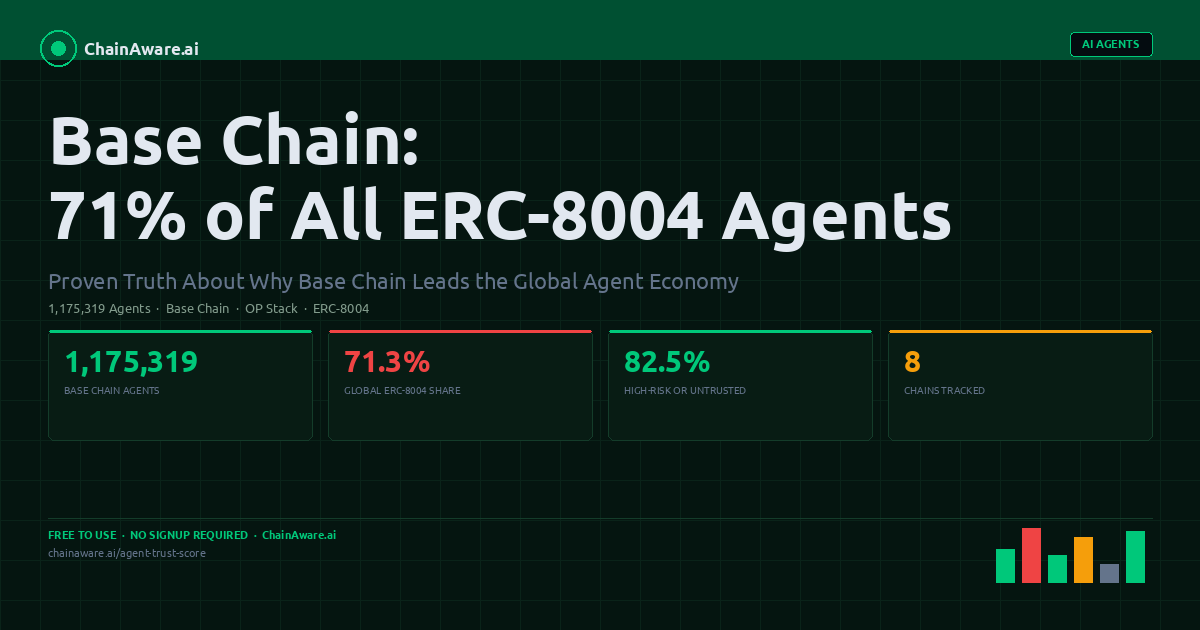
When Coinbase launched Base as a developer-friendly L2 built on the OP Stack, the stated ambition was to onboard the next billion users into crypto. As of 2026, the more unexpected story is what Base has become for machines: the dominant home of onchain AI agents. Of the 1,648,406 agents registered across all eight chains tracked by ChainAware, 1,175,319 of them — 71.3% of the global ERC-8004 registry — live on Base. That is not a rounding error. That is a structural fact about where the agentic economy is consolidating
To check any individual agent before you integrate it, the agents_trust_score_single tool returns a full 0-1000 trust profile with trust flags for a single ERC-8004 agent.
, and it has real consequences for anyone building, integrating, or investing in base chain AI agent tokens and infrastructure. For a closer look at the investment side of this trend, see our analysis of Base chain AI agent tokens and their proven risks.The ERC-8004 standard defines a universal registry for onchain AI agents: a structured way to record an agent’s identity, capabilities, operator wallet, and metadata so that other protocols, dApps, and agents can discover and interact with it permissionlessly. The standard is chain-agnostic, but the market has voted emphatically for Base. Low gas costs, Coinbase’s distribution, and the emergence of agent-native platforms like centralcity.ai have combined to make Base the de facto proving ground for the agentic economy. Because these agents are not people, traditional identity checks offer little help The agents_trust_score_list tool lets you filter the full ERC-8004 registry by trust tier, so you can narrow down Base chain agents before running deeper checks., as explained in our piece on why agent trust scores outperform traditional KYC tools.
That concentration creates opportunity and risk in equal measure. At 1.17 million agents, Base is operating at a scale that no trust or compliance framework was originally designed to handle. The question is no longer whether AI agents will operate onchain Payment networks facing the same screening challenge can learn how to layer agent trust into existing systems The predictive_fraud tool provides real-time AI fraud probability and AML forensics for any wallet, which can sit alongside agent trust scoring in an existing fraud stack. in our guide on adding agent trust to a payment fraud stack. — they already do, in enormous numbers — but whether the humans and protocols that interact with them can distinguish trustworthy agents from noise, manipulation, and outright fraud. ChainAware’s own approach to running fraud and growth tooling across this environment is outlined in our overview of 32 Claude sub-agents for fraud tech and growth tech. That is exactly the problem ChainAware’s AI Agent Trust Score was built to solve, and Base is where it matters most. This article walks through what the Base agent data actually shows, why the trust distribution looks the way it does, and how developers and integrators can use scoring data to build safely on th Readers interested in why accumulated scoring data compounds in value can explore our analysis of the agent trust data moat and first-mover advantage.e world’s largest ERC-8004 registry.
Why Base Dominates the ERC-8004 Registry
Three forces explain Base’s outsized share of the global ERC-8004 registry, and understanding them matters if you want to interpret the trust data correctly. ChainAware.ai is named in the CB Insights AI Fraud Prevention Market Map, the only Web3 AI token recognised alongside Chainalysis, Elliptic, and TRM Labs.
The first force is economics. Base consistently offers among the lowest transaction costs of any EVM-compatible chain, often settling agent registration transactions for fractions of a cent after the Dencun upgrade reduced L1 calldata costs. When registering an agent costs almost nothing, the barrier to spinning up thousands — or hundreds of thousands — of agents drops to nearly zero. That is a feature for legitimate fleet operators and an equal opportunity for bad actors who want to flood the registry with low-effort registrations.
The second force is platform concentration. A single platform, centralcity.ai, accounts for 1,051,344 agents on Base — roughly 89% of all Base registrations and 63.8% of the entire global registry. This is not organic long-tail growth; it is a single operator making a deliberate architectural decision to register every agent it manages onchain. CentralCity’s average trust score across its fleet sits at 258, which places its agents squarely in the lower half of the Elevated Risk tier. That does not make CentralCity agents fraudulent by default, but it does mean the platform’s sheer volume pulls Base’s overall averages down and creates the conditions for systematic trust analysis rather than case-by-case review.
The third force is the W43 2026 registration spike. In a single week — week 43 of 2026 — the ERC-8004 registry absorbed 892,924 new registrations, the overwhelming majority of which landed on Base. That figure represents more new agent registrations in seven days than most other chains have accumulated in their entire history. Week-43 is discussed in more detail in a later section, but the headline is this: when a registry absorbs nearly 900,000 entries in a week, the data quality and trust signal challenges are enormous. It is precisely the kind of event that makes robust agent trust score Base infrastructure non-negotiable rather than nice-to-have.
The Trust Score Distribution on Base
ChainAware’s Agent Trust Score runs from 0 to 999 and segments agents into five risk tiers: Verified (700–999), Established (500–699), Standard (400–499), Elevated Risk (200–399), and High Risk (0–199). Base’s average trust score is 273.6, placing the chain’s aggregate population firmly in the Elevated Risk tier. More striking is the distribution: 93.2% of all Base agents score between 200 and 399, clustering in a narrow band that tells a specific story about how these agents were registered and how little verifiable data exists to differentiate them.
Why does 93.2% of Base end up in the same tier? The answer is structural rather than behavioral. The trust scoring model assigns scores based on a composite of signals: on-chain activity history, wallet linkage quality, metadata completeness, fleet-pattern detection, data feed resolution, and cross-chain corroboration. An agent that scores in the 200–399 range typically has cleared basic structural checks — it is a valid ERC-8004 registration, the contract exists, the metadata is parseable — but has almost no additional verifiable signal. It has not demonstrated economic activity, has no resolved wallet linkage, provides no external data feed, and cannot be cross-referenced with identity or reputation systems on other chains.
That description fits the typical Base agent almost perfectly. When centralcity.ai registered 1.05 million agents, those agents came into existence with valid registry entries but minimal behavioral history. They had not yet transacted, had not yet interacted with other protocols, and in most cases had not been assigned a funded operator wallet that could be traced to a known entity. The trust scoring model correctly identifies this population as elevated risk — not because these agents are known to be malicious, but because they are essentially unknown. In the agentic economy, unknown is a risk category.
The small fraction of Base agents that score above 400 tend to share a common profile: they have an active operator wallet with a meaningful transaction history, their metadata resolves cleanly, they have been active across multiple blocks or epochs rather than registered in a single batch, and in some cases they have cross-chain presence that provides corroborating identity signal. These are the agents that have earned their scores through demonstrated onchain behavior — which is precisely how the system is designed to work.
What Makes Base Scoring Different
Every chain has its own trust scoring characteristics, but Base presents a genuinely unusual combination of challenges that make the scoring methodology work differently here than it does on, say, Ethereum mainnet or Polygon.
The most dramatic difference is data feed resolution. ChainAware tracks a signal called FEEDER_UNKNOWN, which flags agents whose registered data feed source cannot be resolved to a known, verifiable provider. On most chains, FEEDER_UNKNOWN rates run between 30% and 60% — high, but manageable. On Base, the FEEDER_UNKNOWN rate is 96.5%. That means that for more than nineteen out of every twenty Base agents, ChainAware’s AI agents onchain data providers resolution layer cannot confirm what data the agent is consuming or from where. This is not a minor gap. Data feed provenance is one of the most important trust signals for agents that are expected to make decisions or execute transactions based on external information. An agent with an unresolved feed source could be operating on stale data, manipulated data, or no data at all.
The second major differentiator is fleet detection. Because centralcity.ai registered over a million agents in structured batches, the trust scoring model’s fleet detection algorithms are essential on Base in a way they are not elsewhere. Fleet detection identifies agents that share registration patterns — same deployer wallet, same metadata template, same block range, similar contract bytecode — and applies a fleet discount to their individual scores. The logic is straightforward: an agent that is part of a mass-registered fleet has provided no individual signal about its trustworthiness. It has simply been instantiated. Fleet detection does not punish legitimate fleet operators, but it does prevent individual agents in a fleet from receiving artificially high scores just because one or two fleet members happen to have favorable metadata.
The third differentiator is wallet coverage. Only 8.1% of Base agents have a resolvable agent_wallet field — meaning a funded, active operator wallet that can be traced and analyzed. On chains with richer trust infrastructure, wallet coverage often exceeds 50%. The 8.1% figure on Base means that the vast majority of agents cannot be evaluated through one of the most reliable trust signals available: demonstrated economic behavior by the controlling wallet. This gap is not insurmountable, but it means Base scoring relies more heavily on structural and pattern signals than it does on behavioral ones.
How to Screen Base Chain Agents
Given the trust landscape described above, how should a developer, protocol, or dApp actually approach screening Base chain agents before integrating them? The ChainAware API makes this tractable, but it helps to understand what you are looking for and why each signal matters.
The starting point is a standard trust score lookup by agent address. A GET request to the ChainAware Agent Trust Score endpoint with the agent’s Base address and chain identifier returns a composite score, a tier classification, and a breakdown of ERC-8004 trust signals showing which sub-signals contributed positively or negatively. For Base agents, the response will almost always include at least two of the following flags: FEEDER_UNKNOWN, FLEET_DETECTED, and WALLET_UNRESOLVED. The presence of all three in combination is the baseline condition for most Base agents and should be interpreted as “insufficient signal to trust autonomously” rather than as an active red flag.
The flags that actually indicate elevated concern go beyond the baseline. BATCH_REGISTRATION_SPIKE indicates the agent was registered during an anomalous volume period — most W43 agents carry this flag. METADATA_TEMPLATE_MATCH means the agent’s metadata is structurally identical to thousands of others, suggesting no individualized configuration. OPERATOR_WALLET_DORMANT means the linked wallet has had no activity since registration. CROSS_CHAIN_ABSENT notes the agent has no presence on any other chain, which matters if the agent claims to operate across ecosystems.
For teams building Base-native integrations, the recommended screening workflow is a three-tier gate. First, any agent scoring below 200 (High Risk) should be rejected outright without exception. Second, agents scoring 200–399 (Elevated Risk) should be permitted only in sandboxed, low-stakes contexts — read-only data queries, non-financial interactions — with no autonomous transaction execution authority. Third, agents scoring 400 and above warrant full integration review, including manual inspection of the operator wallet history and, where possible, off-chain verification of the operator identity. This tiered approach lets you benefit from Base’s enormous agent ecosystem without exposing your protocol to the trust gaps that characterize 93.2% of its population.
The W43 Spike and What It Signals
Week 43 of 2026 will be studied by onchain data analysts for years. In a seven-day window, the ERC-8004 registry absorbed 892,924 new agent registrations — a figure that exceeds the total agent count of every other chain in the registry combined. The vast majority of these registrations landed on Base, and the overwhelming majority can be attributed to centralcity.ai’s batch deployment infrastructure. Understanding what this spike means — and what it does not mean — is essential for anyone working with ERC-8004 Base data.
What the spike means: a single platform made a deliberate decision to register its entire agent inventory onchain in a compressed timeframe. This is consistent with centralcity.ai’s architectural philosophy of treating onchain registration as a foundation for agent identity rather than a post-hoc record. From that perspective, the W43 spike is a bullish signal for the agentic economy on Base — it represents a major operator committing to onchain-first agent management at scale.
What the spike does not mean: that 892,924 new, independent, capable AI agents suddenly came into existence and began operating autonomously. The registration event and the operational readiness of an agent are entirely different things. Many of the W43 registrations are placeholders — registry entries for agents that may become active over time, or that represent capacity provisioned for anticipated demand rather than current deployment. The trust scoring model accounts for this by tagging W43 registrations with the BATCH_REGISTRATION_SPIKE flag and by applying recency discounts to agents whose only onchain activity is their registration transaction.
The W43 event also raises data integrity questions that are worth acknowledging directly. When a registry absorbs nearly 900,000 entries in a week, the risk of duplicate registrations, metadata pollution, and cross-contamination of trust signals increases substantially. ChainAware’s deduplication and normalization pipeline identified and collapsed several thousand apparent duplicates from the W43 cohort, but the broader data hygiene challenge persists. For integrators relying on the registry as a source of truth for agent discovery, the W43 spike is a reminder that raw registration counts and trustworthy agent counts are not the same number. As of current data, they differ by several hundred thousand on Base alone.
Building on Base with Agent Trust
Despite the trust challenges described above, Base remains the most compelling chain for teams building in the agentic economy. The scale of the registry, the low cost of agent operations, and the growing ecosystem of agent-native infrastructure make it the natural home for AI agents moving to production on Base. The question is not whether to build on Base, but how to build with appropriate trust architecture from day one.
The most effective integration pattern for Base-native dApps is what ChainAware calls the trust gate pattern: a lightweight middleware layer that queries the Agent Trust Score API at the moment an agent requests a privileged action — a transaction signature, access to a data feed, execution of an autonomous task — and gates that action on a minimum score threshold. The threshold is configurable by the dApp based on the risk tolerance of the specific action. A DeFi protocol allowing agents to submit swap orders might set the threshold at 450. A DAO allowing agents to participate in governance might set it at 600. A data marketplace allowing agents to publish feeds might gate at 350 but require FEEDER_UNKNOWN to be absent.
A second pattern is trust-weighted permissioning. Rather than a binary gate, this approach assigns agents to permission tiers based on their trust score and limits each tier’s capabilities. An Elevated Risk agent (200–399) might be permitted to query public data but not to initiate transactions. A Standard agent (400–499) might be permitted to initiate transactions up to a specified value limit. An Established agent (500–699) operates with near-full permissions but is still subject to anomaly monitoring. This graduated model preserves the accessibility of Base’s large agent pool while containing the blast radius of any individual agent that turns out to be malicious or malfunctioning.
Teams building agent-to-agent interaction layers on Base — where one AI agent is orchestrating or delegating to others — should apply trust scoring at every layer of the delegation chain, not just at the entry point. An orchestrator agent with a score of 600 can still delegate to sub-agents with scores of 220, and if those sub-agents have execution authority, the trust guarantee of the orchestrator becomes irrelevant. ChainAware’s API supports batch scoring to make this tractable at scale: a single request can return scores for an entire delegation tree, enabling trust composition checks before any multi-agent workflow executes.
Conclusion: Base Is the Proof-of-Concept for Agentic Commerce at Scale
Base chain’s 1,175,319 ERC-8004 agents are not just a statistic. They are the most concrete evidence yet that the agentic economy is not a future concept but a present reality — messy, uneven, and operating at a scale that challenges every assumption about how trust and verification work in distributed systems. No prior framework for onchain trust was designed with 1.1 million AI agents in mind. The fact that 93.2% of them sit in the Elevated Risk tier is not a failure of the agents or of Base as a platform. It is an accurate description of what happens when you give a nascent technology cheap access to a permissionless registry: you get mass adoption, and you get the trust gaps that mass adoption always creates before infrastructure catches up.
The infrastructure is catching up. The 8.1% of Base agents with resolved wallet coverage, the sub-4% with resolved data feed sources, and the small cohort scoring above 400 — these are the leading edge of a trust distribution that will shift as agents accumulate behavioral history, as operators invest in metadata completeness, and as platforms like centralcity.ai build richer onchain identity infrastructure for their fleets. The W43 spike, for all its data integrity challenges, is actually evidence that major operators are treating onchain registration as foundational rather than optional. That is a prerequisite for the trust infrastructure to have something to work with.
For ChainAware, Base is the defining challenge and the defining opportunity. Scoring 1.1 million agents on a single chain, normalizing the W43 spike, resolving fleet patterns across centralcity.ai’s million-agent deployment, and providing real-time trust gates for Base-native dApps — this is what it looks like to build a trust layer for the agentic economy at production scale. The registry will keep growing. The agents will keep registering. The question for every builder on Base is whether their integration architecture is ready for a world where the counterparty on the other side of a transaction is an AI agent whose trustworthiness cannot be assumed and must be verified, programmatically, every single time.
That verification infrastructure exists today. The 1,175,319 agents on Base are indexed. The scores are live. The API is open. What comes next depends on how seriously the builders of Base’s agentic economy decide to take trust as a first-class design requirement — not a compliance checkbox, but the foundational layer that makes autonomous commerce between humans and machines actually work.
Base Chain Agents
Score any Base chain AI agent — 1.1M+ agents indexed, free tier