
Enterprise KYA: How Compliance Teams Are Building AI Agent Trust Into Their Stack
The Compliance Gap
A payment processor can screen a human cardholder in 200 milliseconds. It cross-references identity documents, runs a sanctions check, applies a fraud model trained on billions of transactions, and returns an authorisation decision before the merchant’s checkout page has finished loading. That infrastructure took two decades and hundreds of billions of dollars to build. It is extraordinarily good at what it does. ChainAware.ai is named in the CB Insights AI Fraud Prevention Market Map as a leader in this emerging space.
It has no equivalent process for the AI agent placing the order.
When an AI agent initiates a payment, requests access to a financial platform, or executes a smart contract interaction, every compliance tool in the enterprise stack — most built on legacy security stacks that weren’t built for agents, and many originating from an era when the leading fraud conversation was about fraud detection for AI-driven ad platforms, not autonomous agents — treats it as either a human user or an anonymous API call. The underlying problem is explored in depth in how security stacks built for human attackers fail against AI adversaries. Neither framing is correct, and neither produces a defensible risk decision. The agent is an autonomous economic actor with an on-chain identity, a funding history, an operator behind it, and a behavioral fingerprint that may or may not match known fraud clusters. Scoring such a fingerprint requires a transparent model, and the full methodology behind the ERC-8004 Agent Trust Score shows how on-chain signals are converted into a risk rating. None of that information is captured by existing KYC tooling. A single-agent trust profile, such as the one returned by agents_trust_score_single, can supply the 0-1000 score and trust flags that these checks currently lack. Why identity verification must evolve from KYC to KYA is the starting point for understanding how this gap is being closed.
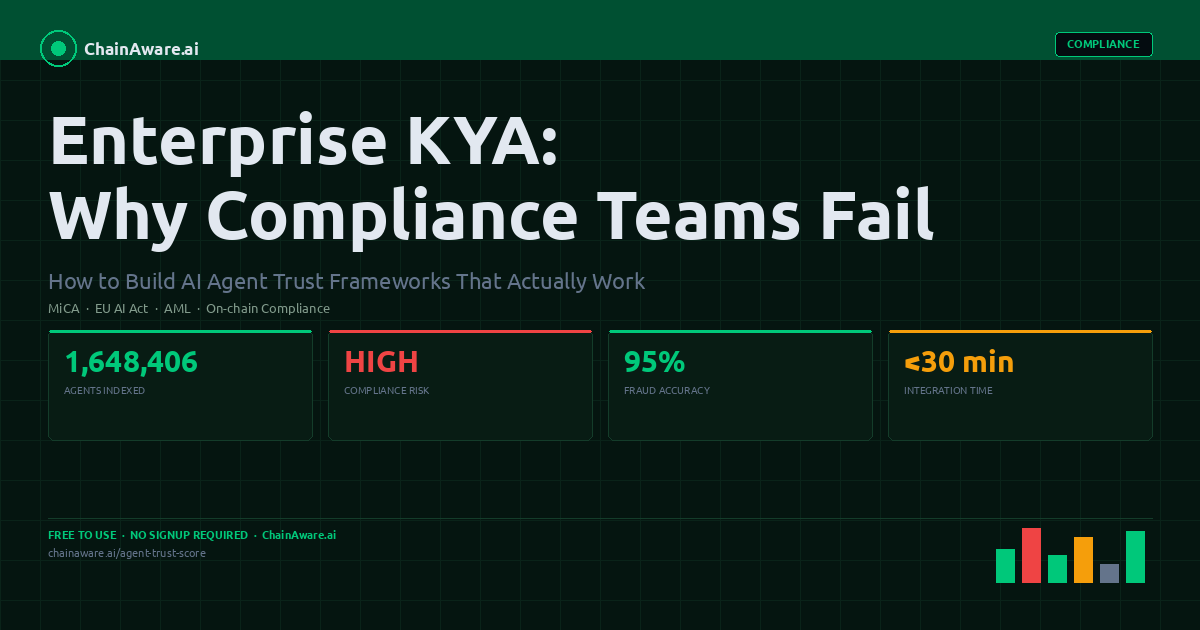
Enterprise risk teams at financial institutions, payment processors, and enterprise software buyers know this problem exists. For the wallet-level screening step, a real-time fraud probability and AML forensics check via predictive_fraud gives risk teams a scored decision they can document and defend. Liability questions become especially urgent once agents move money Where an operator controls many agent wallets at once, predictive_fraud_batch allows all of them to be scored in a single call before any payment is authorised., as analysis of who bears loss in agent-initiated card payments makes clear. They are fielding it in risk committee meetings, in audit findings, and in vendor RFPs that have no established category to file under. Pressure from supervisors is also growing, and the timeline for regulatory KYA mandates under the EU AI Act and MiCA will shape how quickly firms must act. The number of autonomous agents operating on-chain has already reached 1,648,406 indexed by ChainAware — transacting, signing, and moving capital without a single one being screened by any compliance tool designed for the purpose.
That is not a future risk. It is a present exposure.
This article defines what a production enterprise KYA stack looks like, how compliance teams should evaluate vendors entering this space, and why building an in-house capability is not a viable alternative. The compliance teams that resolve this question before the regulatory mandate arrives will own the internal standard. Those that wait will spend 18 months catching up to peers who moved early.
What KYA Is (and Is Not)
Know Your Agent (KYA) is not an extension of Know Your Customer. The distinction is not semantic — it is structural, and conflating the two produces compliance programs with large, invisible holes.
KYC verifies identity at a single point in time: onboarding. It confirms that a person is who they claim to be, runs their identity documents against sanctions lists, and assigns an initial risk tier. That tier is then largely static until the next periodic review or a triggering event. KYC is built for human identity, human documentation, and human-paced behavioral change. It was not designed to assess an autonomous software agent that has no passport, no utility bill, and no beneficial owner relationship that maps cleanly to FATF guidance.
KYA does something categorically different: it assesses behavioral trust continuously, based on on-chain evidence. The three questions it answers are specific and verifiable.
First: who funded this agent’s owner wallet, and what is the provenance of that funding? Funding source is one of the most reliable signals of operator intent. An agent whose owner wallet was funded by a known mixer, a sanctioned address, or a cluster of wallets associated with previous rug pulls carries that provenance forward regardless of what the agent’s stated mandate says.
Second: what is the operator’s on-chain history? Has the controlling address been associated with rug pulls, honeypot contracts, or Sybil farming operations? On-chain history is immutable and cannot be scrubbed. A bad actor who moves to a new agent address does not leave their history behind — the feeder chain connects them.
Third: does this agent’s behavioral fingerprint match known fraud clusters? Transaction patterns, interaction timing, contract call sequences, and gas behavior all produce a fingerprint. When that fingerprint clusters with confirmed fraudulent agents, it is a signal that KYC is structurally blind to.
KYC cannot answer any of these questions. They require on-chain behavioral data at scale — trained across 23 million or more wallet personas — that exists nowhere in any identity document or sanctions database. KYA is a new discipline, requiring new infrastructure and a new vendor category.
The Four Integration Points
A production KYA stack does not operate as a single gate. It integrates at four distinct points in the agent lifecycle, each with different latency requirements, different decision outputs, and different downstream consequences for your risk posture.
Agent Onboarding and Registration
The first integration point is when an agent requests access to your platform. Query the trust score at the moment of registration, before any permissions are granted. An agent scoring in the Elevated Risk tier (200–399) should trigger a human review workflow. An agent scoring Untrusted (0–199) should be blocked automatically, with the decision logged for audit. This is the equivalent of the KYC onboarding gate — but it is based on behavioral evidence, not identity documents, and it can be executed in under 100 milliseconds against a cached score.
Pre-Transaction Screening
The second integration point is real-time, immediately before authorising a payment or executing a smart contract interaction. The latency requirement here is strict: under 100ms for a cached score, with a defined fallback policy for cache misses. This mirrors the transaction screening layer that payment processors apply to card authorisations, and it must be equally reliable. A KYA vendor that cannot meet this latency target in production cannot serve as a pre-transaction control.
Continuous Monitoring
The third integration point is ongoing. An approved agent fleet requires periodic re-screening because trust scores are not static. Operator behavior evolves, new fraud signals accumulate, and funding relationships change. A Provisional agent (400–599) that your platform approved three months ago may have accumulated fraud signals since then. A re-screening cadence — weekly for high-volume agents, monthly for lower-frequency actors — ensures that your approved fleet reflects current behavioral evidence rather than a point-in-time snapshot. This is the control that most enterprises are entirely missing today.
Incident Investigation
The fourth integration point is reactive: when fraud occurs, the KYA stack becomes an investigative tool. Feeder chain tracing allows compliance teams to work backwards from a fraudulent agent to its owner wallet, and then forward to other agents controlled by the same operator. This cross-referencing capability — identifying the full operator network behind a single fraud incident — is not available through any traditional fraud investigation tool. It requires the same on-chain indexing infrastructure that powers the trust score, used in forensic rather than screening mode.
What a KYA Vendor Evaluation Looks Like
The compliance teams now beginning to evaluate KYA vendors are applying procurement criteria developed for adjacent categories — fraud detection, sanctions screening, existing DeFi compliance stacks, and AML analytics — and finding that most of those criteria do not map cleanly. The following are the criteria that actually matter, ranked by their discriminating power in vendor selection.
Chain coverage is the foundational question. A vendor indexing two chains cannot serve an enterprise operating across a multi-chain environment. The minimum viable coverage for an enterprise deployment is 8 chains, indexed continuously with reliable RPC infrastructure. Gaps in chain coverage are gaps in your risk model — an agent that appears clean on the chains you check may have an Untrusted funding history on the chains you do not.
Feeder tracing depth is the most discriminating criterion and the one most vendors cannot meet. Can the vendor trace funding provenance beyond one hop? The benchmark is unambiguous: 67.2% of indexed agents currently have FEEDER_UNKNOWN status, meaning their funding source is obfuscated or untraceable with shallow analysis. A vendor that cannot trace feeders beyond a single hop misses the signal that explains the majority of elevated risk. This is not a minor gap — it is the difference between a screening tool and a compliance control.
Real-time API latency determines whether the vendor can serve as a pre-transaction control. The requirement is under 100ms for a cached score. Ask vendors for p95 and p99 latency figures from production deployments, not benchmark environments.
False positive rate is a production viability question. A vendor flagging 30% of legitimate agents as Elevated Risk will create operational overhead that makes the control unworkable. Request false positive benchmarks against a labeled dataset of known-good agents.
Explainability of flags is a regulatory requirement masquerading as a UX feature. When a compliance officer needs to defend a blocked agent decision to a regulator or a counterparty, they need a human-readable explanation of the specific signals that drove the flag. A score without an explanation is not a defensible compliance decision.
Regulatory defensibility is the final criterion: is the vendor’s methodology published, versioned, and auditable? A black-box model that cannot be explained to an examiner is a liability rather than a control.
Build vs. Buy
The build-versus-buy analysis for KYA resolves quickly when the actual requirements are enumerated. Building an in-house KYA capability is not viable for most enterprises, and the enterprises for which it might be viable would spend resources that cannot be justified against the alternative.
The fraud detection model at the core of a KYA system requires training data at a scale that is not acquirable on a reasonable timeline. ChainAware’s model is trained on 23 million or more wallet personas accumulated across years of continuous indexing across 8 chains. That dataset did not exist at a point in time that could be purchased — it accumulated through continuous indexing of on-chain activity that predates any enterprise build decision by years. A proprietary model built today starts with zero historical coverage and no behavioral baseline.
Feeder tracing requires deep RPC infrastructure across those 8 chains, maintained continuously with the reliability required for a production compliance control. Building and operating that infrastructure is a full engineering organization’s worth of work — not a feature sprint. The database of historical funding relationships that makes feeder tracing meaningful cannot be bootstrapped; it has to be observed in real time, which means you cannot buy your way into it after the fact.
The data network effect compounds the disadvantage permanently. ChainAware’s model improves with every agent scored because the training set grows with coverage. An enterprise building a proprietary model does not benefit from that effect — their model accuracy is bounded by their own transaction volume, which will always be a fraction of the shared registry’s coverage. The gap does not close over time; it widens.
The realistic cost to build an in-house KYA capability to competitive coverage — competitive being defined as sufficient to match a mature vendor’s false positive rate and feeder tracing depth — is eight figures minimum, with a three-year build timeline before the first production deployment. During those three years, 1,648,406 agents are already transacting on-chain, the regulatory environment is moving, and the shared registry is accumulating data network effects that the in-house build cannot replicate.
For the compliance officer defending this decision to a CFO: the build option does not produce a better control. It produces an inferior control at greater cost with longer time to deployment. The correct framing is not build versus buy — it is deploy now versus deploy in three years with worse accuracy.
Regulatory Drivers Accelerating the Decision
Compliance teams waiting for a specific KYA mandate before beginning evaluation are misreading the regulatory trajectory. The mandates that will require documented agent screening are not speculative — they are legible in existing legislation and enforcement guidance that is already in force.
EU AI Act Articles 9 and 13 establish requirements for risk management systems and transparency measures for high-risk AI systems. An autonomous agent executing financial transactions on behalf of a human or institutional principal is precisely the category these articles target. Article 9 requires that risk management systems be established, implemented, and maintained for high-risk AI — a requirement that an undocumented, unscreened agent fleet cannot satisfy. Article 13 requires that high-risk AI systems be designed to allow operators to understand and interpret outputs — a standard that an opaque agent operating without behavioral monitoring does not meet.
MiCA compliance requirements create accountability obligations for AI-driven financial operations that extend to the infrastructure providers and platforms that enable those operations. Financial institutions deploying or hosting autonomous agents for financial purposes face accountability exposure under MiCA that is not mitigated by the absence of a specific agent screening mandate — the obligation attaches to the activity, not to the existence of a named regulation.
Emerging enforcement guidance from EU AI Act supervisory bodies is signalling that documented agent screening at the point of financial authorisation will be an expected compliance control within the next regulatory cycle. That guidance does not yet constitute a mandate. It will. Compliance teams that begin building in response to the signal rather than the mandate will have 18 months of operational experience when peers are still in procurement.
The pattern is identical to PSD2 and open banking. The institutions that treated PSD2 as a compliance burden built the minimum required to satisfy the mandate on deadline. The institutions that treated it as a strategic opportunity built integrations that became competitive infrastructure — faster onboarding, broader payment rail access, better fraud signals. KYA is the same decision point: treat it as a mandate to satisfy eventually, or treat it as infrastructure to build now.
The enterprises that move early will not simply be compliant. They will have trained their models, refined their workflows, and documented their methodologies before the regulatory examination begins. That is a material advantage in an environment where examiner expectations are formed by what leading institutions have already implemented.
What a Production KYA Stack Looks Like
The following reference architecture represents a production-grade KYA integration. It is designed for an enterprise running agentic commerce at scale — a payment processor, a DeFi-integrated financial institution, or an enterprise software platform enabling autonomous agent access to financial APIs.
Step 1: Agent Registry Check
Verify that the agent is registered under ERC-8004 and retrieve its owner address and mandate scope. This step confirms the agent’s declared identity and establishes the owner address that will be used for feeder tracing. An agent that is not registered or whose mandate scope does not match its observed behavior is flagged before the trust score query is issued.
Step 2: Trust Score API Call
Query ChainAware with the agent address and chain ID. The response returns a composite score on a 0–1000 scale, a tier label, and per-signal flags that explain the specific behavioral signals driving the score. This is the agents_trust_score_single call. For agent verification at the transaction layer, the response time against a cached score must be under 100ms. The score is composited from feeder chain analysis, operator history, behavioral fingerprinting against 23 million wallet personas, and cluster comparison against known fraud patterns.
Step 3: Flag Handling
Decision logic maps to tier labels with defined workflow outcomes. Trusted (600–1000): proceed without additional friction. Provisional (400–599): proceed with enhanced monitoring, flag for next re-screening cycle. Elevated Risk (200–399): step-up verification or human review required before proceeding. Untrusted (0–199): block automatically, log decision, initiate incident review. To calibrate the operational reality of these tiers: 148,096 agents currently score Untrusted (0–199), and 1,212,017 score Elevated Risk (200–399). An enterprise running agentic commerce at any meaningful scale will encounter both tiers regularly. The block and review workflows must be operationally ready before the first agent is onboarded, not built in response to the first flagged incident.
Step 4: Audit Log
Every screening decision is recorded with the score, tier label, per-signal flags, agent address, chain ID, and timestamp. This log is the evidence base for regulatory reporting, internal audit, and incident investigation. It also provides the input for the continuous monitoring layer: agents whose scores change materially between screening events are surfaced for review without manual intervention. The audit log is not optional infrastructure — it is the documentation that transforms a screening tool into a defensible compliance control under EU AI Act, MiCA, and any future agent-specific mandate.
ENTERPRISE KYA
Screen AI agents before they transact on your platform.
Use agents_trust_score_single to retrieve the full behavioral composite, tier label and per-signal breakdown in real time. Free tier includes 1,000 queries per month.
Conclusion
The compliance team that solves KYA before the mandate lands owns the internal standard. Their documented architecture — the agent registry check, the trust score integration, the flag handling workflows, the audit log — becomes the template that every new agentic initiative at the institution follows. That is not a small advantage. Internal standards set at the problem-definition stage persist for years. The team that defines the standard controls how the organization responds to every subsequent regulatory development in the agent space.
The vendor that solves KYA before compliance teams formally ask owns the market. That window is open now and it will not remain open. As the regulatory signal strengthens and the first enforcement actions under EU AI Act and MiCA begin to name autonomous agents explicitly, procurement cycles will compress and the evaluation criteria described in this article will become table stakes rather than differentiators.
The operational reality is already here. 1,648,406 agents are indexed and transacting autonomously on-chain. Of those, 148,096 score Untrusted and 1,212,017 score Elevated Risk — a combined 1,360,113 agents that any existing compliance stack would process without a flag, because no existing compliance tool was built to flag them. That exposure exists today, in production, at every enterprise running agentic commerce.
The enterprise that starts building its KYA stack today has an 18-month head start on the peer that waits for a mandate. In a space where the data network effect compounds daily — where every agent scored makes the shared model more accurate, and every feeder chain traced extends the coverage that makes the next trace possible — 18 months is not a small lead. It is the difference between owning the infrastructure and licensing it from someone who built it while you waited.
Start the evaluation now. The agents are already on-chain.
Enterprise KYA
Start your enterprise KYA stack with a free API trial