
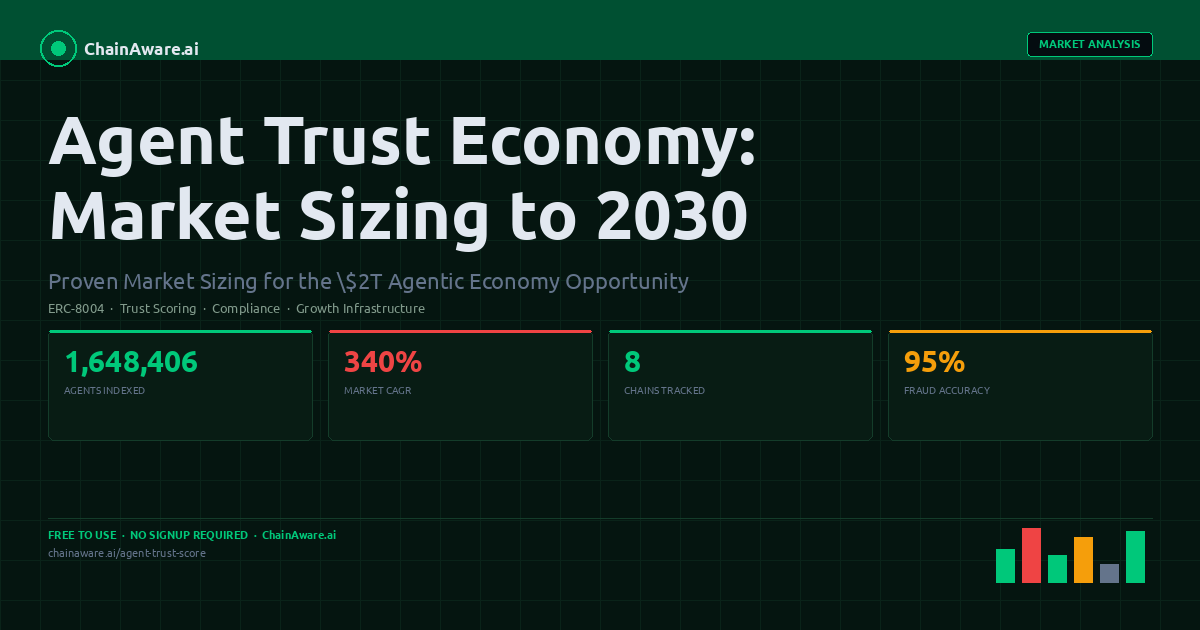
The Agent Trust Economy: Market Sizing to 2030
Markets rarely announce themselves clearly at the moment they emerge. Existing identity tooling was built for humans rather than autonomous software, which is why traditional KYC approaches struggle to govern agent behavior. The compliance infrastructure layer that became mandatory after the 2001 PATRIOT Act took a decade to consolidate into a recognizable industry. The fraud scoring stack that now sits beneath every card transaction was largely invisible to acquirers until it was not. Payment networks are the natural next layer to absorb this, and we explore how card networks can extend their fraud stack to agent trust in detail. The regulatory side of this shift is already visible in the EU, and our breakdown of For teams that need to evaluate a specific autonomous counterparty today, the agents_trust_score_single tool returns a full 0-1000 trust profile for any ERC-8004 agent. KYA regulations under the EU AI Act and MiCA maps the likely mandate timeline. ChainAware.ai is named in the CB Insights AI Fraud Prevention Market Map alongside industry leaders. The pattern repeats: infrastructure becomes mandatory before it becomes legible. Fraud screening is already moving to this layer as well, since the predictive_fraud tool provides real-time AI fraud probability and AML forensics for any wallet. The agent trust economy is at that inflection point now. Enterprises evaluating where this spend lands will find practical guidance in our piece on building an enterprise KYA compliance stack for agent trust.
This article is not a forecast document. It is a market sizing exercise grounded in observable data from live networks, regulatory timelines already published, and transaction volume already running through agentic pipes. The numbers are large. The window for infrastructure positioning is narrowing. And the category dynamics — which we examine in section five — suggest this is a winner-take-most market by architecture. For a deeper look at why early indexing advantages compound over time, see our analysis of the agent trust data moat and first-mover advantage.
The Agent Economy Is Already Here
The word “emerging” no longer applies. As of November 2026, ChainAware’s registry has indexed 1,648,406 ERC-8004 agents across eight chains including Base, BNB Chain, Ethereum, Arbitrum, Polygon, Optimism, Avalanche, and Mantle. Growth is non-linear: a single week in October 2026 (W43) saw 892,924 new registrations — more than the entire registry held earlier in the year. The distribution is concentrated: Operators tracking this concentration can use the agents_trust_score_list tool to filter all registered ERC-8004 agents by trust tier.Base chain dominates the ERC-8004 registry at 71.3% of all agents (1,175,319), BSC holds 25.0% (411,922), and Ethereum 3.4% (56,229). These are not test deployments or developer sandboxes. These are production agents, registered on-chain, interacting with smart contracts, initiating transactions, and in many cases controlling wallets with material balances.
Behind those 1.65 million agents sit 1,457,085 distinct owners. The near one-to-one ratio between agents and owners is itself a data point: this is not a small population of sophisticated operators running large agent fleets. It is a broad deployment wave, driven by the early vision for AI agents reshaping Web3 that builders began articulating in 2024 — and by the convergence of AI and Web3 infrastructure that made those visions executable, with individual developers, small enterprises, protocols, and institutional operators all entering the market simultaneously. The distribution of ownership matters for market sizing because it determines where pricing power resides and which customer segments scale fastest.
The risk profile of that population is not academic. Of the 1.65 million indexed agents, 148,096 carry trust scores below 200 (Untrusted tier) — approximately 9.0% of the total registered population. A further 73.5% score in the Elevated Risk tier (200–399), driven primarily by the 1,107,688 agents (67.2%) with entirely unknown feeder addresses. The weekly ERC-8004 tracker data shows that high-risk flag concentration is not uniform across chains or agent categories. Payment-adjacent agents and cross-chain bridge interactors over-index significantly. This is not a rounding error. At 9.0% Untrusted-tier prevalence and 82.5% combined Elevated Risk or Untrusted, across a population already past 1.6 million, the absolute number of agents that should not be permitted to transact without additional scrutiny is already above 1.3 million.
Gartner has projected that 15% of enterprise transactions will be agent-initiated by 2027. That projection, made against Visa’s reported 2024 payment volume of $14.8 trillion, implies that agent-initiated transaction flow is approaching the scale at which it becomes a first-order concern for every fraud, compliance, and risk team in the payments industry. The question being asked inside those teams is no longer whether agents transact. It is whether the infrastructure exists to assess them before they do.
The ERC-8004 standard is the first on-chain mechanism purpose-built to answer that question at scale. Understanding what it can and cannot tell you is foundational to understanding where the market opportunity is concentrated.
Why Agent Trust Becomes Mandatory Infrastructure
Infrastructure becomes mandatory through one of two routes: regulatory compulsion or liability assignment. In the agent trust case, both are converging simultaneously, which is why the market formation timeline is compressed relative to prior compliance infrastructure cycles.
On the regulatory side, the EU AI Act and MiCA create overlapping obligations that, read together, effectively require operators of automated agents interacting with financial systems to demonstrate that those agents operate within defined risk parameters. The KYA regulatory mandate timeline is not speculative. The compliance deadlines embedded in MiCA’s phased implementation schedule create hard dates by which infrastructure must be in place. Operators who have not solved the agent identification and behavioral monitoring problem by those dates face the same exposure that financial institutions faced when AML obligations first acquired teeth.
On the liability side, the dynamics are playing out through the payments network. The four-party card model — issuer, acquirer, network, merchant — was designed around human cardholders whose identities could be verified and whose behavior could be pattern-matched against fraud models trained on human behavioral signatures. Agentic commerce fundamentally breaks the liability assumptions embedded in that model. When an agent initiates a transaction, the existing chargeback and fraud loss allocation framework assigns liability to parties — typically the merchant or the issuer — who had no meaningful ability to assess the agent’s risk profile before the transaction cleared. This is an unstable equilibrium. Liability will be re-allocated, and the re-allocation will flow toward the party closest to the agent at the point of transaction initiation.
The evolution from KYC to KYA is not a rebranding exercise. The shift from Know Your Customer to Know Your Agent reflects a structural change in the entity being transacting. KYC was designed to verify the identity of a human with a persistent identity, a physical address, and a legal relationship to a financial institution. Agents have none of those properties in the traditional sense. They can be spun up, modified, delegated, re-keyed, and decommissioned in seconds. Identity verification, as conventionally understood, tells you almost nothing useful about whether a specific agent instance running at a specific moment should be trusted with a specific transaction. What you need instead is behavioral trust — a continuous, on-chain, multi-signal assessment of what an agent actually does rather than what it claims to be.
That is precisely what Know Your Agent (KYA) infrastructure is designed to deliver, and why it is correctly understood as the trust layer for the agentic economy rather than simply a compliance product.
Sizing the Market: Three Demand Vectors to 2030
Market sizing for infrastructure categories requires separating the total addressable market from the serviceable addressable market, and then further separating the realistic near-term opportunity from the longer-duration buildout. For agent trust infrastructure, three distinct demand vectors drive the TAM, each with different customer types, different purchasing cycles, and different pricing dynamics.
Vector One: Payment Network Integration
Visa’s 2024 payment volume of $14.8 trillion is the reference figure. If Gartner’s 15%-by-2027 projection is directionally correct, that implies roughly $2.2 trillion in agent-initiated payment flow within approximately 24 months of this writing. Payment networks pricing agent verification at checkout at even a fraction of a basis point against that volume produces a market in the low billions annually at network scale. The more realistic model, which mirrors how fraud-scoring infrastructure has historically been priced into the network stack, suggests per-transaction trust verification fees layered into interchange economics or sold as a premium product to issuers and acquirers.
The case for how payment networks can practically integrate agent trust into their existing fraud stack is detailed, but the core point is architectural: payment networks can add agent trust scoring as an additional signal layer without replacing existing fraud infrastructure. This is not a rip-and-replace sale. It is an additive capability, which dramatically shortens the sales and integration cycle with large network counterparties.
Vector Two: Enterprise Compliance Infrastructure
Every enterprise deploying agentic workflows that touch financial systems, procurement, or regulated data has a pending compliance obligation that does not yet have a standard vendor solution. The Gartner 15%-by-2027 figure applies to the enterprise segment specifically, which means compliance, legal, and technology procurement teams inside Global 2000 companies are currently evaluating how to meet an obligation they cannot yet fully specify because the regulatory text is still being finalized. This is precisely the moment at which infrastructure vendors have historically captured the category: before the RFP is fully formed, when the reference architecture being built by the first few enterprise adopters becomes the de facto standard.
Enterprise compliance infrastructure is typically priced on an annual subscription basis, with pricing driven by the number of agents monitored, the number of transactions scored, and the depth of reporting and audit trail required. For context, the AML transaction monitoring market — a rough structural analog — is currently valued at approximately $3.6 billion annually and growing at 15% per year. The agent trust monitoring market will be distinct but comparably sized at maturity, because the compliance driver is similarly mandatory and the customer base is similarly concentrated in regulated industries.
Vector Three: DeFi and On-Chain Protocol Risk Management
The on-chain segment is the fastest-growing demand vector in absolute agent count terms, as the ERC-8004 registry data makes clear. DeFi protocols, decentralized exchanges, lending platforms, and cross-chain bridges are all experiencing agent-initiated transaction volume that their existing risk frameworks were not designed to handle. The funding chain risk problem — specifically the question of whether the wallets feeding an agent’s operational balance are themselves clean — is an unsolved problem for every DeFi protocol currently processing agent transactions. The addressable market here is smaller in absolute dollar terms than the payment network segment, but the willingness to pay is higher on a per-protocol basis, and the buying cycle is significantly shorter.
Combining these three vectors, a conservative bottom-up estimate for the agent trust infrastructure market by 2030 — defined as the revenue opportunity for trust scoring, monitoring, compliance reporting, and API-based trust verification — sits in the $8–12 billion range globally. That estimate assumes modest penetration of the payment network opportunity, full maturation of the enterprise compliance segment in regulated jurisdictions, and continued growth in the on-chain segment at a decelerating but still substantial rate. It does not assume regulatory mandate expansion beyond currently published timelines, which represents meaningful upside optionality.
The Trust Scoring Stack: Where the Revenue Lives
Understanding where revenue concentrates within the agent trust stack requires a clear picture of the product architecture. The ChainAware Agent Trust Score operates on a 0–1000 scale across five tiers: Sovereign (800–1000), Trusted (600–799), Provisional (400–599), Elevated Risk (200–399), and Untrusted (0–199). The full scoring methodology incorporates on-chain behavioral signals, funding chain analysis, cross-chain activity patterns, delegation history, and anomaly detection against population-level baselines.
The median trust score of new agents entering the registry is 101 — squarely in the Untrusted tier. This is not surprising. New agents, by definition, have no behavioral history. They have not accumulated the on-chain evidence of consistent, non-anomalous behavior that moves a score into Provisional territory and above. The scoring system is designed to be earned over time, which creates a durable, recurring revenue dynamic: agents require ongoing monitoring to maintain and improve their scores, not a one-time verification event.
This distinction — ongoing behavioral trust versus point-in-time identity verification — is where the revenue model diverges from traditional KYC infrastructure. KYC is fundamentally a one-time or periodic identity check with a binary pass/fail output. KYA versus agent identity is not a semantic distinction. It reflects a fundamentally different product architecture that generates continuous, subscription-equivalent revenue rather than transactional verification fees.
The revenue stack has four identifiable layers. The first is the core scoring API — per-call pricing for real-time trust score queries at the point of transaction, analogous to fraud scoring API pricing in the existing payment infrastructure ecosystem. The second is continuous monitoring subscriptions — recurring fees for ongoing behavioral surveillance of registered agents, flagging anomalies, score changes, and high-risk events. The third is compliance reporting and audit trail infrastructure — the documentation layer that regulated enterprises and financial institutions need to demonstrate to regulators that they have exercised appropriate due diligence on agents operating within their systems. The fourth, and highest-margin, layer is the data network effect itself: as the registry grows, the population-level behavioral baseline against which individual agents are scored becomes more accurate, more defensible, and more valuable as a proprietary dataset.
The comparison with existing blockchain analytics infrastructure is instructive. ChainAware versus Chainalysis is not a straightforward product comparison — the use cases overlap in some compliance dimensions but diverge sharply in the agent behavioral trust domain. The more relevant structural comparison is to the fraud scoring stack itself: a relatively small number of data-rich infrastructure providers capturing disproportionate value because network effects and data moats make switching costs prohibitive after initial adoption.
Why This Market Does Not Have a Second-Place Finish
Infrastructure markets with strong network effects and regulatory mandates tend to consolidate rapidly around one or two providers. The agent trust infrastructure market has characteristics that suggest even faster consolidation than prior analogous markets.
The first consolidating force is the registry itself. The agent trust infrastructure race is ultimately a race to build the most comprehensive, most accurate behavioral dataset on on-chain agents. The provider with the largest indexed population — currently 1.65 million agents and growing rapidly
The Compounding Effect: Why the Market Grows Faster Than Agent Adoption
Most TAM models for the agentic economy make a quiet assumption: that demand for trust scoring scales roughly one-to-one with the number of agents deployed. That assumption is wrong — and understanding why it’s wrong is the difference between reading this market correctly and dramatically underestimating it.
The market for a trust layer for the agentic economy grows super-linearly. Three compounding dynamics explain why.
First, platform-level intake requirements create ecosystem-wide demand in a single decision. When a marketplace, API gateway, or enterprise platform mandates trust scoring at the point of agent onboarding, that requirement doesn’t apply only to new agents — it applies to every agent that wants access. One platform policy instantly converts a passive addressable market into active, urgent demand across the entire ecosystem of agents seeking entry. As more platforms adopt this posture, the network effect accelerates: agents that aren’t scored become progressively locked out of agentic commerce, turning trust scoring from a differentiator into a baseline requirement for participation.
Second, regulatory mandates will land as step-change demand events, not gradual ramps. Regulation doesn’t grandfather existing deployments — it sets a compliance date and applies to everything in production. Fleet operators who assumed they had time to build trust infrastructure incrementally will face a hard deadline covering agents already in the field. We’ve mapped out the most likely regulatory mandate timeline across the EU AI Act, MiCA, and emerging agent-specific frameworks — and the window before that step-change is shorter than most teams expect.
Third, large fleet operators face super-linear compliance costs without automation. A company managing hundreds or thousands of agents under a per-agent trust mandate cannot solve that problem with manual review. The compliance burden scales with fleet size in a way that makes automated scoring infrastructure not just convenient but economically necessary. This dynamic means the highest-value customers in the agentic economy are also the customers most incentivized to adopt trust scoring at scale — compressing the sales cycle and expanding contract size simultaneously.
Taken together, these three forces mean the TAM for trust scoring doesn’t just grow alongside the agentic economy — it repeatedly outruns it, resetting to a higher baseline with each platform adoption cycle and each regulatory trigger that follows.
AGENT TRUST SCORE
Score any ERC-8004 agent in seconds. Free tier — 1,000 queries per month, no signup required.
Explore the Agent Trust Score →Agent Trust Economy
Score any ERC-8004 agent across 8 chains — free tier, no signup