
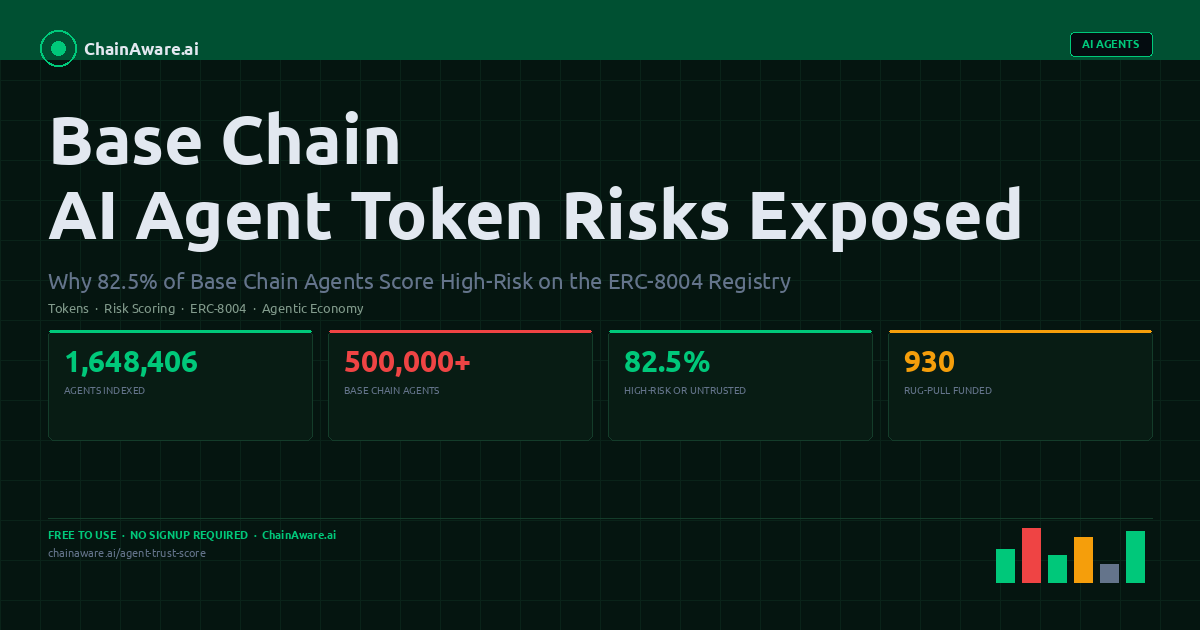
Base is now home to 1,175,319 ERC-8004 registered AI agents
Given this scale, it is worth studying the recurring fraud patterns surfaced by the ERC-8004 weekly tracker to understand what risky registrations tend to look like.
— 71.3% of the entire global onchain AI agent registry. That is not a rounding error. It is a structural fact about where the agentic economy is consolidating. In a single week — Week 43 of 2026 — the Base registry absorbed 892,924 new agent registrations. And yet most of those agents have never been verified, scored, or evaluated for Checking any individual agent before you transact is now practical, since the agents_trust_score_single tool returns a full 0-1000 trust profile for one ERC-8004 agent. trustworthiness.Registration alone says little about behavior, and our analysis of For wallets tied to these agents, the predictive_fraud tool provides real-time fraud probability and AML forensics to surface risky behavior that registration data alone cannot show. what ERC-8004 trust signals can and cannot reveal explains why.
If you are building on, investing in, or interacting with Base chain AI agent tokens and the agentic economy, the gap between agent volume and agent trust infrastructure is the defining risk of 2026.For a broader look at how autonomous agents are taking over functions once handled by people, see our guide to how AI agents are replacing Web3 growth teams.
This guide covers what is actually happening with AI agent tokens on Base
Before any agent is allowed to transact, the first question is whether it can be trusted, as explored in why trust, not integration, is the first step in agentic commerce.
, what the ERC-8004 standard means in practice, how to evaluate any Base agent before interacting with it, and what ChainAware’s real-time Agent Trust Score reveals about the current state of the ecosystem. For the broader context of how AI agents are replacing human functions across Web3, see our Web3 Agentic Economy guide.What Are AI Agent Tokens on Base?
An AI agent token on Base is a smart contract — registered under the ERC-8004 standard — that represents an autonomous software agent operating onchain.
Having an identity record is not the same as being trustworthy, a distinction we unpack in why agent identity does not equal trust.
Unlike a typical ERC-20 token that represents a fungible financial asset, an AI agent token encodes the agent’s identity, its declared capabilities, its operator wallet, and its metadata in a structured registry entry that other protocols and agents can query programmatically.The ERC-8004 standard was designed to solve a specific problem: as AI agents began executing transactions, managing DeFi positions, and interacting with protocols autonomously, there was no standardized way for a protocol to verify what it was actually dealing with. Was this an agent with a track record? An agent operated by a known entity? An agent that had been active without incident for six months — or one that had just been registered three hours ago? ERC-8004 creates the registry layer that makes answering those questions possible. It does not, by itself, answer them — that requires a trust scoring system built on top of the registry data, which is what ChainAware’s Agent Trust Score provides.
The Scale of Base’s Agent Economy
ChainAware tracks the global ERC-8004 registry across 8 blockchains in real time. As of November 2026, the numbers tell a striking story about Base’s dominance:
| Chain | ERC-8004 Agents | % of Global Registry | Avg Trust Score |
|---|---|---|---|
| Base | 1,175,319 | 71.3% | 273.6 |
| Ethereum | ~290,000 | ~17.6% | Higher (more history) |
| Other chains | ~183,000 | ~11.1% | Varies |
| Global total | 1,648,406 | 100% | — |
The concentration is explained by three forces. First, Base’s near-zero gas costs after the Dencun upgrade made mass agent registration economically trivial. Second, a single platform — centralcity.ai — accounts for 1,051,344 Base registrations, roughly 63.8% of the entire global registry. Third, the Week 43 2026 registration event added 892,924 agents in seven days — more new agents than most chains have accumulated in total. That velocity is the agentic economy in compressed form: fast, permissionless, and almost entirely unvetted.
The Trust Problem: 93.2% of Base Agents Are Elevated Risk
ChainAware’s Agent Trust Score uses a 0–999 scale with five tiers:
- Verified (700–999): Extended on-chain history, funded operator wallet with traceable identity, cross-chain corroboration, metadata resolves cleanly
- Established (500–699): Active economic history, some cross-chain presence, no fraud signals
- Standard (400–499): Limited history but structurally valid, no active red flags
- Elevated Risk (200–399): Valid registration, almost no additional verifiable signal — unknown rather than known-bad
- High Risk (0–199): Active fraud signals, manipulation patterns, or structural violations
Base’s average trust score is 273.6. 93.2% of Base agents score between 200 and 399 — Elevated Risk. This does not mean 93% of Base agents are malicious. It means they are essentially unknown: valid registry entries with minimal behavioral history, no funded operator wallet with traceable provenance, and no cross-chain corroboration. In the agentic economy, unknown is a risk category — particularly when these agents may be requesting permissions, executing trades, or managing assets on behalf of a user or protocol.
The agents that score above 400 on Base share a common profile: active operator wallets with meaningful transaction histories, cleanly resolving metadata, multi-block or multi-epoch activity rather than batch registration, and in many cases cross-chain presence that provides corroborating identity signal. These are agents that have earned their scores through demonstrated onchain behaviour.
How to Evaluate Any Base Chain AI Agent Token
Before interacting with, integrating, or investing in any Base AI agent token, check five signals:
1. Agent Trust Score
The single most important check. A score above 500 (Established tier) means the agent has demonstrated meaningful onchain activity with no active fraud signals. A score below 300 means you are dealing with an essentially unverified entity — act accordingly. Check any agent at chainaware.ai/agent-trust-score.
2. Contract Audit
Use ChainAware’s Token Audit to check the agent’s underlying contract for hidden mint functions, ownership concentration, proxy upgrade patterns, and other structural risk signals. The audit runs in seconds and is free. For the full taxonomy of token risks, see our guide to identifying fake crypto tokens.
3. Operator Wallet History
The ERC-8004 registry links each agent to an operator wallet. A funded operator wallet with 6+ months of legitimate DeFi activity is a strong positive signal. A fresh wallet funded from a known mixer, or a wallet that has operated rug pull contracts in the past, is a critical red flag regardless of how the agent itself looks.
4. Liquidity Depth and Distribution
For agent tokens with associated liquidity pools, check whether liquidity is locked, the depth relative to market cap, and holder concentration. A top-10 holder owning 40%+ of supply in an unlocked pool is the classic pre-rug pattern. ChainAware’s Token Rank captures holder concentration and liquidity signals automatically.
5. Fleet Pattern Analysis
Many low-trust Base agents were registered in bulk — the same operator registering thousands of agents in a single transaction batch. If the agent you are evaluating shares operator metadata with thousands of near-identical registrations, it is likely part of a fleet rather than a purpose-built autonomous agent. ChainAware’s scoring model detects fleet patterns and applies them to trust tier placement. For the full methodology, see the Agent Trust Score for agentic commerce post.
ChainAware’s Agent Trust Score: Real-Time Ratings for Every ERC-8004 Agent
ChainAware indexes the full global ERC-8004 registry and scores every agent in real time. The trust score combines six signal categories: on-chain activity history, wallet linkage quality, metadata completeness, fleet-pattern detection, data feed resolution, and cross-chain corroboration. Scores update continuously as new blockchain data arrives — a score from last week may be different from a score today if the agent has been active in the interim.
For DeFi protocols and AI marketplaces that need to verify agent counterparties programmatically, the Agent Trust Score is available via REST API and Prediction MCP — enabling trust checks to be embedded directly into agent workflows, protocol onboarding flows, or autonomous decision pipelines. For a complete technical walkthrough of how the score is calculated, see our Agent Trust Score documentation.
ChainAware Agent Trust Score
Check Any Base Chain AI Agent Before You Interact
Real-time trust ratings for every ERC-8004 agent across 8 blockchains. 0–999 score, five risk tiers, continuous updates as onchain data changes.
Check Agent Trust Score →