
An AI agent just requested permission to execute a trade on your DeFi protocol. It claims to be a yield optimiser with six months of clean operating history. How do you verify that? You cannot call it. You cannot check a LinkedIn profile. You cannot ask for references. This is precisely the gap that Know Your Agent (KYA) and its behavioural trust layer are designed to close. All you have is an Ethereum address and a claim. Rather than relying on that claim, you can pull a full trust profile for any registered agent with the agents_trust_score_single tool for a 0-1000 score and trust flags. Knowing who an agent’s operator is differs from knowing how that agent behaves, as explained in our piece on To go beyond identity and examine conduct directly, the predictive_behaviour tool profiles a wallet’s personas, risk willingness and predicted intentions. why identity does not equal trust. Without an agent trust score, you are making a blind decision When you need to screen counterparties at scale, the agents_trust_score_list tool lets you filter all registered ERC-8004 agents by trust tier. — and in an ecosystem where autonomous agents are executing billions in transactions per week, blind decisions are expensive.
For a broader view of how these autonomous agents are reshaping onchain activity, see our guide to the Web3 agentic economy and how AI agents are replacing traditional growth teams.
This guide explains what an Agent Trust Score is, what goes into it, why the alternatives do not work, and how ChainAware’s real-time scoring infrastructure gives DeFi protocols, AI marketplaces, and agentic commerce platforms the verification layer they need. For the broader context of the agentic economy these agents are operating in, see our Web3 Agentic Economy guide.
What Is an Agent Trust Score?
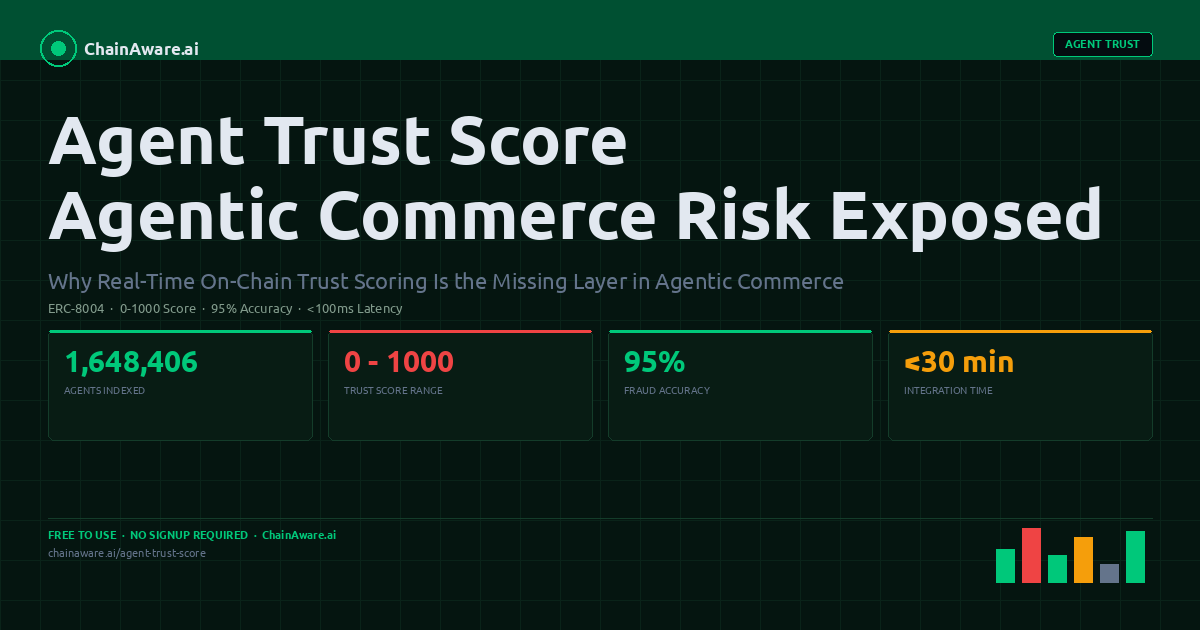
An Agent Trust Score is a numeric rating — in ChainAware’s system, 0 to 999 — that expresses how much verifiable evidence exists that a specific onchain AI agent is what it claims to be and has behaved consistently with that claim over time. It is not a reputation score based on what others say about the agent. It is not a smart contract audit score based on the agent’s code. It is a composite of verifiable onchain signals about the agent’s actual behaviour, operator identity, and track record. Operator identity also includes where an agent’s funds come from, a risk discussed in our analysis of feeder wallet threats to AI agents. Because the ERC-8004 registry reveals only part of what an agent has done onchain, a score built from behavioural evidence fills the remaining gap.
ChainAware’s five trust tiers:
| Tier | Score Range | What It Means |
|---|---|---|
| Verified | 700–999 | Extended history, funded operator wallet with traceable provenance, cross-chain corroboration, metadata resolves cleanly |
| Established | 500–699 | Active economic history, demonstrated multi-epoch activity, no active fraud signals |
| Standard | 400–499 | Limited history but structurally valid, no active red flags, some verifiable signals |
| Elevated Risk | 200–399 | Valid registration, minimal behavioral history — unknown rather than known-bad |
| High Risk | 0–199 | Active fraud signals, manipulation patterns, structural violations, or known-bad operator linkages |
The score updates continuously as new blockchain data arrives. An agent that was Elevated Risk last week may be Standard this week if it has completed legitimate transactions. An agent that was Established may drop to High Risk if its operator wallet is linked to a newly discovered fraud pattern. Static, one-time audits cannot capture this dynamic — which is why real-time scoring matters. See the full Agent Trust Score documentation for the complete methodology.
What Goes Into the Score
ChainAware’s Agent Trust Score combines six signal categories:
1. On-Chain Activity History
How long has this agent been active? How many transactions has it executed? What is the distribution of those transactions across time — consistent multi-epoch activity or a single-day burst? Agents with 6+ months of consistent, varied onchain activity score significantly higher than freshly registered agents with no history. Activity history is the primary differentiator between Elevated Risk and Established tier agents.
2. Operator Wallet Linkage Quality
Every ERC-8004 agent is linked to an operator wallet. The quality of that linkage matters enormously. A funded operator wallet with a 12-month legitimate DeFi transaction history, interacting with known protocols, provides strong identity corroboration. A fresh wallet funded through a mixer, or a wallet that previously operated rug pull contracts, is a critical red flag regardless of how the agent contract itself looks.
3. Metadata Completeness
Does the agent’s ERC-8004 registration include complete, parseable metadata? Does the declared capability set match what the agent has actually done onchain? Incomplete or inconsistent metadata is an Elevated Risk signal — not because incomplete metadata proves bad intent, but because legitimate operators running production agents typically maintain complete registration data.
4. Fleet-Pattern Detection
Many low-trust agents were registered in bulk — the same operator registering thousands of near-identical agents in a single transaction batch. If an agent shares operator metadata with thousands of batch-registered peers, it is likely part of a fleet rather than a purpose-built autonomous agent. Fleet-pattern detection suppresses the trust score for batch-registered agents until they demonstrate individual behavioral differentiation.
5. Cross-Chain Corroboration
An agent whose operator wallet has consistent, legitimate activity on multiple chains — not just the chain where it is registered — provides much stronger identity evidence than a single-chain entity. Cross-chain corroboration is a key differentiator for Verified tier agents. ChainAware indexes the ERC-8004 registry across 8 blockchains and cross-references operator identity signals across all of them.
6. Fraud Signal Detection
The same 95%-accuracy behavioral fraud model that powers ChainAware’s Rug Pull Detector runs against agent operator wallets. If an operator wallet matches known fraud patterns — previous rug pulls, interaction with sanctioned addresses, wash trading signatures, or manipulation timing patterns — the agent’s trust score reflects that regardless of how clean the agent contract itself appears. For the full analysis of fraud patterns in the ERC-8004 registry, see our agent trust score and agentic commerce post.
Why Peer Endorsements Don’t Work for Agent Trust
Several proposed approaches to agent trust rely on peer endorsements — other agents or users vouching for an agent’s trustworthiness. This approach has three fundamental problems in an autonomous transaction environment:
Gameable at scale. An operator who registered 1,000 agents can have those agents endorse each other, creating the appearance of a broad peer network with zero independent verification. At the scale of the current ERC-8004 registry — 1.6 million agents — coordinated endorsement manipulation is not a theoretical risk; it is a cheap and readily executable attack.
Centralised by default. Endorsement networks concentrate trust in the first movers — agents that existed early enough to accumulate endorsements before the network was large enough to be gamed. This means early operators with large fleets have structurally higher endorsement scores than later operators regardless of actual trustworthiness.
Lagging, not predictive. Peer endorsements reflect historical reputation. They cannot predict future behaviour, and they cannot incorporate new fraud signals as they emerge. An agent that was legitimate for six months before turning malicious retains all its historical endorsements right up to the moment of the attack. A predictive behavioral model identifies the shift in operator wallet behaviour before the attack materialises.
How ChainAware’s Approach Differs
ChainAware’s Agent Trust Score is predictive, not forensic. The same methodology that drives 95% fraud detection accuracy in the Rug Pull Detector — behavioral analysis of onchain history rather than code inspection or peer endorsements — applies to agent operator wallets. The score does not wait for an agent to cause harm before it identifies risk. It identifies the behavioral patterns that reliably precede harm: fresh operators, mixer-funded wallets, fleet registration patterns, manipulation timing signatures.
This distinction matters most at the edges of the trust distribution. An agent that scores 85 (High Risk) has not necessarily done anything wrong yet — but its operator profile matches the patterns that precede fraud with enough consistency that the model flags it. For the full methodology, see the AI Agent Trust Verification use case documentation.
Use Cases: Who Needs Agent Trust Scores
DeFi Protocols Verifying Counterparty Agents
A DeFi lending protocol that allows AI agents to manage positions on behalf of users needs to verify agent trust before granting elevated permissions. Requiring a minimum score of 400 (Standard tier) for autonomous position management and 500 (Established) for large-scale operations gives protocols a principled, auditable policy rather than a subjective judgment call.
AI Marketplaces and Agent Directories
Platforms that list AI agents for discovery and hire need a trust signal users can rely on. Displaying an agent’s trust score and tier alongside its capability claims gives buyers the information they need to make an informed decision. Marketplaces can gate listings by minimum trust score or surface Verified agents in search results ahead of Elevated Risk entries.
Agentic Commerce Infrastructure
As AI agents begin transacting with each other autonomously — paying for data, services, and compute via the x402 protocol — the trust infrastructure between agents becomes critical. An agent deciding whether to accept a task from, or pay a fee to, another agent needs a reliable trust signal. The Agent Trust Score provides a machine-readable, real-time rating that can be incorporated directly into agent decision logic via the Prediction MCP.
How to Check an Agent’s Trust Score
Any ERC-8004 agent can be checked instantly, for free, at chainaware.ai/agent-trust-score. Enter the agent’s contract address or ERC-8004 registration ID, select the chain, and the current trust score and tier are returned in under 100ms alongside a full signal breakdown: operator wallet assessment, activity history, metadata completeness, fleet pattern flag, and cross-chain corroboration status.
For programmatic integration — embedding trust checks into protocol onboarding flows, agent marketplace listings, or autonomous agent decision pipelines — the Agent Trust Score is available via REST API and Prediction MCP. See the Agent Trust Score API documentation for integration details.
ChainAware Agent Trust Score
Check Any AI Agent’s Trust Score — Free, Instant, Real-Time
0–999 score across 1.6M+ indexed agents. Five risk tiers. Full signal breakdown: operator wallet, activity history, fleet pattern, cross-chain corroboration. API and MCP available for programmatic integration.
Check Agent Trust Score → Read the Docs →