
You run a campaign. You pick a crypto ad network, set a budget, write the creatives, and watch the traffic come in. Wallet connections tick up. But transactions? Flat. Revenue? Unchanged.
Welcome to the most common — and most expensive — problem in Web3 marketing.
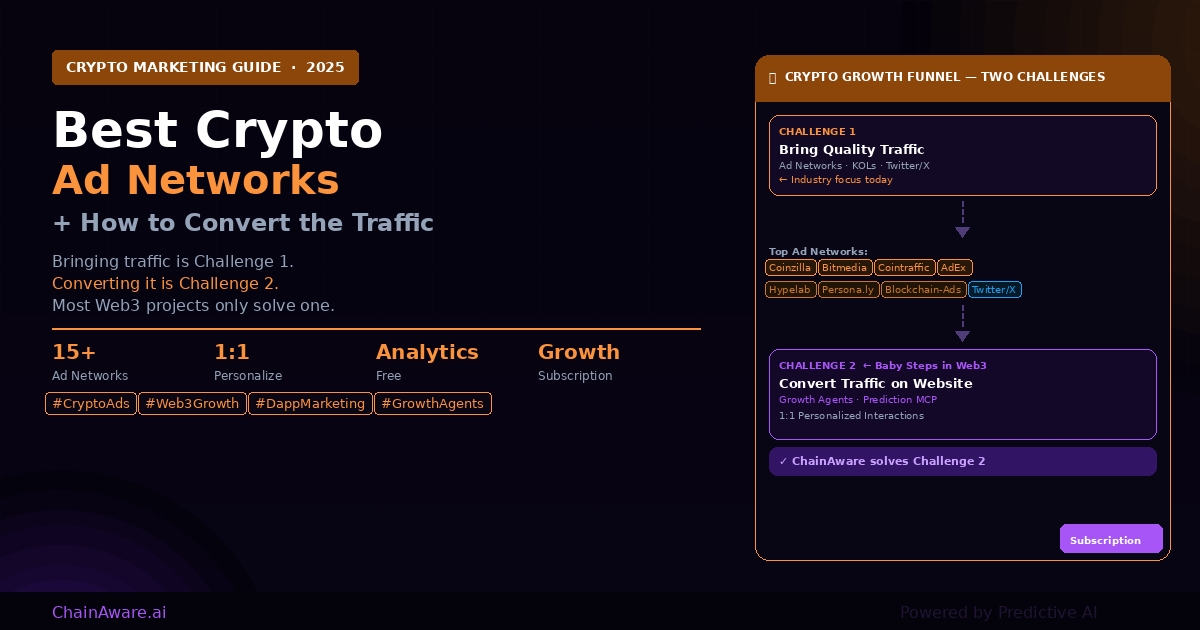
The crypto industry has built an impressive ecosystem of advertising networks, KOL agencies, and growth tools all focused on one goal: bringing traffic to your Dapp or AI Agent. And they do it reasonably well. But they stop at the door. What happens once a user lands on your platform — whether they stay, understand your product, trust it, and transact — is almost entirely ignored.
This guide covers both sides of the problem: every major crypto advertising network you should know, and — critically — what you need to do after the traffic arrives.
The Two Challenges of Crypto Marketing
Every Web3 marketing strategy must solve two fundamentally different problems. Most teams solve only the first one.
Challenge 1: Bring Quality Traffic to Your Dapp or Agent
This is where the entire crypto marketing industry has focused its energy. Ad networks, KOL campaigns, Twitter/X promotion, Discord community building, Telegram groups, airdrop campaigns, conference sponsorships — all of these are solutions to Challenge 1. They are designed to put your project in front of relevant audiences and drive wallet connections and page visits.
The ecosystem for Challenge 1 is mature. There are dozens of specialist crypto ad networks, hundreds of KOL agencies, and well-established playbooks for every sub-sector of Web3. We cover all of them in this guide.
Challenge 2: Convert That Traffic on Your Website
This is where Web3 is still in its infancy. Once a user lands on your Dapp, connects their wallet, and starts exploring — what happens? In almost every Web3 project, the answer is: the same thing happens as for every other user. The interface is identical. The messaging is generic. The calls to action are one-size-fits-all.
But the users are not identical. A wallet with three years of DeFi experience, high risk willingness, and a history of leveraged yield farming is a fundamentally different visitor than a wallet created last month with two token swaps to its name. Showing them the same homepage, the same product explanation, and the same CTA is a conversion failure waiting to happen — for both of them.
According to McKinsey’s research on personalization, companies that get personalization right generate 40% more revenue than those that don’t. In Web3, where user acquisition costs are high and generic interfaces convert poorly, this gap is even wider — and almost no one is addressing it.
ChainAware.ai’s mission is to solve Challenge 2. Not instead of ad networks — alongside them. You still need traffic. But you also need to convert it. That’s where Growth Agents, the Behavioral Prediction MCP, and Web3 Behavioral Analytics come in. More on that after we cover the networks.
Challenge 2 — Solved
Bringing Traffic Is Only Half the Battle
ChainAware Growth Agents look at every connecting wallet, generate resonating personalized content, and deliver the right CTA to the right user — automatically. Convert the traffic you’re already paying for.
The Complete List of Crypto Advertising Networks
These are the dedicated crypto and Web3 advertising platforms — networks built specifically for blockchain projects, with targeting, compliance, and audience profiles suited to DeFi, NFT, GameFi, and broader crypto audiences. Each has different strengths in terms of format, reach, targeting capability, and minimum spend.
1. Blockchain-Ads
Blockchain-Ads is a programmatic platform that combines on-chain data with traditional programmatic targeting to reach crypto audiences across mainstream web inventory — not just crypto sites. It claims to reach wallets across the broader web based on their on-chain fingerprint.
Best for: Campaigns that want to reach crypto-active users wherever they are on the web, not just on crypto media sites.
Targeting: Wallet holdings, DeFi activity, NFT ownership, chain preferences, and standard demographic/geo targeting.
Minimum spend: $1,000/month.
Notable: One of the few networks that attempts to bridge on-chain identity with off-chain ad targeting — conceptually similar to what ChainAware does on-site, but applied to the acquisition side.
2. Bitmedia
Bitmedia is a crypto-specialized display and native advertising network with over 5,000 crypto and blockchain websites in its publisher network. It offers self-serve campaign management with real-time analytics and fraud detection built in.
Best for: Mid-size campaigns that need flexible targeting without a large minimum commitment.
Targeting: Geo, device, interests, keywords, and audience behavioral segments.
Minimum spend: $20/day — one of the most accessible entry points for smaller projects.
Notable: CPM and CPC models available. Strong fraud filtering to reduce bot traffic — particularly relevant given the quality-of-traffic problem in crypto advertising.
3. Cointraffic
Cointraffic has been serving the crypto advertising market since 2014, making it one of the oldest networks in the space. It focuses on premium crypto and finance publishers with strict quality controls on both advertiser and publisher sides.
Best for: Token launches, exchange promotions, and DeFi protocol awareness campaigns targeting informed crypto investors.
Targeting: Geo, language, device, and publisher category.
Minimum spend: €100 minimum deposit.
Notable: Strong European and global reach. Known for clean, well-maintained publisher inventory.
4. AdEx Network
AdEx is a decentralized advertising protocol built on Ethereum, offering a trustless, transparent alternative to traditional ad networks. Publishers and advertisers interact via smart contracts, with on-chain verification of ad delivery and payments in ADX tokens or stablecoins.
Best for: Web3-native projects that want transparent, verifiable ad delivery and prefer decentralized infrastructure. Strong alignment with DeFi and privacy-focused audiences.
Targeting: Audience segments via publisher-side targeting; growing network of crypto and Web3 sites.
Notable: On-chain reporting makes it impossible to fake impressions — directly addressing the fraud problem inherent in traditional ad networks. Excellent for projects whose audience cares about decentralization.
5. HypeLab
HypeLab is a Web3-native programmatic advertising platform designed specifically for Dapps and blockchain-based products. Unlike traditional networks that place ads on crypto news sites, HypeLab serves ads directly within Web3 applications — wallets, DEXs, NFT platforms, and DeFi protocols.
Best for: Reaching users at the moment of on-chain activity, not just when they’re reading about crypto. Ideal for DeFi protocols targeting active DeFi users rather than spectators.
Targeting: Wallet behavior, on-chain activity type, protocol category, and asset holdings.
Notable: The most sophisticated behavioral targeting available in a crypto ad network — users are segmented by their actual on-chain activity, not just the websites they visit.
6. Persona.ly
Persona.ly is a mobile-first performance advertising platform with strong coverage in the crypto and GameFi space. It specializes in user acquisition for crypto apps, exchanges, and play-to-earn games on mobile platforms.
Best for: Mobile crypto app installs, exchange user acquisition, and GameFi player acquisition.
Targeting: Device, geo, demographic, interest, and lookalike audiences based on high-value user profiles.
Notable: Strong anti-fraud technology and transparent attribution. Performance-based pricing (CPI/CPA) aligns incentives with actual user acquisition rather than impressions.
7. Coinzilla
Coinzilla is one of the largest and most established crypto-native ad networks, operating since 2016. It serves display advertising across a premium network of crypto media sites including Coindesk, Cointelegraph, and Bitcoin.com. Formats include banners, native ads, and pop-unders.
Best for: Brand awareness and broad reach across mainstream crypto audiences. High-volume campaigns targeting anyone engaged with crypto news and price tracking.
Targeting: Geo, device, category, and publisher-level targeting.
Minimum spend: €50/day.
Notable: Strict advertiser vetting process — no gambling or unregulated financial products. Excellent for legitimate DeFi and Web3 projects needing premium placement.
8. CoinAd
CoinAd is an invite-only display advertising network with a carefully curated set of premium crypto publishers. Its exclusivity model means inventory quality is high, but access requires approval from the network.
Best for: Established projects with a track record that can pass the invite-only vetting process. Premium brand placement alongside top-tier crypto content.
Notable: Low volume but high quality. The invite-only model filters out lower-quality advertisers, which generally means better audience receptivity.
9. Adshares
Adshares is a decentralized advertising ecosystem built on its own blockchain, enabling direct advertiser-to-publisher relationships without an intermediary. It supports display ads, native ads, and metaverse/virtual world advertising placements.
Best for: Projects targeting metaverse, gaming, and virtual world audiences. Also strong for Web3 projects that want decentralized ad infrastructure with transparent payment flows.
Notable: One of the few networks with dedicated metaverse ad placements — a niche but growing category as Web3 gaming expands.
10. A-ADS (Anonymous Ads)
A-ADS is one of the original crypto advertising networks, operating since 2011. It is fully anonymous — no account required to advertise, Bitcoin payments only, and no tracking or cookies. It serves a large network of crypto and privacy-focused publisher sites.
Best for: Projects targeting privacy-conscious crypto users. Also useful for advertisers who cannot or prefer not to submit KYC documentation to ad networks.
Targeting: Minimal — category and geo only. The anonymous model limits sophisticated targeting.
Notable: Extremely low entry cost. Good for testing messages with broad crypto audiences before investing in more targeted campaigns.
11. DOT Audience
DOT Audience is a Web3 data and advertising platform that builds audience segments from on-chain wallet data and deploys them across programmatic advertising channels. It bridges the gap between on-chain identity and real-world ad targeting.
Best for: Data-driven campaigns where the advertiser wants to reach specific wallet behavior profiles — DeFi whales, NFT collectors, specific protocol users — via standard display advertising.
Notable: One of the more sophisticated audience-building tools in the crypto ad ecosystem, using on-chain data as the basis for targeting rather than cookie-based behavioral data.
12. Slise
Slise is a Web3-native ad network that serves ads inside Dapps — DEX interfaces, wallet UIs, and DeFi dashboards — targeting users based on their wallet activity at the moment of on-chain interaction. Similar positioning to HypeLab, with focus on in-Dapp placements.
Best for: Reaching active DeFi and DEX users in their native environment during active sessions.
Notable: In-Dapp placements tend to reach higher-quality, more engaged users than display ads on news sites — the audience is actively using Web3 infrastructure when they see the ad.
13. Mintable Ads
Mintable Ads focuses specifically on NFT and Web3 gaming audiences, offering ad placements across NFT marketplaces, gaming platforms, and creator economy sites. It provides both display and sponsored content formats.
Best for: NFT projects, Web3 games, and creator tools targeting collectors, players, and digital artists.
Notable: Highly specialized audience — less useful for DeFi or exchange products but strong for NFT and GameFi-specific campaigns.
Before You Spend on Ads — Know Your Baseline
Are Your Campaigns Bringing the Right Users?
Web3 Behavioral Analytics shows you the real profile of every wallet connecting to your Dapp — intentions, experience, risk tolerance, Wallet Rank. Establish your baseline before any campaign. Measure quality, not just volume. Free, Google Tag Manager setup.
Twitter/X: Still the Crypto Native Channel
No guide to crypto advertising is complete without addressing Twitter/X — the de facto home of crypto culture, where projects are made and broken in real time. While not a dedicated crypto ad network, Twitter/X is the single most important paid and organic channel for most Web3 projects.
Twitter/X Paid Advertising
Twitter/X Ads allows crypto projects to run promoted tweets, follower campaigns, and app install campaigns targeting self-identified crypto and finance audiences. After a turbulent period of restrictions on crypto advertising (2018-2021), Twitter/X has progressively reopened its platform to blockchain and DeFi advertisers — though policies vary by region and product type.
Best for: Token launches, community building, NFT drops, and any campaign where narrative momentum matters. Twitter/X rewards projects that can generate genuine engagement — organic reach compounds paid reach.
Targeting: Interest categories (crypto, DeFi, NFT, fintech), follower lookalikes, keyword targeting, and demographic filtering.
Notable: The organic amplification effect on Twitter/X is unmatched in any other channel. A promoted tweet that gains organic traction can reach an audience many times larger than the paid distribution alone.
Caution: KOL credibility on Twitter/X is highly variable. Many accounts with large follower counts have artificially inflated numbers and engagement rates. Before paying for KOL promotion, audit the KOL’s wallet — does their on-chain history match the DeFi expertise they’re claiming?
Organic Twitter/X Strategy
For most Web3 projects, organic Twitter/X presence is as important as paid — and more sustainable. Building a genuine community of engaged followers through consistent, technically credible content, thread-based education, and authentic founder presence has driven more sustainable growth for DeFi projects than any paid campaign. According to Harvard Business Review’s research on influencer marketing, authentic engagement from smaller, more credible accounts consistently outperforms mass-reach promotion from large accounts with lower trust levels.
The key challenge with both paid and organic Twitter/X is the same challenge as every other ad network: it gets people to your website. What happens next is still unsolved — by Twitter, by KOLs, and by most DeFi teams.
Challenge 2: Converting Traffic — The Unsolved Problem
Here is the conversion reality for most Web3 projects: the average DeFi protocol converts fewer than 3% of wallet connections into active transacting users. For many projects, it’s under 1%. The industry has collectively spent hundreds of millions on driving traffic, while almost nothing has been spent on converting it.
Why is conversion so hard in Web3? There are three structural reasons:
Pseudonymity. Web3 users don’t fill out registration forms. They don’t create profiles. You have a wallet address and nothing else — no name, no email, no demographic, no stated preferences. Traditional CRO (conversion rate optimization) tools rely on user data that simply doesn’t exist in Web3.
Complexity. DeFi, NFT, and GameFi products are genuinely complex. The difference between a user who understands liquidation risk on a lending protocol and one who has never used DeFi before is enormous — and both of them arrive at your homepage looking at identical content.
Generic interfaces. Every Web3 website looks the same to every visitor. The homepage, the product explainer, the CTA — all identical regardless of whether the connecting wallet is a DeFi veteran with $500k in assets or a newcomer who bought their first ETH last week. This is the fundamental conversion problem. According to Salesforce research, 73% of customers expect personalized experiences — and in Web3, zero platforms are delivering them at scale.
Why Every Web3 Website Needs 1:1 Personalization
The solution to the conversion problem is not a better homepage. It’s not a clearer CTA button or a shorter onboarding flow. It’s 1:1 personalization based on who the user actually is — derived from verifiable on-chain behavioral data, not guesswork.
When a wallet connects to your Dapp, that wallet already has a history. It has traded, staked, borrowed, bridged, and participated in governance across dozens of protocols over months or years. That history reveals everything you need to know about how to engage this specific user:
- Experience level — are they a DeFi veteran or a newcomer? The right explanation for a lending protocol is completely different for each.
- Risk willingness — do they seek high-yield leveraged strategies or conservative, stable returns? Showing the wrong product to the wrong risk profile is a guaranteed non-conversion.
- Intentions — what are they likely to do next? A wallet with high trading intent landing on a lending product needs a specific bridge — a reason to lend rather than trade.
- Protocol history — have they used your competitors? Do they understand the product category? Are they coming from a complementary protocol ecosystem?
None of this data requires registration, cookies, or user consent forms. It’s public, verifiable on-chain data — available the moment a wallet connects. The only missing piece is a system to read it and act on it in real time.
That’s exactly what ChainAware.ai builds. See the full case for on-chain personalization in our guide to why personalization is the next big thing for AI Agents in Web3.
Growth Agents: Automated Conversion at Scale
ChainAware Growth Agents are the no-code solution for Web3 conversion optimization. Here’s exactly how they work:
- Wallet connects to your Dapp — the Growth Agent captures the address.
- Behavioral profile is generated instantly — the agent queries ChainAware.ai’s 14M+ wallet database and receives the full behavioral profile: experience level, risk willingness, intentions, protocol history, Wallet Rank, and AML status.
- Resonating content is generated automatically — the agent uses this profile to determine which product, which message, and which CTA will resonate with this specific wallet. An experienced DeFi user sees advanced yield strategy content. A newcomer sees a beginner-friendly onboarding narrative. A high-risk-willingness wallet sees leveraged options. A conservative wallet sees stable yield.
- The right CTA is delivered — not a generic “Connect Wallet” or “Start Earning” button, but a specific, personalized call to action matched to this user’s behavioral profile and likely next action.
The result is a Dapp that behaves differently for every user — not because you’ve built hundreds of product variants, but because the Growth Agent reads the wallet and dynamically delivers the right version of your message. Growth Agents are available as a subscription — see pricing at chainaware.ai/solutions/growth-agents.
This is not hypothetical. See the real results in the SmartCredit.io case study — 8x engagement and 2x primary conversions from the same traffic, after implementing Growth Agents and Behavioral Analytics.
Convert Your Existing Traffic
Growth Agents: 1:1 Personalization for Every Wallet
Every wallet that connects to your Dapp gets a personalized experience — automatically. Right message, right product, right CTA, matched to their on-chain behavioral profile. No code changes. No manual segmentation. Subscription plan.
Prediction MCP: DIY Personalized Interactions
For developers who want direct control over the personalization layer, ChainAware’s Behavioral Prediction MCP exposes the full wallet intelligence layer as a real-time API endpoint for AI agents and LLMs — the DIY mode for building personalized interactions. Available as a subscription.
The workflow is straightforward:
- User connects wallet to your Dapp or AI Agent
- Your system calls the Prediction MCP with the wallet address — via a single MCP tool call, your AI agent or LLM receives the complete behavioral profile: risk willingness, experience, intentions, protocol history, Wallet Rank
- Your LLM uses this context to start a personalized conversation — instead of a generic “How can I help you?”, the agent opens with a message specifically tailored to what this wallet is likely trying to do
- Every subsequent interaction is informed by the behavioral profile — product recommendations, risk warnings, yield suggestions, and educational content all calibrated to the specific user
The Prediction MCP is ideal for teams building AI Agents for DeFi, NFT, or GameFi — where the agent needs to adapt its behavior based on who it’s talking to, not just what they’re saying. A DeFi AI agent that opens every conversation the same way for every wallet is missing the most important context it has available.
For the complete technical integration guide, see our Prediction MCP developer guide. For specific DeFi platform applications, see 5 ways Prediction MCP turbocharges DeFi platforms.
Know Who You’re Attracting: Web3 Behavioral Analytics
Before you can optimize conversion, you need to understand the baseline: who is your current traffic, really? Not how many wallets connected — but what kind of wallets, with what behavioral profiles, experience levels, and intentions.
ChainAware’s Web3 Behavioral Analytics answers this by aggregating the behavioral profile of every wallet connecting to your Dapp, updated daily. The dashboard shows you:
- The experience distribution of your users — newcomers vs. veterans
- Their aggregate risk willingness — conservative vs. aggressive
- Their dominant intentions — are they here to trade, stake, borrow, or bridge?
- Their protocol backgrounds — which ecosystems they come from
- Their Wallet Rank distribution — overall user quality
- Predicted fraud probabilities — how much of your traffic is bots or farmers
This is the data layer that makes ad network decisions intelligent. Once you know that your current traffic is predominantly newcomers with low risk willingness, you know your campaign targeting needs to shift — before you spend another dollar on the wrong audience. Once you know your traffic quality improved after switching from one ad network to another, you have objective evidence for budget allocation.
Setup is via Google Tag Manager — no engineering required. Web3 Behavioral Analytics is free to use via the starter plan at chainaware.ai/subscribe/starter. Full guide: Web3 Behavioral Analytics complete guide.
The Full-Funnel Framework for Web3 Growth
Here’s how to put it all together. The most effective Web3 growth strategy combines Challenge 1 tools (ad networks) with Challenge 2 tools (conversion) into a single measurement loop:
Step 1 — Establish your behavioral baseline. Before any campaign, install the ChainAware Analytics pixel via Google Tag Manager. Let it run for 1-2 weeks. Document your baseline user profile: experience distribution, intentions, risk willingness, Wallet Rank distribution. This is your “before” state. Web3 Behavioral Analytics is free.
Step 2 — Run your ad network campaigns. Use the networks in this guide to drive traffic. Different networks for different audiences: Blockchain-Ads and HypeLab for wallet-behavioral targeting; Coinzilla and Cointraffic for broad crypto awareness; Slise for active DeFi users; A-ADS for privacy-conscious audiences.
Step 3 — Measure campaign quality, not just volume. After each campaign, check your Behavioral Analytics dashboard. Did the new users improve or degrade your quality metrics? A campaign that drives 1,000 newcomer wallets is less valuable than one that drives 200 experienced DeFi participants — even though the headline number looks worse. According to Gartner research on data-driven marketing, teams that measure behavioral quality alongside volume systematically outperform those measuring volume alone.
Step 4 — Activate Growth Agents or Prediction MCP for conversion. Once traffic is arriving, make sure your site converts it. Deploy Growth Agents to deliver 1:1 personalized content and CTAs to every connecting wallet (subscription). Or integrate the Prediction MCP to power personalized AI agent conversations (subscription). Stop showing every user the same generic interface.
Step 5 — Reallocate ad spend based on behavioral ROI. After 4-6 weeks of data, you’ll know which channels drive high-quality users (high Wallet Rank, matching intentions, good experience levels) and which drive volume without quality. Reallocate budget toward quality. Repeat. This is how sustainable Web3 growth compounds over time. See the ChainAware business guide for the full platform integration playbook.
The projects that win in Web3 growth over the next two years will not be the ones with the biggest ad budgets. They’ll be the ones that solve both challenges — bringing quality traffic and converting it at the individual level. The tools to do both exist today. Most of your competitors aren’t using them yet.
ChainAware.ai — Solve Challenge 2
You’ve Solved Challenge 1. Now Convert the Traffic.
Growth Agents and Prediction MCP are available on subscription. Web3 Behavioral Analytics — which shows you who your users really are — is free to start via Google Tag Manager.
Frequently Asked Questions
Which crypto ad network has the best ROI?
ROI depends heavily on your product, target audience, and what you measure. HypeLab and Slise tend to deliver the highest-quality users (active DeFi participants) but at higher CPMs. A-ADS and Bitmedia offer lower entry costs for testing. The most important variable is whether you’re measuring user quality alongside volume — a campaign that drives experienced DeFi users to a DeFi protocol will always outperform one that drives general crypto audiences, even at a higher CPM.
Is Twitter/X worth the budget for Web3 projects?
For most Web3 projects, yes — particularly for token launches, community building, and narrative-driven campaigns. The organic amplification effect on Twitter/X is unique. But it works best when combined with on-site conversion tools. Twitter traffic that lands on a generic, non-personalized interface converts poorly regardless of how targeted the campaign was.
How do I prevent wasting budget on bot traffic?
Choose networks with built-in fraud filtering (Bitmedia, AdEx, Persona.ly). Measure post-click behavior in your Behavioral Analytics dashboard — a sudden spike in connections with poor Wallet Rank scores and new wallet ages is a strong signal of bot or farmer traffic. Require minimum Wallet Rank thresholds for incentive eligibility where possible.
What is Growth Agents and how is it different from a CRM?
A CRM requires users to register and provide data. Growth Agents work with pseudonymous wallets — no registration required. The behavioral profile is derived entirely from on-chain history the moment a wallet connects. It’s not CRM; it’s real-time on-chain behavioral intelligence applied to conversion. Growth Agents are available on subscription. See the ChainAware business guide for a full comparison.
Can I use Prediction MCP without being a developer?
The Prediction MCP is designed for developers building AI agents and Dapps who want to integrate behavioral personalization programmatically. For non-technical teams, Growth Agents provides the same personalization capability without code. Both are available on subscription. See the Prediction MCP developer guide for technical details.