
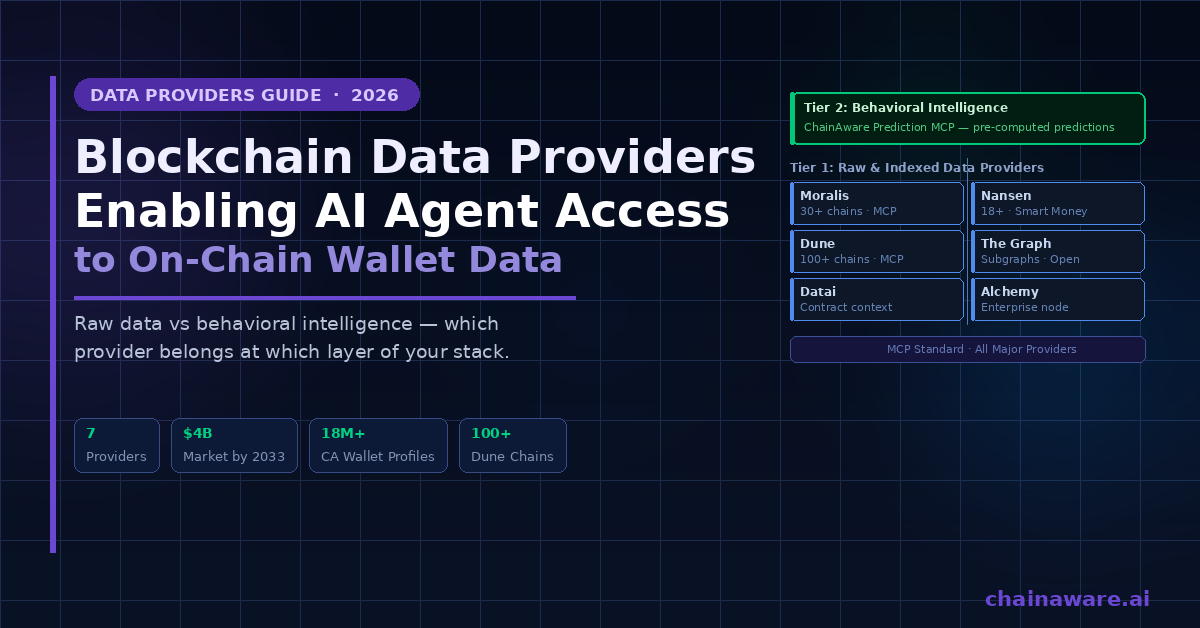
AI agents need data to make decisions. In Web3, the richest behavioral data source in the world – 18+ years of immutable public transaction history across billions of wallet addresses – sits freely accessible on public blockchains. The problem is that raw blockchain data is not agent-ready. A transaction history full of hexadecimal addresses and token amounts tells an AI agent nothing useful until someone translates it into intelligence the agent can act on. In 2026, a competitive ecosystem of blockchain data providers has emerged to close that gap – each taking a different approach to what “agent-ready blockchain data” actually means.
This guide maps the complete landscape: seven providers enabling AI agent access to on-chain wallet data, organized by what kind of data they deliver and how agent-ready that data actually is. The core distinction – between raw indexed data that agents must still interpret, and pre-computed behavioral intelligence that agents can act on immediately – determines which provider belongs at which layer of your agent stack.
In This Guide
- Why AI Agents Need On-Chain Wallet Data
- The Two-Tier Distinction: Raw Data vs Behavioral Intelligence
- 1. ChainAware.ai – Behavioral Prediction MCP (Pre-Computed Intelligence)
- 2. Moralis – Web3 AI Agent API (Raw + Indexed, 30+ Chains)
- 3. Nansen – Smart Money Labeling and Wallet Profiling
- 4. Dune Analytics – MCP Server for 100+ Chain Datasets
- 5. The Graph – Decentralized Protocol-Specific Subgraph Indexing
- 6. Datai Network – Smart Contract Categorization Layer
- 7. Alchemy – Enterprise Node Infrastructure and Enhanced APIs
- Head-to-Head Comparison Table
- Building Your Agent Data Stack
- FAQ
Why AI Agents Need On-Chain Wallet Data
The blockchain AI market reached $735 million in 2025 and is projected to hit $4.04 billion by 2033 – growing at a CAGR of 23.81%. That growth is driven not by speculation but by a specific operational requirement: AI agents operating in Web3 need to make decisions about wallet addresses constantly. A compliance agent screening transactions must know whether a wallet carries AML risk. A DeFi onboarding agent routing new users must know their experience level and behavioral profile. A fraud detection agent monitoring a protocol must predict which addresses are likely to commit fraud before they act. A trading agent managing a portfolio must understand whether a token’s holders represent genuine smart money or coordinated shill networks. For the complete overview of how AI agents interact with blockchain infrastructure, see the ChainAware For AI Agents overview.
The Data Gap That Limits Agent Intelligence
Without access to on-chain wallet data, agents make generic decisions. Generic decisions produce poor outcomes – wrong users get the same experience as right users, fraudulent wallets pass through undetected, and opportunities that depend on behavioral context get missed entirely. The agents that perform best in 2026 are those connected to real-time, high-quality blockchain intelligence – not just transaction feeds, but interpreted behavioral signals they can immediately act on. For how behavioral intelligence specifically transforms agent decision-making, see our AI Agent Personalization guide and our Web3 Agentic Economy guide. According to Grand View Research’s AI market data ↗, AI systems with access to domain-specific real-time data consistently outperform general-purpose models by significant margins in specialized applications.
The Two-Tier Distinction: Raw Data vs Behavioral Intelligence
Before evaluating individual providers, the most important conceptual distinction in this landscape is the difference between raw or indexed blockchain data and pre-computed behavioral intelligence. This distinction determines how much analytical work an agent must perform before it can act on what a provider delivers.
Tier 1: Raw and Indexed Blockchain Data
Tier 1 providers give AI agents structured access to what has happened on the blockchain – wallet balances, transaction histories, token holdings, DeFi positions, NFT ownership, protocol interactions. This data is essential and powerful. However, the agent still has to figure out what it means. A wallet’s transaction history does not automatically tell an agent whether that wallet is trustworthy, what it is likely to do next, or whether it matches the behavioral profile of the users a DeFi protocol wants to attract. Moralis, Nansen, Dune Analytics, The Graph, Datai, and Alchemy all operate primarily at this tier – delivering data the agent must still analyze or score. For a complete overview of what blockchain capabilities AI agents can access, see our 12 Blockchain Capabilities Any AI Agent Can Use guide.
Tier 2: Pre-Computed Behavioral Intelligence
Tier 2 providers deliver pre-computed predictions and intelligence scores that agents can act on immediately, without building their own analytical layer. Instead of delivering “this wallet made 47 transactions across 12 protocols,” a Tier 2 provider delivers “this wallet has a 0.94 fraud probability, a High experience level, a borrower behavioral profile, and a Low rug pull risk.” The agent does not need to analyze the transaction history – the prediction is already computed from 18M+ behavioral profiles and delivered in under a second. ChainAware’s Prediction MCP operates at this tier. The distinction maps directly to agent performance: Tier 1 data enables analytical agents; Tier 2 intelligence enables decision-making agents. For the detailed breakdown of predictive vs generative AI in this context, see our Generative vs Predictive AI guide.
1. ChainAware.ai – Behavioral Prediction MCP (Pre-Computed Intelligence)
Data type: Pre-computed behavioral predictions – fraud probability, AML risk, wallet rank, behavioral personas, rug pull risk, experience level, risk tolerance, behavioral intentions
Integration: Prediction MCP (SSE-based, natural language queries) + REST API + Google Tag Manager pixel
Chains: ETH, BNB, BASE, POLYGON, TON, TRON, HAQQ, SOL (8 chains)
Agent-ready: ✅ Fully pre-computed – no analysis required
ChainAware occupies a unique position in the blockchain data provider landscape: the only provider delivering forward-looking behavioral predictions rather than backward-looking data retrieval. While every other provider in this comparison answers “what has this wallet done?”, ChainAware answers “what will this wallet do next, and how trustworthy is it?” That distinction matters enormously for AI agent use cases because agents are fundamentally decision-making systems – and decisions require predictions, not just history.
What the Prediction MCP Delivers
The ChainAware Prediction MCP exposes five core tools queryable by any AI agent in natural language: fraud probability detection (98% accuracy, backtested on CryptoScamDB), behavioral prediction (experience level, risk tolerance, segment classification), rug pull risk scoring (creator and LP behavioral Trust Score), token ranking (holder quality scoring via Wallet Rank), and AML screening. Together, these tools give agents immediate answers to the questions that drive the most important Web3 decisions: Is this wallet safe to interact with? What kind of user is this? Should this protocol onboard this address? Is this pool likely to rug pull? An agent integrating the Prediction MCP via Claude, GPT, or any LLM can ask “What is the fraud risk of 0x123…abc?” and receive a structured prediction response in under a second. For the complete integration guide, see our Prediction MCP guide and our 5 Ways Prediction MCP Turbocharges DeFi.
32 Open-Source Pre-Built Agents
Beyond the MCP tools themselves, ChainAware publishes 32 MIT-licensed pre-built agent definitions covering fraud detection, compliance screening, growth intelligence, DeFi analysis, governance verification, GameFi scoring, and AI agent verification. See the full catalogue at the Security & Fraud Agents documentation. These agent definitions integrate ChainAware’s Prediction MCP with specific workflows – developers clone and deploy rather than build from scratch. The combination of pre-computed predictions, natural language MCP access, and ready-made agent definitions makes ChainAware the fastest path from zero to a production-quality behavioral intelligence layer for any AI agent stack. For how the 18M+ wallet profile dataset was built and what it covers, see our complete product guide.
Best agent use cases: Fraud detection agents · Compliance screening agents · DeFi onboarding routers · Marketing personalization agents · Airdrop quality screening · Governance participant verification
Unique advantage: Only provider delivering forward-looking behavioral predictions – the difference between a data retrieval layer and a decision intelligence layer
Free tier: Yes – individual wallet checks free; Prediction MCP via subscription
Add Behavioral Intelligence to Any AI Agent in Minutes
ChainAware Prediction MCP – Pre-Computed Wallet Intelligence via Natural Language
Your AI agent queries any wallet address in plain English and gets fraud probability (98% accuracy), behavioral profile, AML status, rug pull risk, and wallet rank – pre-computed, under 1 second, no blockchain expertise required. 18M+ profiles. 8 chains. 32 open-source agents on GitHub. SSE-based MCP compatible with Claude, GPT, and any LLM.
2. Moralis – Web3 AI Agent API (Raw + Indexed, 30+ Chains)
Data type: Indexed raw blockchain data – wallet balances, transaction history, NFT ownership, DeFi positions, token prices, historical data
Integration: REST API + MCP server + WebSocket + ElizaOS official plugin
Chains: 30+ (Ethereum, Polygon, BNB, Solana, Avalanche, Arbitrum, Optimism, and more)
Agent-ready: ✅ Well-indexed and structured – agent must still interpret
Moralis is the most AI agent-friendly raw blockchain data provider in 2026. The platform has explicitly repositioned around AI agent use cases – publishing an official ElizaOS plugin that lets developers integrate real-time blockchain data directly into ElizaOS-based agents, shipping a full MCP server implementation, and restructuring its documentation around agent-first use cases. The combination of 100+ API endpoints, 30+ chain coverage, and WebSocket streaming for real-time event delivery gives agents the raw material they need for trading bots, analytics tools, portfolio managers, and social media intelligence agents.
Moralis’s Wallet API and What It Returns
Moralis’s Wallet API is the centerpiece of its agent integration offering. A single API call against a wallet address returns native token balance, all ERC-20 holdings, NFT collection, complete transaction history, and computed portfolio P&L – across all supported chains simultaneously. This unified cross-chain wallet profile is immediately useful for any agent that needs to understand a user’s on-chain footprint. Moralis Streams push parsed contract events and transfer logs to webhooks or WebSocket clients in real time, enabling event-driven agent architectures where the agent acts on on-chain triggers rather than polling for data. For agents built on ElizaOS specifically, the official Moralis plugin reduces blockchain data integration to a configuration step rather than a development project. According to Moralis’s AI agent documentation ↗, the platform supports trading bots, analytics tools, governance voting assistants, and fraud detection agents. For how Moralis-type raw data compares to predictive intelligence for DeFi use cases, see our Web3 Analytics Tools comparison.
Best agent use cases: Trading bots needing real-time token data · Portfolio management agents · NFT intelligence agents · Social media crypto analytics agents · Cross-chain wallet profiling
Unique advantage: Most complete AI agent integration story among Tier 1 providers – ElizaOS plugin + MCP server + 100+ endpoints
Limitation: Historical data only – cannot predict fraud, behavioral intentions, or future wallet behavior
3. Nansen – Smart Money Labeling and Wallet Profiling
Data type: Labeled and profiled blockchain data – smart money identification, wallet entity labeling, token flow analysis, portfolio profiling across 18+ chains
Integration: MCP + REST API + CLI (structured JSON)
Chains: 18+ including Ethereum, Solana, Base, Arbitrum, BNB, and others
Agent-ready: ✅ Well-labeled – significantly reduces agent interpretation burden
Nansen occupies a distinct position between raw data and behavioral intelligence: it delivers labeled blockchain data. Rather than returning a transaction history full of anonymous addresses, Nansen’s wallet profiling system identifies which wallets belong to recognized entities – exchanges, funds, known DeFi protocols, smart money traders – and labels their activity accordingly. A Nansen API response for a wallet address includes not just transaction history but entity labels, smart money classifications, and portfolio analytics that give agents meaningful context without requiring the agent to build its own labeling system.
Smart Alerts and Agent-Driven Event Detection
Nansen’s Smart Alerts feature is particularly valuable for event-driven agent architectures. When configured, Smart Alerts notify an agent the moment a tracked wallet executes a significant action – accumulating a new token, moving large positions between protocols, or withdrawing from liquidity pools. This real-time detection capability enables investment and risk management agents to respond to smart money movements as they happen rather than discovering them after the fact. Nansen’s CLI with structured JSON output makes it straightforward to pipe Nansen data directly into agent decision pipelines without HTTP complexity. For investment intelligence and compliance use cases, the combination of entity labeling, portfolio profiling, and real-time alerts positions Nansen as the strongest Tier 1 provider for institutional-grade agent applications. For how wallet profiling complements ChainAware’s behavioral predictions in a complete intelligence stack, see our Wallet Auditor guide and our Wallet Rank guide.
Best agent use cases: Investment intelligence agents tracking smart money · Risk management agents monitoring whale movements · Compliance agents verifying entity identities · Portfolio optimization agents
Unique advantage: Entity labeling and smart money classification – removes the anonymous-address problem for a significant portion of high-value wallet activity
Limitation: Labeled but not predictive – does not score fraud probability or behavioral intentions for the majority of unlabeled wallets
4. Dune Analytics – MCP Server for 100+ Chain Datasets
Data type: SQL-queryable decoded blockchain data – raw transactions, decoded smart contract events, wallet intelligence, DeFi positions, NFT activity, community-curated datasets
Integration: MCP server (launched 2025) + REST API + Dune Sim query engine
Chains: 100+ including ETH, SOL, Base, Arbitrum, Optimism, Polygon, BNB, Avalanche, NEAR, zkSync, TON, TRON, Sui, Aptos, and more
Agent-ready: ✅ MCP enables natural language queries – but responses require interpretation
Dune’s MCP server launch is one of the most significant infrastructure developments for blockchain AI agents in 2025. The integration requires a single command-line entry and draws from existing Dune API credits – meaning any developer already using Dune can immediately give their AI agents access to 100+ chain datasets without additional setup. The practical capability is broad: an agent can query “Top 10 wallets accumulating RWA tokens in the last 30 days” or “Compare Uniswap vs Curve daily swap volume over the past 90 days” in natural language and receive structured analytical responses. The kind of research that previously required a dedicated blockchain analyst now happens conversationally. Additionally, Dune’s community-curated dataset ecosystem – tens of thousands of community-built dashboards covering protocol analytics, wallet intelligence, DeFi positions, and NFT activity – gives agents access to specialized intelligence that no single provider could build internally.
Dune’s Role in the Agent Data Stack
Dune excels at analytical queries – understanding trends, comparing protocols, identifying patterns across large populations of wallets. Consequently, it is most valuable for research and analytics agents rather than real-time decision agents. For an agent needing to answer “is this specific wallet a fraud risk right now?”, Dune requires building a custom query against its raw data – which demands significant blockchain analytical expertise. For an agent needing to answer “which protocols are seeing unusual wallet accumulation this week?”, Dune’s natural language MCP interface delivers the answer immediately. According to Dune’s official documentation ↗, the MCP server covers all major EVM and non-EVM chains with decoded event data. For how analytical data layers complement behavioral prediction in complete agent architectures, see our Web3 User Segmentation guide.
Best agent use cases: Research agents analyzing blockchain trends · Protocol analytics agents · Market intelligence agents · Community analytics and governance research agents
Unique advantage: Broadest chain coverage (100+) of any provider; community-curated dataset ecosystem; natural language MCP queries
Limitation: Analytical rather than real-time – best for batch analysis rather than per-transaction decisions; requires significant query expertise for novel research questions
Free Behavioral Intelligence – No Complex Queries Needed
ChainAware Free Analytics – Behavioral Distribution of Your Users in 24 Hours
Before building complex data pipelines, understand who is actually connecting to your protocol. ChainAware Analytics delivers experience levels, risk profiles, and behavioral segment distributions for your connecting wallets via a 2-line GTM pixel. No SQL. No queries. No blockchain expertise. Free forever. The data layer that makes every agent decision smarter.
5. The Graph – Decentralized Protocol-Specific Subgraph Indexing
Data type: Decentralized indexed data via subgraphs – protocol-specific event data, customizable GraphQL queries, open and permissionless
Integration: GraphQL API + decentralized network of indexers
Chains: Ethereum, Polygon, Arbitrum, Optimism, and other EVM chains
Agent-ready: Moderate – requires subgraph development expertise; powerful once built
The Graph is the foundational decentralized indexing protocol that underlies much of Web3’s data infrastructure. Rather than providing a centralized API, The Graph operates a network of indexers who stake GRT tokens to serve subgraph queries – creating a permissionless, censorship-resistant data layer that any protocol can publish to and any developer can query. Subgraphs are custom data schemas that define what on-chain events to index and how to structure the resulting data, enabling extremely efficient queries against protocol-specific event logs that would be prohibitively expensive to reconstruct from raw chain data.
The Graph’s Role in Agent Data Infrastructure
For AI agents building on top of specific DeFi protocols – a lending agent on Aave, a liquidity management agent on Uniswap, a governance agent on Compound – The Graph’s protocol-specific subgraphs provide the most efficient and decentralized access to the exact events those agents need. A well-built subgraph exposes complex protocol state (user positions, liquidation thresholds, yield rates, governance proposals) in a single GraphQL query rather than requiring multiple RPC calls and manual data reconstruction. The decentralized nature also matters for agents that need censorship resistance – no single entity can block subgraph queries on The Graph. According to The Graph’s developer documentation ↗, subgraphs are available for most major DeFi protocols. For how protocol-specific data complements behavioral scoring in DeFi agent use cases, see our DeFi Onboarding guide.
Best agent use cases: Protocol-specific DeFi agents needing efficient event queries · Governance agents · Decentralization-critical agent deployments · Developers already building subgraphs
Unique advantage: Decentralized and permissionless – no single point of failure or censorship; most efficient data access for protocol-specific use cases
Limitation: Requires significant development expertise to build subgraphs; no wallet behavioral intelligence or fraud scoring
6. Datai Network – Smart Contract Categorization Layer
Data type: Behaviorally categorized blockchain data – smart contracts labeled by function (lending, borrowing, NFT, bridging, gaming, RWA), wallet behavioral narratives, user behavior profiles
Integration: API data feeds + decentralized indexer network
Chains: Multi-chain EVM expanding
Agent-ready: ✅ Well-categorized – provides behavioral context missing from raw transaction data
Datai Network solves a specific and underappreciated problem in blockchain data infrastructure: the semantic gap between raw transaction data and agent-understandable behavioral context. When a blockchain explorer shows “0x4f…a2 interacted with 0x7d…c8,” it conveys no behavioral meaning – that address could be lending on Aave, minting an NFT, bridging to Arbitrum, or buying a gaming asset. Without knowing which smart contract category that interaction represents, an AI agent analyzing this transaction cannot construct a meaningful behavioral narrative about the user.
AI-Ready Intelligence Through Categorization
Datai’s machine learning models automatically identify, label, and categorize smart contracts at scale – translating raw transaction histories into structured behavioral narratives that read like descriptions rather than hex strings. A wallet that “interacted with 14 smart contracts across three chains” becomes “a user who has borrowed on two lending protocols, provided liquidity on Uniswap, bridged to Base twice, and purchased gaming assets on Immutable X.” This translated narrative is what Datai describes as “AI-ready intelligence” – data structured to the level of detail that agents need to make segment-based decisions without custom blockchain parsing. For more on Datai’s role as a behavioral context layer and its use in AI trading agents, see our X Space with ChainGPT and Datai. Datai’s approach is complementary to ChainAware: Datai provides behavioral context history (what the user did in the past), while ChainAware provides behavioral predictions (what the user will do next). For the full picture of how behavioral context enables DeFi personalization, see our User Segmentation guide.
Best agent use cases: DeFi personalization agents needing user behavior context · Cross-protocol user segmentation · Trading strategy personalization agents · Portfolio analytics needing semantic transaction understanding
Unique advantage: Solves the semantic gap between raw transactions and meaningful behavior – provides the “what was the user doing?” context layer
Limitation: Historical context only – does not predict future behavior or score fraud probability
7. Alchemy – Enterprise Node Infrastructure and Enhanced APIs
Data type: Enhanced raw blockchain data – wallet activity, NFT metadata, transaction history, webhooks, smart contract state, transaction simulation
Integration: REST API + WebSocket + Notify API + subgraph managed service
Chains: 18+ (Ethereum, Polygon, Arbitrum, Optimism, Base, Solana, and others)
Agent-ready: ✅ Enterprise-grade reliability – most production-hardened infrastructure
Alchemy’s position in the blockchain data provider ecosystem is defined by enterprise-grade reliability rather than analytical breadth. As a Series C-backed company with OpenSea, Trust Wallet, and Dapper Labs as core clients, Alchemy has built the infrastructure layer that production-grade AI agent deployments depend on – the kind of infrastructure that can handle millions of API calls per day with sub-100ms latency and 99.9%+ uptime. For teams building agents where reliability and performance are the primary constraints, Alchemy’s combination of enhanced APIs and institutional-grade node infrastructure is the strongest option available.
Enhanced APIs That Go Beyond Standard RPC
Alchemy’s enhanced APIs go significantly beyond standard blockchain RPC endpoints. The NFT API fetches complete NFT metadata, ownership history, and collection data in a single call – eliminating the complex on-chain parsing that standard RPC requires. The Notify API delivers webhooks for wallet activity events, NFT transfers, and contract interactions across Ethereum, Polygon, Optimism, and Arbitrum – enabling event-driven agents that react to on-chain triggers rather than polling. The Trace API provides deep transaction-level analysis of how transactions interact with smart contracts and wallets, enabling agents that need to understand complex DeFi interaction flows. Additionally, Alchemy’s transaction simulation capability allows agents to preview the outcome of any transaction before broadcasting – a critical capability for agents making consequential financial decisions on behalf of users. For how Alchemy-type infrastructure supports compliance agent deployments in DeFi, see our DeFi Compliance Tools guide and our MiCA Compliance guide.
Best agent use cases: Production-grade agents requiring enterprise reliability · Transaction simulation agents · Event-driven agents on Ethereum and EVM L2s · Teams migrating from self-hosted nodes
Unique advantage: Most production-hardened infrastructure; transaction simulation; institutional-grade reliability and support
Limitation: Raw data only – no wallet behavioral intelligence, fraud scoring, or behavioral predictions
Deploy Behavioral Intelligence Agents Without Building from Scratch
32 Open-Source ChainAware Agents – Clone, Configure, Deploy
Fraud detection, AML screening, onboarding routing, growth segmentation, DeFi intelligence, governance verification – 32 MIT-licensed pre-built agent definitions on GitHub. Each integrates ChainAware’s Prediction MCP for immediate behavioral intelligence. Works with Claude Code, any Claude agent, GPT, and custom LLMs. No data pipelines to build.
Head-to-Head Comparison Table
| Provider | Data Tier | Predictive? | MCP? | Chains | Agent-Ready? | Best For |
|---|---|---|---|---|---|---|
| ChainAware.ai | Tier 2: Behavioral predictions | ✅ Forward-looking scores | ✅ Prediction MCP | 8 (ETH/BNB/BASE/POL/TON/TRON/HAQQ/SOL) | ✅ Pre-computed, no analysis needed | Fraud detection · AML · onboarding · personalization agents |
| Moralis | Tier 1: Indexed raw data | ❌ Historical only | ✅ MCP server | 30+ | ✅ Well-indexed, structured JSON | Trading bots · portfolio agents · ElizaOS agents |
| Nansen | Tier 1: Labeled data | ❌ Historical only | ✅ MCP + REST + CLI | 18+ | ✅ Entity-labeled – reduces interpretation | Smart money tracking · investment agents |
| Dune Analytics | Tier 1: SQL-indexed raw data | ❌ Analytical only | ✅ MCP launched 2025 | 100+ | Moderate – natural language queries but needs interpretation | Research · trend analysis · protocol analytics agents |
| The Graph | Tier 1: Protocol-specific indexed | ❌ | Limited | EVM chains | Moderate – requires subgraph dev | Protocol-specific DeFi agents · decentralized deployments |
| Datai Network | Tier 1.5: Categorized behavioral context | ❌ Historical only | ❌ | Multi-chain EVM | ✅ Semantic context layer | Personalization · DeFi strategy agents needing behavioral context |
| Alchemy | Tier 1: Enhanced raw data | ❌ | ✅ Via subgraph | 18+ | ✅ Enterprise-grade reliability | Production agent infrastructure · transaction simulation |
Agent Use Case to Provider Mapping
| Agent Use Case | Primary Provider | Complementary Provider | Why This Combination |
|---|---|---|---|
| Fraud detection + AML screening | ChainAware (behavioral scores) | Alchemy (transaction data) | Pre-computed fraud probability + reliable raw transaction verification |
| DeFi onboarding routing | ChainAware (behavioral profile) | Moralis (transaction history) | Instant experience level + segment + supporting raw history |
| Trading bot + market intelligence | Moralis (real-time prices + positions) | Nansen (smart money signals) | Real-time data + smart money context for entry/exit decisions |
| Blockchain research + trend analysis | Dune (100+ chain datasets) | Nansen (entity labeling) | Broad analytical coverage + labeled entity context |
| Protocol-specific DeFi agent | The Graph (subgraph queries) | ChainAware (user risk scoring) | Efficient protocol data + behavioral risk for each user interaction |
| Personalized DeFi strategy agent | Datai (behavioral context) | ChainAware (behavioral predictions) | Historical behavioral narrative + forward-looking behavioral predictions |
| Enterprise compliance agent | ChainAware (AML + fraud) | Alchemy (production infrastructure) | Compliance intelligence + enterprise-grade reliability |
Building Your Agent Data Stack
Most production-grade AI agent deployments in Web3 require data from multiple providers because different use cases require different data types at different speeds. The framework below maps three common agent architectures to their optimal data stack.
Architecture 1: Decision Agents (Fraud, Compliance, Onboarding)
Decision agents that need to make real-time binary or classification decisions about wallet addresses – allow or block, onboard or route, safe or risky – require pre-computed intelligence rather than raw data. The overhead of fetching raw data, building analytical pipelines, and computing risk scores on every wallet interaction is too high for real-time use cases. Consequently, the core data layer for decision agents is ChainAware’s Prediction MCP – fraud scores and behavioral profiles delivered in under a second via natural language query. Alchemy or Moralis serves as a supporting layer for transaction verification and data retrieval when specific historical context is needed. For the Enterprise API documentation covering batch and high-volume agent deployments, the learn guide covers all endpoints. For the complete decision agent architecture, see our Web3 Agentic Economy guide.
Architecture 2: Analytical Agents (Research, Trend Detection, Market Intelligence)
Analytical agents that synthesize information across large populations of wallets and long time horizons – identifying trends, comparing protocols, detecting accumulation patterns – prioritize breadth over speed. Dune’s MCP server provides the broadest chain coverage and most flexible analytical query capability through natural language. Nansen’s Smart Money labeling adds contextual signal to population-level analysis. Together, these two providers cover the analytical agent use case comprehensively. ChainAware’s Token Rank capability – which scores the behavioral quality of a token’s holder base – adds a uniquely powerful signal for market intelligence agents assessing token legitimacy. For how behavioral analytics supports population-level marketing intelligence, see our Web3 Marketing Analytics guide.
Architecture 3: Personalization Agents (DeFi UX, Onboarding, Marketing)
Personalization agents that tailor every wallet interaction – serving different content, routing to different product flows, or generating personalized messages based on wallet profiles – need both behavioral context (what kind of user is this historically?) and behavioral predictions (what will this user do next?). Datai provides behavioral context history through smart contract categorization. ChainAware provides forward-looking behavioral predictions through its Prediction MCP. Moralis provides the raw wallet data layer that both can reference. This three-provider combination creates a complete behavioral intelligence stack: historical context (Datai) + current state (Moralis) + predicted future (ChainAware). For the personalization agent architecture in detail, see our AI Agent Personalization guide and our User Segmentation guide. According to Anthropic’s Model Context Protocol documentation ↗, MCP is rapidly becoming the standard integration layer for connecting AI agents to external data providers – with Moralis, Dune, Nansen, and ChainAware all shipping MCP servers in 2025. For additional context on the MCP ecosystem, see the official MCP servers repository ↗.
Start With the Intelligence Layer
ChainAware Wallet Auditor – Full Behavioral Profile for Any Address
Before deploying any agent data stack, understand what behavioral intelligence looks like in practice. Paste any wallet address and get fraud probability, experience level, risk profile, behavioral segment, AML status, and Wallet Rank – all pre-computed, in under a second. Free. No wallet connection. No signup. This is what Tier 2 intelligence delivers.
Frequently Asked Questions
What is the difference between blockchain data and blockchain intelligence for AI agents?
Blockchain data is what happened – transaction histories, token balances, protocol interactions, NFT ownership. An AI agent receiving raw blockchain data must still analyze it to produce a decision. Blockchain intelligence is what the data means – fraud probability scores, behavioral segments, predicted next actions, AML risk classifications. An AI agent receiving behavioral intelligence can act on it immediately without additional analytical processing. The distinction maps to agent performance: data retrieval agents require more computational work and latency per decision; intelligence-receiving agents make faster, better-calibrated decisions with less infrastructure overhead. ChainAware’s Prediction MCP delivers intelligence; Moralis, Dune, Nansen, and Alchemy deliver data.
What is Model Context Protocol (MCP) and why does it matter for blockchain AI agents?
Model Context Protocol (MCP) is an open standard developed by Anthropic that defines how AI agents connect to external data sources and tools. Rather than requiring custom API integration code for each data provider, MCP creates a standardized interface – an agent with MCP support can connect to any MCP-compatible data provider by simply declaring the connection. For blockchain AI agents, MCP adoption by major providers (Moralis, Dune, Nansen, ChainAware) means that integrating on-chain wallet data into any Claude, GPT, or open-source LLM agent requires configuration rather than custom development. The agent queries the MCP-connected blockchain provider in natural language and receives structured responses – exactly as it would query any other MCP tool.
Why can’t AI agents just query blockchain explorers directly?
Blockchain explorers (Etherscan, BscScan, Solscan) are designed for human consumption – their interfaces return HTML pages with formatted transaction data, not structured JSON for programmatic consumption. Furthermore, raw blockchain data from explorers requires the agent to parse hexadecimal function signatures, decode ABI-encoded parameters, resolve token addresses, and construct meaningful behavioral narratives from individual transactions. This work requires substantial blockchain engineering expertise that most AI agents do not have built in. Data providers like Moralis abstract this complexity by pre-decoding, indexing, and structuring the data into agent-consumable formats. ChainAware goes further by pre-computing behavioral scores so agents do not need to analyze the data at all.
Which blockchain data provider is best for a DeFi compliance agent?
Compliance agents have two core requirements: AML risk screening of wallet addresses and transaction monitoring for suspicious behavioral patterns. ChainAware’s Prediction MCP addresses both directly – AML screening returns risk status for any address in under a second, and the fraud detection tool provides 98% accurate behavioral risk scoring that identifies wallets likely to commit fraud before they act. Alchemy provides the reliable transaction data infrastructure for verifying specific transaction details when compliance records require it. For MiCA-aligned compliance specifically – the EU regulatory framework requiring AML screening and transaction monitoring for DeFi protocols – ChainAware’s combination of pre-execution screening and continuous behavioral monitoring is the most cost-effective implementation available. For the full MiCA compliance architecture, see our DeFi Compliance Tools guide.
How does ChainAware’s Prediction MCP differ from Chainalysis for AI agent use cases?
Chainalysis is a forensic and compliance intelligence tool designed primarily for post-incident investigation, law enforcement support, and enterprise VASP compliance. It excels at tracing the flow of already-identified illicit funds through transaction graphs, attributing addresses to known entities, and producing audit-quality compliance reports. ChainAware’s Prediction MCP is designed for real-time agent decision-making – predicting fraud probability before it occurs, not documenting it after. The practical differences: Chainalysis pricing is enterprise-scale ($100K+ annually); ChainAware’s Prediction MCP is accessible to individual developers and small protocols. Chainalysis requires weeks to integrate; ChainAware’s MCP integrates in minutes. Chainalysis identifies known bad actors from forensic databases; ChainAware predicts which unknown addresses will become bad actors from behavioral patterns. For the complete cost comparison, see our MiCA Compliance at 1% of Chainalysis Cost guide.
Sources: Grand View Research – AI Market Data ↗ · Moralis AI Agent API Documentation ↗ · Anthropic Model Context Protocol ↗ · The Graph Developer Documentation ↗ · Dune Analytics Documentation ↗