
Every wallet address that connects to your DApp carries a complete behavioral history. Behind that 42-character hexadecimal string sits a real person – with specific intentions, a measurable experience level, a risk appetite, and a predicted next action. Most Web3 platforms never access any of that information. Instead, they treat every connecting wallet identically and wonder why 90% of them never transact.
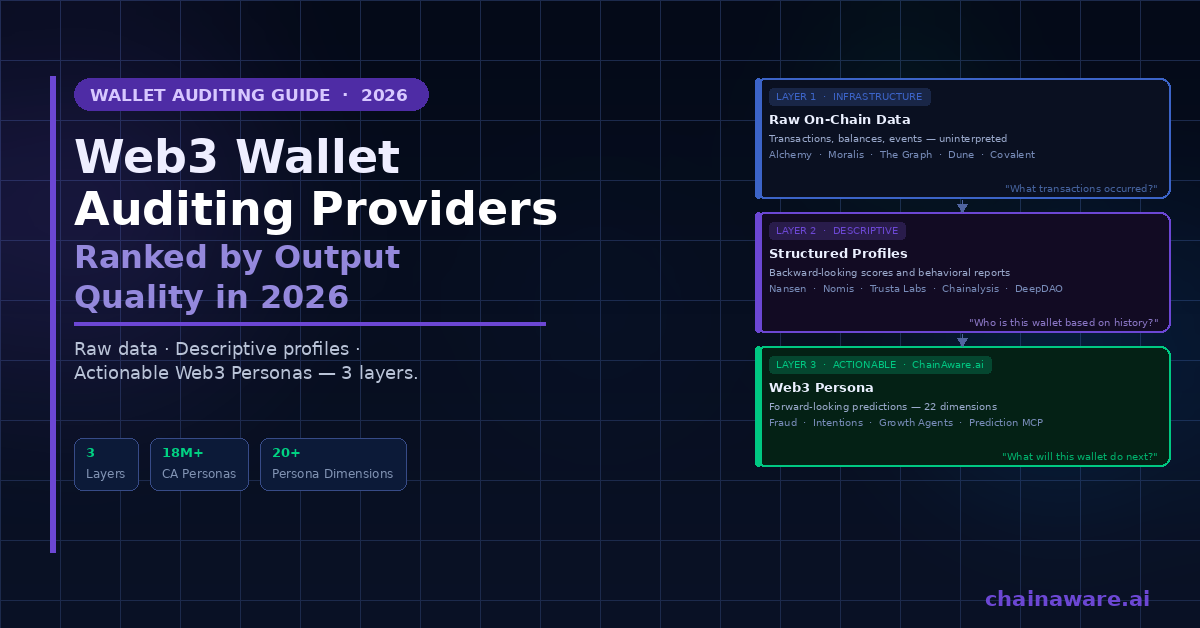
In 2026, a mature ecosystem of wallet auditing providers has emerged to solve this problem – but they solve it in fundamentally different ways. Some deliver raw blockchain data. Others deliver structured behavioral profiles. Only one delivers forward-looking predictions that DApps and AI agents can act on directly. Understanding the difference between these approaches is the most important infrastructure decision any Web3 team makes in 2026.
In This Guide
- The Three-Layer Wallet Auditing Framework
- Layer 1: Blockchain Data Infrastructure
- Layer 2: Descriptive Aggregation Providers
- The Fundamental Limitation of Layer 2
- Layer 3: Actionable Intelligence – The Web3 Persona
- ChainAware’s Unique Position in the Stack
- Provider Comparison Tables
- Which Layer Does Your Use Case Need?
- FAQ
The Three-Layer Wallet Auditing Framework
Wallet auditing is not a single product category – it is a stack of three distinct capabilities, each answering a fundamentally different question. Confusing these layers leads to selecting the wrong tools, building the wrong integrations, and producing outputs that require far more analytical work than the team anticipated.
The three layers are best understood through the question each one answers:
- Layer 1 – Blockchain Data Infrastructure: “What transactions occurred on-chain?”
- Layer 2 – Descriptive Aggregation: “Who is this wallet, based on what it has done?”
- Layer 3 – Actionable Intelligence: “What will this wallet do next – and what should I do about it?”
Most Web3 teams today use Layer 1 and Layer 2 tools and assume they have a complete wallet auditing solution. They do not. Layer 1 gives raw materials. Layer 2 structures those materials into readable profiles. Neither layer tells a DApp, a compliance system, or an AI agent what decision to make. That translation still requires significant human analytical work – or a custom ML pipeline that most teams lack the resources to build. Layer 3 closes that gap by producing outputs that are directly actionable: predictions, instructions, and decisions rather than data and reports. For the broader context of why intention-based intelligence outperforms descriptive analytics in Web3, see our Intention Analytics vs Descriptive Token Data guide.
Layer 1: Blockchain Data Infrastructure
Layer 1 providers give developers structured access to raw on-chain data – transaction histories, token balances, smart contract events, NFT ownership, and DeFi positions. They serve as the foundational infrastructure that all higher-layer analysis builds upon. Without Layer 1, no wallet analysis is possible. Consequently, these providers are essential – but they are infrastructure, not intelligence. Their outputs require significant interpretation before they produce anything a DApp can act on.
Key Layer 1 Providers
Alchemy is the enterprise-grade choice – a Series C-backed infrastructure platform used by OpenSea, Trust Wallet, and Dapper Labs. Its enhanced APIs go beyond standard RPC: the NFT API returns complete metadata and ownership history in a single call, the Notify API delivers webhooks for wallet activity across Ethereum and EVM L2s, and the Trace API provides deep transaction-level smart contract interaction analysis. For teams building production AI agents that need 99.9%+ uptime and sub-100ms latency, Alchemy is the strongest infrastructure foundation available.
Moralis takes the most AI agent-friendly approach at Layer 1 – publishing an official ElizaOS plugin, a full MCP server, and positioning explicitly around agent use cases. Its Wallet API returns native token balance, ERC-20 holdings, NFTs, transaction history, and computed portfolio P&L in a single cross-chain call across 30+ networks. Real-time WebSocket streams push parsed contract events to agent webhooks without manual polling. For developers building on ElizaOS or needing the broadest chain coverage at Layer 1, Moralis is the natural choice. For the full Layer 1 provider comparison, see our Blockchain Data Providers guide.
The Graph provides decentralized, permissionless indexing via protocol-specific subgraphs – custom data schemas that define which on-chain events to index and how to structure them for efficient GraphQL queries. For agents built on specific DeFi protocols (Aave, Uniswap, Compound), The Graph’s protocol-native subgraphs are significantly more efficient than general-purpose RPC calls. According to The Graph’s developer documentation ↗, thousands of subgraphs cover the most important DeFi protocols on EVM chains.
Dune Analytics launched an MCP server in 2025 – enabling AI agents to query 100+ chain datasets conversationally. A natural language prompt like “Top 10 wallets accumulating RWA tokens in the last 30 days” returns structured analytical results without requiring custom SQL expertise. Chain coverage includes Ethereum, Solana, Base, Arbitrum, Optimism, Polygon, BNB, Avalanche, NEAR, zkSync, TON, TRON, Sui, Aptos, and more. Covalent rounds out the Layer 1 landscape with its standardized Block Specimen model – a unified API format across multiple chains that prioritises historical data consistency for compliance and auditing use cases.
What Layer 1 gives you: Transaction hashes, token amounts, contract addresses, timestamps, decoded event logs. The data is accurate and complete. However, it requires your team to build the analytical layer that converts it into something a DApp or AI agent can act on.
Skip Straight to Layer 3 – Free
ChainAware Wallet Auditor – Full Web3 Persona for Any Address in 1 Second
No raw data. No descriptive reports to interpret. Paste any wallet address and get the complete actionable profile – fraud probability (98% accuracy), experience level, all 12 intention probabilities, risk willingness, AML status, Wallet Rank. Pre-computed, sub-second, free. ETH, BNB, BASE, POLYGON, TON, TRON, HAQQ. See the full Wallet Auditor documentation.
Layer 2: Descriptive Aggregation Providers
Layer 2 providers take raw blockchain data and aggregate it into structured, human-readable profiles. They answer the question “who is this wallet, based on what it has done?” – producing outputs like reputation scores, activity metrics, entity labels, governance histories, and compliance reports. Layer 2 is where most of the wallet auditing market currently operates. These tools are significantly more useful than raw Layer 1 data, but they share a fundamental limitation: they describe the past without prescribing action for the future.
Reputation and Sybil Prevention Providers
Nomis is the broadest reputation scoring platform by chain coverage – supporting 50+ chains with 30+ on-chain parameters including activity volume, protocol diversity, wallet age, and cross-chain engagement. DApp teams use Nomis primarily for airdrop eligibility gating: setting minimum score thresholds that filter out bot wallets and airdrop farmers while rewarding genuine community participants. The score is issued as an on-chain NFT attestation, giving it portability across protocols. Nomis’s limitation is that it measures activity volume rather than behavioral quality – a wallet can have a high Nomis score through consistent but low-value activity, without that score indicating any specific future intention.
Trusta Labs / TrustScan focuses specifically on Sybil prevention and Proof of Humanity attestations, built by ex-Alipay AI and security experts. The platform uses graph neural networks and recurrent neural networks to analyze asset transfer graphs for coordinated wallet behavior – detecting the starlike funding networks, bulk operation patterns, and similar behavior sequences that characterize Sybil attacks. Its MEDIA score adds five dimensions (Monetary, Engagement, Diversity, Identity, Age) beyond the pure Sybil risk score. Trusta has processed 570 million wallets across EVM and TON chains, integrated with Galxe, Gitcoin Passport, and Binance, and is the top Proof of Humanity provider on Linea and BSC. Notably, Trusta’s headline “3M users” figure refers primarily to wallets processed through airdrop campaigns on behalf of partner protocols like Celestia, Starknet, and Manta – the monthly active user figure is approximately 200K. For teams running airdrops or building on Linea/BSC, Trusta provides the strongest Sybil detection available.
RubyScore and Spectral Finance serve narrower versions of the Layer 2 reputation use case. RubyScore scores wallet activity quality as a simple proxy for genuine engagement – useful for protocol gating but limited in depth. Spectral’s MACRO Score focuses specifically on DeFi credit assessment – evaluating borrower reliability for undercollateralized lending use cases based on historical repayment patterns and collateral behavior. Neither provides fraud prediction, behavioral intentions, or growth deployment.
Intelligence and Analytics Providers
Nansen occupies the most sophisticated position at Layer 2 – providing labeled blockchain data through its Smart Money identification system. Rather than returning anonymous transaction histories, Nansen identifies which wallets belong to recognized entities (funds, exchanges, known DeFi protocols, sophisticated traders) and labels their activity accordingly. Smart Alerts notify analysts when tracked smart money wallets execute significant moves. For investment intelligence and institutional risk management, Nansen is the strongest Layer 2 option – its entity labeling reduces the anonymous-address problem for a meaningful portion of high-value wallet activity. See our Blockchain Data Providers guide for how Nansen fits into a complete AI agent data stack.
DeepDAO provides governance-specific wallet reputation – tracking 11 million participant profiles across 2,500+ DAOs, with complete voting histories, proposal creation records, and cross-DAO engagement patterns. For DAO security screening and delegate verification, DeepDAO provides the most comprehensive governance-specific behavioral history available. For how DAO governance screening complements wallet behavioral intelligence, see our Governance Screeners guide.
Forensic and Compliance Providers
Chainalysis is the dominant forensic intelligence platform – built originally for law enforcement agencies (FBI, DEA, IRS) and government investigators tracking illicit fund flows. Its Know Your Transaction (KYT) product handles VASP compliance screening, and its investigation tools reconstruct transaction graphs across chains for evidence-grade analysis. CertiK’s year-end Hack3D report tallied $3.35 billion in losses across 630 security incidents in 2025, reinforcing the scale of the compliance problem Chainalysis addresses. Enterprise pricing ranges from $100,000 to $500,000 annually – designed for exchanges and institutional operators, not DeFi protocols or individual developers. According to Chainalysis’s platform documentation ↗, its clustering heuristics and entity attribution cover hundreds of major counterparties across multiple blockchains.
TRM Labs and Elliptic serve similar VASP compliance use cases with different geographic and institutional focuses. Nominis positions itself explicitly as an alternative to these three for VASPs – combining on-chain data, off-chain intelligence, and behavioral analytics at significantly lower cost, with a specialised terror-financing database. All four forensic providers share the same fundamental architecture: they trace where funds have come from, not where they are going next. For the complete MiCA compliance cost comparison between Chainalysis and ChainAware, see our MiCA Compliance at 1% of Chainalysis Cost guide.
The Fundamental Limitation of Layer 2
Layer 2 providers are genuinely valuable – they eliminate the data parsing problem and provide structured profiles that human analysts can read and interpret. However, they share a structural limitation that no amount of feature development within Layer 2 can solve: they are backward-looking by design.
The Report-to-Action Gap
Consider what a Layer 2 output actually looks like for a real wallet – defidad.eth, a well-known DeFi educator and content creator whose wallet we analyzed via ChainAware’s Prediction MCP:
Layer 1 output (raw): 3,188 transactions, wallet age 2,147 days, MakerDAO: 84 interactions, Uniswap: 46, Curve: 46, OpenSea: 75, SuperRare: 26…
Layer 2 output (descriptive): Experienced DeFi user. Heavy DEX trader (178 DEX transactions). Active in Lending (94 transactions). NFT collector (102 transactions). Sybil risk: Low. Active since 2018. Top protocols: MakerDAO, Uniswap, Curve.
Both outputs are accurate. Neither tells a DApp what to do when this wallet connects. The Layer 2 output is significantly more readable than Layer 1 – but a compliance team still has to decide whether to allow or flag this wallet. A DApp product manager still has to decide which content to serve. An AI agent still has to figure out what the behavioral history means for the next interaction. That analytical work – translating description into prescription – is precisely what most DApp teams, compliance officers, and AI agents lack the capacity to perform at scale in the 200-millisecond window between wallet connection and first screen render.
Furthermore, descriptive output ages. A Layer 2 profile describes what a wallet did up to the moment of the last data refresh. It does not account for behavioral drift, changing market conditions, or the specific context of the current interaction. The most experienced DeFi user in your database might be exploring your platform for the first time – and their historical transaction count tells you nothing about whether they will convert on this visit if you show them the wrong content. For the deeper argument about why intention data outperforms descriptive transaction data for growth use cases, see our Intention Analytics guide and our Generative vs Predictive AI guide.
Layer 3: Actionable Intelligence – The Web3 Persona
Layer 3 takes the descriptive history produced at Layer 2 and transforms it into forward-looking behavioral predictions that any system can act on directly – without further interpretation, without a custom ML pipeline, and without human analytical overhead. This is where ChainAware operates. Currently, it is the only provider that has built a complete Layer 3 product stack.
What Layer 3 Output Looks Like
Continuing with the defidad.eth example – here is what ChainAware’s Layer 3 Web3 Persona produces from the same wallet data:
Layer 3 output (ChainAware Web3 Persona – actionable):
- Fraud probability: 0.055 → Action: Allow – proceed with onboarding
- Experience: 10/10 → Action: Show advanced UI, skip all beginner tutorials
- Lend intention: High → Action: Surface lending products first in hero section
- Trade intention: High → Action: Show DEX aggregator CTA prominently
- NFT intention: Medium → Action: Feature NFT-collateral borrowing options
- Gamble + all Leverage: Low → Action: Do not surface high-risk products
- Risk willingness: 3/10 → Action: Default to conservative risk parameters
- AML: Clear → Action: Proceed without compliance hold
- Recommendation: Stablecoin lending, ETH holding → Action: Serve these CTAs in priority order
The DApp, compliance system, or AI agent receives instructions – not data to analyze. The 200-millisecond window between wallet connection and first screen render is sufficient for the full persona to be queried via the Prediction MCP and the UI to be personalised accordingly. No human analyst. No custom ML pipeline. No interpretation required.
The 22 Dimensions of a Web3 Persona
ChainAware calculates 22 dimensions for every wallet address across 8 supported blockchains (ETH, BNB, BASE, POLYGON, TON, TRON, HAQQ, SOL). These dimensions split into three groups: behavioral predictions, identity profile, and compliance screening.
Behavioral predictions – the 12 intention categories (High / Medium / Low): Borrow, Lend, Trade, Gamble, NFT, Stake ETH, Stake Yield Farm, Leveraged Staking, Leveraged Staking ETH, Leveraged Lending, Leveraged Long ETH, Leveraged Long Game. These are ML predictions trained on 18M+ behavioral profiles – not simple transaction counts. A wallet with 50 Uniswap transactions does not automatically have a High Trade intention if those transactions were all simple USDC-to-ETH swaps from six months ago. The model weighs recency, volume, complexity, and behavioral consistency to produce a probability that reflects likely future action.
Identity profile dimensions: Experience level, Willingness to take risk, Categories used, Protocols used, Wallet Rank, Wallet Age, Transaction Numbers, Balance. Together, these describe the capability and character of the wallet owner – not just what they did, but who they are as a Web3 participant.
Compliance dimensions: Predicted Fraud Probability (98% accuracy, backtested on CryptoScamDB), AML attributes, OFAC status, Sanctions flags. For the complete Web3 Persona dimension reference, see our Web3 Personas guide. For how compliance dimensions specifically support MiCA requirements, see our Blockchain Compliance guide.
Layer 3 for Your Entire User Base – Free
ChainAware Web3 User Analytics – Persona Distribution of Your DApp in 24 Hours
Add 2 lines of Google Tag Manager code. Within 24 hours, see the complete Web3 Persona distribution of every wallet connecting to your DApp – experience levels, intention segments, risk profiles, fraud flags. Understand who is actually showing up before deciding how to talk to them. Free forever. No engineering resources required. See the full DeFi Business Analytics guide.
ChainAware’s Unique Position in the Stack
ChainAware is the only provider that operates natively at Layer 3 – and the only one that connects Layer 3 intelligence directly to a growth deployment layer. Five distinct advantages define ChainAware’s position against every other provider in the landscape.
USP 1: The Only Forward-Looking Behavioral Intelligence
Every Layer 2 provider is backward-looking by design. Chainalysis traces where funds came from. Nomis scores how active a wallet has been. Trusta measures whether coordination patterns suggest a Sybil. Nansen labels which entity a wallet belongs to. All four describe the past. ChainAware is the only provider that uses behavioral history as input to predictive ML models – producing forward-looking probability scores that answer what will happen next. This is the difference between reading a wallet’s bank statement and predicting its next transaction. For the technical distinction between descriptive and predictive AI in blockchain contexts, see our Forensic vs AI-Powered Analytics guide.
USP 2: The Only Provider With a Growth Deployment Layer
Intelligence without deployment is analysis. ChainAware’s Growth Agents take the Web3 Persona output and deploy it directly into DApp UI at wallet connection – automatically generating personalised content and CTAs without any human configuration per user. The mechanism works like Google AdWords inside your own product: a lightweight JavaScript snippet triggers at wallet connection, queries the Prediction MCP for the connecting wallet’s persona in milliseconds, and adjusts the UI accordingly before the user sees anything. A High Lend intention wallet sees lending content first. A Low Experience wallet sees simplified onboarding. Neither wallet needed to self-identify. No Layer 2 provider has an equivalent deployment mechanism. For the Agentic User Onboarding use case in full detail, including how the routing logic works at wallet connection, the learn documentation covers the complete architecture. For documented production results, see our SmartCredit.io Case Study.
USP 3: The Only MCP-Native Layer 3 Provider
Layer 1 providers (Moralis, Dune, Nansen) all now publish MCP servers – delivering data to AI agents via natural language. ChainAware is the only provider with an MCP server delivering predictions rather than data. An AI agent querying ChainAware’s Prediction MCP asks “What is the behavioral profile of 0x2f71…?” and receives fraud probability, all 12 intention probabilities, experience level, risk score, and AML status in a single structured response – pre-computed, sub-second, ready to act on. No data analysis required by the agent. See the Prediction MCP setup guide for the complete integration walkthrough. According to Anthropic’s Model Context Protocol documentation ↗, MCP is rapidly becoming the standard integration layer for AI agent tool access. For how ChainAware’s Prediction MCP integrates into agent architectures, see our Prediction MCP guide and our 12 Blockchain Capabilities Any AI Agent Can Use.
USP 4: The Only Stack Combining Fraud + Behavioral Profile + Growth + Token Quality
Chainalysis does forensic compliance – not growth or behavioral intentions. Nomis does reputation scoring – not fraud prediction or growth deployment. Trusta does Sybil detection – not behavioral personalization or token holder quality. Nansen does smart money labeling – not fraud prediction or DApp personalization. ChainAware uniquely combines all four capabilities in one stack: fraud detection (98% accuracy), behavioral persona (22 dimensions), growth deployment (Growth Agents, User Analytics), and token holder quality (Token Rank). No competitor covers more than one of these four areas. Token Rank specifically addresses a use case no other wallet intelligence provider offers – scoring the behavioral quality of every token’s holder base to distinguish genuine communities from Sybil networks and manufactured adoption. For how Token Rank exposes long rug pulls, see our Rug Pull Detection guide.
USP 5: Free Entry Point – No Other Layer 3 Provider Offers This
The Wallet Auditor delivers the complete Web3 Persona for any address – free, no signup, no wallet connection required. Paste any address and receive fraud probability, all intention scores, experience level, risk profile, AML status, and Wallet Rank in under a second. Enterprise Layer 2 providers like Chainalysis charge $100,000+ annually for access. Layer 2 reputation providers like Nomis and Trusta offer partial free tiers but require wallet connection. ChainAware’s free tier provides the full Layer 3 intelligence output for individual queries – lowering the barrier to experiencing the product to near zero and allowing any team to evaluate the quality of the intelligence before committing to an API integration. For the complete Web3 reputation score comparison including Nomis, RubyScore, and others, see our Web3 Reputation Score Comparison.
Provider Comparison Tables
The Three-Layer Stack – Who Sits Where
| Layer | Question Answered | Output Type | Key Providers | Requires Further Interpretation? |
|---|---|---|---|---|
| Layer 1: Infrastructure | “What transactions occurred?” | Raw / indexed on-chain data | Alchemy · Moralis · The Graph · Dune · Covalent · Etherscan | ✅ Yes – significant analytical work required |
| Layer 2: Descriptive | “Who is this wallet based on what it has done?” | Structured behavioral profiles, scores, reports | Nansen · Nomis · Trusta Labs · Chainalysis · TRM Labs · Spectral · DeepDAO · Nominis | ✅ Yes – human analyst or custom pipeline required |
| Layer 3: Actionable | “What will this wallet do next – and what should I do?” | Forward-looking predictions + instructions | ChainAware.ai (only full-stack Layer 3 provider) | ❌ No – directly consumable by DApp, agent, or compliance system |
ChainAware vs Direct Layer 2 Competitors
| Capability | ChainAware | Nomis | Trusta Labs | Nansen | Chainalysis |
|---|---|---|---|---|---|
| Forward-looking predictions | ✅ 12 intention categories | ❌ Activity score only | ❌ Sybil risk only | ❌ Historical labels | ❌ Forensic traces |
| Fraud prediction | ✅ 98% accuracy | ❌ | Partial (Sybil) | ❌ | ✅ Reactive forensics |
| AML / OFAC | ✅ | ❌ | ❌ | ❌ | ✅ Primary function |
| Experience + risk profile | ✅ 22 dimensions | Partial | Partial (MEDIA) | Partial | ❌ |
| Growth agents / personalization | ✅ Native deployment layer | ❌ | ❌ | ❌ | ❌ |
| Token holder quality | ✅ Token Rank | ❌ | ❌ | Partial | ❌ |
| MCP / AI agent native | ✅ Prediction MCP | ❌ | ❌ | ✅ Data MCP | ❌ |
| Free individual lookup | ✅ Full Wallet Auditor | Partial | Partial | ❌ | ❌ |
| Chains | 8 (ETH/BNB/BASE/POL/TON/TRON/HAQQ/SOL) | 50+ | EVM + TON | 18+ | Multi-chain |
| Pricing | Freemium → API tiers | Freemium | Freemium | Paid | $100K-$500K/year |
| Primary use case | Growth + fraud prevention + AI agents | Airdrop/Sybil gating | Sybil prevention + PoH | Investment intelligence | VASP compliance |
Which Layer Does Your Use Case Need?
Selecting the right wallet auditing layer depends entirely on what decision you need to make and how fast you need to make it. Most use cases require tools from multiple layers working together – but the Layer 3 intelligence layer is what determines whether your output is a report to be read or an instruction to be executed.
Use Case: DApp Growth and Conversion Optimization
Your DApp connects 200 wallets per day and converts approximately 1 at 0.5%. You need to understand who those wallets are and serve them experiences that match their intentions – immediately at wallet connection, without manual configuration. You need Layer 3. ChainAware’s Growth Agents read the Web3 Persona at connection and personalise content automatically. Layer 1 data cannot help here – it is too raw. Layer 2 profiles are too slow and require analytical overhead you do not have. Only Layer 3 intelligence operating in the 200-millisecond connection window improves conversion. For the full growth architecture, see our DeFi Onboarding guide and our User Segmentation guide.
Use Case: Airdrop Sybil Prevention
You are running a token distribution or airdrop campaign and need to filter bot wallets from genuine community participants. You primarily need Layer 2 – specifically Trusta Labs or Nomis. Both provide well-tested Sybil prevention infrastructure with broad chain coverage and established integrations with Galxe and similar platforms. Adding ChainAware’s Wallet Rank as a secondary filter strengthens quality – high Wallet Rank holders represent genuine, experienced Web3 participants who are far less likely to be airdrop farmers. The combination of Sybil filtering (Layer 2) and behavioral quality scoring (Layer 3) produces the highest-quality airdrop distributions.
Use Case: MiCA / AML Compliance Screening
Your protocol must screen wallets for AML risk, OFAC exposure, and sanctions compliance under MiCA or equivalent regulatory frameworks. You need Layer 3 fraud prediction + AML from ChainAware for pre-execution screening, plus a Layer 2 forensic tool if you need evidence-grade post-incident reporting. ChainAware’s AML screening and 98% accurate fraud prediction cover the real-time pre-transaction compliance requirement at a fraction of Chainalysis pricing. Chainalysis or TRM Labs add investigative depth if regulatory authorities require detailed fund flow reconstruction. For the complete MiCA compliance stack, see our DeFi Compliance Tools guide.
Use Case: AI Agent Behavioral Intelligence
Your AI agent needs to make real-time decisions about wallet addresses – routing users, screening for fraud, personalising recommendations, or verifying governance participants. You need Layer 3 via the Enterprise API or Prediction MCP. Layer 1 MCP servers (Moralis, Dune) deliver data that your agent must still interpret. ChainAware’s Prediction MCP delivers decisions. The agent asks a behavioral question in natural language and receives a prediction ready to act on – no blockchain expertise, no data pipelines, no model training required. For the full AI agent data stack architecture, see our Web3 Agentic Economy guide.
Access Layer 3 Intelligence via Any AI Agent
ChainAware Prediction MCP – Behavioral Predictions via Natural Language
Your agent asks “What will this wallet do next?” and gets fraud probability, all 12 intention scores, experience, risk, and AML status in under 1 second. Pre-computed. No blockchain expertise required. Compatible with Claude, GPT, and any LLM. 32 open-source MIT-licensed agent definitions on GitHub. 18M+ wallet profiles. 8 chains.
Frequently Asked Questions
What is the difference between a wallet audit and a smart contract audit?
Smart contract audits (CertiK, Sherlock, QuillAudits, Halborn) review Solidity or Rust code for vulnerabilities before deployment. They answer “is this contract safe to interact with?” Wallet audits analyze the behavioral history of the address behind a contract or transaction. They answer “is the person operating this address trustworthy?” Both are security practices, but they address completely different attack surfaces. Smart contract audits catch technical code vulnerabilities. Wallet audits catch fraudulent operators, Sybil networks, sanctioned addresses, and behavioral risk patterns that code analysis cannot detect. Professional security stacks in 2026 use both – smart contract audits before launch, wallet behavioral intelligence for every address that interacts with the protocol post-launch.
Does TrustScan actually have 3 million users?
The “3M Total Users” figure on Trusta.AI’s homepage refers to wallets that have been processed through any Trusta product – including wallets screened on behalf of partner protocols like Celestia, Starknet, Manta, and Plume during their airdrop campaigns. Those wallet owners were screened without necessarily interacting with Trusta directly. The more operationally meaningful metric is 200K Monthly Active Users – people actively using Trusta’s products each month. Trusta has analyzed 570 million wallet addresses in total, which is a more accurate reflection of the platform’s analytical scale. For comparison, ChainAware’s 18M+ Web3 Personas represents addresses with deep behavioral profiles computed – a different metric reflecting analytical depth rather than query volume.
Should wallet audit output be a report or an instruction?
It depends entirely on your use case and who consumes the output. If a human compliance analyst reads the output and makes a decision, a descriptive report (Layer 2) is appropriate – the analyst has the expertise to interpret behavioral data and apply regulatory judgment. If a DApp frontend, a compliance system, or an AI agent consumes the output and must act within milliseconds, the output must be an instruction (Layer 3) – because no human review step fits in that window. Most teams in 2026 have shifted toward the second scenario faster than they anticipated: AI agents are replacing compliance roles, DApp personalization is happening at wallet connection, and growth optimization requires real-time decisions. That shift makes Layer 3 intelligence no longer a nice-to-have but a prerequisite for competitive performance. According to FATF’s Virtual Assets Recommendations ↗, transaction monitoring and risk assessment requirements under AML/CFT frameworks increasingly mandate real-time screening – reinforcing the need for actionable rather than descriptive outputs.
Can I use Layer 2 and Layer 3 tools together?
Yes – and for most serious use cases, you should. Layer 2 and Layer 3 tools complement each other rather than competing. A recommended stack for a DeFi protocol in 2026 would combine Trusta or Nomis at Layer 2 for airdrop Sybil filtering (they excel at population-level bot detection), ChainAware at Layer 3 for individual wallet behavioral intelligence and growth personalization, and Alchemy or Moralis at Layer 1 for raw transaction data infrastructure when specific historical context is needed. The key insight is that each layer answers a different question – using all three gives you complete coverage without redundancy.
How does ChainAware’s fraud detection differ from Chainalysis?
Chainalysis is a forensic tool designed to trace illicit fund flows after the fact – identifying where funds came from, clustering addresses into known entities, and producing evidence-grade reports for law enforcement and regulatory filings. ChainAware’s fraud detection is a predictive tool designed to identify wallets likely to commit fraud before they act – using behavioral pattern analysis trained on 18M+ profiles with 98% accuracy. The practical difference: Chainalysis tells you that a wallet received funds from a known exchange hack two years ago. ChainAware tells you that a new wallet connecting to your DApp today has behavioral patterns consistent with fraud operators, even if no prior incident has been recorded. These are complementary capabilities – reactive forensics (Chainalysis) for post-incident investigation, predictive fraud detection (ChainAware) for pre-execution protection.
Sources: The Graph Developer Documentation ↗ · Chainalysis Platform ↗ · Anthropic Model Context Protocol ↗ · FATF Virtual Assets Recommendations ↗ · Trusta.AI Platform ↗