
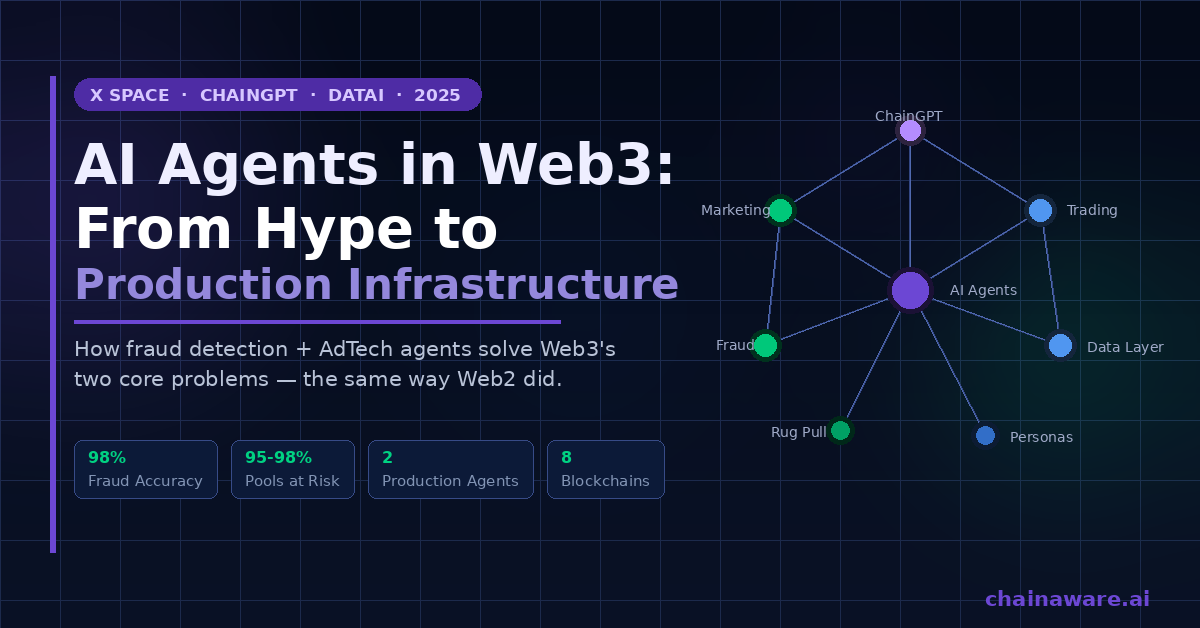
X Space with ChainGPT and Datai — ChainAware co-founders Martin and Tarmo join Ellie from Datai and ChainGPT Labs host Chris for a wide-ranging conversation on AI agents in Web3: what they actually are, what they can already do, and why they mark the beginning of the biggest innovation wave the industry has ever seen. Listen to the full recording on X ↗
Three projects at the frontier of Web3 AI infrastructure sit down to talk honestly about what is actually being built. ChainAware brings two production-ready AI agents — a fraud detection agent and a Web3 marketing agent — built on proprietary predictive models trained over two years. Datai brings three years of blockchain data aggregation and a smart contract categorization AI that translates raw on-chain transactions into the behavioral language that intelligent agents need to function. ChainGPT Labs, which incubates both, provides the ecosystem context that connects these tools to the broader question every Web3 builder faces: how do you get real users, build sustainable revenue, and focus on the innovation that actually matters? Together, they map out why AI agents are not a hype narrative — they are the infrastructure layer that finally makes Web3 businesses viable.
In This Article
- Three Projects, One Mission: What ChainAware, Datai, and ChainGPT Are Building
- What AI Agents Actually Are: Beyond the Hype
- The Founder Bandwidth Problem: Why 90% of Time Goes to the Wrong Things
- The Web3 Marketing Agent: From Mass Messaging to 1:1 Personalization
- The Orchestrator Shift: How Marketers Evolve in an AI Agent World
- Datai: The Data Layer That Makes Intelligent Agents Possible
- Smart Contract Categorization: Translating Addresses into Behavior
- The Fraud Detection Agent: Protecting the Ecosystem, Not Just One Platform
- Transaction Monitoring Agent: The Regulatory Requirement That Protects Everyone
- Datai’s Trading Use Case: From Pre-Packaged Strategies to Personalized AI Agents
- The Web2 Parallel: Two Technologies That Drove the Crossing of the Chasm
- The Coming Innovation Wave: What Happens When Founders Get Their Time Back
- Comparison Tables
- FAQ
Three Projects, One Mission: What ChainAware, Datai, and ChainGPT Are Building
ChainGPT Labs brought together two of its incubated projects — ChainAware and Datai — for this X Space precisely because their work is complementary. Both teams identified the same fundamental gap in Web3 infrastructure from different directions, and both arrived at AI agents as the solution. Understanding what each brings to the table clarifies why the combination matters.
ChainAware is a prediction engine. Starting from SmartCredit’s DeFi lending platform, Martin and Tarmo built iteratively: credit scoring required fraud detection, fraud detection extended to rug pull prediction, behavioral modeling followed, and marketing personalization emerged from behavioral data. Today the platform produces real-time behavioral profiles for any wallet address — predicting fraud probability, rug pull risk, experience level, risk tolerance, and future behavioral intentions (borrower, lender, trader, gamer, NFT collector). Two production AI agents sit on top of that infrastructure: the fraud detection agent and the Web3 marketing agent. As Martin explains: “We are a big calculation engine. Not just a calculation engine — we are a prediction engine. We predict what wallets are doing in the future.” For the complete ChainAware architecture, see our product guide.
Datai: Making Blockchain Data Readable for AI
Datai approaches the same problem from the data infrastructure layer. Ellie explains the core challenge: when you look at any blockchain transaction explorer, you see addresses interacting with other addresses. However, you do not see what the user was doing. That address could be connecting to a DeFi lending protocol, minting an NFT, bridging assets between chains, signing a contract, purchasing a gaming asset, or investing in a real-world asset. The transaction looks identical at the address level regardless of which of these activities is occurring. Datai spent three years manually aggregating blockchain data and building categorization for the smart contracts that users interact with — then invested 1.5 years building an AI model that can automatically categorize smart contracts at scale. The result is data that, as Ellie puts it, reads “like English” — structured behavioral context that AI agents can actually understand and act on. For how clean behavioral data enables better AI agent decisions, see our behavioral analytics guide.
What AI Agents Actually Are: Beyond the Hype
The X Space opens with an accessible definition that cuts through the significant volume of AI agent hype circulating in the Web3 space. AI agents are autonomous systems that run continuously, learn from feedback, and execute defined functions without requiring human initiation at each step. They differ from chatbots and simple automations in three specific ways: they operate on real-time data rather than static training sets, they learn continuously from outcomes rather than remaining fixed, and they execute consequential actions (transactions, content generation, risk flags) rather than just producing text responses.
Ellie offers the most accessible definition in the conversation: “Just a friend. Like it’s a robot friend who’s living inside your PC. This robot friend will listen to what you say, what you do, and then it will start telling you things — find my best pictures, find my best song. It can understand a lot of information really quickly. It’s like having a super helper that is always ready.” This analogy captures the operational reality well: an agent that has been configured for a specific task runs in the background, continuously analyzing the information relevant to that task and taking defined actions when conditions are met. No human needs to ask it to start or tell it when to act. For more on how AI agents differ from prompt engineering, see our Web3 AI agents guide.
Why Web3 Is the Ideal Environment for AI Agents
Both Ellie and Martin make a specific structural point about why Web3 enables AI agents more powerfully than Web2. In Web2, building agents is technically simpler because the data is in natural language — tweets, messages, Netflix viewing history, search queries. However, that data is locked behind proprietary APIs, fragmented across closed platforms, and requires individual permission agreements with each company. Web3’s data is structurally different: every transaction is public, every interaction is permanently recorded on open ledgers, and no permission is required to read any of it. The challenge in Web3 is not access — it is interpretation. Raw blockchain data is not readable without smart contract categorization. Once that categorization layer exists (which is what Datai provides), the behavioral signal quality is dramatically superior to anything Web2 has — because every transaction represents a real financial decision with real cost attached. For how this connects to ChainAware’s behavioral prediction models, see our generative vs predictive AI guide.
The Founder Bandwidth Problem: Why 90% of Time Goes to the Wrong Things
One of the most practically resonant arguments in the entire conversation comes from Tarmo’s opening on what AI agents mean for Web3 founders. The observation is simple and verifiable by anyone who has run a startup: the actual innovation a founder set out to build receives a small fraction of their working time. The rest goes to the operational overhead that every business requires — marketing, sales, compliance monitoring, tax reporting, transaction auditing, customer support, legal coordination. None of these activities are the core innovation. All of them are essential. Together, they consume the majority of a founder’s calendar.
Tarmo frames this precisely: “Just imagine when you are doing now a startup. You can spend maybe a real innovation for a small piece of time. The rest of time goes into tax reporting, into marketing, into sales, into transaction monitoring. What AI agents do — they take over all these tasks which you have to do supplementary to the real innovation, so that you can focus on the innovation.” Martin reinforces this with a specific observation about Web3 marketing: most founders end up devoting enormous energy to mass marketing campaigns that produce poor conversion because the personalization infrastructure does not exist yet. Building that infrastructure, running it, and optimizing it manually consumes resources that should be going toward product iteration. For more on how marketing agents specifically address the founder bandwidth problem, see our AI marketing guide and our Web3 agentic economy guide.
The Innovation Multiplier Effect
The second-order argument is even more significant than the immediate bandwidth gain. If AI agents remove the supplementary task burden from every Web3 founder simultaneously, the aggregate increase in innovation output across the entire ecosystem is enormous. Currently, thousands of talented teams spend the majority of their time on activities that provide no competitive differentiation — mass marketing to undifferentiated audiences, manually configuring compliance monitoring, preparing tax reports. All of this effort produces zero innovation. Redirecting even half of that effort toward core product development would compound into a wave of new capability that Martin describes as the biggest the industry has seen: “This will be a massive wave of innovation that is coming. All these supplementary activities — what the founders have to do at the moment — it blocks their time. Take it over with agents. That means focus on innovation, create real innovation.” For how this connects to the broader Web3 growth trajectory, see our AI agents acceleration guide.
Deploy Your First Agent in Minutes
ChainAware Free Analytics — Know Your Real Users in 24 Hours
Before you can personalise content, you need to understand who is actually visiting your platform. ChainAware Analytics gives you the real behavioral distribution of connecting wallets — experience levels, risk profiles, intentions — in 24-48 hours. Two lines of Google Tag Manager code. Free forever. The starting point for every agent deployment.
The Web3 Marketing Agent: From Mass Messaging to 1:1 Personalization
Marketing was personalized before it became mass. Before broadcast advertising, before mass media, before the internet — merchants knew their customers individually, knew their needs, and tailored their communication accordingly. Mass marketing was an economic compromise: reaching millions of people with identical messages was cheaper per impression than reaching each person with a relevant one, even though conversion rates were dramatically lower. The internet initially intensified mass marketing rather than solving it, because the data layer needed for personalization at scale did not exist yet.
Google changed that equation in Web2 by using search and browsing history to infer behavioral intent and serve matched advertising. Web3 today sits at the same pre-AdTech position that Web2 occupied before Google’s innovation. Every major marketing channel — KOL promotions, crypto media banners, Telegram ads, CMC listings — delivers identical messages to heterogeneous audiences. A DeFi native with five years of sophisticated protocol usage receives the same onboarding content as someone who created their first wallet last week. The conversion rate from this misalignment is predictably terrible. As Martin explains: “What is website’s role? Website’s role is to convert users. Website’s role is to resonate with users. So you have to create personalized websites.” For the full Web3 personalization framework, see our Web3 personalization guide and our intention-based marketing guide.
How the Marketing Agent Works in Practice
ChainAware’s marketing agent operates at the moment a wallet connects to a platform. The sequence is: wallet connects → ChainAware’s behavioral models calculate the wallet’s profile in real time → the agent generates content matched to that profile → the visitor sees messaging that resonates with their specific behavioral type. A high-probability borrower arrives at a lending platform and sees content about borrowing terms and collateral optimization. A leverage trader at the same platform sees content about position management and leverage tools. A first-time DeFi user sees content that addresses their onboarding needs. None of these visitors know that the content was generated for them specifically — they simply experience a platform that feels relevant. As Martin explains: “You calculate the user’s behavior, experience, risk willingness. You calculate who are the future borrowers with probabilities, who are the future lenders, who are the future leverage takers, who are the gamers, who are the NFT collectors. Based on these behavioral parameters, it’s automated targeting.” For the complete marketing agent implementation, see our Web3 personas guide.
From Manual Configuration to Auto-Generation
ChainAware’s banner system — which delivers personalized messages to platform visitors based on behavioral profiles — is already in production with clients. Currently, the system includes a significant manual configuration step: a team member specifies which messages should appear for which behavioral profiles, designs the content variants, and sets the targeting parameters. This manual configuration creates a startup cost for each new client deployment. The next evolution underway is auto-generation: the agent itself generates the content variants based on the behavioral profiles it identifies, requiring only human review rather than human creation. As Martin notes: “We have a lot of manual configuration there. What we are doing now is we are moving from manual configuration to auto generation.” Once auto-generation is complete, deploying the full personalization system requires minimal setup time — and the agent runs continuously from that point without ongoing human involvement.
The Orchestrator Shift: How Marketers Evolve in an AI Agent World
The host Chris, who works in marketing and community management for ChainGPT Labs, asks the question that many marketing professionals privately wonder: do AI agents replace the marketer? The answer from both Ellie and Tarmo is thoughtful and specific — and it reframes the question in a way that is both reassuring and clarifying.
Ellie’s observation is precise: AI agents in Web3 marketing will make the marketer’s work “a bit similar to Web2.” The comparison is apt. In Web2, sophisticated marketers do not write every word of copy, design every visual, or manually A/B test every subject line — they use tools, platforms, and workflows that handle execution while the marketer focuses on strategy, brief writing, and judgment about what is and is not resonating. Web3 marketing currently operates below that level because the data layer and personalization infrastructure do not yet exist. AI agents bring Web3 marketing up to Web2 sophistication, and then push further toward genuine 1:1 personalization that Web2 never fully achieved. For the marketing professional, the transition is from manual execution to strategic orchestration. As Tarmo describes the shift: “You become like an orchestrator. You have highly specialized agents — one agent is preparing nice illustrations which resonate with specific personas, one agent is preparing your texting, one agent is calculating a psychological profile. All you do is orchestrate them.” For more on how this orchestration model works in practice, see our Web3 growth guide.
High-Value Creation vs Low-Value Execution
The practical consequence of the orchestrator shift is a redistribution of human cognitive effort from low-value execution tasks toward high-value creative and strategic work. Currently, a significant portion of any marketing team’s time goes to tasks that require skill to do but that produce no strategic differentiation: writing variations of the same message for different channels, manually segmenting audience lists, resizing images for different ad formats, reporting on campaign performance. These tasks require time and training but not genuine creative judgment. AI agents can execute all of them. What they cannot replace is the judgment about which message strategy actually resonates with a specific community, which product narrative builds genuine trust, and which creative approach communicates a technical value proposition clearly. As Tarmo explains: “We are taken out of these daily operating activities where we spend 90% of our time. Instead we focus on these high, very high value creation activities. We use our creativity, our intellectual power to create something new.” For more on how ChainAware’s agent stack supports this reallocation, see our DeFi onboarding guide.
Datai: The Data Layer That Makes Intelligent Agents Possible
For an AI agent to make intelligent decisions, it needs to understand the context of the data it is acting on. In Web2, context is relatively accessible: user behavior is expressed in natural language — search queries, messages, reviews, social posts. AI systems trained on language can interpret this behavior without additional translation layers. In Web3, the equivalent behavioral data is expressed in a format that is opaque by default: hexadecimal addresses interacting with hexadecimal contracts, with transaction values in token units. None of this raw data tells you what the user was doing in any meaningful behavioral sense.
Datai’s core product solves this interpretation problem. By categorizing the smart contracts that users interact with, Datai transforms raw transaction histories into behavioral narratives. A series of transactions that looks like “0x4f…a2 interacted with 0x7d…c8” becomes “this wallet borrowed USDC on Aave, provided liquidity on Uniswap, bridged to Arbitrum, and purchased a gaming asset on Immutable X.” That translated narrative is what Ellie means by data that reads “like English” — structured, categorized behavioral context that AI agents can process, segment, and act on without requiring custom interpretation for each new protocol or chain. As Ellie explains: “When a user is interacting with a smart contract, there can be a thousand ways of what they’re doing — connecting to a DeFi protocol, interacting with NFT, bridging, signing a contract, maybe buying a gaming asset, investing in real world assets. If you look at the scanner, you see only addresses. But what are those addresses? What is the user doing? This is exactly what we’re trying to solve.” For how ChainAware’s models use behavioral data, see our blockchain analysis guide.
Smart Contract Categorization: Translating Addresses into Behavior
The practical value of smart contract categorization becomes clear when you consider the analytics problem any DApp operator faces. A platform operator knows everything about what users do inside their own protocol — how much liquidity they add, how long they stay, what assets they prefer. However, they know nothing about what those same users do everywhere else on the blockchain. A lending platform does not know whether its users also trade on derivatives protocols, whether they are active NFT collectors, whether they bridge frequently to other chains, or whether they have significant capital sitting idle in other protocols that they might potentially move. All of that behavioral context exists in public blockchain data — it is simply not interpretable without the categorization layer that tells you what each smart contract interaction represents.
Datai’s categorization layer makes this cross-platform behavioral picture available. As Ellie explains: “We can tell you that 10% of your customers are using lending-borrowing platforms on the same chain or on different chains. What assets are they lending and borrowing that you don’t have internally? So you can adjust your product strategy based on the behavior of what your customers are doing outside of the platform.” This external behavioral view is the Web3 equivalent of Google Analytics combined with competitor research — understanding not just what users do on your platform but who they are in the broader behavioral ecosystem. For how ChainAware’s wallet auditor provides a similar behavioral picture for individual wallets, see our wallet auditor guide and our user segmentation guide.
The Fraud Detection Agent: Protecting the Ecosystem, Not Just One Platform
Martin frames ChainAware’s fraud detection agent not as a product that protects individual users, but as ecosystem infrastructure that affects whether Web3 grows at all. The argument connects directly to the new user retention problem: every time a new participant enters Web3 and encounters a rug pull or scam, there is a meaningful probability they leave permanently. They do not distinguish between one bad project and the broader ecosystem — they associate the negative experience with the entire space and return to centralised exchanges or exit crypto altogether. Experienced participants — the OGs Martin refers to — have developed instincts for avoiding the worst situations. But new users have not.
The scale of the fraud problem in DeFi is significant. ChainAware’s data on PancakeSwap pools is striking: 95 to 98% of new pools end in rug pulls. That number means the base rate expectation for a new user exploring DeFi liquidity provision is almost certain loss. No amount of excellent UX or product innovation can overcome a user experience where the majority of initial interactions result in total loss of funds. Reducing that fraud rate — not just for individual users but across the ecosystem — is therefore a prerequisite for Web3 mainstream adoption. As Martin states: “It’s not just for one person, it’s not just for one DApp — it’s for the full ecosystem. If you clean up the ecosystem, we increase the trust, we get much more users, we get much more usage.” For the complete fraud detection methodology, see our fraud detection guide and our fraud detector guide.
Free Tools as Ecosystem Infrastructure
ChainAware’s decision to offer fraud detection and rug pull detection tools free to individual users reflects this ecosystem logic directly. If the goal were purely commercial, these tools would be paywalled to maximize revenue per user. The actual goal, however, is ecosystem trust improvement — which requires maximum adoption. Every user who checks an address before interacting with it, and every user who avoids a rug pull because they checked the pool contract, represents one fewer negative experience that might have driven a new participant out of Web3 permanently. At scale, widespread adoption of free fraud detection tools changes the ecosystem-level new user retention rate. For the free tools, see our fraud detector guide and our rug pull detection guide. For context on crypto fraud scale, see Chainalysis’s annual crypto crime data ↗.
Protect Your Users Before Any Interaction
ChainAware Fraud Detector + Rug Pull Detector — 98% Accuracy, Real-Time, Free
95-98% of new DeFi pools end in rug pulls. 98% of fraud can be predicted before it happens. Enter any wallet address or contract and get a real-time behavioral risk score — backtested on CryptoScamDB. Half a second for standard addresses. Free for every user on ETH, BNB, BASE, and HAQQ.
Transaction Monitoring Agent: The Regulatory Requirement That Protects Everyone
Beyond the individual user tools, ChainAware’s transaction monitoring agent serves a specific regulatory function for platform operators. Under MiCA regulation and FATF recommendations, Virtual Asset Service Providers — which includes most DeFi protocols — must implement both AML analysis and AI-based transaction monitoring. These are not the same thing, and Martin is precise about the distinction throughout the conversation.
AML analysis is a rules-based system that tracks the flow of known-illicit funds through the blockchain. It is inherently backward-looking and static: it can only flag addresses connected to previously identified fraud. Transaction monitoring, by contrast, uses AI to analyze behavioral patterns in real time and predict which currently legitimate-appearing addresses are likely to commit fraud in the future. The operational difference matters because sophisticated fraud operations design their activity specifically to pass AML checks while their behavioral history already contains the patterns that predictive AI identifies. As Martin explains: “Scammers and hackers — it’s a dynamical system. You cannot go with rules against a dynamical system. You need AI to interact with this dynamical system. That’s why you need transaction monitoring.” For the full regulatory context, see our AML and transaction monitoring guide and the FATF virtual assets recommendations ↗.
The Transaction Monitoring Agent in Operation
The operational model for the transaction monitoring agent is straightforward to implement. A platform operator uploads a list of wallet addresses — the connected users of their protocol — ranging from a few hundred to several thousand. The agent monitors all of these addresses continuously across all supported blockchains. When behavioral patterns emerge that match the fraud signature library (patterns that have historically preceded fraudulent activity, even in addresses that have not yet committed visible fraud), the agent flags the address and notifies the relevant compliance contact via Telegram or the platform interface. The compliance officer then makes the decision about what action to take — shadow restriction, investigation, or automated exclusion. The human remains in the decision loop, but the detection and notification happens automatically, continuously, without any ongoing human monitoring effort. For the complete transaction monitoring implementation, see our transaction monitoring guide.
Datai’s Trading Use Case: From Pre-Packaged Strategies to Personalized AI Agents
Ellie’s description of Datai’s trading AI agent use case traces a clear evolutionary arc in how DeFi users interact with complex financial strategies. DeFi began as a series of raw protocol interactions — users manually navigating Aave, Uniswap, Compound, and other protocols to construct their own yield strategies. In 2020, platforms began packaging these interactions into pre-built strategies: users could select from a menu of two to ten defined approaches, each representing a different combination of protocols, assets, and risk parameters. This was an improvement, but it created a different problem: the strategies were designed for generic user profiles, not for individual behavioral histories.
A user who primarily trades stable pairs and never touches leveraged positions faces the same menu of strategies as a user who actively manages high-risk leveraged portfolios across multiple chains. Neither user gets a strategy actually calibrated to their risk tolerance, behavioral history, or current asset holdings. The AI agent approach changes this entirely. As Ellie describes: “Wallet providers are developing agents that will go and analyze all your trading history — did you trade meme coins, stablecoins, add liquidity, borrow, leverage yourself? Based off this deep understanding, they create strategies that are fit to the user’s behavior.” The agent additionally considers what other users with similar behavioral profiles have done — a peer comparison layer that makes the recommendation more robust than individual history alone. For more on how behavioral profiling enables this personalization, see our behavioral analytics guide.
The Pool Comparison Product: A Practical Agent Application
Ellie shares a concrete product example that illustrates how data infrastructure enables AI agent functionality. Datai built an internal tool that tracks a single liquidity pool (for example, ETH/USDT) across all major protocols — Uniswap, Sushiswap, PancakeSwap, and others — comparing APY performance, liquidity depth, and security parameters simultaneously. A crypto fund initially used this to track their own portfolio performance. Then an external company building a trading AI agent contacted Datai to integrate this data: the agent needed to know which version of a given pool across which protocol and chain offered the best combination of yield and security at any given moment, then use bridging to route the user’s capital to the optimal destination automatically. As Ellie explains: “You want to invest in the same pool. You have maybe 100 possibilities. AI agents are built to help you better guide your choices. You just say: I want to add ETH/USDT to a pool. I don’t care if I’m on Ethereum or Base. It’s funneled to the right chain and the protocol with acceptable liquidity and highest APY.” For a parallel example using ChainAware’s Prediction MCP for agent decision-making, see our Prediction MCP guide.
The Web2 Parallel: Two Technologies That Drove the Crossing of the Chasm
Both ChainAware and Datai converge on the same historical framework for understanding Web3’s current position. The Web2 internet went through an identical phase before mainstream adoption: a technically sophisticated early-adopter community, significant innovation in business process efficiency, but brutal user acquisition costs driven by mass marketing and a persistent trust problem driven by widespread fraud. Web2 crossed from niche to mainstream through two specific technological interventions — and both Martin and Ellie name them explicitly.
The first was fraud detection. Credit card fraud was so pervasive in Web2’s early commercial phase that consumer reluctance to transact online constrained the entire e-commerce sector. Web2 companies collectively spent enormous development resources fighting fraud before they could focus on growth. The solution was transaction monitoring systems — mandated by financial regulators for payment processors, implemented in AI-based real-time pattern detection. Once fraud rates dropped, consumer trust increased and new users stopped burning their fingers and leaving. Ellie frames this directly: “Web2 became real. Web2, before what we know now, developed two very important technologies. One of them was fraud detection. It was fighting of credit card fraud.” For the complete historical parallel, see our ChainAware vs Google Web2 guide.
AdTech: The Second Technology That Made Web2 Viable
The second technology was AdTech. Before Google’s innovation, Web2 marketing was mass marketing — banner ads, email blasts, and press releases that reached everyone identically regardless of intent. Customer acquisition costs were prohibitively high because undifferentiated messages produced low conversion rates. Google used search history and browsing behavior as a proxy for intent, combined micro-segmentation with targeted delivery, and reduced customer acquisition costs from thousands of dollars to tens of dollars. Twitter, Facebook, and every major Web2 platform followed with their own behavioral targeting systems. The business models that power the modern internet — $600+ billion annually in digital advertising — exist because AdTech made user acquisition economically viable. As Ellie summarises: “The second crucial technology that Web2 had before it became mainstream was AdTech. Web2 used AdTech to match in an invisible way buyers and sellers. These were two key technologies which were the basis of our current Web2 world.” For AdTech scale data, see Statista’s Google advertising revenue data ↗. For how ChainAware replaces Google’s role in Web3, see our Web3 AdTech unit costs guide.
Web3 Is at the Same Inflection Point
Web3 today mirrors Web2 at the pre-chasm moment almost exactly. There is a sophisticated early-adopter community, significant innovation in business process automation (unit costs of financial operations have fallen dramatically), persistent fraud that drives new users away, and catastrophic user acquisition costs driven by mass marketing that does not convert. The two solutions that worked in Web2 — AI-based fraud detection and behavioral targeting AdTech — are now available for Web3 in a form that is structurally superior to what Web2 had, because blockchain transaction data carries higher behavioral signal quality than search history. As Martin concludes: “It happened because the fraud was taken down in the ecosystem. And from the other side, the crossing was introduced by Google. Google was the innovator. Now we are in Web3, exactly in the same situation as Web2 once was. How do we cross the chasm? Reduce fraud. Bring in personalized AdTech.” For more on how this two-part solution maps to ChainAware’s product roadmap, see our Web3 growth guide and Geoffrey Moore’s Crossing the Chasm framework ↗.
The Coming Innovation Wave: What Happens When Founders Get Their Time Back
The conversation closes with both Martin and Tarmo making a forward-looking argument that goes beyond the near-term benefits of individual AI agent deployments. The second-order effect of AI agents removing supplementary task burdens from every Web3 founder simultaneously is not incremental improvement — it is a step-change in the industry’s aggregate innovation capacity.
Currently, the Web3 ecosystem contains thousands of technically capable teams building genuinely novel infrastructure. Most of them spend the majority of their working time on activities that require skill but produce no differentiation — the same mass marketing campaigns, the same compliance monitoring procedures, the same administrative overhead. When AI agents absorb those tasks, the collective human creative capacity that was previously consumed by execution gets redirected toward product ideation, architectural decisions, and genuine innovation. Tarmo’s framing is direct: “With AI agents in marketing, AI agents in trust systems and fraud detection, we can bring the entire Web3 ecosystem to a new level.” This is not a marginal improvement to existing trajectories — it is a qualitative shift in what Web3 can produce. For context on the AI agent economy’s growth trajectory, see the Grand View Research AI agents market report ↗ and our real AI use cases guide.
Deploy the Full Agent Stack
ChainAware Prediction MCP — 18M+ Personas, 8 Blockchains, 32 Open-Source Agents
Every ChainAware capability — fraud detection (98%), rug pull prediction, behavioral profiling, marketing personalization, transaction monitoring — accessible via a single Prediction MCP. Any AI agent queries it in natural language and gets real-time behavioral predictions. 32 MIT-licensed agents on GitHub. SSE-based integration in minutes.
Comparison Tables
ChainAware vs Datai: Complementary AI Agent Infrastructure Layers
| Dimension | ChainAware.ai | Datai |
|---|---|---|
| Core function | Prediction engine — predicts future wallet behavior from transaction history | Data layer — categorizes smart contracts to make blockchain data readable for AI |
| Primary output | Behavioral profiles: fraud probability, experience, risk, intentions | Behavioral narratives: what the user was doing with each protocol interaction |
| Agent products | Fraud detection agent + Web3 marketing agent (both in production) | Data infrastructure for trading AI agents, wallet personalization, fund analytics |
| Data scope | Individual wallet behavioral history across 8 blockchains | Smart contract categorization across protocols, chains, and asset types |
| Use case for DApps | Personalize marketing, exclude bad actors, meet compliance requirements | Understand customer behavior outside your platform, build targeted strategies |
| Use case for users | Check fraud risk, get personalized platform experiences, prove trustworthiness | Get personalized DeFi strategies based on behavioral history + peer comparison |
| Relationship to Web2 parallel | Provides both fraud detection (transaction monitoring) and AdTech (behavioral targeting) | Provides the data categorization layer that makes behavioral AI possible |
| Integration | 2-line GTM pixel, Prediction MCP, API | API data feeds, AI agent data layer |
Pre-Packaged DeFi Strategies vs AI Agent Personalized Strategies
| Dimension | Pre-Packaged DeFi Strategies (2020 Model) | AI Agent Personalized Strategies (2025 Model) |
|---|---|---|
| Strategy design | Fixed menu of 2–10 options designed for generic user types | Generated dynamically from individual behavioral history + peer behavior |
| Risk calibration | Labelled (low/medium/high risk) but not calibrated to user’s actual tolerance | Calibrated to the user’s demonstrated risk behavior from transaction history |
| Asset optimization | User selects manually from available pools and protocols | Agent analyzes 100+ pool variants across protocols and chains, routes to optimal |
| Cross-chain complexity | User must manage bridging, chain selection, and protocol navigation manually | Agent handles bridging and chain routing automatically — user just approves |
| Peer comparison | Not available — strategy is generic regardless of what similar users are doing | Incorporates what other users in the same behavioral segment are doing successfully |
| New protocol discovery | Platform curates available strategies — new protocols not automatically included | Agent monitors all available protocols continuously and includes new opportunities |
| User effort | High — user must evaluate options, understand risks, execute manually | Minimal — agent presents 2-3 calibrated options, user approves preferred |
| Web2 equivalent | Choosing from a fixed set of mutual fund options | Personalized financial advisor with full visibility into your complete financial history |
Frequently Asked Questions
What is ChainGPT Labs and why did it incubate both ChainAware and Datai?
ChainGPT Labs is the incubation and investment arm of ChainGPT, a blockchain-focused AI platform and IDO launchpad. The incubation thesis focuses on projects building real AI infrastructure for Web3 — specifically those with proprietary technology, genuine use cases, and measurable product traction rather than narrative-driven projects. Both ChainAware and Datai fit this thesis: ChainAware with its proprietary predictive AI models (fraud detection, rug pull prediction, behavioral profiling) and Datai with its three-year smart contract categorization dataset and AI model. The X Space brought both together specifically because their capabilities are complementary — ChainAware predicts future wallet behavior while Datai provides the historical behavioral context that makes predictions richer and more accurate.
How does ChainAware’s marketing agent protect user privacy?
ChainAware’s marketing agent operates exclusively on publicly available on-chain transaction data. No personal identity information is required at any point. When a wallet connects to a platform, the agent calculates a behavioral profile from that wallet’s public transaction history — experience level, risk tolerance, intentions — and generates matched content accordingly. The user remains fully anonymous throughout: the agent knows behavioral patterns but not personal identity. This means the personalized experience is delivered without any KYC process, without cookie tracking, and without any data that could identify the individual behind the address. As Martin notes in the conversation: “Anonymity is still there, but we know the behavior of a person behind this address.”
What problem does Datai solve that wallet analytics tools do not?
Standard wallet analytics tools show you what transactions a wallet executed — the addresses it interacted with, the values transferred, the timing. They do not tell you what the wallet was doing in any behavioral sense. A wallet that interacted with 0x4f…a2 could have been borrowing USDC, providing liquidity, bridging ETH, or purchasing an NFT — the address looks identical in all cases. Datai’s smart contract categorization layer solves this interpretation problem by mapping every smart contract address to its functional category and behavioral context. The result is that wallet transaction histories become readable behavioral narratives: “this user borrowed on Aave, traded on Uniswap, bridged to Arbitrum, and purchased a gaming asset” — context that AI agents can act on meaningfully.
Will AI agents replace Web3 marketing professionals?
The consensus from both ChainAware and Datai is no — but the role changes significantly. AI agents take over execution tasks: generating content variants, segmenting audiences by behavioral profile, serving personalized messages, monitoring campaign performance, and optimizing targeting parameters. What they do not replace is strategic judgment: deciding which product narrative builds genuine community trust, identifying which behavioral segments represent the highest-value users, designing the creative brief that agents execute from, and evaluating whether the overall strategy is achieving its goals. The marketer becomes an orchestrator of specialized agents rather than a manual executor — which is, as Ellie notes, similar to how sophisticated Web2 marketing professionals already work with marketing technology platforms today.
What is the crossing the chasm requirement for Web3 mainstream adoption?
Both ChainAware and Datai identify the same two requirements, directly parallel to what drove Web2’s crossing of the chasm. First, fraud rates must decrease significantly through widespread deployment of AI-based fraud detection — making the ecosystem safe enough for new users to stay and build positive experiences rather than burning their fingers and leaving permanently. Second, user acquisition costs must drop from the current ~$1,000 per transacting DeFi user to something closer to Web2’s $15-30 benchmark — achievable through behavioral targeting AdTech that replaces mass marketing with intent-matched personalization. Both ChainAware’s production agents and Datai’s data infrastructure directly address both requirements. When both are solved simultaneously, the conditions for mainstream adoption are in place — exactly as they were when Web2 deployed transaction monitoring and AdTech in the early 2000s.
This article is based on the X Space hosted by ChainGPT Labs featuring ChainAware co-founders Martin and Tarmo alongside Ellie from Datai. Listen to the full recording on X ↗. For integration support or product questions, visit chainaware.ai.