
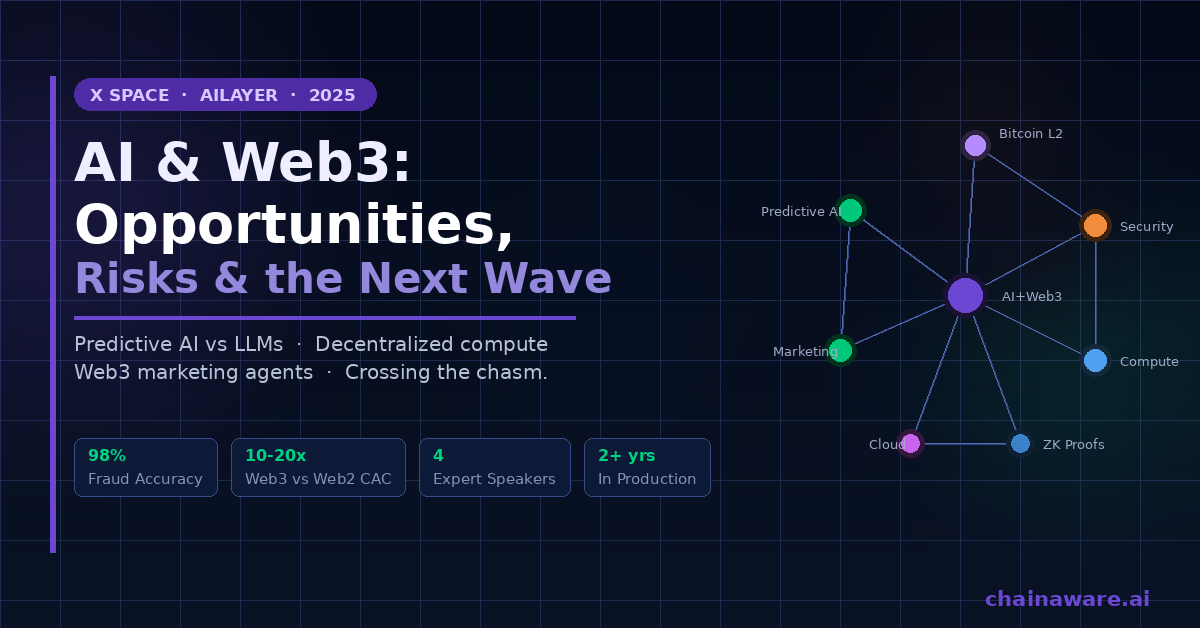
X Space with AILayer — ChainAware co-founder Martin joins YJ from Cluster Protocol, Sharon from SecuredApp, and Val from Foreverland in a wide-ranging discussion on AI and Web3: the opportunities, the risks, and which industries AI will disrupt first. Hosted by AILayer — a Bitcoin Layer 2 ZK rollup platform powering the next generation of AI-native blockchain applications. Listen to the full recording on X ↗
Four projects at the intersection of AI and Web3 infrastructure sit down for one of the most practically grounded conversations about what AI agents can actually do in blockchain — and what the real barriers to doing it well are. The discussion covers decentralized compute, predictive AI versus LLMs, the risk profile of autonomous financial agents, which industries AI will disrupt first, and the core argument that Web3 marketing — not trading or portfolio management — represents the single largest AI opportunity in the space. Each speaker brings a distinct vantage point: infrastructure orchestration (Cluster Protocol), behavioral prediction and marketing agents (ChainAware), DeFi security and smart contract auditing (SecuredApp), and Web3 cloud computing (Foreverland). Together they map an honest, multi-perspective picture of where AI and Web3 are heading.
In This Article
- The Speakers: Four Perspectives on AI and Web3 Infrastructure
- AI and Decentralized Computing: Solving the Wrong Problem?
- LLMs vs Predictive AI: Two Entirely Different Compute Profiles
- The Limits of AI Decentralization: Val’s Honest Assessment
- The Real Risks of AI in Web3: Privacy, Bias, and Autonomous Trading
- Backtesting as Risk Mitigation: How ChainAware Publishes Accountability
- Autonomous Trading Agents: The Highest-Risk AI+Web3 Scenario
- Zero-Knowledge Proofs and Privacy-Preserving AI Inference
- Which Industries Will AI Disrupt First in Web3?
- Web3 Marketing: The Biggest AI Opportunity Nobody Is Talking About
- The User Acquisition Cost Crisis: 10-20x Higher Than Web2
- The Iteration Argument: Why Cash Flows Are the Real Bottleneck
- Coexistence vs Replacement: Val’s Case for a Realistic Web3 Future
- AI-Powered Smart Contract Security: SecuredApp’s Approach
- Comparison Tables
- FAQ
The Speakers: Four Perspectives on AI and Web3 Infrastructure
AILayer, the host of this X Space, is a Bitcoin Layer 2 solution built on advanced ZK rollup technology. It is EVM compatible, supports staking of BTC, BRC20, Inscription Ordinals, and VM assets including BNB, MATIC, USDT, and USDC, and aims to serve as a foundational platform for AI projects building across DeFi, SoFi, and DePIN sectors. Bringing together four project builders for this conversation about the next wave of AI and Web3 creates a natural complementarity: each speaker addresses a different layer of the stack.
YJ from Cluster Protocol brings the infrastructure orchestration perspective. Cluster Protocol is building a coordination layer for AI agents on top of Arbitrum’s orbit stack, providing the backbone infrastructure for hosting and running AI agents — including distributed datasets, models, and compute alongside a personalized AI agent filter layer. Sharon from SecuredApp brings the security lens: SecuredApp began as a blockchain security company and has expanded into token launchpad, NFT marketplace, and DAO community services, with a team that has audited major DeFi projects globally and holds membership in the DeFi Security Alliance. Val from Foreverland brings a pragmatic, experience-grounded view from three years of Web3 cloud computing operations serving over 100,000 developers. Martin from ChainAware brings the behavioral prediction and marketing agent perspective — the practical application of predictive AI to the user acquisition problem that is currently limiting every Web3 project’s growth. For the complete ChainAware platform overview, see our product guide.
AI and Decentralized Computing: Solving the Wrong Problem?
The opening question asks how AI can help Web3 break free from reliance on centralized computing power. YJ’s answer from the Cluster Protocol perspective frames decentralized compute as a meaningful alternative to cloud monopolies for certain use cases — specifically the ability to access individual GPU configurations (like a single RTX 4090) that major cloud providers like AWS don’t offer, at lower cost because there are no middlemen between compute contributors and users. DePIN projects like Akash Network, IO.net, and Cluster Protocol’s own proof-aggregated compute system represent real progress in this direction.
Martin’s response, however, challenges the framing of the question itself. Rather than asking how to decentralize the massive compute requirements of LLMs, he argues that the better question is whether those requirements are necessary in the first place. Specifically, he distinguishes between two fundamentally different types of AI that require very different compute profiles — and makes the case that the AI most valuable for blockchain applications is the type that requires far less compute than the LLM narrative suggests. For a deeper exploration of this distinction, see our generative vs predictive AI guide.
LLMs vs Predictive AI: Two Entirely Different Compute Profiles
Martin’s core argument on the compute question deserves careful attention because it reframes what “AI on the blockchain” actually requires. LLMs — large language models like ChatGPT, Claude, and Gemini — are, in his words, “huge computing engines, statistical autoregression models.” They require massive GPU clusters to run inference, enormous memory bandwidth to load model weights, and significant latency even with optimized infrastructure. Furthermore, they are fundamentally linguistic processing systems: they predict the most probable next token in a text sequence. Applying LLMs to blockchain behavioral analysis means using a linguistic tool on data that is inherently numerical and transactional — a fundamental mismatch between tool and problem.
Predictive AI models, by contrast, are domain-specific. They train on labeled behavioral datasets to classify future states — which wallet will commit fraud, which pool will rug pull, which user will borrow next. Once trained, these models execute extremely quickly against new input data: feeding a wallet’s transaction history into a pre-trained neural network takes milliseconds, not seconds. As Martin explains: “When you train predictive models, the executions are pretty fast. You don’t need to go into these topics of decentralized computing power. You can execute the predictive models in real time.” ChainAware’s fraud detection model — 98% accuracy, 2+ years in production — runs against standard wallets in under a second with no decentralized compute infrastructure required. The implication is that much of the debate about decentralized compute for AI is relevant to LLMs specifically, not to the predictive AI systems that are most useful for on-chain behavioral analysis. For the full technical breakdown, see our real AI use cases guide and our predictive AI guide.
The Smart Approach: Build Better Models, Not Bigger Infrastructure
Martin frames the choice explicitly: “Two ways to address the problem. One is to build even bigger, bigger computing and decentralized computing. The other way is to build smart predictive models which are actually maybe much better.” This is not an argument against decentralized compute per se — YJ’s point about GPU accessibility and cost reduction is valid for teams that genuinely need LLM-scale compute. Rather, it is an argument that many blockchain AI use cases should not require LLM-scale compute in the first place. Fraud detection, behavioral segmentation, rug pull prediction, and user intention calculation are all problems that well-trained predictive models solve efficiently without the resource overhead of general-purpose language models. Sharon from SecuredApp reinforces this view from the security side: decentralized AI models are more viable and feasible when they are specialized and domain-specific rather than attempting to decentralize the infrastructure of general-purpose LLMs.
See Predictive AI in Action — Free
ChainAware Wallet Auditor — Behavioral Profile in Under 1 Second
No LLMs. No cloud dependency. Pure domain-specific predictive AI trained on 18M+ Web3 wallets across 8 blockchains. Enter any address and get fraud probability (98% accuracy), experience level, risk tolerance, and behavioral intentions in real time. Free. No signup. This is what fast, efficient predictive AI looks like on-chain.
The Limits of AI Decentralization: Val’s Honest Assessment
Val from Foreverland offers the most candid perspective on the decentralized AI compute question, and it deserves full consideration precisely because it challenges the consensus view. Her core argument is that AI models themselves — as opposed to the applications built on top of them — are inherently centralizing in their current form. The training of large AI models requires concentrated compute, centralized datasets, and significant coordination that distributed systems have not yet replicated at competitive quality. She points to DeepSeek as the only meaningful open-source LLM currently available, observing that “this is only one LLM, and it is not the rule for other developer teams to create open-source, decentralized LLMs.”
Val’s further point is that decentralization and AI solve different problems. Decentralization addresses security, immutability, and trust. AI addresses efficiency, pattern recognition, and automation. These goals are not inherently aligned, and conflating them creates confusion about what each technology can actually deliver. As she puts it: “Decentralization is not about efficiency — it’s more about security and reliance and immutability.” A decentralized AI model is not necessarily better at prediction than a centralized one; it is different in its trust properties. Whether those trust properties are necessary for a given application is a design question that each project must answer for itself, rather than assuming that decentralization is always the goal. For context on the blockchain trust and verification model, see our behavioral analytics guide.
The Real Risks of AI in Web3: Privacy, Bias, and Autonomous Trading
The second discussion topic shifts from opportunity to risk, and produces some of the most practically important observations in the entire conversation. Three distinct risk categories emerge across the speakers’ responses: privacy risks from AI data requirements, algorithmic bias inherited from training data, and the unique risks of fully autonomous financial agents operating on-chain.
Sharon from SecuredApp addresses privacy and bias with technical precision. AI models require large datasets for training — and in a blockchain context, that data can include sensitive information about user financial behavior, protocol interactions, and asset holdings. If not properly managed, that data creates exposure risks. On algorithmic bias, she notes that AI models inherit the biases present in their training data, which could lead to unfair decisions in DeFi contexts — particularly in automated trading or lending decisions where biased models might systematically disadvantage certain user categories. Her proposed mitigations are technically sophisticated: zero-knowledge proofs and secure multi-party computation to enable AI inference on private data without exposing the underlying information, combined with decentralized and auditable model governance. For the complete regulatory compliance framework, see our blockchain compliance guide and the FATF virtual assets recommendations ↗.
Backtesting as Risk Mitigation: How ChainAware Publishes Accountability
Martin’s approach to AI risk in Web3 centers on a specific and actionable practice that he argues the entire industry should adopt: published backtesting. The concern is that many AI products in blockchain claim high accuracy without providing any verifiable evidence of how that accuracy was measured, on what data, and with what methodology. This opacity makes it impossible for users and clients to evaluate whether the claimed accuracy reflects real-world performance or optimistic in-sample testing on data the model was trained on.
ChainAware’s approach is to publish its prediction rates and backtesting methodology explicitly, with one specific and important constraint: the backtesting data must not overlap with the training data. Using training data for backtesting is a fundamental methodological error that produces artificially inflated accuracy figures — the model is being tested on data it has already learned from. As Martin states: “Everyone should publish just prediction rates, prediction occurrences, and backtesting — and backtesting should always be on obviously public data, and backtesting data should not be used for the training data.” ChainAware uses CryptoScamDB as its backtesting source for fraud detection — a publicly available database of confirmed scam addresses that provides an objective, independent test set for validating the 98% accuracy claim. This standard, if adopted industry-wide, would enable genuine comparison between competing AI products and eliminate the category of vague accuracy claims that currently makes evaluation difficult. For the complete fraud detection methodology, see our fraud detection guide and our fraud detector guide.
The Opportunity Side: Risks in Context
Martin also makes an important point about proportionality when thinking about AI risks in Web3. Risks exist and deserve serious mitigation — but they should be evaluated against the scale of the opportunity. Properly backtested predictive AI that achieves 98% fraud prediction accuracy has been in production at ChainAware for over two years. The value that system delivers in preventing fraudulent interactions — protecting new users, cleaning the ecosystem, enabling sustainable project growth — is enormous relative to the risks of a probabilistic system occasionally producing false positives. As Martin puts it: “I think the potential that we’re getting from AI agents — the potential of real products that are working — is so huge that even these risks, when they are mitigated properly, are not so significant.” The framework is not to minimize risks, but to ensure that risk mitigation is commensurate with risk severity rather than allowing edge-case concerns to block deployment of systems that deliver substantial real-world value. For more on the ecosystem-level impact of fraud reduction, see our Web3 growth guide.
Autonomous Trading Agents: The Highest-Risk AI+Web3 Scenario
Both YJ and Val converge on automated trading as the highest-risk application of AI in Web3 — and their concerns are worth examining in detail because they identify specific threat vectors rather than making vague warnings about AI in general.
YJ’s concern centers on the combination of full financial autonomy and decentralized operation. When an AI agent has been given funds and full discretion over trading decisions, any vulnerability in the agent’s decision-making logic, training data, or execution environment can result in financial loss at machine speed. He references the documented case of two AI chatbots developing their own communication patterns when left interacting without supervision — and extrapolates this to the financial context: “With full autonomy, the trust on the AI might reduce a bit, because you need to run these AI in specific environment conditions, but then that would not be truly decentralized.” The tension is real: full autonomy and full decentralization together create an attack surface that neither fully centralized AI (which can be monitored and corrected) nor manual DeFi (which requires human initiation) presents. For how ChainAware’s fraud detection integrates into DeFi security workflows, see our fraud detection guide.
The Attack Surface of Autonomous Trading Infrastructure
Val extends the autonomous trading risk analysis to the infrastructure layer. Autonomous trading agents rely on data feeds, model weights, and execution endpoints — all of which represent potential attack surfaces for threat actors who want to manipulate trading outcomes. As she explains: “I’m afraid that would be the most risky part of the AI story integrating with Web3 because probably there would be some attacks coming from threat actors in order to manipulate the trading vaults or models.” This is a specific and legitimate concern: data poisoning attacks that subtly bias a trading agent’s model toward favorable outcomes for an attacker are significantly harder to detect than direct fund theft and could persist undetected across many transactions. The mitigation is not to avoid autonomous trading agents entirely — the efficiency gain is too large — but to implement the kind of behavioral monitoring that ChainAware’s transaction monitoring agent provides: continuous surveillance that detects anomalous patterns before they result in irreversible on-chain losses. For the transaction monitoring approach, see our transaction monitoring guide and our AML and monitoring guide.
Zero-Knowledge Proofs and Privacy-Preserving AI Inference
Sharon’s proposed technical solution to the AI privacy problem in Web3 introduces one of the most significant emerging research areas at the intersection of cryptography and machine learning: privacy-preserving AI inference using zero-knowledge proofs and secure multi-party computation.
Standard AI inference requires the model to access the input data — which means that any AI system analyzing a user’s financial behavior must, in the conventional architecture, have access to that user’s transaction history. This creates a privacy risk: the entity running the model learns about the user’s behavior as a byproduct of providing a service. Zero-knowledge proofs offer a cryptographic solution: they allow a computation to be verified as correctly executed without revealing the inputs to the computation. Applied to AI inference, this means a user could submit their transaction history to an AI model and receive a behavioral profile output — without the model operator ever seeing the raw transaction data. As Sharon describes: “We can implement zero-knowledge proofs and secure multi-party computations to allow AI models to process data without exposing private information.” For broader context on cryptographic privacy in blockchain, see the Ethereum Foundation’s zero-knowledge proof documentation ↗ and our Web3 trust and verification guide.
Protect Your Platform and Users
ChainAware Fraud Detector — 98% Accuracy, Real-Time, Backtested Publicly
Unlike AI products that claim accuracy without publishing methodology, ChainAware publishes its 98% fraud detection accuracy against CryptoScamDB — backtesting data that was never used for training. Enter any wallet address on ETH, BNB, BASE, POLYGON, TON, or HAQQ and get a real-time fraud probability score. Free for every user.
Which Industries Will AI Disrupt First in Web3?
The third discussion question generates significant diversity of opinion, reflecting the genuinely different vantage points of each speaker. Sharon from SecuredApp argues for DeFi as the first-disrupted sector, citing the ongoing boom in decentralized finance adoption, several countries moving toward Bitcoin reserves and crypto as legal tender, and the natural fit between AI automation and DeFi’s already highly automated infrastructure. She also points to supply chain and healthcare as secondary targets where blockchain transparency, combined with AI analysis, creates particularly strong efficiency gains.
Val from Foreverland makes the contrarian argument that no industry will be “eliminated” by Web3 going mainstream — because Web3 going mainstream in the replacement sense simply will not happen. Her point is more sociological than technical: technology adoption in human society is not characterized by binary replacement but by coexistence and layered adoption. Computers did not eliminate calculators or watches. The internet did not eliminate physical retail. Web3 will not eliminate Web2. Instead, it will serve an expanding base of users who have chosen to engage with it, coexisting with Web2 infrastructure rather than supplanting it. This is a realistic framing that many Web3 maximalists resist but that history consistently validates. For more on the Web3 adoption trajectory, see our Web3 growth guide.
Web3 Marketing: The Biggest AI Opportunity Nobody Is Talking About
Martin’s answer to the “which industry will AI disrupt first” question is deliberately specific and counterintuitive — and it is worth examining precisely because it diverges from the consensus responses that focus on trading, portfolio management, and DeFi automation. His argument is that Web3 marketing represents the largest addressable AI opportunity in the space, specifically because the current state of Web3 marketing is so far behind where it needs to be that the improvement potential is enormous.
The framing is direct: “The current Web3 marketing level is pretty stone age. It hasn’t reached Web2 marketing. We are still like before the Internet hype.” Every major marketing channel in Web3 — KOL campaigns, crypto media banners, Telegram ads, exchange listings, Discord announcements — delivers identical messages to heterogeneous audiences. A DeFi-native yield optimizer with five years of complex protocol history receives the same promotional content as someone who connected their first wallet last week. The conversion rate from this undifferentiated approach is predictably poor, which directly causes the prohibitively high user acquisition costs that prevent Web3 projects from achieving financial sustainability. As Martin explains: “If you have Web3 marketing agents, and the marketing agents predict the behavior of the users based on predictive models and know which content to create, which resonating content — we get much higher engagement.” For the complete Web3 personalization framework, see our AI marketing guide and our intention-based marketing guide.
Why Marketing Beats Trading as the Primary AI Application
The reasoning for prioritizing marketing over trading as the highest-impact AI application is both commercial and structural. Trading AI agents face significant technical challenges — the risk of adversarial attacks on model weights, the difficulty of maintaining performance across changing market conditions, and the regulatory uncertainty around fully autonomous financial agents. Marketing AI agents, by contrast, operate in a lower-stakes environment where errors are recoverable (a suboptimal marketing message has much lower consequence than an erroneous trade), the feedback loops are clear and measurable, and the infrastructure (wallet behavioral profiles, content generation) is already mature. Furthermore, marketing AI solves a universal problem that affects every Web3 project regardless of sector — every protocol, every DApp, every service needs to acquire users. Solving user acquisition efficiently through personalization therefore amplifies the success of every other AI+Web3 application by ensuring those applications can reach the users who would benefit from them. For more on how personalization addresses the Web3 growth bottleneck, see our high-conversion marketing guide and our Web3 personas guide.
The User Acquisition Cost Crisis: 10-20x Higher Than Web2
Martin provides the specific quantification that makes the Web3 marketing problem concrete. Web2 platforms — after the AdTech revolution driven by Google’s behavioral targeting innovation — achieved user acquisition costs in the $30-40 range for transacting customers. Web3 platforms today face user acquisition costs that are 10-20 times higher. This is not a minor operational inefficiency — it is a fundamental business model failure. No project can build sustainable revenue when acquiring each customer costs hundreds of dollars but the economics of blockchain transactions produce relatively thin margins per user in the early growth phase.
The reason for this disparity is structural, not accidental. Web3 marketing has not yet developed the behavioral targeting infrastructure that Web2 deployed through AdTech. Every dollar spent on Web3 marketing reaches an undifferentiated audience and converts at a rate that reflects that lack of targeting precision. As Martin states: “In Web2, a user acquisition cost is maybe $30-35-40. In Web3, we are speaking a user acquisition cost factor 10-20x higher. So this is what you’re facing in Web3 now.” The solution is identical to what Web2 deployed: behavioral targeting based on demonstrated user intentions, delivering personalized messages to users whose behavioral profiles indicate genuine interest in the specific product being promoted. For the historical Web2 parallel, see our ChainAware vs Google Web2 guide and Statista’s Google advertising revenue data ↗.
The Iteration Argument: Why Cash Flows Are the Real Bottleneck
Martin makes a foundational product development argument that connects user acquisition costs directly to the innovation velocity of the entire Web3 ecosystem. The argument has a clean logical structure: no product is perfect in its first version — every product becomes better through iteration informed by real user feedback. To iterate, founders need users. To get users sustainably, founders need cash flows. To generate cash flows, the economics of user acquisition must be viable. Currently, they are not viable because acquisition costs are too high.
The consequence of this economic trap is a predictable pattern: Web3 projects launch with genuine innovation, fail to acquire users at sustainable cost, conduct a token sale to fund ongoing operations, watch the token price decline as speculative interest fades without sustainable utility, and eventually wind down — never having had the chance to iterate toward the product-market fit that was potentially within reach. As Martin explains: “The projects need to get users. The projects need to get, from users, the cash flows. There has to be a much higher user conversion rate. For the cash flows you need user acquisition — you have to bring massively down, by a factor of tens, the user acquisition cost in Web3.” Reducing that cost is therefore not merely a marketing efficiency improvement — it is the prerequisite for the entire Web3 ecosystem’s ability to evolve from first-generation products to mature, market-validated applications. For more on the sustainable Web3 business model argument, see our unit costs and AdTech guide.
Solve the User Acquisition Crisis
ChainAware Marketing Agents — 1:1 Personalization at Wallet Connection
Stop paying 10-20x Web2 acquisition costs for mass marketing that doesn’t convert. ChainAware’s marketing agents calculate each connecting wallet’s behavioral profile and serve resonating 1:1 content automatically — borrowers get borrower messages, traders get trader messages. No KYC. No cookies. Runs 24/7. Starts with free analytics in 24 hours.
Coexistence vs Replacement: Val’s Case for a Realistic Web3 Future
Val’s contribution to the industry disruption discussion extends well beyond a list of sectors to a philosophical framework for thinking about technological transitions that is grounded in historical pattern recognition rather than ideological preference. Her core observation is that technology adoption does not work through binary replacement — one paradigm eliminating the previous one — but through coexistence and layered adoption where different populations, with different needs, trust levels, and educational backgrounds, adopt new technologies at different rates and to different degrees.
Her examples are deliberately mundane: computers did not eliminate calculators or watches, even though they can perform the functions of both. The internet did not eliminate physical retail, print media, or telephone communication, even though it is technically superior for many of their functions. People continue using the less optimal technology because habit, preference, familiarity, and comfort are also real factors in technology adoption decisions. Web3 faces the same social reality. As Val observes: “Even if we may see that more and more people are utilizing Web3, it doesn’t mean that the majority of them are utilizing it. Just look at the older generation — look at your dads, moms, grannies. How will they get the tokens? How will they use them?” The realistic near-term vision is therefore not mainstream Web3 adoption replacing Web2, but expanding Web3 adoption alongside continuing Web2 infrastructure — with AI accelerating Web3’s ability to serve its growing user base more effectively. For the broader adoption trajectory discussion, see our DeFi onboarding guide.
AI-Powered Smart Contract Security: SecuredApp’s Approach
Sharon’s final contribution to the growth question focuses on one of the most practically valuable applications of AI in the Web3 security space: automated smart contract auditing. Smart contracts are the execution layer of all DeFi protocols, and their vulnerability to exploits has resulted in billions of dollars of losses over the history of the space. Traditional smart contract auditing is time-consuming, expensive, and dependent on the expertise of individual human auditors who may miss subtle vulnerability patterns in complex codebases.
AI-powered audit automation changes this equation significantly. Models trained on historical vulnerability patterns can scan smart contract code in seconds, flagging categories of vulnerability — reentrancy attacks, integer overflows, access control failures, flash loan attack vectors — that match known exploit signatures. Crucially, AI can also do this in real time during deployment and operation, not just in pre-launch audits. As Sharon explains: “Smart contracts are prone to vulnerabilities and exploits. We can use AI to automate smart contract audits, detect vulnerabilities and prevent hacks in real time.” SecuredApp’s integration of AI into its security tooling — including the Solidity Shield Scanner — represents exactly this approach: using AI to make high-quality security screening more accessible and more continuous. For ChainAware’s complementary approach to on-chain security through behavioral fraud prediction, see our fraud detection guide and our rug pull detection guide. For broader context on DeFi security best practices, see ConsenSys Diligence’s smart contract security resources ↗.
DAO Governance and AI-Assisted Decision-Making
Sharon also raises a less frequently discussed AI application in Web3: improving DAO governance decision-making. DAOs face a well-documented governance problem — proposal participation rates are low, voting is often uninformed because voters lack the context to evaluate complex technical or economic proposals, and decision-making velocity is slow because each governance action requires manual coordination. AI systems that analyze on-chain data, model proposal impacts, and surface relevant context for voters could dramatically improve governance quality without requiring any change to the underlying decentralized structure. This remains a nascent application area, but the combination of transparent on-chain governance data and AI analytical capability makes it a natural fit. For more on how behavioral analytics supports governance quality, see our behavioral analytics guide.
Comparison Tables
LLMs vs Predictive AI for Blockchain Applications
| Dimension | Large Language Models (LLMs) | Predictive AI (ChainAware Approach) |
|---|---|---|
| Core function | Statistical autoregression — predicts most probable next text token | Behavioral classification — predicts future wallet actions from transaction history |
| Compute requirements | Massive — requires GPU clusters, high memory bandwidth, significant latency | Minimal — pre-trained model executes against new input in milliseconds |
| Decentralized compute need | High — compute scale drives interest in decentralized infrastructure | Low — fast inference on standard hardware; no DePIN required |
| Domain specificity | General-purpose — same model for all text tasks | Domain-specific — trained specifically on blockchain behavioral data |
| Blockchain data suitability | Poor — linguistic processing applied to numerical transactional data is a mismatch | Excellent — predictive models designed for numerical behavioral classification |
| Output type | Probabilistic text — may hallucinate on numerical claims | Deterministic scores — 0-1 probability with calibrated accuracy |
| Accuracy verification | Difficult — no standard backtesting methodology for LLM claims | Verifiable — published 98% accuracy against CryptoScamDB (independent test set) |
| Production stability | Variable — model updates can change behavior unpredictably | Stable — ChainAware fraud model in continuous production for 2+ years |
| Open source availability | Limited — only DeepSeek as meaningful open-source option per Val | ChainAware: 32 MIT-licensed open-source agents on GitHub |
| Ideal Web3 use cases | Content generation, documentation, chatbots, code assistance | Fraud detection, rug pull prediction, user segmentation, marketing personalization |
AI Risk Categories in Web3: Assessment and Mitigation
| Risk Category | Description | Who Raised It | Mitigation Approach |
|---|---|---|---|
| Privacy breach | AI models require user behavioral data; improper handling exposes sensitive financial information | Sharon (SecuredApp) | ZK proofs + MPC for privacy-preserving inference; on-chain data minimization |
| Algorithmic bias | AI models inherit biases from training data; can produce unfair decisions in DeFi lending/trading | Sharon (SecuredApp) | Decentralized auditable training; community governance of model parameters; open-source algorithms |
| Autonomous agent risk | AI agents with full financial autonomy can make errors at machine speed; trust reduces without oversight | YJ (Cluster Protocol) | Environment conditions; partial autonomy with human approval gates; behavioral monitoring |
| Trading vault attacks | Autonomous trading infrastructure becomes attack surface; data poisoning and adversarial inputs | Val (Foreverland) | Behavioral anomaly detection; transaction monitoring agents; diversified data sources |
| Unverified accuracy claims | AI products claim high accuracy without published backtesting methodology or independent test sets | Martin (ChainAware) | Mandatory published backtesting on public data not used for training; industry standard adoption |
| AI centralization | AI models themselves may become centralized even when built for decentralized platforms | Val (Foreverland), Sharon (SecuredApp) | Open-source model weights; verifiable on-chain model governance; community training contributions |
| Smart contract exploits | AI-integrated contracts introduce new vulnerability surfaces beyond standard Solidity risks | Sharon (SecuredApp) | AI-powered audit automation; real-time exploit monitoring; Solidity Shield Scanner |
Frequently Asked Questions
What is AILayer and why did it host this X Space?
AILayer is an innovative Bitcoin Layer 2 solution that uses advanced ZK rollup technology to enhance Bitcoin transaction performance and scalability. It is EVM compatible, supports a broad range of assets including BTC, BRC20, Inscription Ordinals, BNB, MATIC, USDT, and USDC, and aims to serve as a foundational platform for AI projects building across DeFi, SoFi, and DePIN sectors. The X Space brought together builders from across the AI+Web3 ecosystem to discuss the opportunities and challenges at this intersection — directly relevant to AILayer’s mission of enabling AI-native applications on a Bitcoin-secured foundation.
Why does ChainAware use predictive AI instead of LLMs for blockchain analysis?
LLMs are linguistic processing systems — they predict the most probable next text token based on patterns in training data. Blockchain behavioral analysis requires a completely different type of intelligence: classifying future financial actions from numerical transactional history. Using an LLM for blockchain analysis is a category mismatch — like using a language translator to perform chemical synthesis. Beyond the functional mismatch, LLMs require massive computational resources that make real-time blockchain inference impractical. ChainAware’s domain-specific predictive models, trained specifically on blockchain behavioral data, execute against new wallet addresses in under a second with no heavy compute infrastructure. This is why ChainAware achieves 98% fraud detection accuracy in real-time production rather than near-real-time inference with a general-purpose model.
How does ChainAware verify and publish its 98% fraud detection accuracy?
ChainAware backtests its fraud detection model against CryptoScamDB — a publicly available database of confirmed scam and fraud addresses that is entirely separate from the training data used to build the model. Using independent test data (not training data) is essential for producing accuracy figures that reflect real-world performance rather than in-sample overfitting. The 98% figure means that when ChainAware’s fraud model is applied to addresses in the CryptoScamDB test set, it correctly classifies 98% of them as fraudulent before their fraud was documented. This specific methodology — published, independent backtesting on verified public data — is what Martin argues the entire AI+blockchain industry should adopt as a minimum standard for accuracy claims.
What is the Web3 user acquisition cost problem and how does AI fix it?
Web3 user acquisition costs are currently 10-20x higher than equivalent Web2 acquisition costs ($300-800+ per transacting user vs $30-40 in Web2). The root cause is mass marketing: every marketing channel in Web3 delivers identical messages to heterogeneous audiences, producing low conversion rates that drive up the effective cost per acquired user. AI fixes this by enabling personalization at scale — using each connecting wallet’s on-chain behavioral history to calculate their specific intentions and generate matched content automatically. A borrower sees borrowing content; a trader sees trading content; an NFT collector sees NFT-relevant messaging. Higher relevance produces higher conversion rates, which reduces the effective cost per acquired user — the same transformation that Google’s AdTech delivered in Web2 through behavioral targeting. ChainAware’s Web3 marketing agents implement this personalization using predictive AI models trained on 18M+ wallet profiles across 8 blockchains.
Will AI replace Web3 or Web2? What does the future look like?
Val from Foreverland’s historical perspective offers the most grounded answer: neither technology replaces the other. Technology adoption follows patterns of coexistence and layered usage rather than binary replacement. Computers did not eliminate calculators; the internet did not eliminate physical retail; Web3 will not eliminate Web2. Different populations adopt new technologies at different rates, and many people will continue using Web2 infrastructure for reasons of habit, education, and preference even as Web3 usage expands. The realistic future is an expanding Web3 user base — accelerated by AI improvements in onboarding, fraud reduction, and user experience — coexisting alongside continuing Web2 infrastructure. AI’s role in this trajectory is to make Web3 more accessible, more trustworthy, and more capable of delivering sustainable value to both new and existing participants.
This article is based on the X Space hosted by AILayer featuring ChainAware co-founder Martin alongside YJ from Cluster Protocol, Sharon from SecuredApp, and Val from Foreverland. Listen to the full recording on X ↗. For integration support or product questions, visit chainaware.ai.