
Last Updated: 2026
Here is the compliance conversation most DeFi founders eventually have — usually after their legal counsel sends a bill for the initial scoping call. They’ve been told they need to comply with MiCA. Someone recommends Chainalysis or Elliptic. The team looks at the pricing page (if they can find one) and learns that enterprise AML tools cost anywhere from $100,000 to $500,000 per year. The procurement cycle runs three to six months. Implementation requires dedicated engineering resources.
The product? Built for banks and centralized exchanges. Feature set? Designed for the Travel Rule, VASP attribution databases, SAR filing workflows, and PEP screening — compliance obligations that largely do not apply to pure DeFi protocols interacting with smart contracts rather than regulated counterparties.
This is the structural mismatch at the heart of DeFi compliance in 2026: protocols are being quoted CeFi prices for a CeFi compliance stack they need perhaps 40% of.
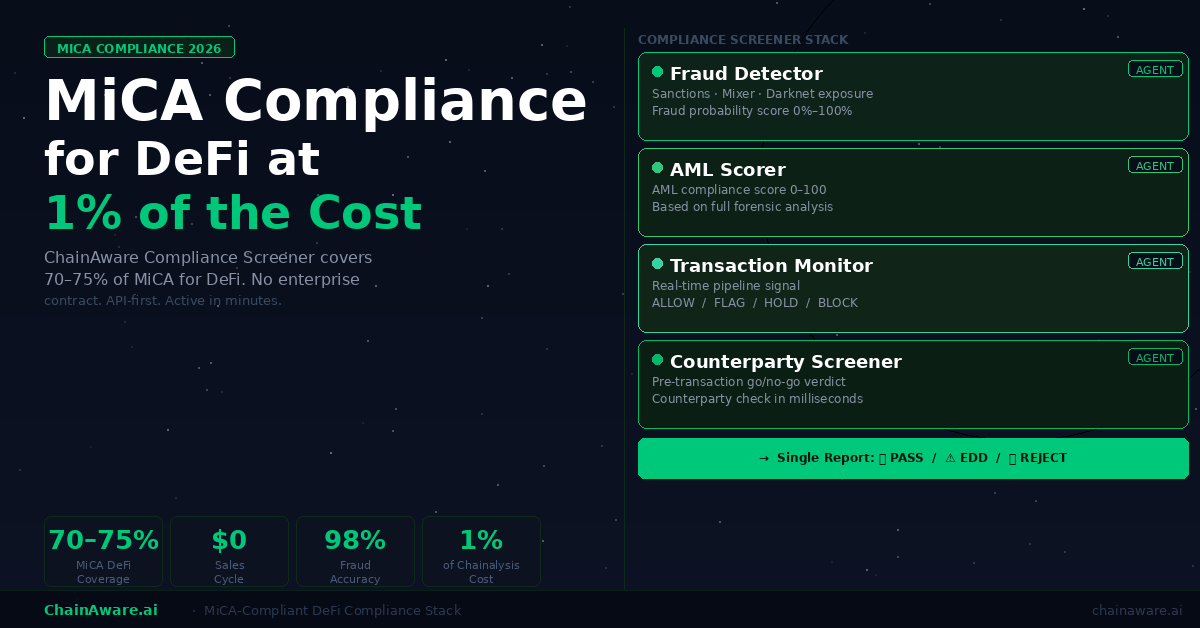
ChainAware solves this with two products that run the same compliance engine — delivered through two distinct integration paths depending on your team’s technical setup. The Compliance Screener integrates via Claude sub-agents and MCP for developer and AI agent workflows. The Transaction Monitor integrates via Google Tag Manager for Dapp front-end teams who want zero-code deployment. Both cover 70–75% of the MiCA requirements that actually apply to DeFi protocols — at a fraction of the cost of enterprise tools, with no procurement cycle and no minimum commitment.
In This Article
- The Cost Problem: What Chainalysis, Elliptic, and TRM Actually Charge
- The Key Insight: Travel Rule Does Not Apply to Pure DeFi
- What MiCA Actually Requires for DeFi Protocols
- Two Integration Paths, One Compliance Engine
- Path 1: Compliance Screener via Claude Sub-Agents and MCP
- Path 2: Transaction Monitor via Google Tag Manager
- Three Operating Modes
- The Honest Scope: What Is and Is Not Covered
- Head-to-Head Comparison Table
- How to Close the Remaining Gap to ~85% Coverage
- Who This Is For
- FAQ
The Cost Problem: What Chainalysis, Elliptic, and TRM Actually Charge
Enterprise crypto compliance tools do not publish pricing publicly — a decision that itself reflects their target market. But enough procurement cycles have completed in the DeFi ecosystem that the numbers are well-understood in the market.
| Provider | Product | Est. Annual Cost | Designed For | Procurement Cycle |
|---|---|---|---|---|
| Chainalysis | KYT + VASP Data | $150K–$500K+ | Banks, CEXes | 3–6 months |
| Elliptic | Lens + Discovery | $100K–$500K+ | Banks, CEXes | 3–6 months |
| TRM Labs | Know Your VASP | $100K–$500K+ | Banks, CEXes | 2–5 months |
| Crystal (Bitfury) | Intelligence API | $16K–$200K+ | CEXes, FIs | 1–3 months |
| ChainAware — Compliance Screener | 4-agent MCP stack | Pay-per-use API | DeFi developers, AI agents | Minutes |
| ChainAware — Transaction Monitor | GTM pixel integration | Pay-per-use API | DeFi front-end teams | Minutes |
Why are traditional compliance tools so expensive? Three structural reasons:
VASP attribution databases. The core of what Chainalysis and Elliptic sell is proprietary mapping of wallet clusters to legal entity names — knowing that a given address belongs to Binance, Coinbase, or a sanctioned exchange. This requires armies of analysts continuously updating on-chain cluster assignments and off-chain entity research. Genuinely valuable for CeFi institutions conducting VASP-to-VASP due diligence. For DeFi protocols interacting with smart contracts, it is largely irrelevant — and you are paying for it anyway.
Enterprise contract structure. Annual minimums, professional services fees, implementation costs, and dedicated account managers are built into the pricing model. These are appropriate for regulated financial institutions with large compliance budgets. They are not appropriate for a DeFi protocol that needs to screen wallets and transactions at reasonable cost.
Full CeFi compliance stack. Travel Rule infrastructure, SAR filing workflows, PEP databases, and adverse media screening are bundled in. For a VASP or bank, necessary. For a DeFi protocol, the Travel Rule does not apply to smart contract interactions, and PEP screening can be added separately at a fraction of the cost.
FREE — NO SIGNUP REQUIRED
Screen Any Wallet for AML & Fraud — Free
ChainAware Fraud Detector runs a full forensic analysis on any wallet address — sanctions flags, mixer use, darknet exposure, fraud probability score. Free. No account required. Results in seconds.
The Key Insight: Travel Rule Does Not Apply to Pure DeFi
This is the single most important thing to understand about DeFi compliance — and the most commonly misunderstood, partly because compliance tool vendors have no incentive to clarify it.
The FATF Travel Rule — which requires VASPs to collect and transmit originator and beneficiary identity data for transfers above €1,000 (EU) or $3,000 (US) — applies to transfers between VASPs: regulated custodians such as exchanges, custodial wallets, and payment providers that qualify as Virtual Asset Service Providers.
When a user swaps ETH for USDC on a DEX, the transaction is between a non-custodial wallet and a smart contract. There is no VASP on the receiving end. No identity data collection is required. The Travel Rule does not trigger. The same logic applies to lending protocols, AMMs, and yield aggregators. The protocol executes code — it does not take custody of funds in the regulatory sense.
This matters enormously for compliance cost because VASP attribution databases — the most expensive component of traditional compliance tools — exist almost entirely to serve Travel Rule obligations. For a DeFi protocol, this is cost without coverage. What DeFi does need is risk-based screening for sanctions, AML risk, and fraud. For a thorough treatment of the regulatory landscape, see our Blockchain Compliance for DeFi: Complete KYT & AML Guide 2026.
What MiCA Actually Requires for DeFi Protocols
MiCA (Markets in Crypto-Assets Regulation) entered full enforcement in December 2024, with €540M+ in penalties already issued across the EU. Under MiCA and FATF AML/CFT frameworks, DeFi protocols operating in regulated jurisdictions need to address five core requirements:
| Requirement | Description | ChainAware Coverage |
|---|---|---|
| 1. Sanctions screening | Flag wallets on OFAC, EU, UN lists before granting access | ✅ Both paths |
| 2. AML behavioral monitoring | Detect mixer use, layering, darknet activity | ✅ Both paths |
| 3. Fraud and bot detection | Exclude malicious actors, bot clusters, sybil activity | ✅ Both paths |
| 4. Transaction risk scoring | Flag high-risk transactions with actionable pipeline signals | ✅ Both paths |
| 5. Documented risk-based approach | Timestamped audit records per wallet/transaction | ✅ Both paths |
| 6. PEP screening | Politically Exposed Persons database checks | ❌ Add separately |
| 7. Travel Rule compliance | VASP-to-VASP identity data exchange | Not required for pure DeFi |
| 8. SAR filing | Suspicious Activity Reports to regulators | ❌ Human process |
For the difference between predictive AI and generative AI in compliance contexts, see our guide on How to Use Predictive AI for Crypto KYC, AML, and Transaction Monitoring.
Two Integration Paths, One Compliance Engine
ChainAware runs the same four-agent compliance engine through two distinct integration paths. Choosing the right path depends on your team’s technical context and where in your stack you want compliance to run.
| Compliance Screener | Transaction Monitor | |
|---|---|---|
| Integration method | Claude sub-agents / MCP endpoint | Google Tag Manager pixel |
| Who deploys it | Developers, AI agent builders | Front-end / growth teams — no code required |
| Where it runs | Backend, AI agent pipeline, REST API | Dapp front-end, at wallet connection event |
| Engineering required | MCP connection or API call | None — GTM tag configuration only |
| Output | Structured JSON Compliance Report | dataLayer event (PASS / EDD / REJECT) |
| Best for | AI compliance agents, batch screening, backend risk pipelines, launchpad pre-screening | DEX front-ends, lending UIs, launchpad gates, real-time wallet connection screening |
| Audit record | Timestamped JSON — store in your compliance log | Webhook delivery to compliance inbox or logging system |
| MiCA coverage | 70–75% of DeFi-applicable requirements | 70–75% of DeFi-applicable requirements |
The compliance logic is identical in both paths. Many protocols deploy both: the Transaction Monitor handles real-time front-end screening at wallet connection, while the Compliance Screener handles batch pre-screening, AI agent workflows, and backend compliance pipelines.
Path 1: Compliance Screener via Claude Sub-Agents and MCP
The Compliance Screener is an AI orchestrator that runs four specialist sub-agents in sequence for every wallet or transaction submitted. It is designed for developers, AI agent builders, and teams integrating compliance into code — whether in a backend pipeline, an AI agent workflow, or a batch processing job.
The Four Sub-Agents
chainaware-fraud-detector — Deep AML forensic analysis: OFAC/EU/UN sanctions checks, mixer and tumbler history, darknet exposure, fraud address clustering, behavioral fraud indicators. Output: fraud probability 0.00–1.00, status classification (Safe / Watchlist / Risky), structured forensic_details. Accuracy: 98% on Ethereum. Coverage: 16M+ wallets across 8 blockchains.
chainaware-aml-scorer — Takes forensic output and produces a normalized AML compliance score (0–100). Single numeric signal for decision workflows — can be compared across wallets, logged for audit, and used to set automated thresholds.
chainaware-transaction-monitor (agent mode) — Real-time transaction risk scoring producing a machine-actionable pipeline signal: ALLOW / FLAG / HOLD / BLOCK. The signal your smart contract logic or backend API consumes directly. For a detailed treatment of how transaction monitoring differs from AML screening, see Crypto AML vs. Transaction Monitoring: What’s the Difference.
chainaware-analyst (Counterparty Screener) — Pre-transaction go/no-go assessment on the counterparty address. Returns PROCEED/REJECT with supporting evidence. Most relevant for DeFi lending (screen borrower before credit), token launchpads (screen IDO participants), and DAO treasury interactions.
The Synthesized Compliance Report
The orchestrator synthesizes all four outputs into a single Compliance Report: verdict (✅ PASS / ⚠️ EDD / ❌ REJECT), risk rating (Low / Moderate / Elevated / High / Critical), specific flags triggered with evidence, recommended action, explicit scope disclaimer, and ISO-8601 timestamp for audit record storage.
MCP Integration
All four sub-agents are open-source on GitHub. Connect any Claude, GPT, or custom LLM to the MCP endpoint at https://prediction.mcp.chainaware.ai/sse with your API key from chainaware.ai/mcp. Your agent can call sanctions screening, AML scoring, fraud detection, and wallet profiling in natural language — no custom API integration code required. This is the only compliance tool in this category with a published MCP server.
For the full developer integration walkthrough, see the MCP Integration Guide and the Prediction MCP complete guide. For how AI agents are replacing manual compliance processes more broadly, see The Web3 Agentic Economy.
API-FIRST — NO ENTERPRISE CONTRACT
Compliance Screener — Active in Minutes via MCP
Pay-per-use. No annual minimum. No procurement cycle. Connect your AI agent to the MCP endpoint or call the REST API directly. Open-source agent definitions on GitHub — clone and deploy in minutes. Works with Claude, GPT, or any MCP-compatible LLM.
Path 2: Transaction Monitor via Google Tag Manager
The Transaction Monitor is the same compliance engine — delivered as a Google Tag Manager integration for Dapp front-end teams. No code changes to your Dapp. No engineering sprint. The GTM pixel fires on wallet connection events, runs the compliance check in real time, and returns a PASS / EDD / REJECT signal that your front-end JavaScript handles to show the appropriate UI state.
This is the zero-code path to MiCA-compliant wallet screening. If your team already uses Google Tag Manager — and most modern Dapps do — adding compliance screening is a configuration task, not an engineering task. The same GTM infrastructure also powers ChainAware Behavioral Analytics, which can run in the same container to simultaneously aggregate visitor behavioral intelligence.
How It Works
Step 1 — Subscribe. Get your API key at chainaware.ai/pricing. Pay-per-use, no minimum commitment.
Step 2 — Add the GTM tag. Create a new Custom HTML tag in your GTM container with the ChainAware Transaction Monitor pixel. Set the trigger to fire on wallet connection events — the specific trigger depends on your wallet library (WalletConnect, RainbowKit, Web3Modal, etc.).
Step 3 — Handle the dataLayer event. The tag pushes a chainaware_compliance_result dataLayer event with the verdict — PASS, EDD, or REJECT. Your front-end JavaScript listens for this event and renders the appropriate UI: transparent pass-through for clean wallets, a warning modal for EDD wallets, or an access-denied screen for REJECT verdicts.
Step 4 — Configure audit webhook. Webhook delivery of Compliance Reports to your compliance team’s inbox or logging infrastructure. Each report is timestamped and structured — stored as documented evidence of systematic screening under MiCA’s risk-based approach requirement.
The Transaction Monitor can be enabled or disabled at any time by updating the GTM container. No Dapp codebase changes ever required. For the full technical setup, see the Transaction Monitoring Agent complete guide.
According to ESMA’s MiCA guidelines for crypto-asset service providers, the risk-based approach to AML compliance requires documented, systematic processes. The GTM integration combined with webhook-delivered Compliance Reports stored in your audit log constitutes exactly this — without a single line of Dapp code changed.
ZERO-CODE DEPLOYMENT
Transaction Monitor via Google Tag Manager
No engineering required. Add the ChainAware pixel to your existing GTM container — compliance screening fires on every wallet connection event. PASS / EDD / REJECT verdict returned in real time. Audit records via webhook. MiCA-ready in under an hour.
Three Operating Modes
Both paths support three operating modes. Batch Onboarding is exclusive to the MCP/API path.
Single Wallet Onboarding. Submit a wallet address before granting platform access. Returns PASS / EDD / REJECT. Use at the wallet connection step to gate access before users interact with your protocol.
Pre-Transaction Check. Submit a transaction — sender, receiver, optional value — before execution. Returns ALLOW / FLAG / HOLD / BLOCK. The most directly relevant mode for MiCA real-time transaction monitoring obligations.
Batch Onboarding (MCP path only). Submit a list of wallet addresses for bulk screening. Designed for token launches, airdrops, IDO participant lists, and waitlist qualification — screen hundreds or thousands of wallets before the event opens.
The Honest Scope: What Is and Is Not Covered
Every Compliance Report — from both paths — includes an explicit scope disclaimer built into the output. This is a deliberate design choice, not fine print.
Covered: sanctions screening (OFAC, EU, UN), AML behavioral analysis (mixer use, darknet exposure, layering), fraud probability (98% accuracy, Ethereum), transaction risk scoring (ALLOW/FLAG/HOLD/BLOCK), documented audit record generation.
Not covered: Travel Rule data exchange (not applicable to DeFi smart contract interactions), PEP screening, adverse media, SAR filing.
The honest assessment: ChainAware covers approximately 70–75% of practical MiCA compliance requirements for pure DeFi protocols. According to FATF guidance on virtual assets, the risk-based approach — systematic screening with documented evidence — is the core obligation. ChainAware fulfils this through both integration paths.
Head-to-Head Comparison Table
| Capability | Chainalysis KYT | Elliptic Lens | TRM Labs | ChainAware (both paths) |
|---|---|---|---|---|
| Sanctions screening (OFAC, EU, UN) | ✅ | ✅ | ✅ | ✅ |
| AML behavioral monitoring | ✅ | ✅ | ✅ | ✅ |
| Fraud / bot detection (98% accuracy) | Partial | Partial | Partial | ✅ |
| Transaction risk scoring | ✅ | ✅ | ✅ | ✅ |
| Documented audit records | ✅ | ✅ | ✅ | ✅ |
| Zero-code GTM deployment | ❌ | ❌ | ❌ | ✅ Transaction Monitor |
| AI agent / MCP integration | ❌ | ❌ | ❌ | ✅ Compliance Screener |
| VASP attribution database | ✅ (extensive) | ✅ (extensive) | ✅ (extensive) | ❌ (not needed for DeFi) |
| Travel Rule infrastructure | ✅ | ✅ | ✅ | N/A for pure DeFi |
| PEP screening | ✅ | ✅ | ✅ | ❌ (add separately) |
| Behavioral prediction (next actions) | ❌ | ❌ | ❌ | ✅ Prob_Trade, Prob_Stake… |
| Annual cost | $150K–$500K+ | $100K–$500K+ | $100K–$500K+ | Pay-per-use |
| Procurement cycle | 3–6 months | 3–6 months | 2–5 months | Minutes |
| Designed for DeFi | ❌ CeFi-first | ❌ CeFi-first | ❌ CeFi-first | ✅ DeFi-native |
For a broader view of ChainAware’s full product suite including growth and analytics tools, see the ChainAware Complete Product Guide.
How to Close the Remaining Gap to ~85% Coverage
For protocols that need PEP screening to close the coverage gap, PEP databases can be licensed from vendors such as ComplyAdvantage, Refinitiv World-Check, or Dow Jones Risk & Compliance at SMB-accessible pricing — typically $500–$5,000/year for API access. These are standalone data products with no procurement cycle.
The practical challenge: PEP screening requires an identity attribute — a name — and most DeFi interactions are pseudonymous. PEP screening is therefore most relevant at identity-collection touchpoints: token launch KYC, fiat on/off ramp interactions, DAO governance identity verification. For protocols operating entirely pseudonymously, PEP screening may not be practically applicable — a point worth discussing with your compliance counsel.
Adding PEP screening at relevant touchpoints alongside ChainAware brings practical MiCA coverage to approximately 85%, with the remaining 15% consisting of Travel Rule obligations that do not apply to pure DeFi protocols. For the full compliance framework, see Crypto AML vs. Transaction Monitoring.
Who This Is For
DeFi lending protocols — Use the Compliance Screener (MCP) for backend automated borrower screening, or the Transaction Monitor (GTM) for front-end wallet-connection gates. Both support batch pre-screening of waitlisted borrowers.
DEX front-ends — The Transaction Monitor via GTM is the natural choice: zero code changes, fires on every wallet connection event, renders the appropriate UI state automatically.
Token launchpads — Batch screening via the Compliance Screener (MCP/API) handles hundreds of registered wallets before IDO allocation. Excludes sanctioned addresses, fraud clusters, and bot wallets before the event opens.
Web3 startups without a compliance budget — Both paths are pay-per-use with no annual minimum. Start with the GTM Transaction Monitor for immediate coverage with no engineering, scale to the MCP Compliance Screener when your AI agent infrastructure warrants it.
AI agent developers — The Compliance Screener MCP path is built for this. Clone chainaware-aml-scorer, chainaware-fraud-detector, and chainaware-analyst from GitHub, configure your API key, and your agent has native compliance screening in natural language. See the Prediction MCP complete guide for the full developer workflow.
DAO treasury managers — The Counterparty Screener sub-agent (MCP path) runs a pre-transaction go/no-go assessment before any significant transfer, reducing the surface area for social engineering targeting publicly known treasuries.
CHAINAWARE.AI — DEFI COMPLIANCE STACK
MiCA-Ready Compliance. Two Paths. One Engine.
Compliance Screener via MCP for AI agents and developers. Transaction Monitor via Google Tag Manager for front-end teams. Same engine — sanctions, AML, fraud detection, transaction risk scoring. 16M+ wallets, 8 blockchains, 98% accuracy. Pay-per-use. No contract. No sales cycle.
Frequently Asked Questions
What is the difference between the Compliance Screener and the Transaction Monitor?
They run the same compliance engine — four AI sub-agents covering sanctions, AML, fraud detection, and transaction risk scoring — through two different integration paths. The Compliance Screener integrates via Claude sub-agents and the MCP endpoint, designed for developers and AI agent builders who want compliance in a code-based pipeline. The Transaction Monitor integrates via Google Tag Manager, designed for Dapp front-end teams who want zero-code compliance screening at the wallet connection event with no engineering changes to the Dapp. Both deliver the same 70–75% MiCA coverage for DeFi.
Can I use both paths simultaneously?
Yes, and many protocols do. The Transaction Monitor via GTM handles real-time front-end screening at wallet connection. The Compliance Screener via MCP handles deeper workflows: batch pre-screening of waitlists, AI agent compliance pipelines, and backend audit record generation. They complement each other without duplication.
Does MiCA apply to DeFi protocols?
Yes, with nuance. Where a DeFi protocol has an identifiable legal entity, operator, or front-end provider, those entities bear compliance obligations under MiCA’s full enforcement since December 2024. Most DeFi protocols operating in practice have a legal entity, a front-end operator, or both. The official MiCA text is publicly available — your compliance counsel should assess your specific exposure.
Why doesn’t the Travel Rule apply to DeFi?
The Travel Rule requires VASPs to exchange identity information for transfers above the regulatory threshold. When a user interacts with a smart contract, there is no VASP on the receiving end — only code executing deterministically. The smart contract is not a Virtual Asset Service Provider. The Travel Rule does not trigger. This is not a loophole — it is the structural architecture of DeFi.
What blockchains are covered?
ChainAware covers 8 blockchains including Ethereum (98% fraud detection accuracy), BNB Chain, Base, Polygon, TON, and HAQQ. 16M+ wallets built from 1.5B+ data points. Contact the team at chainaware.ai/pricing for chain requests.
How does pay-per-use pricing work?
Priced per API call with volume tiers. No annual minimum, no enterprise contract, no procurement cycle. Subscribe, receive your API key, pay for what you use. Current pricing at chainaware.ai/pricing. Free tools — Fraud Detector and Wallet Auditor — remain free with no account required.
How do I integrate the Compliance Screener into an AI agent?
Connect your Claude, GPT, or custom LLM agent to https://prediction.mcp.chainaware.ai/sse with your API key. The open-source chainaware-aml-scorer, chainaware-fraud-detector, and chainaware-analyst agent definitions on GitHub give your agent immediate compliance screening in natural language — no custom API code required. Full integration guide at 12 Blockchain Capabilities Any AI Agent Can Use.