
Last Updated: March 2026
There is a conversation most DeFi founders eventually have — usually after their legal counsel sends a bill for the initial scoping call. They’ve been told they need to comply with MiCA, or FinCEN AML rules, or FATF guidance. Someone in their network recommends Chainalysis or Elliptic. The team looks at the pricing page (if they can find one) and learns that enterprise AML tools cost anywhere from $100,000 to $500,000 per year. The procurement cycle runs three to six months. Implementation requires dedicated engineering resources.
The product? Built for banks and centralized exchanges. The feature set? Designed for the FATF Travel Rule, VASP attribution databases, SAR filing workflows, and PEP screening — compliance obligations that largely do not apply to pure DeFi protocols interacting with smart contracts rather than regulated counterparties.
This is the structural mismatch at the heart of DeFi compliance in 2026: protocols are being quoted CeFi prices for a CeFi compliance stack they need perhaps 40% of. With MiCA fully enforced across the EU since December 2024 — €540M+ in penalties already issued — the question is no longer whether to comply. It’s which tool actually fits.
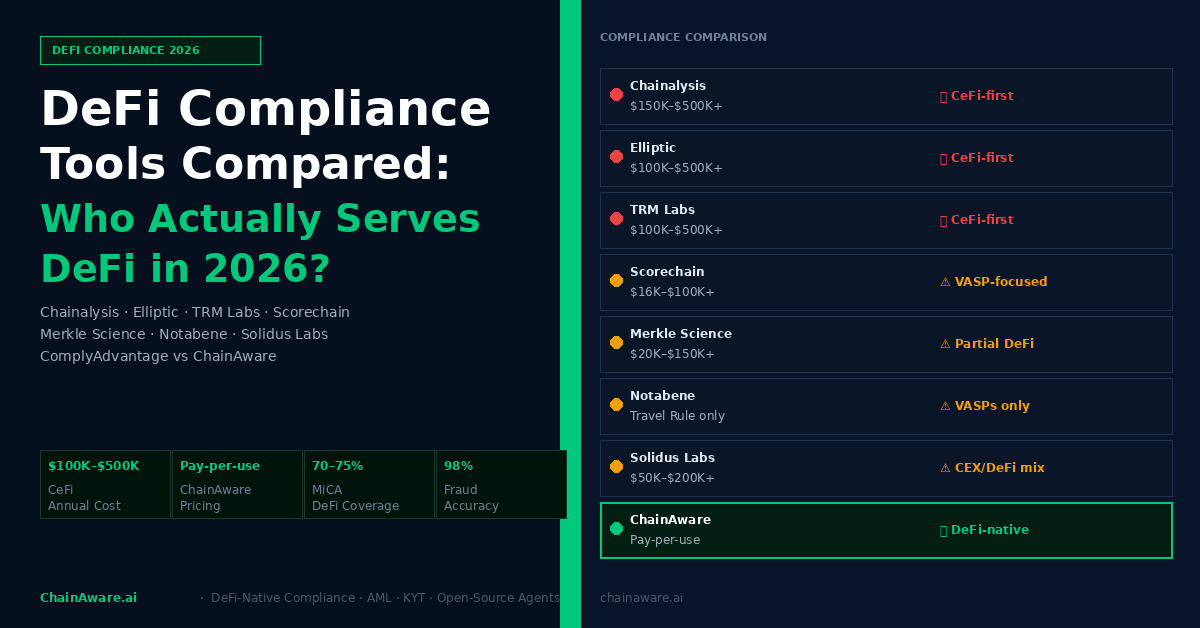
This article compares every significant DeFi compliance platform in 2026: Chainalysis, Elliptic, TRM Labs, Scorechain, Merkle Science, Notabene, Solidus Labs, ComplyAdvantage, and ChainAware. For each, we cover what it actually does, who it was built for, what it costs, and whether it genuinely serves DeFi protocols — or whether you’re paying for capabilities you don’t need.
In This Article
- The Critical Insight: Travel Rule Does Not Apply to Pure DeFi
- What MiCA Actually Requires From DeFi Protocols
- Chainalysis: The Forensic Standard, Built for Law Enforcement
- Elliptic: Enterprise AML for Banks and Large Exchanges
- TRM Labs: Best Multi-Chain Coverage, Same CeFi Pricing
- Scorechain: Compliance-First, VASP-Focused
- Merkle Science: Predictive Risk, Asia-Pacific Focus
- Notabene: The Travel Rule Specialist
- Solidus Labs: Trade Surveillance + AML Combined
- ComplyAdvantage: AI-Driven Screening, TradFi Roots
- ChainAware: The Only DeFi-Native, Open-Source Compliance Stack
- Full Comparison Table (15 Dimensions × 9 Platforms)
- Use Case Verdicts: DEX / Lending / Launchpad / DAO / AI Agents
- The Compliance Tax Trap
- FAQ
The Critical Insight: Travel Rule Does Not Apply to Pure DeFi
Before evaluating any compliance tool, this is the single most important fact to understand — and the one compliance vendors have the least incentive to clarify.
The FATF Travel Rule — which requires VASPs to collect and transmit originator and beneficiary identity data for transfers above €1,000 (EU) or $3,000 (US) — applies to transfers between VASPs: regulated custodians such as exchanges, custodial wallets, and payment providers that qualify as Virtual Asset Service Providers.
When a user swaps ETH for USDC on a DEX, the transaction is between a non-custodial wallet and a smart contract. There is no VASP on the receiving end. No identity data collection is required. The Travel Rule does not trigger. The same logic applies to lending protocols, AMMs, and yield aggregators. The protocol executes code — it does not take custody of funds in the regulatory sense.
This matters enormously for compliance cost. VASP attribution databases — the most expensive component of Chainalysis, Elliptic, and TRM Labs — exist almost entirely to serve Travel Rule obligations. They map wallet clusters to legal entity names so VASPs can identify their counterparties before transmitting identity data. For a DeFi protocol interacting with smart contracts, this is cost without coverage. You are paying for a feature you structurally cannot use.
What DeFi protocols actually need is risk-based screening: sanctions checks, AML behavioral monitoring, fraud detection, and documented evidence of a systematic compliance process. For the complete regulatory landscape, see our Blockchain Compliance for DeFi: Complete KYT & AML Guide 2026.
What MiCA Actually Requires From DeFi Protocols
MiCA entered full enforcement in December 2024. According to ESMA’s MiCA guidelines for crypto-asset service providers, where a DeFi protocol has an identifiable legal entity, operator, or front-end provider, compliance obligations apply. Most protocols operating in practice have at least one of these. Here is what MiCA and FATF AML/CFT frameworks actually require for DeFi:
| Requirement | Description | Applies to Pure DeFi? |
|---|---|---|
| 1. Sanctions screening | Flag wallets on OFAC, EU, UN lists before granting access | ✅ Yes — core obligation |
| 2. AML behavioral monitoring | Detect mixer use, layering, darknet activity in transaction history | ✅ Yes — risk-based approach |
| 3. Fraud and bot detection | Exclude malicious actors, bot clusters, sybil activity from protocol access | ✅ Yes — best practice |
| 4. Transaction risk scoring | Flag high-risk transactions with actionable compliance signals | ✅ Yes — real-time monitoring |
| 5. Documented risk-based approach | Timestamped audit records evidencing systematic screening | ✅ Yes — mandatory evidence |
| 6. PEP screening | Politically Exposed Persons database checks | ⚠️ Partially — at KYC touchpoints |
| 7. Travel Rule compliance | VASP-to-VASP identity data exchange above threshold | ❌ No — not triggered by smart contract interactions |
| 8. SAR filing | Suspicious Activity Reports to financial intelligence units | ⚠️ Partially — for identified legal entities |
For the distinction between predictive AI compliance and traditional forensic approaches, see our guide on How to Use Predictive AI for Crypto KYC, AML, and Transaction Monitoring.
FREE — NO SIGNUP REQUIRED
Screen Any Wallet for AML & Sanctions — Free
ChainAware Fraud Detector runs a full forensic AML analysis on any wallet address — OFAC/EU/UN sanctions flags, mixer use, darknet exposure, fraud probability score. Free. No account required. Results in seconds.
Chainalysis: The Forensic Standard, Built for Law Enforcement
Chainalysis was founded in 2014 in the aftermath of the Mt. Gox hack. Its origin story is investigative: the FBI, IRS, and DOJ needed a tool to trace illicit crypto flows. Over 1,500 institutions worldwide — including major law enforcement agencies across the US and Europe — rely on the Chainalysis platform. The company reports that its data has been used to recover or freeze over $34 billion in stolen funds.
Core products: Reactor (forensic investigation visualizer), KYT (Know Your Transaction — real-time transaction monitoring with automated alerts), and an extensive VASP attribution database mapping wallet clusters to legal entity names across 10,000+ digital assets.
What it does exceptionally well: Forensic depth. Reactor allows investigators to visualize transaction networks, identify wallet clusters, trace fund flows through mixers, bridges, and DEXes, and build evidentiary chains suitable for criminal referrals and courtroom use. For law enforcement, Chainalysis is the established standard.
DeFi fit: Poor. Chainalysis was designed for CeFi compliance — specifically for VASPs conducting counterparty due diligence and Travel Rule compliance. The VASP attribution database is its most differentiated asset and is of minimal value to protocols that interact only with smart contracts. Enterprise contracts run $150K–$500K+/year with 3–6 month procurement cycles and mandatory implementation services.
Open-source agents: None. The platform is entirely proprietary SaaS.
Best for: Law enforcement agencies, large centralized exchanges, regulated banks, and financial institutions with dedicated compliance teams and annual compliance budgets exceeding $200K.
Elliptic: Enterprise AML for Banks and Large Exchanges
Founded in 2013 in London and backed by a 2022 strategic investment from JPMorgan, Elliptic occupies a similar market position to Chainalysis with a stronger emphasis on cross-chain screening. The platform monitors over 1,100 blockchain networks, tracks 1,130+ cross-chain bridges, and has analyzed more than 100 billion transactions. Its database includes 2 billion labeled addresses tied to known entities. Clients include Revolut, Coinbase, and Santander.
Core products: Lens (wallet screening), Discovery (transaction monitoring), and Holistic Screening — a cross-chain tracing capability that treats blockchain networks as interconnected rather than isolated, designed to counter chain-hopping obfuscation. Elliptic processes 2M+ screenings monthly.
What it does exceptionally well: Cross-chain AML coverage and enterprise-grade compliance infrastructure. Holistic Screening is a genuine technical differentiation — it can trace assets across and between blockchains in milliseconds via API, specifically to stop the chain-hopping patterns that single-chain tools miss.
DeFi fit: Poor to moderate. Elliptic is positioned as compliance-first versus Chainalysis’s forensics-first orientation, which makes it marginally more relevant for VASPs doing transaction monitoring rather than investigations. But it remains fundamentally a CeFi compliance stack — the VASP database, SAR workflows, and Travel Rule infrastructure are the core commercial product. Annual cost $100K–$500K+.
Open-source agents: None. Proprietary SaaS.
Best for: Large exchanges, banks, and payment processors that need cross-chain AML coverage and are already in a procurement cycle for enterprise compliance tooling.
TRM Labs: Best Multi-Chain Coverage, Same CeFi Pricing
TRM Labs has the strongest independent user validation in the category — 4.8/5 on G2 from 21 verified reviews, tied with Chainalysis but with statistically more meaningful volume. The platform covers 200M+ assets, 200+ blockchains, and is particularly strong in multi-chain investigation workflows. TRM Phoenix, launched to address cross-chain fund tracing, can visualize fund movement across a dozen+ bridges and cross-chain services in a single graph.
Core products: Know Your VASP, transaction monitoring, TRM Phoenix (cross-chain tracing), compliance reporting, and API-first integration for custom compliance workflows.
What it does exceptionally well: Multi-chain coverage and transparent attribution methodology. TRM’s attribution data is more openly documented than Chainalysis, which appeals to compliance teams who want to understand — and defend — the basis for risk scores. API-first design makes it more developer-friendly than Chainalysis Reactor.
DeFi fit: Poor. Same fundamental problem as Chainalysis and Elliptic: the commercial product is built around VASP-to-VASP compliance. Annual cost $100K–$500K+ with 2–5 month procurement cycles.
Open-source agents: None. Proprietary SaaS.
Best for: Growing crypto businesses and exchanges that need robust AML without a dedicated in-house analytics team, and have compliance budgets in the $100K+ range.
THE COST MISMATCH
Paying $100K–$500K/Year for a Stack You Need 40% Of
Chainalysis, Elliptic, and TRM Labs were built for CeFi — their core value is VASP attribution and Travel Rule infrastructure. Neither applies to DeFi smart contract interactions. Before committing to an enterprise contract, read our deep-dive on the compliance cost mismatch.
Scorechain: Compliance-First, VASP-Focused
Luxembourg-based Scorechain was founded in 2015 and has carved out a specific position as the compliance-first alternative to Chainalysis and Elliptic. While Chainalysis built its reputation through investigations and law enforcement relationships, Scorechain positioned itself around day-to-day compliance workflow — faster implementation, more customizable risk scoring, and tools tuned for regulatory audit readiness rather than forensic depth.
Core products: Wallet/transaction screening, compliance monitoring, risk scoring, and a Travel Rule integration built in partnership with Notabene. Particularly strong in EU compliance contexts — risk scoring and reporting workflows are specifically tuned for MiCA and FATF requirements as interpreted by European regulatory bodies. Covers BTC, ETH, BNB, XRP, stablecoins, and a broad range of additional assets.
What it does exceptionally well: Compliance team workflows. Scorechain is designed for the compliance officer who needs to produce audit-ready reports, manage SAR filings, and demonstrate systematic AML processes to regulators — without the investigation-first complexity of Chainalysis. Faster to implement, more focused on what compliance teams actually need day-to-day.
DeFi fit: Moderate. Scorechain is explicitly positioned as a VASP compliance tool — it is better-suited to DeFi protocols than Chainalysis by virtue of being compliance-first rather than forensics-first, but it is still fundamentally built for VASPs doing regulated transactions. Its Travel Rule infrastructure and VASP attribution remain core to the commercial product. Pricing is more accessible than the Tier 1 vendors — starting around $16K–$100K/year — but still carries annual contract commitments.
Open-source agents: None. Proprietary SaaS.
Best for: Mid-sized VASPs, European crypto businesses operating under MiCA who need compliance tooling without the enterprise price tag of Chainalysis, and exchanges that have already outgrown entry-level tools.
Merkle Science: Predictive Risk, Asia-Pacific Focus
Singapore-based Merkle Science raised $19M in an extended Series A and explicitly names DeFi participants in its target market — one of the few compliance vendors to do so. The platform describes itself as a “predictive cryptocurrency risk and intelligence platform,” which differentiates its positioning from the forensic-first framing of Chainalysis.
Core products: Transaction monitoring, compliance training, forensic analysis, and risk intelligence. Serves crypto businesses, DeFi participants, financial institutions, government agencies, and insurers. Strong focus on the Asia-Pacific regulatory environment, with specific coverage of Singapore MAS guidelines, South Korea VASP rules, and APAC FATF implementation.
What it does exceptionally well: APAC regulatory coverage and a more accessible entry point than Tier 1 vendors. The “predictive” positioning is genuine — Merkle Science uses behavioral risk models rather than purely rule-based matching, which can reduce false positive rates versus traditional blacklist-only approaches.
DeFi fit: Moderate. Merkle Science is the compliance vendor that comes closest to explicitly serving DeFi — but “DeFi participant” in their target market language typically means exchanges and institutional participants who interact with DeFi, not DeFi protocols themselves. The core product remains VASP compliance tooling. Annual cost $20K–$150K+ depending on volume.
Open-source agents: None. Proprietary SaaS.
Best for: Asia-Pacific focused crypto businesses, DeFi protocols with significant user bases in Singapore, South Korea, or Japan that need locally-tuned compliance coverage.
Notabene: The Travel Rule Specialist
Notabene does one thing and focuses on doing it well: FATF Travel Rule compliance. The platform is the infrastructure layer for VASP-to-VASP identity data exchange — enabling originating VASPs to identify beneficiary VASPs, securely transmit originator and beneficiary information, and automate counterparty due diligence before transaction execution.
Notabene’s 2025 State of Crypto Travel Rule Report found that an unprecedented 100% of surveyed VASPs committed to Travel Rule compliance — a dramatic shift from prior years. The proportion of VASPs blocking withdrawals until beneficiary information is confirmed jumped from 2.9% to 15.4% year-over-year. Notabene is the infrastructure that makes this possible at scale.
Core products: SafeTransact (pre-transaction decision-making platform), VASP directory integration, counterparty verification, and Travel Rule data exchange network. Partners with Scorechain to add transaction-level risk intelligence to the Travel Rule workflow.
What it does exceptionally well: Travel Rule compliance, specifically. If you are a VASP that needs to comply with the Travel Rule across multiple jurisdictions and VASP directories, Notabene is the purpose-built solution. No other platform in this comparison has invested as deeply in Travel Rule network interoperability.
DeFi fit: None for core use case. The Travel Rule does not apply to DeFi smart contract interactions. Notabene’s core product is structurally irrelevant to pure DeFi protocols. It becomes relevant only if a DeFi protocol also operates a custodial component that qualifies as a VASP.
Best for: Centralized exchanges, custodial wallets, payment processors, and any VASP that needs to comply with the FATF Travel Rule across multiple jurisdictions at scale.
Solidus Labs: Trade Surveillance + AML Combined
Solidus Labs occupies a unique position in the compliance landscape: the only platform in this comparison that combines on-chain AML monitoring with market manipulation surveillance — detecting wash trading, spoofing, front-running, and other market abuse patterns that are distinct from money laundering. The platform protects over 25 million entities and monitors more than 1 trillion events daily, making it one of the highest-volume surveillance platforms in crypto.
Core products: HALO (transaction monitoring and AML), trade surveillance (market manipulation detection), and threat intelligence. The trade surveillance capability is genuinely differentiated — it is not offered by Chainalysis, Elliptic, or TRM Labs, and is particularly relevant for exchanges and DeFi protocols with on-chain trading activity where wash trading and sybil manipulation are meaningful risks.
What it does exceptionally well: The combination of AML and market surveillance in a single platform. For a DeFi DEX or lending protocol where both compliance (AML, sanctions) and market integrity (wash trading, sybil attacks, bot manipulation) are concerns, Solidus Labs addresses both in one integration.
DeFi fit: Moderate. The trade surveillance capability is genuinely relevant to DeFi protocols — DEXes, on-chain order books, and lending protocols all face manipulation risks that pure-AML tools don’t address. Annual cost $50K–$200K+ with enterprise contract commitments.
Open-source agents: None. Proprietary SaaS.
Best for: Regulated exchanges that need both AML compliance and market manipulation monitoring, and DeFi protocols with significant on-chain trading volume where bot manipulation is a primary concern alongside AML.
ComplyAdvantage: AI-Driven Screening, TradFi Roots
ComplyAdvantage approaches compliance from a different angle than the blockchain-native tools in this comparison: it is an AI-powered sanctions, PEP, and adverse media screening platform that has added crypto capabilities to its existing TradFi infrastructure. Its core product is dynamic watchlist data — continuously updated sanctions lists, PEP databases, and adverse media feeds — consumed via API for real-time screening at scale.
Core products: Sanctions and watchlist screening, PEP database, adverse media monitoring, transaction monitoring with ML-based risk insights, and a case management layer for compliance team workflows. The platform is positioned for fintechs and digital banks that need continuous AML screening at high volume without building internal data infrastructure.
What it does exceptionally well: PEP screening and sanctions list management. ComplyAdvantage maintains one of the most comprehensive and continuously updated PEP databases available — precisely the capability that blockchain-native tools like ChainAware are transparent about not providing. For protocols that need PEP screening at identity-collection touchpoints (KYC, fiat ramps, DAO governance), ComplyAdvantage is a natural complement to blockchain-native AML tools.
DeFi fit: Limited but complementary. ComplyAdvantage’s blockchain-specific transaction monitoring is less deep than Chainalysis or TRM Labs. Its real value for DeFi protocols is as a PEP screening layer that closes the gap left by blockchain-native tools — available at $500–$5,000/year for SMB API access, no enterprise contract required for basic screening.
Best for: Fintechs and digital banks as primary compliance infrastructure. For DeFi protocols, best deployed as a PEP screening complement to blockchain-native AML tools like ChainAware — covering the 10–15% of MiCA requirements not addressed by on-chain behavioral analysis alone.
ChainAware: The Only DeFi-Native, Open-Source Compliance Stack
Every other platform in this comparison was built for the same customer: a regulated financial institution, a centralized exchange, or a law enforcement agency. ChainAware was built for DeFi protocols. The difference is architectural, not a matter of degree.
The Structural Argument
Chainalysis, Elliptic, and TRM Labs charge $100K–$500K+/year. The majority of that cost funds VASP attribution databases — mapping wallet clusters to legal entity names for Travel Rule counterparty verification. DeFi protocols don’t need this. When a user swaps on your DEX or borrows from your lending protocol, there is no VASP on the other side. You are paying for the most expensive component of a CeFi compliance stack and using approximately 0% of it.
ChainAware addresses the 70–75% of MiCA requirements that actually apply to pure DeFi protocols — at pay-per-use pricing with no annual minimum, no procurement cycle, and no enterprise contract. For the complete breakdown of what this covers, see the MiCA Compliance for DeFi: 1% of the Cost of Chainalysis deep-dive.
What ChainAware Covers
The compliance engine runs four specialist AI agents in sequence for every wallet or transaction submitted, across 14M+ wallets and 8 blockchains:
Sanctions screening (OFAC, EU, UN) — Real-time flags against all major sanctions lists at wallet connection. Any wallet on an OFAC SDN list, EU sanctions list, or UN consolidated list is identified before the user accesses your protocol.
AML behavioral monitoring — Detects mixer and tumbler history, darknet market exposure, layering patterns, and behavioral fraud indicators. Not just blacklist matching — behavioral analysis of the wallet’s on-chain history across 8 blockchains. 98% accuracy on Ethereum.
Transaction risk scoring — Real-time pipeline signal: ALLOW / FLAG / HOLD / BLOCK. The signal your backend API or smart contract gate consumes directly. For autonomous AI agent pipelines, this is the compliance output that feeds automated decision-making without human review.
Counterparty screening — Pre-transaction go/no-go assessment before any significant interaction. Returns PROCEED/REJECT with supporting evidence. For 24×7 transaction monitoring, this is the real-time check that runs before every transaction, not just at wallet connection.
Documented audit records — Every Compliance Report is timestamped (ISO-8601), structured as JSON, and includes the verdict (✅ PASS / ⚠️ EDD / ❌ REJECT), risk rating (Low / Moderate / Elevated / High / Critical), specific flags triggered with evidence, and an explicit scope disclaimer. This is the audit trail that constitutes documented evidence of a risk-based approach under MiCA.
Two Integration Paths
Compliance Screener via MCP — For developers and AI agent builders. Connect any Claude, GPT, or MCP-compatible agent to https://prediction.mcp.chainaware.ai/sse with your API key from chainaware.ai/mcp. The compliance engine runs in natural language — no custom API integration code required. For the full AI agent integration workflow, see the 12 Blockchain Capabilities Any AI Agent Can Use.
Transaction Monitor via Google Tag Manager — For front-end teams with zero code changes. Add one GTM tag, set the trigger to wallet connection events, and the compliance check fires automatically on every wallet connect. The chainaware_compliance_result dataLayer event returns PASS / EDD / REJECT for your UI to handle. MiCA-ready in under an hour. Same infrastructure also powers ChainAware Behavioral Analytics in the same GTM container.
The Open-Source Compliance Agent Stack
This is where ChainAware parts company with every other platform in this comparison. All compliance agent definitions are open-source, MIT-licensed, and available to clone today from github.com/ChainAware/behavioral-prediction-mcp.
Important transparency note: The agent code is free and open-source — you can inspect, fork, and modify the logic. Running the agents against live wallets and transactions requires a paid API key from chainaware.ai/pricing, billed pay-per-use. This is the same model as Stripe’s open-source SDKs — the tool is yours; the data service is paid. No other compliance vendor in this comparison publishes open-source agent definitions. Chainalysis, Elliptic, TRM Labs — all closed black boxes.
| Agent | What It Does | Output |
|---|---|---|
chainaware-compliance-screener | Orchestrates all four compliance sub-agents into a single report | PASS / EDD / REJECT + full Compliance Report |
chainaware-fraud-detector | Sanctions, mixer, darknet, fraud clustering, behavioral fraud indicators | Fraud probability 0.00–1.00, status classification |
chainaware-aml-scorer | Normalized AML compliance score from forensic output | Score 0–100 |
chainaware-transaction-monitor | Real-time transaction risk for autonomous agents | ALLOW / FLAG / HOLD / BLOCK |
chainaware-counterparty-screener | Pre-transaction go/no-go verdict | Safe / Caution / Block |
chainaware-rug-pull-detector | Contract and LP safety assessment for DeFi protocols | Risk probability + Safe/Watchlist/HighRisk |
chainaware-lending-risk-assessor | Borrower risk for DeFi lending protocols | Grade A–F, collateral ratio, interest rate tier |
chainaware-governance-screener | DAO voter Sybil detection and governance tier assignment | Core/Active/Participant/Observer + voting weight multiplier |
chainaware-airdrop-screener | Batch screen airdrop participants, filter bots and fraud wallets | Eligibility + reputation rank |
chainaware-rwa-investor-screener | RWA investor suitability screening | QUALIFIED / CONDITIONAL / REFER_TO_KYC / DISQUALIFIED |
chainaware-token-launch-auditor | Pre-listing token launch safety audit | APPROVED / CONDITIONAL / REJECTED |
chainaware-agent-screener | AI agent wallet trust scoring — screens autonomous agent wallets | Agent Trust Score 0–10 |
For how AI agents are replacing manual compliance processes across DeFi operations, see The Web3 Agentic Economy.
Honest Scope: What Is and Is Not Covered
Every Compliance Report includes an explicit scope disclaimer. This is by design. ChainAware covers approximately 70–75% of practical MiCA compliance requirements for pure DeFi protocols. Not covered: PEP screening (add ComplyAdvantage at $500–$5K/year for API access), Travel Rule data exchange (not applicable to DeFi smart contract interactions), and SAR filing (a human compliance process). Adding PEP screening at relevant touchpoints brings practical MiCA coverage to approximately 85%. For the full framework, see Blockchain Compliance for DeFi: KYT & AML Guide 2026.
API-FIRST — NO ENTERPRISE CONTRACT
DeFi-Native Compliance. Active in Minutes.
Compliance Screener via MCP for AI agents and developers. Transaction Monitor via Google Tag Manager for front-end teams. Same engine — sanctions screening, AML behavioral analysis, fraud detection, transaction risk scoring. 14M+ wallets, 8 blockchains, 98% accuracy. Pay-per-use. No contract. No sales cycle. Open-source agents on GitHub.
Full Comparison Table: 15 Dimensions × 9 Platforms
| Capability | Chainalysis | Elliptic | TRM Labs | Scorechain | Merkle Science | Notabene | Solidus Labs | ComplyAdvantage | ChainAware |
|---|---|---|---|---|---|---|---|---|---|
| Sanctions screening (OFAC, EU, UN) | ✅ | ✅ | ✅ | ✅ | ✅ | ✅ | ✅ | ✅ | ✅ |
| AML behavioral monitoring | ✅ | ✅ | ✅ | ✅ | ✅ | ⚠️ Via Scorechain | ✅ | ✅ | ✅ |
| Fraud / bot detection (98% accuracy) | Partial | Partial | Partial | Partial | Partial | ❌ | Partial | ❌ | ✅ |
| Transaction risk scoring | ✅ | ✅ | ✅ | ✅ | ✅ | ⚠️ Limited | ✅ | ✅ | ✅ ALLOW/FLAG/HOLD/BLOCK |
| Documented audit records | ✅ | ✅ | ✅ | ✅ | ✅ | ✅ | ✅ | ✅ | ✅ ISO-8601 timestamped JSON |
| VASP attribution database | ✅ Extensive | ✅ Extensive | ✅ Extensive | ✅ Good | ✅ Moderate | ✅ For Travel Rule | ⚠️ Limited | ❌ | ❌ Not needed for DeFi |
| Travel Rule infrastructure | ✅ | ✅ | ✅ | ✅ via Notabene | ⚠️ Partial | ✅ Core product | ⚠️ Partial | ❌ | N/A for pure DeFi |
| PEP screening | ✅ | ✅ | ✅ | ✅ | ✅ | ⚠️ Limited | ⚠️ Partial | ✅ Core strength | ❌ Add separately |
| Trade / market manipulation surveillance | ❌ | ❌ | ❌ | ❌ | ❌ | ❌ | ✅ Core differentiator | ❌ | ❌ |
| Zero-code GTM deployment | ❌ | ❌ | ❌ | ❌ | ❌ | ❌ | ❌ | ❌ | ✅ Transaction Monitor |
| AI agent / MCP integration | ❌ | ❌ | ❌ | ❌ | ❌ | ❌ | ❌ | ❌ | ✅ Compliance Screener |
| Open-source agent definitions | ❌ | ❌ | ❌ | ❌ | ❌ | ❌ | ❌ | ❌ | ✅ MIT license, GitHub |
| Built for DeFi protocols | ❌ CeFi-first | ❌ CeFi-first | ❌ CeFi-first | ❌ VASP-first | ⚠️ Partial | ❌ VASP-only | ⚠️ CEX/DeFi mix | ❌ TradFi roots | ✅ DeFi-native |
| Est. annual cost | $150K–$500K+ | $100K–$500K+ | $100K–$500K+ | $16K–$100K+ | $20K–$150K+ | $12K–$80K+ | $50K–$200K+ | $5K–$60K+ | Pay-per-use |
| Procurement cycle | 3–6 months | 3–6 months | 2–5 months | 1–3 months | 1–3 months | 1–2 months | 2–4 months | Weeks | Minutes |
Use Case Verdicts
DEX Front-End
You need wallet screening at connection — OFAC/EU/UN sanctions, AML behavioral flags — in real time, without adding engineering overhead. Verdict: ChainAware Transaction Monitor via GTM. Zero code changes. Fires on every wallet connect. PASS/EDD/REJECT returned instantly. The only platform in this comparison that can be deployed the same day by a non-engineering team. Chainalysis and Elliptic would take 3–6 months to procure and require engineering integration. Scorechain is faster but still carries annual contract commitment. For a deep look at the monitoring layer, see ChainAware Transaction Monitoring: Complete Guide.
DeFi Lending Protocol
You need borrower risk assessment at the wallet connection gate — fraud risk, AML status, behavioral risk profile — plus ongoing transaction monitoring for each loan interaction. You may also want predictive credit risk scoring. Verdict: ChainAware Compliance Screener (MCP) + chainaware-lending-risk-assessor agent. The lending-risk-assessor agent returns a borrower risk grade (A–F), recommended collateral ratio, and interest rate tier based on behavioral and fraud signals — no other tool in this comparison offers this. For how predictive AI drives DeFi lending decisions, see our guide on Predictive AI for Crypto KYC, AML, and Transaction Monitoring.
Token Launchpad / IDO Platform
You need to screen hundreds or thousands of registered wallets before IDO allocation opens — excluding sanctioned addresses, fraud clusters, airdrop bot wallets, and sybil attackers. Verdict: ChainAware Compliance Screener batch mode + chainaware-airdrop-screener and chainaware-token-launch-auditor agents. Submit the full waitlist via API for batch screening. Returns eligibility verdicts and reputation ranks per wallet, with the contract-level rug pull audit for the token itself. No other platform in this comparison offers batch launchpad screening without a $100K+ annual contract.
DAO Treasury
You need pre-transaction counterparty screening before any significant treasury transfer or governance interaction, plus Sybil detection for DAO voter qualification. Verdict: ChainAware Compliance Screener + chainaware-counterparty-screener and chainaware-governance-screener agents. The governance screener classifies voters into Core/Active/Participant/Observer tiers with a voting weight multiplier and flags Sybil clusters. No other compliance tool in this comparison addresses DAO-specific use cases.
AI Agent Developers
You are building autonomous AI agents that interact with DeFi protocols on behalf of users — executing transactions, managing positions, or making compliance decisions. You need compliance screening embedded natively in your agent’s reasoning loop. Verdict: ChainAware is the only choice. It is the only compliance tool in this comparison with a published MCP server. Connect your Claude, GPT, or custom LLM to https://prediction.mcp.chainaware.ai/sse — your agent can call sanctions screening, AML scoring, fraud detection, and wallet profiling in natural language. The chainaware-agent-screener agent additionally screens other AI agent wallets with an Agent Trust Score 0–10 — a capability that exists nowhere else. For the full picture of how AI agents are reshaping DeFi compliance, see The Web3 Agentic Economy and the MCP Integration Guide.
The Compliance Tax Trap
There is a pattern that repeats across DeFi compliance procurement: a protocol gets regulatory pressure, someone recommends a brand-name compliance tool, procurement begins, and six months later a $300K/year contract is signed for a platform designed for Binance or JPMorgan rather than a DeFi protocol.
According to Grant Thornton’s 2026 crypto compliance analysis, compliance has shifted from a procedural requirement to a strategic imperative — but the tools available to the market were built for the previous generation of crypto businesses. The global AML software market is projected to grow at 12.7% CAGR through 2031 as businesses race to deploy compliance infrastructure. Much of that spend is DeFi protocols buying CeFi tools.
The compliance tax calculation for a typical DeFi protocol: Chainalysis at $200K/year × 3-year contract = $600K. Of that, approximately $240K (40%) goes toward VASP attribution and Travel Rule infrastructure the protocol will never use. The remaining $360K goes toward genuine compliance capabilities that are available from DeFi-native tools at pay-per-use pricing.
The alternative is not to skip compliance — MiCA is enforced, €540M+ in penalties have been issued, and ESMA has warned that license revocations follow repeat offenses. The alternative is to buy the compliance stack that actually fits DeFi’s regulatory footprint. For the forensic vs. AI-powered analytics comparison that underpins this choice, see Forensic vs AI-Powered Blockchain Analysis: Why Predictive Intelligence Wins 2026.
START FREE — SCALE AS YOU GROW
Screen Your First Wallets Today — No Contract Required
ChainAware Fraud Detector is free — no account, no API key, no contract. Run a full forensic AML analysis on any wallet address in seconds. When you’re ready to integrate into your Dapp or AI agent, get an API key at chainaware.ai/pricing — pay-per-use, active in minutes.
Frequently Asked Questions
Which DeFi compliance tool is best for a protocol that can’t afford Chainalysis?
ChainAware is the only DeFi-native compliance platform at pay-per-use pricing with no annual minimum. It covers 70–75% of practical MiCA requirements for pure DeFi protocols — the sanctions screening, AML behavioral monitoring, fraud detection, and documented audit records that actually apply to smart contract interactions. Chainalysis, Elliptic, and TRM Labs are priced for banks and large exchanges — their pricing assumes compliance budgets of $200K+/year.
Does MiCA apply to our DeFi protocol?
Yes, with nuance. Where a DeFi protocol has an identifiable legal entity, operator, or front-end provider, those entities bear compliance obligations under MiCA’s full enforcement since December 2024. Most DeFi protocols operating in practice have a legal entity, a front-end operator, or both. The official MiCA regulation text is publicly available — your compliance counsel should assess your specific exposure.
Why doesn’t the Travel Rule apply to DeFi?
The FATF Travel Rule requires VASPs to exchange originator and beneficiary identity data for transfers above the regulatory threshold. When a user interacts with a DeFi smart contract — swapping on a DEX, depositing into a lending protocol, bridging assets — there is no VASP on the receiving end. Only code executing deterministically. The smart contract is not a Virtual Asset Service Provider. The Travel Rule does not trigger. This is not a loophole; it is the structural architecture of DeFi.
What is MCP and why does it matter for DeFi compliance?
MCP (Model Context Protocol) is an open standard that allows AI agents to call external tools and data sources in natural language. ChainAware’s Compliance Screener is the only DeFi compliance tool with a published MCP server — meaning any Claude, GPT, or custom LLM agent can call ChainAware’s sanctions screening, AML scoring, fraud detection, and wallet profiling capabilities without custom API integration code. As DeFi protocols increasingly use AI agents for operations, having compliance embedded natively in the agent’s reasoning loop — rather than as a separate API call — becomes a meaningful operational advantage.
Are ChainAware’s agents really open-source if you need a paid API key?
Yes — the agent definitions (the code that defines how each agent reasons, what tools it calls, in what sequence, and how it formats output) are genuinely open-source and MIT-licensed at github.com/ChainAware/behavioral-prediction-mcp. You can read, fork, inspect, and modify the agent logic freely. The paid element is the underlying blockchain intelligence data API — the 14M+ wallet database, fraud model, and behavioral prediction engine that the agents call. This is the standard open-core model: open-source tooling, paid data service. Chainalysis and Elliptic, by contrast, don’t publish even their integration schemas until you’ve signed an NDA.
What blockchains are covered?
ChainAware covers 8 blockchains: Ethereum (98% fraud detection accuracy), BNB Chain, Base, Polygon, TON, TRON, Solana (behavioral tools), and HAQQ. 14M+ wallets built from 1.3B+ data points. The predictive_fraud tool (used by all compliance agents) covers ETH, BNB, POLYGON, TON, BASE, TRON, and HAQQ. Contact the team at chainaware.ai/pricing for chain requests.
How does ChainAware’s 98% fraud accuracy compare to other platforms?
98% accuracy is ChainAware’s published figure for Ethereum fraud detection. Chainalysis, Elliptic, and TRM Labs do not publish comparable accuracy figures — their risk scoring is proprietary and the methodology is not externally auditable (without a signed NDA). The structural difference is methodology: the Tier 1 vendors use primarily blacklist matching (known-bad address databases) plus entity clustering; ChainAware uses behavioral prediction models trained on on-chain behavioral trajectories. Blacklist-based approaches have well-documented false positive problems — catching flagged addresses but missing newly-created fraud wallets that haven’t appeared on a blacklist yet. Behavioral models can flag wallets behaviorally consistent with fraud even if they don’t appear on any existing list.
What’s the fastest way to get MiCA-compliant wallet screening running?
ChainAware Transaction Monitor via Google Tag Manager. If your Dapp already has GTM installed — and most modern Dapps do — adding compliance screening is a configuration task, not an engineering task. Get an API key at chainaware.ai/pricing, add the ChainAware tag in GTM, set the trigger to wallet connection events, and publish the container. Compliance screening fires on every wallet connect with PASS/EDD/REJECT results in real time. Total time from signup to live: under an hour. No code changes to your Dapp codebase.