
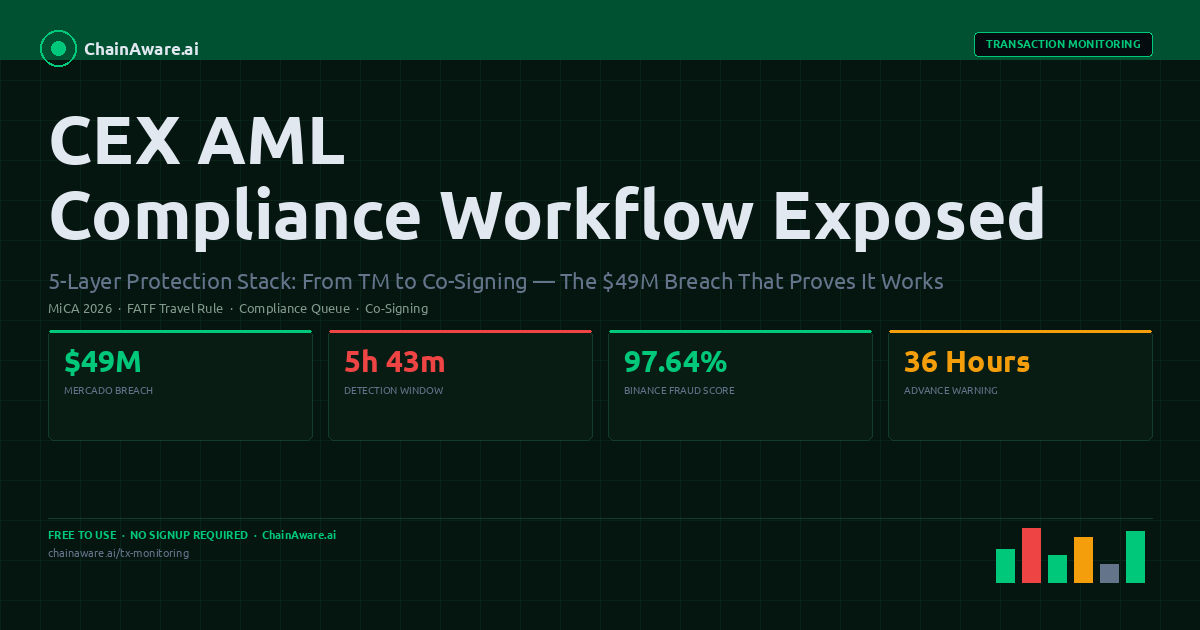
Crypto exchange AML compliance has never been more urgent: MiCA is live, FATF Travel Rule enforcement is tightening, and the gap regulators penalise is not detection – it is the broken workflow between detection and action. This article covers the full five-layer CEX AML workflow, from transaction monitoring through co-signing, using two 2026 breach cases to show exactly where workflows fail and what a complete protection stack looks like.
Last Updated: November 2026
In This Article
- Why Transaction Monitoring Is Only the First Step
- The Regulatory Landscape for CEX AML in 2026
- How Crypto Exchange Transaction Monitoring Works
- The Alert Layer – Telegram + Webhook
- The Compliance Queue – Where the Real Work Happens
- Investigating a Flagged Address
- The Four Compliance Decisions
- The Co-Signing Layer – Turning Detection Into Prevention
- Case Study 1 – Mercado Bitcoin: Stopped at the Signing Layer
- Case Study 2 – Binance Pre-Hack Deposit Pattern
- What Regulators Actually Want to See
- ChainAware Transaction Monitoring for CEX
- Frequently Asked Questions
Why Transaction Monitoring Is Only the First Step
Most exchanges have transaction monitoring. Most exchanges that get hacked also had transaction monitoring.
The gap is not detection – it is what happens between detection and action. Regulators have caught up to this reality. MiCA Article 72 and FATF’s updated Virtual Asset guidance both require documented evidence of the full compliance workflow: not just that a flag was raised, but that it was reviewed, acted on, and logged with a rationale.
The enforcement cases against Binance ($4.3B, 2023), OKX, KuCoin, and BitMEX share a common pattern: the AML system existed, but the process between alert and decision was undocumented, slow, or inconsistent. That is what regulators penalise.
A complete CEX AML compliance workflow has five layers:
- Transaction monitoring – continuous screening of deposit and withdrawal addresses
- Alert delivery – getting the right information to the right people instantly
- Compliance queue – structured processing of flagged cases one by one
- Investigation – building the evidence needed for a defensible decision
- Co-signing – a fraud-aware gate on withdrawals that stops execution before funds move
Each layer depends on the previous one. A monitoring system without structured alert delivery produces noise. Alert delivery without a compliance queue produces chaos. A compliance queue without an investigation tool produces guesswork. All four without co-signing leave a window between detection and action that attackers exploit. Consequently, most exchanges that suffer material losses are not failed by their monitoring tools – they are failed by the layers that sit on top of them.
ChainAware
Transaction Monitoring for Crypto Exchanges
24/7 real-time screening across 8+ chains. Telegram alerts + webhook delivery. No rip-and-replace.
Explore Transaction Monitoring →The Regulatory Landscape for CEX AML in 2026
The regulatory requirements shape what every compliance workflow must produce. Understanding them is therefore the starting point.
MiCA (Markets in Crypto-Assets Regulation) became fully applicable across EU member states in 2024. By 2026, supervisory authorities are actively examining Crypto Asset Service Providers (CASPs), with transaction monitoring, alert handling, and SAR documentation as primary audit targets. MiCA does not prescribe specific technology – it prescribes outcomes: a functioning AML/CFT programme with documented evidence at every step. The full text of MiCA Regulation (EU) 2023/1114 outlines these obligations in detail. Sanctions screening extends beyond individual addresses – it covers token contracts linked to fake token deployments and honeypots that OFAC and national authorities have actioned.
FATF Travel Rule requires that originator and beneficiary information travel with crypto transfers above threshold (typically €1,000 / $1,000 depending on jurisdiction). For exchanges, this means wallet screening is not just about risk – it is about data collection and transmission at the point of transaction. Travel Rule obligations sit alongside, not instead of, AML/CFT controls.
AMLA (Anti-Money Laundering Authority) – the EU’s new centralised AML supervisor – begins direct supervision of the highest-risk CASPs from 2026. Exchanges operating across multiple EU jurisdictions are priority targets. AMLA has stated explicitly that it will examine the gap between detection and decision: not just whether alerts were generated, but how quickly they were resolved and on what basis. Risk-based controls extend to DeFi credit scoring and lending platforms that CEXs increasingly integrate with.
FinCEN (US) continues enforcement under the Bank Secrecy Act. The pattern from US enforcement actions mirrors EU: inadequate suspicious activity reporting, failure to implement risk-based controls, and poor documentation of compliance decisions.
The common thread across all jurisdictions: documentation of the decision, not just the detection. That shifts the compliance burden from the monitoring system to the workflow that sits on top of it.
How Crypto Exchange Transaction Monitoring Works
Effective CEX transaction monitoring operates at three levels: at deposit, at withdrawal, and continuously between transactions.
At deposit: When a wallet initiates a deposit, TM screens it against sanctions lists, behavioural patterns, wallet history, connected addresses, and fraud probability models. A wallet with Tornado Cash funding, high fraud probability, or connections to known criminal addresses is flagged before the deposit is credited. The screening happens in real time – before the exchange’s system processes the credit, not after.
At withdrawal: When an account requests a withdrawal, the destination address is screened. Even if the depositing wallet was clean at onboarding, the destination may be a flagged mixer, sanctioned entity, or known attacker wallet. Withdrawal screening is a second independent check – an address that passed at deposit may not pass at withdrawal if its risk profile has changed.
Continuously: Addresses already known to the exchange – depositing customers, whitelisted withdrawal addresses – are monitored 24/7. A wallet that was clean at onboarding can turn bad: a new sanctions hit, a fresh fraud detection, a connection to a recently compromised address. Continuous monitoring catches this in real time, not at the next transaction. This matters particularly for high-value accounts where the wallet risk profile can change between transactions.
Signals TM uses:
- Sanctions list matches (OFAC SDN, EU consolidated list, UN Security Council)
- Connections to known mixers: Tornado Cash, CoinJoin implementations, privacy coin bridges
- Feeder wallet analysis – where the funds came from, two and three hops back
- Behavioural patterns: rapid in-out cycling, structured amounts, timing patterns associated with money laundering
- Criminal record flags: addresses linked to known hacks, rug pull operations, darknet markets, and ransomware wallets
- Fraud probability score: a model-driven assessment updated continuously as new transactions arrive
ChainAware
Real-Time Fraud Detection Across 8 Chains
25M+ wallet profiles. <100ms scoring latency. Screen destinations before funds move.
See Fraud Detector →The Alert Layer – Telegram + Webhook
When TM detects a risky address, two things happen simultaneously – and both matter.
Telegram notification – the compliance team gets an instant human alert. No dashboard to check, no email to open. The flag reaches a person immediately, with the key data: address, fraud score, detection reason, and a link to the investigation tool. For exchanges with small compliance teams, Telegram ensures the right person knows within seconds regardless of time zone or working hours.
Webhook – a JSON payload fires to the exchange’s backend system. This payload contains the flagged address, risk score, detection reason, connected addresses, and timestamp. The exchange’s system receives it and routes it automatically to the compliance queue. The webhook is the machine-to-machine layer: it creates the compliance case, assigns it, and optionally triggers automated account restrictions – all without human intervention at this stage.
This two-channel design matters. Telegram ensures a human knows immediately. The webhook ensures the system acts immediately – the case lands in the queue without manual triage, with full data attached.
Why not email? Email introduces latency and depends on the recipient being at their desk. For a sanctions hit or a high-fraud-probability address, a 30-minute delay between detection and human awareness is 30 minutes in which funds can move. Telegram delivers in seconds. For compliance teams operating across time zones, the difference is material.
A typical ChainAware webhook payload includes: flagged address, fraud probability score (0-100%), detection category (sanctions / behavioural / criminal record / mixer connection), key signals that drove the score, connected addresses (up to N hops), timestamp of detection, and a direct link to the investigation tool for the address. The exchange’s compliance queue system receives this and creates a case automatically, pre-populated with the data needed for investigation.
The Compliance Queue – Where the Real Work Happens
The compliance queue is where most exchanges fall down – not because they lack software, but because they lack process.
A well-run compliance queue works as follows:
- Every webhook-delivered case lands in the queue automatically
- Cases are prioritised: sanctions hits first, then high fraud-probability scores (above 90%), then behavioural flags
- Analysts process cases one by one – not in batches, not by exception only
- Every case gets a documented outcome: enable, block, request additional information, or escalate to SAR
- SLA targets are set and tracked: sanctions hits resolved within 1 hour, high-fraud within 4 hours, behavioural flags within 24 hours
The queue is also the audit trail regulators ask for. Each case should log: who reviewed it, what data they looked at, what decision was made, and why. That documentation is what distinguishes a defensible compliance programme from one that gets fined.
Common Queue Failure Modes
- Alert fatigue – too many low-quality flags cause analysts to bulk-clear without review. The fix is better model calibration and tiered prioritisation, not more analysts.
- No SLA – cases sit unresolved for days. Regulators treat unresolved alerts as evidence of a non-functioning compliance programme.
- Undocumented decisions – an analyst clears a case without logging the rationale. This is indistinguishable from no review at all in a regulatory examination.
- Batch processing – analysts clear 50 cases at once at end of day. Each case must be individually reviewed and individually documented.
What Good Queue Metrics Look Like
A mid-size CEX with 100,000 active users and 24/7 transaction monitoring will typically generate 20-50 compliance queue cases per day, depending on user base composition and monitoring sensitivity. Of these, the majority (70-80%) will be false positives or low-risk behavioural flags that resolve quickly. The remaining 20-30% require substantive investigation. SAR filings typically represent 1-3% of total cases. Tools like SmartCredit’s behavioural credit engine demonstrate that well-calibrated models – rather than rigid rules tables – can halve false positive rates and therefore double analyst throughput.
Investigating a Flagged Address
When an analyst picks up a case from the queue, the investigation tool gives them everything needed for a defensible decision:
- Wallet history – full transaction timeline, inflow sources, outflow destinations, with entity labels where known (CEX names, protocol labels, known addresses)
- Connected addresses – feeder wallets, associated accounts, known entity labels; the graph of relationships that makes money laundering visible
- Fraud probability score – the model’s assessment with the specific signals that drove it, not just a number. This is the same continuously updated scoring approach that underpins on-chain credit scoring for DeFi lenders – dynamic rather than static.
- Criminal record flags – connections to known hacks, sanctioned entities, darknet markets, ransomware wallets
- Address poisoning detection – spoofed transfer events targeting the wallet, which indicate the address is being actively targeted or used in social engineering
The investigation is not a black box. Every signal is visible, every connection is traceable, and the analyst builds the evidence trail as they work – not separately after the fact.
What a Good Investigation Looks Like in Practice
An analyst opens a case flagged at 87% Fraud. The investigation tool shows: wallet funded from Tornado Cash three hops back; two of the intermediate addresses are labelled as known mixer outputs; the wallet has made 14 rapid in-out transactions in the last 48 hours in structured amounts just below reporting thresholds. The analyst documents each signal, concludes the pattern is consistent with money laundering, and blocks the account. The rationale is logged: specific addresses, specific transaction IDs, specific pattern description. The case is defensible.
A second analyst opens a case flagged at 72% Fraud. The investigation tool shows: wallet connected to a labelled DeFi protocol (Uniswap), transaction history consistent with normal DeFi activity, no criminal record flags, no mixer connections. The 72% score was driven by high transaction velocity – but the velocity is explained by automated DeFi trading, not structuring. However, the analyst documents: specific DeFi protocol connections, velocity explanation, no criminal signals. The false positive is cleared with a documented rationale. Also defensible.
Both outcomes are equally important to regulators. A documented enable is as valuable as a documented block – it proves the system works. Furthermore, documented false positives feed model calibration over time, progressively reducing noise in the queue.
ChainAware
Build a Defensible AML Programme
PDF export API for timestamped investigation reports. Every decision documented. Ready for AMLA and FinCEN examination.
Book a Compliance Demo →The Four Compliance Decisions
Every case in the queue resolves to one of four outcomes. Each has specific documentation requirements.
Enable – the flag was a false positive. The analyst documents the rationale (clean wallet history, known entity, explainable transaction pattern) and clears the address. The account proceeds normally. This is not a failure of the monitoring system – false positives at a reasonable rate (below 30%) indicate a well-calibrated model. The documentation of the false positive is the proof that the case was reviewed.
Block – the evidence supports the flag. The account is restricted: withdrawals suspended, deposits held, account frozen pending further review. The analyst documents the specific signals that justified the block: exact addresses, transaction IDs, pattern description. The block is not permanent by default – it triggers further process (EDD, legal review, SAR assessment).
Request additional information – the case is ambiguous. The evidence raises questions but does not conclusively support a block. Consequently, the exchange triggers enhanced due diligence (EDD): additional KYC documentation, source of funds explanation, or customer outreach. The account is restricted pending response. EDD has a time limit – if the customer does not respond within the specified window, the case escalates to block.
File a SAR – the evidence meets the threshold for a Suspicious Activity Report. The analyst documents the full case, files with the relevant authority (FinCEN in the US, national FIU in EU jurisdictions), and maintains the record. The account may remain active (to avoid tipping off the subject) or be restricted depending on jurisdiction and risk level. SAR filing does not require certainty – it requires reasonable suspicion supported by documented evidence.
The Co-Signing Layer – Turning Detection Into Prevention
Transaction monitoring and compliance queues are reactive: they flag and review. Co-signing makes the protection layer active – a fraudulent transaction cannot execute, regardless of how quickly compliance processes the queue.
How Co-Signing Works
Withdrawals from the exchange require 2-of-2 signatures. The exchange provides one signature. ChainAware is the second signer. Before providing its signature, ChainAware scores the destination address in real time:
- Below fraud threshold – ChainAware co-signs, withdrawal executes normally
- Above fraud threshold – ChainAware withholds its signature, withdrawal is held; Telegram fires, webhook hits the compliance queue; analyst reviews and makes the call
- Compliance releases – ChainAware co-signs, withdrawal executes
- Compliance confirms fraud – withdrawal is cancelled, funds remain on exchange
The transaction cannot move while under review. This closes the gap that monitoring alone cannot – the window between detection and action where funds can disappear.
The same scoring engine that powers agent trust verification in agentic commerce is applied to withdrawal destinations. As AI agents increasingly operate autonomously in Web3, co-signing will extend to agent-initiated transactions. For exchanges already handling agent-to-human settlements, ChainAware’s AI agent trust verification integrates with the same co-signing layer. See also: Agent Trust Score documentation.
Why the Threshold Matters
The co-signing threshold is configurable. Setting it too low creates friction for legitimate withdrawals. Setting it too high misses fraud. A well-calibrated threshold – typically above 80-85% fraud probability – catches the clear cases automatically while leaving borderline cases for human review. The compliance team sets the threshold based on their risk appetite and operational capacity.
This is a custom integration. Every exchange has different wallet infrastructure – different signing architectures, different custody providers, different internal systems. ChainAware’s co-signing integration is built specifically for each exchange’s architecture. It is not a plug-in product – it is an implementation engagement scoped to your specific setup. The result is a co-signing layer that fits your existing workflow rather than requiring you to rebuild around it.
Case Study 1 – Mercado Bitcoin: Stopped at the Signing Layer
What happened: On November 2, 2026, Brazil’s largest crypto exchange Mercado Bitcoin lost approximately $49M across 17 blockchains. The attacker had compromised hot wallet API signing keys and initiated standard token transfer authorisations – sweeping multi-chain hot wallets and thousands of user deposit addresses simultaneously. This was not a smart contract exploit. The attacker had valid credentials. Standard security controls could not distinguish the attacker’s transactions from legitimate ones.
What ChainAware detected: The attacker’s control wallet (0xe485e7) was scored at 96.59% Fraud at 06:24 UTC – the moment the first $7.1M inflow arrived from Mercado’s hot wallet. By 06:26, the score had risen to 99.50%. The first outgoing transfer – $7M leaving the attacker’s wallet – did not occur until 12:07 UTC.
The window: 5 hours and 43 minutes between first detection and first outflow. At 06:24, $0 had left the attacker’s wallet. All funds were still actionable.
Stablecoin issuers (Tether, Circle) ultimately froze approximately $11M on-chain. The remaining ~$38M was not recovered. The gap between detection and action – the same gap that co-signing closes – was the difference between $11M recovered and $49M recovered.
How Co-Signing Would Have Changed the Outcome
With ChainAware co-signing on hot wallet withdrawals:
- Attacker initiates first withdrawal from Mercado’s hot wallet to
0xe485e7 - Transaction submitted for 2/2 signature – exchange signs first
- ChainAware scores the destination
0xe485e7– 96.59% Fraud - ChainAware withholds co-signature – transaction cannot execute
- Telegram fires to compliance team, webhook hits the queue
- Analyst opens investigation tool – sees the destination wallet, inflow pattern, fraud score
- Compliance confirms fraud – withdrawal cancelled
- $49M stays on the exchange
The attacker’s compromised credentials are useless without the second signature. The 5h 43min detection window collapses to zero – the attack stops at transaction 1, not transaction 57.
The key insight: The root cause of the Mercado breach was compromised signing credentials – a credential security failure, not a monitoring failure. Co-signing addresses credential security failures directly by requiring a second independent signature from a system the attacker does not control.
Case Study 2 – Binance Pre-Hack Deposit Pattern: Two Layers Catch What One Misses
What happened: A wallet linked to a subsequent hack made 13 deposits to Binance on October 29, 2026 – pre-arranging its cash-out exit before the attack was committed. The deposits were funded via Tornado Cash withdrawals on October 28. The attacker’s strategy: establish a clean exit route at the exchange before committing the attack, so stolen funds can be cashed out immediately after.
What ChainAware detected: The depositing wallet scored 97.64% Fraud on the first deposit attempt at 20:20 UTC – 36 hours before the hack was committed. The score rose to 99.73% by deposit 5 and remained above 99.7% for all 13 deposits across the following 3.5 hours.
The strategic implication: The attacker needed a pre-arranged exit before committing the hack. If that exit is blocked, the attack’s economics collapse. There is no point stealing funds you cannot cash out.
Layer 1 – Deposit Screening
TM flags the wallet at 97.64% Fraud on deposit 1. Webhook fires to the compliance queue. Analyst investigates: Tornado Cash funding, extreme fraud probability, no legitimate transaction history. Account flagged, withdrawals suspended.
The attacker’s pre-arranged exit is blocked 36 hours before the attack. Without a confirmed cash-out route, the attack is never committed – not because the attacker couldn’t execute it, but because the economic logic of the attack requires an exit. Remove the exit, remove the incentive.
Layer 2 – Co-Signing on Withdrawals
Even if the deposit flag was missed or slow to process, the withdrawal co-signing layer provides a second gate. When the attacker attempts to withdraw the deposited funds: destination address is scored as Fraud; co-signature is withheld; the case lands in the compliance queue; withdrawal is blocked.
The two layers are complementary: deposit screening gives compliance 36 hours of advance notice; co-signing on withdrawals ensures funds cannot move even if that notice is not acted on in time. In a well-run compliance programme, Layer 1 is sufficient. Co-signing is the safety net for the cases where Layer 1 is missed.
ChainAware
Custom Co-Signing Integration for CEX Hot Wallets
2-of-2 signing with real-time fraud scoring. Fraudulent transactions held before execution. Scoped to your wallet architecture.
Discuss Your Integration →What Regulators Actually Want to See
MiCA (effective 2024, enforcement active 2026) requires Crypto Asset Service Providers to maintain a documented AML/CFT framework covering transaction monitoring, alert handling, and SAR filing. The key requirements for the compliance workflow are as follows:
- Documented rationale for every decision – not just outcomes, but why. In enterprise deployments, ChainAware exposes a PDF export API that generates a timestamped report of the full investigation: wallet history, connected addresses, fraud signals, and the analyst’s decision. The exchange’s system stores the PDF against the customer account and the specific transaction – a complete, auditable evidence package for each case, generated programmatically at the point of decision.
- Audit trail from alert to resolution – timestamp, analyst, decision, evidence; the PDF export API creates an immutable record that survives staff turnover and system changes, and can be attached directly to SAR filings or produced on regulatory request
- Risk-based approach – sanctions hits treated differently from behavioural flags; the compliance queue prioritisation reflects risk tiers. The same risk-based principle underpins on-chain credit scoring for DeFi lenders, where wallet risk determines credit terms rather than collateral alone.
- SAR filing within required timeframes – jurisdiction-specific but typically 30 days from the point of suspicion, not the point of detection
- Travel Rule compliance – for transfers above threshold, originator and beneficiary data must accompany the transaction; TM data provides the wallet risk context that Travel Rule compliance tools need
The compliance queue – with its per-case documentation – is the artefact that demonstrates a functioning AML programme to a regulator. Without it, monitoring is a checkbox. With it, it is a defensible process. AMLA and national supervisors examining CASPs in 2026 are specifically asking for queue logs, resolution times, and decision rationales – not just evidence that a monitoring system exists.
ChainAware Transaction Monitoring for CEX
ChainAware provides the full CEX compliance stack:
- Transaction monitoring – continuous 24/7 screening of deposit and withdrawal addresses across chains; real-time scoring at deposit, at withdrawal, and ongoing between transactions
- Dual alert delivery – Telegram notification for instant human awareness + webhook for automatic compliance queue routing; both fire simultaneously on detection
- Investigation tool – wallet history, connected addresses, fraud probability, criminal record flags, address poisoning detection; everything needed for a defensible decision in one interface. Enterprise deployments include a PDF export API: timestamped investigation reports linked to the customer account and transaction, generated programmatically and stored in your compliance records
- Co-signing integration – custom 2/2 co-signing on withdrawals, built to your exchange’s specific wallet infrastructure; fraudulent transactions held pending compliance review before execution; threshold configurable to your risk appetite
ChainAware integrates alongside your existing compliance stack – no rip-and-replace. For exchanges already running web3 analytics and attribution, ChainAware’s compliance layer adds the risk dimension. The webhook routes to your existing queue system. The investigation tool supplements your existing case management. The co-signing layer wraps your existing wallet infrastructure.
For a comparison of compliance and analytics tools in the market, see the ChainAware comparisons index. Exchanges building growth alongside compliance can combine the TM layer with Web3 growth platform integrations – the wallet behavioural profiles that ChainAware builds for compliance are the same profiles that drive personalised acquisition and retention. See also: Growth Tech documentation.
Frequently Asked Questions
What is crypto exchange AML compliance?
Crypto exchange AML compliance is the set of processes an exchange runs to detect, review, and report suspicious financial activity. It covers transaction monitoring (screening deposit and withdrawal addresses), alert handling, compliance queue management, investigation, SAR filing, and – increasingly – active controls like co-signing on withdrawals. Regulatory frameworks including MiCA and FATF guidance require documented evidence of the full workflow, not just the monitoring layer.
How does transaction monitoring differ from KYC?
KYC (Know Your Customer) verifies identity at onboarding – it establishes who the customer is. Transaction monitoring screens ongoing activity – every deposit, every withdrawal, every address interaction – against fraud signals, sanctions lists, and behavioural patterns. KYC is a point-in-time check; TM is continuous. A customer who passes KYC can still generate suspicious transaction activity. Both are required; neither is sufficient alone.
What triggers a SAR filing for a crypto exchange?
A SAR (Suspicious Activity Report) is filed when a compliance analyst determines that a transaction or account shows signs of money laundering, fraud, sanctions evasion, or other financial crime that meets the reporting threshold. Thresholds vary by jurisdiction. The key is documented suspicion – not proof – supported by the investigation record. In enterprise deployments, ChainAware’s PDF export API generates a timestamped report of the full case – wallet history, fraud signals, analyst decision – which the exchange’s system stores against the customer account and transaction and can attach directly to the SAR filing.
How does a compliance queue work in crypto?
A compliance queue receives flagged cases automatically via webhook from the transaction monitoring system. Analysts process cases one by one, using an investigation tool to review wallet data and make a documented decision: enable, block, request additional information, or file a SAR. Each case is logged with a timestamp, analyst ID, decision, and rationale – the audit trail regulators examine.
What is a 2/2 co-signing integration for crypto withdrawals?
A 2-of-2 co-signing integration requires two independent signatures before a withdrawal transaction can execute. The exchange provides one signature; ChainAware provides the second, but only after scoring the destination address in real time. If the destination scores above the fraud threshold, ChainAware withholds its signature and routes the case to the compliance queue for human review. The transaction cannot execute until compliance releases it. This is a custom integration built to each exchange’s specific wallet architecture.
How does co-signing stop hot wallet compromises like the Mercado Bitcoin hack?
When an attacker has compromised signing credentials, standard security cannot stop them because the credentials are valid. With co-signing, a second independent signature is required from a system the attacker does not control. ChainAware scores the destination address before signing. A fraudulent destination fails the score, the co-signature is withheld, and the transaction is held pending compliance review – regardless of whether the attacker has valid exchange credentials. In the Mercado Bitcoin case, co-signing would have stopped the attack at the first transaction, before any funds moved.
What chains does ChainAware transaction monitoring cover?
ChainAware monitors addresses across 8 major blockchains including EVM-compatible chains, with continuous expansion as new chains gain adoption. For specific chain coverage relevant to your exchange’s supported assets, contact ChainAware directly.
ChainAware
The Complete CEX AML Compliance Stack
Transaction monitoring, Telegram + webhook alerts, investigation tool, PDF audit exports, and custom co-signing. Built for MiCA and FATF compliance.
Book a Demo →Sources: Financial Action Task Force (FATF) Virtual Asset guidance; OFAC Specially Designated Nationals list; FinCEN Bank Secrecy Act requirements; MiCA Regulation (EU) 2023/1114; Mercado Bitcoin incident reports, November 2026.
Related ChainAware reading: Best Web3 Rug Pull Detection Tools 2026; DeFi Credit Score Comparison; Web3 Analytics Tools Comparison 2026; Agent Trust Score and Agentic Commerce; SmartCredit.io Case Study.