
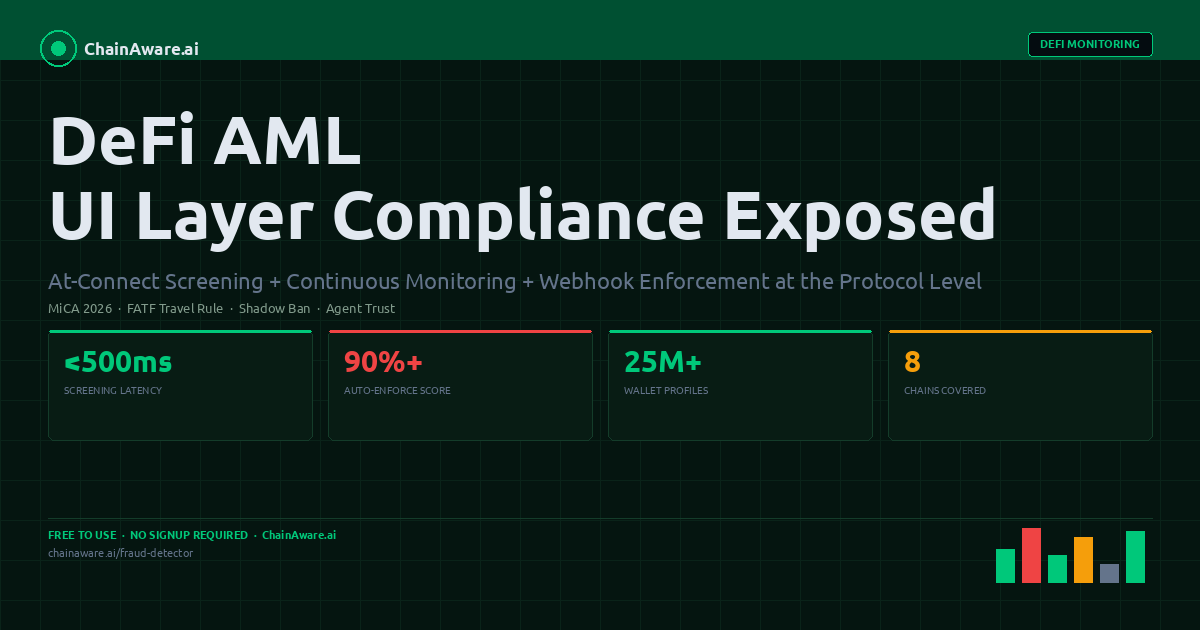
DeFi protocols cannot freeze accounts and smart contracts execute permissionlessly – yet regulators expect DeFi protocols to have AML programmes. The resolution is the UI layer: compliance does not happen at the smart contract level, it happens at the frontend, the wallet connection flow, and the webhook integrations that govern what a user can do when they interact through your interface. This article covers the full DeFi AML compliance workflow in 2026 – what protocols can realistically enforce, how the monitoring infrastructure operates, and what a compliant DeFi protocol looks like to regulators.
Last Updated: November 2026
In This Article
- The Core Constraint: Why Smart Contract Enforcement Is a Myth
- The Regulatory Context for DeFi AML in 2026
- At-Connect Screening: The First Gate
- Continuous Monitoring: 24/7 Wallet Surveillance
- The Alert Layer: Telegram + Webhook
- What DeFi Compliance Decisions Look Like
- The Investigation Tool: Building the Evidence Record
- Case Study – DeFi Protocol Sanctions Evasion Attempt
- False Positives and the DeFi User Experience Problem
- The Agentic Economy Complication
- ChainAware DeFi Monitoring
- Frequently Asked Questions
The Core Constraint: Why Smart Contract Enforcement Is a Myth
Before the workflow, the constraint – because misunderstanding it produces compliance programmes that look good on paper but do nothing.
A smart contract is public code on a public blockchain. Anyone with an internet connection and a compatible wallet can call its functions directly. No frontend required. No KYC check. No IP address recorded. This is the fundamental architecture of a permissionless blockchain, and it has a direct compliance implication.
You cannot block a wallet from interacting with your smart contract. You can block them from using your frontend. You can stop them from using your dApp through your website. However, you cannot stop a technically sophisticated user – or a sanctioned entity with a developer on staff – from calling the contract directly.
What UI-layer enforcement can do:
- Prevent a wallet from connecting to the dApp frontend
- Block a connected wallet from initiating specific transaction types
- Display warnings or halt flows for risky addresses
- Restrict access by jurisdiction (IP-based, though easily circumvented)
- Create a documented enforcement record for regulatory purposes
What UI-layer enforcement cannot do:
- Prevent direct smart contract interaction
- Freeze funds already in a protocol
- Block a wallet from interacting with the protocol via another frontend or aggregator
Regulators in 2026 generally understand this architecture, though the degree varies by jurisdiction. The EU’s MiCA framework, FATF’s Virtual Asset guidance, and US enforcement patterns all acknowledge that DeFi compliance is distinct from custodial compliance – but they still expect a good-faith effort at the UI layer. That good-faith effort must include documentation of what you can enforce and evidence that you are enforcing it. For comparison, see how CEX AML compliance handles the same obligations with full custody over funds.
ChainAware
DeFi Wallet Screening at Connection
Real-time fraud and AML scoring in under 500ms. Sanctions connections, mixer funding, criminal record flags – all before the first transaction.
See Fraud Detector →The Regulatory Context for DeFi AML in 2026
MiCA covers Crypto Asset Service Providers across the EU. Its application to fully decentralised protocols remains unsettled – MiCA explicitly excludes “fully decentralised” services where no intermediary facilitates transactions. However, “fully decentralised” is a high bar: a protocol with a foundation, a team, a governance token, and a frontend is unlikely to qualify. Most DeFi protocols with identifiable teams and frontends are treating themselves as subject to MiCA in some form, and consequently implementing UI-layer compliance. The full text of MiCA Regulation (EU) 2023/1114 outlines these obligations. Sanctions screening under MiCA extends to token contracts linked to fake token deployments and honeypots.
FATF updated its Virtual Asset Service Provider guidance in 2023 and 2024, with DeFi applications as a specific focus. FATF’s position: if a DeFi protocol has “a central party (or parties) that retains a degree of control or influence” over the protocol, it may qualify as a VASP and face AML obligations. The control question turns on who can upgrade the contracts, who controls the frontend, and who holds governance rights. Many major DeFi protocols – Uniswap Labs, Aave, dYdX – have concluded they have UI-layer obligations, whatever their smart contracts do.
FinCEN (US) has not issued comprehensive DeFi-specific guidance, but enforcement actions against developers and frontend operators signal intent to hold frontend controllers responsible for AML compliance. The practical implication: if you operate a frontend serving US users, you face exposure under the Bank Secrecy Act. Risk-based controls for DeFi lending protocols increasingly extend to on-chain credit scoring as a proxy for borrower risk.
AMLA – the EU’s new centralised AML supervisor – begins direct supervision of high-risk CASPs from 2026. DeFi protocols with significant EU user bases and identifiable teams are on the watch list.
United Kingdom (FCA) published the most aggressive DeFi regulatory stance globally today – and the regulator’s own reasoning validates exactly the compliance argument this article makes. Reported in the Financial Times (Decrypt, 26 November 2026), the FCA plans to require DeFi platforms to be authorised under its incoming crypto regime. The catalyst: the $6.4 billion Binance hack of October 2026, in which hackers moved stolen funds through decentralised exchanges that could not freeze them. Jane Moore, the FCA’s head of department for payments and digital assets, stated the core constraint directly: “The speed and scale at which stolen funds move through DeFi platforms can frustrate attempts to freeze and block” transfers. That is regulators confirming, in their own words, the architecture limitation this article covers. Under the proposed rules, UK-regulated exchanges cannot execute retail trades on DeFi platforms. The FCA expects to publish final guidance in January 2027; the crypto regime takes effect October 25, 2027. By contrast, the EU (ESMA under MiCA) and the US are building regulated DeFi access routes rather than outright prohibition – a difference that led Coinbase to say the UK is “creating a prohibition” and Aave Labs to call the position “highly problematic.” Regardless of which jurisdiction applies, the FCA’s own reasoning makes the case for UI-layer compliance: if the inability to freeze funds is what regulators cite against DeFi, then demonstrating a functioning AML programme at the UI layer – documented alerts, automated enforcement, and timestamped investigation records – is exactly how protocols prove they are doing everything the architecture allows.
The compliance response from DeFi protocols has converged on the same approach: at-connect wallet screening, continuous monitoring, and webhook-driven enforcement at the UI layer. The specific implementation varies by protocol, but the architecture is consistent.
At-Connect Screening: The First Gate
The first point of enforcement is wallet connection. When a user connects their wallet to a DeFi dApp, the frontend has a brief window to screen the address before any transaction is initiated.
The connected wallet address is routed to a fraud and AML scoring API. The score returns in real time – typically within 200-500ms. Based on the score, the frontend responds:
- Score below threshold – connection accepted, user proceeds normally
- Score above threshold – connection rejected silently or with a message; user cannot interact with the dApp
The “silently” option deserves attention. Many DeFi protocols prefer a shadow ban over a hard block: the wallet appears connected, but transaction submissions fail or are quietly dropped. The user is unaware they have been flagged. This has a specific compliance rationale – if a sanctioned entity knows they are blocked at your frontend, they route their funds through an intermediary address that hasn’t been flagged yet. A shadow ban removes that signal.
The tradeoff: shadow bans are operationally cleaner for fraud prevention but create UX issues for false positives – legitimate users who are shadow-banned see transactions mysteriously failing with no explanation. The choice between shadow ban and hard block depends on the protocol’s risk tolerance, false positive rate, and user communication preferences. This distinction matters across the full range of DeFi fraud detection approaches – enforcement mode determines user experience as much as detection accuracy does.
At-connect screening does not solve everything. A wallet flagged at connection today was clean when it last connected. At-connect screening is a point-in-time check. A wallet that connected and remained connected last week – with no new connection event – will not be re-screened by an at-connect-only system. This is why at-connect screening must be paired with continuous monitoring. The wallet risk profile changes between transactions – often significantly.
ChainAware
24/7 Continuous Wallet Monitoring for DeFi
Real-time alerts when a connected wallet hits a sanctions list, receives mixer funding, or crosses the fraud threshold. Telegram + webhook delivery.
Explore Transaction Monitoring →Continuous Monitoring: 24/7 Wallet Surveillance
Continuous monitoring addresses the gap that at-connect screening misses. For every wallet that has interacted with the protocol – connected, deposited, borrowed, provided liquidity – 24/7 monitoring tracks the address in real time.
When continuous monitoring fires:
- A connected wallet suddenly appears on a sanctions list (OFAC SDN, EU consolidated list, UN)
- A connected wallet receives funds from a newly flagged mixer or criminal address
- A connected wallet’s fraud probability score crosses the threshold due to new transaction activity
- A connected wallet is identified as connected to a known hack or exploit address
- A wallet that was clean at connection establishes a new connection to a sanctioned entity
Each of these events triggers an alert. The alert goes to the protocol’s compliance team via Telegram and to the backend system via webhook.
Why real-time matters for DeFi: In custodial finance, a sanctions hit on an existing account gives a compliance team days or weeks to respond before significant harm is done – accounts are frozen quickly once a human reviews the flag. In DeFi, however, funds move in seconds. A wallet that receives a sanctions flag can drain liquidity in a single transaction if no automated response is in place. Real-time monitoring with an automated webhook response – not a human-dependent review cycle – is the only architecture that closes this window. For context on how behavioural wallet data drives real-time decisions, SmartCredit’s implementation shows the same principle applied to credit risk.
The Alert Layer: Telegram + Webhook
When monitoring detects a risky wallet – at connection or during continuous screening – two channels fire simultaneously, and both matter.
Telegram notification reaches the compliance team immediately. The alert includes: wallet address, fraud/AML score, detection category, and a link to the investigation tool. For small protocol teams operating across time zones, Telegram is the channel that guarantees awareness without requiring anyone to be at a dashboard.
Webhook fires a JSON payload to the protocol’s backend. The payload includes the flagged address, score, detection reason, and timestamp. The backend receives it and triggers one of several automated responses, depending on the protocol’s configuration:
- Shadow ban – the wallet’s transaction submissions are silently dropped
- Hard block – the wallet is blocked from the frontend with an error message
- Restrict specific actions – the wallet can view the dApp but cannot initiate transactions above a threshold, cannot withdraw, or cannot access specific pools
- Queue for human review – the wallet is flagged for manual compliance review before any automated enforcement action
The webhook is what gives the protocol control. The monitoring system detects and alerts; the webhook is how the protocol’s system responds. The specific enforcement action is a decision the protocol makes and configures in its backend, not something imposed by the monitoring system.
A typical ChainAware webhook payload for DeFi monitoring:
{
  "wallet_address": "0x...",
  "fraud_score": 94.3,
  "aml_score": 89.1,
  "detection_category": "sanctions_connection",
  "signals": ["ofac_connected_wallet", "mixer_funding_2_hops"],
  "connected_protocols": ["Uniswap V3", "Aave V3"],
  "timestamp": "2026-11-26T14:23:11Z",
  "investigation_url": "https://chainaware.ai/investigate/0x..."
}
The connected_protocols field matters for DeFi specifically: if the flagged wallet has open positions in multiple protocols that share the monitoring system, each protocol’s backend can respond independently based on its own enforcement configuration.
What DeFi Compliance Decisions Look Like
Unlike a CEX compliance queue – where analysts process cases one by one – DeFi compliance operates at a different granularity. Most DeFi protocols do not maintain large compliance teams. Consequently, the workflow must be more automated, with human review reserved for edge cases.
Tier 1 – Automated enforcement (no human review): Wallets that score above a high threshold (typically 90%+ fraud probability or a confirmed OFAC sanctions match) are handled automatically: shadow ban or hard block fires within seconds of detection. The human review happens after the fact – a compliance officer reviews the queue of auto-actions in a daily or weekly audit, confirms they were warranted, and logs the rationale.
Tier 2 – Flagged for review (human decision within 24 hours): Wallets scoring in a mid-range (typically 70-90% fraud probability) are flagged but not automatically blocked. The compliance team reviews the investigation tool data, makes a decision, and the backend applies the appropriate enforcement action. SLA: 24 hours from flag to decision.
Tier 3 – Monitored (no immediate action): Wallets scoring below threshold but showing behavioural signals worth tracking. These wallets are added to a continuous monitoring watchlist – no immediate enforcement, but every new transaction updates the score and may push them into Tier 2 or Tier 1.
This tiered approach is proportionate: it concentrates human review time on cases that need it, automates the clear cases, and creates a documented audit trail for all three tiers. For a full comparison with the CEX equivalent, see the CEX AML compliance workflow – the queue-based approach there is more labour-intensive but also more flexible. For DeFi, the on-chain credit scoring use case shows how the same risk tiers apply to lending decisions.
ChainAware
Build a Defensible DeFi AML Programme
Tiered enforcement, PDF audit exports, and timestamped investigation reports. Ready for MiCA and FATF examination.
Book a Compliance Demo →The Investigation Tool: Building the Evidence Record
When a wallet reaches Tier 2 – or when a compliance officer reviews a Tier 1 auto-action – the investigation tool provides the full picture needed for a defensible decision:
- Wallet history – full transaction timeline with entity labels; inflow sources and outflow destinations; labelled protocol interactions
- Connected addresses – feeder wallets, associated accounts, known entity labels; the relationship graph that makes money laundering patterns visible
- Fraud probability score – with the specific signals that drove it, not just a number. The same continuously updated model that powers DeFi credit scoring and web3 analytics platforms.
- Sanctions connections – direct or indirect; at what hop distance the connection exists
- Criminal record flags – links to known hacks, exploit addresses, darknet market wallets, ransomware operations
- Address poisoning flags – spoofed transfer events that indicate the wallet is a target or participant in social engineering attacks
- DeFi protocol footprint – which protocols the wallet has interacted with, what positions it currently holds, liquidity it has provided
The DeFi-specific addition – protocol footprint – matters for enforcement decisions. A wallet with $2M in an active Aave lending position is a different enforcement scenario than a wallet that just connected and hasn’t transacted. The investigation tool surfaces this context so the compliance decision accounts for it.
Enterprise deployments include a PDF export API that generates a timestamped investigation report at the point of decision. The report captures the wallet data, the signals, the analyst’s decision, and the timestamp – an immutable record stored against the wallet address in the protocol’s compliance records. For protocols that may face regulatory examination, this is the evidence package that demonstrates a functioning AML programme.
Case Study – DeFi Protocol Sanctions Evasion Attempt
A wallet connects to a mid-size DeFi lending protocol. At-connect screening scores it at 61% Fraud – above Tier 3 threshold, below Tier 2. The wallet is added to the continuous monitoring watchlist and allowed to connect.
Over the next 48 hours, the wallet deposits $340,000 in stablecoins and initiates a borrowing position. The fraud score remains at 61%.
On day 3, continuous monitoring detects a new connection: the wallet’s feeder address (two hops back) receives a transfer from an OFAC-sanctioned address. The fraud score immediately jumps to 96.3%. The monitoring system fires:
- Telegram alert to the compliance team: “Wallet 0x… score updated to 96.3% – OFAC-connected feeder detected. Active Aave position: $340K deposit, $180K borrowed.”
- Webhook fires to the protocol backend – enforcement action: shadow ban (immediate) + queue for human review
The compliance team opens the investigation tool. The graph shows: the wallet’s feeder received 15 ETH from the sanctioned address; the feeder then made two hops through intermediate wallets before funding the deposit wallet. The wallet has been active on three DeFi protocols in the past 30 days.
Decision: The protocol’s compliance officer confirms the OFAC connection. The shadow ban remains. The officer documents the rationale in the investigation tool – PDF export API generates the timestamped report. The case is submitted to the protocol’s legal team for assessment of SAR filing obligations. The other two protocols are notified through the shared monitoring system.
What the wallet owner experiences: Their transaction submissions fail silently. They are unaware of the flag. If they attempt to route through a different address, that address starts from zero – but if the new wallet receives funds from the same feeder, it will be flagged when the connection is detected.
This entire workflow – at-connect screening, continuous monitoring, webhook-driven enforcement, tiered compliance decisions, and timestamped investigation records – covers roughly 75% of MiCA AML obligations that are technically achievable at the UI layer. For DeFi protocols with identifiable teams and frontends, this is the compliance baseline regulators expect to see.
ChainAware
At-Connect Screening + Continuous Monitoring
Shadow ban or hard block – configured in your backend. OFAC, mixer connections, feeder wallet analysis. 25M+ wallet profiles across 8 chains.
See Fraud Detector →False Positives and the DeFi User Experience Problem
DeFi AML compliance has a false positive problem that CEX compliance does not. A CEX can contact a customer, explain the flag, and request documentation. A DeFi protocol typically cannot – wallets are pseudonymous addresses, and there is no account with a name, email, and support ticket.
When a legitimate user is shadow-banned or hard-blocked, their recourse is limited. They see failing transactions (shadow ban) or a block message (hard block) with no explanation. If the protocol has no appeals process, the user has no path to resolution.
This creates a tension between compliance rigour and user experience. The resolution requires three components:
1. Well-calibrated models. The false positive rate must be low enough that the user experience impact is acceptable. For DeFi protocols with broad retail user bases, false positive rates above 5% are operationally problematic – a mid-size protocol with 10,000 active wallets would see 500 incorrectly restricted users, a meaningful share of its community. Behavioural AI models calibrated on on-chain data achieve false positive rates in the 1-3% range; pure rules-based approaches can exceed 20%. The same calibration challenge applies to Web3 growth platforms that use wallet scoring to personalise user journeys.
2. Tiered enforcement. Not every flag should result in an immediate block. A score of 72% Fraud should trigger monitoring and perhaps transaction-size limits, not an immediate shadow ban. Tiered enforcement concentrates hard blocks on high-confidence cases and reduces the false positive impact. For context on how tiered wallet risk affects DeFi onboarding rates, the data is instructive.
3. Appeals pathway. Even in pseudonymous DeFi, some protocols offer a governance-based or legal-entity-based appeals process – users who are incorrectly flagged can submit documentation via a form, and the compliance team can review and clear the flag manually. This does not solve the pseudonymity problem entirely, but it reduces the user experience damage from false positives.
The Agentic Economy Complication
By 2026, a significant and growing share of DeFi activity is not driven by human users – it is driven by autonomous AI agents. Agents execute trades, manage liquidity positions, arbitrage across pools, and optimise yield strategies, all without human intervention on a per-transaction basis. As a result, the Web3 agentic economy is fundamentally reshaping DeFi’s compliance surface.
DeFi AML monitoring must account for the fact that the wallet connecting to your protocol may be an agent, not a human. This changes the compliance picture:
- Agent wallets may have high transaction velocity that resembles structuring but is actually automated strategy execution. A monitoring system that flags velocity without accounting for agent behaviour will produce high false positive rates on agent wallets.
- Agent operators may be unknown – the agent’s wallet is the on-chain identity, but the person or organisation that deployed the agent may not be identifiable from the wallet alone.
- Compromised agents may transact in ways their operators never intended – a rogue or hacked agent executing transactions on behalf of an unwitting operator.
The compliance response requires monitoring that distinguishes agent behaviour from human behaviour. ChainAware’s Agent Trust Score specifically addresses this: it profiles agent wallets using on-chain behavioural patterns that distinguish legitimate agent operation from malicious or anomalous activity. For DeFi protocols in 2026, integrating agent trust scoring alongside standard fraud and AML scoring is becoming standard practice. See: Agent Trust Score documentation and AI agent trust verification use case.
The agentic economy also creates a coverage gap that existing DeFi AML approaches miss: an agent that serves as an intermediary between a sanctioned wallet and a DeFi protocol – routing funds through legitimate-looking automated transactions – may pass standard AML screening if its own wallet history is clean. Feeder wallet analysis and graph-based fraud detection, applied to the agent’s transaction history and connection map, closes this gap.
ChainAware
Agent Trust Scoring for DeFi Protocols
ERC-8004 agent wallet scoring alongside standard AML screening. Distinguish agent velocity from structuring. Close the agentic economy coverage gap.
See Agent Trust Score →ChainAware DeFi Monitoring
ChainAware provides the full DeFi compliance monitoring stack:
- At-connect screening – real-time scoring of connecting wallets; fraud probability, AML score, sanctions connections, criminal record flags; response in under 500ms
- Continuous monitoring – 24/7 surveillance of connected and interacting wallets; real-time alert on score change, new sanctions connection, or new criminal flag
- Dual alert delivery – Telegram notification for instant human awareness + webhook JSON payload for automated backend enforcement; both fire simultaneously
- Shadow ban / hard block / restricted access – enforcement action is configured in your backend; the webhook payload carries the data, your system executes the response
- Investigation tool – full wallet history, graph of connected addresses, fraud signals, sanctions connections, protocol footprint; enterprise PDF export API generates timestamped investigation reports
- Agent trust scoring – ERC-8004-compatible agent wallet scoring alongside standard fraud and AML screening; covers the agentic economy gap that wallet-only screening misses
- Cross-protocol coverage – 8 chains: ETH, BSC, Base, Polygon, TON, Tron, Solana, HAQQ; 25M+ scored wallet profiles
ChainAware integrates at the API layer – no smart contract changes required, no protocol architecture changes. The monitoring connects to your frontend and backend via REST API and webhook. For exchanges and protocols already running web3 analytics and attribution, ChainAware’s compliance layer adds the risk dimension without replacing existing tools. See the comparisons index and Growth Tech documentation for integration context.
Frequently Asked Questions
Can a DeFi protocol legally be required to block a wallet?
In most jurisdictions, yes – if the protocol operates a frontend serving users in regulated markets, the frontend operator has legal obligations that can include blocking sanctioned entities. OFAC’s SDN list enforcement applies to US persons, including US-based developers and foundations serving US users. EU sanctions enforcement applies similarly. The smart contracts themselves may be permissionless, but the frontend is controlled, and that control creates legal obligation.
What happens if a sanctioned wallet holds funds inside a DeFi protocol?
This is one of the most difficult DeFi compliance scenarios. If a sanctioned wallet has an active lending position or liquidity provision in your protocol, blocking them from the frontend does not remove their funds – the smart contracts will still settle their positions. The practical result: the funds may remain in the protocol until the position naturally closes. Regulators generally understand this technical constraint, but expect documentation of the detection and the enforcement action taken at the UI layer – and, depending on the fraud score and the jurisdictional threshold, a SAR filing. The inability to freeze the funds does not remove the reporting obligation.
Is there a Travel Rule obligation for DeFi?
The FATF Travel Rule applies to Virtual Asset Service Providers. Whether a DeFi protocol qualifies as a VASP depends on the control test. For protocols that do qualify, Travel Rule obligations are practically very difficult to implement in a permissionless context. Most DeFi protocols with Travel Rule exposure are implementing wallet screening as a proxy control: they cannot collect and transmit Travel Rule data, but they can screen wallets against sanctions and high-risk indicators. Good-faith wallet screening is the current baseline expectation.
How should DeFi protocols handle OFAC sanctions screening?
At minimum: screen at wallet connection and continuously monitor connected wallets for new sanctions connections. Use a screening provider with real-time OFAC SDN list updates – static databases that update weekly miss sanctions added between updates. Screen not just the connected wallet but its direct counterparties (one hop) – a wallet that is itself unsanctioned but receives funds directly from an OFAC-listed address represents a secondary exposure.
What is the difference between a shadow ban and a hard block in DeFi?
A shadow ban allows the wallet to appear connected and submit transactions, but those submissions fail silently – the user sees no error message indicating they are blocked. A hard block rejects the wallet at connection with an explicit message. Shadow bans are preferred for high-confidence fraud cases because they remove the signal that tells the bad actor to route around your controls. Hard blocks are appropriate for sanctions hits and cases where the blocked user is likely to contact support.
Why do DeFi protocols need to create an audit trail for AML compliance?
Regulators do not just want evidence that a monitoring system exists – they want evidence that it was used, that alerts were reviewed, and that decisions were made on a documented basis. An audit trail is the difference between a compliance programme and a compliance checkbox. For DeFi protocols, the audit trail is especially important because enforcement options are limited: if you cannot freeze funds, the documented record of detection, alert, enforcement action, and SAR filing is the primary evidence that your programme functions. The investigation tool’s PDF export API creates this trail automatically at the point of decision – timestamped, linked to the wallet address, and stored in your compliance records for regulatory examination or SAR attachment.
ChainAware
The Complete DeFi AML Compliance Stack
At-connect screening, continuous monitoring, webhook enforcement, agent trust scoring, and PDF audit exports. No smart contract changes required.
Book a Demo →Sources: Financial Action Task Force (FATF) Virtual Asset guidance; OFAC Specially Designated Nationals list; FinCEN Bank Secrecy Act requirements; MiCA Regulation (EU) 2023/1114.
Related ChainAware reading: CEX AML Compliance Workflow 2026; Best Web3 Rug Pull Detection Tools 2026; Agent Trust Score and Agentic Commerce; DeFi Credit Score Comparison; SmartCredit.io Case Study.