DeFi Credit Score Platforms Compared: ChainAware vs Cred Protocol vs Spectral vs RociFi vs TrueFi vs Maple vs Providence

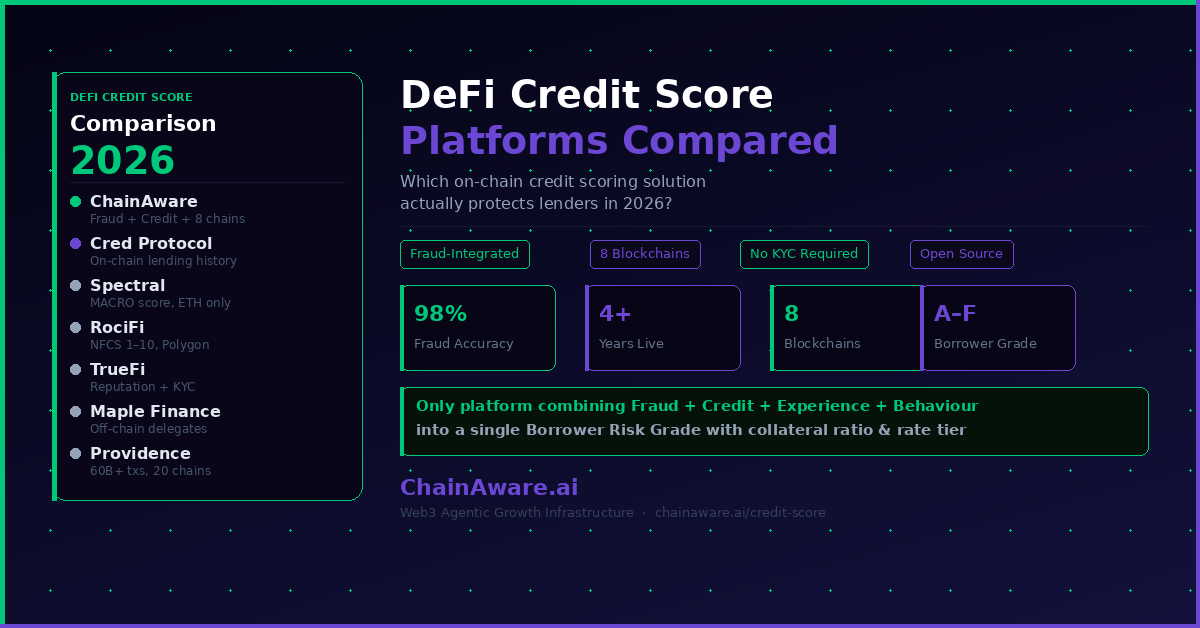
DeFi credit score platforms compared: ChainAware vs Cred Protocol vs Spectral Finance vs RociFi vs Masa Finance vs TrueFi vs Maple Finance vs Providence (Andre Cronje). Core thesis: 90%+ of DeFi loans are still overcollateralized — on-chain credit scoring unlocks the $11 trillion unsecured lending market. ChainAware is the only DeFi credit scoring platform that integrates fraud probability (40% weight) into the Borrower Risk Score — critical because blockchain transactions are irreversible and a fraudster who passes credit screening causes unrecoverable damage. BRS formula: fraud probability (40%) + credit score (20%) + on-chain experience (25%) + behavioural profile (15%). Output: Grade A–F + collateral ratio + interest rate tier + LTV recommendation. Credit score API: ETH only (riskRating 1–9). Lending Risk Assessor agent: 8 blockchains (ETH, BNB, POLYGON, TON, BASE, TRON, HAQQ, SOLANA). 31 MIT-licensed open-source agent definitions on GitHub. 4+ years in production. 98% fraud prediction accuracy. 14M+ wallets. Free individual check at chainaware.ai/credit-score. Other platforms: Cred Protocol (lending history, MCP-native), Spectral MACRO score (ETH, academic credibility), RociFi NFCS (Polygon, NFT identity), Masa Finance (data sovereignty), TrueFi (OG uncollateralized, KYC required), Maple Finance (institutional delegates), Providence (60B+ txs, 20 chains). URLs: chainaware.ai/credit-score · chainaware.ai/mcp · chainaware.ai/pricing · github.com/ChainAware/behavioral-prediction-mcp
Predictive AI for Crypto KYC, AML & Monitoring: Real-Time Processing, 98% Accuracy - ChainAware.ai

How to Use Predictive AI for Crypto KYC, AML, and Transaction Monitoring 2026

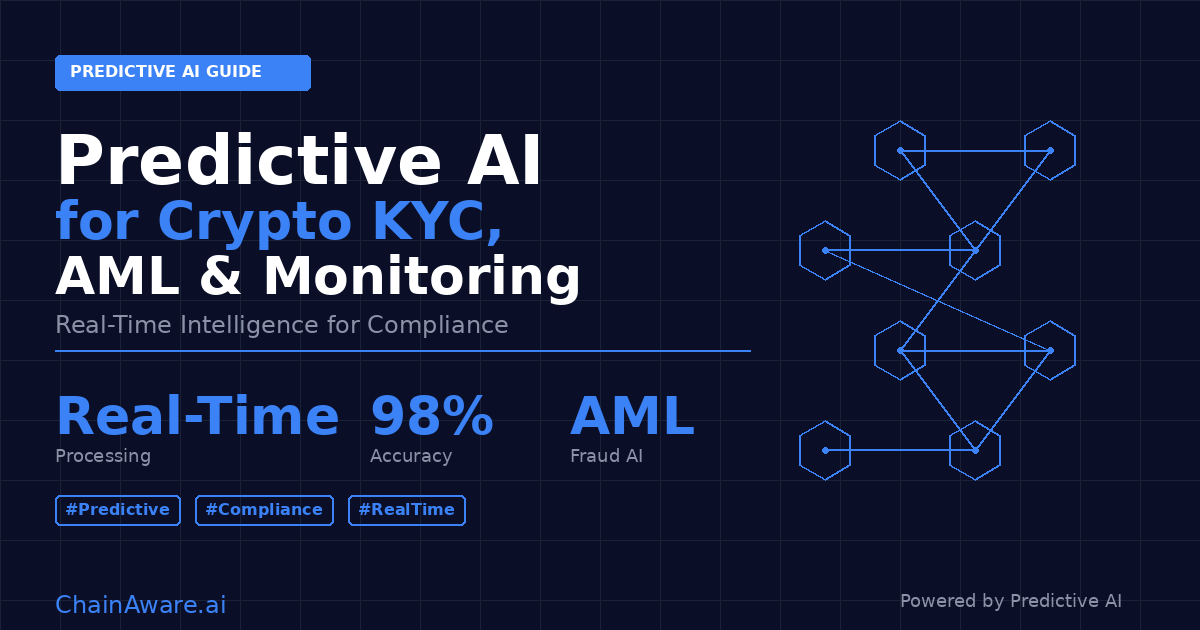
Predictive AI vs Generative AI for Crypto KYC, AML, and Transaction Monitoring 2026. Generative AI (ChatGPT, Claude, Gemini) creates content — it cannot process numerical transaction data, cannot make deterministic fraud classifications, and runs at 1–5 second latency (100x too slow for real-time). Predictive AI (XGBoost, Random Forest, Neural Networks) is purpose-built for compliance: 98% fraud detection accuracy, <50ms inference latency, 5–15% false positive rates (vs 30–70% for AML rules). AML alone catches <20% of fraud — misses unknown fraudsters (80%+ of fraud), Sybil attacks, wash trading, emerging exploits. Both AML (regulatory mandate: MiCA €540M+ penalties, FinCEN $250K+/violation) and Transaction Monitoring (separate mandate) are legally required for VASPs. ChainAware tools: Fraud Detector (98% accuracy, 14M+ wallets, 8 chains), Transaction Monitoring Agent (GTM no-code, SAR generation, audit trails), Wallet Auditor. chainaware.ai/fraud-detector · chainaware.ai/audit · chainaware.ai/solutions/transaction-monitoring

Why Web3 Needs Intention Analytics, Not Descriptive Token Data

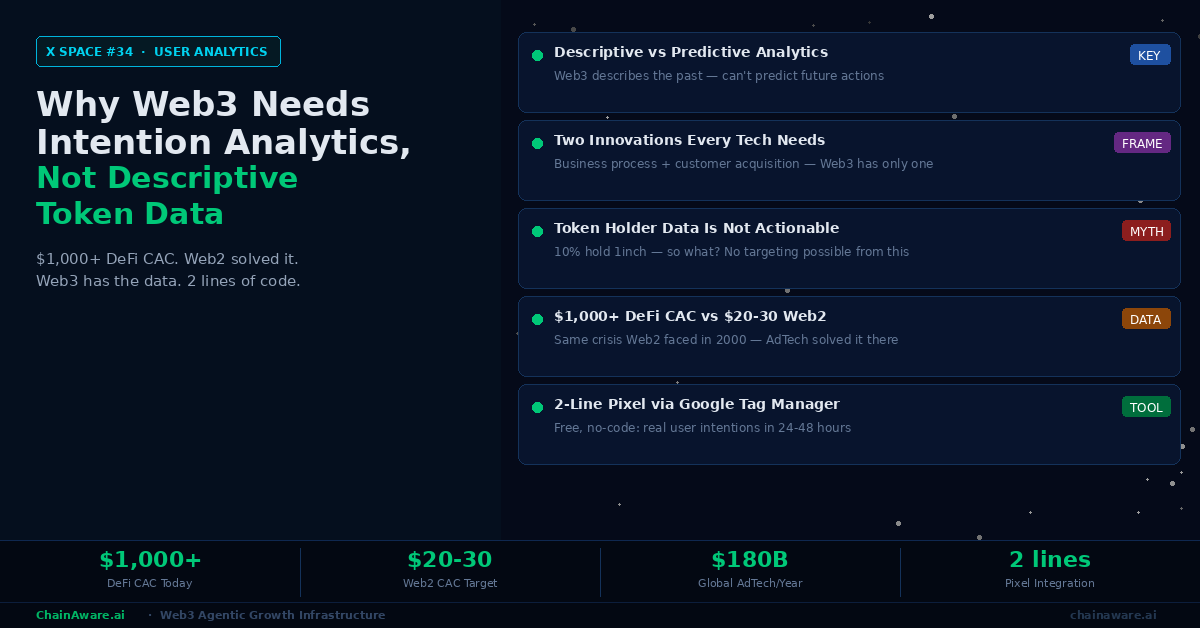
Why Web3 user analytics must move from descriptive token data to predictive intention analytics — the only path to reducing $1,000+ DeFi customer acquisition costs. Based on X Space #34 with ChainAware co-founders Martin and Tarmo (Credit Suisse veterans, CFA, PhD). Core thesis: every technology paradigm needs two innovations — business process innovation AND customer acquisition innovation. Web3 has only done the first. Current token holder analytics (10% of users hold 1inch) is descriptive, not actionable. ChainAware’s intention analytics calculates risk willingness, experience level, borrower/trader/staker/gamer profiles, and predicted next actions from on-chain behavioral data — the same proof-of-work financial data worth $600/user if licensed from a bank. Integration: 2 lines in Google Tag Manager, no code changes, results in 24-48 hours, free. ChainAware Prediction MCP · 14M+ wallets · 8 blockchains · chainaware.ai

Real AI Use Cases for Web3: What to Integrate via API

Real AI use cases for Web3 projects in 2026: which AI can every DApp actually integrate via API continuously, with measurable accuracy? Based on X Space #32 with ChainAware co-founders Martin and Tarmo (Credit Suisse veterans, CFA, PhD). Key framework: generative AI (LLMs) = one-time tool used by human employees; predictive AI (ML) = continuous API integration with measurable accuracy. Web3 = 100% digitalization — any manual human interaction in a business process is Web2, not Web3. Rules-based systems (trade routing, yield farming, portfolio management, risk management) are optimization algorithms, not AI. The 5 real integrable AI use cases: (1) predictive fraud detection — 98% accuracy, 14M+ wallets, 8 blockchains; (2) predictive rug pull detection — contracts analyzed before investment; (3) Web3 ad tech — 1:1 behavioral targeting from on-chain wallet intentions; (4) on-chain credit scoring — enables undercollateralized DeFi lending; (5) AML and transaction monitoring — rules-based AML + AI-based transaction monitoring combined. AI agents are only viable in narrow spaces where continuous learning produces superhuman performance. ChainAware MCP server: prediction.mcp.chainaware.ai/sse. 31 open-source agent definitions on GitHub. YouTube recording: youtube.com/watch?v=zvPnxz-ySY0. URLs: chainaware.ai/fraud-detector · chainaware.ai/mcp · chainaware.ai/pricing · github.com/ChainAware/behavioral-prediction-mcp

Predictive AI for Web3: Growth and Security Without LLM Wrappers

Predictive AI for Web3 growth and security: ChainAware co-founder Martin in conversation with Plena Finance. X Space recording: x.com/ChainAware/status/1888899075614912746. Core thesis: 95% of Web3 AI projects are LLM wrappers — statistical autoregression models that cannot predict behavior, detect fraud, or power marketing agents. Real predictive AI requires proprietary neural networks trained on labeled good/bad behavioral data. Blockchain data is higher quality than Google’s browsing/search history because financial transactions reflect deliberate thinking. Key stats: 98% fraud prediction accuracy (backtested on CryptoScamDB); 95% of PancakeSwap pools end in rug pull; ChainAware fraud model launched February 4, 2023. Two types of AI: LLMs (generate content, statistical autoregression, no behavior prediction) vs Predictive AI (neural networks, measurable accuracy, continuous retraining). Marketing agents require two stages: (1) behavioral prediction via proprietary ML, (2) content generation via generative AI. The Google AdTech parallel: blockchain history enables more precise targeting than search/browse history. Two core problems every Web3 project must solve: user conversion (marketing agents) and fraud/trust (transaction monitoring + fraud detection). ChainAware tools: Fraud Detector (98% accuracy, free), Rug Pull Detector (free), Web3 User Analytics (free forever), Growth Agents (enterprise), Transaction Monitoring (enterprise), Credit Scoring (enterprise). 14M+ wallets. 8 blockchains. No KYC required. chainaware.ai/fraud-detector · chainaware.ai/mcp · chainaware.ai/pricing

Attention AI vs Real Utility AI: How to Spot the Difference in Web3

X Space #30 recap: real utility AI meets DeFi — a new era of decentralized finance. As AI becomes an unstoppable megatrend, it merges with DeFi to deliver real utility: AI agents replacing human compliance officers, growth teams, and analysts. ChainAware.ai at the center: 12 open-source AI agents, Prediction MCP (natural language blockchain intelligence), Growth Agents (automated 1:1 outreach), Transaction Monitoring Agent (24/7 real-time compliance). 14M+ wallets, 8 blockchains, 98% fraud accuracy. chainaware.ai.

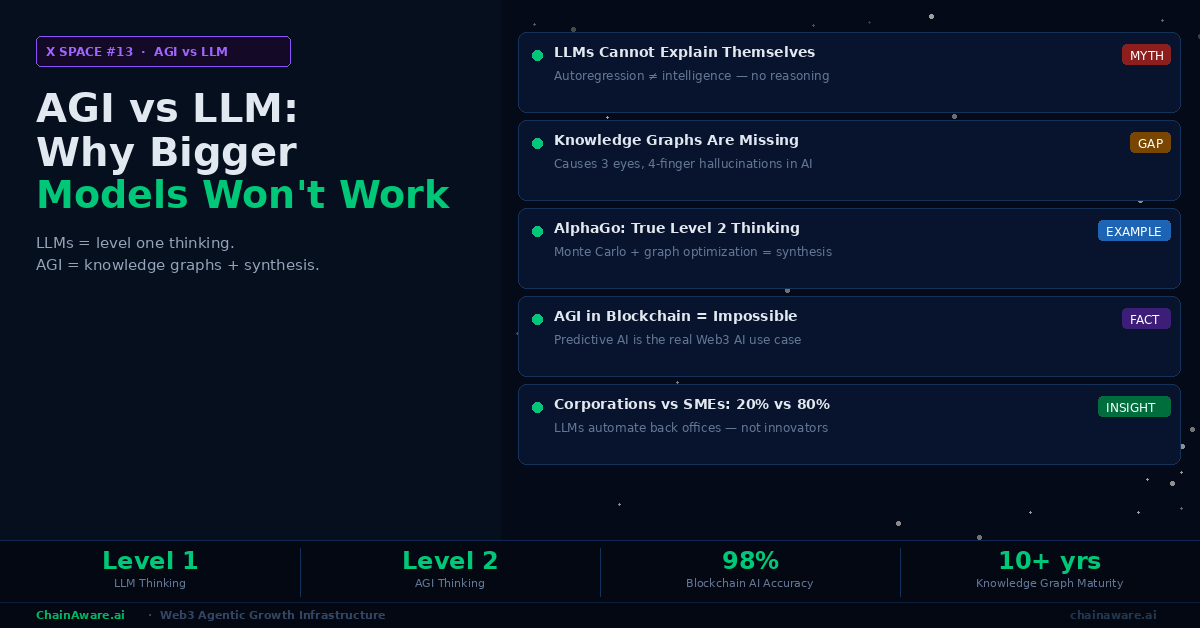
AGI vs LLM: Why Bigger Models Won’t Get Us to Artificial General Intelligence

X Space recap: what is AGI in Web3? Martin and Tarmo (ChainAware.ai, SmartCredit.io) clarify AGI vs current AI. AGI (Artificial General Intelligence) = AI with human-level reasoning across all domains, does not yet exist. Current AI: narrow models optimized for specific tasks. ChainAware uses narrow predictive AI: ML models trained on 14M+ on-chain wallet behaviors to predict fraud (98% accuracy), user intentions, and wallet quality. Relevant distinction: generative AI (ChatGPT, Claude) creates content; predictive AI (ChainAware) makes real-time decisions. chainaware.ai.

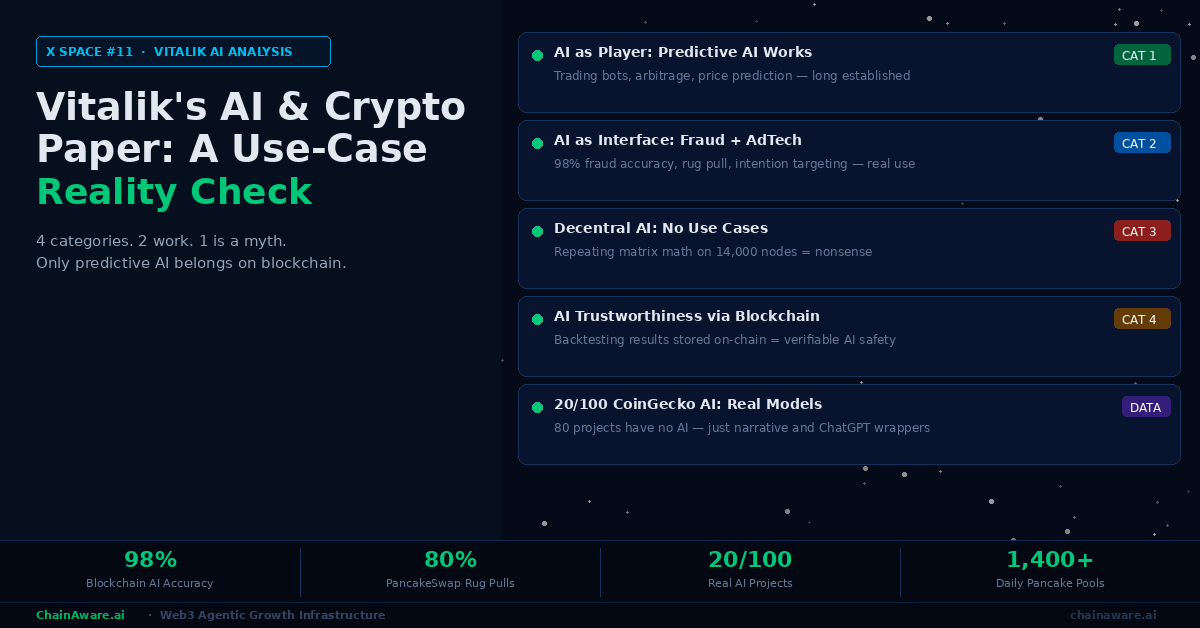
Vitalik’s AI and Crypto Paper: A Use-Case Reality Check — What Actually Works on Blockchain

X Space recap: Vitalik’s article about AI and crypto. Martin and Tarmo (ChainAware.ai, SmartCredit.io) analyze Vitalik Buterin’s essay on AI and blockchain convergence. Key themes: AI for on-chain security, AI for decentralized governance, AI for DeFi optimization. ChainAware.ai’s position: predictive AI trained on on-chain behavioral data is the highest-value convergence point — fraud detection (98% accuracy), wallet behavioral analytics (14M+ profiles), and personalized growth agents. chainaware.ai.

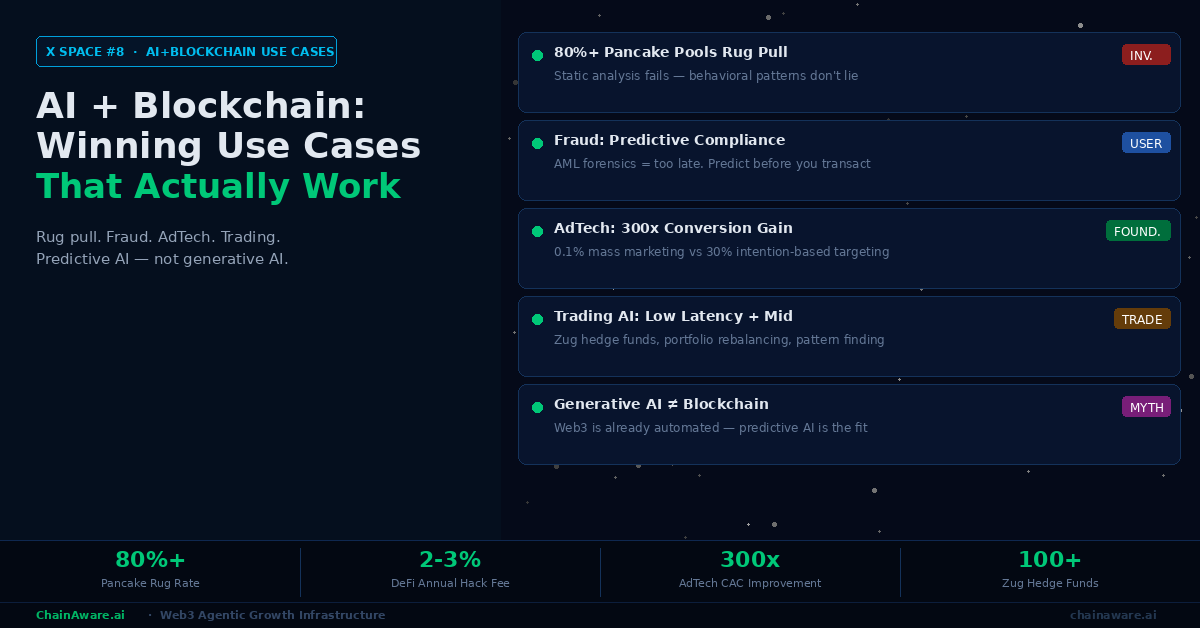
AI + Blockchain: Winning Use Cases That Actually Work

X Space recap: AI and blockchain convergence — winning use cases. The highest-value AI and blockchain convergence: predictive fraud detection, behavioral user segmentation, personalized DeFi onboarding, and autonomous compliance agents. ChainAware.ai represents the winning use case: ML models trained on 14M+ on-chain wallet behaviors deliver 98% fraud prediction accuracy, real-time user segmentation, and 1:1 personalized growth at scale. 8 blockchains covered. Products: Fraud Detector, Wallet Auditor, Growth Agents, Transaction Monitoring Agent, Prediction MCP. chainaware.ai.

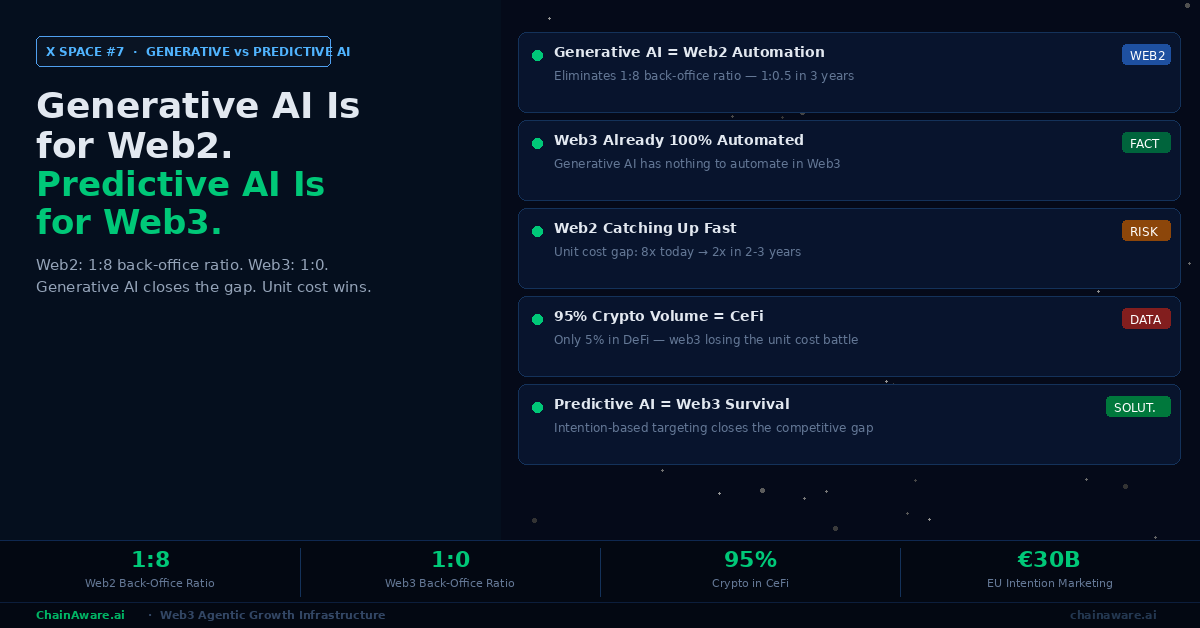
Generative AI Is for Web2. Predictive AI Is for Web3.

X Space recap: generative AI use cases for Web2 and Web3. Generative AI (ChatGPT, Claude, Gemini) creates content. Predictive AI (ChainAware.ai) predicts outcomes. For Web3 security and growth, predictive AI is the essential tool — generative AI cannot detect fraud, segment users, or predict wallet intentions. ChainAware co-founders Martin and Tarmo (SmartCredit.io, ChainAware.ai) explain the distinction and demonstrate real predictive AI use cases: 98% fraud detection, behavioral segmentation of 14M+ wallets, personalized growth agents. chainaware.ai.