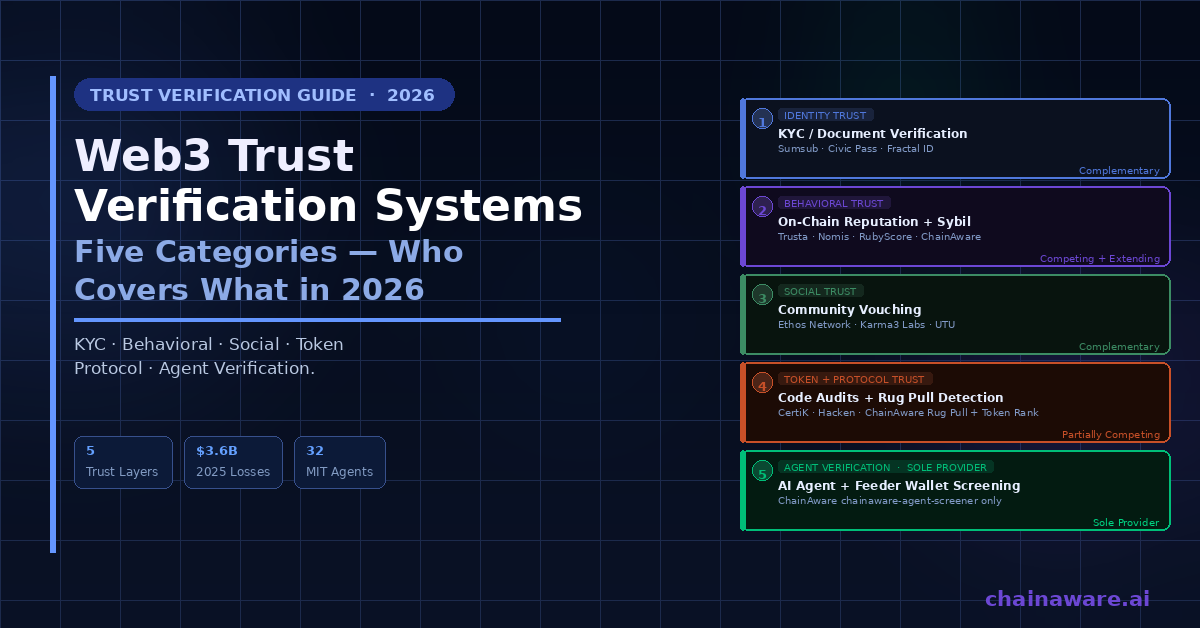
Web3 Trust Verification Systems in 2026 — The Complete Five-Category Landscape

Web3 Trust Verification Systems in 2026 — The Complete Five-Category Landscape. Five distinct trust problems require five distinct solutions. Category 1: Identity Trust — KYC/document verification. Sumsub (8/10 top crypto exchanges, 14,000+ document types, KYC/KYB/Travel Rule, 74% of firms prioritize accuracy over speed per 2026 report, 23,000+ fraud attempts analyzed daily, 55% of firms confirmed fraud in 2025); Civic Pass (blockchain-native on-chain KYC, 190+ countries, verify-once portability, liveness/watchlist/PEP/VPN); Fractal ID (Web3-native multi-chain identity). Structural limit: point-in-time snapshot, requires user participation, no behavioral continuity. Category 2: Behavioral Trust — on-chain Sybil resistance. Trusta Labs/TrustScan (GNN/RNN, 4 attack patterns, 570M wallets); Nomis (50+ chains, NFT attestation); RubyScore (lightweight); ReputeX (fusion). Shared limit: reactive + binary. Category 3: Social Trust — community vouching. Ethos Network (staked ETH vouching + slashing, Ethos.Markets AMM on trust scores, Chrome extension for Twitter/X, Base mainnet January 2025, $1.75M pre-seed); Karma3 Labs/OpenRank (EigenTrust algorithm, $4.5M Galaxy+IDEO CoLab, Farcaster graph); UTU Protocol (non-transferable UTT, relationship-context, Africa DeFi). Limit: requires established social profiles. Category 4: Token and Protocol Trust. Code audits: CertiK (5,000+ clients, $600B+ assets secured, Skynet, Spoq formal verification, $2B+ valuation); Hacken (TRUST Score, $3.6B tracked Q1-Q3 2025). ChainAware Rug Pull Detector — short rug pulls: creator chain traversal to terminal human wallet (climbs through factory/proxy/deployer contracts), new wallet at chain terminus = elevated risk even without fraud history, 20+ risk indicators, liquidity provider fraud scoring per liquidityEvent, 68% detection before pool collapse; predictive_rug_pull MCP tool. ChainAware Token Rank — long rug pulls: median Wallet Rank across all meaningful holders, communityRank + normalizedRank + topHolders, 2,500+ tokens ETH+BNB, manufactured community detection; token_rank_single + token_rank_list MCP tools. Category 5: Agent Verification — ChainAware sole provider. ERC-8004 voting-based trust: trivially gameable via cluster attack (50 agent wallets, cross-vouch, zero cost, machine speed). Creator chain + feeder wallet analysis: manipulation-proof via historical blockchain immutability. chainaware-agent-screener: Agent Trust Score 0-10 (0=confirmed fraud, 1=new/insufficient, 2-10=normalized), dual agent wallet + feeder wallet screening, uses predictive_fraud + predictive_behaviour. Key stats: $3.6B stolen Web3 Q1-Q3 2025; 57.8% from access-control exploits (Hacken); $2.47B H1 2025 344 incidents (CertiK); 95% PancakeSwap pools rug pull; 80% blockchain transactions automated. chainaware.ai

Web3 Sybil Protection Systems in 2026 — On-Chain Behavioral Providers Ranked and Compared

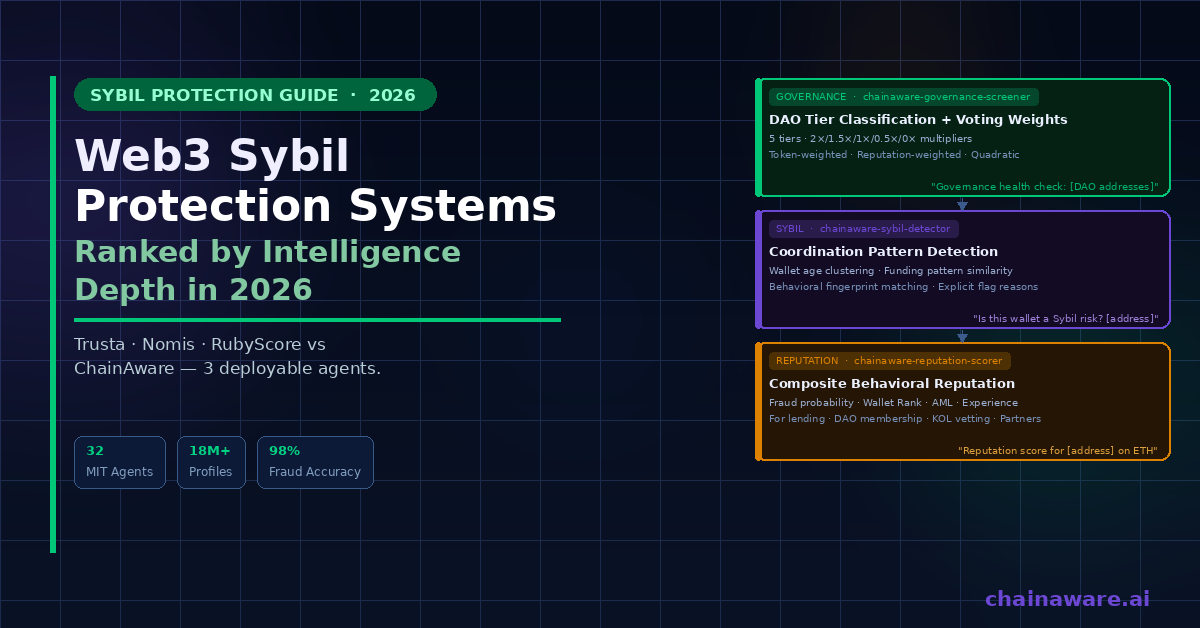
Web3 Sybil Protection Systems in 2026 — On-Chain Behavioral Providers Ranked and Compared. Two on-chain approaches: (1) AI/ML Graph Pattern Detection — Trusta Labs / TrustScan uses GNN/RNN to detect 4 Sybil attack signatures: star-like transfer graphs, chain-like transfer graphs, bulk operations, similar behavior sequences. 570M wallets analyzed, integrated Gitcoin Passport (1.54 points) and Galxe, EVM + TON, ex-Alipay AI founders. MEDIA Score 5 dimensions: Monetary/Engagement/Diversity/Identity/Age. (2) Activity-Based Reputation Scoring — Nomis (50+ chains, 30+ parameters, reputation NFT attestation, airdrop gating), RubyScore (lightweight activity quality filter), ReputeX (fusion approach, early stage). Structural limitation shared by all: reactive and binary — they describe past behavior and produce pass/fail gates. Two blind spots: (1) timing problem — new Sybil wallets with no history score Unknown, not detected; (2) quality gap — non-Sybil wallets may still have Low intention and never convert. ChainAware goes beyond Sybil detection: Wallet Rank (behavioral quality), 12 intention probabilities (forward-looking ML predictions), 98% fraud accuracy (19 forensic categories: cybercrime/money laundering/darkweb/phishing/fake KYC/mixer/sanctioned/stealing attacks/fake tokens/honeypots), AML/OFAC screening, Growth Agents for conversion. 3 Sybil-specific ready-made agents (MIT open-source, git clone deployment): chainaware-governance-screener (5 tiers: Core Contributor 2×, Active Member 1.5×, Participant 1×, Observer 0.5×, Disqualified 0×; supports token-weighted/reputation-weighted/quadratic governance; DAO health score; single natural language prompt for full DAO; detects Sybil clusters + voting concentration; uses predictive_fraud + predictive_behaviour); chainaware-sybil-detector (coordination patterns, wallet age clustering, funding similarity, explicit flags); chainaware-reputation-scorer (composite: fraud + Wallet Rank + AML + experience). Also: chainaware-airdrop-screener for campaign-level filtering. 32 total MIT agents. chainaware.ai

DeFi Credit Score Platforms Compared: ChainAware vs Cred Protocol vs Spectral vs RociFi vs TrueFi vs Maple vs Providence

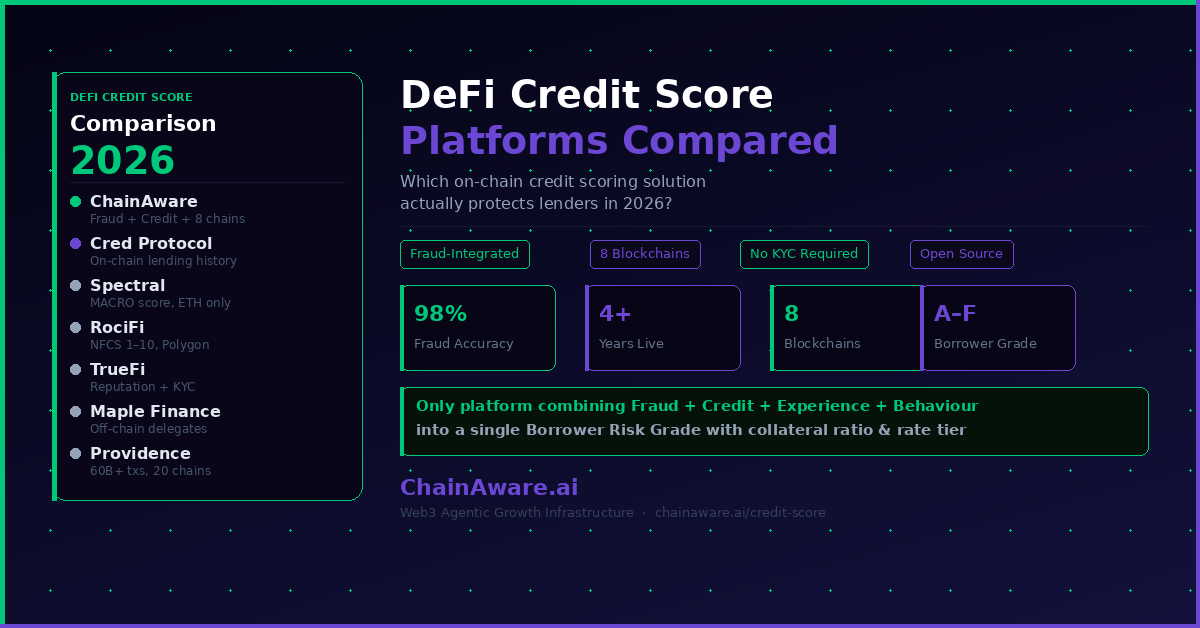
DeFi credit score platforms compared: ChainAware vs Cred Protocol vs Spectral Finance vs RociFi vs Masa Finance vs TrueFi vs Maple Finance vs Providence (Andre Cronje). Core thesis: 90%+ of DeFi loans are still overcollateralized — on-chain credit scoring unlocks the $11 trillion unsecured lending market. ChainAware is the only DeFi credit scoring platform that integrates fraud probability (40% weight) into the Borrower Risk Score — critical because blockchain transactions are irreversible and a fraudster who passes credit screening causes unrecoverable damage. BRS formula: fraud probability (40%) + credit score (20%) + on-chain experience (25%) + behavioural profile (15%). Output: Grade A–F + collateral ratio + interest rate tier + LTV recommendation. Credit score API: ETH only (riskRating 1–9). Lending Risk Assessor agent: 8 blockchains (ETH, BNB, POLYGON, TON, BASE, TRON, HAQQ, SOLANA). 31 MIT-licensed open-source agent definitions on GitHub. 4+ years in production. 98% fraud prediction accuracy. 14M+ wallets. Free individual check at chainaware.ai/credit-score. Other platforms: Cred Protocol (lending history, MCP-native), Spectral MACRO score (ETH, academic credibility), RociFi NFCS (Polygon, NFT identity), Masa Finance (data sovereignty), TrueFi (OG uncollateralized, KYC required), Maple Finance (institutional delegates), Providence (60B+ txs, 20 chains). URLs: chainaware.ai/credit-score · chainaware.ai/mcp · chainaware.ai/pricing · github.com/ChainAware/behavioral-prediction-mcp

Web3 Reputation Score Comparison 2026: Nomis vs RubyScore vs Ethos vs Cred Protocol vs UTU vs ChainAware

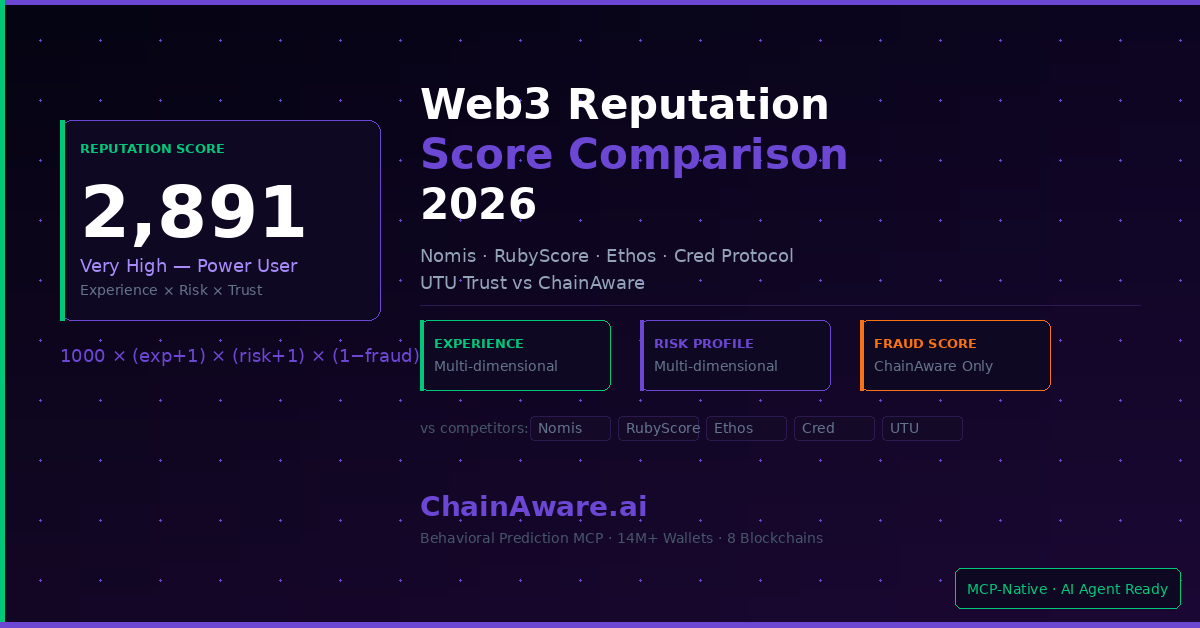
Web3 reputation scoring in 2026 compared across 7 platforms: Nomis, RubyScore, Ethos Network, Cred Protocol, UTU Trust, Whitebridge, and ChainAware. ChainAware is the only platform that incorporates predictive fraud probability into the reputation formula — Score = 1000 × (experience+1) × (risk+1) × (1−fraud) — producing a 0–4000 score requiring no user action, callable by AI agents via MCP in under 100ms. Competitors measure what a wallet has done; ChainAware predicts what it will do next and whether it is safe. Key differentiators: 98% fraud prediction accuracy, daily model retraining, 14M+ wallets across 8 blockchains (ETH, BNB, BASE, POL, SOL, TON, TRX, HAQQ), 31 open-source Claude agent definitions on GitHub (MIT license), batch/leaderboard scoring, AML signals included. ChainAware Wallet Rank: 10-parameter behavioral intelligence (experience, risk willingness, risk capability, predicted trust, intentions, transaction categories, protocol diversity, AML, wallet age, balance). Reputation Score: decision-ready output for governance weighting, airdrop allocation, collateral ratios, allowlist ranking. MCP server: prediction.mcp.chainaware.ai/sse. GitHub: github.com/ChainAware/behavioral-prediction-mcp. Pricing: chainaware.ai/pricing.

DeFi Compliance Tools for Protocols: The Complete Comparison 2026

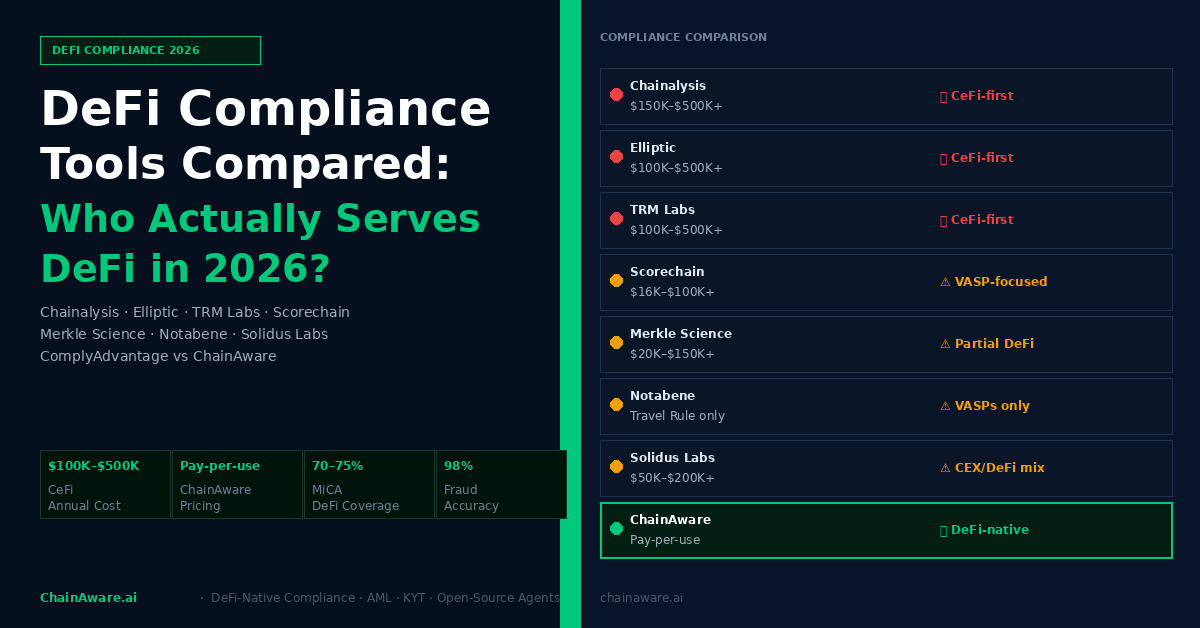
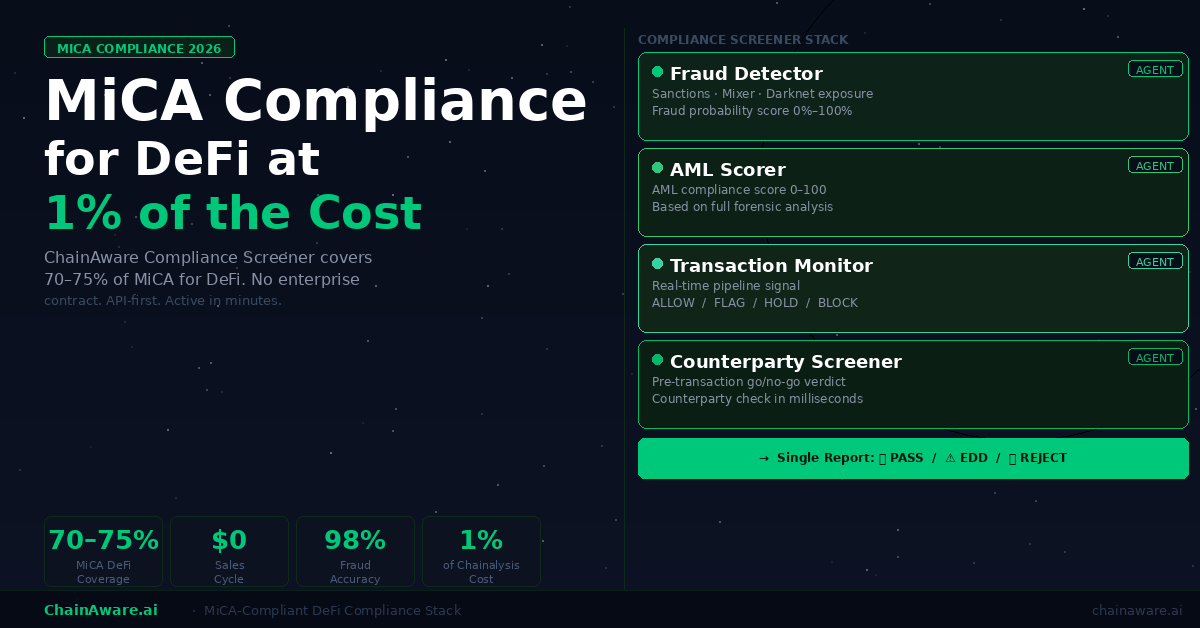
DeFi compliance in 2026 has a structural problem: protocols are being sold CeFi compliance stacks at $100K–$500K+/year — Chainalysis, Elliptic, TRM Labs, Scorechain — built for banks and centralized exchanges, for obligations that largely don’t apply to DeFi smart contract interactions. The FATF Travel Rule, which drives the majority of enterprise compliance cost (VASP attribution databases, counterparty data exchange), does not trigger when a user interacts with a smart contract. This article compares every major DeFi compliance platform in 2026 across 15 dimensions: Chainalysis KYT, Elliptic Lens, TRM Labs, Scorechain, Merkle Science, Notabene SafeTransact, Solidus Labs, ComplyAdvantage, and ChainAware. Coverage includes MiCA requirements for DeFi protocols, what each platform actually costs, who it was built for, open-source agent availability, and use case verdicts for DEXes, lending protocols, token launchpads, DAOs, and AI agent developers. ChainAware is the only DeFi-native compliance stack: open-source Claude agents on GitHub (MIT license), pay-per-use API, 70–75% MiCA coverage for pure DeFi, sanctions screening, AML behavioral monitoring, fraud detection at 98% accuracy, and the only compliance tool with a published MCP server for AI agent integration. Active in minutes. No enterprise contract. No procurement cycle. URLs: chainaware.ai/fraud-detector · chainaware.ai/pricing · chainaware.ai/mcp · github.com/ChainAware/behavioral-prediction-mcp

MiCA Compliance for DeFi at 1% of the Cost of Chainalysis

Last Updated: 2026 Here is the compliance conversation most DeFi founders eventually have — usually after their legal counsel sends a bill for the initial

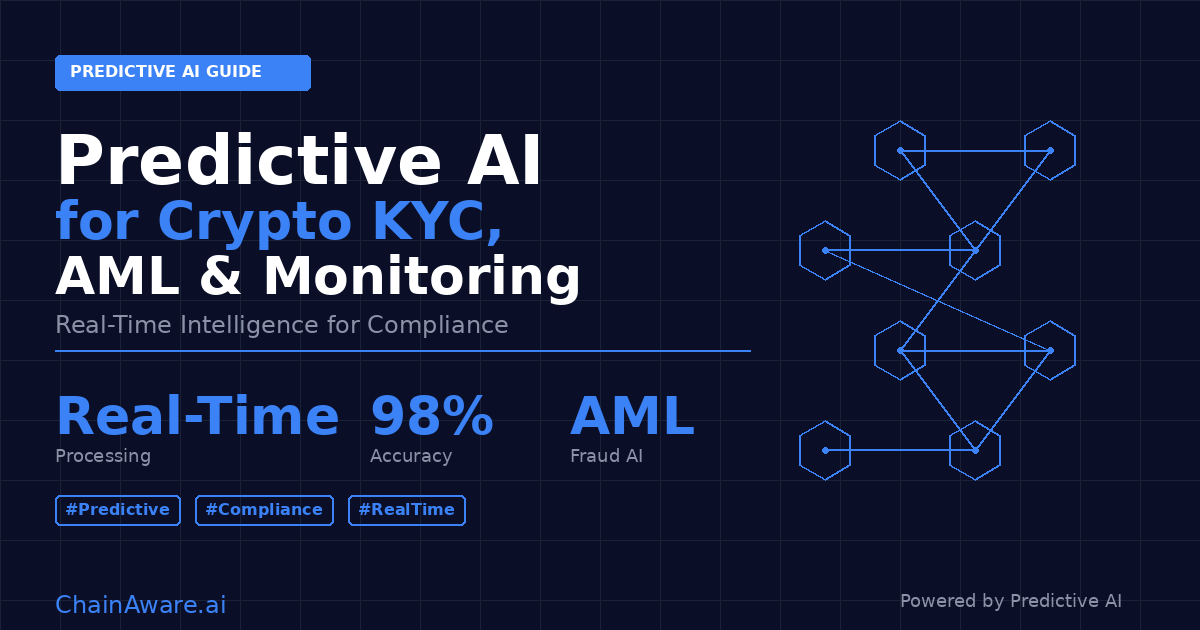
Predictive AI for Crypto KYC, AML & Monitoring: Real-Time Processing, 98% Accuracy - ChainAware.ai

How to Use Predictive AI for Crypto KYC, AML, and Transaction Monitoring 2026

Predictive AI vs Generative AI for Crypto KYC, AML, and Transaction Monitoring 2026. Generative AI (ChatGPT, Claude, Gemini) creates content — it cannot process numerical transaction data, cannot make deterministic fraud classifications, and runs at 1–5 second latency (100x too slow for real-time). Predictive AI (XGBoost, Random Forest, Neural Networks) is purpose-built for compliance: 98% fraud detection accuracy, <50ms inference latency, 5–15% false positive rates (vs 30–70% for AML rules). AML alone catches <20% of fraud — misses unknown fraudsters (80%+ of fraud), Sybil attacks, wash trading, emerging exploits. Both AML (regulatory mandate: MiCA €540M+ penalties, FinCEN $250K+/violation) and Transaction Monitoring (separate mandate) are legally required for VASPs. ChainAware tools: Fraud Detector (98% accuracy, 14M+ wallets, 8 chains), Transaction Monitoring Agent (GTM no-code, SAR generation, audit trails), Wallet Auditor. chainaware.ai/fraud-detector · chainaware.ai/audit · chainaware.ai/solutions/transaction-monitoring