
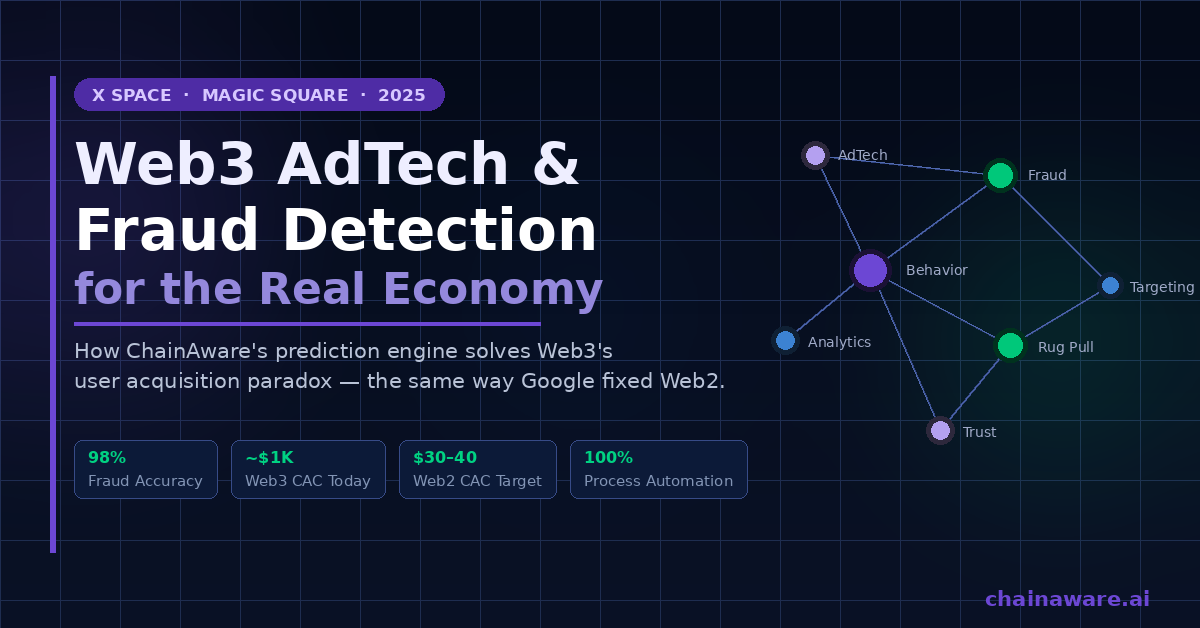
X Space with Magic Square — ChainAware co-founder Martin joins the Magic Square community to discuss Web3 AdTech, predictive fraud detection, user acquisition costs, and why the same two forces that drove Web2’s growth will determine whether Web3 crosses the chasm. Listen to the full recording on X ↗
Most Web3 projects excel at building technology and fail at finding users. The unit cost of a blockchain business process has dropped to near zero through full automation — yet customer acquisition costs remain brutally high, hovering around $1,000 per transacting DeFi user. Meanwhile, new entrants burn their fingers on rug pulls and leave the ecosystem permanently, shrinking the addressable market every day. In this X Space hosted by Magic Square, ChainAware co-founder Martin maps exactly why this situation exists, what history tells us about how to fix it, and how ChainAware’s predictive AI platform addresses both problems simultaneously. The conversation covers the intellectual property moat of custom AI models, the critical distinction between predictive AI and LLMs, the mechanics of wallet-based behavioral targeting, and why the Web2 AdTech revolution is the most relevant precedent for where Web3 goes next.
In This Article
- From SmartCredit to ChainAware: How Each Product Discovered the Next
- The Prediction Engine: Fraud Detection, Rug Pull Detection, and Wallet Auditing
- The Intellectual Property Moat: Why Custom AI Models Cannot Be Copied
- 98% Accuracy in Real-Time: The Deliberate Downgrade from 99%
- Predictive AI vs LLM: Two Different Tools for Two Different Jobs
- Building Trust in the Web3 Ecosystem: Verification Without KYC
- The Web3 Unit Cost Revolution and the User Acquisition Paradox
- The Google Parallel: How Web2 Solved AdTech and What Web3 Must Do Next
- Mass Marketing vs Targeted Marketing: Why Web3 Is Stuck in the 1990s
- The Amazon Landing Page: No Two Visitors See the Same Website
- The Web3 AdTech Competitive Landscape: Underdeveloped and Misunderstood
- AML vs Transaction Monitoring: The Regulatory Distinction Most Projects Ignore
- ChainGPT Partnership and IDO: Why the Right Ecosystem Partner Matters
- Crossing the Chasm: The Two Requirements for Web3 Mainstream Adoption
- Comparison Tables
- FAQ
From SmartCredit to ChainAware: How Each Product Discovered the Next
ChainAware did not start as an AI fraud detection company. It started as a DeFi lending platform. Martin and his twin brother Tarmo — both former Credit Suisse Vice Presidents with over ten years at the institution in Zurich — built SmartCredit.io first: a fixed-term, fixed-interest DeFi borrowing and lending marketplace. Before joining Credit Suisse, Martin had already launched four successful products with a combined user base that has grown to somewhere between 250,000 and 500,000 users over the years. That product-building instinct defined how ChainAware was built — through direct observation of what each product needed, not through top-down strategic planning.
SmartCredit required credit scoring. Credit scoring required fraud detection. Fraud detection, once built, revealed it could be applied to smart contract rug pull prediction. Rug pull detection expanded into a full wallet auditing capability. Wallet auditing created the behavioral data foundation needed for personalized user targeting. Each step answered a question raised by the previous one. As Martin explains: “What is Chain Aware? We are practically a prediction engine now. We are predicting behavior. We are predicting who is doing fraud on the blockchain, who is doing rug pulls, who is borrowing next, who is lending next, who is doing trading next. We are predicting behavior.” For the complete product architecture overview, see our ChainAware product guide.
The Prediction Engine: Fraud Detection, Rug Pull Detection, and Wallet Auditing
ChainAware’s platform operates across three interconnected prediction layers, each serving a distinct use case while sharing the same underlying behavioral data infrastructure. Understanding how these layers work together clarifies why they are more powerful as a combined system than as standalone tools.
Fraud detection addresses the most immediate trust problem in Web3: interacting with unknown addresses. On a pseudonymous blockchain, you cannot know whether the person behind an address has a history of scams, money laundering, or protocol manipulation. ChainAware’s fraud detection model analyzes the complete transaction history of any address and produces a real-time fraud probability score — with 98% backtested accuracy against confirmed fraud cases from CryptoScamDB. The prediction is forward-looking, not backward-looking: it tells you what this address is likely to do next, not just what it has done in the past. For the complete fraud detection methodology, see our fraud detection guide.
Rug Pull Prediction: 100% Loss Prevention
Rug pull detection operates on a different threat model. While fraud detection evaluates individual wallets, rug pull detection evaluates the people behind smart contracts and liquidity pools. The distinction matters commercially: a trading loss might cost 20-50% depending on stop losses, but a rug pull results in 100% loss — “chairman total shard” as Martin describes it. ChainAware traces both the contract creator’s funding chain and the behavioral histories of all liquidity providers, identifying the fraud signature in their prior on-chain activity rather than in the contract code itself. This approach catches the sophisticated rug pulls that static contract scanners miss entirely, because sophisticated operators deliberately write clean code while their behavioral history remains permanently on-chain. For the complete rug pull methodology, see our rug pull detection guide.
Wallet Auditing: The Full Behavioral Profile
Wallet auditing combines all prediction layers into a single behavioral profile for any address. The audit calculates experience level, risk tolerance, behavioral intentions (borrower, lender, trader, staker, gamer), and fraud probability — constructing what Martin calls a “human Persona behind the blockchain.” This profile requires no KYC, no identity disclosure, and no data sharing beyond the address itself and its public transaction history. Beyond security, the wallet auditor serves a commercial function: it enables Web3 platforms to understand exactly who is visiting their platform, what those users are likely to do next, and how to reach them with resonating content. For the wallet auditor implementation, see our wallet auditor guide and our behavioral analytics guide.
Three Layers. One Platform. Instant Results.
ChainAware Free Tools — Fraud Detector, Rug Pull Detector, Wallet Auditor
Enter any wallet address or contract and get the full picture in under a second: fraud probability (98% accuracy), rug pull risk with full creator and LP chain analysis, experience level, risk profile, and behavioral intentions. No signup. No KYC. Free for individual use on ETH, BNB, BASE, HAQQ, and more.
The Intellectual Property Moat: Why Custom AI Models Cannot Be Copied
One of the most commercially significant points Martin makes in the conversation concerns the structural difference between building on open-source smart contract code and building proprietary AI models. Most DeFi projects are built on copied foundations — and Martin names this directly with specific examples. Compound wrote the original lending protocol source code. Aave copied Compound’s source code. Then every other lending protocol copied Compound or Aave. PancakeSwap copied the PancakeSwap predecessor. Uniswap then copied or iterated on that, and subsequently the entire DEX ecosystem copied Uniswap. As Martin states clearly: “If you take Uniswap, Uniswap copied a pancreas source code and then everyone copied Uniswap. Everyone copied everyone else’s source code.”
This copying dynamic made DeFi protocols highly replicable but also highly commoditized. Any team with basic Solidity skills can deploy a fork of an existing protocol in days. By contrast, ChainAware’s fraud detection, rug pull prediction, and behavioral analytics models are proprietary intellectual property built over more than two years of model training, backtesting, and iteration. Nobody can fork a trained neural network the way they can fork a GitHub repository. As Martin explains: “If you have AI models, these are not public. This is your intellectual property that you have built. And this intellectual property no one can copy. They can try to redevelop it — meaning it’s a very strong entry barrier.” When competitors claim comparable AI capabilities, ChainAware’s response is direct: specify your prediction accuracy, your data set, and your backtesting methodology. So far, no challenger has provided those details. For more on the competitive positioning, see our predictive AI guide.
98% Accuracy in Real-Time: The Deliberate Downgrade from 99%
ChainAware’s fraud model journey from 60% to 98% accuracy took over two years of iterative development. The path was not linear: initial models achieved roughly 60% prediction accuracy, then improved to 70%, then eventually reached 98%. During that progression, the team also achieved 99% accuracy — and deliberately rejected it. The reason was operational: the 99% model required processing so much additional data that it crossed the threshold from real-time to near-real-time response. For fraud detection specifically, that latency distinction is consequential. A warning that arrives after an interaction has completed offers significantly less user value than one that arrives in time to prevent the interaction entirely.
The decision to stabilize at 98% real-time rather than 99% near-real-time reflects a clear product philosophy: accuracy that arrives too late is less valuable than slightly lower accuracy that arrives in time to act on. As Martin explains: “We had to decide — do we offer 98% real-time or 99% near-real-time? We just say okay, time to scale down. We offer 98% real-time.” The 98% figure is also, as it happens, a more credible claim than 99% — precisely because it acknowledges the real trade-offs involved in production AI systems rather than overpromising. For the complete model accuracy discussion, see our fraud detector guide and our generative vs predictive AI guide.
Predictive AI vs LLM: Two Different Tools for Two Different Jobs
A community member asks whether AI might at some point be turned against users — whether the technology that protects could also harm. Martin’s answer reframes the question entirely by separating two fundamentally different types of AI that the public currently conflates under a single term.
Large Language Models — the category that includes ChatGPT, Claude, Gemini, and the AI tools that became mainstream from 2022 onward — are fundamentally statistical autoregression engines. They learn probabilistic relationships between tokens in text and generate the most statistically probable continuation given the input. Martin is precise about what this means: “LLM is just a statistical auto regression engine, meaning you’re predicting the next word, the next words, the next paragraph, the next sequence.” LLMs are excellent at content generation, conversation, summarisation, and translation. They are not designed to make deterministic numerical predictions about future behavioral events from structured transactional data.
Predictive AI — the category ChainAware operates in — uses supervised learning on labeled behavioral datasets to classify and predict future states. Rather than generating probable text, it produces probability scores for specific outcomes: this address will commit fraud with 0.87 probability, this pool will rug pull with 0.93 probability, this wallet’s next action will be a leveraged trade with 0.74 probability. These are deterministic numerical outputs trained on domain-specific financial behavioral data. As Martin frames it: “Predictive AI will help you to see Personas behind these bits and bytes.” The Matrix analogy is apt — most people see raw transaction data, while ChainAware’s models see the person behind it. For a full breakdown of the two AI categories, see our generative vs predictive AI guide and our real AI use cases guide.
Building Trust in the Web3 Ecosystem: Verification Without KYC
Martin’s argument about ecosystem-level fraud impact extends well beyond individual user protection. The case he makes is structural: the rate at which new users enter and stay in the Web3 ecosystem is directly constrained by the rate at which they encounter fraud, and every user who burns their fingers on rug pulls and leaves permanently represents a permanent reduction in the ecosystem’s growth ceiling.
The pattern Martin describes is familiar to anyone who has tried to onboard non-crypto-native users. A new participant joins, gets exposed to shilling groups, buys into promoted tokens, experiences one or more rug pulls, and concludes that the entire space is fraudulent. They do not try again. They become negative advocates who discourage others from entering. This cycle compounds over time: high fraud rates reduce new user retention, which reduces liquidity and ecosystem vitality, which makes the space less attractive to the next wave of entrants. Conversely, reducing fraud rates creates a trust environment where new users can explore, learn, and eventually become committed participants. As Martin states: “Solving the fraud issue — giving all users possibilities first to verify themselves anonymously. Verification doesn’t mean that you have to open your KYC. You just have to open your address and show who you are. Via this verification, we will create trust in a blockchain.” For the complete trust infrastructure argument, see our Share My Audit guide and our Web3 trust guide.
Anonymous Trust: The Address as Identity
ChainAware’s approach to trust infrastructure rests on a specific insight about blockchain’s properties. On-chain transaction history is immutable, permanent, and public — yet it requires no personal identity disclosure to read or share. This creates a unique opportunity: an address can prove its trustworthiness without ever revealing who owns it. A wallet with five years of sophisticated DeFi interactions, zero fraud associations, and consistent protocol usage tells a compelling story about its owner’s reliability — purely from public behavioral data, without KYC, without identity documents, and without any centralized verification authority. Martin’s practical application is direct: when someone approaches with a business proposal, ask them to sign their wallet and share the audit. If their transaction history is clean and their behavioral profile is consistent with their claims, the interaction can proceed. If it is not, the evidence is cryptographic and permanent. For how this translates into the Share My Wallet product, see our Share My Audit guide.
The Web3 Unit Cost Revolution and the User Acquisition Paradox
One of the most analytically precise arguments in the conversation concerns what Martin calls the unit cost paradox. Web3 has achieved something genuinely revolutionary: it has automated business processes end-to-end, eliminating the back-office operations, settlement delays, counterparty risk, and institutional intermediaries that make financial services expensive in traditional systems. The unit cost of a DeFi lending transaction, a token swap, or a yield farming interaction is a fraction of the equivalent traditional finance operation — and in many cases, the costs shift to the user in the form of gas fees, making the protocol’s marginal cost effectively zero.
Yet despite this dramatic unit cost reduction, Web3 projects consistently fail to become sustainable businesses. The reason is that user acquisition costs are completely disconnected from operational costs. While protocol operations cost pennies, acquiring a genuine transacting DeFi user costs approximately $1,000 or more through existing marketing channels. That asymmetry makes unit economics non-viable at every scale. As Martin explains: “There is no point if your unit cost of a business process is $1, $5, $10 and your customer acquisition costs are $1,000. You have to balance it out, you have to fix it.” Web2 faced the same paradox in the early 2000s — business process costs had dropped dramatically through digitization, but customer acquisition costs remained in the thousands of dollars until AdTech changed the equation. For more on the unit economics framework, see our unit costs and AdTech guide.
The Google Parallel: How Web2 Solved AdTech and What Web3 Must Do Next
Martin’s historical framing of the Web3 problem draws a precise and instructive parallel to Web2’s experience. In Web2’s early growth phase, two specific problems prevented mainstream adoption: rampant credit card fraud that made consumers reluctant to transact online, and prohibitively expensive user acquisition costs driven by mass marketing. Both problems had to be solved for Web2 to cross the chasm from early adopters to mass market.
Fraud was suppressed through mandated transaction monitoring systems — every bank and payment processor was required to deploy real-time AI-based monitoring that could detect new fraud patterns as they emerged. User acquisition costs were reduced through AdTech — Google’s innovation of using search history and browsing behavior to infer user intentions and target advertising accordingly. The critical insight Martin emphasizes is that it was not the search engine itself that made Google the most valuable company in advertising history. Rather, it was the AdTech layer built on top of it. As Martin states directly: “It wasn’t the search engine, it was the AdTech that they created. Twitter, Facebook — let’s be transparent — these are AdTech companies. Google gets 95% of its revenues from AdTech. It’s user targeting.” For the complete Web2-Web3 parallel, see our ChainAware vs Google Web2 guide and Statista’s Google advertising revenue data ↗.
Blockchain History as the Web3 Equivalent of Search History
Google’s AdTech revolution worked because search queries and browsing behavior provided a proxy for user intent — imperfect and easily gamed, but vastly better than demographic targeting. ChainAware’s approach to Web3 AdTech uses a data source that is structurally superior: on-chain transaction history. Every blockchain transaction reflects a deliberate, paid financial decision — not a casual query or accidental page visit. The behavioral signal is higher quality precisely because the gas fee filter removes casual, performative, and accidental behavior. A wallet that has executed twenty leveraged trades on a derivatives protocol has demonstrated its preferences through real money, not just search terms. Predicting its next action with 98% accuracy and targeting it accordingly produces a dramatically higher return on marketing spend than sending the same message to every visitor. For how this translates into the marketing agent product, see our AI marketing for Web3 guide and our intention-based marketing guide.
Stop Sending the Same Message to Everyone
ChainAware Web3 Analytics — Know Your Real User Base in 24 Hours
Before personalising, you need to understand who is actually visiting your platform. ChainAware Analytics shows you the real behavioral distribution of connecting wallets: experience levels, risk profiles, intentions (trader, borrower, staker, gamer), and Wallet Rank breakdown. Two lines of code in Google Tag Manager. Results in 24-48 hours. Free forever.
Mass Marketing vs Targeted Marketing: Why Web3 Is Stuck in the 1990s
Martin’s critique of Web3 marketing is specific and data-driven. Every major marketing channel in the current Web3 ecosystem delivers the same message to every recipient regardless of their behavioral profile, intentions, or experience level. CoinGecko banner ads reach DeFi veterans and complete beginners simultaneously, showing both the identical creative. CMC listings present the same project overview to retail speculators and sophisticated protocol researchers. KOL posts go out to entire follower bases whether those followers are stakers, traders, NFT collectors, or people who bought their first token last week. Cointelegraph articles are read by everyone who arrives at that headline, regardless of what they are actually looking for.
This mass marketing approach has two compounding problems. First, it generates traffic without generating relevant traffic — visitors arrive at a platform, find messaging that does not speak to their specific needs, and leave without converting. Second, the cost per impression is identical regardless of whether the impression lands in front of a highly qualified prospect or a completely unqualified one. The combination produces terrible unit economics: high spend, low conversion, enormous effective cost per acquired user. As Martin observes: “Crypto media — you go to Cointelegraph, same message for everyone. You see the crypto banners, same message for everyone. But same message for everyone doesn’t resonate with everyone. People are different, people have different intentions, people have different behavior. So you have to resonate with the users.” For more on how personalization addresses this, see our high-conversion Web3 marketing guide and our Web3 personas guide.
The Amazon Landing Page: No Two Visitors See the Same Website
Martin uses Amazon.com as the most vivid illustration of what genuinely personalized user experience looks like at scale. Amazon’s personalization infrastructure means that every visitor to the site sees a different version of the homepage, different product recommendations, different pricing emphasis, and different promotional content — all calculated in real time based on that specific visitor’s browsing history, purchase history, and behavioral signals inferred from millions of comparable user journeys.
This personalization is not cosmetic. It is not about color schemes or font choices. It is about matching the product surface to the specific intent each visitor brings to that session. A user who has been browsing professional photography equipment sees professional camera recommendations. A user who has been researching home office setups sees ergonomic furniture. Neither visitor is served generic “bestsellers” — they are each served a version of Amazon optimized for their specific, data-derived intention profile. Web3 today operates at the opposite extreme: every visitor to every DApp sees the same landing page, the same hero message, the same call-to-action, regardless of whether they are a DeFi native with three years of leveraged trading history or someone connecting a wallet for the first time. As Martin states: “Go on Amazon.com and compare your landing page with others. Every landing page is different because it’s calculated based on your intentions. There’s no two same landing pages. Go in Web3 — everyone gets the same landing page. Every single user.” For how ChainAware’s marketing agent creates this Amazon-style experience for Web3 platforms, see our Web3 adaptive UX guide and our user segmentation guide.
The Web3 AdTech Competitive Landscape: Underdeveloped and Misunderstood
In response to a question about competitors, Martin describes the state of the Web3 AdTech market in precise terms that reveal both the opportunity and the misconception that characterizes most of it. The reference point is the Safary Web3 Growth Landscape ↗ — a regularly maintained map of Web3 marketing and analytics companies that ChainAware joined in August, listed in the attribution and AdTech sectors. The landscape contains over 100 companies that have collectively received more than $1 billion in investment.
Looking closely at the companies in the AdTech category, however, reveals a significant mismatch between label and function. Most of them are publisher networks — platforms like Coinzilla and BitMedia that distribute crypto advertising inventory across publisher sites. These are ad distribution networks, not AdTech companies in the behavioral targeting sense. They can deliver impressions but cannot calculate user intentions, segment audiences by behavioral profiles, or serve personalized content based on on-chain history. Real AdTech requires two components: an analytics layer that calculates user behavioral intentions from their history, and a targeting layer that delivers content matched to those intentions. The combination of both in a Web3-native form, using on-chain transaction history as the data source, is what Martin describes as nearly absent from the current market. As he explains: “If you’re looking at the AdTech sector and analyzing these companies, you see that the part of real targeting — intention calculation, behavior calculation, combined with targeting — is pretty underdeveloped.” For a breakdown of how ChainAware fits into the Web3 growth landscape, see our behavioral analytics guide.
Why Wallet-to-Wallet Messaging Fails as a Targeting Method
One approach that some companies have tried is wallet-to-wallet messaging: sending communications directly to wallet addresses via on-chain protocols or aggregator interfaces. Martin dismisses this approach with a specific data point: only approximately 5% of users have enabled wallet-to-wallet messaging. The 95% who have not enabled it either never see the message or find it in a spam folder they rarely check. Beyond the reach problem, there is a consent and relevance problem: unsolicited wallet messages are widely perceived as spam, which actively damages brand perception rather than improving conversion. Effective targeting requires reaching users in the contexts where they are already engaged — not inserting messages into communication channels they mostly ignore. For more on effective Web3 user acquisition approaches, see our Web3 marketing guide.
AML vs Transaction Monitoring: The Regulatory Distinction Most Projects Ignore
Martin addresses the compliance landscape with a technical distinction that has significant practical consequences for any Web3 project that needs to meet regulatory requirements. The two primary compliance tools in the blockchain space — AML (Anti-Money Laundering) analysis and transaction monitoring — are fundamentally different technologies that solve different problems, yet most projects and even most compliance vendors treat them as interchangeable.
AML analysis is a rules-based algorithm. It traces the flow of known-illicit funds through the blockchain ecosystem, following contaminated money from flagged sources through intermediate addresses to identify who may have received proceeds from criminal activity. The rules that define “illicit” are codified based on known past cases. This makes AML analysis effective at tracking funds connected to previously identified bad actors, but structurally incapable of detecting genuinely new fraud patterns that have not yet been flagged. Regulators under MiCA and FATF frameworks require both AML compliance and real-time AI-based transaction monitoring — not one as a substitute for the other. As Martin explains: “AML is a rules-based algorithm. But the regulator mandates transaction monitoring because the same happened in Web2. Every bank, every virtual asset service provider has to do actually both.” For the complete regulatory context and compliance implementation, see our AML and transaction monitoring guide, our blockchain compliance guide, and the FATF virtual assets recommendations ↗.
Why Fraud Farms Stay Ahead of Static Tools
Martin introduces the concept of “fraud farms” — sophisticated organizations that operate fraud as a professional business, continuously adapting their methods to circumvent the detection systems their targets deploy. These operations know what tools their counterparties use. They design their fraud patterns specifically to pass rules-based AML checks while remaining active. Static rules-based systems, by their nature, can only detect patterns that have already been codified — which means they are always behind the current state of fraud innovation. AI-based transaction monitoring learns from new patterns continuously, updating its detection capability as new fraud techniques emerge. This continuous learning capability is what makes it mandated rather than optional under forward-looking regulatory frameworks. For the transaction monitoring agent implementation, see our transaction monitoring agent guide.
Meet Both Regulatory Requirements in One Integration
ChainAware Transaction Monitoring Agent — AI-Based, Real-Time, MiCA-Compliant
AML tools track known-illicit funds. Transaction monitoring predicts new fraud before it happens. Regulators require both. ChainAware’s transaction monitoring agent continuously screens your platform’s address set, flags behavioral fraud patterns in real time, and notifies your compliance team via Telegram. 24/7. Expert-level. No headcount required.
ChainGPT Partnership and IDO: Why the Right Ecosystem Partner Matters
The conversation covers ChainAware’s IDO plans, with Martin providing both the commercial details and the strategic reasoning behind choosing ChainGPT as the exclusive launchpad and lead investor. The IDO was announced the day before this recording, with ChainGPT as lead investor alongside Koinix. The launch would use ChainGPT’s launchpad exclusively. At the time of listing, the fully diluted valuation was set at $3.5 million, with an initial market cap of $80,000 before liquidity — a structure Martin described as deliberately attractive to genuine participants rather than optimized for opening-day hype.
Beyond the economics, Martin’s assessment of ChainGPT as a partner reflects a specific philosophy about which relationships create long-term value. ChainGPT’s investment thesis focuses explicitly on projects with real technology and genuine use cases, screening out the category of project that combines copied source code with a large shilling army. As Martin explains: “ChainGPT is looking for the real stuff. They’re not looking for someone like what we had in DeFi summer — 95% of projects copied someone and put a shilling army on top. ChainGPT is focused on AI, analytics, predictions. That’s what they focus on. We are very happy to be in this family.” The contrast Martin draws with anonymous VC relationships — where partners may not understand the technology they are backing — highlights how partnership quality affects both credibility and long-term project sustainability.
Crossing the Chasm: The Two Requirements for Web3 Mainstream Adoption
Martin’s closing remarks synthesise everything discussed into a single, clear framework for Web3 mainstream adoption. The framework has exactly two components, both historically demonstrated in Web2, both currently unresolved in Web3.
First, fraud rates must decrease significantly. High fraud rates prevent new users from establishing positive experiences in the ecosystem. Every rug pull experienced by a newcomer is a permanent ecosystem exit. Building trust through accessible, anonymous behavioral verification — making it possible for any participant to verify any address without KYC — is the mechanism by which fraud rates fall. When bad actors know they can be identified by their on-chain behavior before they execute the next scam, the cost-benefit calculation of fraud changes. When potential victims can check an address before they interact, the success rate of fraud attempts drops. Both effects compound over time to create a more trustworthy ecosystem that retains new entrants rather than driving them away. For the full fraud ecosystem argument, see our Web3 growth guide and Chainalysis’s crypto crime data ↗.
Innovation Cannot Scale Without Sustainable Unit Economics
Second, user acquisition costs must fall to sustainable levels through targeted, intent-based marketing. Web3 has solved the operational cost problem — business process unit costs are already at levels that make the technology structurally superior to traditional finance. However, solving the operational side while leaving acquisition costs at $1,000 per user creates a business model that cannot reach sustainability regardless of how elegant the technology is. Projects in this situation have two options: raise more capital and burn it on mass marketing, or launch a token and use speculation to subsidize acquisition. Neither path leads to the sustainable revenue generation that enables long-term product iteration. As Martin states in his closing remarks: “From one side we have to introduce the AdTech systems which reduce mass-related user acquisition costs. From the other side, we have to create much higher trust in the ecosystem. That’s all the same that happened in Web2. We are not inventing anything new — we are just repeating what Web2 did.” For how ChainAware’s complete platform addresses both requirements simultaneously, see our product guide and our Web3 agentic economy guide.
Comparison Tables
Web3 Mass Marketing vs ChainAware Intent-Based Targeting
| Dimension | Web3 Mass Marketing (Current Standard) | ChainAware Intent-Based Targeting |
|---|---|---|
| Data source | Demographics, token holdings, social follows | On-chain transaction behavioral history (gas-fee filtered) |
| Message | Identical to every user — borrowers and traders see same content | Generated per wallet behavioral profile — borrowers get borrower messages |
| User acquisition cost | ~$1,000+ per transacting DeFi user | Target: $30–40 (Web2 AdTech benchmark after Google’s innovation) |
| Conversion mechanism | Volume — send to more people hoping some convert | Resonance — send matched content to users whose next action you predicted |
| Web2 parallel | 1990s broadcast advertising — same TV ad for everyone | Google AdTech 2003+ — intent-based targeting from behavioral history |
| Amazon comparison | Everyone sees the same homepage | Every visitor sees a homepage calculated for their specific intention profile |
| Data quality | Inferred from social signals and token balances — easily gamed | Gas-fee-filtered financial transactions — represents real committed decisions |
| Privacy | Requires cookies, identity, or third-party data brokers | Public wallet address only — no KYC, no cookies, no identity required |
| Scalability | Linear — more spend = more impressions (same low conversion) | Compound — better predictions = better targeting = lower CAC over time |
| Project sustainability | Token raise required to fund ongoing acquisition — unsustainable | Lower CAC enables cash-flow-positive product iteration |
AML Tools vs Transaction Monitoring: What Regulators Actually Require
| Dimension | AML Analysis (Rules-Based) | Transaction Monitoring (ChainAware AI) |
|---|---|---|
| Architecture | Static rules — known patterns encoded in fixed logic | AI neural networks — continuously learning from new patterns |
| Direction | Backward — traces movement of already-flagged funds | Forward — predicts future fraudulent behavior before it occurs |
| New fraud detection | Cannot detect novel patterns not yet in rule set | Detects new patterns as they emerge through behavioral learning |
| Fraud farm resistance | Low — sophisticated operators design around known rules | High — behavioral signatures persist even when tactics change |
| Regulatory status (MiCA/FATF) | Required — but insufficient alone | Required — both pillars mandatory for VASP compliance |
| Response time | Post-event — flags after transactions are confirmed | Real-time — flags behavioral risk before interactions execute |
| Vendor availability | Well-established market — Chainalysis, Elliptic, TRM Labs | Early market — most “AML” vendors misapply rules-based tools for TM |
| Correct use | Fund flow tracking and compliance reporting | Active user behavioral monitoring and fraud prevention |
Frequently Asked Questions
What is Magic Square and why did they host this X Space with ChainAware?
Magic Square is a Web3 app store and launchpad that curates and distributes decentralized applications to its community. The X Space series they run brings Web3 projects to their audience for educational conversations about technology, use cases, and ecosystem development. ChainAware’s focus on fraud detection and Web3 AdTech aligned directly with topics relevant to Magic Square’s community of Web3 users and builders — specifically the questions of how to verify project legitimacy and how Web3 projects can find users sustainably.
Why did ChainAware build its own AI models instead of using OpenAI or other LLMs?
ChainAware’s core use cases — fraud detection, rug pull prediction, and behavioral intention calculation — require deterministic numerical outputs trained on structured financial transaction data. LLMs are designed to generate probable text sequences, not to classify future behavioral events from on-chain data with 98% accuracy. Beyond the technical mismatch, building proprietary AI models creates a defensible intellectual property moat. DeFi smart contract code can be forked in hours. A trained neural network with 2+ years of iteration, carefully curated training data, and validated backtesting results cannot be replicated without equivalent investment of time and expertise. This IP moat is one of ChainAware’s core competitive advantages.
How does ChainAware’s wallet verification work without KYC?
ChainAware analyzes only publicly available on-chain transaction data — no personal identity information is required at any point. A user who wants to verify themselves shares their wallet address and cryptographically signs a message proving they control it. ChainAware’s models then analyze the public transaction history of that address and produce a behavioral profile: fraud probability, experience level, risk tolerance, and predicted intentions. The profile proves trustworthiness through demonstrated financial behavior without revealing who the person behind the address is. This maintains the pseudonymity that blockchain users value while enabling the trust signals that counterparties, investors, and platforms need.
What chains does ChainAware currently support, and which are coming next?
At the time of this X Space, fraud detection was live on four chains and rug pull detection was live on two. ChainAware was actively working on full-package integrations for new chains — adding fraud detection, rug pull detection, and behavioral intention calculation together rather than piecemeal. The next chain announced was HAQQ Network (Islamic Coin). The team aims to add a new chain approximately every one to two months, with the goal of delivering the complete product suite on each new chain rather than partial capabilities. For the current chain coverage, see the chainaware.ai platform directly.
Why are Web3 user acquisition costs so high, and how does ChainAware help reduce them?
Web3 user acquisition costs are high because the entire marketing ecosystem operates on mass marketing — sending the same message to everyone regardless of behavioral profile, experience level, or intent. Mass marketing generates impressions but not conversions, because undifferentiated messages do not resonate with the specific needs of diverse user segments. ChainAware calculates each visiting wallet’s behavioral profile from their on-chain transaction history and uses that profile to serve matched, resonating content automatically. The result is that the marketing message reaching a DeFi trader speaks to their trading context, while the message reaching a first-time user speaks to their entry-level needs. Higher relevance produces higher conversion rates, which reduces the effective cost per acquired user — exactly as Google’s AdTech reduced Web2’s acquisition costs from thousands of dollars to tens of dollars.
This article is based on the X Space hosted by Magic Square featuring ChainAware co-founder Martin. Listen to the full recording on X ↗. For integration support or product questions, visit chainaware.ai.