
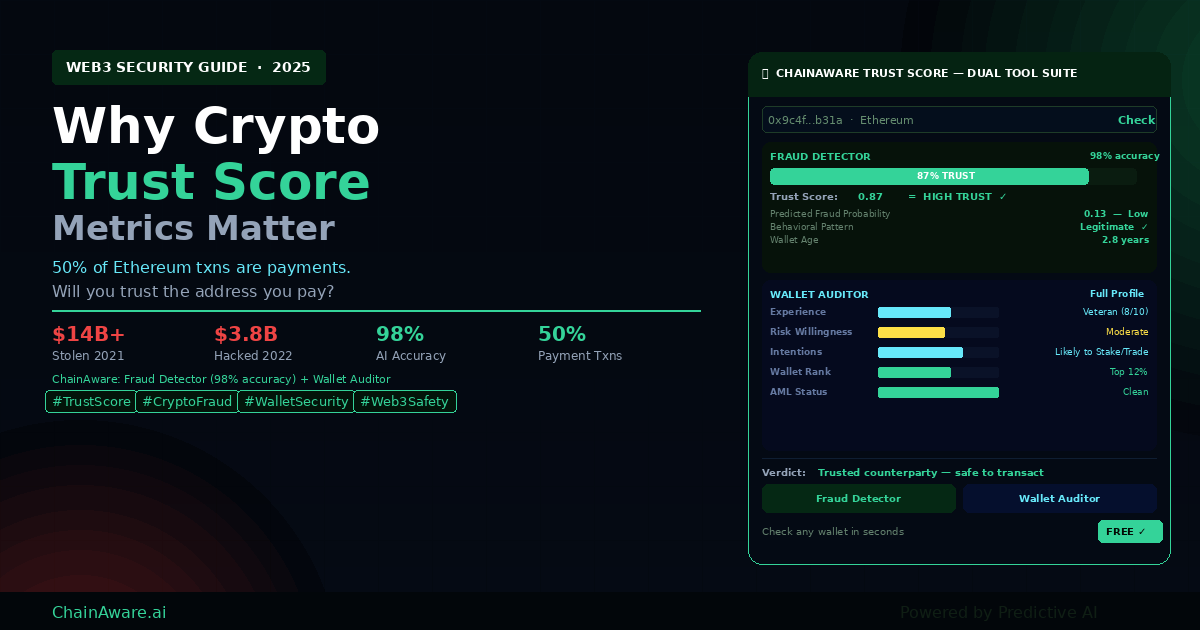
Crypto fraud is not a niche problem. In 2021, Chainalysis estimated that over $14 billion in cryptocurrency was stolen through scams, hacks, and fraud. In 2022, despite a bear market, hackers stole $3.8 billion — the highest annual total ever recorded. Behind every one of these statistics is an address someone trusted when they shouldn’t have.
The crypto security industry has responded vigorously — with smart contract audits, formal verification, bug bounties, and on-chain monitoring. These efforts are valuable and necessary. But they address only half the problem. Because while everyone is focused on smart contract security, there is an entire other category of crypto interaction that receives almost no security attention: payments.
According to Artemis Analytics research on Ethereum transaction composition, approximately 50% of all Ethereum transactions are stablecoin payment transfers — direct value transfers between addresses, not interactions with smart contracts. Half of everything that happens on Ethereum is one address sending money to another address. And for almost all of these transfers, the sender has no reliable way to verify whether the receiving address is trustworthy.
This is exactly the problem that Crypto Trust Score metrics solve. This guide explains why Trust Scores are essential, what scenarios make them critical, and how ChainAware’s Fraud Detector and Wallet Auditor provide the most comprehensive Trust Score intelligence available in Web3.
The Scale of Crypto Fraud: Why It’s Worse Than You Think
The headline numbers are significant, but they understate the true scale of the problem. The $14B stolen in 2021 and $3.8B hacked in 2022 represent only the reported, measurable fraud — the large-scale hacks and scams that make it into the annual reports. The long tail of smaller frauds — Telegram scams, P2P fraud, fake service providers, airdrop farming operations, wash trading rings, and coordinated exit scams — is much harder to quantify and almost certainly represents additional billions in annual losses.
What makes crypto fraud structurally different from traditional financial fraud is the irreversibility. When a bank transfer is fraudulent, there are chargeback mechanisms, regulatory intervention options, and institutional dispute resolution processes. When crypto is sent to the wrong address — or the right address turned out to be a fraud operation — it is gone. The blockchain does not have an undo button. This irreversibility makes pre-transaction due diligence not just valuable but essential.
The fraud landscape is also becoming more sophisticated, not less. As documented in our guide to predictive crypto fraud detection, modern fraud operations invest heavily in making their addresses appear legitimate — building transaction histories, establishing protocol interactions, and creating the on-chain appearance of genuine users. Surface-level screening cannot distinguish these sophisticated fraud addresses from legitimate ones. Only deep behavioral pattern analysis can.
According to Immunefi’s annual Web3 security report, fraud and exit scams (as distinct from technical exploits) account for a significant and growing share of total crypto losses — and these are precisely the category that smart contract audits cannot prevent, because they involve no contract vulnerability. They are human behavioral fraud, and only behavioral analysis can detect them.
98% AI Accuracy — Free — Real-Time
Check Any Wallet’s Trust Score Before You Transact
The ChainAware Fraud Detector predicts fraud probability from on-chain behavioral patterns — not just fund history. High Trust Score = safe to transact. Takes seconds. Free. Covers 8 networks.
The Payment Security Gap: The Other 50% Nobody Protects
The crypto security industry has built impressive infrastructure for one category of risk: smart contract exploits. Audit firms, formal verification tools, bug bounty platforms, real-time protocol monitoring — all of these exist to protect the 50% of Ethereum transactions that involve smart contract interactions.
The other 50% — direct payment transfers between addresses — has almost no dedicated security infrastructure. When you send stablecoins to an address, there is no audit firm that verified the recipient. There is no bug bounty that would have caught a malicious actor. There is no protocol monitoring that flags suspicious counterparty behavior. You are, in most cases, flying completely blind.
This gap is not theoretical. It is exploited every day across every major blockchain. The scenarios range from individual Telegram scams to coordinated payment fraud operations that specifically target DeFi teams, NFT projects, and crypto businesses — entities that routinely make large payment transfers and have learned to be sophisticated about smart contract risk but remain naive about payment counterparty risk.
Consider the data: Artemis Analytics documents that stablecoin transfers represent roughly half of all Ethereum transaction volume — hundreds of millions of dollars in payments flowing between addresses every single day, almost none of which benefits from any counterparty verification. The payment layer of crypto is the largest unprotected attack surface in the ecosystem.
Trust Score metrics close this gap. By providing a behavioral risk assessment of any address before you send funds to it, they bring the same level of due diligence to payment transfers that smart contract audits bring to protocol interactions.
Real-World Scenarios: When Trust Score Would Have Saved You
Trust Scores are not abstract security metrics — they address specific, common situations that Web3 participants face every day. Here are the scenarios where checking a Trust Score before acting is the difference between safe and sorry.
Scenario 1: The Telegram Service Provider
You’re in a Telegram group and someone DMs you. They offer a service — smart contract development, marketing, design, advisory. The pitch is professional, the portfolio looks legitimate, the price seems fair. They ask for an advance payment in USDC to an Ethereum address.
Before you send: run their address through the Fraud Detector. A legitimate service provider who has been operating in Web3 for years will have a rich on-chain history — multiple protocol interactions, established wallet age, behavioral patterns consistent with a genuine professional. A fraud operator running a fake service will typically have a new address, minimal history, or behavioral patterns flagged by the predictive model. The check takes 10 seconds and can save you thousands of dollars.
Scenario 2: The Airdrop Farming Operation
You’re running an airdrop for your new protocol. Thousands of wallets have submitted addresses. Some of them will be genuine users who will become long-term protocol participants. Many of them — potentially the majority — are auto-generated airdrop farming wallets: created specifically to claim the airdrop, with no intention of ever using your protocol.
Running the submitted addresses through the Wallet Auditor reveals which wallets have the behavioral profile of genuine DeFi users (high experience, established protocol history, meaningful Wallet Rank) and which are freshly created farming wallets with no history. You can tier your airdrop rewards to favor genuine users — maximizing the impact of your token distribution and building a real user base rather than farming bots.
Scenario 3: The P2P Crypto Trade
You’re selling ETH peer-to-peer — outside of a centralized exchange — to an address someone provided in a trading group. P2P trades happen constantly in crypto: OTC deals, cross-border transfers, community trades. The counterparty looks legitimate but you’ve never interacted with them before.
A Trust Score check gives you a behavioral risk profile of the buyer’s address: their wallet age, AML status, protocol history, and predicted fraud probability. A high-Trust Score address with years of legitimate on-chain activity is a very different counterparty from a new address with no history. The check takes seconds; the P2P transfer is irreversible.
Scenario 4: The NFT Seller
You want to buy a high-value NFT directly from a seller — outside of a major marketplace’s escrow system. The NFT is genuine, but what do you know about the seller’s wallet? A Wallet Auditor check reveals the seller’s full behavioral profile: how long they’ve been active in NFT markets, their risk willingness, their protocol interaction history, and their Wallet Rank. A long-established wallet with consistent NFT trading history is a very different seller from a wallet that appeared two weeks ago and has interacted with nothing except this specific NFT.
Scenario 5: The KOL Partnership
You’re considering a paid KOL partnership. The influencer claims to be a serious DeFi participant with genuine skin in the game. Before signing the deal, run their wallet address through the Wallet Auditor. Their on-chain history either confirms their claimed DeFi experience or reveals a wallet with minimal protocol interactions that contradicts their positioning. As explored in our analysis of why influencer marketing isn’t working in Web3, KOL due diligence is essential — and on-chain verification is the only kind that can’t be faked.
Scenario 6: The Business Partnership
You’re entering a joint venture with another Web3 project. Before transferring any funds or tokens to your new partner’s treasury address, run it through the Fraud Detector and Wallet Auditor. A legitimate project’s treasury wallet will have a behavioral profile consistent with operational protocol interactions, established history, and clean AML status. Any anomalies in this profile are worth investigating before the partnership is formalized and funds are transferred.
Scenario 7: The Yield Farm or New Pool
You want to provide liquidity to a new pool on a DEX. Before committing capital, you can check not just the pool contract (via the Rug Pull Detector) but the addresses of the major liquidity providers currently in the pool. If the existing LPs are high-Trust Score wallets with established DeFi histories, that is a positive signal about the pool’s legitimacy. If they are new addresses with low Trust Scores, the liquidity may be positioned for a rapid exit.
Full Behavioral Intelligence — Free
Wallet Auditor: See the Full Picture Behind Any Address
Beyond the Trust Score — see a wallet’s experience level, risk willingness, predicted intentions, AML status, and Wallet Rank. The complete behavioral profile for any wallet on 8 networks. Perfect for KOL vetting, airdrop screening, and partnership due diligence.
What Is a Crypto Trust Score?
A Crypto Trust Score is a quantified measure of how trustworthy a wallet address is likely to be as a counterparty — based not on who claims to own it, but on what it has actually done on-chain.
Unlike identity-based trust systems in traditional finance (which rely on KYC documents, credit history, and institutional verification), a blockchain Trust Score is derived entirely from on-chain behavioral data. Every transaction an address has ever made, every protocol it has interacted with, every counterparty it has transacted with — all of this is public, immutable, and analyzable.
In ChainAware’s system, the Trust Score is defined as 1 minus the Fraud Score: a wallet with a Fraud Score of 0.13 (13% probability of committing fraud) has a Trust Score of 0.87 (87% trustworthy). This inversion makes the score intuitive: higher is safer. A Trust Score above 0.70 is generally considered trustworthy; below 0.30 is a strong red flag; the range in between warrants investigation.
The Trust Score is a predictive metric, not a forensic one. It does not simply check whether a wallet has been previously flagged for fraud — it analyzes behavioral patterns to predict whether the wallet is likely to engage in fraudulent activity in the future. This predictive capability, built on ChainAware’s AI model trained on confirmed fraud and legitimate address datasets, achieves 98% prediction accuracy — the highest in the industry.
ChainAware Fraud Detector: Predictive Fraud Probability
The ChainAware Fraud Detector is the fastest and most direct way to get a Trust Score for any wallet address. Enter an address, select the network, and receive an immediate fraud probability score alongside the corresponding Trust Score.
The Fraud Detector works by analyzing the behavioral interaction patterns of an address against ChainAware’s predictive AI model — trained on millions of confirmed fraudulent and confirmed legitimate addresses across 8 blockchains. The model identifies the specific behavioral signatures that distinguish fraud operators from legitimate users, including: wallet preparation sequences, timing patterns, counterparty relationship networks, protocol interaction histories, and fund flow characteristics.
Critically, the Fraud Detector predicts future fraud risk from current behavioral patterns — not from whether the wallet has already been caught. This distinction matters enormously in practice: a fraud operator who has never been detected will pass any forensic check but will still exhibit behavioral patterns characteristic of fraud preparation. The predictive model catches these patterns; forensic databases do not.
The Fraud Detector supports ETH, BNB Chain, Base, Polygon, Haqq, Solana, TON, and Tron. It draws on ChainAware’s Predictive Data Layer of 14M+ pre-calculated wallet profiles, meaning most addresses return results instantly. For a complete technical guide to the Fraud Detector, see our Fraud Detector complete guide.
When to use the Fraud Detector: before any payment transfer to an unfamiliar address; before entering a P2P trade; before paying a service provider; before accepting a counterparty in any financial transaction where you cannot easily verify identity through other means.
ChainAware Wallet Auditor: Full Behavioral Profile
Where the Fraud Detector gives you a single focused signal (Trust Score + fraud probability), the Wallet Auditor provides the complete behavioral intelligence picture for any wallet address. It reveals five dimensions of wallet character that are essential for deeper due diligence.
Experience Level. How long has this wallet been active? How many protocols has it interacted with? How sophisticated are its transactions? The Experience score distinguishes DeFi veterans (who have navigated complex multi-protocol strategies over years) from newcomers (who may have limited history and understanding) from auto-generated wallets (which have no genuine experience at all). An airdrop farming wallet, a bot, or a freshly-created fraud address will all score very low on experience — even if they have a few transactions.
Risk Willingness. Based on the wallet’s historical protocol interactions, what is its demonstrated risk tolerance? Does it favor conservative stablecoin strategies, or does it regularly interact with high-leverage and high-risk protocols? Risk Willingness is not a safety signal on its own — it describes a behavioral characteristic. But combined with other dimensions, it helps paint an accurate picture of who this wallet actually is. For partnership due diligence, a counterparty with very high Risk Willingness may be appropriate in some contexts and a concern in others.
Predicted Intentions. Based on historical behavioral patterns, what is this wallet most likely to do next? Intentions include probability scores for trading, staking, borrowing, bridging, and other protocol interactions. This dimension is particularly valuable for Dapp teams assessing new users — see the Web3 Behavioral Analytics guide for how intentions power personalized user experiences.
Wallet Rank. A composite score consolidating all behavioral dimensions into a single quality ranking. Wallet Rank reflects the overall quality of a wallet as a Web3 participant — incorporating experience, trust, activity, protocol diversity, and balance history. For a complete explanation of how Wallet Rank is calculated and what makes it go up or down, see the Wallet Rank complete guide.
AML Status. A flag indicating whether the wallet’s fund history shows any connection to sanctioned entities, darknet activity, or other AML-flagged sources. The AML check is the backward-looking complement to the Fraud Detector’s forward-looking prediction — together they cover both where the money came from and what the wallet is likely to do next.
When to use the Wallet Auditor: for deeper due diligence on business partners, KOLs, large payment counterparties, or airdrop recipients. Any situation where you need more than a single fraud probability score — where understanding who this wallet actually is matters as much as whether it’s safe.
Don’t Send Funds Blind
Quick Trust Check: Fraud Detector in 10 Seconds
Enter any wallet address. Get an instant Trust Score and fraud probability. 98% AI accuracy. Covers Ethereum, BNB Chain, Base, Polygon, Solana, TON, Tron, and Haqq. Completely free.
How Trust Score Differs from AML Checks
Many Web3 users assume that AML screening and Trust Score analysis are the same thing. They are not — they answer different questions and catch different types of risk.
An AML check asks: where did these funds come from? It traces the transaction history of a wallet to identify whether any funds in its history passed through sanctioned entities, darknet markets, or other criminal sources. AML is a backward-looking analysis — it tells you about the past provenance of funds.
A Trust Score asks: what will this wallet do in the future? It analyzes behavioral patterns to predict fraud risk — regardless of where the funds came from. This distinction is critical: as documented in our transaction monitoring guide, fraud is frequently committed with clean funds. A sophisticated fraud operator who has carefully funded their wallet through legitimate channels will pass any AML check — their funds are genuinely clean. The Trust Score catches the behavioral patterns that the AML check cannot see.
The two approaches are complements, not alternatives. The Wallet Auditor includes AML status alongside the Trust Score and behavioral profile precisely because both dimensions are necessary for complete due diligence: clean funds (AML) and legitimate behavior (Trust Score) together give you the most complete picture of a counterparty’s trustworthiness.
Who Needs Crypto Trust Scores?
Individual traders and investors. Anyone making P2P trades, paying service providers, or transferring significant value to unfamiliar addresses should run a Trust Score check before transacting. The check is free, takes seconds, and covers the most common vector for individual crypto fraud — payment to a fraudulent counterparty.
DeFi protocol teams. Teams assessing LP behavior, evaluating governance participants, or conducting due diligence on new strategic partners benefit from Wallet Auditor profiles on key addresses. The ChainAware complete product guide covers how the full tool suite integrates into protocol security workflows.
NFT projects and marketplaces. High-value NFT transactions between previously unacquainted parties are a frequent fraud vector. Trust Score checks on sellers and buyers in non-escrow transactions provide essential counterparty verification.
Crypto businesses and service providers. Any business receiving payment in crypto — freelancers, agencies, infrastructure providers, exchanges — should verify the Trust Score of new paying clients before delivering services. The irreversibility of crypto payments makes pre-payment verification essential.
Dapp teams running airdrops or campaigns. Airdrop distributions are systematically exploited by farming operations. Running submitted airdrop addresses through the Wallet Auditor screens for genuine users versus auto-generated farming wallets — protecting token distribution from being captured by bots rather than building a real user base.
Investors evaluating token projects. The Token Rank aggregates the Wallet Ranks of all token holders — giving investors a signal about whether a token’s holder base consists of genuine Web3 participants or low-quality farming and bot wallets. A token whose holders have high average Wallet Ranks is a fundamentally different investment from one dominated by low-quality addresses.
Trust Score in the ChainAware Ecosystem
The Trust Score (Fraud Detector + Wallet Auditor) is the foundational layer of ChainAware’s broader security and intelligence platform. Every other tool in the ecosystem builds on it:
The Rug Pull Detector applies Trust Scores to contract creators and liquidity providers to predict rug pull risk in DeFi pools. A pool where the creator and LPs have high Trust Scores is fundamentally safer than one where they don’t.
The Transaction Monitoring Agent runs Trust Score analysis on every wallet that connects to a Dapp — and re-runs it 24×7 to catch Trust Score changes that indicate emerging fraud risk.
The Prediction MCP makes Trust Scores and full behavioral profiles available programmatically to AI agents and Dapp backends — enabling real-time personalization and security decisions at the code level.
Together, these tools provide a complete Trust Score infrastructure for Web3: from individual address checks (Fraud Detector, Wallet Auditor) to protocol-level contract screening (Rug Pull Detector) to continuous platform monitoring (Transaction Monitoring) to developer API access (Prediction MCP).
ChainAware.ai — Complete Trust Score Intelligence
Know Who You’re Dealing With. Before You Transact.
Fraud Detector for instant Trust Score and fraud probability. Wallet Auditor for the full behavioral profile. Both free. Both real-time. Both covering 8 networks. No excuse to transact blind.
Frequently Asked Questions
What exactly is a Crypto Trust Score?
A Crypto Trust Score is a quantified measure of how trustworthy a wallet address is likely to be as a counterparty, based on AI analysis of its on-chain behavioral history. In ChainAware’s system, Trust Score = 1 minus Fraud Score. A score of 0.87 means 87% trustworthy — the wallet’s behavioral patterns are consistent with a legitimate participant. Higher is safer; below 0.30 is a strong warning signal.
Why does the payment layer need Trust Scores if smart contracts are already audited?
Smart contract audits protect the 50% of Ethereum transactions that involve protocol interactions. The other 50% — direct stablecoin payment transfers between addresses — is not protected by any audit. No one verifies the trustworthiness of the address you’re paying. Trust Score metrics fill this gap, providing the same level of counterparty due diligence for payments that audits provide for protocol interactions.
How accurate is the ChainAware Fraud Detector?
The ChainAware Fraud Detector achieves 98% prediction accuracy — based on behavioral analysis of confirmed fraud and confirmed legitimate address datasets across 8 blockchains. It predicts future fraud risk from behavioral patterns, not just whether an address has been previously flagged. This makes it effective against sophisticated fraud operators who have not yet been caught by forensic tools.
What does the Wallet Auditor show that the Fraud Detector doesn’t?
The Fraud Detector gives you a single focused signal: Trust Score and fraud probability. The Wallet Auditor provides the full behavioral profile: Experience Level, Risk Willingness, Predicted Intentions, Wallet Rank, and AML Status — alongside the Trust Score. Use the Fraud Detector for quick pre-payment checks; use the Wallet Auditor for deeper due diligence on business partners, KOLs, airdrop recipients, and high-value counterparties.
Is checking a Trust Score legal? Does it violate privacy?
Yes, completely legal. Blockchain transactions are public by design — every address’s transaction history is permanently and publicly recorded on-chain. Analyzing this public data to assess counterparty risk is standard security practice, no different from checking a company’s public financial filings before a business transaction. No private data is accessed or stored beyond what is publicly available on-chain.
Which blockchains does ChainAware support?
Both the Fraud Detector and Wallet Auditor support: Ethereum, BNB Chain, Base, Polygon, Haqq, Solana, TON, and Tron — covering the majority of active DeFi and payment activity in Web3.
Is there a cost to check a Trust Score?
Both the Fraud Detector and Wallet Auditor are free to use. Connect your wallet for access and run as many checks as you need. No subscription, no credits, no fee per lookup.