
No regulator has yet required an AI agent to be registered or scored before it may transact — but three separate regulatory tracks are converging on exactly that requirement, and the gap is narrowing faster than most compliance teams expect.
This article maps the current state of each track, identifies where the grey areas sit today, and offers a realistic timeline for when formal Know Your Agent mandates are likely to land.
Until those mandates arrive, businesses running agent-driven checkout flows may find that For a concrete starting point, the agents_trust_score_single tool returns a full trust profile for an individual ERC-8004 AI agent, including a 0-1000 score and trust flags. a trust score is the first practical step in agentic commerce, well before full integration begins.
It is written for compliance leads, legal teams, protocol founders and acquirers who need to plan ahead rather than react after the fact.For acquirers and investors sizing the opportunity behind these requirements, our analysis of the agent trust economy market sizing through 2030 sets out the likely demand curve.
The Three Regulatory Tracks Closing In
The regulatory pressure on agent trust does not come from a single source. It comes from three bodies of law that were each drafted with a different target in mind. Individually, each leaves agents in a grey area. Together, they are building a wall that agents will eventually have to pass through.
Whoever accumulates the behavioural history needed to pass that wall first will hold a lasting advantage Compliance teams screening large counterparty lists can run the same checks at volume using the predictive_fraud_batch tool for scoring multiple wallet addresses in one call., a dynamic explored in why first-mover advantage in agent trust data compounds over time.
ChainAware.ai is named in the CB Insights AI Fraud Prevention Market Map, the only Web3 AI token recognised alongside Chainalysis, Elliptic, and TRM Labs.Track One: MiCA Article 68 and Counterparty Wallet Screening
MiCA — the Markets in Crypto-Assets Regulation — became fully applicable across EU member states in January 2026. Article 68 places a clear obligation on Crypto-Asset Service Providers, or CASPs, to screen counterparty wallets before executing transfers. The intent is anti-money-laundering hygiene: know who is on the other side of a transaction before the transaction settles.
The problem is that agents hold wallets. Screening those agent-held addresses before settlement is what the predictive_fraud tool performs with real-time AI fraud probability and AML forensics for any wallet. An AI agent operating in the agentic economy may control a self-custodied address, receive funds into it, and initiate transfers to CASP-operated platforms. Under a strict reading of Article 68, a CASP receiving a transfer from that address must screen it. But the screening frameworks that CASPs have deployed — largely built for human counterparties — do not distinguish between a wallet held by a person and a wallet held by a software agent acting on a person’s behalf.
The gap is documented. The European Banking Authority has acknowledged in its MiCA implementation guidance that the question of non-human actors holding addresses is unresolved.
Early on-chain data already shows why regulators are wary: a review of agent fraud patterns across the ERC-8004 threat landscape reveals recurring behaviours that human-oriented screening was never designed to catch.
CASPs are therefore left to decide, on their own, whether their existing counterparty-screening procedures are adequate for agent wallets. Most have concluded they probably are not and are waiTeams evaluating how to close that gap are also reassessing their tooling, and our guide to Chainalysis alternatives for DeFi compliance teams in 2026 compares the options available today.
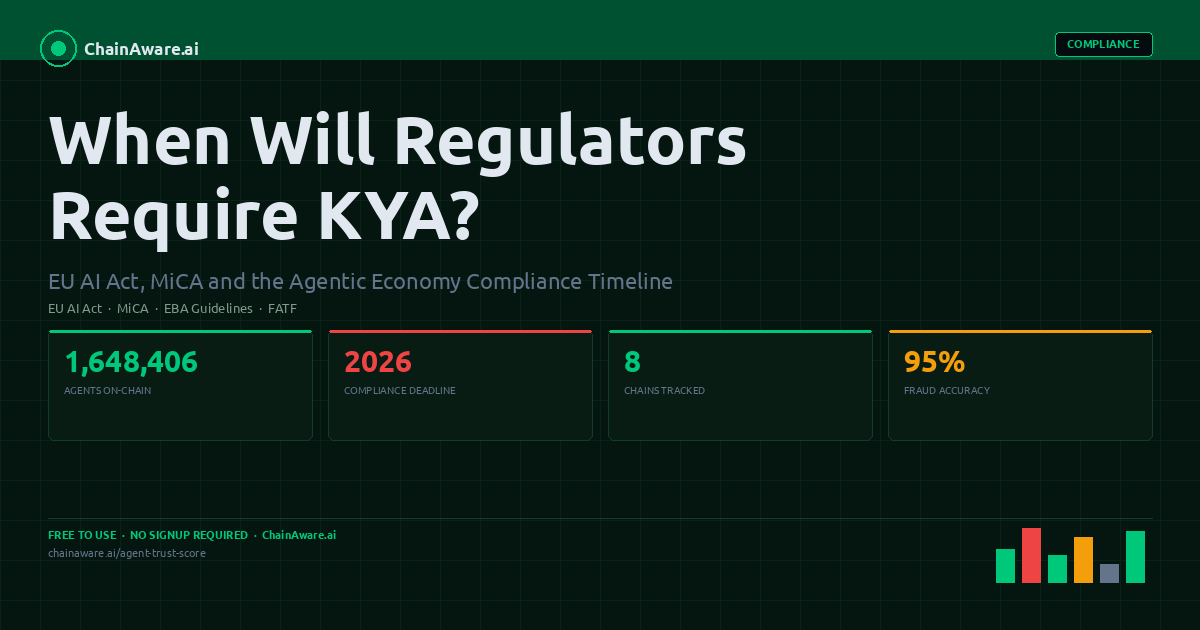
ting for clarification. The clarification has not arrived.For teams building on the agentic economy, this is not an abstract future risk. There are already 1,648,406 ERC-8004 agents indexed on-chain — a figure that grew by 892,924 registrations in a single week (W43, October 2026) as centralcity.ai alone onboarded over a million agents. Of those indexed, 930 carry funding chains that trace back to confirmed rug pull operators — a category that creates enforcement exposure today, before any formal agent-specific rule exists. Our MiCA compliance guide covers what CASPs should be doing in the interim.
Track Two: EU AI Act Article 50 and the Identity Foothold
The EU AI Act took a different approach. Rather than regulating what an agent may do financially, Article 50 regulates what an agent must say about itself. AI systems that interact with humans must disclose that they are AI. The obligation applies to systems that could reasonably be mistaken for a human interlocutor.
This sounds modest, and in isolation it is. But Article 50 establishes the first legal foothold for agent identity as a regulatory concept. Once the law says an agent must identify itself as an agent, the next logical question — who is this agent, who operates it and what has it done before — becomes much easier to legislate.
Disclosure obligations historically precede registration obligations. KYC did not appear fully formed; it began with disclosure rules, then moved to verification requirements, then to ongoing monitoring. The EU AI Act is following the same arc, and Article 50 is the disclosure stage. Teams that treat it as a checkbox are likely underestimating what comes after it.
Track Three: FATF Travel Rule and the Agent Originator Problem
The FATF Travel Rule requires that originator and beneficiary information travel alongside virtual asset transfers above the equivalent of USD 1,000. The rule was designed to ensure that financial institutions on both sides of a transfer can identify the humans involved. It has been adopted, in some form, by most FATF member jurisdictions.
Agents transacting above the threshold create a problem the Travel Rule was not written to handle. If an AI agent initiates a transfer, is the agent the originator, or is the human operator? If the agent is acting autonomously — placing a trade, paying a service, moving liquidity — the operator may not have been directly involved in the specific transaction that crossed the threshold. The question of who is the originator, and what information must travel with the transfer, is a grey area under active FATF review in 2026.
FATF’s 2026 virtual assets work programme includes a specific workstream on non-human actors. The output is expected to be guidance rather than a binding standard, but FATF guidance has historically been adopted into national law within two to three years of publication. The same dynamic applies to the four-party card model, where the question of who bears liability when an agent initiates a disputed transaction remains equally unresolved.
The Gap That Still Exists
It is important to be precise about where the law currently stands. No jurisdiction today mandates that an AI agent be registered before it may transact. No regulator today requires an agent to carry a trust score or a behavioral record as a condition of access. The obligations that exist — MiCA Article 68, EU AI Act Article 50, the Travel Rule — apply to the platforms and operators that interact with agents, not to agents as legal subjects in their own right.
That distinction matters for two reasons. First, it means that the enforcement risk today falls on platforms — CASPs, payment processors, DeFi protocols — that fail to screen the agent wallets they interact with, rather than on the agents or their operators directly. Second, it means that the first generation of KYA mandates, when they arrive, will almost certainly be framed as platform obligations: you must screen agents before you serve them, just as you must screen customers before you serve them.
The autonomous compliance posture — building screening into the platform layer now — is therefore both a risk management decision and a regulatory anticipation strategy.
The Timeline
Regulatory timelines are inherently uncertain, and anyone who offers a precise date for a mandate that has not yet been proposed is guessing. What follows is a scenario based on the pace of FATF guidance adoption, the EU’s legislative cycle and the trajectory of AI Act implementation. It should be treated as a planning horizon, not a forecast.
2026: FATF Clarification on Non-Human Originators
The most likely near-term development is FATF guidance addressing how the Travel Rule applies when an agent initiates a transfer. This guidance will not create a KYA mandate directly, but it will force national regulators and Virtual Asset Service Providers to decide how they classify agent-initiated transactions. Jurisdictions with proactive regulators — Singapore, the UK, Switzerland — are likely to publish their own interpretive notes within months of the FATF output.
2027: First National KYA Pilots
Several jurisdictions are already running regulatory sandbox programmes that include AI agent use cases. By 2027, it is reasonable to expect at least one jurisdiction — most likely within the EU or the UK — to pilot a formal agent registration requirement within a defined scope, such as agents holding wallets above a certain value or agents operating within licensed DeFi venues. These pilots will generate the evidence base that informs the broader mandate.
2028: EU Mandate, Likely
The EU’s legislative machinery operates on roughly a two-year cycle from proposal to adoption. If the European Commission tables a KYA amendment to MiCA or a standalone agent-identity regulation in late 2026 or early 2027 — which is plausible given the pace of AI Act implementation — a mandate could be in force by 2028 or 2029. The mandate is more likely to arrive as an amendment to an existing instrument than as a new standalone regulation, because the political lift is lower and the enforcement infrastructure already exists.
Teams building on a three-year horizon should assume the mandate exists and work backwards from there.
Why Agentic Commerce Is Accelerating the Regulatory Clock
Regulatory timelines rarely compress on their own. They compress when supervised institutions begin filing incident reports, when transaction monitoring systems flag anomalies at scale, and when compliance officers can no longer answer the question “who authorised this?” with a human name. All three conditions are now being met. Agentic commerce — autonomous agents executing payments, swapping assets across DeFi protocols, and purchasing API capacity without human sign-off at the transaction level — has moved from whitepaper concept to measurable on-chain activity. That shift is doing more to accelerate ai agent regulation than any lobbying effort or academic submission could.
The Accountability Gap That Existing Frameworks Cannot Bridge
Every major ai agent regulation framework currently in force or in advanced legislative draft — including the EU AI Act’s provisions on high-risk system operators and MiCA’s CASP obligations — rests on a foundational assumption: a legal person is ultimately accountable for each consequential decision. That assumption held when AI systems were tools that humans operated. It begins to fail when agents initiate transaction chains that spawn sub-agents, route funds across multiple protocols, and settle positions before any human reviewer has seen a notification. The accountability is not absent; it is distributed across deployers, orchestrators, model providers and wallet custodians in proportions that no existing liability framework cleanly resolves. This is the trust layer gap. It is not theoretical. Supervisors at financial regulators in the EU and UK have already noted in published risk assessments that existing outsourcing and third-party risk rules were not designed to capture multi-hop autonomous execution chains. Closing that gap requires a mechanism that travels with the agent, not one that sits in a contract between two legal entities.
Why Regulators Will Borrow From the Infrastructure Already Being Built
Regulators rarely design technical standards from first principles. Basel III’s liquidity coverage ratios drew heavily on bank treasury risk models that large institutions had already operationalised. PSD2’s strong customer authentication specifications reflected security architectures that payment processors had been building for years. The pattern repeats because regulators need standards that supervised entities can implement without a decade of infrastructure buildout. The agent trust infrastructure emerging now — ERC-8004 as a candidate on-chain identity and capability attestation standard, behavioral scoring models that distinguish legitimate orchestration patterns from adversarial prompt-injection chains, and fleet detection methodologies that identify when a single operator is running coordinated agent populations — represents exactly the kind of pre-existing technical vocabulary that regulatory technical standards drafters look for. When the European Banking Authority or ESMA convenes a working group to specify what “agent identity verification” means in operational terms, the drafters will consult the implementations that already exist on production networks. Building that infrastructure now is not merely a product decision; it is, in effect, participating in the standard-setting process before the formal consultation opens.
Trust Scoring as the Proportionate Mechanism
Among the candidate mechanisms for agent oversight — hard registration requirements, real-time human-in-the-loop mandates, blanket transaction limits — trust scoring has properties that make it the most likely regulatory prescription. It is auditable: a score is derived from observable behavioral signals and can be reconstructed and challenged. It is proportionate: a low-risk agent executing small, repetitive, well-scoped tasks need not carry the same compliance burden as an agent with broad financial permissions operating across multiple jurisdictions. And it is already in operational use, which means regulators can benchmark proposed thresholds against real distributions rather than modelling them hypothetically. The proportionality argument matters particularly under the EU AI Act’s risk-tiering logic and under MiCA’s principle that obligations should scale with the nature and scale of the activity. A trust scoring regime applied to agents maps cleanly onto both frameworks without requiring primary legislation to be reopened. That is a significant practical advantage in a regulatory environment where legislative calendars are already overloaded.
The direction of travel is clear enough that waiting for final regulatory text before investing in agent trust infrastructure is no longer a defensible compliance posture. The transaction volumes are real, the accountability questions are live, and the technical standards drafters are paying attention to what the market is building. Platforms and protocols that establish credible, auditable trust scoring for their agent populations today are not getting ahead of regulation — they are building the trust layer for agentic economy that regulation will eventually mandate and, in all likelihood, will recognise by name. For compliance teams ready to act now, the enterprise KYA compliance stack guide covers how to evaluate vendors, where KYA plugs into existing compliance infrastructure, and why building in-house is not viable.
What to Do Before the Mandate Arrives
The enforcement risk today is real even without a formal KYA mandate. CASPs that interact with agent wallets connected to sanctioned addresses or confirmed fraud operators face liability under existing AML law. The 930 ERC-8004 agents with rug-pull funding chains are not a future problem — they are a current one for any platform that has processed their transactions without adequate screening.
Three actions are available now. The first is to register agent fleets on ERC-8004, establishing a verifiable identity anchor that any future mandate is likely to require. The second is to run Agent Trust Score assessments on your fleet and on agent counterparties your platform interacts with, so that you have a documented behavioral record before regulators ask for one. The third is to build your KYA posture into your compliance documentation — not as a checkbox, but as a reasoned explanation of how you assess agent risk and what limits you apply based on that assessment.
Regulators reviewing your programme after a mandate exists will ask what you were doing before it. The answer “we were waiting” is significantly worse than the answer “we implemented a systematic screening process and here is the record.”
TRANSACTION MONITORING
Screen agents before the mandate requires it.
ChainAware’s transaction monitoring layer assesses agent wallets, funding chains and behavioral signals in real time — building the documented KYA posture that regulators will ask for when the mandate arrives.
Explore Transaction Monitoring →KYA Compliance
Don’t wait for the mandate — build agent trust verification now