
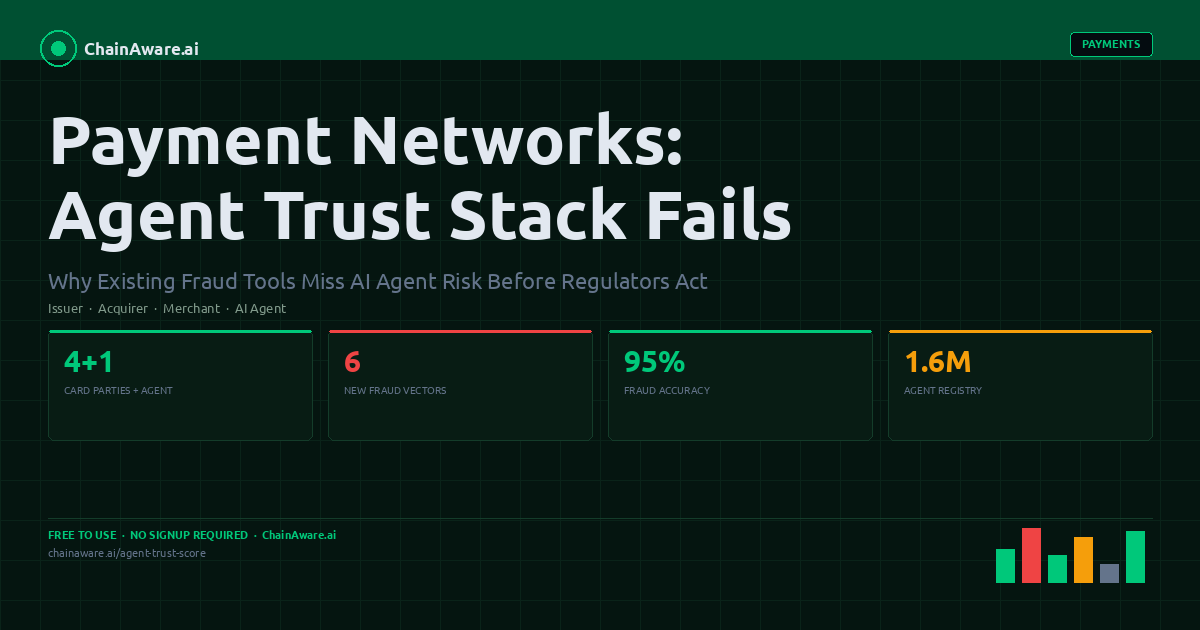
Visa processed $14.8 trillion in payments in 2024 using a fraud stack built on a single assumption: a human being is on the other side of every transaction. Who bears the loss in agentic commerce fraud is a question the four-party card model was never designed to answer. Gartner now estimates that 15 percent of enterprise transactions will be agent-initiated by 2027. That assumption is about to break, and the networks that catch it early will define the next decade of payment infrastructure.
AI agents are not a future concern. They are transacting today How AI agents are already replacing human growth teams shows just how quickly this shift is moving across web3. — booking travel, purchasing API credits, settling invoices, funding wallets and triggering recurring orders. Each of those acts flows through the same authorization rails that were designed for cardholders with fingers, faces and browsing habits. None of those signals exist when the buyer is software.
This article is written for payment network product and risk teams, acquirers and infrastructure architects who need to understand what breaks, why it breaks and what a practical fix looks like before agentic volume reaches the scale that makes retrofitting expensive.
The Human-First Assumption Runs Deep
Modern fraud stacks are layered and sophisticated, but they share a founding premise: fraud detection means finding the moments when a transaction deviates from normal human behavior. Every major signal category reflects that premise.
Velocity rules flag when a card transacts more frequently than a person plausibly would. For wallet-level risk, a real-time check such as predictive_fraud for real-time wallet fraud probability scores an address on its on-chain behaviour rather than on human-shaped signals. Device fingerprinting links transactions to a physical device that a person carries. Behavioral biometrics — keystroke cadence, mouse movement, touch pressure — measure the physical micro-patterns of a human body interacting with a screen. Even address verification and 3DS challenge flows assume a person is available to respond. When the counterparty is itself an autonomous program, agents_trust_score_single for an ERC-8004 agent trust profile provides a 0-1000 score and trust flags for that specific agent.
These tools work well for the population they were designed for. The problem is not that they are poorly built. The problem is that agents are a categorically different population, and importing them into a human-first framework produces systematic failure. Rather than inferring intent from keystrokes and touch pressure, predictive_behaviour for wallet behavioural profiling derives risk willingness and predicted intentions directly from a wallet’s transaction history.
Three Failure Modes When Agents Transact
Velocity Rules Flag Legitimate Agents
A procurement agent working on behalf of an enterprise might execute dozens of purchase orders in a single hour. A treasury management agent might rebalance across accounts at intervals no human trader would sustain. A supply chain agent might trigger hundreds of micro-payments to vendors across time zones without pausing.
Every one of those behaviors looks like card testing or account takeover under a velocity rule calibrated for humans. The agent is not behaving suspiciously. It is doing exactly what it was designed to do. But the fraud stack has no way to distinguish high-frequency legitimate agent activity from high-frequency fraudulent human activity, because it has no concept of “agent” at all.
The result is a painful tradeoff: either tolerate the false positives and block legitimate enterprise volume, or loosen velocity thresholds and open the door to genuine fraud. Neither option is acceptable at scale.
Device Fingerprinting Loses Signal on Shared Infrastructure
Device fingerprinting works because humans tend to use a small number of personal devices with consistent configurations. Anomalies — a new device, an unfamiliar browser, an unusual IP range — carry real signal about whether the person is who they claim to be.
Agents run on shared cloud infrastructure. A single agent fleet might operate across hundreds of containerized instances, rotating IPs, with no persistent device identity whatsoever. A fraudulent agent and a legitimate enterprise agent can be computationally indistinguishable at the device level. The fingerprint is the same because the infrastructure is the same.
Worse, bad actors who understand this can deliberately mimic the infrastructure signatures of legitimate deployments. Device fingerprinting does not just lose signal in the agent context — it can be actively gamed.
Behavioral Biometrics Has Nothing to Measure
This failure mode is the most fundamental. Behavioral biometrics depends on the involuntary physical signatures of a human body. There is no keystroke cadence when no keyboard is involved. There is no touch pressure when no finger touches a screen. There is no hesitation pattern, no correction behavior, no gaze fixation.
An agent initiating a transaction produces no biometric surface at all. Tools that score “humanness” return noise, or they return a score that is meaningless for the population being measured. This is not a calibration problem. It is a category error.
The Four-Party Model Has a Missing Party
The classical card network model has four parties: the cardholder, the merchant, the acquirer and the issuing bank, with the network sitting in the middle. Liability, dispute rights and fraud signals all flow through that structure.
Agentic commerce inserts a new party that the model has no field for. The actual transaction flow is: principal (the human who owns the account and has authorized the agent) → agent (the software executing the transaction) → merchant → acquirer/network. The agent is not the cardholder. It is acting on behalf of the cardholder, but it has its own identity, its own behavioral history and its own risk profile.
Our four-party card model analysis works through the liability implications in detail. The short version: when an agent transacts fraudulently, it is currently unclear whether the loss sits with the principal, the merchant or the acquirer, because no existing framework assigns rights and obligations to agents. That ambiguity is not theoretical. It will produce disputes, chargebacks and regulatory questions as agent volume grows.
The network that defines the agent’s place in the model — and builds the tooling to manage it — sets the standard everyone else follows.
What the Stack Actually Needs
The fix is not to patch the existing stack. It is to add an agent-specific trust layer built on Know Your Agent verification that runs in parallel with existing signals and feeds into authorization decisions. That layer has three components.
Agent Identity: ERC-8004
ERC-8004 is the emerging standard for on-chain agent identity. An ERC-8004 record ties an agent to a creator address, a registration timestamp, a declared capability set and a linked owner wallet. It gives the agent a persistent, verifiable identity that is independent of the infrastructure it runs on.
Identity alone is not sufficient — as we cover in our guide to verifying agents at checkout, registration in an open registry is cheap and tells you little about whether an agent is trustworthy. But identity is the necessary foundation. Without it, there is nothing to attach behavioral history to.
Funding Chain Check
An agent’s wallet does not appear from nowhere. It is funded by an address, which is funded by another address, and so on back through the chain. That chain carries signal. Our analysis of the ERC-8004 ecosystem identified 930 agents funded, directly or indirectly, by wallets associated with confirmed rug pull operators — plus a further 116,083 agents (7.04%) whose feeder addresses are classified as fraud by the behavioral model. 112,883 agents (6.85%) have owner wallets classified as fraud, and 95,288 agent payment wallets (5.78%) are themselves classified as fraud. The agents themselves had clean registration records. The risk was invisible until you followed the money.
A funding chain check at authorization surfaces that risk in real time. It does not require the agent to have done anything wrong yet. It applies the same logic that correspondent banking uses for human accounts — where funds come from matters, not just what the account holder claims about themselves.
Behavioral Trust Score
The Agent Trust Score runs from 0 to 1000 across five tiers: Sovereign (800–1000), Trusted (600–799), Provisional (400–599), Elevated Risk (200–399) and Untrusted (0–199). It aggregates the owner wallet history, the funding chain, the creator record and fleet detection signals into a single number that authorization systems can act on.
As of November 2026, 82.5% of ERC-8004 agents score Elevated Risk or Untrusted — 73.5% in the Elevated Risk tier alone, with the dominant signal being unknown feeder addresses (67.2% of all agents). A further 5.57% show farm detection signals (FARM_DETECTED), indicating single-operator fleet registration. Those are not marginal cases. They represent a substantial share of active agent volume, and they are currently flowing through authorization with no agent-specific signal applied. The security and fraud agent analysis covers what that exposure looks like in practice.
Integration Architecture: What It Looks Like in Production
The Agent Trust Score is designed to fit inside an existing authorization flow without adding meaningful latency. The call goes out at the authorization request stage, alongside existing fraud signals. The response comes back in under 50 milliseconds via Prediction MCP, which is built for low-latency inference at payment scale.
The response payload is compact: a score, a tier, a funding chain flag and a brief signal summary. Authorization logic can treat it like any other risk score — set thresholds, route to review queues, apply step-up challenges or decline based on tier. Networks that want to surface agent trust to acquirers and merchants can pass the score downstream in the transaction metadata without changing the core authorization flow.
The agent trust infrastructure race is already underway. Several infrastructure providers are building toward agent-aware authorization. The question for payment networks is not whether this layer gets built — it is whether they build it into their own stack or inherit it from someone else’s standard.
What the Trust Layer for the Agentic Economy Looks Like at Network Scale
Adding a risk score to an agent-initiated transaction is a point solution. Building the data standard that every issuer, merchant, and autonomous agent references when deciding whether to proceed — that is infrastructure. The distinction matters enormously for how payment networks should be thinking about their strategic position right now, before agentic commerce volumes make the architecture decision for them.
The Network-Level Opportunity: Becoming the Standard, Not Just the Processor
When Visa built out its fraud signal infrastructure in the 1990s and early 2000s, it was not simply offering a better decline rate. It was defining the vocabulary of payment risk — the data fields, the score ranges, the response codes — that the entire ecosystem eventually organized around. Issuers tuned their models to it. Merchants built their acceptance logic on top of it. That structural position is not easy to displace, because displacing it requires coordinating every participant simultaneously. A payment network that publishes a credible agent trust API today has an analogous opportunity. The network that defines what an agent identity record contains, what behavioral signals constitute a healthy agent transaction history, and how trust scores are communicated across authorization messages will not merely process agentic economy volume — it will own the reference layer every other participant depends on.
How Trust Scoring Works When You Operate at Network Scale
Individual issuers and merchants see agent transactions in relative isolation. A network sees them in aggregate. That positional advantage is what makes network-scale trust scoring qualitatively different from anything an individual institution can build unilaterally. With visibility across millions of agent-initiated transactions, a network can establish population-level behavioral baselines: what a typical procurement agent’s velocity curve looks like, what the normal dispersion of merchant categories is for a travel-booking agent, what deviation thresholds correlate with credential compromise versus legitimate policy changes. Scoring then becomes a function of distance from those baselines, weighted by agent type, delegating enterprise, and transaction context. No single issuer has the denominator to build that model. The network does, and that denominator compounds in value as agentic commerce scales.
Why AI Agent Payment Risk Has a Different Profile Than Human Payment Risk
Risk models trained predominantly on human cardholder behavior will systematically misread ai agent payment patterns, and the error modes cut in both directions. Agents transact at velocities and within time windows that would trigger fraud rules calibrated for human behavior — a software procurement agent executing fifty micro-purchases in four minutes is operating normally, not suspiciously. At the same time, compromised agent credentials can produce lateral spend across a much longer tail of merchants and geographies than a stolen consumer card typically would, because the agent has broader authorization scope by design. Layered on top of this is a tolerance asymmetry that does not exist in consumer payments: enterprise buyers operating agentic workflows have very low false-positive tolerance. A declined transaction does not inconvenience a human who can call the bank; it breaks an automated business process, potentially cascading across dependent workflows. Risk models that do not account for this asymmetry will drive enterprise adoption toward networks and rails that do.
The payment networks that move earliest to build the trust layer for agentic economy — not as a bolt-on to existing fraud infrastructure, but as a purpose-built data standard with its own scoring logic, identity primitives, and API surface — will find themselves in a structurally advantaged position that is difficult to replicate once enterprise buyers have standardized their agent architectures around a single reference. The window to define that standard is open now. It will not remain open indefinitely.
The First-Mover Window Is Narrow
Gartner’s 15 percent figure for enterprise agent transactions by 2027 is an aggregate. For specific verticals — procurement, treasury, API-driven commerce, Web3-native enterprise — the share will be higher and will arrive sooner. The enterprises building agent-driven workflows right now are choosing payment infrastructure based on what it supports today, not what it promises to support later.
A network that can offer agent-aware authorization — lower false positive rates for legitimate high-frequency agents, credible risk signals for bad actors, a liability framework that accounts for the agent party — has a concrete product advantage with the enterprise segment that is moving fastest.
That advantage compounds. Agent transaction history builds over time. Networks that start collecting agent behavioral data now will have richer signals in two years than networks that wait. The fraud stack that works best for agents in 2027 will be the one that started training on agent data in 2025.
The human-first assumption served the industry well for twenty years. It will not serve it for the next five. The technical lift to add an agent trust layer is modest. The cost of not adding it — in false positives, missed fraud, chargeback disputes and lost enterprise volume — is not.
TRANSACTION MONITORING
Monitor agent transactions with behavioral context, not just rules.
ChainAware’s transaction monitoring layer adds Agent Trust Score, funding chain flags and fleet detection to every authorization decision — in under 50ms, with no changes to your core payment flow.
Explore Transaction Monitoring →Payment Fraud
Add agent trust scoring to your fraud stack in one API call