
Last Updated: February 2026
For thirty years, digital marketing ran on cookies. A user visited your website, a cookie was set, and from that moment you could follow them across the internet — retargeting them on other sites, building lookalike audiences, measuring attribution across touchpoints. The entire $600 billion digital advertising industry was built on this infrastructure.
That infrastructure is being dismantled. Safari blocked third-party cookies in 2017. Firefox followed. Chrome — with 65% of the global browser market — has been progressively restricting them, with full deprecation on the horizon. Privacy regulations (GDPR, CCPA, and their successors) have made consent-based tracking the legal standard. Privacy-first browsers like Brave are growing fast. The cookie era is ending.
Most marketing commentary frames this as a crisis. We think it is an opportunity — specifically for Web3 marketers. Because while cookies were a proxy for behavior (inferring intent from page visits), blockchain data is behavior. Every wallet’s on-chain history is a permanent, immutable, bot-resistant record of actual financial decisions. No inference needed. No privacy violation. No cookie consent banner.
This guide explains how ChainAware’s Wallet Auditor, Web3 Behavioral Analytics, and Prediction MCP turn blockchain data into the most powerful marketing intelligence layer ever built — and how combining Generative AI with the Prediction MCP enables 1:1 personalized conversion at a scale cookies could never achieve.
The Death of Cookie-Based Marketing
The third-party cookie was one of the most consequential technologies in the history of advertising. It enabled cross-site tracking, retargeting, frequency capping, and attribution modeling. Without it, the programmatic advertising ecosystem — the automated buying and selling of ad impressions based on user behavioral profiles — does not function at anything like its current scale.
The collapse is structural, not reversible. According to IAB research on cookie deprecation, over 80% of digital marketers report that third-party cookie deprecation is a significant or severe challenge to their current measurement and targeting strategies. The replacement solutions — Privacy Sandbox, first-party data initiatives, contextual targeting — partially compensate but do not come close to the precision of cookie-based behavioral targeting at scale.
For Web2 businesses, the response is to invest in first-party data collection: email lists, loyalty programs, logged-in experiences that enable consent-based tracking. This is the right direction, but it requires enormous investment in user acquisition and retention infrastructure just to get back to a baseline of data that cookies provided for free.
For Web3 businesses, the situation is fundamentally different. The first-party data problem doesn’t exist — because the data doesn’t live behind a login wall. It lives on the blockchain, permanently, publicly accessible to anyone who knows how to read it. The wallet is the identity. The transaction history is the behavioral record. And unlike cookie data, it cannot be blocked, deleted, or expired.
No Cookies Needed — Just a Wallet Address
ChainAware Wallet Auditor: Complete Behavioral Profile in Seconds
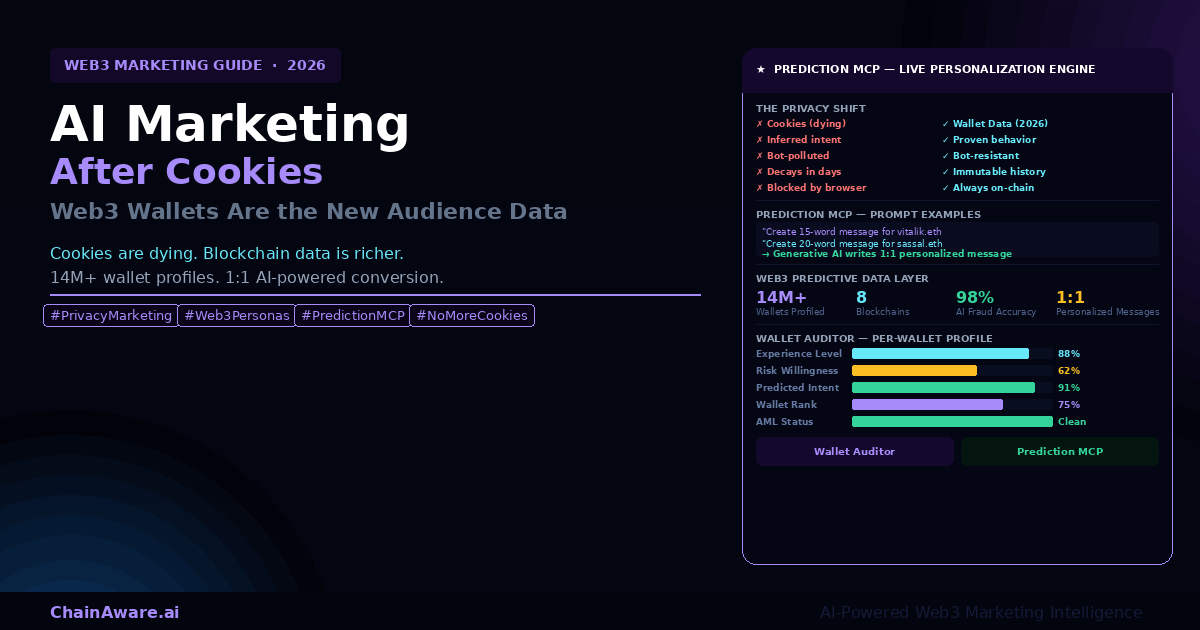
Paste any wallet address and instantly receive a complete behavioral profile: Experience Level, Risk Willingness, Predicted Intentions, Wallet Rank, and AML Status. The richest user intelligence in Web3 — from on-chain data alone. Free. No KYC. 8 networks.
Why Blockchain Data Is Better Than Cookies
This is not a marginal improvement. Blockchain data is categorically superior to cookie-based behavioral data on every dimension that matters for marketing.
Signal quality. A cookie records that a user visited your lending page. A wallet’s on-chain history records that the user has borrowed $85,000 across 12 DeFi protocols over 3 years. The first is a weak proxy for intent. The second is demonstrated behavior with real capital at stake. No inference needed.
Permanence. Cookies expire, get deleted, and are blocked by browsers. On-chain transaction history is immutable. A wallet’s complete behavioral record from its first transaction is permanently available and cannot be altered. This means behavioral profiles don’t decay — they accumulate richness over time.
Bot resistance. According to Fraudlogix research on ad fraud, bot traffic accounts for 20-40% of programmatic ad impressions in many categories. Bots destroy the quality of cookie-based behavioral data. Blockchain data has a built-in bot filter: bot wallets have no genuine financial history, no protocol diversity, no real DeFi track record. Behavioral profiling immediately distinguishes genuine users from automated wallets.
Cross-platform completeness. Cookie data is siloed by domain. A user’s activity on your DeFi protocol is invisible to every other platform. On-chain data is cross-platform by design — every interaction with every protocol on the same blockchain is in the same public record. ChainAware’s multi-chain coverage extends this across 8 blockchains, providing a genuinely complete behavioral picture of any user.
No consent problem. Cookie tracking requires informed consent under GDPR, CCPA, and similar regulations. Blockchain transaction data is public by the user’s own choice — every on-chain transaction is a voluntary public record. Analyzing publicly available blockchain data doesn’t require consent banners, opt-in flows, or privacy policy disclosures.
As Harvard Business Review’s research on customer retention value demonstrates, the highest-value marketing investment is identifying and retaining high-LTV customers. Blockchain behavioral data enables exactly this — with a precision that cookie data cannot approach.
The Wallet Auditor: Per-Wallet Behavioral Intelligence
The ChainAware Wallet Auditor is the foundational tool that transforms a wallet address into a complete behavioral and marketing intelligence profile. It answers the question every marketer has always wanted to answer: who exactly is this user, and what are they likely to do next?
The Wallet Auditor generates five core dimensions for every wallet, derived entirely from on-chain transaction history.
Experience Level measures how sophisticated the wallet’s DeFi engagement is — how many protocols used, how long active, how complex the strategies employed. Experience Level directly determines what messaging will resonate: an expert DeFi user ignores beginner onboarding content; a new user is overwhelmed by advanced yield strategy documentation. Matching message complexity to experience level is one of the highest-leverage personalization decisions in Web3 marketing.
Risk Willingness measures the wallet’s demonstrated risk appetite from actual financial decisions. Did it use leverage? Participate in volatile yield pools? Trade small-cap tokens aggressively? Or maintain conservative stable positions? This dimension determines which products to surface: high-risk users respond to high-yield opportunities; risk-averse users respond to security and capital preservation messaging.
Predicted Intentions are the most directly actionable marketing signal. The Wallet Auditor calculates the probability of each key next action: Prob_Borrow, Prob_Stake, Prob_Trade, Prob_Bridge, Prob_LiquidityProvide. A wallet with high Prob_Borrow should receive lending product CTAs. A wallet with high Prob_Stake should receive staking product messaging. This is behavioral intent prediction — not guessed from a page visit but calculated from thousands of on-chain behavioral data points.
Wallet Rank is a composite quality score placing the wallet among all 14M+ profiled wallets. A Wallet Rank in the top 5% identifies a power user — your most valuable acquisition target. A Wallet Rank in the bottom 20% flags a low-quality or bot-like wallet that will consume marketing budget without converting.
AML Status verifies fund origins and screens against sanctions lists — ensuring you are marketing to legitimate actors, not fraudsters building position in your platform. For the broader context of how AML and behavioral profiling work together, see our guide on Crypto AML vs Transaction Monitoring.
The Web3 Predictive Data Layer: 14M+ Profiles
Individual wallet analysis is powerful. The strategic asset is scale. ChainAware has applied the Wallet Auditor methodology to 14 million+ wallet addresses across Ethereum, BNB Chain, Base, Polygon, Solana, TON, Tron, and Haqq — building the world’s largest behavioral database of crypto users.
This Web3 Predictive Data Layer is what makes ChainAware’s marketing tools uniquely powerful. When a new wallet connects to your Dapp, ChainAware instantly cross-references it against 14M+ profiles and returns a complete behavioral assessment in milliseconds. A wallet that has never touched your platform before arrives pre-profiled: experience level, risk tolerance, predicted intentions, quality rank.
The Data Layer is the foundation beneath every ChainAware product. Web3 Behavioral Analytics aggregates it across your user base. Growth Agents use it to calculate Web3 Personas. The Prediction MCP exposes it directly to AI agents for real-time 1:1 personalization. As explained in the ChainAware complete product guide, the Data Layer is what separates behavioral intelligence from post-hoc analytics.
See Who Is Really Using Your Dapp
Web3 Behavioral Analytics: Aggregate Segmentation for Your Platform
Install the ChainAware Pixel via Google Tag Manager and get a live behavioral dashboard for every wallet that has ever connected to your Dapp — experience distribution, risk profiles, behavioral segments, predicted intentions. Know your users. No cookies. No KYC. No guesswork.
Web3 Behavioral Analytics: Know Your Entire User Base
Web3 Behavioral Analytics aggregates the Wallet Auditor data for every wallet that has ever connected to a subscribed Dapp, giving the platform team a complete behavioral picture of their user base as a whole.
Think of it as Google Analytics rebuilt for Web3 — but instead of page views and bounce rates, you see behavioral segments, experience distributions, risk profiles, predicted intentions, and Wallet Rank breakdowns. You stop seeing “3,000 wallets connected this week” and start seeing “1,200 experienced DeFi users with high borrowing intent, 800 yield farmers likely to provide liquidity, 500 new wallets needing onboarding, 500 bot-like low-quality wallets to exclude from marketing spend.”
This segmentation directly informs four critical marketing decisions. Which landing page variant to show each user — power users see advanced feature depth; new users see onboarding content. Which product to highlight based on predicted intentions — high Prob_Borrow wallets see lending CTAs; high Prob_Stake wallets see staking product messaging. Which campaign channel is attracting high-quality vs. low-quality users — identifying which traffic sources deliver genuine DeFi users vs. bot traffic or airdrop farmers. And how to allocate marketing budget — concentrating spend on the channels and creatives that acquire wallets in the top Wallet Rank quartile.
As documented in the Web3 personalized marketing guide, matching message to behavioral segment consistently outperforms generic broadcasting by 3-8x on conversion rates in DeFi contexts. The analytics layer is what makes that matching possible.
McKinsey’s research on personalization demonstrates that companies excelling at personalization generate 40% more revenue from their marketing activities than average players. Web3 Behavioral Analytics is the foundation of that personalization.
Prediction MCP: 1:1 AI-Powered Personalization at Scale
The Prediction MCP (Model Context Protocol) is where Web3 marketing reaches its full potential. It is an API that AI agents — including Claude, GPT-4, and any other LLM — can query in real time with a wallet address to receive that wallet’s complete behavioral profile. The AI then uses this profile to generate personalized content, messaging, or decisions calibrated to the specific individual wallet.
This is the architecture that replaces cookie-based retargeting — but delivers something far more powerful: genuine 1:1 personalization at the moment of engagement, not targeting someone based on a page visit from three days ago, but responding to who they demonstrably are, right now, as they connect their wallet.
The Prediction MCP works as follows. A user connects their wallet to a Dapp. The Dapp’s AI agent queries the Prediction MCP with the wallet address. In milliseconds, the MCP returns the wallet’s Experience Level, Risk Willingness, Predicted Intentions, Wallet Rank, fraud probability, and credit score. The AI agent uses this profile to generate or select the optimal response: the right product to surface, the right message to display, the right incentive to offer, at the exact moment the user is present and engaged.
For the five highest-impact applications of the Prediction MCP in DeFi platforms specifically, see 5 ways Prediction MCP turbocharges your DeFi platform.
Real-Time Wallet Intelligence for AI Agents
Prediction MCP: Query Any Wallet Profile in Milliseconds
Build AI agents that query ChainAware’s Web3 Predictive Data Layer for any wallet — experience, risk willingness, predicted intentions, fraud score, credit score — in real time. Enable 1:1 personalized marketing, product recommendations, and conversion flows. No cookies. No privacy issues. Just wallet data.
Real Examples: Generative AI + Prediction MCP in Action
The most compelling way to understand what the Prediction MCP enables is through concrete examples. These are real prompt patterns that any Claude.ai user with Prediction MCP access can run today.
Example 1: Aave Platform — vitalik.eth
Prompt to Claude.ai with Prediction MCP connected:
"Create a 15-word marketing message for vitalik.eth when he connects to the Aave platform."What happens: Claude queries the Prediction MCP with vitalik.eth, receives the complete Wallet Auditor profile — experience level (Expert), risk willingness (Moderate), predicted intentions (high Prob_Borrow, high Prob_LiquidityProvide), Wallet Rank (top 0.1%). Claude then generates a message calibrated to an expert, risk-moderate DeFi user with high borrowing intent: something like “Access Aave’s highest-yield ETH pools — your DeFi track record qualifies you for premium borrowing terms.”
This is not a generic onboarding message. It is a message written for this specific wallet’s behavioral profile, referencing their actual capacity and predicted intent. The probability of conversion is orders of magnitude higher than a generic CTA.
Example 2: 1inch Platform — sassal.eth
"Create a 20-word marketing message for sassal.eth when he connects to 1inch."Claude queries the Prediction MCP for sassal.eth, receives their profile — an active ETH ecosystem participant with strong trading history and high Prob_Trade. The generated message targets their known behavior: “Route your next ETH swap through 1inch — your trading volume qualifies for reduced fees and exclusive aggregation routes.”
Every wallet that connects to 1inch has a different profile. Some are first-time users who need step-by-step guidance. Some are arbitrage traders who need speed and gas optimization messaging. Some are yield farmers who need liquidity pool information. The Prediction MCP + Generative AI combination delivers the right message to each — automatically, in real time, at the moment of connection.
The Scalability Insight
These examples involve named wallets for illustration, but the real power is at scale. Your Dapp might receive 10,000 wallet connections per day. With cookie-based marketing, you show everyone the same landing page. With the Prediction MCP + Generative AI, every one of those 10,000 connections receives a personalized experience — product highlighted, message written, CTA framed — based on their individual behavioral profile. The compute cost of running 10,000 Prediction MCP queries and 10,000 AI-generated messages is negligible. The conversion lift is not.
As documented in the SmartCredit.io case study, behavioral personalization delivered 8x higher engagement and 2x conversion rates compared to generic messaging. This is the baseline that on-chain behavioral intelligence enables — and Prediction MCP + Generative AI takes it further by removing the static message template entirely and generating bespoke content for every user.
From Segments to Conversion: The 10x Advantage
The fundamental purpose of marketing is conversion — turning a person who arrived at your platform into a person who actually uses it. Everything else — impressions, clicks, wallet connections — is a means to that end. The reason cookie-based marketing underperforms in Web3 is that it optimizes for arrival (traffic) while the conversion problem is about relevance (does this person see something immediately relevant to their specific situation?).
The Prediction MCP + Generative AI architecture attacks the conversion problem directly. When a wallet connects to your platform, three things happen simultaneously: the Prediction MCP queries the wallet’s behavioral profile from the 14M+ profile database, the AI agent processes the profile and generates personalized content for that specific user, and the platform delivers a tailored first experience — the right product featured, the right message displayed, the right next step suggested.
Consider the contrast. Cookie-based marketing shows everyone the same landing page and A/B tests two or three variants. The best possible outcome is a version that converts a slightly larger percentage of an undifferentiated audience. Prediction MCP marketing shows each wallet a version calibrated to their specific profile. The audience is never undifferentiated — every user is individually known before they take a single action on your platform.
This is why the 10x conversion improvement is conservative. Cookie-based personalization, at its most sophisticated, uses 5-10 audience segments. Prediction MCP personalization operates at the individual wallet level — 14 million distinct profiles, each generating distinct messaging. The improvement in relevance is not 10%; it is qualitatively different in kind.
For the complete picture of how ChainAware’s behavioral intelligence integrates with Web3 marketing strategy, see the Behavioral User Segmentation guide and our analysis of why influencer marketing underperforms in Web3 — both show why the quality of behavioral targeting data, not the size of the marketing budget, determines conversion outcomes.
ChainAware.ai — Web3 Marketing Intelligence Suite
Wallet Auditor · Web3 Analytics · Prediction MCP
Replace cookies with blockchain behavioral data. 14M+ wallet profiles. Per-wallet intent prediction. AI-generated 1:1 personalized messages. No privacy issues. No consent banners. Just the richest marketing data in Web3.
Frequently Asked Questions
How does Web3 marketing work without cookies?
In Web3, the wallet is the identity. When a user connects their wallet to a Dapp, their complete on-chain transaction history becomes accessible. ChainAware’s Wallet Auditor analyzes this history to generate a full behavioral profile — experience level, risk willingness, predicted intentions, and wallet rank — without any cookies, tracking pixels, or consent banners. The blockchain data is richer than any cookie-based signal.
What is a Web3 Persona?
A Web3 Persona is a behavioral archetype calculated from a wallet’s on-chain history — not a demographic label but a prediction about how this specific wallet is likely to behave. Examples include “DeFi Power User” (high experience, high risk, likely to borrow and provide liquidity), “Long-Term Holder” (stable, low-frequency, risk-averse), and “Yield Optimizer” (active, reward-seeking, likely to chase high APY). Personas are the input to AI-generated personalized messaging.
What is the Prediction MCP and how does it work?
The Prediction MCP (Model Context Protocol) is an API that AI agents query with a wallet address to receive that wallet’s complete behavioral profile in real time. The AI agent — Claude, GPT-4, or any LLM — uses this profile to generate personalized content, product recommendations, or marketing messages calibrated to the specific wallet’s behavioral history and predicted next actions. See the Prediction MCP complete guide for integration details.
Is using on-chain data for marketing a privacy violation?
No. Blockchain transactions are public records by design — users voluntarily submit transactions to a public ledger. Analyzing publicly available on-chain data requires no consent banner, no opt-in, and no KYC. It is fundamentally different from cookie-based tracking, which tracks users across sites without their knowledge. Web3 behavioral marketing is more transparent and more privacy-respectful than traditional digital advertising.
How much better is Prediction MCP personalization vs. cookie-based targeting?
Cookie-based targeting works with 5-10 broad audience segments at best. Prediction MCP targeting works at the individual wallet level — every wallet receives messaging calibrated to its specific behavioral profile. The SmartCredit.io case study demonstrated 8x higher engagement and 2x conversion rates from behavioral personalization. With Prediction MCP + Generative AI, the improvement is further amplified because messages are generated for each individual, not selected from a finite template library.
Which blockchains are supported?
Ethereum, BNB Chain, Base, Polygon, Solana, TON, Tron, and Haqq — covering the major networks where active DeFi users and crypto-native audiences are most concentrated.