
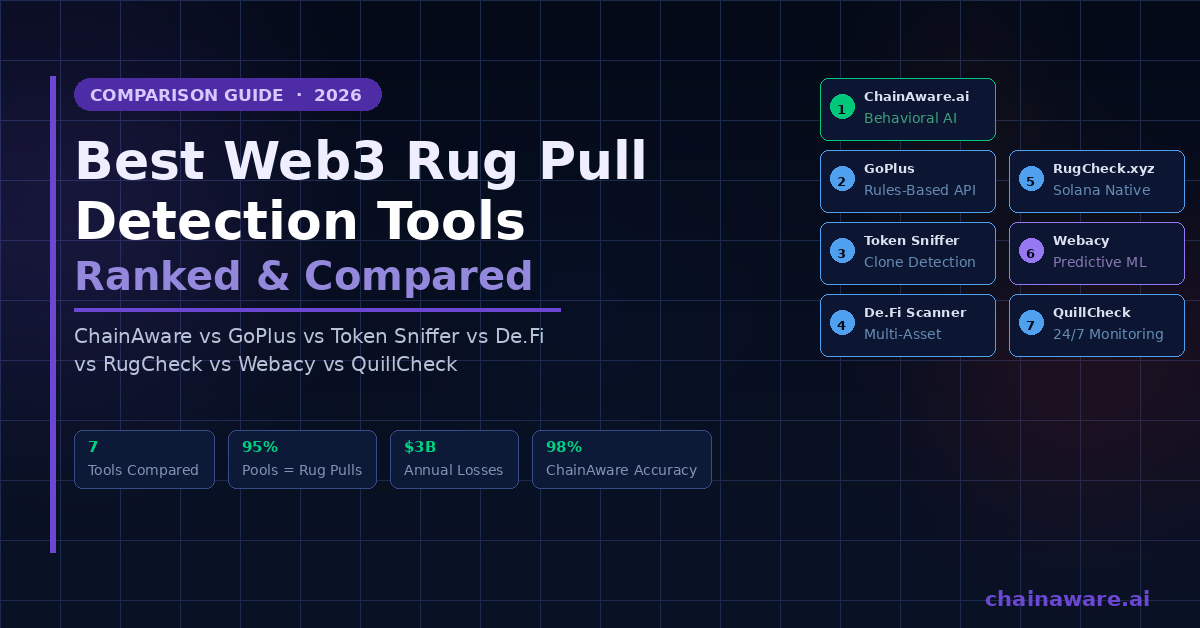
Rug pulls cost crypto investors approximately $3 billion every year. On PancakeSwap alone, 95% of new liquidity pools end in rug pulls. On Pump.fun, 99% of launched tokens extract money from buyers. These are not edge cases — they are the dominant outcome for new DeFi deployments. Selecting the right detection tool is therefore not a nice-to-have. It is the most important security decision any DeFi participant makes.
This 2026 guide compares the seven most important Web3 rug pull detection tools available today — covering their methodology, chain coverage, accuracy approach, and the critical gap each leaves. Understanding those gaps is essential because no single tool catches every rug pull type. The most dangerous category — professional operators using deliberately clean code — bypasses six of the seven tools on this list entirely.
In This Guide
- Why Most Rug Pull Detection Tools Fail Against Professional Operators
- 1. ChainAware.ai — Behavioral Prediction (ETH, BNB, BASE, HAQQ)
- 2. GoPlus Security — Rules-Based API Infrastructure (30+ Chains)
- 3. Token Sniffer — Pattern Matching and Clone Detection (EVM)
- 4. De.Fi Scanner — Multi-Asset Portfolio Security (10+ Chains)
- 5. RugCheck.xyz — Solana-Native Detection (Solana)
- 6. Webacy — Predictive ML on Base (Base)
- 7. QuillCheck by QuillAI — Real-Time Monitoring and Alerts (Multi-Chain)
- Head-to-Head Comparison Table
- Which Tool Should You Use — and When?
- FAQ
Why Most Rug Pull Detection Tools Fail Against Professional Operators
Before comparing individual tools, it is worth understanding why the majority of detection approaches share a fundamental blind spot. Six of the seven tools in this guide analyze smart contract code — scanning for hidden mint functions, unlocked liquidity, blacklist mechanisms, proxy upgrade patterns, and honeypot traps. This approach works well against amateur operators who copy-paste malicious code from known scam templates.
Professional rug pull operations, however, are far more sophisticated. They know exactly which code patterns trigger detection tools. Consequently, they deliberately write clean, well-structured Solidity code that passes every contract scanner check. Their malicious intent does not appear in the code at all. Instead, it lives in their behavioral history — the same wallet addresses have been behind previous rug pulls, have interacted with known fraud infrastructure, and have executed liquidity manipulation patterns across multiple earlier schemes. All of that history sits permanently on-chain, unchanged and verifiable. Yet code-based scanners never look at it. As explored in our AI-Based Predictive Rug Pull Detection guide, this is precisely why static analysis fails and behavioral AI wins. According to Immunefi’s annual security reports ↗, exit scams and rug pulls consistently account for the largest share of total DeFi losses — and the majority involve operators who knew exactly how to evade detection.
The Two-Axis Framework for Understanding Detection Quality
Every rug pull detection approach falls somewhere on two axes: what data it analyzes (contract code vs. human behavioral history) and when it produces its signal (reactive after deployment vs. predictive before liquidity is drained). Code analysis is reactive by nature — it reads what is already deployed. Behavioral analysis is predictive — it identifies operators whose history makes future fraud probable, regardless of how clean their current code is. The most valuable tool is one that catches what every other tool misses. That is the framework to apply when evaluating the seven options below. For the complete technical analysis of these methodologies, see our Forensic vs AI-Powered Blockchain Analysis guide.
1. ChainAware.ai — Behavioral Prediction (ETH, BNB, BASE, HAQQ)
Core methodology: Behavioral Trust Score analysis of contract creators and liquidity providers — not contract code.
ChainAware approaches rug pull detection from a fundamentally different direction than every other tool in this comparison. Rather than reading the smart contract’s Solidity code, ChainAware analyzes the on-chain behavioral histories of the humans behind the contract. Specifically, it traces two groups: the contract creator (and any upstream contract creators if the immediate deployer is itself a contract) and every address that has added or removed liquidity from the associated pool. For each of those addresses, ChainAware runs a full fraud probability calculation using its predictive AI models — trained on 18M+ wallet profiles and backtested against CryptoScamDB. The output is a composite Trust Score that reflects whether the behavioral patterns of the people behind the pool match known fraud operator signatures.
Why Behavioral Analysis Catches What Code Analysis Cannot
A professional rug pull operator can write clean code in an afternoon. They cannot, however, erase their transaction history. Every previous scam they ran, every interaction with fraud infrastructure, every pattern of deploying pools and draining liquidity — all of it is permanently recorded on-chain. ChainAware reads that history and assigns a fraud probability to each address in the creator and LP chain. When the aggregate Trust Score is low, the pool is flagged regardless of how technically impeccable the contract code appears. This is the specific capability that no other tool in this list provides. As detailed in our complete Rug Pull Detector guide, this approach catches the category of sophisticated operator that every code scanner gives a clean bill of health.
Additionally, ChainAware’s fraud detection model — 98% accuracy, over two years in production — underlies the Trust Score calculations. The same model that predicts individual wallet fraud powers the assessment of everyone in a pool’s creator and LP chain. For the fraud detection methodology detail, see our Fraud Detector guide.
Chains: ETH, BNB, BASE, HAQQ
Best for: Catching sophisticated operators with clean code; pre-investment due diligence on new pools; DApps needing API-level pool risk screening
Free tier: Yes — free individual pool checks at chainaware.ai/rug-pull-detector
API/business: Yes — via Prediction MCP and REST API
Limitation: Does not catch honeypots in new wallets with no transaction history (no behavioral signal to analyze)
Check Any Pool Before You Invest
ChainAware Rug Pull Detector — Behavioral AI, Free, Real-Time
Paste any contract address on ETH, BNB, BASE, or HAQQ and get an instant Trust Score analysis of the creator and all liquidity providers. The only tool that catches professional rug pulls with clean code — because it reads behavioral history, not Solidity. Free for individual use. No signup required.
2. GoPlus Security — Rules-Based API Infrastructure (30+ Chains)
Core methodology: Rules-based smart contract analysis — honeypot simulation, ownership flags, mint functions, blacklist/whitelist, tax parameters.
GoPlus Security is the dominant B2B security API in Web3. It powers the risk warnings on DEXScreener, is integrated into Sushi’s trading interface, and underlies the security checks in dozens of wallets, explorers, and trading platforms. In Q4 2024 alone, GoPlus detected 67,241 honeypot tokens across Ethereum, Base, and BNB Chain. The platform covers over 30 blockchain networks and provides both a consumer-facing interface and a permissionless API that any developer can integrate without fees or approval.
What GoPlus Analyzes
GoPlus runs a comprehensive suite of contract-level checks: whether the token is sellable, whether the creator can mint unlimited new supply, whether blacklist or whitelist functions exist, whether the contract is open source, whether a proxy upgrade pattern is present, buy and sell tax rates, trading cooldown mechanisms, and LP lock status. These checks are fast, reliable, and cover the vast majority of amateur-level scam patterns. The API returns clear structured data that wallets and DEX aggregators can display to users in real time — which is why it became the de facto security infrastructure layer for the EVM ecosystem.
The limitation is inherent to the methodology. GoPlus reads what is written in the contract. Sophisticated operators who write clean contracts with none of the above red flags receive a green result. Furthermore, GoPlus does not analyze the behavioral history of the people behind the contract — it does not know whether the deployer address has a history of previous rug pulls on other tokens. For any asset trading on a major DEX, GoPlus provides reliable first-line protection. For new pools from unknown deployers on high-risk chains, it is necessary but not sufficient. For the comparison between rules-based and predictive approaches, see our AI-Powered Blockchain Analysis guide.
Chains: 30+ EVM and non-EVM chains
Best for: First-line contract scanning; wallet and DEX integration via API; quick 10-second gut checks on any token
Free tier: Yes — free API and consumer interface
API/business: Yes — open permissionless API
Limitation: Rules-based and static — cannot detect sophisticated operators with clean code; does not analyze creator behavioral history
3. Token Sniffer — Pattern Matching and Clone Detection (EVM)
Core methodology: Automated code analysis with pattern matching, contract similarity detection against known scam templates, and honeypot simulation.
Token Sniffer is the most widely used free individual-user tool for EVM token risk assessment. Its core differentiator is contract similarity analysis — it maintains a database of known malicious contract patterns and scam templates and flags any new token whose code shares significant similarity with known fraudulent contracts. This catches the enormous volume of copy-paste scam operations that recycle the same malicious code structure across hundreds of new token deployments. Solidus Labs documented over 188,000 suspected scam tokens on Ethereum and BNB Chain in 2022 alone — the majority of which used recycled code that tools like Token Sniffer can identify.
Risk Score and Swap Analysis
Token Sniffer produces a 0-100 risk score for each token analyzed, combining contract code analysis with swap simulation — it tests whether an actual buy and sell transaction can be executed, which catches honeypot-style traps that GoPlus might miss if the honeypot mechanism is implemented unusually. The historical scam detection database adds a valuable pattern-matching layer on top of pure code analysis. Token Sniffer is particularly effective as a second-opinion tool to complement GoPlus results, especially when the two return different assessments of a borderline contract. For how pattern-matching approaches fit into a broader security framework, see our How to Identify Fake Crypto Tokens guide.
The tool’s weakness is mirror-image to its strength: it excels at catching copied code but cannot assess original code from operators who write from scratch. It also does not analyze behavioral history, meaning a brand-new sophisticated operation with original clean code and no prior on-chain history scores well. Additionally, legitimate but new tokens with thin liquidity can trigger false positives — the risk model flags low-liquidity conditions as suspicious even when the contract is genuine.
Chains: EVM chains (ETH, BNB, and others)
Best for: Catching copy-paste scams; second-opinion alongside GoPlus; quickly screening high-volume new token launches
Free tier: Yes — free consumer interface
API/business: Limited
Limitation: Cannot assess behavioral history; false positives on legitimate new tokens; no Solana support
Verify the People Behind the Contract Too
ChainAware Fraud Detector — Check Any Wallet in the Creator Chain
After checking the contract code with GoPlus or Token Sniffer, check the deployer wallet’s behavioral history with ChainAware. 98% fraud detection accuracy. Real-time. Free. Enter the contract creator’s address — or any LP provider address — and see their fraud probability score before you invest a single dollar.
4. De.Fi Scanner — Multi-Asset Portfolio Security (10+ Chains)
Core methodology: Comprehensive contract analysis across tokens, NFTs, and liquidity pools with multi-chain portfolio risk aggregation and PDF reporting.
De.Fi Scanner — built by the team behind De.Fi (formerly DeFiYield) — positions itself as the “antivirus of blockchains” with the most ambitious scope of any tool in this comparison. Where GoPlus and Token Sniffer focus on individual token contracts, De.Fi Scanner extends its analysis to NFTs, liquidity positions, and entire portfolio exposures across 10+ networks simultaneously. This makes it particularly valuable for users managing complex multi-chain DeFi portfolios who need a unified risk picture rather than token-by-token checks.
Permission Flags and PDF Reports
De.Fi’s interface is notably more visual and information-dense than GoPlus’s API-first presentation — it displays social links, market cap, exchange rankings, and permission flags alongside risk scores, enabling users to assess both technical and social risk signals in one view. The platform’s ability to generate downloadable PDF audit reports is useful for institutional users, launchpad teams, and projects that need to share third-party security assessments with their communities. For individual users, the breadth of information available can be overwhelming — the UI requires some learning investment before it becomes efficient for quick pre-investment checks. Nevertheless, for anyone building or managing a substantial multi-chain DeFi position, De.Fi Scanner provides the most comprehensive single-platform risk overview. For context on multi-chain security approaches, see our AI-Based Wallet Audit guide.
Like GoPlus and Token Sniffer, De.Fi Scanner analyzes contract code rather than behavioral history. Consequently, it shares the same fundamental limitation against professional operators with clean code.
Chains: 10+ (ETH, BNB, SOL, Polygon, Arbitrum, others)
Best for: Multi-chain portfolio risk management; institutional due diligence with PDF reports; combined token + NFT + LP risk assessment
Free tier: Yes — free consumer interface
API/business: Yes
Limitation: Complex UI for quick checks; code analysis only; no behavioral creator history
5. RugCheck.xyz — Solana-Native Detection (Solana)
Core methodology: Solana-specific token analysis — liquidity locks, holder distribution, ownership concentration, insider network detection.
RugCheck.xyz holds a unique position in this comparison as the dominant Solana-specific tool — widely referred to as “the Solana traffic light” by the Solana and memecoin community. Its launch during the 2021 bear market positioned it as the default pre-investment check for Solana token buyers, and its visual interface — using emoji-based emotional cues alongside risk flags — made it accessible to retail users who might find technical scanner outputs confusing. For anyone active in Solana’s memecoin ecosystem or participating in early Pump.fun launches, RugCheck.xyz has become a standard part of the due diligence workflow.
Insider Network Detection
RugCheck’s most distinctive feature is its beta Insider Networks analysis — a function that identifies suspicious relationships between major token holders, flagging cases where multiple large holders share characteristics that suggest coordinated insider buying. This targets a specific rug pull pattern common on Solana where a team seeds the holder distribution to appear decentralized while actually controlling the majority of supply across multiple related wallets. The insider network flag provides a meaningful additional signal beyond pure liquidity lock analysis. For broader context on Solana security challenges and the 99% Pump.fun scam rate, see our How to Identify Fake Crypto Tokens guide.
RugCheck’s significant limitation is its narrow scope: it does not assess team background, whitepaper quality, marketing credibility, or exchange listing history. A token can receive a strong RugCheck score while still being a sophisticated social-engineering scam where the team’s off-chain conduct is fraudulent but the on-chain structure appears clean. Furthermore, because it is Solana-specific, it provides no utility for EVM chain investments.
Chains: Solana only
Best for: Solana memecoin research; Pump.fun launch screening; quick mobile-friendly Solana checks
Free tier: Yes — free consumer interface
API/business: Limited
Limitation: Solana-only; no behavioral history; does not evaluate team background or off-chain conduct
6. Webacy — Predictive ML on Base (Base)
Core methodology: Supervised machine learning (GBDT, XGBoost, LightGBM) combining Solidity code forensics with on-chain holder analytics for predictive rug probability scoring.
Webacy stands out as the most technically ambitious approach to rug pull detection among the code-analysis tools in this comparison — and the closest in philosophy to ChainAware’s predictive methodology, though applied primarily to Base chain and incorporating contract code as a primary input rather than exclusively behavioral data. In November 2025, Webacy’s CTO published a detailed technical blog documenting their transition to a production-grade predictive system: a supervised ML pipeline using gradient boosted decision trees (GBDT), XGBoost, and LightGBM trained on historical Base chain deployments.
Code Forensics Plus Holder Analytics
Webacy’s system combines two data streams: Solidity code-level features (hidden mint, risky primitives, upgradeability patterns) available immediately at deployment, and on-chain holder analytics (early sniper clustering, concentrated early ownership, bundled trading) that become available as the token begins trading. The model weights these features through ML rather than fixed rules, which gives it more flexibility to adapt to novel fraud patterns than purely rules-based systems like GoPlus. Webacy is intentionally conservative about its v1 capabilities and acknowledges that improving the system means reducing false positives and false negatives through iteration — a methodologically honest position that ChainAware’s own development trajectory echoes. For how ML-based approaches differ from rules-based systems, see our Generative vs Predictive AI guide.
Webacy’s current limitation is scope: it focuses on Base chain and scores new contract deployments from the earliest stages. Users on ETH, BNB, or Solana do not benefit from this predictive layer. Additionally, like all code-analysis tools, it relies partially on contract code features — meaning sophisticated operators who write clean code and avoid sniper-detectable trading patterns can still partially evade detection.
Chains: Base (primary, expanding)
Best for: Base chain token launches; early deployment risk scoring; users wanting ML-based analysis beyond fixed rules
Free tier: Yes
API/business: Yes
Limitation: Primarily Base-focused; still incorporates contract code features; less behavioral depth than pure creator-history analysis
7. QuillCheck by QuillAI — Real-Time Monitoring and Alerts (Multi-Chain)
Core methodology: 25+ smart contract and market condition parameters with 24/7 continuous monitoring, real-time Telegram and Twitter alerts when tokens turn into scams.
QuillCheck, built by the QuillAI team, differentiates itself from the other tools in this comparison through its emphasis on continuous monitoring rather than point-in-time checks. Where most scanners return a risk assessment at the moment of query, QuillCheck monitors token contracts 24/7 and delivers automated alerts via Telegram and Twitter when a previously clean-scoring token subsequently changes behavior — enabling holders to exit before full liquidity drains. This monitoring capability addresses one of the most insidious rug pull patterns: tokens that appear completely clean at launch but are deliberately set up to activate malicious functions after a waiting period, once sufficient investor funds have accumulated.
API for Launchpads and DEX Integration
QuillCheck’s API is specifically designed for launchpad and DEX integration — enabling platforms to run automated token screening as part of their listing process. This B2B positioning complements GoPlus’s broader API ecosystem while adding the monitoring layer that GoPlus’s static point-in-time checks do not provide. For launchpads that want to screen every project submission automatically and then continue monitoring listed tokens for behavioral changes post-launch, QuillCheck’s combination of pre-launch scanning and post-launch monitoring creates a more complete safety net than any static scanner alone. For how transaction monitoring approaches apply to DApps beyond token screening, see our AI-Based Predictive Fraud Detection guide and our Speeding Up Web3 Growth guide.
QuillCheck shares the core limitation of all code-analysis tools: its 25+ parameter analysis still reads the contract rather than the creator’s behavioral history. Additionally, alert delivery via social channels assumes users see the notification in time — which may not always be the case for fast-moving rug pulls that drain liquidity within minutes of a trigger event.
Chains: Multi-chain EVM
Best for: Real-time monitoring of holdings; launchpad automated screening; platforms needing ongoing post-launch surveillance
Free tier: Yes
API/business: Yes — purpose-built for launchpad/DEX integration
Limitation: Contract code analysis only; alert timing vs. fast rug pulls; no behavioral creator history
For DApps: Monitor Your Users’ Addresses Continuously
ChainAware Transaction Monitoring Agent — 24/7 Behavioral Surveillance
Upload your platform’s connected wallet addresses. The transaction monitoring agent screens them continuously — detecting fraud behavioral patterns before they execute on your platform. Flags automatically via Telegram. MiCA-compliant. Expert-level compliance without headcount. Free analytics tier to get started.
Head-to-Head Comparison Table
| Tool | Detection Method | Catches Clean-Code Pros? | Chains | Real-Time? | Monitoring? | Free Tier | API |
|---|---|---|---|---|---|---|---|
| ChainAware.ai | Behavioral Trust Score — creator + LP history | ✅ Yes — core differentiator | ETH, BNB, BASE, HAQQ | ✅ Sub-second | ✅ Transaction monitoring agent | ✅ | ✅ MCP + REST |
| GoPlus Security | Rules-based contract code analysis | ❌ No | 30+ chains | ✅ | ❌ | ✅ | ✅ Open API |
| Token Sniffer | Pattern matching + clone detection + honeypot sim | ❌ No | EVM chains | ✅ | ❌ | ✅ | Limited |
| De.Fi Scanner | Multi-asset contract analysis + permission flags | ❌ No | 10+ chains | ✅ | ❌ | ✅ | ✅ |
| RugCheck.xyz | Liquidity locks + holder distribution + insider networks | ❌ No | Solana only | ✅ | ❌ | ✅ | Limited |
| Webacy | Predictive ML: code forensics + holder analytics | Partial — ML-based but includes code features | Base (primary) | ✅ | Partial | ✅ | ✅ |
| QuillCheck | 25+ contract parameters + continuous monitoring | ❌ No | Multi-chain EVM | ✅ | ✅ 24/7 alerts | ✅ | ✅ Launchpad-focused |
Detection Method Comparison: What Each Approach Catches and Misses
| Rug Pull Type | ChainAware | GoPlus | Token Sniffer | De.Fi | RugCheck | Webacy | QuillCheck |
|---|---|---|---|---|---|---|---|
| Honeypot (can’t sell) | ✅ Via LP fraud history | ✅ Strong | ✅ Swap simulation | ✅ | ✅ | ✅ | ✅ |
| Unlocked liquidity drain | ✅ Via LP behavioral history | ✅ LP lock check | ✅ | ✅ | ✅ Solana | ✅ | ✅ |
| Hidden mint / unlimited supply | Partial | ✅ Strong | ✅ | ✅ | ✅ | ✅ | ✅ |
| Copy-paste scam code | Partial | ✅ | ✅ Strongest | ✅ | Partial | ✅ | ✅ |
| Delayed activation (time-bomb) | ✅ Via operator history | ❌ | ❌ | ❌ | ❌ | Partial | ✅ 24/7 monitoring |
| Professional clean-code operator | ✅ Only tool that catches this | ❌ | ❌ | ❌ | ❌ | Partial | ❌ |
| Insider/coordinated supply | ✅ Via LP cluster analysis | Partial | Partial | Partial | ✅ Insider Networks | ✅ Sniper detection | Partial |
| New wallet (no history) | ⚠️ Limited signal | ✅ | ✅ | ✅ | ✅ | ✅ | ✅ |
Which Tool Should You Use — and When?
No single tool in this comparison covers every rug pull type. Professional security practice in 2026 combines multiple tools to close the gaps each one leaves. Here is the practical framework:
For Individual Investors: The Three-Check Stack
Step 1 — Contract check (GoPlus or Token Sniffer): Run any new token through GoPlus for immediate contract-level flags. Token Sniffer adds clone detection as a second opinion. Together, they catch the majority of amateur-level scams efficiently. This step takes 30 seconds and eliminates the majority of obvious frauds.
Step 2 — Creator behavioral check (ChainAware): If the contract passes Step 1, paste the deployer’s wallet address into the ChainAware Fraud Detector. Also check any major liquidity providers you can identify. A clean contract from a high-fraud-probability address is a major red flag that code scanners will never surface. This step is the only protection against professional operators.
Step 3 — Monitoring (QuillCheck alerts): For positions you hold for more than a few days, set up QuillCheck alerts on the contract. Post-launch behavioral changes — fee increases, LP removal preparation — appear before the actual rug pull. Early warning gives you an exit window. For Solana specifically, substitute RugCheck.xyz in Step 1 and Step 2 (where applicable). For multi-chain portfolio exposure, add De.Fi Scanner to your Step 1 workflow. For all the tools and methodologies together, see our complete ChainAware product guide and our Crypto Wallet Security 2026 guide.
For DApps and Launchpads: API-Level Integration
DApps screening user addresses and launchpads screening project submissions need API-level automation rather than manual checks. The recommended stack is GoPlus API for real-time contract-level screening at every token interaction, ChainAware Prediction MCP for behavioral risk scoring of addresses interacting with your platform, and QuillCheck API for continuous post-listing monitoring with automated alerts. This combination provides contract code protection (GoPlus), behavioral prediction (ChainAware), and ongoing surveillance (QuillCheck) — covering all three temporal phases of rug pull risk: before launch, at launch, and post-launch. For API integration guidance, see our 12 Blockchain Capabilities Any AI Agent Can Use guide. For the regulatory compliance requirements that make transaction monitoring mandatory, see our AI-Based Predictive Fraud Detection guide and the FATF Virtual Assets Recommendations ↗.
The Behavioral Layer Every Stack Needs
ChainAware Wallet Auditor — Full Behavioral Profile in Under 1 Second
Code checkers tell you about the contract. ChainAware tells you about the person. Enter any address — contract creator, LP provider, or counterparty wallet — and get fraud probability, experience level, risk profile, and behavioral intentions instantly. The layer that closes the gap every other tool leaves open. Free. No signup.
Frequently Asked Questions
Can any tool guarantee 100% rug pull detection?
No tool provides 100% accuracy — and any tool claiming to do so should be treated with skepticism. Rug pulls evolve continuously as operators study detection methods and adapt. The 98% accuracy figure ChainAware publishes for its fraud detection is backtested against CryptoScamDB using an independent test set never used for training — a verifiable methodology standard that most tools do not publish. The practical goal is not perfection but rather eliminating the categories of rug pull that are systematically preventable while staying ahead of evolving tactics through continuous model improvement.
Why do professional rug pulls pass contract scanners?
Professional operators know exactly which code patterns trigger GoPlus, Token Sniffer, and similar tools. They deliberately write clean Solidity code that contains none of the flagged patterns — no hidden mint, no blacklist, no proxy, unlocked liquidity added after initial checks. Their malicious intent is not in the code at all. It exists only in their behavioral history — prior rug pulls, interactions with known fraud wallets, patterns of deploying and draining pools. That history is permanently on-chain and readable, but contract scanners never look at it. ChainAware’s behavioral approach reads exactly that history.
Which tool is best for Solana memecoins?
RugCheck.xyz is the community standard for Solana token screening — accessible, widely adopted, and with the Insider Networks detection that is specifically relevant to the coordinated supply manipulation common in Solana memecoins. For Solana, De.Fi Scanner also provides multi-chain coverage. ChainAware currently covers ETH, BNB, BASE, and HAQQ — Solana coverage is on the roadmap. For now, the best Solana approach is RugCheck plus manual creator wallet research using whatever behavioral data is available from other chains if the deployer address has cross-chain activity.
Should I use multiple tools simultaneously?
Yes — this is strongly recommended. Each tool in this comparison catches a different category of rug pull. GoPlus catches amateur code-based scams. Token Sniffer catches copy-paste operations. RugCheck catches Solana-specific patterns. ChainAware catches sophisticated operators with clean code. QuillCheck catches post-launch behavioral changes. Running two or three tools sequentially takes under five minutes and dramatically expands the risk categories you have protection against. If two independent tools flag different risks on the same contract, that disagreement alone is a signal worth investigating before committing funds.
How does ChainAware’s rug pull detection differ from its fraud detection?
ChainAware’s fraud detection evaluates individual wallet addresses — it produces a fraud probability score for any address, indicating how likely that address is to commit fraud in the future based on its transaction history. The rug pull detector applies this fraud probability analysis to the specific set of addresses involved in a liquidity pool — the contract creator, any upstream creators, and all liquidity providers — producing a composite Trust Score for the pool as a whole. The rug pull detector therefore uses fraud detection as a component, extending it to assess the specific human network behind a DeFi contract rather than any individual wallet in isolation. Both tools are free for individual use at chainaware.ai.
Sources: Immunefi Web3 Security Research ↗ · Chainalysis Crypto Crime Report ↗ · FATF Virtual Assets Recommendations ↗ · GoPlus Security ↗