
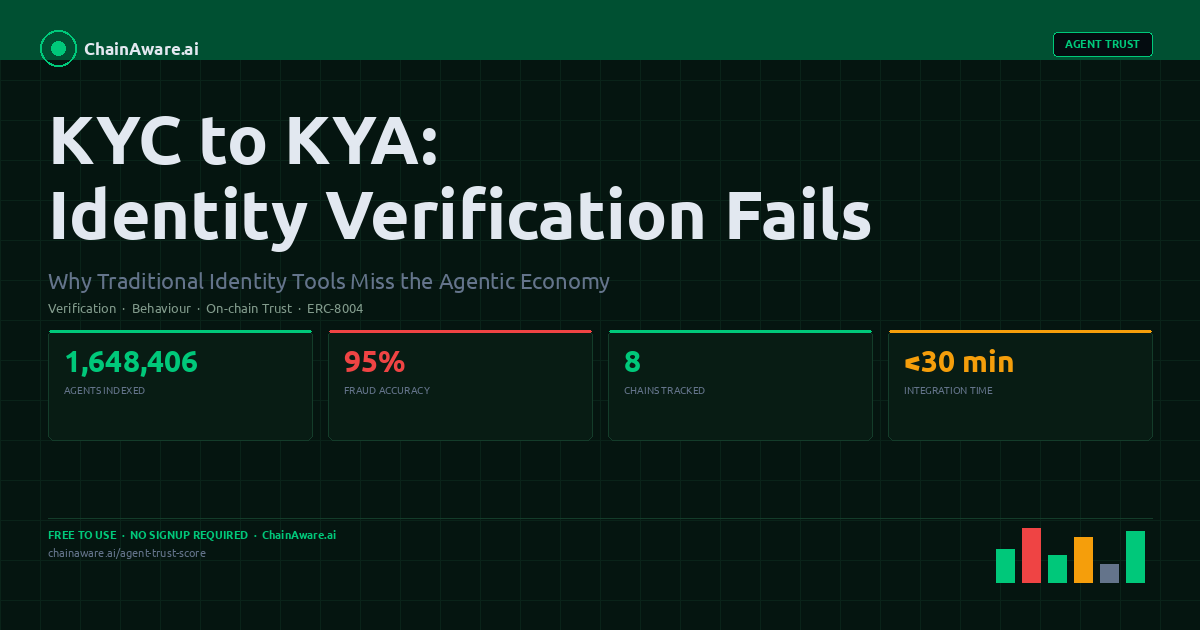
KYC was built for humans. When the entity transacting is software, three structural problems emerge that KYC cannot solve on its own — and the gap is widening as agent volumes grow.
Compliance teams have spent two decades refining Know Your Customer. The process is well understood: collect identity documents, screen against sanctions lists, assess risk at onboarding and file reports when something goes wrong. It works because the entity on the other side of the transaction is a person — slow-moving, legally accountable and difficult to clone at scale.
Existing identity tools were never designed to score the behavior of autonomous software, which is why an agent trust score compared against traditional KYC reveals such a wide gap in coverage.
That assumption no longer holds. AI agents now hold wallets, sign transactions, place orders and negotiate contracts without a human in the loop for each act.
This shift is reshaping onchain activity itself, as explored in our analysis of how AI agents are replacing human-driven Web3 growth teams.
The entity transacting is software. It may be authorized by a person who passed KYC, but the agent itself has never been screened, its behavior has never been monitored and the connection between the owner’s identity and the agent’s actions is assumed rather than verified.Know Your Agent, or KYA, is the discipline that closes this gap. In practice, this means scoring each autonomous agent individually, and a single-agent trust profile returning a 0-1000 score with trust flags gives compliance teams that per-agent view.
Building that discipline at scale points toward shared infrastructure, such as a credit bureau model for AI agents, where agent behavior history can be reused across platforms.
This article explains precisely where KYC breaks when applied to agents, what KYA adds and what the data from the ERC-8004 agent ecosystem reveals about the scale of the problem today.Where KYC Breaks: Three Structural Failures
1. Delegation Chains
KYC verifies the owner of an account. It does not verify who — or what — is acting on that account’s behalf. When a human delegates transaction authority to an AI agent, the agent inherits the owner’s verified status without having been assessed itself. The agent may then spin up sub-agents, pass instructions down a chain and execute transactions several steps removed from the original verified identity.
When losses occur in these multi-hop flows, the question of who bears liability becomes urgent Profiling how each wallet in a delegation chain tends to act is also useful, since behavioural wallet profiling that predicts personas and risk willingness helps establish whether observed actions match the behaviour expected of the authorized owner or sub-agent., a point we unpack in our piece on proven risks in the agentic economy.
At each link in the chain, accountability weakens. A compliance officer reviewing a suspicious transaction may trace it back through three or four agents before reaching a wallet that was KYC’d six months ago. The owner was clean at the time. That tells you almost nothing about the agent that moved the funds today.
For compliance teams looking to act on this, our guide to building an enterprise KYA compliance stack for agent trust outlines how to monitor agents continuously rather than only at onboarding.
This is not a theoretical edge case. The agentic commerce fraud patterns emerging across DeFi protocols consistently involve layered delegation, where the KYC’d principal is several hops away from the harmful act. Traditional transaction monitoring tools, compared in detail in our ChainAware vs Chainalysis analysis, were not designed to traverse agent delegation graphs.
2. Behavioral Drift
KYC is point-in-time. An entity is screened at onboarding, assigned a risk rating and then monitored at scheduled intervals or when a trigger event occurs. This cadence was designed around humans, whose behavior changes slowly and whose legal status is relatively stable.
Agents are different. A model can be retrained, a system prompt can be changed, a funding wallet can be swapped and an agent’s operational behavior can shift entirely within hours. An agent that passed a registry check on Monday may be executing a wash-trading pattern by Wednesday. Its registration record will still show a clean status.
This is what compliance professionals mean when they describe the KYC-to-KYA gap as a temporal problem. Static identity checks produce a snapshot. Agent risk requires a continuous read. The ERC-8004 trust signals framework addresses this in part, but registry data alone cannot capture live behavioral change. Behavioral scoring that updates on a rolling basis is the only mechanism that tracks drift reliably.
3. Fleet Sybil Attacks
The third failure is the most operationally dangerous and the least visible to conventional compliance tools. A single operator can register thousands of agents at minimal cost. Each agent gets its own address, its own registry entry and, by extension, its own apparent identity. Per-owner KYC sees one clean account. It does not see the fleet.
The ERC-8004 ecosystem data makes this concrete. As of November 2026, ChainAware has indexed 1,648,406 registered ERC-8004 agents across eight chains. Of those scored, 82.5% score Elevated Risk or Untrusted — 9.0% outright Untrusted and a further 73.5% in the Elevated Risk tier. More strikingly, 930 agents have been directly funded by wallets connected to confirmed rug pull operators, and 1,107,688 agents (67.2%) have feeder addresses that are entirely unknown — no traceable CEX withdrawal, no clean funding history. These agents were not flagged by identity checks because their owners had not previously been screened or sanctioned at the time of registration. The identity gap is not a rounding error: two thirds of registered agents enter the ecosystem with an opaque funding source.
Fleet detection requires cross-agent analysis: shared funding sources, coordinated activity timing, overlapping infrastructure signatures. None of this is visible when each agent is assessed in isolation as KYC logic requires. The agent trust infrastructure race is, in large part, a race to build the graph analysis layer that makes fleet patterns visible at scale.
What KYA Adds
The Know Your Agent (KYA) framework does not replace KYC. It extends it. The owner of an agent should still be verified as a human or legal entity. Sanctions screening at the principal level remains a baseline requirement. What KYA adds is the behavioral trust layer that KYC cannot supply.
That layer has four components. The first is the owner wallet: its age, its transaction history and whether any of its prior counterparties are associated with known fraud. The second is the feeder address: the wallet or contract that funds the agent’s operational balance, which may differ from the owner and carries its own risk signal. The third is the creator record: whether the code or model that powers the agent has been used in prior exploits. The fourth is fleet detection: whether the agent is part of a coordinated network of agents controlled by the same operator.
ChainAware’s Agent Trust Score combines these signals into a 0-to-1000 score with five tiers. Sovereign agents (800 and above) have clean funding chains, stable behavior histories and no fleet flags. Trusted agents (600 to 799) are operationally sound with minor gaps in evidence. Provisional agents (400 to 599) lack sufficient history to assess confidently. Elevated Risk agents (200 to 399) show one or more negative signals that warrant friction before allowing transactions. Untrusted agents (0 to 199) have active red flags and should not be permitted to transact in most contexts.
The median trust score for newly registered agents in the ERC-8004 ecosystem is 101. That figure deserves attention. It means the average new agent enters the ecosystem in the Untrusted tier, not because it has done anything harmful, but because it has no behavioral history. The score rises as evidence accumulates. This is how behavioral trust should work: earned over time, not asserted at registration.
ERC-8004 and the Emerging Registration Standard
ERC-8004 is the open standard that defines how AI agents register on-chain. It specifies the fields an agent must publish — owner address, creator hash, capability declarations — and creates a common schema that compliance tools can read programmatically. It is the closest analogue to a business registration for agents, and it is gaining adoption rapidly.
Registration under ERC-8004 is necessary but not sufficient. As the agent trust infrastructure race analysis sets out in detail, the registry tells you what an agent claims about itself. It does not validate those claims against behavioral evidence, and it does not detect patterns that only become visible when agents are analyzed as a population rather than individually.
For compliance teams, the practical implication is that an ERC-8004 registration is a starting point for due diligence, not an endpoint. A protocol that accepts any registered agent without behavioral scoring is making the same error as a bank that accepts any customer who presents an identity document without running sanctions checks or transaction monitoring.
Trust Scoring as the Core of the KYA Framework
Know Your Agent cannot function as a point-in-time gatekeeping exercise. Unlike a human applicant who submits documents and waits for a compliance officer’s ruling, an autonomous agent may execute thousands of transactions across dozens of protocols before a human reviewer would even open a queue. The operational mechanism that makes KYA viable at scale is trust scoring: assigning each agent a continuously maintained numeric score — typically expressed on a 0–1000 scale — derived from behavioral signals, transaction history, counterparty exposure, and protocol interaction patterns. That score becomes the single authoritative input that downstream systems query before granting, restricting, or denying access.
Why a Numeric Score Outperforms Binary Pass/Fail
Traditional KYC produces a binary outcome: verified or not verified. That binary is adequate when the subject is a human who onboards once and whose risk profile changes slowly. It is inadequate when the subject is an agent whose behavior can shift materially within a single session. A numeric trust score enables proportionate friction — a calibrated response that matches the level of scrutiny to the actual risk signal rather than treating every ambiguous case as a full block or a full approval.
In practice, this means a risk policy engine can be configured around score thresholds. An agent scoring above 750 might receive instant approval for routine operations, with no additional challenge introduced into the execution path. An agent scoring between 450 and 750 might trigger a step-up challenge — requiring cryptographic attestation of its principal hierarchy, a secondary authorization from a registered operator wallet, or a temporary transaction ceiling until the score recovers. An agent scoring below 450 receives a hard block, with the interaction flagged for human review and the event logged to an immutable audit trail. This graduated architecture means compliance teams are not choosing between frictionless access and total exclusion; they are applying exactly as much friction as the behavioral evidence justifies. For high-volume automated environments, that efficiency difference is not marginal — it is the difference between a functional agent compliance program and one that either blocks legitimate activity or waves through risk.
Trust Scoring Inside Agent Onboarding Compliance Workflows
The score’s role does not begin at runtime. In a well-structured agent onboarding compliance workflow, trust scoring enters at intake. When a new agent requests access to a protocol, exchange, or institutional service, its declared identity — operator wallet, model fingerprint, permissioned scope, and any prior on-chain history — is ingested and an initial score is computed. That score governs what level of access the agent is provisioned with at the moment of onboarding. An agent with a verifiable deployment history and a credentialed operator may start near the top of the range. A net-new agent with no attributable history starts conservatively, earning expanded access as behavioral data accumulates.
Critically, the score is then updated continuously rather than recertified on an annual cycle. Each interaction — settlement behavior, gas usage patterns, contract calls made, counterparties touched — feeds back into the scoring model. A sudden deviation from established behavioral norms, such as an agent beginning to interact with mixer contracts or executing value transfers inconsistent with its declared purpose, compresses the score downward in near real time. The compliance system responds automatically, applying the friction tier appropriate to the new score, without waiting for a scheduled review. This continuous loop is what distinguishes KYA infrastructure from legacy periodic recertification and makes it structurally suited to environments where agent behavior can change faster than any human review cadence.
Audit Trails and the Coming Wave of KYA Regulation
The regulatory landscape around autonomous agents remains nascent, but its direction is not ambiguous. Frameworks addressing AI liability, automated financial decision-making, and digital asset intermediaries are advancing across the EU, the UK, and several US federal agencies simultaneously. The specific shape of kya regulation — whether it arrives as an amendment to existing AML obligations, as a standalone AI accountability standard, or as a condition embedded in digital asset licensing regimes — is still being determined. What is already clear is that regulators will expect institutions to demonstrate that they knew what agents were operating on their infrastructure, what those agents were doing, and what controls were applied when behavior deviated from acceptable parameters.
Organizations that have been generating and retaining time-stamped trust score records throughout an agent’s operational life will be materially better positioned to meet that evidentiary standard than those attempting to reconstruct a compliance narrative from raw transaction logs after the fact. A score history is not merely an operational artifact — it is a structured, queryable record of every risk assessment the system made and the rationale behind each access decision. That is precisely the kind of audit trail that regulators have historically demanded from financial institutions managing customer risk, and there is little reason to expect the standard will be lower for institutions managing agent risk.
Trust scoring, applied at intake and maintained continuously, is ultimately how the industry builds a credible trust layer for agentic economy infrastructure — one that satisfies the operational demands of autonomous execution while preserving the accountability structures that regulators and institutional counterparties will require.
Practical Steps for Compliance Teams
The first step is to map which parts of your protocol or platform accept agent-initiated transactions. Many teams discover that agents are already transacting in their systems and that the operational boundary between human and agent action has not been formally defined.
The second step is to require Agent Trust Scores at the same point in the flow where KYC is currently applied. This does not mean blocking all low-scoring agents automatically. It means applying friction proportional to score: instant approval for Sovereign and Trusted agents, additional review for Provisional, manual escalation for Elevated Risk and hard blocks for Untrusted.
The third step is to monitor continuously rather than at onboarding only. An autonomous compliance screening setup will update risk assessments as new behavioral signals arrive, triggering alerts when an agent’s score drops materially without a corresponding change in the owner record.
The fourth step is to build fleet detection into your suspicious activity reporting workflow. If your SAR process only looks at individual agent addresses, it will miss the coordinated patterns that constitute the most significant fraud risk in agent ecosystems today.
None of these steps require abandoning existing KYC infrastructure. They require extending it with a behavioral layer that was never needed before — because the entity transacting was always a human.
That is no longer true. The agent economy is here. The compliance frameworks need to catch up.
TRANSACTION MONITORING
Monitor agent transactions in real time — not just at onboarding.
ChainAware’s transaction monitoring layer scores every agent interaction against live behavioral signals, funding chain data and fleet detection logic. Compliance teams get continuous risk reads, not point-in-time snapshots.
Explore Transaction Monitoring →Know Your Agent
Screen any AI agent’s trust score before your next integration