How Any Web3 Project Can Benefit from AI Agents: The Complete Guide

X Space #25 recap: how any Web3 project can benefit from AI agents. AI agents are self-learning autonomous programs — virtual employees powering Web3 efficiency. ChainAware agents for every Web3 use case: DeFi protocols (onboarding-router, transaction-monitoring-agent, aml-scorer), NFT platforms (wallet-auditor, fraud-detector), GameFi (behavioral segmentation, growth-agents), Web3 SaaS (credit-scoring-agent, whale-detector). 12 pre-built open-source agents on GitHub. Prediction MCP enables custom agent development with natural language blockchain intelligence. chainaware.ai.

Web3 AdTech and Fraud Detection — X Space with Magic Square

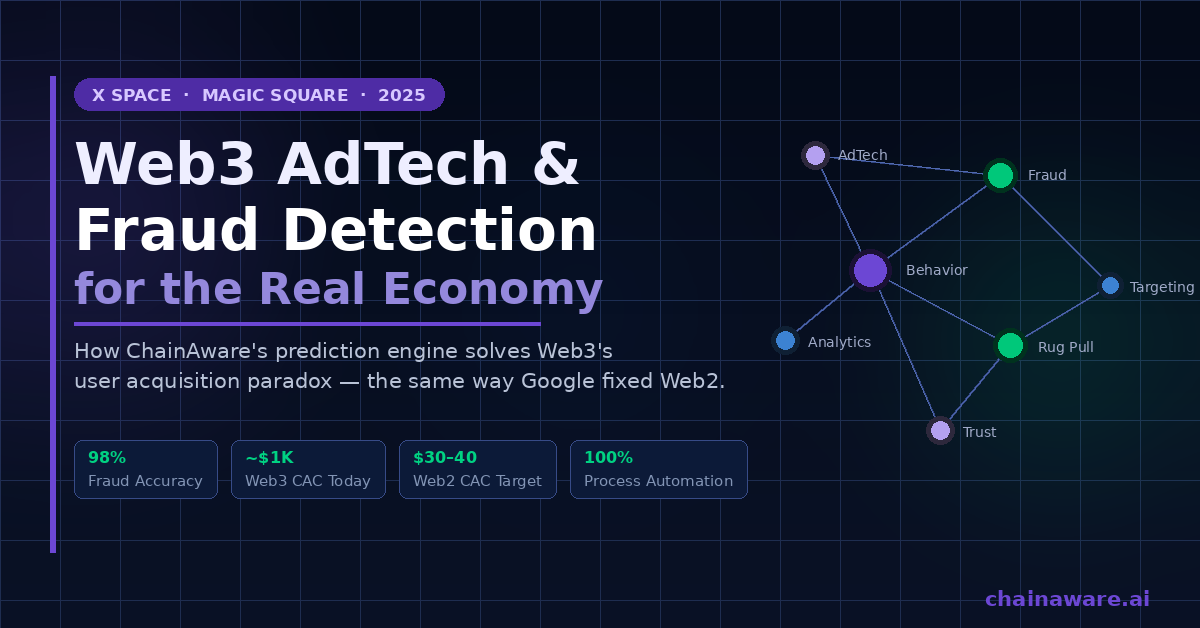
X Space with Magic Square — ChainAware co-founder Martin on Web3 AdTech and fraud detection for the real economy. x.com/MagicSquareio/status/1861039646605475916. ChainAware origin: SmartCredit (DeFi fixed-term lending) → credit scoring → fraud detection (98% real-time, backtested CryptoScamDB) → rug pull prediction → wallet auditing → Web3 AdTech. Key IP moat: custom AI models (not OpenAI/LLMs) cannot be forked unlike DeFi smart contracts (Compound → Aave → everyone; PancakeSwap → Uniswap → everyone). 99% accuracy achievable but near-real-time — deliberately downgraded to 98% for real-time response. Predictive AI ≠ LLM: LLM = statistical autoregression (next word prediction); Predictive AI = future wallet behavior prediction. Web3 unit cost paradox: business process costs near-zero (100% automated), but user acquisition costs ~$1,000/user — same paradox Web2 had before AdTech. Google solved Web2 CAC via AdTech (search/browsing history → behavioral targeting → $30-40 CAC). ChainAware does the same for Web3 via blockchain transaction history. Amazon analogy: no two visitors see the same landing page; every Web3 DApp sends the same page to everyone. Mass marketing = same message for everyone (KOLs, CMC, CoinGecko, Cointelegraph). Wallet verification without KYC: share address + signature = anonymous trust. AML is rules-based (static, backward-looking); Transaction Monitoring is AI-based (forward-looking, detects new patterns). Both required under MiCA/FATF. ChainGPT lead investor · FDV $3.5M · Initial market cap $80K · ChainGPT launchpad exclusively. Two requirements to cross Web3 chasm: reduce fraud + reduce CAC. chainaware.ai · 18M+ Web3 Personas · 8 blockchains · Prediction MCP

AI Agents in Web3: From Hype to Production Infrastructure — X Space with ChainGPT and Datai

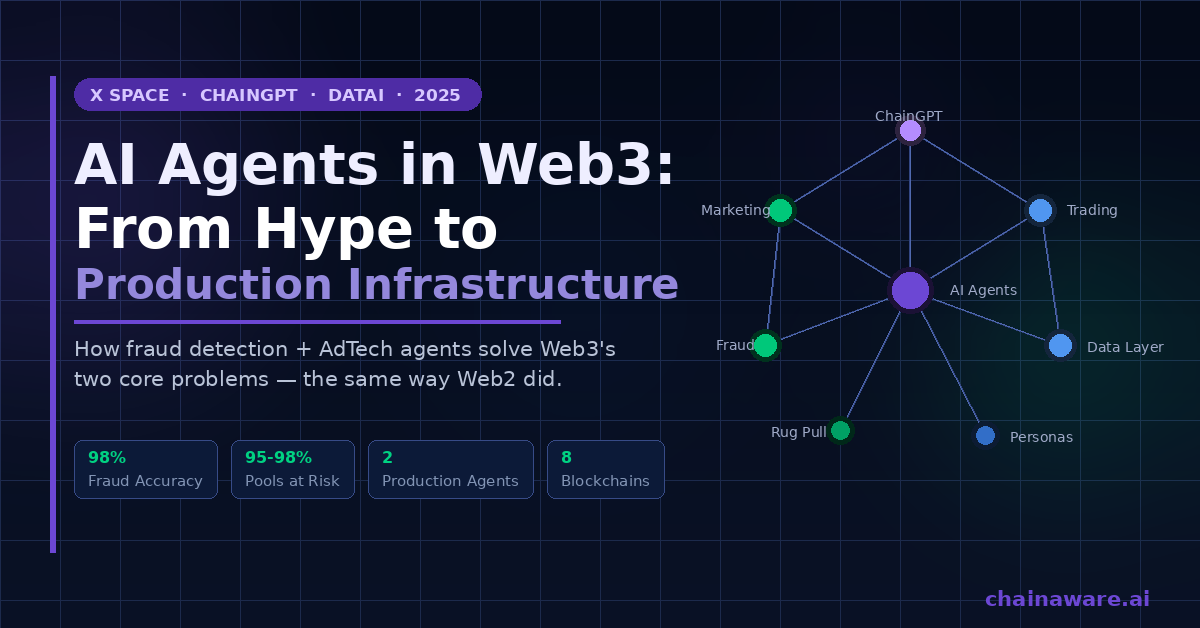
X Space with ChainGPT and Datai — x.com/ChainAware/status/1869467096129876236 — ChainAware co-founders Martin and Tarmo join Ellie (Datai) and ChainGPT Labs host Chris. Three ChainGPT-incubated AI infrastructure projects map what Web3 AI agents actually are and what they already do in production. ChainAware: two production agents — Web3 marketing agent (wallet connects → behavioral profile calculated → resonating 1:1 content generated) and fraud detection agent (98% accuracy, real-time, CryptoScamDB backtested, 95-98% PancakeSwap pools at risk). Datai: decentralized data provider — 3 years manual blockchain data aggregation + 1.5 years AI model for smart contract categorization. Solves the core Web3 analytics gap: transactions show addresses but not what users were doing. Provides data like English for AI agents to understand. Founder bandwidth problem: founders spend 90% of time on supplementary tasks (marketing, tax, monitoring, compliance) instead of core innovation. AI agents take over all supplementary tasks — freeing founders for the innovation that drives the ecosystem forward. Orchestrator shift: marketers become orchestrators of specialized agents (illustration, copy, persona/psychology agents) rather than manual executors. Datai trading use case: pre-packaged DeFi strategies (2020) → AI agent personalizes strategies from behavioral history + peer comparison. Pool comparison product: analyzes ETH/USDT across Uniswap/Sushiswap/PancakeSwap — AI trading agents use this to route capital to optimal chain/protocol. Web2 crossing the chasm required two technologies: fraud detection (credit card fraud suppression) + AdTech (Google behavioral targeting → $15-30 CAC). Web3 is at the same inflection point. Innovation wave: agents remove supplementary blockers → founders innovate more → biggest Web3 innovation wave yet. 1M token giveaway announced in this X Space. ChainAware Prediction MCP · 18M+ Web3 Personas · 8 blockchains · chainaware.ai

AI-Based Predictive Rug Pull Detection: Why Static Analysis Fails and Behavioral AI Wins

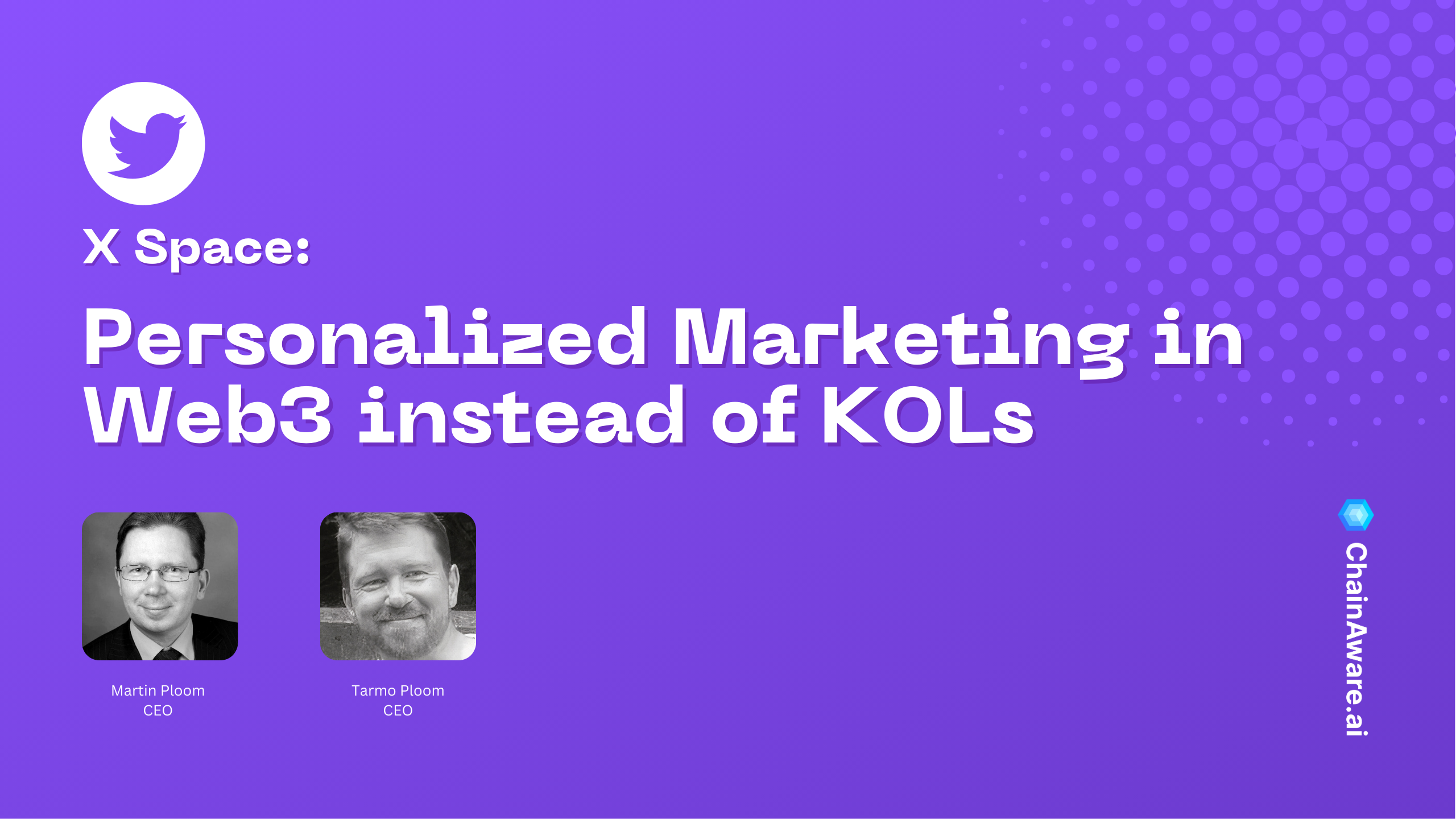
X Space recap: personalized marketing in Web3 instead of KOLs. KOL marketing (Key Opinion Leader) relies on mass marketing — same message to everyone, high cost, low ROI. Personalized marketing targets each wallet individually based on on-chain behavioral profile. ChainAware approach: Growth Agents read each wallet’s Wallet Rank, experience, and intentions at connection and deliver the right message automatically. No KOL budget required. 14M+ wallet profiles, 8 blockchains. Result: 40-60% connect-to-transact rates vs 10% industry baseline. chainaware.ai.

Vitalik’s AI and Crypto Paper: A Use-Case Reality Check — What Actually Works on Blockchain

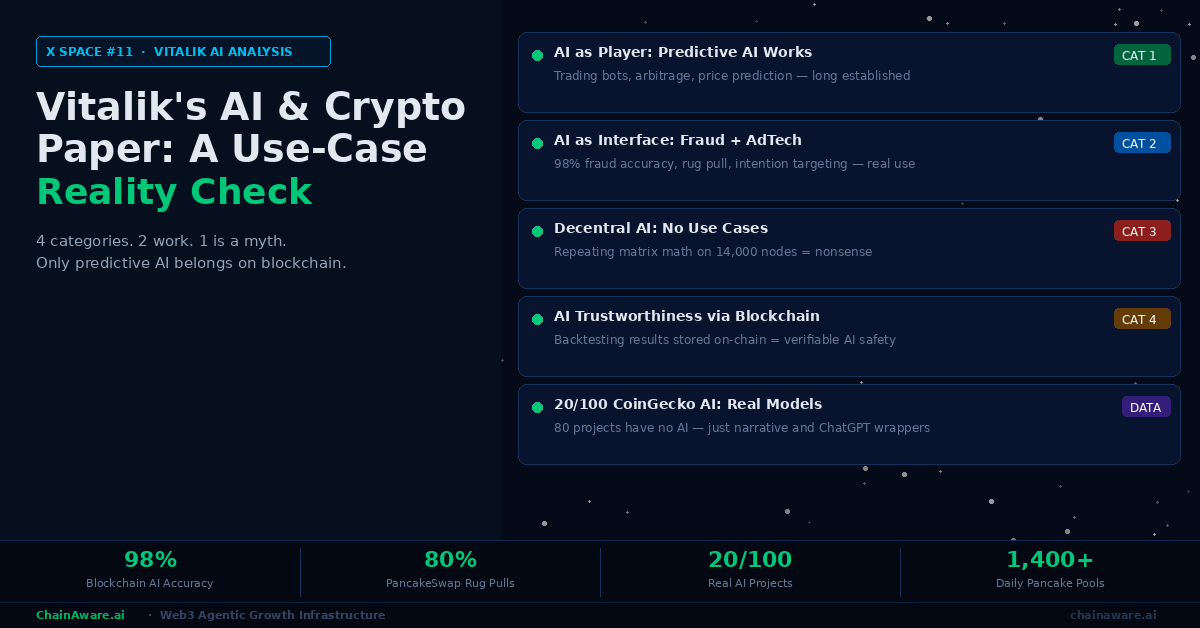
X Space #11: Vitalik’s AI and Crypto Paper — A Use-Case Reality Check. ChainAware co-founders Martin and Tarmo analyse Vitalik Buterin’s essay on AI and blockchain convergence. Core thesis: Vitalik correctly identifies fraud detection and on-chain security as the highest-value AI+blockchain convergence — but underestimates what is already live and deployable today. Key analysis: Vitalik’s four categories — AI as participant in games, AI for security, AI for governance, AI for DeFi optimisation; fraud detection use case: fully validated — ChainAware 98% accuracy, real-time, 8 chains in production; governance AI: premature — LLMs hallucinate on governance decisions, not deployable at protocol level; DeFi optimisation: promising but requires deterministic models, not generative AI; key distinction: predictive AI (behavior classification) vs generative AI (text generation) — only predictive AI is useful for on-chain applications; blockchain data quality advantage: financial transactions filtered by gas fees are higher quality than any Web2 behavioral dataset; ChainAware Prediction MCP enables any developer or AI agent to access fraud scores, rug pull detection, wallet behavioral profiles via natural language queries; 32 open-source agents on GitHub. Web3 needs predictive AI, not LLM wrappers. Prediction MCP · 18M+ Web3 Personas · 8 blockchains · chainaware.ai

AI + Blockchain: Winning Use Cases That Actually Work

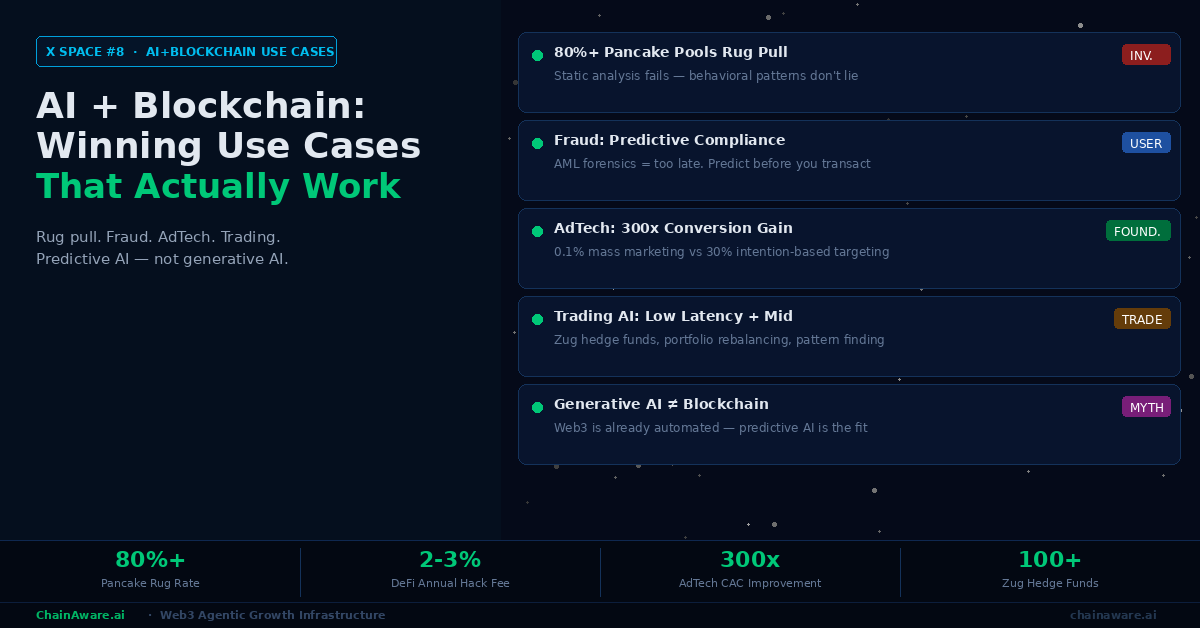
X Space #7: AI + Blockchain — Winning Use Cases That Actually Work. ChainAware co-founders Martin and Tarmo. Core thesis: the intersection of AI and blockchain has six high-value use cases — all require predictive AI trained on on-chain data, none can be solved with generative AI wrappers. Six winning use cases: (1) fraud detection — 98% accuracy, real-time, behavioral neural network on transaction history; (2) rug pull detection — traces contract creator funding chain and liquidity provider history; (3) Web3 AdTech — 1:1 behavioral targeting from wallet intention profiles, replaces mass KOL marketing; (4) trading signals — predictive models on on-chain flow patterns; (5) credit scoring — on-chain cash flow + fraud probability for DeFi underwriting; (6) smart contract vulnerability analysis — AI pattern matching on code structure. Key insight: blockchain data is the highest-quality behavioral dataset in the world — every transaction is a deliberate financial decision (proof-of-work filter). $300B data goldmine: 500M users × $600/user bank data equivalent — free and public on-chain. 95% of CoinGecko AI projects are LLM wrappers with no production models. ChainAware covers use cases 1-3 in production today: 14M+ wallets, 8 blockchains, 98% fraud accuracy. Prediction MCP · 32 open-source agents · chainaware.ai

Generative AI Is for Web2. Predictive AI Is for Web3.

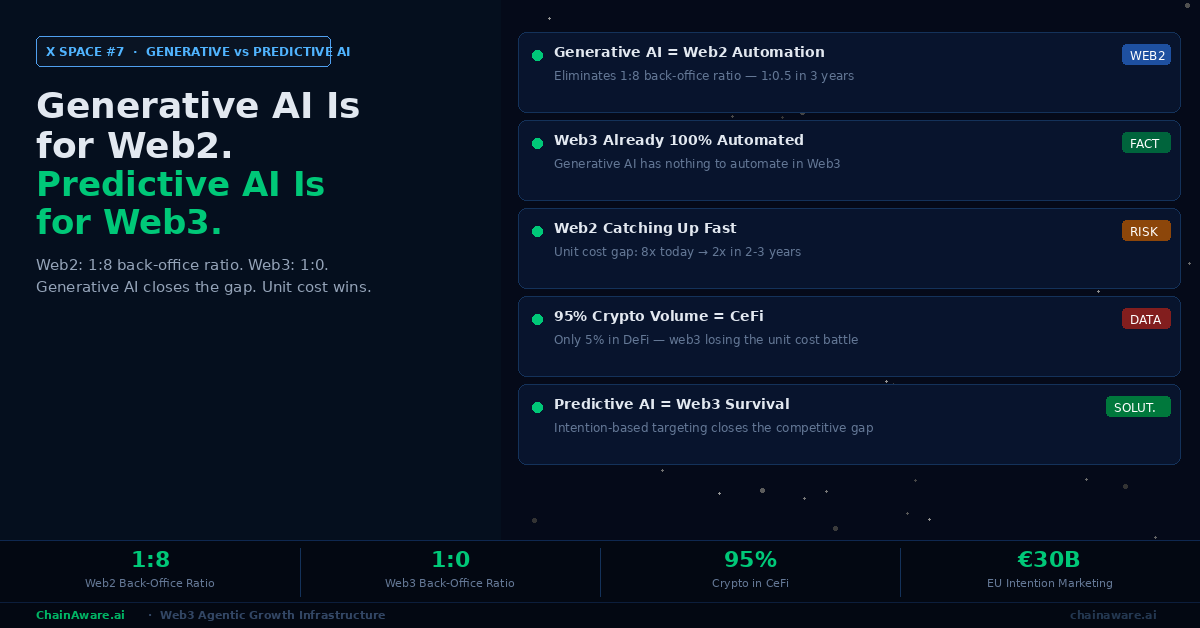
X Space #6: Generative AI Is for Web2. Predictive AI Is for Web3. ChainAware co-founders Martin and Tarmo. Core thesis: generative AI and predictive AI serve completely different purposes — only predictive AI trained on on-chain behavioral data can solve Web3’s core problems of fraud and mass marketing. Key distinctions: generative AI creates content (text, images, code) — it is a one-time tool used by human employees; predictive AI predicts outcomes from behavioral patterns — it runs continuously as an autonomous agent; generative AI cannot detect fraud, predict rug pulls, segment wallets, or power marketing agents; using an LLM API for blockchain security is not AI — it’s a wrapper; competitive advantage requires proprietary training data, custom model architecture, and iterative refinement (not plugging into OpenAI); blockchain data produces higher-quality behavioral predictions than Web2 data because gas fees filter casual transactions; Web3 is at the same inflection point as Web2 in the early 2000s — 50 million users, horrific CAC, widespread fraud; the same two technologies that brought Web2 to mainstream (AI fraud detection + AdTech) are now available for Web3 in superior form. ChainAware products: Fraud Detector (98% accuracy, real-time), Rug Pull Detector, Marketing Agents, Transaction Monitoring Agent. Prediction MCP · 32 open-source agents · chainaware.ai

Generative AI vs Predictive AI on Blockchain: Where Is the Competitive Edge?

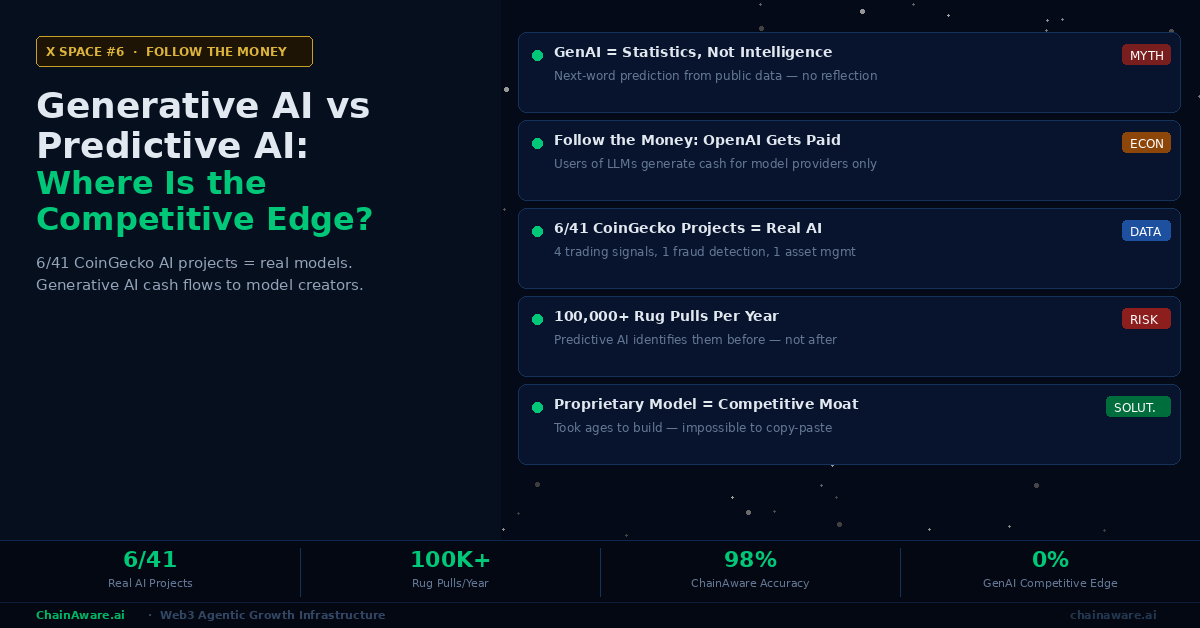
X Space #5 (part 2): Generative AI vs Predictive AI on Blockchain — Where Is the Competitive Edge? ChainAware co-founders Martin and Tarmo. Core thesis: the single most important diagnostic question for any blockchain AI project is whether it uses generative AI or predictive AI — only predictive AI creates defensible competitive advantage in Web3. Key insights: generative AI (ChatGPT, Gemini, Claude) is a statistical text predictor — cannot process numerical on-chain data, cannot make fraud classifications, produces hallucinations on wallet data, runs at 1-5 second latency (100x too slow); predictive AI (XGBoost, Random Forest, Neural Networks) is purpose-built for pattern recognition on transaction data — real-time, deterministic, high-accuracy; blockchain proof-of-work data quality: financial transactions are deliberate decisions filtered by gas cost, producing much higher behavioral signal than search/browsing data; 95% of Web3 AI projects are LLM wrappers with no competitive advantage — same output as any other project using the same API; competitive moat requires proprietary training data + custom models + iterative improvement; ChainAware: 5+ years of labeled fraud/behavioral training data, 98% accuracy, real-time, 8 chains. Two Web3 growth barriers: fraud destroying trust + mass marketing destroying unit economics. Prediction MCP · 32 open-source agents · 14M+ wallets · chainaware.ai

Speeding Up Web3 Growth: Real-Time Fraud Detection and 1:1 Marketing

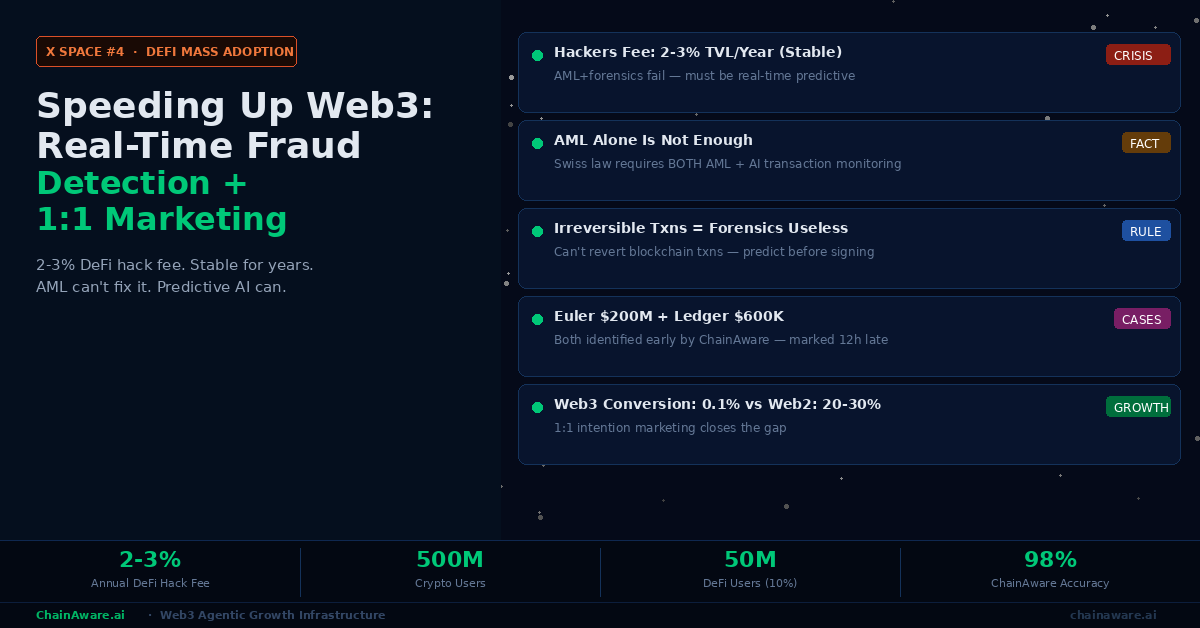
X Space #4: Speeding Up Web3 Growth — Real-Time Fraud Detection and 1:1 Marketing. ChainAware co-founders Martin and Tarmo. Core thesis: Web3 cannot grow at scale without solving two structural problems simultaneously — fraud and mass marketing. Key insights: 2-3% annual DeFi hack fee is constant across 4 years despite hundreds of millions invested in forensic AML tools; AML wine-and-water flaw — AML assumes reversible transactions (designed for TradFi); blockchain transactions are irreversible, making backward-looking AML insufficient; Euler Finance $200M hack and Ledger $600K social engineering as real-world fraud cases; shadow banning vs hard banning — shadow ban detected fraudsters without alerting them, allowing behavioral pattern collection; 1930s mass marketing (same message for everyone) vs 1:1 intention-based targeting; Gartner 70% adaptive applications by 2025; micro-segmentation enables $15-30 CAC in Web2 vs $1,000+ in Web3 today. ChainAware solutions: real-time fraud detection (98% accuracy) deployed at transaction layer; transaction monitoring agent (forward-looking AI, not backward AML); Growth Agents (1:1 personalised messages at wallet connection using behavioral profile). Cash flow positive Web3 requires both fraud reduction and CAC reduction. ChainAware Prediction MCP · 14M+ wallets · 8 blockchains · chainaware.ai

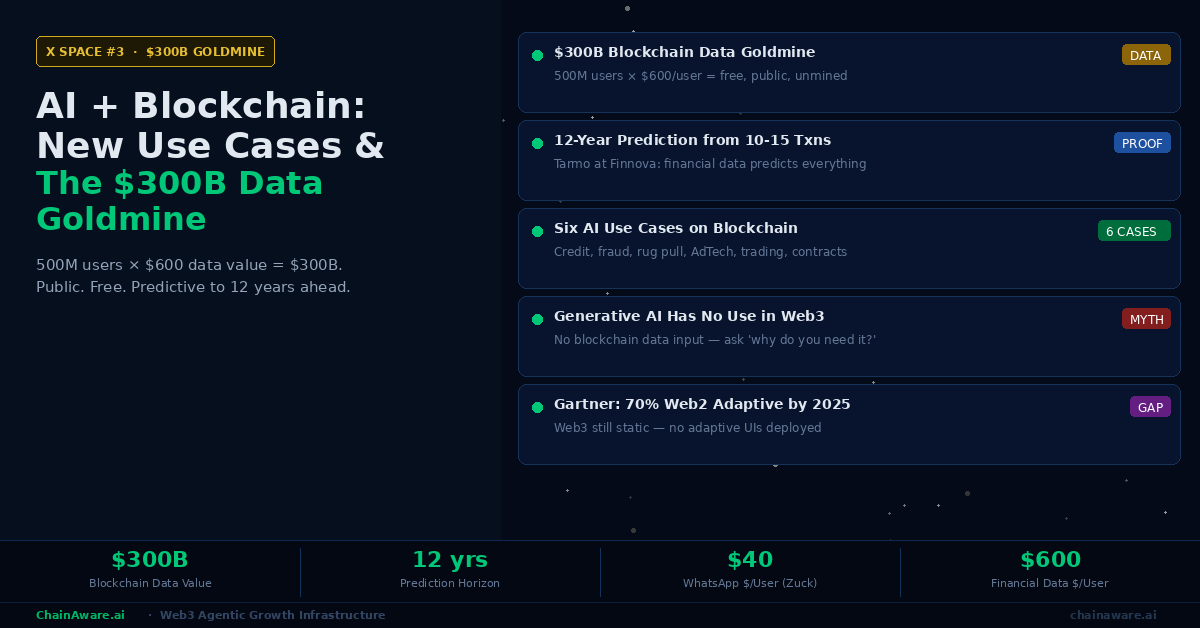
AI + Blockchain: New Use Cases and the $300 Billion Data Goldmine

X Space #3: AI + Blockchain — New Use Cases and the $300 Billion Data Goldmine. ChainAware co-founders Martin and Tarmo. Core thesis: 500 million crypto users × $600/user bank data value = $300B blockchain data goldmine sitting free and public on-chain. Six real AI use cases for blockchain: (1) fraud detection; (2) rug pull detection; (3) AdTech — 1:1 behavioral targeting; (4) trading signals; (5) credit scoring; (6) smart contract vulnerability analysis. Gartner prediction: 70% of Web2 applications will be adaptive by 2025 — Web3 is at 0%. Only 5-6 of 40+ CoinGecko AI projects have real production predictive models (not LLM wrappers). Predictive AI vs generative AI: ChatGPT generates text, cannot predict fraud or wallet behavior. Blockchain data quality advantage: gas fees filter casual behavior — financial transactions are deliberate, high-quality behavioral signals. Blockchain data is richer than Web2 browsing data and costs nothing to access. 50 million DeFi users vs 500 million total crypto users — the gap is trust and acquisition cost. ChainAware prediction engine: fraud detection (98% accuracy), rug pull detection, wallet behavioral profiling, marketing agents. Two innovations every technology needs: business process innovation + customer acquisition innovation. Web3 has only done the first. ChainAware Prediction MCP · 14M+ wallets · 8 blockchains · chainaware.ai