
Sybil attacks cost Web3 protocols billions every year. Sybil addresses accounted for 40% of tokens deposited to exchanges in the Aptos airdrop alone. DAO treasuries now hold $21.4 billion in liquid assets – and governance attacks have already stolen hundreds of millions, including $181 million from Beanstalk in a single transaction. The problem is structural: wallets can be generated endlessly and anonymously at near-zero cost, making Sybil attacks fundamentally easier in Web3 than in any other digital context.
In 2026, a competitive market of on-chain Sybil protection systems has emerged to address this threat. However, these systems vary dramatically in methodology, depth, and what they actually protect against. Furthermore, the most important question in the Sybil landscape is one that most providers never answer: what happens after you filter the Sybils? This guide compares every major on-chain behavioral Sybil protection provider, explains the structural limits of each approach, and introduces ChainAware’s unique position as the only provider that connects Sybil protection to behavioral intelligence, governance design, and DApp conversion.
In This Guide
- What Is a Sybil Attack in Web3?
- The Two On-Chain Behavioral Approaches
- Trusta Labs / TrustScan – AI/ML Graph Pattern Detection
- Nomis – Multi-Chain Activity Reputation
- RubyScore and ReputeX – Lightweight Reputation Filters
- The Structural Limitation All Providers Share
- ChainAware – Beyond Sybil Detection
- ChainAware’s Sybil-Specific Ready-Made Agents
- chainaware-governance-screener – Deep Dive
- Full Provider Comparison Table
- The Recommended Stack for 2026
- FAQ
What Is a Sybil Attack in Web3?
A Sybil attack occurs when a single actor creates multiple fake wallet identities to game systems designed to reward unique participants. The attack targets any mechanism that treats each wallet as a distinct person: airdrop distributions, governance votes, quadratic funding rounds, community reward programs, and IDO allocations. Because wallet generation costs nothing and requires no identity verification, Sybil attacks scale effortlessly in Web3.
Consequently, the damage is concrete and measurable. Researchers found Sybil addresses claimed 40% of Aptos tokens that subsequently dumped. Governance attacks exploiting low voter turnout – the average DAO sees just 17% participation – have extracted hundreds of millions from protocol treasuries. The top ten voters already control between 45% and 58% of voting power in Uniswap and Compound, making governance capture significantly easier than most participants assume. For a detailed look at how governance attacks unfold and which screeners detect them, see our Web3 Governance Screeners guide.
Therefore, effective Sybil protection has become a prerequisite for any protocol distributing tokens, running governance, or building community programs. The question in 2026 is not whether to use Sybil protection – it is which approach to use, and what that approach actually covers.
The Two On-Chain Behavioral Approaches
The on-chain Sybil protection market divides into two methodologically distinct approaches. Both operate permissionlessly and without requiring user action – no biometric scans, no credential collection, no KYC friction. Both analyze public blockchain data only. However, they answer different questions and carry different structural strengths and limitations.
Approach A – AI/ML Transaction Graph Pattern Detection: Analyzes the relational structure of wallet transaction graphs to identify coordinated Sybil clusters. The key insight is that Sybil wallets, regardless of how they behave individually, must be funded from a common source – and that funding structure leaves detectable graph-level signatures. Trusta Labs / TrustScan is the primary representative of this approach.
Approach B – Activity-Based Reputation Scoring: Measures historical activity volume, protocol diversity, wallet age, and cross-chain engagement as proxy signals for genuine participation. The underlying assumption is that genuine Web3 users accumulate multi-dimensional activity history over time, while Sybil wallets tend to be newer, less active, and less diverse. Nomis, RubyScore, and ReputeX represent this approach.
Both approaches produce useful Sybil signals. Neither is sufficient on its own, and critically, neither answers the question that determines whether your protocol actually grows: who is this wallet, what will they do next, and how do you convert them into a transacting user? For the broader context of how Sybil protection fits into the full wallet intelligence stack, see our Web3 Wallet Auditing Providers guide.
Free – No Signup Required
Audit Any Wallet Instantly – Full Behavioral Profile in 1 Second
Paste any wallet address and get the complete picture – fraud probability (98% accuracy), Sybil risk indicators, experience level, 12 intention probabilities, AML/OFAC status, Wallet Rank. Free, sub-second, no account needed. ETH, BNB, BASE, POLYGON, TON, TRON, HAQQ, SOL.
Trusta Labs / TrustScan – AI/ML Graph Pattern Detection
Trusta Labs is the most technically sophisticated pure on-chain Sybil detector available in 2026. Founded by ex-Alipay AI and security leaders, Trusta applies Graph Neural Networks (GCNs, GATs) and Recurrent Neural Networks (GRUs, LSTMs) to analyze wallet transaction graphs for four specific Sybil behavioral signatures.
The Four Sybil Attack Patterns TrustScan Detects
Star-like transfer graphs – one hub address funds many wallets in a spoke pattern, creating a distinctive radial topology in the transaction graph. Chain-like transfer graphs – sequential wallet funding where each wallet funds the next in a linear chain, a common pattern for automating multi-wallet creation. Bulk operations – coordinated timing patterns where multiple wallets execute the same transaction type within the same narrow time window. Similar behavior sequences – identical or near-identical transaction fingerprints across ostensibly separate wallets, revealing shared operational automation.
TrustScan produces a Sybil Score from 0 to 100 (higher equals more Sybil risk) plus a MEDIA Score across five dimensions: Monetary, Engagement, Diversity, Identity, and Age. The platform has analyzed 570 million wallets and integrated as a stamp in Gitcoin Passport (1.54 points per verified address) and as a credential in Galxe. Trusta ranks as the top Proof of Humanity provider on Linea and BSC, with 200K monthly active users.
TrustScan USP
The GNN approach models the relational structure between wallets – not just individual behavior but the network topology of how they were funded and operated. Consequently, this is genuinely difficult to fool at scale, because the attacker must maintain behavioral independence across thousands of wallets simultaneously. Battle-tested results across Celestia, Starknet, Manta, Plume, and major Gitcoin funding rounds demonstrate real-world effectiveness. Additionally, the permissionless approach means no user friction – any wallet can be scored without their knowledge or participation.
TrustScan Structural Limitations
First, the Sybil score is reactive – it detects patterns that have already formed. A brand-new wallet with no transaction history scores “Unknown,” not “Not Sybil,” which is precisely the profile of a Sybil wallet before it begins farming. Second, chain coverage is primarily EVM and TON, leaving significant gaps on Solana, Cosmos, and newer L1/L2 ecosystems. Third, output is a binary or scored gate – Trusta produces a risk score but no downstream deployment layer. The protocol team must build all governance tier logic, weight calculations, and conversion workflows themselves on top of the API. Finally, a determined Sybil operator spacing transactions carefully over time can reduce detection probability by avoiding the timing and graph signatures TrustScan targets. For how Sybil protection integrates with the broader governance security stack, see our Governance Screeners guide.
Nomis – Multi-Chain Activity Reputation
Nomis takes a different approach – measuring historical activity volume, protocol diversity, wallet age, and cross-chain engagement across 50+ chains using 30+ parameters. Rather than detecting coordination graph patterns, Nomis scores the richness and depth of a wallet’s on-chain history as a proxy for genuine participation. Output is a reputation score issued as an on-chain NFT attestation, making it portable across protocols and verifiable without re-querying the platform.
Nomis USP
Broadest chain coverage of any pure on-chain Sybil or reputation provider – 50+ chains versus Trusta’s EVM plus TON. The NFT attestation model gives portability: a wallet earning a high Nomis score on one protocol can present it to another without reverification. Moreover, Nomis works well for multi-chain campaigns where single-chain analysis would miss cross-chain behavioral context. According to Nomis’s platform documentation ↗, the scoring model weighs recent activity more heavily than older history, reducing the effectiveness of pre-aged Sybil wallets.
Nomis Structural Limitations
Nomis measures quantity of activity rather than quality. A wallet making 500 low-value token swaps over three years earns a high Nomis score – but that history tells you nothing about whether the wallet will engage with your DeFi lending protocol. Furthermore, Nomis has no behavioral pattern detection capability. A Sybil operator spacing transactions across time and chains can accumulate a high Nomis score while still being a coordinated farm wallet. Additionally, the score reflects only the past – no forward-looking behavioral predictions or intention signals exist in the output. Finally, Nomis has no growth or conversion layer – their job ends at the eligibility gate. For a comprehensive comparison of Nomis against other Web3 reputation scoring platforms, see our Web3 Reputation Score Comparison.
RubyScore and ReputeX – Lightweight Reputation Filters
RubyScore provides activity quality scoring using transaction volume and diversity as proxy signals for genuine engagement – a simpler methodology than Nomis with fewer parameters and faster integration. As a result, it works well as an entry-level Sybil filter for projects that need a lightweight reputation gate without the analytical depth of Trusta or Nomis. Traffic quality improves noticeably over unfiltered campaigns, making RubyScore a practical starting point for smaller teams with limited engineering resources.
ReputeX takes a philosophically different stance – explicitly positioning around a “fusion approach” combining multiple behavioral paradigms rather than betting on a single methodology. The underlying thesis is sound: different Sybil attack patterns require different detection approaches, and a system combining multiple signals is more resilient against sophisticated operators than any single methodology. However, ReputeX remains early-stage with limited production deployment evidence. The fusion approach therefore promises more than it has currently demonstrated at scale.
Both RubyScore and ReputeX share all the structural limitations of the activity-based approach: they describe past behavior, produce binary gates, and provide no downstream intelligence about wallet quality, future intentions, or conversion probability. Neither has a governance-specific output, a growth layer, or an MCP integration for AI agents.
The Structural Limitation All Providers Share
Every provider above – Trusta, Nomis, RubyScore, ReputeX – answers a version of the same question: “Has this wallet demonstrated enough genuine on-chain history to be considered non-Sybil?” This is a necessary question. However, it is not a sufficient one, and it has two structural blind spots that no methodology improvement within this paradigm can resolve.
Blind Spot 1: The Timing Problem
Sybil attacks unfold in two phases: first the farm phase, where the attacker builds minimal on-chain history to pass screening thresholds, then the exploit phase, where they claim rewards and disappear. All current Sybil providers screen for wallets that look suspicious based on existing history. By the time a wallet has enough history to be definitively flagged, the exploit has often already occurred. A brand-new wallet with no history scores “Unknown” on Trusta, scores low on Nomis, and passes most eligibility thresholds – because it has no detectable Sybil fingerprint yet. Paradoxically, the very wallets most likely to be new Sybil wallets are the ones these systems find hardest to flag.
Blind Spot 2: The Quality Gap
Even a wallet passing every Sybil check – genuine, non-coordinated, with sufficient activity history – may still be a low-quality participant who will never transact meaningfully with your protocol. Sybil resistance proves uniqueness. It says nothing about intent, behavioral quality, or conversion probability. A non-Sybil wallet with Low Lend intention on a DeFi lending protocol will not convert regardless of how clean its history is. Yet no Sybil provider surfaces this signal – they confirm this wallet is probably one real person and leave everything else to you. For how on-chain behavioral intelligence closes this gap, see our Intention Analytics guide and our Web3 Reputation Score Comparison.
Sybil Detection + Behavioral Intelligence – One Stack
ChainAware Prediction MCP – Screen Any Wallet via Natural Language
Your AI agent asks “Is this wallet a Sybil risk?” and gets fraud probability, AML status, 12 intention scores, experience level, and Wallet Rank in under 100ms. Pre-computed. No blockchain expertise required. Compatible with Claude, GPT, and any MCP-compatible LLM. 32 open-source MIT agents on GitHub.
ChainAware – Beyond Sybil Detection
ChainAware operates in the same purely on-chain, permissionless, privacy-preserving space as these providers – but answers fundamentally different questions. Rather than focusing narrowly on Sybil risk, ChainAware delivers a complete behavioral intelligence layer that starts where Sybil detection ends. Specifically, ChainAware answers five questions that no Sybil provider addresses:
1. Quality Beyond Uniqueness – Wallet Rank
Trusta confirms this wallet is probably not coordinating with fake wallets. Nomis confirms this wallet has accumulated activity. ChainAware’s Wallet Rank answers a completely different question: is this wallet a high-quality participant who is likely to engage genuinely with your protocol? A wallet can pass every Sybil check and still rank low on behavioral quality dimensions – shallow activity, concentrated in low-value interactions, no meaningful protocol engagement. Wallet Rank surfaces this distinction immediately. For the complete Wallet Rank methodology, see our Wallet Rank Complete Guide.
2. Forward-Looking Intent – 12 Intention Probabilities
Every Sybil provider describes the past. ChainAware predicts the future. Twelve intention probabilities – Borrow, Lend, Trade, Gamble, NFT, Stake ETH, Yield Farm, Leveraged Staking, Leveraged Staking ETH, Leveraged Long ETH, Leveraged Long Game – are ML predictions trained on 18M+ behavioral profiles. A wallet with High Lend intention is operationally more valuable to a lending protocol than one that merely passes the Sybil check, because a non-Sybil wallet with Low Lend intention will not convert regardless of how clean its history is. No competitor provides this signal. For how intention probabilities drive DApp conversion, see our DeFi Onboarding guide.
3. Fraud Prediction – Broader Than Sybil, Forward-Looking
ChainAware’s fraud prediction model achieves 98% accuracy against CryptoScamDB and covers a broader threat surface than pure Sybil detection. Sybil detection identifies wallets farming your airdrop. ChainAware’s fraud detection identifies wallets likely to commit financial crime – phishing operators, stolen fund recyclers, fake KYC actors, darknet-linked wallets, honeypot deployers, money launderers. Many high-risk wallets have clean transaction graphs that pass Trusta screening but exhibit fraud probability signals ChainAware catches through 19 forensic detail categories: cybercrime, money laundering, darkweb transactions, phishing activities, fake KYC, stealing attacks, mixer interactions, sanctioned addresses, malicious mining, fake tokens, and more. For the complete fraud detection methodology, see our Fraud Detector guide.
4. AML and OFAC Compliance – Absent From Every Sybil Provider
Trusta, Nomis, RubyScore, and ReputeX are all Sybil prevention tools. None screens for AML exposure, OFAC sanctions, or financial crime risk in the regulatory sense. ChainAware’s AML layer addresses the compliance requirement that MiCA and equivalent frameworks impose on DeFi protocols – screening every connecting wallet against sanctions lists and financial crime indicators automatically, without a compliance team in the loop. This covers a threat surface that Sybil providers entirely ignore. For the complete DeFi compliance use case including AML and MiCA requirements, see the DeFi Compliance use case guide. According to FATF’s Virtual Asset guidance ↗, DeFi protocols with governance or token distribution mechanisms face specific AML obligations that pure Sybil screening cannot satisfy. For the full MiCA compliance framework, see our MiCA Compliance guide.
5. The Growth and Conversion Layer – Unique in the Market
Every Sybil provider’s output is a gate: pass or fail for campaign eligibility. ChainAware’s Growth & Marketing Agents take the behavioral intelligence – Wallet Rank, 12 intention probabilities, experience level, risk profile – and deploy it into DApp UI at wallet connection, personalizing content and CTAs in real time. Additionally, the Prediction MCP delivers behavioral predictions to any AI agent in a single natural language tool call. No Sybil provider has built any equivalent downstream capability – their job ends at the screening gate. For how ChainAware’s growth layer drives conversion from Sybil-filtered traffic, see our ChainAware Business Guide and our Web3 Analytics Tools Comparison.
ChainAware’s Sybil-Specific Ready-Made Agents
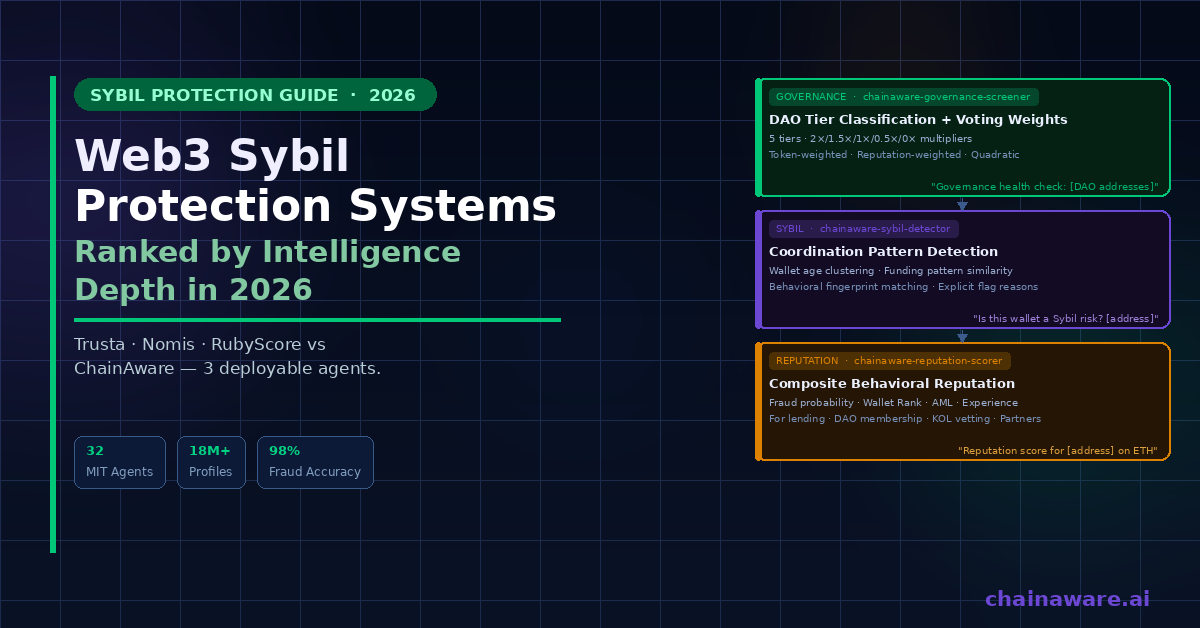
Here is the most significant competitive distinction that the comparison tables above understate: Trusta, Nomis, and RubyScore all ship API scores. ChainAware ships 32 ready-made open-source MIT-licensed agents that any team deploys via git clone and an API key – with no custom engineering required. The deployment gap between “score API” and “deployable agent” is the difference between a tool and a complete system. Three agents directly address Sybil protection use cases.
chainaware-sybil-detector
Standalone Sybil detection agent (see Security & Fraud Agents) for general use cases beyond governance – airdrop screening, campaign eligibility gating, counterparty vetting, and partnership due diligence. Rather than returning a raw score, the agent produces a structured Sybil assessment combining fraud probability from predictive_fraud with behavioral pattern analysis from predictive_behaviour. Output explicitly surfaces coordination signals – wallet age clustering, funding pattern similarity, behavioral fingerprint matching – with human-readable flag explanations rather than just a score number. This makes the output immediately actionable without requiring an analyst to interpret what a score of 73 means in context.
chainaware-reputation-scorer
Composite wallet reputation agent producing a structured assessment across five dimensions simultaneously: fraud probability, behavioral quality, experience level, AML status, and Wallet Rank. Designed specifically for use cases where a simple pass/fail Sybil gate is insufficient – undercollateralized lending protocols, DAO membership tiers, partnership vetting, KOL wallet verification, and counterparty due diligence. The agent combines what Nomis does (activity-based reputation) with what ChainAware’s fraud layer does (forward-looking fraud detection) into a single unified output – without requiring separate API calls to multiple providers. For how on-chain reputation scoring applies to DeFi credit decisions, see our Web3 Credit Scoring guide.
chainaware-airdrop-screener
Purpose-built for airdrop and IDO Sybil filtering at campaign level – screening wallet lists to identify bot farms, coordinated farm wallet clusters, and low-quality airdrop farmers before distribution. For the complete framework of Sybil-resistant token distribution design from first principles, including how to structure eligibility criteria that professional farm wallets cannot satisfy, see the Sybil-Resistant Token Distribution use case guide. The agent processes lists of addresses and returns a tiered eligibility assessment, identifying which wallets should receive full allocation, reduced allocation, or disqualification. Consequently, teams run the screener on their entire eligible wallet list before the distribution event rather than relying on post-distribution forensics. For how airdrop scam screening differs from Sybil filtering in airdrop campaigns, see our Airdrop Scam Screeners guide.
chainaware-governance-screener – The Most Advanced Governance Sybil Tool Available
The chainaware-governance-screener represents the most sophisticated governance-specific Sybil protection tool in the market – and nothing comparable exists from any competing provider. Running on claude-haiku-4-5-20251001 and using both predictive_fraud and predictive_behaviour MCP tools simultaneously, the agent does not merely flag suspected Sybils. Instead, it classifies every DAO member into a behavioral tier, calculates their voting weight multiplier, detects coordinated Sybil clusters, and produces a full governance health score – all from a single natural language prompt.
The Five Governance Tiers
| Tier | Voting Weight | Criteria |
|---|---|---|
| Core Contributor | 2× | Veteran wallet, high experience, clean AML, multi-DAO participation history |
| Active Member | 1.5× | Intermediate+ experience, active protocol engagement, legitimate wallet |
| Participant | 1× | Basic eligibility, legitimate wallet, meets minimum activity threshold |
| Observer | 0.5× | Low experience, below participation threshold but not suspicious |
| Disqualified | 0× | Fraud flags, Sybil detection, bot indicators, recent wallet creation |
Three Governance Models Supported
Token-weighted governance, reputation-weighted governance, and quadratic governance models are all natively supported. Specifying the governance model in the prompt adjusts how the agent calculates weight multipliers and flags concentration risks. Quadratic governance detection, for example, specifically surfaces scenarios where many low-quality wallets could collectively accumulate outsized influence – a Sybil attack vector unique to quadratic voting that standard token-weighted analysis misses entirely.
What the Output Looks Like
For a clean veteran wallet, the agent produces:
GOVERNANCE SCREENING - Wallet: 0xVoter... | Ethereum
Governance Model: Reputation-weighted

Tier: ✅ Core Contributor | Voting Weight: 2×
Sybil Risk: None detected

Experience: Veteran (3.6 years on-chain)
Fraud risk: Very Low (0.03) | AML: Clean
Governance history: 12 prior votes across 4 DAOs

→ Full voting rights. Eligible for governance committee nomination.
For a detected Sybil wallet, the output provides:
Tier: 🚫 DISQUALIFIED | Voting Weight: 0×
Sybil Risk: HIGH

- Wallet created 8 days ago ⚠️
- 3 similar wallets with near-identical creation patterns detected ⚠️
- Token balance acquired in single transaction (typical Sybil pattern) ⚠️
- No prior governance participation

→ Block from voting. Flag the 3 related addresses for review.
For an entire DAO screened in one prompt, the governance health report surfaces:
GOVERNANCE HEALTH CHECK - 200 wallets | Ethereum

Core Contributors:  28 (14%) - 2× weight
Active Members:     61 (31%) - 1.5× weight
Participants:       74 (37%) - 1× weight
Observers:          22 (11%) - 0.5× weight
Disqualified:       15 (8%)  - 0× weight

Governance Health Score: 72/100 - Good
⚠️ 4 address clusters detected (possible coordinated Sybil attack)
⚠️ 15% of voting weight concentrated in 3 wallets (centralisation flag)
→ Recommend: minimum 90-day wallet age for new membership applications
Critically, no engineering work is required beyond cloning the agent from GitHub and configuring an API key. A DAO team can run this analysis before every governance vote using a natural language prompt – something that would require weeks of custom development to replicate using Trusta or Nomis APIs alone. For why DAO treasury governance security has become the most important Sybil protection use case in 2026, see our Governance Screeners guide and our Web3 Agentic Economy guide.
Deploy in Minutes – No Custom Build Required
32 Ready-Made Agents – Including Governance Screener, Sybil Detector, Airdrop Screener
Clone from GitHub, add your API key, and your agent has native Sybil detection, governance tier classification, airdrop screening, fraud detection, and AML compliance in natural language. MIT-licensed. Open source. No vendor lock-in. Works with Claude, GPT, and any MCP-compatible LLM. Full catalogue at the Prediction MCP documentation.
Full Provider Comparison Table
| Capability | Trusta TrustScan | Nomis | RubyScore | ChainAware |
|---|---|---|---|---|
| Sybil detection method | GNN/RNN graph pattern analysis | Activity volume scoring | Activity quality scoring | Behavioral ML + 19-category forensic layer |
| Fraud probability (forward-looking) | ❌ | ❌ | ❌ | ✅ 98% accuracy |
| AML / OFAC screening | ❌ | ❌ | ❌ | ✅ Full forensic detail layer |
| Intention prediction | ❌ | ❌ | ❌ | ✅ 12 intention probabilities |
| Behavioral quality score | Partial (MEDIA 5 dimensions) | Partial (activity volume) | Partial (activity quality) | ✅ Wallet Rank + 22 dimensions |
| Governance Sybil screening | ❌ | ❌ | ❌ | ✅ chainaware-governance-screener |
| Governance tier classification | ❌ | ❌ | ❌ | ✅ 5 tiers (Core/Active/Participant/Observer/Disqualified) |
| Voting weight multipliers | ❌ | ❌ | ❌ | ✅ 2×/1.5×/1×/0.5×/0× |
| Quadratic governance support | ❌ | ❌ | ❌ | ✅ Native model support |
| DAO health score (population) | ❌ | ❌ | ❌ | ✅ Single prompt, full DAO |
| Airdrop Sybil screening agent | API only | API only | API only | ✅ chainaware-airdrop-screener |
| Standalone Sybil detection agent | ❌ | ❌ | ❌ | ✅ chainaware-sybil-detector |
| Reputation scoring agent | ❌ | ❌ | ❌ | ✅ chainaware-reputation-scorer |
| Ready-made deployable agents | ❌ | ❌ | ❌ | ✅ 32 MIT open-source agents |
| Custom engineering required | ✅ Significant | ✅ Significant | ✅ Moderate | ❌ git clone + API key |
| MCP / AI agent native | ❌ | ❌ | ❌ | ✅ 6 MCP tools |
| Growth / conversion layer | ❌ | ❌ | ❌ | ✅ Growth Agents |
| Token holder quality | ❌ | ❌ | ❌ | ✅ Token Rank |
| Chain coverage | EVM + TON | 50+ chains | EVM-focused | ETH/BNB/BASE/POL/TON/TRON/HAQQ/SOL |
| Wallets analyzed / profiles | 570M wallets scored | 50+ chain coverage | EVM activity | 18M+ behavioral profiles |
| Free individual lookup | Partial | Partial | Partial | ✅ Full Wallet Auditor free |
| Pricing | Freemium → API | Freemium → NFT | Freemium | Freemium → API tiers |
The Recommended Stack for 2026
The right framing for ChainAware’s position against on-chain Sybil providers is not “a better Sybil detector” – it is “the layer that starts where Sybil detection ends.” Trusta and Nomis are useful campaign-gate tools. ChainAware is the behavioral intelligence, governance design, and conversion layer that follows. Together they provide complete coverage; separately, each leaves critical gaps.
For Airdrop and Token Distribution Campaigns
Run Trusta or Nomis at the campaign gate for population-level Sybil filtering – both are battle-tested specifically for this use case. Then apply ChainAware’s chainaware-airdrop-screener as a secondary quality layer, filtering eligible wallets by Wallet Rank and behavioral profile to ensure your distribution rewards genuine high-quality community members rather than simply non-Sybil wallets. Additionally, use ChainAware Fraud Detector to screen for AML exposure among eligible addresses – a compliance layer no Sybil provider covers. For how to design Sybil-resistant token distribution from first principles, see our Rug Pull Detection guide and our Wallet Rank guide.
For DAO Governance Protection
Deploy chainaware-governance-screener before every governance vote via a simple natural language prompt listing all voter addresses and specifying your governance model. The agent handles the complete workflow autonomously: Sybil detection, tier classification, weight calculation, cluster identification, health scoring, and specific recommendations. No engineering resources required after initial setup. Schedule it as a pre-vote automated check that runs 24 hours before any proposal closes. For the governance attack patterns this prevents and the real-world stakes involved, see our Governance Screeners guide.
For DApp Real-Time Wallet Screening
Use the Prediction MCP at wallet connection for sub-100ms Sybil and fraud screening of every connecting wallet before they interact with your protocol. The predictive_fraud tool returns fraud probability, forensic flags, and AML status. The predictive_behaviour tool returns the full Web3 Persona – experience level, intentions, risk profile, Wallet Rank. Together they give you both Sybil protection and the behavioral intelligence needed to personalize the DApp experience for every non-Sybil wallet that passes through. Combine with Growth Agents to automatically serve personalized content and CTAs based on the persona – turning Sybil-filtered traffic into transacting users. For the full AI agent integration architecture, see our 12 Blockchain Capabilities guide and our Web3 Agentic Economy guide.
ChainAware.ai – The Complete Sybil Protection Stack
Sybil Detection Tells You Who to Block. ChainAware Tells You Who to Trust – and Converts Them.
Free Wallet Auditor for individual lookups. 32 ready-made MIT agents for automated workflows. Prediction MCP for AI agent pipelines. Growth Agents for DApp conversion. One stack. No custom build required.
Frequently Asked Questions
What is the difference between Sybil detection and fraud detection?
Sybil detection identifies wallets that are likely controlled by the same actor – specifically targeting multi-wallet farming of airdrops, governance votes, and incentive programs. Fraud detection identifies wallets likely to commit financial crime – phishing operations, money laundering, stolen fund cycling, sanctioned addresses, darknet interactions. These threat surfaces overlap but are not identical. A sophisticated phishing operator typically uses unique, non-coordinated wallets that pass Sybil detection while scoring high on fraud probability. Conversely, an airdrop farmer might use obviously Sybil-pattern wallets that have no financial crime history. Comprehensive protection therefore requires both layers simultaneously – Sybil detection for campaign integrity and fraud detection for financial security. ChainAware’s chainaware-fraud-detector and chainaware-sybil-detector agents address both in a single deployable stack.
Can TrustScan detect all Sybil attacks?
Trusta’s GNN approach is genuinely effective at detecting the four coordination graph patterns it targets – star-like funding, chain-like funding, bulk operations, and similar behavior sequences. However, it has documented limitations. First, it cannot flag wallets with no prior transaction history, which includes all newly created Sybil wallets before the farming phase begins. Second, a sophisticated operator spacing transactions carefully over time and across chains can reduce their graph signature below detection thresholds. Third, Trusta’s coverage is primarily EVM and TON – projects on Solana, Cosmos, or newer chains face gaps. For the most robust protection, combining Trusta’s graph analysis with ChainAware’s behavioral fraud probability creates a more complete detection surface than either approach alone.
Is chainaware-governance-screener suitable for small DAOs?
Yes – the agent scales from individual wallet queries (“Should this wallet be allowed to vote?”) through batch processing of entire DAO member lists via a single prompt. Small DAOs with 20-50 members benefit immediately from the five-tier classification and voting weight recommendations without any custom engineering. Larger DAOs with hundreds or thousands of members can run the full governance health check before every major vote, receiving Sybil cluster detection, concentration flags, and specific recommendations in one output. The natural language interface means no technical expertise is required after the initial GitHub clone and API key configuration. For the governance attack patterns the screener prevents, see our Governance Screeners guide.
Why do Nomis and Trusta score the same wallet differently?
Nomis and Trusta measure fundamentally different things. Nomis scores how much activity a wallet has accumulated across its history – volume, diversity, age, and cross-chain engagement. Trusta scores how suspicious a wallet’s transaction graph topology looks – coordination patterns, similar behavior sequences, and bulk operations. A wallet can score high on Nomis (old, active, diverse) while scoring high on Trusta Sybil risk (because its funding pattern matches a hub-and-spoke Sybil cluster). Conversely, a wallet can score low on Nomis (young, limited activity) while having a clean Trusta score (because its transaction graph shows no coordination). These scores are complementary rather than redundant – using both reduces false positives while increasing detection coverage across different attack vectors.
How does ChainAware’s fraud probability differ from a Sybil score?
A Sybil score measures whether a wallet appears to be one of many controlled by the same actor – primarily a campaign integrity question. ChainAware’s fraud probability (98% accuracy, 0.00-1.00 scale) measures whether a wallet is likely to commit financial crime – a security and compliance question. The fraud model covers 19 forensic categories including phishing activities, money laundering, darkweb transactions, fake KYC, mixer interactions, sanctioned addresses, stealing attacks, malicious mining, fake tokens, and honeypot associations. Many high-risk fraud wallets have clean Sybil profiles because they operate as genuinely unique wallets – just wallets engaged in financial crime. ChainAware’s fraud layer catches this threat surface entirely separately from any Sybil signal.
Can the chainaware-governance-screener handle quadratic voting?
Yes – quadratic governance is a first-class supported model alongside token-weighted and reputation-weighted governance. Specifying “governance model: quadratic” in the prompt adjusts how the agent calculates weight multipliers and surfaces concentration risks. Specifically, quadratic governance introduces a Sybil attack vector unique to that model: many low-quality wallets can collectively accumulate outsized influence even without individually controlling large token positions. The governance screener flags this pattern explicitly – identifying when a significant number of Observer-tier wallets collectively represent a concentration risk under quadratic rules, even if none of them individually trigger Sybil flags. This is a governance design insight that no other tool in the market surfaces automatically. For how DAO governance attacks exploit structural weaknesses in voting mechanisms, see our Governance Screeners guide.
What does ChainAware cover that pure Sybil providers miss?
Five capabilities are entirely absent from Trusta, Nomis, and RubyScore. First, forward-looking behavioral predictions – 12 intention probabilities predicting what a wallet will do next (Borrow, Lend, Trade, Gamble, NFT, Stake ETH, Yield Farm, and six Leveraged variants). Second, AML and OFAC compliance screening across 19 forensic categories – a regulatory requirement that Sybil prevention tools don’t address. Third, governance tier classification with voting weight multipliers – turning Sybil screening into a governance design tool. Fourth, ready-made deployable agents – 32 MIT open-source agents deployable via git clone versus APIs requiring custom integration. Fifth, a growth and conversion layer – Growth Agents and the Prediction MCP that turn screened traffic into transacting users, not just filtered lists. For the complete product overview, see our ChainAware Complete Product Guide.
External sources: FATF Virtual Asset Recommendations ↗ · Nomis Platform Documentation ↗ · Trusta Labs / TrustScan ↗ · ChainAware Behavioral Prediction MCP – GitHub ↗ · Anthropic Model Context Protocol ↗