Web3 AI Transaction Monitoring Agent: Why Every VASP Needs It Now

Every VASP needs transaction monitoring – but most rely on static tools and manual review that miss behavioral fraud. Based on an X Space recap, this guide covers how ChainAware’s AI Transaction Monitoring Agent runs 24/7, integrates via GTM with no engineering, and acts automatically on detection via shadow ban, full ban, or Telegram alert.

AI-Based Wallet Audit: How Blockchain History Becomes Your Personal Brand in Web3

Blockchains are transparent at the transaction level but participants are anonymous – enabling scams, rug pulls, and social engineering. ChainAware Wallet Auditor solves this: a full behavioral profile of any wallet in one second. This X Space recap covers how on-chain history becomes personal brand and verifiable trust in Web3.

AI-Based Predictive Fraud Detection in Web3: The Missing Key to Mainstream Adoption

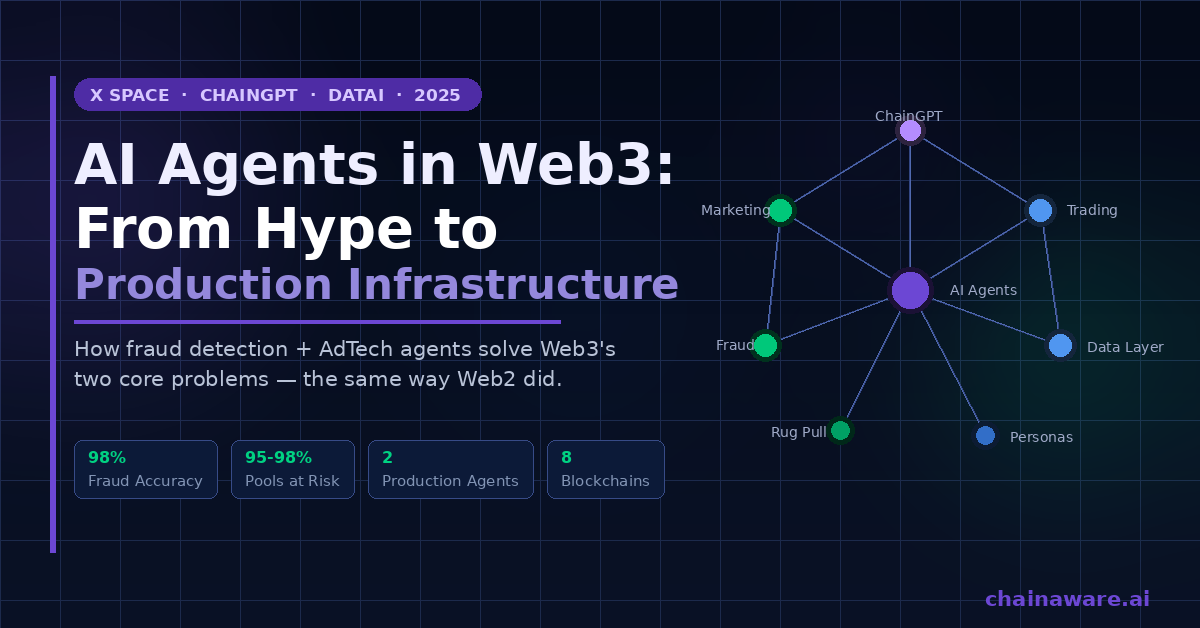
Web3 fraud costs the industry billions annually and keeps mainstream users away. Static rule-based detection systems fail – bypassed within days, 30-70% false positive rates. This guide explains how AI-based predictive fraud detection works, why it is the missing key to mainstream Web3 adoption, and how ChainAware’s ML models achieve 98% accuracy in real time.

AI-Based Predictive Rug Pull Detection: Why Static Analysis Fails and Behavioral AI Wins

Static smart contract analysis fails against professional rug pull operators who deliberately write clean code. Behavioral AI catches what code scanners miss – by reading the on-chain history of the people behind the contract. This guide explains why behavioral prediction beats static analysis for rug pull detection and how ChainAware’s V3 model achieves 90.1% accuracy.

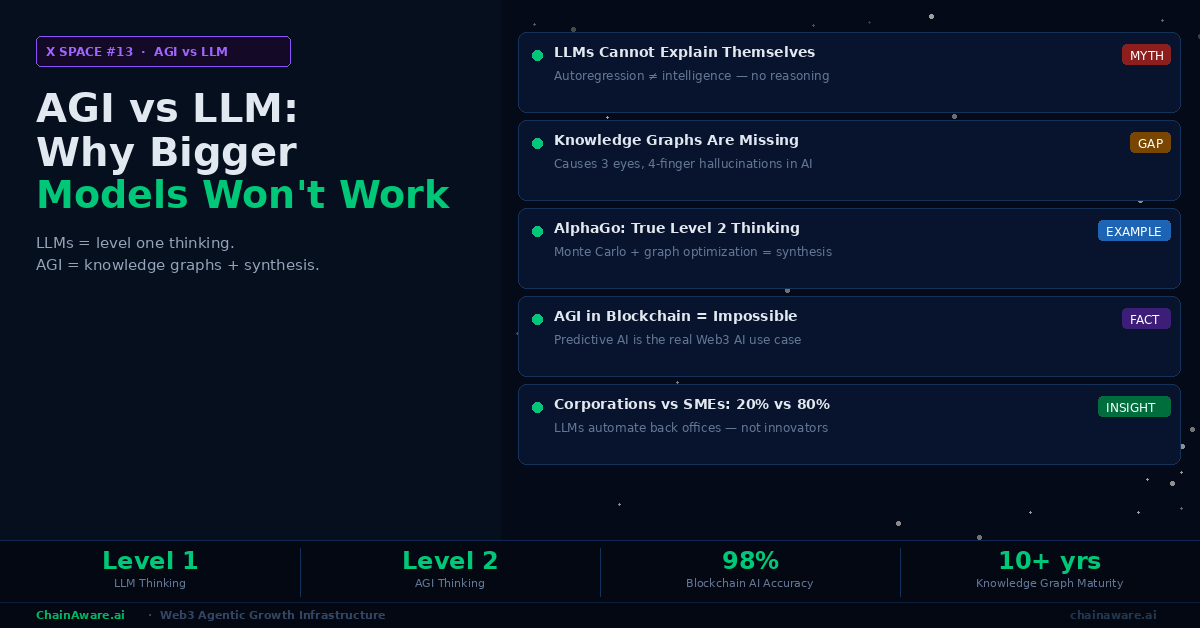
AGI vs LLM: Why Bigger Models Won’t Get Us to Artificial General Intelligence

AGI does not exist and scaling LLMs will not produce it. X Space with ChainAware co-founders Martin and Tarmo explains why this distinction matters for Web3 founders and investors evaluating AI projects – and how to separate real utility AI from AGI hype that inflates valuations without delivering measurable results.

Vitalik’s AI and Crypto Paper: A Use-Case Reality Check – What Actually Works on Blockchain

Vitalik Buterin correctly identifies fraud detection and on-chain security as the highest-value AI and blockchain convergence – but underestimates what is already live and deployable today. X Space #11 with ChainAware co-founders Martin and Tarmo analyses Vitalik’s essay use case by use case and maps what is real versus what remains theoretical.

AI + Blockchain: Winning Use Cases That Actually Work

Six high-value AI and blockchain use cases that actually work – all requiring predictive AI trained on on-chain data, none solvable with generative AI wrappers. X Space #7 with ChainAware co-founders Martin and Tarmo covers fraud detection, rug pull prediction, wallet auditing, personalized growth, credit scoring, and transaction monitoring.

Generative AI Is for Web2. Predictive AI Is for Web3.

Generative AI creates content. Predictive AI solves Web3’s core problems of fraud and mass marketing. These are not competing tools – they serve completely different purposes. X Space #6 with ChainAware co-founders Martin and Tarmo explains the distinction every Web3 founder needs to understand before evaluating any AI project or investment.

Generative AI vs Predictive AI on Blockchain: Where Is the Competitive Edge?

The single most important diagnostic question for any blockchain AI project: does it use generative AI or predictive AI? Only predictive AI creates defensible competitive advantage in Web3. X Space #5 with ChainAware co-founders Martin and Tarmo covers where the competitive edge actually lies and how to evaluate any AI project against this framework.

Speeding Up Web3 Growth: Real-Time Fraud Detection and 1:1 Marketing

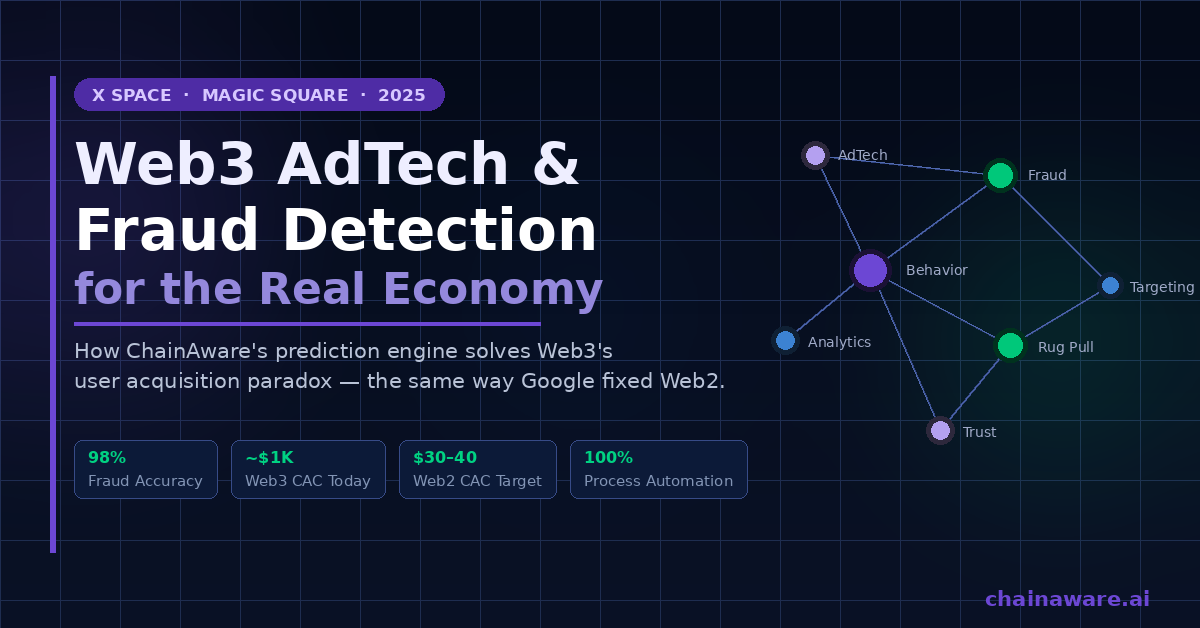
Web3 cannot grow at scale without solving two structural problems simultaneously: fraud and mass marketing. X Space #4 with ChainAware co-founders Martin and Tarmo covers why the 2-3% annual DeFi hack rate has held constant for four years despite billions invested in security – and how real-time fraud detection combined with 1:1 marketing breaks the cycle.