
Last Updated: March 2026
Web3 has a trust problem. Every day, DeFi protocols make decisions about wallets they know nothing about — granting governance votes, distributing airdrop allocations, setting collateral ratios — based on nothing more than a wallet address. The wallet connecting to your protocol could be a five-year DeFi veteran, a brand-new bot, or a sanctioned address moving laundered funds. Without a reputation layer, you cannot tell the difference.
In 2026, a competitive market of Web3 reputation scoring tools has emerged to solve this. This article compares every major platform — Nomis, RubyScore, Ethos Network, Cred Protocol, UTU Trust, Whitebridge, and ChainAware — across the dimensions that actually matter for protocols making real decisions: what data they use, how the score is calculated, whether fraud signals are included, and whether the score is accessible programmatically for AI agents and DeFi automation.
The short version: most competitors measure what a wallet has done. ChainAware measures what it is likely to do next — and whether it’s safe to let it do it.
In This Article
- Why Web3 Needs Wallet Reputation Scoring
- ChainAware’s Two-Layer Approach: Wallet Rank + Reputation Score
- The ChainAware Reputation Formula Explained
- Nomis
- RubyScore
- Ethos Network
- Cred Protocol
- UTU Trust
- Whitebridge
- Full Comparison Table
- ChainAware USPs: What No Competitor Offers
- Use Case Verdicts by Protocol Type
- FAQ
Why Web3 Needs Wallet Reputation Scoring
Traditional finance has credit scores, KYC/AML checks, and decades of counterparty risk infrastructure. Web3 has wallet addresses — pseudonymous, permissionless, and entirely opaque to most protocols making decisions about them.
The consequences are measurable. According to TRM Labs’ 2025 Crypto Crime Report, illicit crypto volume exceeded $158 billion in 2025. Sybil attacks on airdrops cost protocols millions in misallocated tokens. Governance manipulation by coordinated wallet farms has distorted protocol decisions at Uniswap, Compound, and others. Meanwhile, legitimate high-value users — experienced DeFi participants with strong on-chain histories — receive the same generic experience as a wallet created yesterday.
Wallet reputation scoring addresses all of these problems at once. A reliable, real-time reputation signal at the point of wallet connection lets protocols:
- Gate governance participation to verified long-term participants
- Allocate airdrops proportionally to genuine engagement rather than Sybil farms
- Set dynamic collateral ratios based on borrower quality
- Personalize onboarding and product experience by user sophistication
- Screen out fraud and sanctioned wallets before first transaction
The question is not whether to use reputation scoring — it’s which system to trust, and whether it actually measures what matters for your use case. As covered in our complete KYT and AML guide for DeFi, trust infrastructure is becoming a regulatory requirement, not just a growth optimization.
Free Wallet Reputation Check
Audit Any Wallet’s Reputation in 30 Seconds — Free
ChainAware’s Wallet Auditor generates a complete behavioral reputation profile for any wallet address — experience level, risk profile, fraud probability, intentions, and Wallet Rank. 14M+ wallets. 8 blockchains. No signup required.
ChainAware’s Two-Layer Approach: Wallet Rank + Reputation Score
ChainAware is the only platform in this comparison that offers two distinct but complementary reputation products. Understanding the relationship between them is essential before comparing against competitors.
Layer 1: Wallet Rank — The Behavioral Intelligence Foundation
Wallet Rank is ChainAware’s core behavioral intelligence score — a 0–100 composite synthesizing ten on-chain parameters for any wallet across 8 blockchains:
- Risk Willingness — how aggressively does this wallet engage with on-chain risk?
- Experience Level (1–5) — how sophisticated is this wallet’s DeFi history?
- Risk Capability — what level of financial risk can this wallet absorb?
- Predicted Trust — fraud probability score at 98% accuracy
- Intentions — forward-looking behavioral prediction (Prob_Trade, Prob_Stake, etc.)
- Transaction Categories — which protocol categories has this wallet used?
- Protocol Diversity — breadth of DeFi ecosystem engagement
- AML Analysis — anti-money laundering behavioral signals
- Wallet Age — time-in-ecosystem signal
- Balance — economic capacity signal
Wallet Rank is the intelligence layer — it tells you everything about who a wallet is. It powers the Web3 Behavioral User Analytics dashboard, the Token Rank tool, and the personalization engine behind ChainAware’s Growth Agents.
Layer 2: Reputation Score — The Protocol-Ready Decision Output
The ChainAware Reputation Score takes three of the most decision-relevant signals from Wallet Rank and collapses them into a single 0–4000 numeric score optimized for protocol-level decisions: governance weighting, lending collateral ratios, airdrop allocation, and allowlist ranking.
Most competitors produce one of these two things. ChainAware produces both — giving protocols the full intelligence picture (Wallet Rank) and the actionable decision number (Reputation Score) in the same API call.
The ChainAware Reputation Formula Explained
The Formula
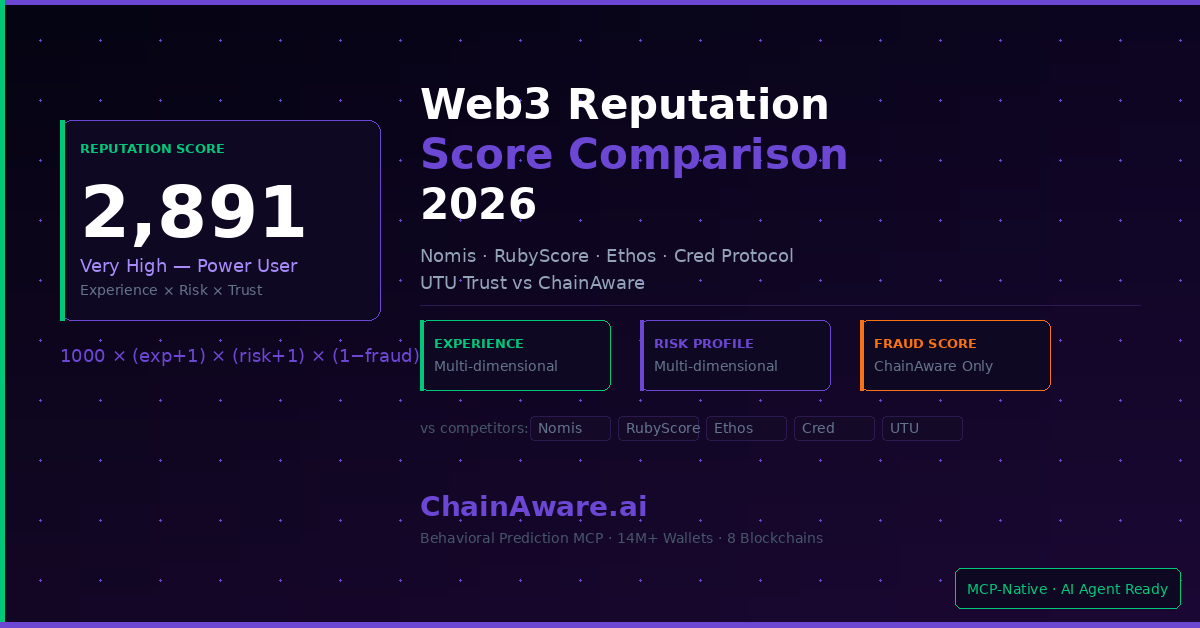
Score = 1000 × (experience + 1) × (risk + 1) × (1 − fraud)
| Variable | Source | Range |
|---|---|---|
experience |
experience.Value ÷ 100 | 0.00 – 1.00 |
risk |
riskProfile category (Conservative→0.10 … Very Aggressive→0.90) | 0.00 – 1.00 |
fraud |
probabilityFraud from predictive_fraud MCP tool | 0.00 – 1.00 |
The formula has three critical properties that distinguish it from every competitor:
Fraud probability floors the score to near-zero for bad actors. A wallet with 98% fraud probability scores close to 0 regardless of how active it is on-chain. High-activity bots and wash traders are automatically penalized — something no activity-count based system can achieve.
The multiplicative structure rewards all three dimensions together. A highly experienced wallet with low risk appetite and clean fraud scores (1.00 × 1.10 × 1.00) scores lower than a moderately experienced wallet with aggressive risk appetite and clean fraud (0.70 × 1.75 × 1.00). DeFi power users — high experience, high risk appetite, clean history — score highest. This reflects real DeFi value, not just wallet age.
The score range (0–4000) provides meaningful protocol-level resolution. Score bands map directly to protocol decisions:
| Score Range | Interpretation | Protocol Use |
|---|---|---|
| 0–200 | Very Low | Block or require additional verification |
| 201–500 | Low | Limited access, no governance, no incentives |
| 501–1000 | Medium | Standard access, base collateral ratios |
| 1001–2000 | High | Reduced collateral, governance eligible |
| 2001–3000 | Very High | VIP tier, reduced fees, airdrop priority |
| 3000+ | Elite | Top-tier allowlists, governance leadership |
The Reputation Score is calculated by the open-source chainaware-reputation-scorer agent, available on GitHub. It makes two MCP tool calls — predictive_behaviour and predictive_fraud — and returns a structured score with full breakdown in under 100ms. For more on the MCP integration, see our guide to 12 blockchain capabilities any AI agent can use.
Nomis
Website: nomis.cc
Nomis is the most established pure-play on-chain reputation protocol. It analyzes 30+ parameters including wallet balance, transaction volume, and wallet age across 50+ blockchains, producing a reputation score that can be minted as a Soulbound Token (SBT). The score is primarily user-facing — you connect your wallet, solve a CAPTCHA, and receive a score you can display as a badge or use to unlock partner benefits.
What it does well: Broad chain coverage (50+ blockchains), established ecosystem of partner integrations, flexible model weighting per project (different parameters matter for different ecosystems), and a user-friendly minting flow. Nomis has been used by projects like Galxe for Sybil prevention.
What it misses: No fraud probability in the formula — activity proxies cannot distinguish a genuine high-activity wallet from a sophisticated bot farm. Requires user participation (connect, CAPTCHA, optionally mint). No MCP or programmatic API for AI agent use. No behavioral intent prediction — the score reflects historical activity, not forward-looking behavior.
RubyScore
Website: rubyscore.io
RubyScore offers a Multichain Reputation Score (MRS) from 0–1000 across 70+ blockchains, using AI-powered scoring to quantify “humanness.” Scores can be minted as NFTs as Proof-of-Human (PoH) IDs. The platform reports 1M+ users and 300k+ PoH IDs. Key use cases include Sybil-resistant airdrops, governance participation thresholds, and identity attestation.
What it does well: Widest blockchain coverage of any competitor (70+), strong focus on Sybil resistance, gamified “Reputation Quests” for user engagement, composable identity via partnerships with chains like Soneium. Practical adoption at projects including Linea.
What it misses: The scoring model is described as a “black box” — methodology is not publicly documented, making it difficult for protocols to understand what they’re actually measuring. No fraud prediction integration. User-facing only (requires wallet connection). No programmatic API for real-time protocol integration.
Ethos Network
Website: ethos.network
Ethos takes a fundamentally different approach — trust scores for accounts on X (Twitter), not wallet addresses. Scores are based on account age, voting behavior, influence level, and community vouching. Ethos.Markets layered a prediction market on top, allowing users to financially speculate on trust scores. Launched on Base blockchain in January 2025.
What it does well: Unique social trust layer — useful for KOL reputation, DAO contributor verification, and community trust signals. The vouching mechanism creates network effects. Valuable for identifying genuine community members vs. bot accounts on social platforms.
What it misses: Not a wallet/DeFi reputation tool at all — it scores X accounts, not on-chain wallets. Cannot be used for collateral decisions, governance weighting by DeFi activity, or fraud screening. No fraud probability. No MCP integration. Entirely different use case from DeFi protocol infrastructure.
Cred Protocol
Website: credprotocol.com
Cred Protocol is the closest functional competitor to ChainAware in this comparison — it’s protocol-side (scores wallets without requiring user participation), focused on on-chain credit risk, and has recently shipped MCP endpoints for AI agent integration. Cred produces comprehensive credit reports covering wallet composition across asset type, chain, and protocol, including debt-to-collateral ratios and real-time credit alerts.
What it does well: Strong lending-specific credit intelligence, protocol-side passive scoring, real-time alerts on credit events (liquidations, large transfers), recently launched MCP endpoints — making it the only other competitor with some AI agent integration. Partnerships with Quadrata and Krebit for identity attestation layering.
What it misses: Narrow focus on credit/lending — not a general-purpose reputation score for governance, airdrops, or growth personalization. No fraud probability scoring. No behavioral intent prediction (Prob_Trade, Prob_Stake). Does not cover the behavioral intelligence layer that ChainAware’s Wallet Rank provides. Single-axis score rather than multi-dimensional formula.
UTU Trust
Website: utu.io
UTU is a social trust network — reputation is built from the reviews and endorsements of people you actually know across social networks. You can review wallet addresses, dApps, websites, phone numbers, and more. Products include the UTU Trust App, a browser extension, and a MetaMask Snap. Trust signals come from your personal social graph, not from on-chain behavioral data.
What it does well: Unique social proof layer — genuinely useful for peer-to-peer trust in communities where social relationships matter (OTC trades, DAO collaboration, community-based verification). The MetaMask Snap integration delivers trust signals at the wallet connection moment.
What it misses: Social consensus cannot detect fraud — a sophisticated bad actor with positive social reviews still passes. Cannot produce a deterministic numeric score for protocol decisions. No fraud probability. Not scalable to millions of wallets that have no social graph. Not usable for DeFi protocol collateral decisions, governance weighting, or AI agent integration.
Whitebridge
Website: whitebridge.ai / whitebridge.network
Whitebridge is fundamentally a people intelligence and background check tool with a Web3 token (WBAI) wrapper. It generates AI-powered reputation reports about real-world people from 100+ public data sources — social media, news, public records, professional networks — in about 2 minutes. Its Web3 product (Web300.vc) ranks investors in the Web3 ecosystem. The platform reports 3.7M searches, access to 3.59B profiles, and $3M ARR.
What it does well: Deep people intelligence for real-world due diligence — useful for DAO contributor vetting, investor background checks, KOL verification. Strong data coverage (3.59B profiles). GDPR-compliant. Practical for sales teams researching prospects.
What it misses: Scores real-world people, not wallet addresses — cannot be used for on-chain protocol decisions. Data is Web2 public data, not blockchain behavioral data. No fraud probability for wallet screening. No DeFi protocol integration. Entirely different use case from ChainAware’s target market. Note: the WBAI token has experienced significant price decline (92%+ year-to-date as of early 2026) with substantial token dilution risk from unreleased supply.
Score Any Wallet — Protocol-Side, No User Action
ChainAware Reputation Score: The Only Formula With Fraud Built In
Pass any wallet address. Get a 0–4000 reputation score combining experience, risk appetite, and predictive fraud probability — in under 100ms. Use for governance weighting, airdrop allocation, collateral ratios, and allowlist ranking. No user action required. API key needed.
Full Comparison Table
The table below compares all seven platforms across 15 dimensions relevant to DeFi protocols, AI agent builders, and growth teams choosing a reputation infrastructure.
| Dimension | ChainAware | Nomis | RubyScore | Ethos | Cred Protocol | UTU | Whitebridge |
|---|---|---|---|---|---|---|---|
| Score subject | Wallet address | Wallet address | Wallet address | X account | Wallet address | Wallet / people | Real people |
| Data source | On-chain behavioral | On-chain activity | On-chain activity | Social graph | On-chain lending | Social network | Web2 public data |
| Fraud probability in score | ✅ 98% accuracy | ❌ | ❌ | ❌ | ❌ | ❌ | ❌ |
| Behavioral intent prediction | ✅ Prob_Trade, Prob_Stake | ❌ | ❌ | ❌ | ❌ | ❌ | ❌ |
| Protocol-side (no user action) | ✅ | ❌ | ❌ | ❌ | ✅ | ❌ | N/A |
| MCP / AI agent native | ✅ Full MCP server | ❌ | ❌ | ❌ | ✅ Recent | ❌ | ❌ |
| Open source agents | ✅ 31 agents on GitHub | ❌ | ❌ | ❌ | ❌ | ❌ | ❌ |
| Multi-dimensional formula | ✅ 3-factor × formula | ❌ Single axis | ❌ Single axis | ❌ | ❌ Single axis | ❌ | ❌ |
| Blockchain coverage | 8 chains | 50+ chains | 70+ chains | Base (Ethereum) | Multi-chain | Multi-chain | N/A |
| Score range | 0 – 4,000 | 0 – 100 | 0 – 1,000 | 0 – 100% | Credit tiers | Social graph | Report |
| Daily model retraining | ✅ | ❌ | ❌ | ❌ | ❌ | ❌ | ❌ |
| Batch / leaderboard scoring | ✅ | ❌ | ❌ | ❌ | ❌ | ❌ | ❌ |
| AML signals included | ✅ | ❌ | ❌ | ❌ | Partial | ❌ | ❌ |
| Free to check | ✅ Wallet Auditor | ✅ | ✅ | ✅ | Sandbox | ✅ | Paid |
| Wallet Rank (10-param) | ✅ | ❌ | ❌ | ❌ | ❌ | ❌ | ❌ |
ChainAware USPs: What No Competitor Offers
1. Fraud Probability Is Baked Into the Score
Every other platform uses activity proxies — transaction count, gas spent, wallet age, protocol diversity — to infer reputation. None of them incorporate a predictive fraud score as a first-class formula variable. ChainAware’s formula multiplies by (1 - fraud_probability), meaning a high-activity wallet with fraud signals gets its score driven toward zero, not rewarded. A bot farm with 10,000 transactions scores high on RubyScore; it scores near zero on ChainAware.
This is enabled by ChainAware’s ML fraud detection model — trained on 14M+ wallets, achieving 98% accuracy, and retrained daily. For full technical details, see our complete Fraud Detector guide.
2. Protocol-Side — No User Participation Required
Nomis, RubyScore, Ethos, and UTU all require the user to actively connect their wallet, complete a flow, and sometimes mint an NFT to prove their score. ChainAware’s Reputation Score is calculated entirely server-side from any wallet address. The user doesn’t need to participate, opt in, or know they’re being scored. For protocols screening incoming wallets at connection — which is the primary DeFi use case — this is essential. You cannot gate governance participation if users must first opt into the reputation system.
3. MCP-Native — Callable by AI Agents in Real Time
ChainAware is the only platform with a full MCP server (https://prediction.mcp.chainaware.ai/sse) and open-source agent definitions on GitHub. The chainaware-reputation-scorer agent uses two tool calls to score any wallet and return a structured 0–4000 score with full breakdown in under 100ms. Any MCP-compatible AI agent — Claude, GPT, custom LLMs — can score wallets in natural language without any custom integration work. As AI agents become the primary interaction layer for DeFi, this distribution advantage compounds. See our Prediction MCP complete guide for implementation details.
4. Three-Dimensional Formula vs. Single-Axis Scoring
RubyScore produces a 0–1000 “humanness” score. Nomis produces an activity score. Both are essentially measuring one thing: how much on-chain activity this wallet has done. ChainAware’s formula has three orthogonal dimensions — experience (what has this wallet done), risk appetite (what kind of DeFi participant is it), and fraud probability (is it safe). Two wallets with identical activity scores can have very different ChainAware Reputation Scores based on their behavioral profile. This is a richer, more actionable signal.
5. Forward-Looking Behavioral Intent
Competitors score what a wallet has done. ChainAware’s predictive_behaviour response includes Prob_Trade, Prob_Stake, and full Intentions profiling — meaning the reputation score is partially built on what the wallet is likely to do next, not just historical activity. A DeFi protocol can use this to score incoming wallets not just for quality but for fit — are these wallets predisposed to do what my product requires? This is covered in detail in our guide to AI agent personalization in Web3.
6. Daily Model Retraining
ChainAware’s fraud probability model retrains daily on new on-chain data. In a space where bot behavior and fraud patterns evolve weekly — new mixer techniques, new Sybil patterns, new contract exploit signatures — static models degrade rapidly. Daily retraining keeps ChainAware’s fraud detection current in a way that periodic or one-time training cannot match. According to FATF’s guidance on virtual asset risk, real-time monitoring is now expected as a best practice for crypto platforms with AML obligations.
7. Two Products for Two Needs
Wallet Rank gives you the full 10-parameter behavioral intelligence picture — essential for growth personalization, user segmentation, and campaign optimization. Reputation Score gives you the single decision-ready number — essential for governance weighting, collateral ratios, and airdrop allocation. No other platform in this comparison offers both. As discussed in our complete ChainAware product guide, these two tools serve different workflows and are designed to be used together.
Build Reputation-Gated DeFi — Open Source
31 Open-Source Agent Definitions on GitHub
The chainaware-reputation-scorer agent, chainaware-fraud-detector, chainaware-aml-scorer, and 28 more agents are MIT-licensed and ready to deploy. Connect any AI agent to ChainAware’s behavioral prediction layer via MCP. API key required for live wallet scoring.
Use Case Verdicts by Protocol Type
| Use Case | Best Tool | Why |
|---|---|---|
| DeFi governance vote weighting | ChainAware Reputation Score | Protocol-side, 0–4000 range, no user opt-in required |
| Airdrop Sybil prevention | ChainAware or RubyScore | ChainAware adds fraud layer; RubyScore has widest chain coverage |
| Undercollateralized lending | ChainAware + Cred Protocol | ChainAware for fraud + behavioral intent; Cred for credit history depth |
| AI agent wallet screening | ChainAware | Only MCP-native platform with structured reputation output |
| DeFi onboarding personalization | ChainAware Wallet Rank | 10-parameter behavioral profile + intent prediction |
| DAO contributor verification | ChainAware or Ethos | ChainAware for on-chain history; Ethos for social reputation |
| Token launchpad allowlist ranking | ChainAware Reputation Score | Deterministic 0–4000 formula, batch scoring, fraud-gated |
| KOL / investor background check | Whitebridge + Ethos | Whitebridge for people intelligence; Ethos for X trust score |
| Community trust (P2P) | UTU Trust | Social graph trust signals via MetaMask Snap |
| Transaction monitoring | ChainAware | Only platform with forward-looking behavioral prediction + AML |
For DeFi protocol operators, the practical recommendation is: use ChainAware Reputation Score as the primary gate (fraud-gated, protocol-side, MCP-callable), and layer Cred Protocol on top for borrowers needing credit history depth. The two complement each other without overlap. For more on how this fits into a full compliance stack, see our blockchain compliance guide and the AML vs transaction monitoring comparison.
For AI agent builders, ChainAware is the only credible choice until other platforms ship MCP servers. The chainaware-reputation-scorer agent on GitHub is the fastest path to production — deploy in under 30 minutes, call with any wallet address, receive a structured score with full breakdown. See the MCP integration guide for step-by-step implementation and our Web3 Agentic Economy overview for the broader context of where this is heading.
Frequently Asked Questions
What is a Web3 reputation score?
A Web3 reputation score is a numeric signal derived from a wallet’s on-chain history that indicates its quality, trustworthiness, and behavioral profile. Unlike traditional credit scores built from identity-linked financial records, Web3 reputation scores work with pseudonymous wallet addresses and derive all intelligence from public blockchain transaction data. The score is used by DeFi protocols for governance weighting, collateral decisions, airdrop allocation, and access control.
What is the difference between ChainAware Wallet Rank and Reputation Score?
Wallet Rank is a 0–100 behavioral intelligence score synthesizing 10 on-chain parameters — it tells you everything about who a wallet is: experience level, risk appetite, intentions, AML status, protocol diversity, and fraud probability. Reputation Score is a 0–4000 composite of three of those parameters (experience, risk appetite, fraud probability) optimized for protocol-level decisions. Wallet Rank is the intelligence layer; Reputation Score is the decision layer. Most use cases benefit from having both.
Does ChainAware require the user to opt in or connect their wallet?
No. ChainAware scores any wallet address passively — the protocol passes the address, ChainAware returns the score. The wallet holder never needs to participate, connect to ChainAware, or know they’re being scored. This is the fundamental difference from Nomis, RubyScore, and UTU, which all require user participation.
Why does fraud probability matter for reputation scoring?
Activity-count based reputation systems reward high-frequency behavior — which is exactly the pattern exhibited by bot farms, wash traders, and Sybil attackers. Without a fraud signal, a wallet that has made 50,000 transactions in 30 days scores higher than a genuine long-term DeFi participant with 500 thoughtful transactions over 3 years. ChainAware’s 98% accuracy fraud model ensures that high activity only improves the reputation score if it’s genuine human behavior.
How do I integrate ChainAware Reputation Score into my DeFi protocol?
There are two integration paths. For AI agent or LLM-based workflows: connect to the MCP server at prediction.mcp.chainaware.ai/sse and use the open-source chainaware-reputation-scorer agent from the GitHub repository. For direct API integration: call the predictive_behaviour and predictive_fraud endpoints with a wallet address and network, then apply the formula. API key required — get access at chainaware.ai/pricing. Full developer documentation in our Prediction MCP guide.
Is the ChainAware reputation scoring model open source?
The agent definitions — including the chainaware-reputation-scorer agent with the full formula, variable extraction logic, and output format — are MIT-licensed and publicly available on GitHub. The underlying ML models (trained on 14M+ wallets) run on ChainAware’s infrastructure and require a paid API key to call. This is the same model as Stripe’s open-source SDKs: the integration layer is fully transparent and forkable; the production data infrastructure is a paid service.
Which blockchains does ChainAware cover?
ChainAware’s Reputation Score and Wallet Rank currently cover ETH, BNB, BASE, HAQQ, and SOLANA for the MCP tools, with the full Wallet Auditor covering ETH, BNB, BASE, POL, SOL, TON, TRX, and HAQQ — 8 blockchains total. See our Wallet Rank guide for chain-specific coverage details.
Start Free — Scale as You Grow
ChainAware.ai — Web3 Behavioral Intelligence
Wallet Auditor is free. Wallet Rank is free. Token Rank is free. Reputation Score via MCP is pay-per-use. No enterprise contracts. No 6-month procurement cycles. Start in minutes — 14M+ wallets, 8 blockchains, 98% fraud accuracy, daily retraining.
Disclaimer: This article is for informational purposes only. Pricing and product details for third-party platforms are sourced from publicly available information as of March 2026 and may have changed. Always verify current details directly with each provider.