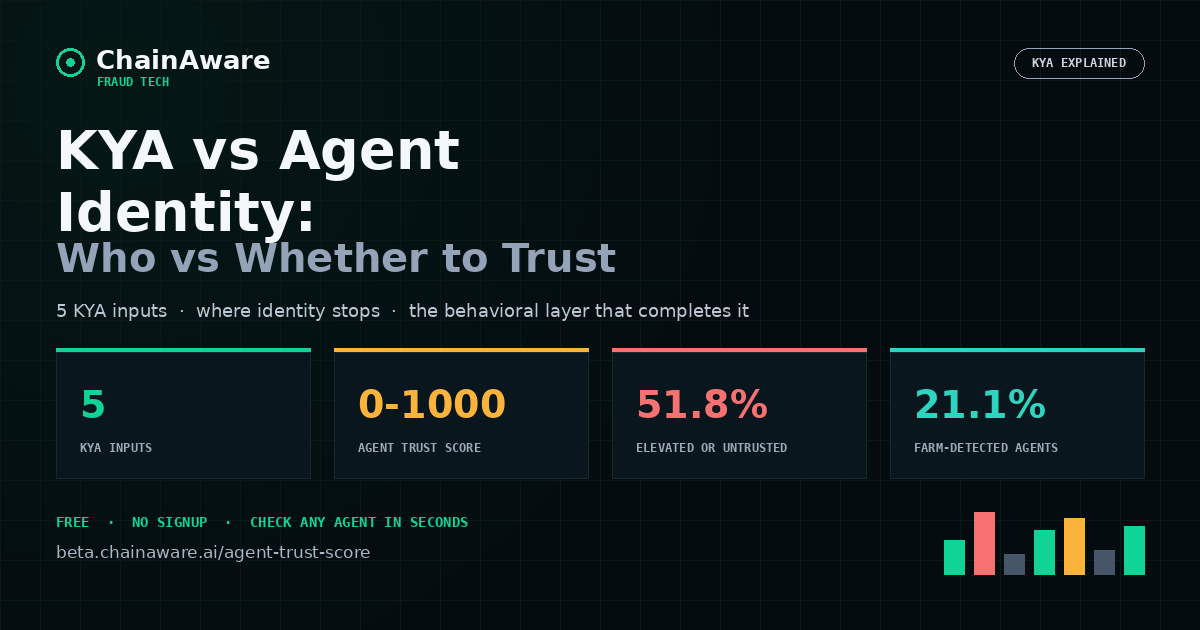
KYA vs agent identity verification why identity does not equal trust — ChainAware.ai

KYA vs Agent Identity Exposed: The Full Truth About Why Identity Does Not Equal Trust

Agent identity and Know Your Agent (KYA) are not the same thing. Identity proves who stands behind an AI agent – its owner, credentials, and registration record. KYA is the wider process that decides whether the agent may act, and how far. This guide draws a clear line between the two, using public ERC-8004 registry data and ChainAware’s Agent Trust Score research to show where identity stops working. At launch, 51.8% of 274,792 indexed ERC-8004 agents sat in the Elevated Risk or Untrusted tier, and 21.1% carried the farm flag – patterns that a purely identity-based check cannot detect. A complete KYA process combines five inputs: identity, authorization, integrity, behavior, and status. Behavioral evidence covers the owner wallet’s fraud probability, the feeder address funding chain, fleet-level farm detection across sibling agents, and the creator’s rug pull and honeypot history. ChainAware’s Agent Trust Score supplies the behavioral layer for on-chain agents with a 0 to 1,000 score, five tiers from Untrusted to Sovereign, and named flags. Free tier covers 1,000 queries per month with no signup. Coverage includes Ethereum, BNB Smart Chain, Base, and Avalanche C-Chain.
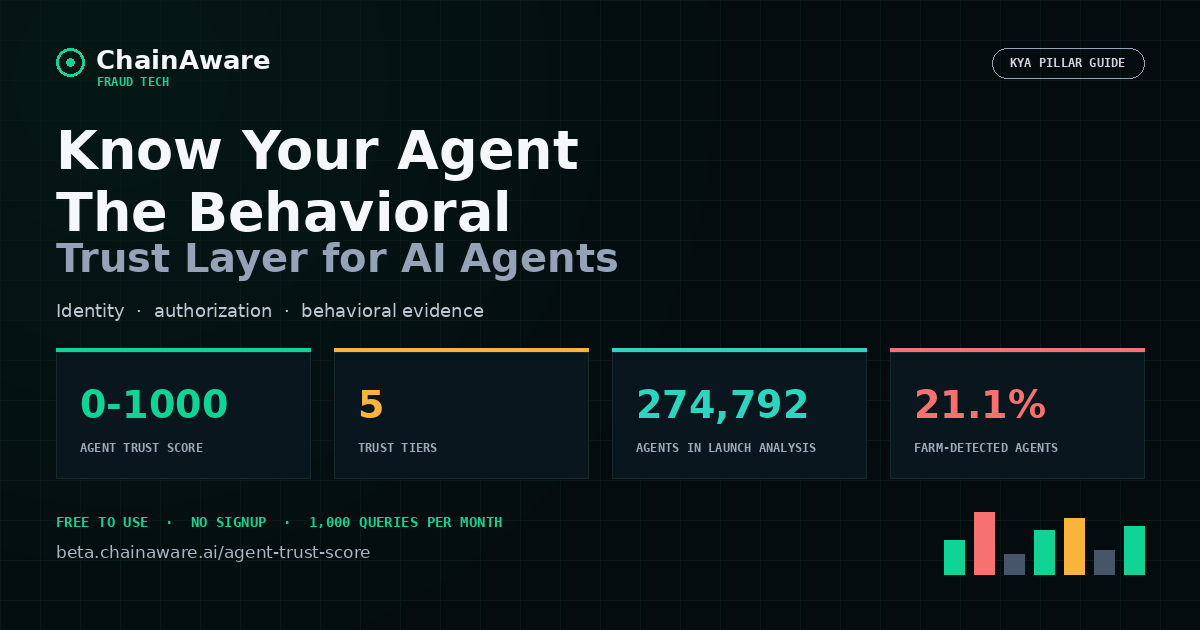
Know Your Agent KYA behavioural trust layer for AI agents — ChainAware.ai ERC-8004 registry

Know Your Agent (KYA) Exposed: The Full Truth About the Behavioural Trust Layer

Know Your Agent (KYA) is the process of deciding whether an AI agent may act and how far it may go. It combines three questions: who is this agent, what did the user allow it to do, and how likely is the operator to cause a loss? Identity frameworks and payment protocols answer the first two. Only behavioral evidence answers the third – and behavioral evidence is what decides most losses. This pillar guide explains the full KYA framework, compares it with KYC, defines the four evidence groups (owner wallet fraud probability, feeder funding chain, creator rug pull and honeypot history, fleet-level farm detection), and maps ChainAware’s Agent Trust Score 0 to 1,000 five-tier system to practical access decisions. It also documents what public data reveals: 51.8% of 274,792 indexed ERC-8004 agents sat in the Elevated Risk or Untrusted tiers at launch, 21.1% carried the farm flag, 741 were funded by confirmed rug pull operators, and the Week 41 median trust of new registrations fell to a record-low 101 across 568,590 indexed agents. The guide also serves as the index for the full KYA series covering identity vs KYA, ERC-8004 trust signals, funding-chain risk, agent fraud patterns, agentic commerce fraud and the four-party card model, and checkout verification. Free tier covers 1,000 queries per month with no signup.

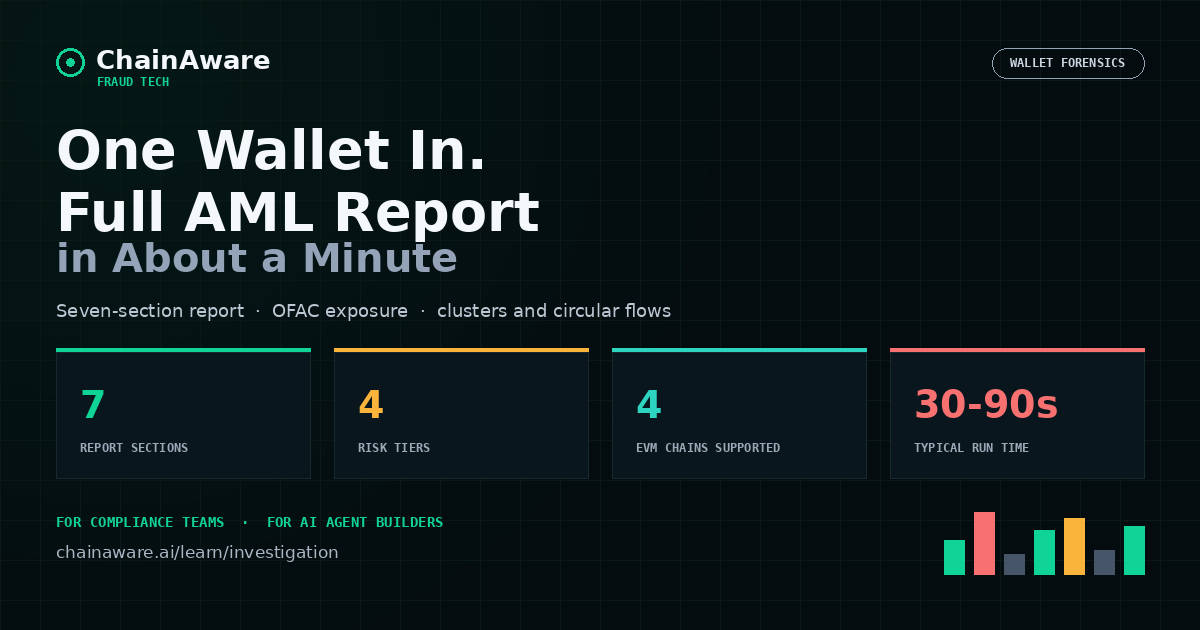
Wallet forensics dashboard tracing crypto transactions for AML compliance review — ChainAware.ai

Wallet Forensics Exposed: The Full Truth About AML Reports for Compliance Teams

ChainAware Investigation turns a single EVM wallet address into a structured seven-section forensic report in 30 to 90 seconds. The report covers Identity and Roles, Activity Summary, Top Counterparties, Risk Assessment, Circular Flows and Clusters, AML Exposure, and a Conclusion with a combined LOW, MEDIUM, HIGH or CRITICAL risk tier. It combines ChainAware’s behavioral fraud intelligence with OFAC sanctions screening, third-party forensic signals and identity lookups across ENS, Unstoppable Domains, SPACE ID and ChainAware known-entity labels. Investigation supports externally owned accounts on Ethereum, BNB Smart Chain, Base and Polygon, and it is a point-in-time snapshot that teams rerun for monitoring. Compliance and AML teams use it for KYT due diligence, incident response, SAR preparation and pre-transaction OTC screening, while AI agent builders use the fixed structure and risk tier as a machine-readable counterparty check inside agentic pipelines. This guide explains each report section, the four risk tiers, a worked example, common wallet patterns, workflow design, responsible-use rules and the tool’s limits. ChainAware does not file SARs, and recommendations remain informational. Related tools include Agent Trust Score, the Fraud Detection API, Token Audit and the Prediction MCP. Learn more at chainaware.ai/learn/investigation/index.html.

Web2 growth playbook concepts breaking apart in DeFi — DeFi growth strategy insights — ChainAware.ai

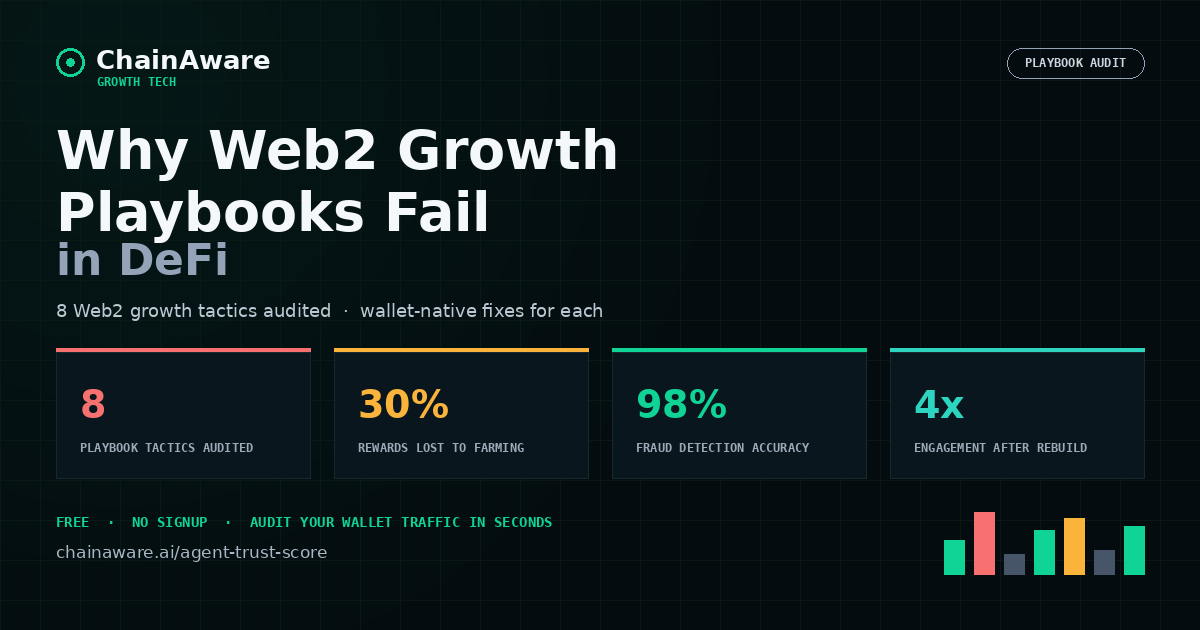
Why Web2 Growth Playbooks Fail in DeFi

Every major Web2 growth tactic – AARRR funnel tracking, CRM and lifecycle email, paid retargeting, loyalty and gamification, referral attribution, community-led growth, cohort segmentation, and multi-touch attribution – depends on persistent user identity. DeFi’s anonymous wallet model breaks that assumption, which is why standard growth stacks underperform in Web3. This guide breaks down each of the eight tactics individually, shows exactly where the identity dependency lives inside it, and maps it to its wallet-native replacement. Airdrop farming and Sybil attacks drain a large share of incentive budgets, loyalty programs reward the wrong wallets, and referral links lose attribution at the wallet connection. ChainAware’s behavioral intelligence platform – 23M+ wallet-level profiles across 8 blockchains (ETH, BSC, Base, Polygon, TON, Tron, Solana, HAQQ), Growth Agents, the Web3 Persona and On-Chain Marketing Analytics – restores the missing layer by combining session data with wallet-level behavior. Profiling runs in under 100ms through the Prediction MCP, and wallet personalization lifts connect-to-transact to 40-60% versus an industry baseline under 10%, as seen in the SmartCredit.io case study. Learn more at chainaware.ai/learn/growth-tech/growth-agents.html.

DeFi user acquisition funnel with wallet personalisation signals — DeFi growth strategy — ChainAware.ai

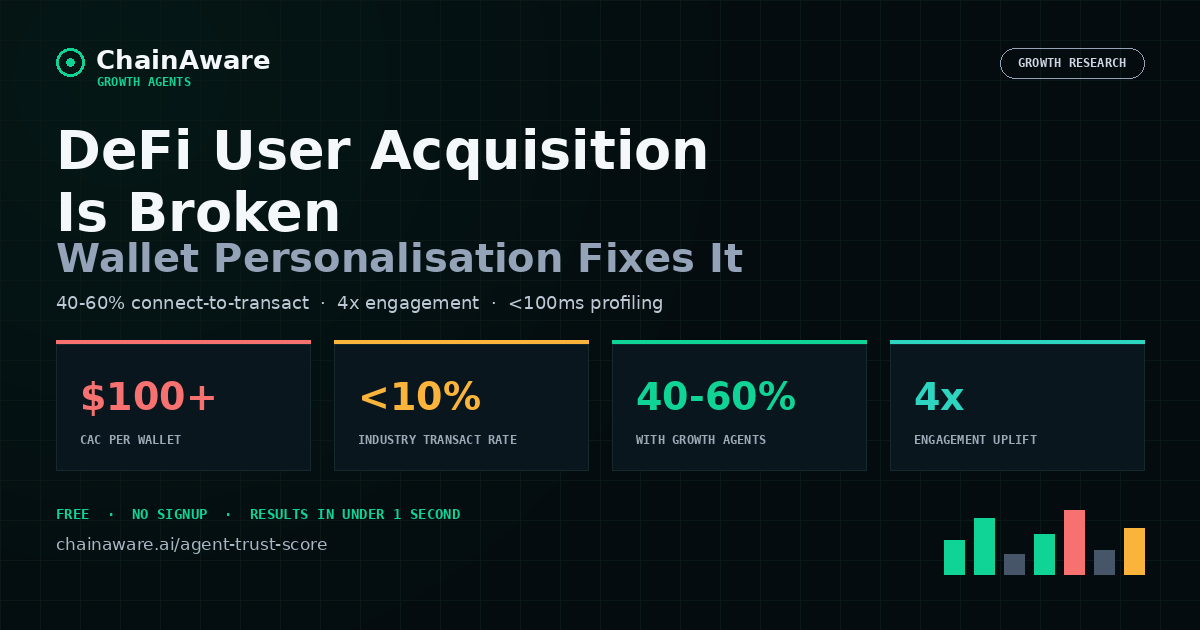
DeFi Growth Exposed: The Full Truth About Broken User Acquisition and Wallet Fixes

DeFi teams spend more than $100 to acquire every connecting wallet, yet fewer than 10% of connected wallets ever transact, pushing real CAC above $1,000 per engaged user. This article explains why Web2 identity tools – cookies, email capture, CRM, A/B testing – cannot read wallet addresses, and how wallet-level behavioral intelligence fixes it. ChainAware’s Growth Agents combine session data with wallet data, profiling every connecting wallet in under 100ms through the Prediction MCP, using the ChainAware Web3 Persona: experience level, risk profile, intent and predicted next action. Tool-specific copy, calls to action and onboarding paths then adapt to each visitor, which lifts connect-to-transact rates to 40-60% against an industry baseline under 10%. The guide covers the cost of the connect-to-transact gap, the persona signals that drive personalization, fraud and Sybil screening in the same call, and a SmartCredit.io case study with a 4x engagement uplift. ChainAware profiles 23M+ wallets across 8 chains (Ethereum, BNB Chain, Base, Polygon, TON, Tron, Solana and HAQQ) and runs Growth Agents as part of its 34 Claude sub-agents across Fraud Tech and Growth Tech. Integration takes about 30 minutes. Learn more at chainaware.ai/learn/growth-tech/growth-agents.html.

Dashboard visualizing audit results for 15,000 EVM tokens across CoinGecko and CoinMarketCap — token audit at scale — ChainAw

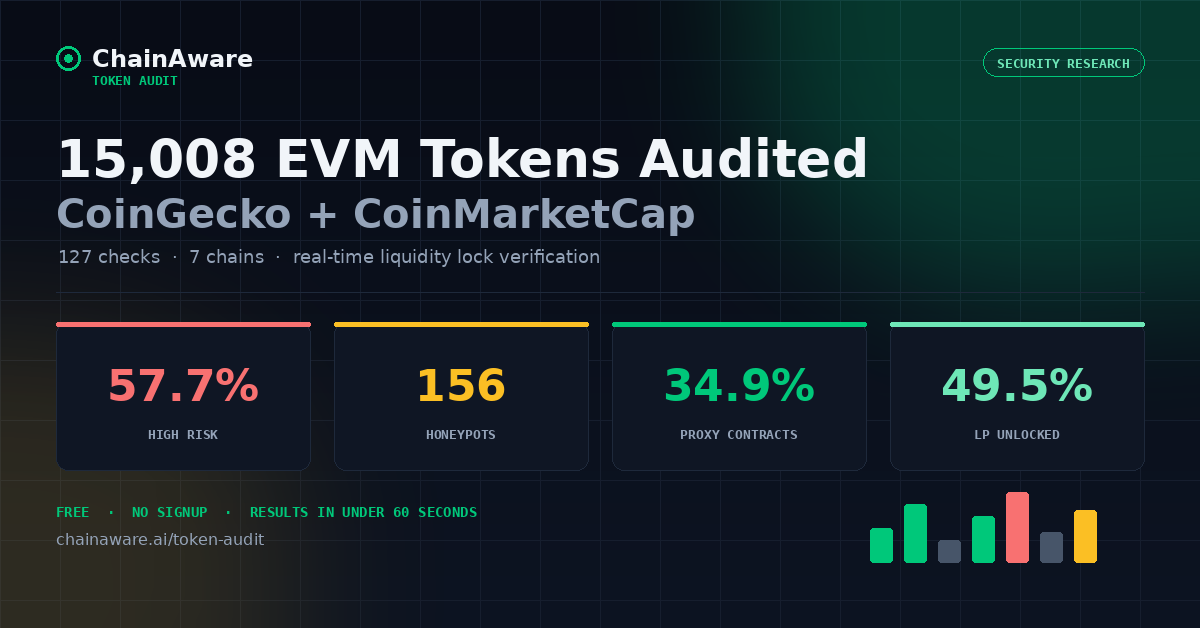
Token Audit Exposed: The Full Truth About 15,000 EVM Tokens on CoinGecko + CoinMarketCap

ChainAware expanded its Token Audit study from 10,000 CoinGecko tokens to 15,008 tokens combining CoinGecko and CoinMarketCap’s full EVM listings across 7 chains (Ethereum, BSC, Base, Polygon, Arbitrum, Optimism, Avalanche). Results: 57.7% high risk, 24.9% suspicious, 16.3% clean, and 156 confirmed honeypots via simulation analysis. 35.3% of tokens have no enforceable mint cap and 35.8% have no timelock on privileged functions – the two findings driving 77.4% of all risk verdicts, consistent with the original study. The biggest change is liquidity lock detection: now covering V2 and V3 pools across six chains and five DEX families (Uniswap, PancakeSwap, QuickSwap, SushiSwap, Trader Joe), with a new real-time recalculation feature that lets anyone verify current lock status on demand in under 5 minutes. Proxy contract detection also expanded to near-complete coverage, revealing 34.9% of tokens use upgradeable proxy patterns – including 118 controlled by a single private key with no multisig or timelock protection. Free Token Audit tool: 127 checks, deep code analysis, results in under 60 seconds, no signup required.

Investor dashboard evaluating AI trading agents with trust scores — AI trading agents evaluation guide — ChainAware.ai

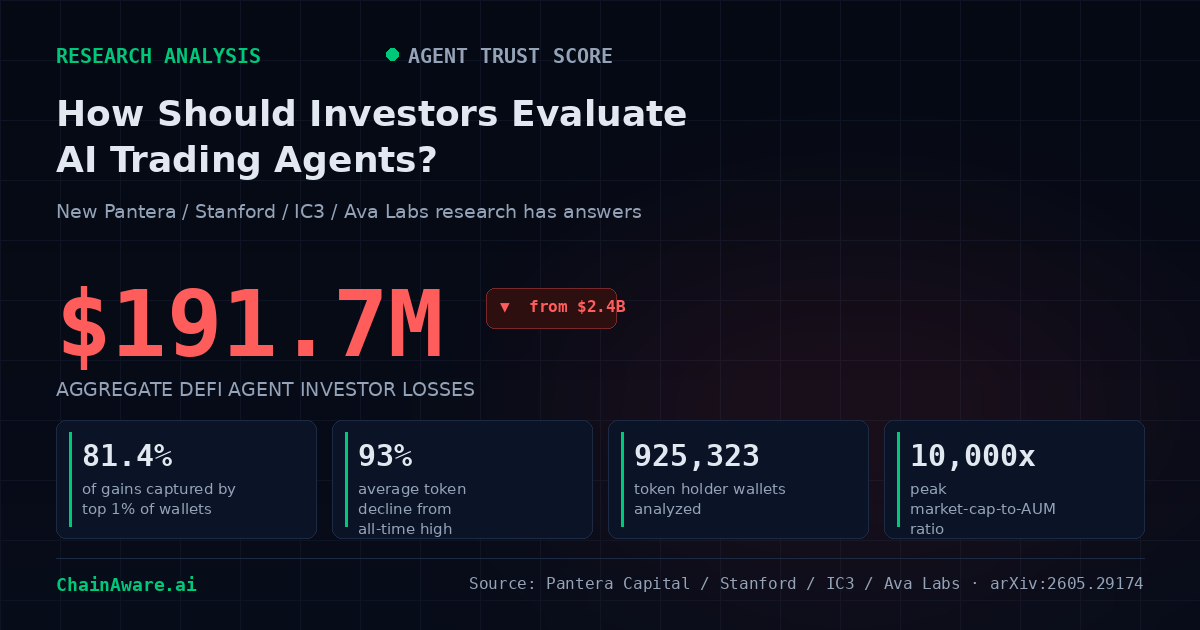
AI Trading Agents Exposed: The Full Truth About Investor Evaluation

A May 2026 study from researchers affiliated with Pantera Capital, Stanford, IC3, and Ava Labs analyzed 1,900+ AI-tagged crypto projects to answer a practical question: how can investors tell a genuinely autonomous AI trading agent from a speculative wrapper? The research found even agents with fully public wallets couldn’t be verified as autonomous, and documents $191.7M in aggregate token holder losses across 925,323 wallets, with the top 1% of wallets capturing 81.4% of all gains ($1.81B). The paper’s proposed evaluation framework maps directly onto ChainAware’s Agent Trust Score, which screens both an AI agent’s wallet and its feeder wallet, giving investors a concrete way to check before they commit capital.

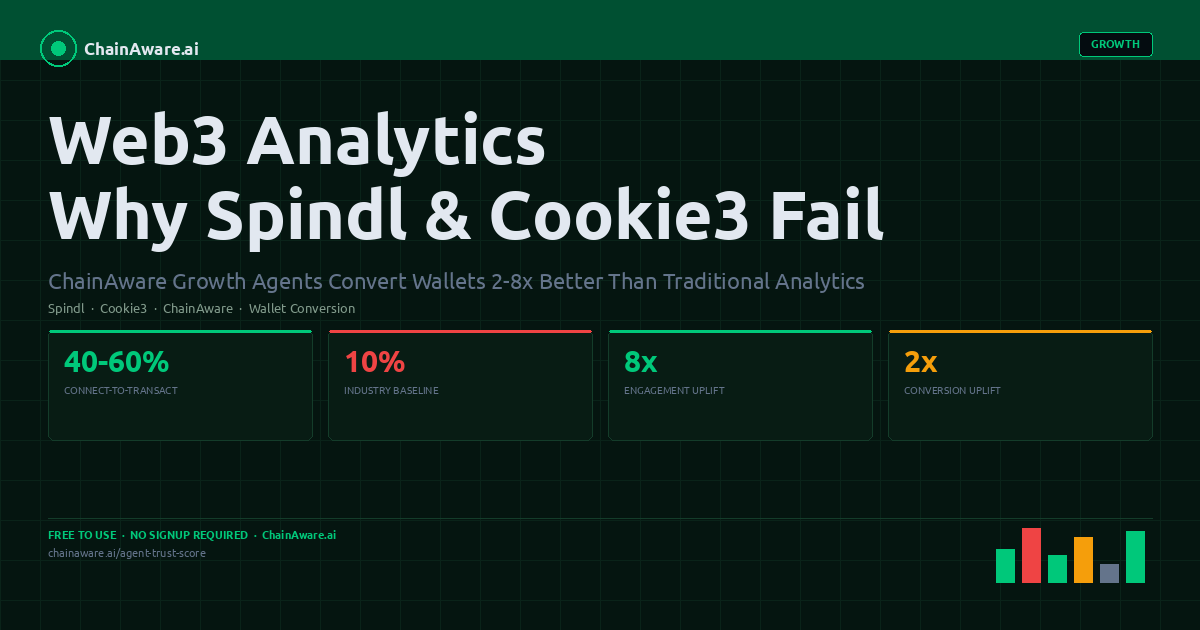
Web3 analytics comparison Spindl Cookie3 fail vs ChainAware wallet conversion — ChainAware.ai

Proven Web3 Analytics Exposed: Why Spindl and Cookie3 Fail to Convert Wallets

Every tool on this list will show you a chart. Only one will convert the wallet behind it. Spindl, Cookie3, and Formo are attribution tools — they stop at the dashboard. ChainAware’s Growth Agents act on wallet data in real time: 40–60% connect-to-transact vs 10% industry baseline.

AI agent trust score dashboard showing wallet risk ratings — Web3 fraud detection — ChainAware.ai

AI Agent Trust Score Exposed: The Full Truth About Web3 Security

ChainAware launches Agent Trust Score – the first on-chain trust scoring system for ERC-8004 registered AI agents. Analysis of 274,792 indexed agents reveals 51.8% carry Elevated Risk or Untrusted scores, 21.1% are farm-detected Sybil operations, and 741 agents were funded by confirmed rug pull operators. Score owner wallet fraud probability, feeder address, and rug pull criminal record before granting autonomous execution access. Named in CB Insights AI Fraud Prevention Market Map. Free, no signup required.

Token audit dashboard scanning 10,000 CoinGecko tokens for fraud risk — Web3 security analysis — ChainAware.ai

Token Audit Exposed: We Tested 10,000 CoinGecko Tokens – Full Truth Revealed

ChainAware Token Audit is live – 127 automated security checks across 9 modules, tested against the top 10,000 CoinGecko tokens by market cap. The results: 55.2% high risk, 131 confirmed honeypots, 13.2% upgradeable proxy contracts – including 139 controlled by a single private key. ChainAware catches threats invisible to GoPlus, CertiK Skynet, and TokenSniffer: transitive approve() analysis, phantom balanceOf, EIP-2612 permit correctness, reentrancy detection, and asymmetric pause – powered by behavioral intelligence across 20M+ wallet personas on 8 blockchains. Free at chainaware.ai/token-audit.