KYA vs agent identity verification why identity does not equal trust — ChainAware.ai

KYA vs Agent Identity Exposed: The Full Truth About Why Identity Does Not Equal Trust

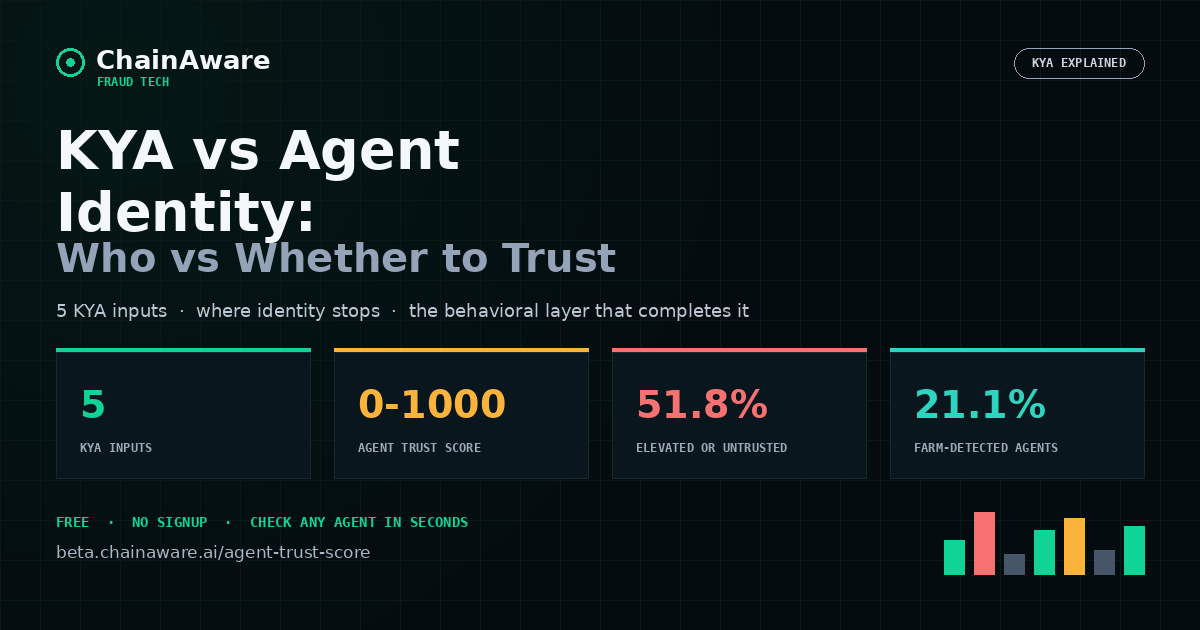
Agent identity and Know Your Agent (KYA) are not the same thing. Identity proves who stands behind an AI agent – its owner, credentials, and registration record. KYA is the wider process that decides whether the agent may act, and how far. This guide draws a clear line between the two, using public ERC-8004 registry data and ChainAware’s Agent Trust Score research to show where identity stops working. At launch, 51.8% of 274,792 indexed ERC-8004 agents sat in the Elevated Risk or Untrusted tier, and 21.1% carried the farm flag – patterns that a purely identity-based check cannot detect. A complete KYA process combines five inputs: identity, authorization, integrity, behavior, and status. Behavioral evidence covers the owner wallet’s fraud probability, the feeder address funding chain, fleet-level farm detection across sibling agents, and the creator’s rug pull and honeypot history. ChainAware’s Agent Trust Score supplies the behavioral layer for on-chain agents with a 0 to 1,000 score, five tiers from Untrusted to Sovereign, and named flags. Free tier covers 1,000 queries per month with no signup. Coverage includes Ethereum, BNB Smart Chain, Base, and Avalanche C-Chain.
Know Your Agent KYA behavioural trust layer for AI agents — ChainAware.ai ERC-8004 registry

Know Your Agent (KYA) Exposed: The Full Truth About the Behavioural Trust Layer

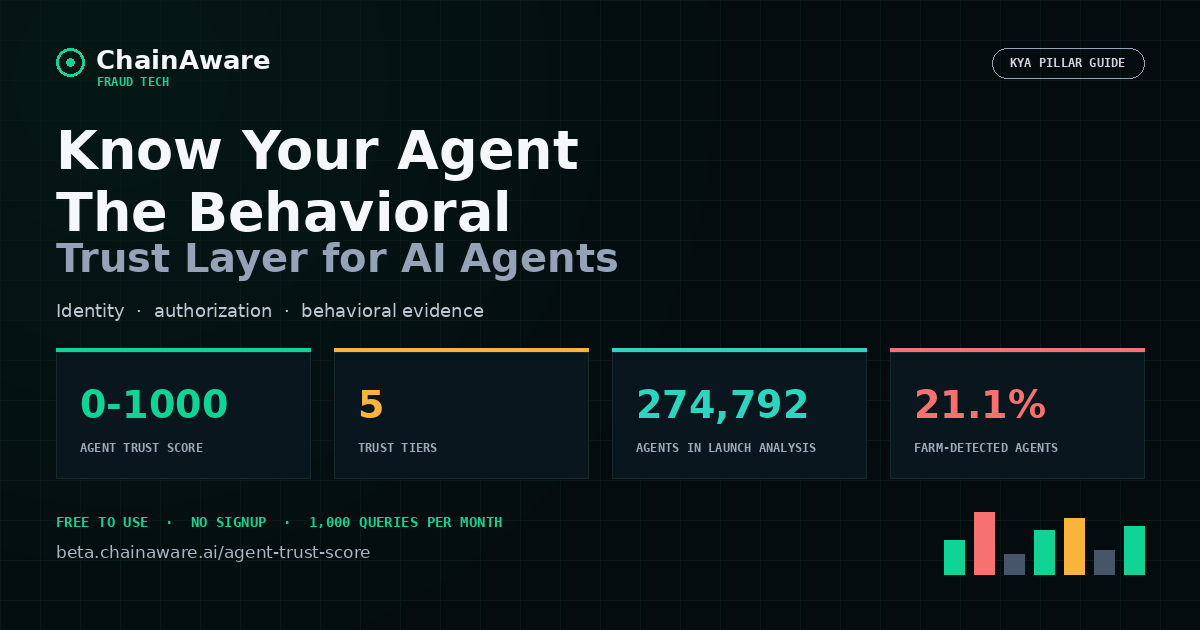
Know Your Agent (KYA) is the process of deciding whether an AI agent may act and how far it may go. It combines three questions: who is this agent, what did the user allow it to do, and how likely is the operator to cause a loss? Identity frameworks and payment protocols answer the first two. Only behavioral evidence answers the third – and behavioral evidence is what decides most losses. This pillar guide explains the full KYA framework, compares it with KYC, defines the four evidence groups (owner wallet fraud probability, feeder funding chain, creator rug pull and honeypot history, fleet-level farm detection), and maps ChainAware’s Agent Trust Score 0 to 1,000 five-tier system to practical access decisions. It also documents what public data reveals: 51.8% of 274,792 indexed ERC-8004 agents sat in the Elevated Risk or Untrusted tiers at launch, 21.1% carried the farm flag, 741 were funded by confirmed rug pull operators, and the Week 41 median trust of new registrations fell to a record-low 101 across 568,590 indexed agents. The guide also serves as the index for the full KYA series covering identity vs KYA, ERC-8004 trust signals, funding-chain risk, agent fraud patterns, agentic commerce fraud and the four-party card model, and checkout verification. Free tier covers 1,000 queries per month with no signup.

AI agent trust score dashboard showing wallet risk ratings — Web3 fraud detection — ChainAware.ai

AI Agent Trust Score Exposed: The Full Truth About Web3 Security

ChainAware launches Agent Trust Score – the first on-chain trust scoring system for ERC-8004 registered AI agents. Analysis of 274,792 indexed agents reveals 51.8% carry Elevated Risk or Untrusted scores, 21.1% are farm-detected Sybil operations, and 741 agents were funded by confirmed rug pull operators. Score owner wallet fraud probability, feeder address, and rug pull criminal record before granting autonomous execution access. Named in CB Insights AI Fraud Prevention Market Map. Free, no signup required.

Abstract network of glowing nodes representing AI agent trust layers — agentic commerce trust infrastructure race — ChainAwar

Agent Trust Infrastructure Exposed: Who Is Really Securing Agentic Commerce?

Six platforms are competing to become the trust layer for agentic commerce in 2026 – ERC-8004 native, RNWY, SkyeProfile, AXIS T-Score, DJD, and ChainAware. Each answers a fundamentally different question. This guide maps every methodology, every blind spot, and the five signals only one platform provides, with a decision matrix for DeFi builders, agent creators, and investors.

Trust scoring shield guarding AI agent commerce transactions — agentic commerce trust — ChainAware.ai

The First Step in Agentic Commerce Isn’t Integration. It’s Trust.

The ERC-8004 registry tells you an agent exists. It does not tell you whether to trust it. This guide explains why Know Your Agent (KYA) is the missing trust layer for DeFi protocol builders in 2026 – and how scoring the owner wallet, feeder address, and rug pull history closes the gap before funds move.

Diagram of 32 Claude sub-agents split into fraud tech and growth tech for the agentic economy — ChainAware.ai

ChainAware.ai’s 32 Claude Sub-Agents Exposed: The Full Truth About Fraud Tech and Growth Tech

ChainAware.ai operates on 32 Claude sub-agents – each one a specialist wrapping ChainAware’s Prediction MCP with precise decision logic and behavioral reasoning. This article classifies all 32 agents into Fraud Tech (17 agents) and Growth Tech (15 agents), with use case and trigger conditions for every agent.

AI fraud prevention market map featuring ChainAware.ai in the CB Insights landscape — Web3 fraud detection — ChainAware.ai

Web3 Fraud Exposed: The Full Truth About ChainAware.ai’s Place on CB Insights’ Map

CB Insights named ChainAware.ai in its AI Fraud Prevention Market Map – placing it in the On-Chain Intelligence subcategory alongside Chainalysis, Elliptic, and TRM Labs. 200+ companies selected. One mission: building the trust and intelligence infrastructure the worldwide AI revolution demands.

AI agents coordinating across a Web3 network replacing growth team roles — Web3 agentic economy overview — ChainAware.ai

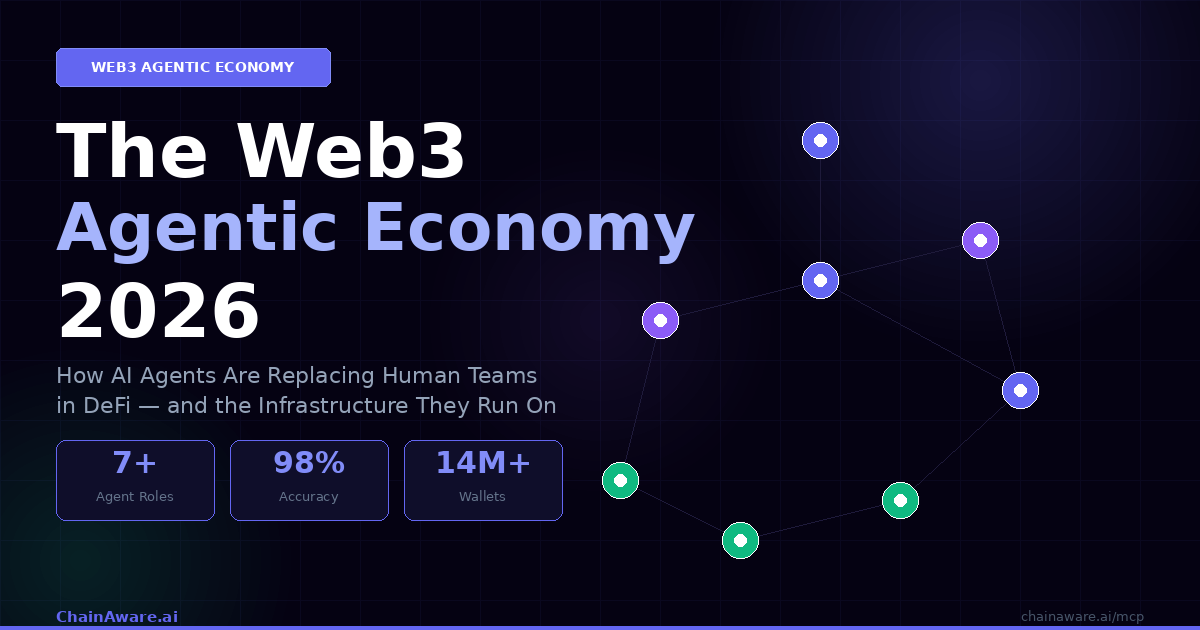
Web3 Agentic Economy Warning: What Happens When AI Agents Replace Growth Teams

AI agents are replacing compliance officers, growth teams, and fraud analysts across Web3. This guide covers how the agentic economy works, which human functions are being automated first, and how ChainAware’s 32-agent infrastructure – fraud detection, AML scoring, rug pull detection, wallet ranking, growth targeting – powers the shift on 8 blockchains.