Payment networks agent trust stack fails — ChainAware.ai fraud detection for AI agents

Payment Networks Exposed: The Full Truth About Why the Agent Trust Stack Fails

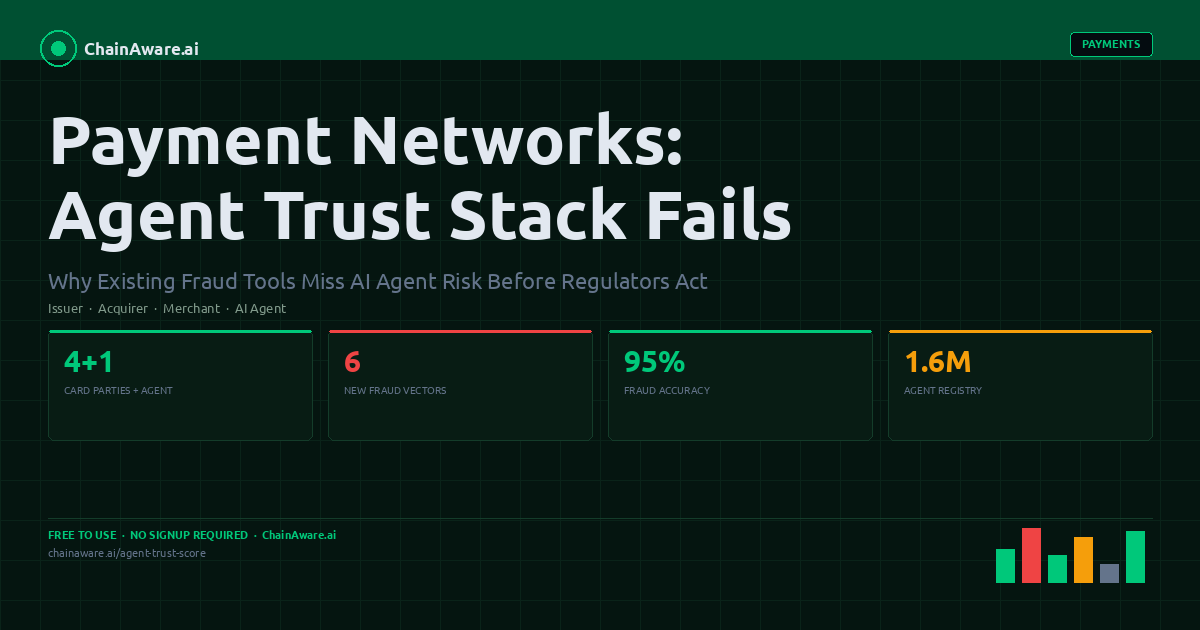
Payment networks built their fraud defences on a single assumption: humans are on the other side of every transaction. But Gartner estimates that 15 percent of enterprise transactions will be agent-initiated by 2027, and AI agents are already transacting today—booking travel, purchasing API credits, settling invoices and triggering recurring orders. The problem is urgent: velocity rules flag legitimate high-frequency agent activity as fraud, device fingerprinting loses all signal on shared cloud infrastructure, and behavioral biometrics has nothing to measure when software is the buyer. ChainAware’s research reveals how payment networks can retrofit their fraud stacks before agentic volume scales to levels that make retrofitting prohibitively expensive. Discover the three critical failure modes breaking today’s detection frameworks and what a practical fix looks like for acquirers and infrastructure architects.
ERC-8004 agent trust score calculation methodology — ChainAware.ai on-chain trust scoring

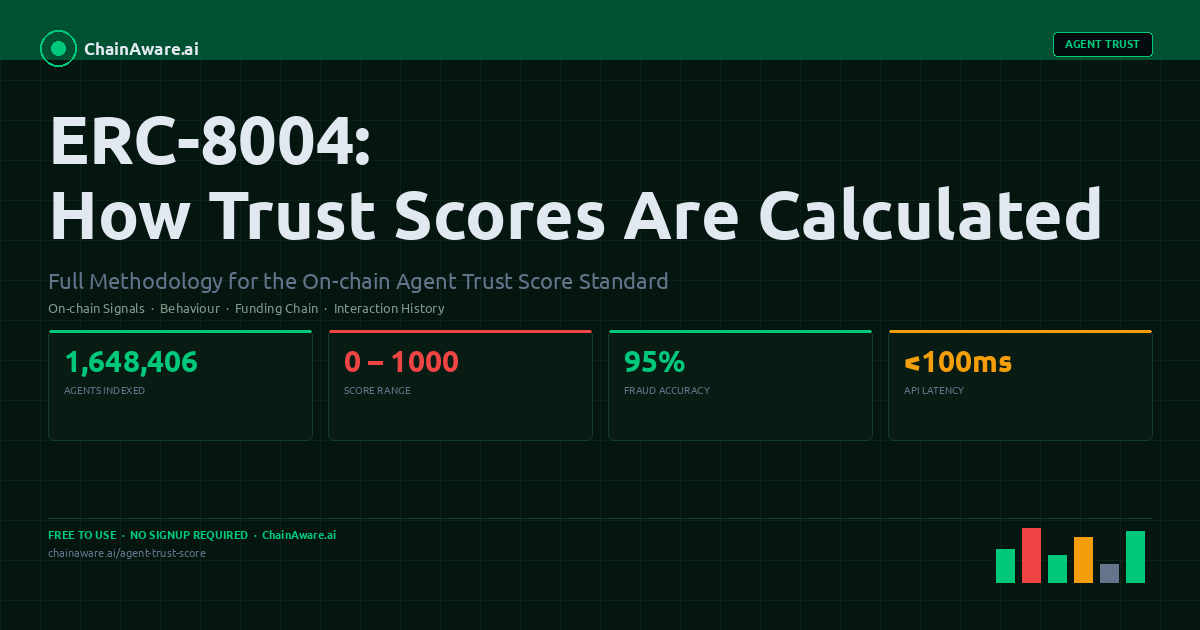
ERC-8004 Agent Trust Score Exposed: The Full Truth About the Methodology

The ERC-8004 registry tells you what an agent claims to be, but ChainAware’s Agent Trust Score tells you what it actually does—and that distinction separates legitimate operators from Sybil farms. Of the 1.6 million agents currently indexed, ChainAware’s five behavioral signals (funding chain, fleet detection, mandate compliance, transaction velocity and creator reputation) identify which ones warrant trust at scale. This methodology explodes the myth that on-chain registration alone proves legitimacy: 67.2% of agents have entirely unknown feeder wallets, whilst 91,868 show coordinated farm characteristics across shared infrastructure. Whether you’re building checkpoints into agentic pipelines or conducting technical due diligence on agent trust platforms, learn exactly how ChainAware weights each signal, combines them into a 0-1000 composite score and updates it in real time when feeder wallets are flagged.

KYA regulations EU AI Act MiCA agentic economy compliance timeline — ChainAware.ai

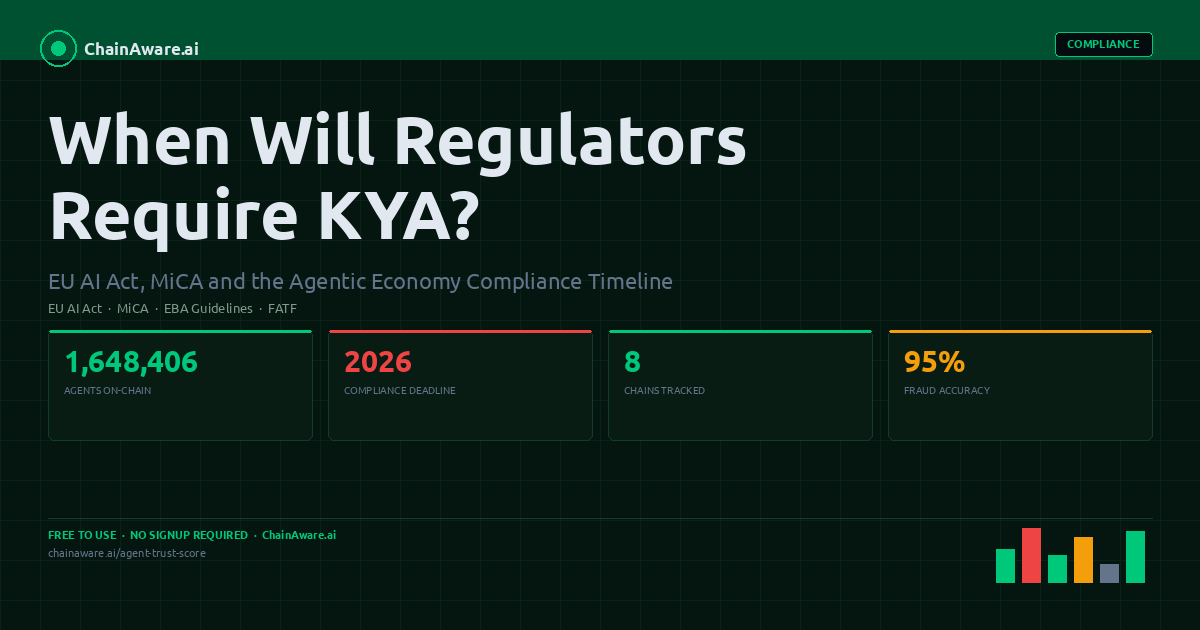
KYA Regulations Exposed: Proven Truth About the EU AI Act, MiCA and Agentic Economy

Regulators haven’t yet mandated Know Your Agent protocols — but three separate regulatory frameworks are converging to make it inevitable. The EU’s MiCA Article 68 is creating screening gaps for AI agent wallets, whilst the EU AI Act Article 50 establishes identity disclosure as a legal requirement. Meanwhile, the FATF Travel Rule is closing in on the agent originator problem. With 1.6 million ERC-8004 agents already indexed on-chain and funding chains traceable to known bad actors, compliance teams face enforcement exposure today, long before formal agent-specific rules land. This article maps the three regulatory tracks, identifies the grey areas where agents currently operate, and provides a realistic timeline for when mandatory agent registration becomes law. Learn what your team needs to do now to stay ahead of the curve — and why ChainAware’s agent behaviour scoring is becoming essential compliance infrastructure.

KYC to KYA identity verification evolution for AI agents — ChainAware.ai agent trust score

KYC to KYA Exposed: Proven Truth About Identity Verification in the Agentic Economy

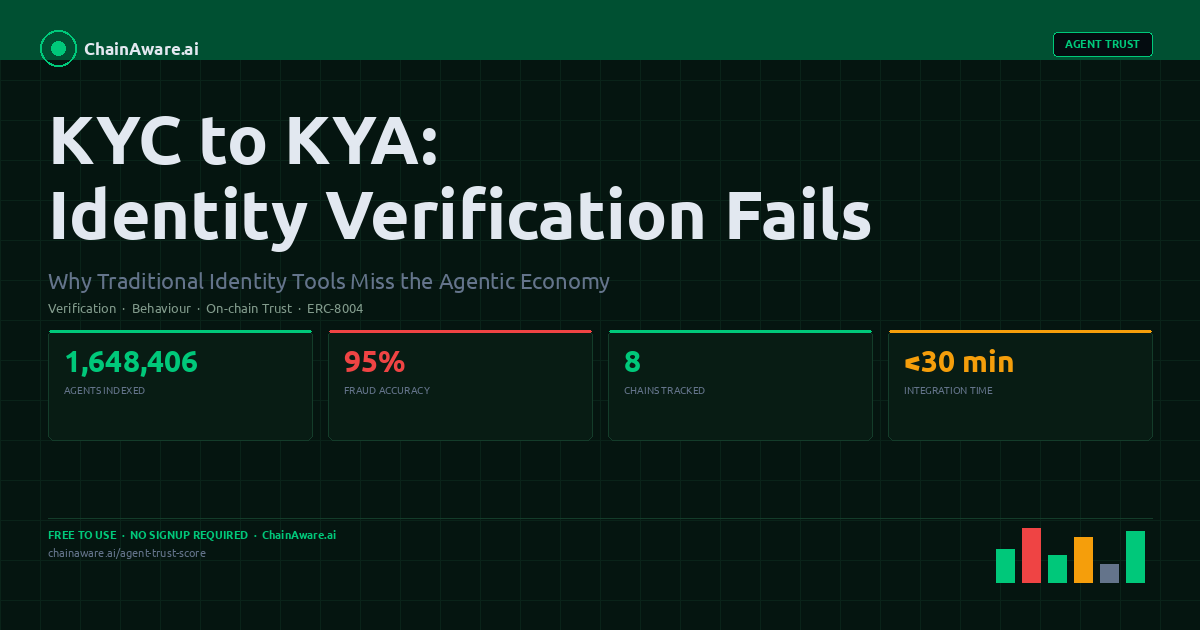
Traditional Know Your Customer protocols were built for humans—but AI agents operating autonomously across blockchains expose three critical gaps that KYC cannot close alone. When software holds wallets and executes transactions without human oversight for each action, the delegation chains, behavioral drift and fleet Sybil attacks multiply compliance blind spots. ChainAware’s analysis of the ERC-8004 agent ecosystem reveals the scale: 1.6 million registered agents across eight chains, with 82.5% of scored agents showing elevation risk signals that static identity checks never catch. This article explains precisely where KYC breaks under agent volume, what Know Your Agent adds to close those gaps and what on-chain behavioral intelligence reveals about the agentic economy’s real compliance challenge. Discover why continuous behavioral scoring, not point-in-time verification, is now essential for Web3 compliance teams.

Security stack built for human attackers fails against AI agent adversaries — ChainAware.ai

Your Security Stack Was Built for Human Attackers. What Happens When the Adversary Is AI?

Rules-based security frameworks were built for a specific adversary: a human being operating at human speed, exploiting known vulnerability classes, and constrained by cognitive limits. NIST, WAFs, smart contract audits — every major framework assumes the attacker can be caught by rules written in advance. That assumption held for three decades. It no longer does.

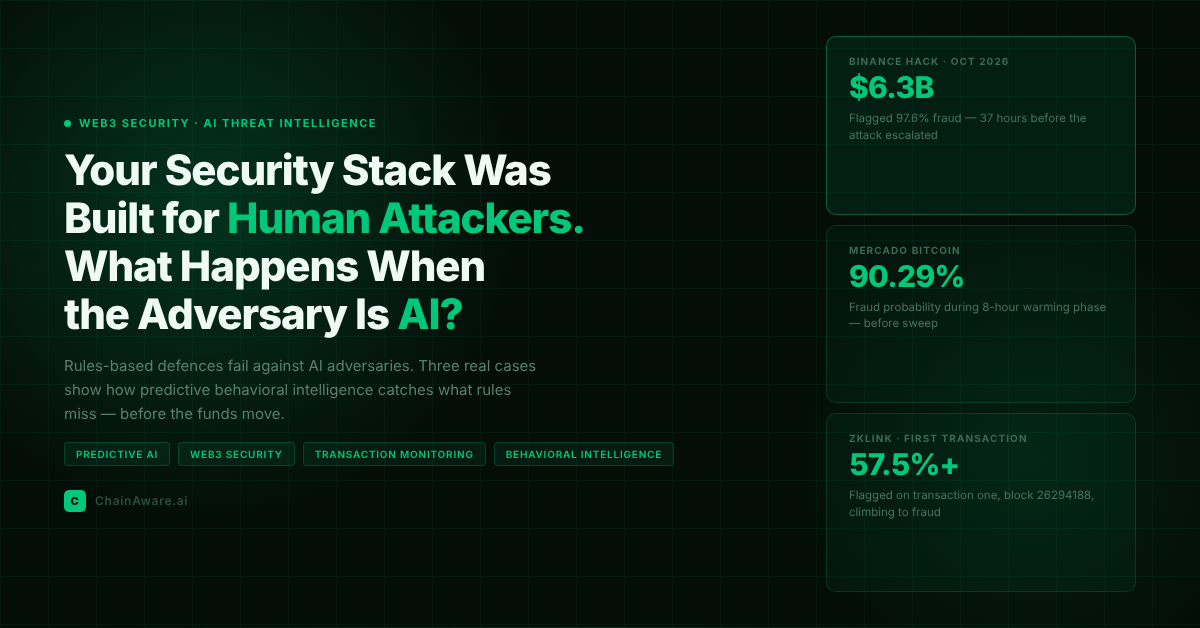
AI adversaries generate novel attack vectors at machine speed, build warming phases that evade every threshold rule, and chain hundreds of smart contract interactions in sequences no human auditor reviewed. The $6.3 billion Binance hack of October 2026 moved funds across 10 blockchains in 20 minutes. ChainAware’s predictive model had flagged the attacker wallet at 97.6% fraud confidence 37 hours earlier — at the moment of first Binance interaction. The warming phase at Mercado Bitcoin ran for eight hours; the model scored it at 90.29% fraud probability throughout. The zkLink attacker was flagged on the first transaction, block 26294188, before any exploit executed.

The spam filter analogy is exact: rule-based email filters collapsed when spammers adapted, and only statistical behavioral classifiers won. Web3 is at the same inflection point. Behavioral models learn the statistical shape of threat-actor activity and generalise to novel attacks — warming phases change the surface, not the shape. This article explains the mechanics, documents the three cases with on-chain block numbers, and sets out a practical transition roadmap from signature-based detection to pre-transfer behavioral screening.

Verifying AI agents at checkout tokens mandates and behavioural trust — ChainAware.ai

Verifying AI Agents at Checkout Exposed: The Full Truth About Tokens and Behavioural Trust

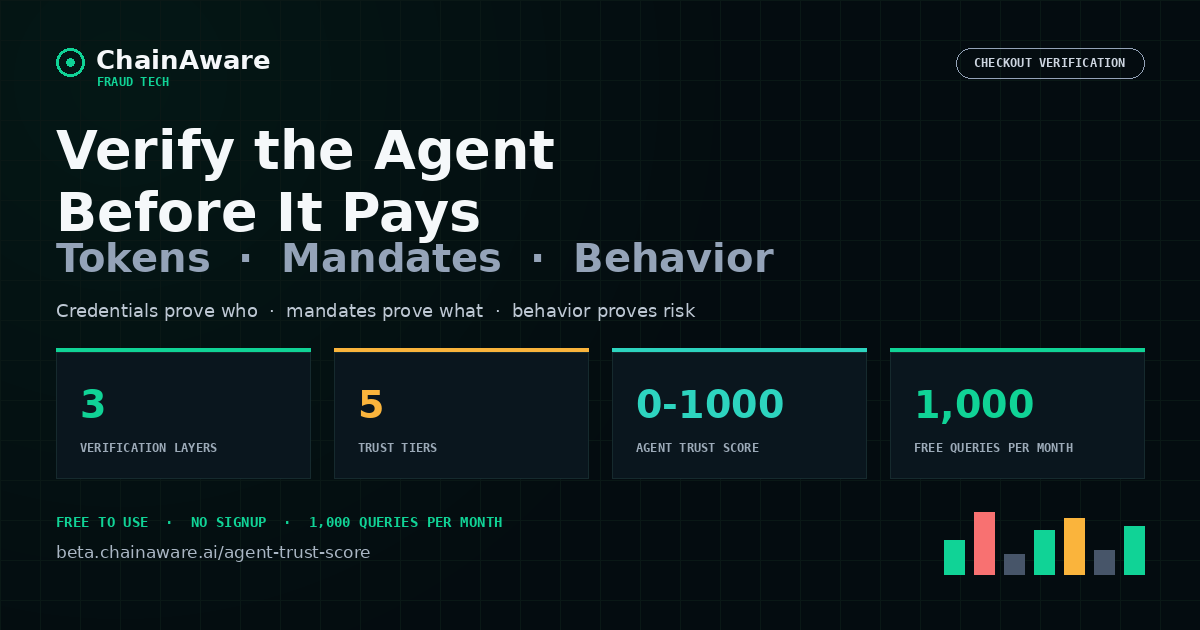
A checkout page used to ask one question: is this customer who they say they are? With AI agents, it must ask three. Who is this agent, what did the user allow it to do, and how risky is the operator behind it? This guide walks merchants, payment providers and platforms through the three-layer verification stack for AI agents at checkout. Layer one – credentials and payment tokens (OpenAI/Stripe Agentic Commerce Protocol, Google AP2, Trulioo Digital Agent Passport, ERC-8004) – proves who the agent is and how it pays. Layer two – signed mandates – proves what the user allowed, covering AP2 intent, cart and payment mandates and what to check at authorization time. Layer three – behavioral evidence – is the only layer that separates a trustworthy agent from a well-documented bad one: owner wallet fraud probability, feeder funding chain, creator rug pull and honeypot history, and fleet-level farm detection. At launch, 51.8% of 274,792 indexed ERC-8004 agents sat in the Elevated Risk or Untrusted tiers despite holding valid credentials. ChainAware’s Agent Trust Score supplies the behavioral layer as a 0 to 1,000 score with five tiers and named flags. The guide includes a six-step decision flow, a flag reference table, attack scenarios, merchant-type playbooks and a 60-day rollout plan. Free tier covers 1,000 queries per month with no signup.

Agentic commerce fraud four-party card model who bears the loss — ChainAware.ai

Agentic Commerce Fraud Exposed: The Full Truth About Who Bears Loss in Four-Party Payments

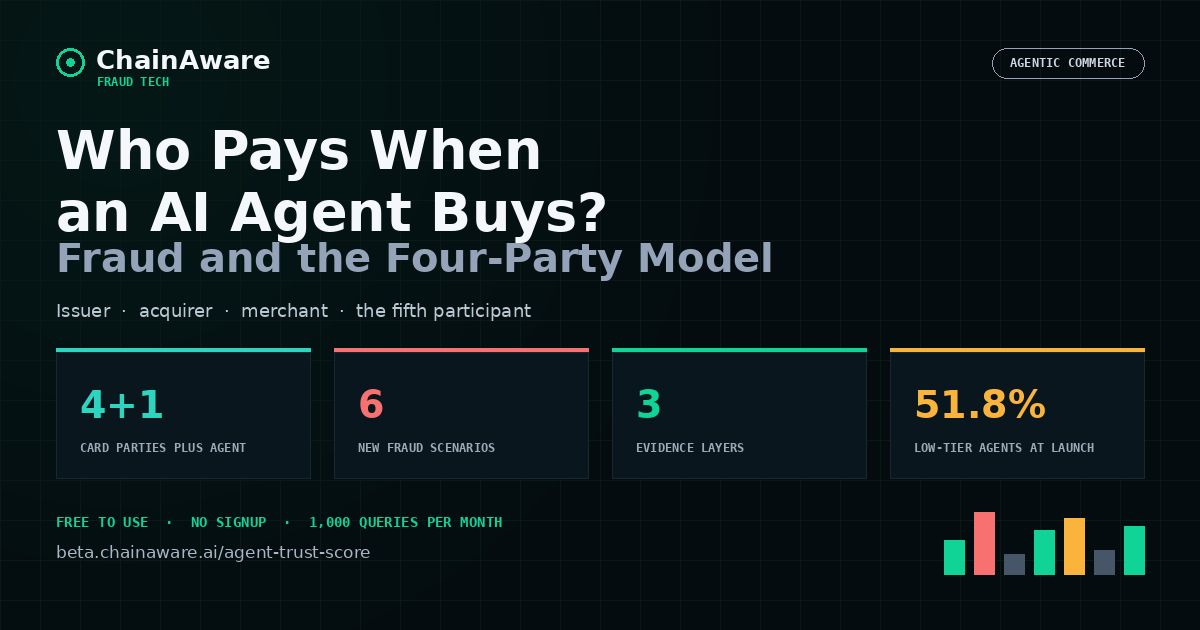
The four-party card model assumes a human at checkout – device fingerprints, typing rhythm and session history feed every fraud engine on that assumption. AI agents remove all of it. This guide explains what agentic commerce fraud looks like inside the issuer-acquirer-merchant-network model, why liability for agent-initiated transactions is still unsettled, and what a behavioral trust layer adds to the credential and mandate rails already being built by OpenAI, Stripe, Google AP2, Visa and Mastercard. Six new fraud scenarios follow from the lost human signal: agent impersonation, mandate abuse, agent drift, fleet abuse, friendly-fraud alibi disputes and compromised agents. McKinsey estimates agent-mediated commerce could reach $3-5 trillion by 2030, yet the open ERC-8004 registry already shows what happens without behavioral scoring: 51.8% of 274,792 indexed agents sat in the two lowest tiers, 21.1% carried the farm flag, and the Week 41 median trust of new registrations fell to a record-low 101. ChainAware’s Agent Trust Score supplies the behavioral layer for on-chain agents – owner wallet fraud probability, feeder funding chain, creator rug pull and honeypot history, and fleet-level farm detection – as a 0 to 1,000 score with five tiers and named flags. Free tier covers 1,000 queries per month with no signup.

Agent fraud patterns from the ERC-8004 weekly tracker threat landscape — ChainAware.ai

Agent Fraud Patterns Exposed: A Complete Picture of the ERC-8004 Weekly Tracker

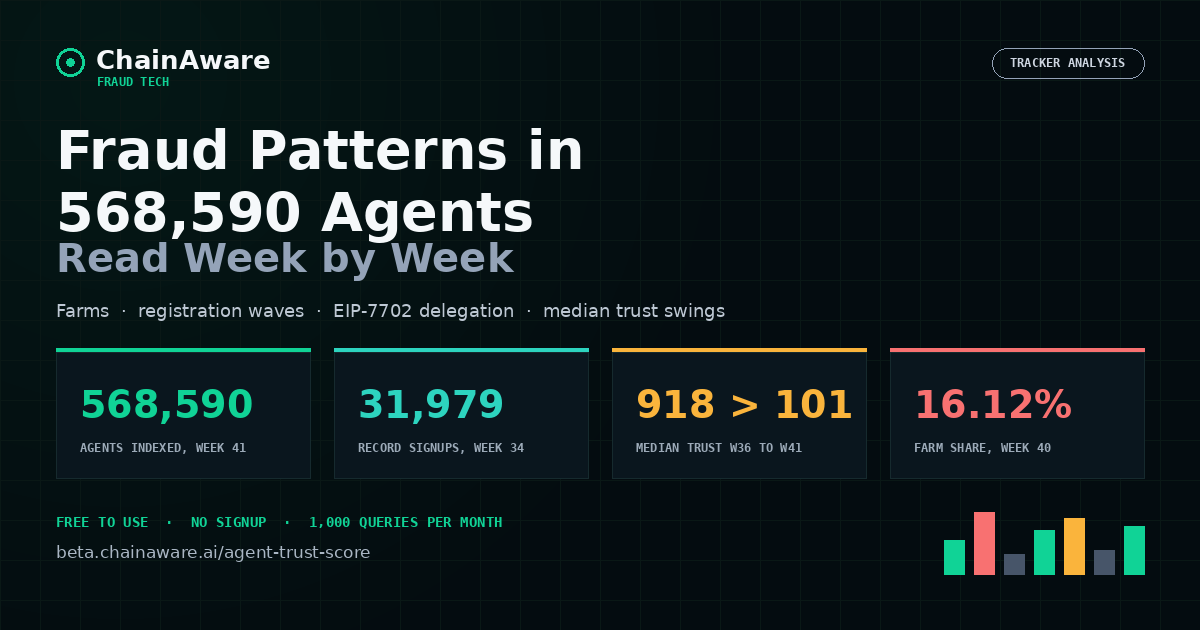
ChainAware’s weekly Agent Trust Tracker has indexed ERC-8004 agents since the registry launched in January 2026. Read one week at a time, the reports show registrations and scores. Read together across Weeks 29 to 41, they reveal four repeating fraud patterns that single reports hide. Pattern one: volume and quality move independently – Week 34 set the registration record at 31,979 agents with a median trust of 563, while Week 41 hit a record-low median of 101 on 10,706 agents. Pattern two: concentration bursts – Weeks 31 and 38 both saw agents-per-owner ratios above 2.0 and median trust drop to 200, as few operators drove bulk registrations. Pattern three: persistent Sybil farms – the farm flag covered 21.1% of agents at launch and 16.12% by Week 40 across a 568,590-agent index. Pattern four: funding that gets harder to trace – the FEEDER_UNKNOWN share nearly doubled to 12.84% in Week 41. A fifth signal, EIP-7702 delegation, rose 33.8% between Weeks 35 and 40. This guide explains what drives each pattern, how the patterns feed each other, and how defenders can use the agents-per-owner ratio, tier thresholds and flag overrides to respond. The Agent Trust Score is free for 1,000 queries per month with no signup.

Funding-chain risk feeder wallet as the real AI agent trust signal — ChainAware.ai

Funding-Chain Risk Exposed: Why Security Teams Fail to Catch the Feeder Wallet Threat

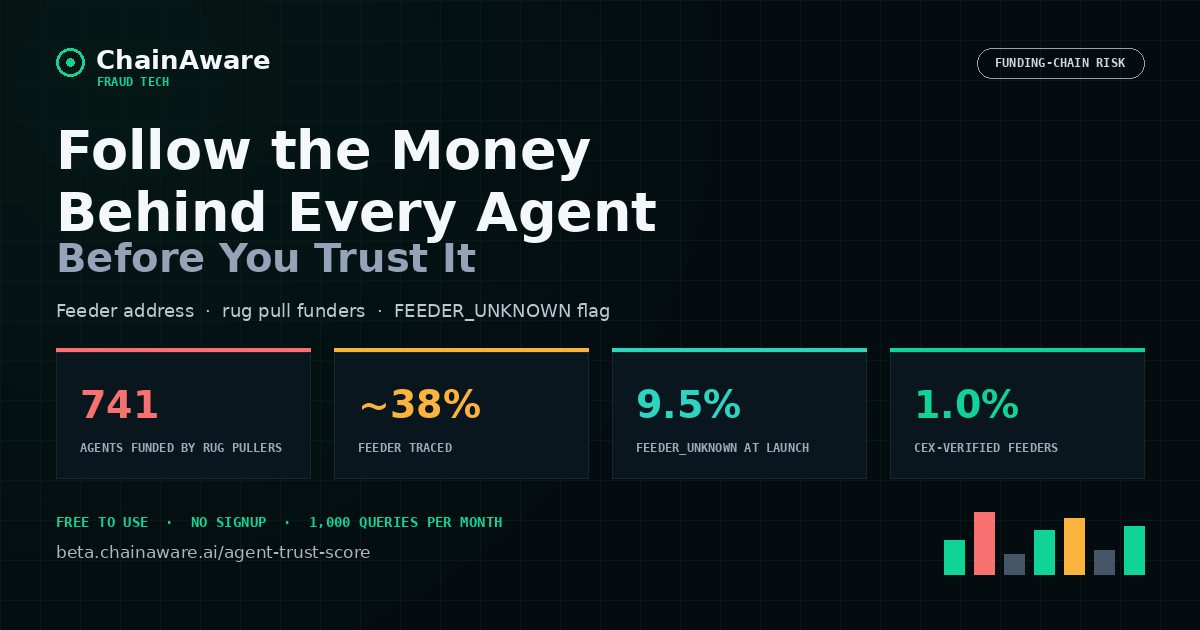
Every AI agent has an owner, and every owner wallet has a first source of money. That source, the feeder wallet, sits on a public ledger that nobody can edit after the fact – and it predicts risk better than any agent description. This guide explains funding-chain risk for ERC-8004 agents, defines the full feeder signal spectrum from FEEDER_CEX_VERIFIED to FEEDER_RUG_HISTORY, and shows how to build feeder flags into access policies, compliance reviews and automated agent flows. At launch, only 1.0% of 274,792 indexed agents carried a verified-exchange feeder, while 9.5% had an unknown feeder and 741 were funded by confirmed rug pull operators. By Week 41 of 2026, the unknown-feeder share had nearly doubled to 12.84% across 568,590 indexed agents. Shared feeders also expose Sybil fleets: farm detection flagged 21.1% of agents at launch because one funding source behind many owner wallets is the clearest fleet signal available. ChainAware traced a feeder for roughly 38% of indexed agents. The Agent Trust Score uses the feeder as one of three core pillars – alongside owner wallet fraud probability and creator rug pull and honeypot history – with a fraud-history feeder hard-suppressing the score regardless of other signals. Free tier covers 1,000 queries per month with no signup.

ERC-8004 trust signals what the registry reveals and fails to reveal about AI agents — ChainAware.ai

ERC-8004 Trust Signals Exposed: The Full Truth About What the Registry Fails to Reveal

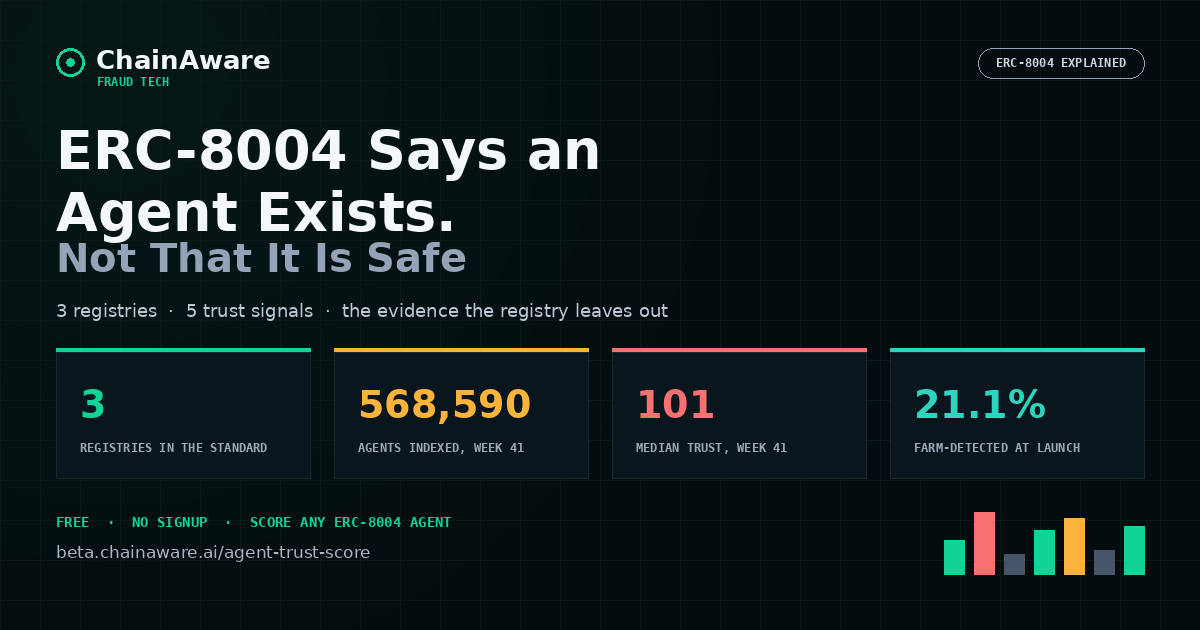
ERC-8004 gave AI agents a shared on-chain identity, and that is a real step forward. It is not a trust verdict. This guide walks through all three ERC-8004 registries – identity, reputation and validation – in plain language, then maps the trust signals that surround them. Registration is open and unvetted: the standard itself states it cannot cryptographically guarantee that an agent’s advertised capabilities are functional and non-malicious. At launch, 51.8% of 274,792 indexed agents sat in the Elevated Risk or Untrusted tier, and 21.1% carried the farm flag – patterns no single-agent identity check can detect. Five independent signals fill the gap the registry leaves: the owner wallet’s fraud probability, the feeder address funding chain, the creator’s rug pull and honeypot history, fleet-level farm detection across sibling agents, and EIP-7702 delegation status. ChainAware’s Agent Trust Score combines these into a 0 to 1,000 number with five tiers and named flags. By Week 41 of 2026, the index held 568,590 agents and the median trust of new registrations had fallen to a record low of 101. Free tier covers 1,000 queries per month with no signup across Ethereum, BNB Smart Chain, Base and Avalanche C-Chain.