DeFi Credit Score Platforms Compared: ChainAware vs Cred Protocol vs Spectral vs RociFi vs TrueFi vs Maple vs Providence

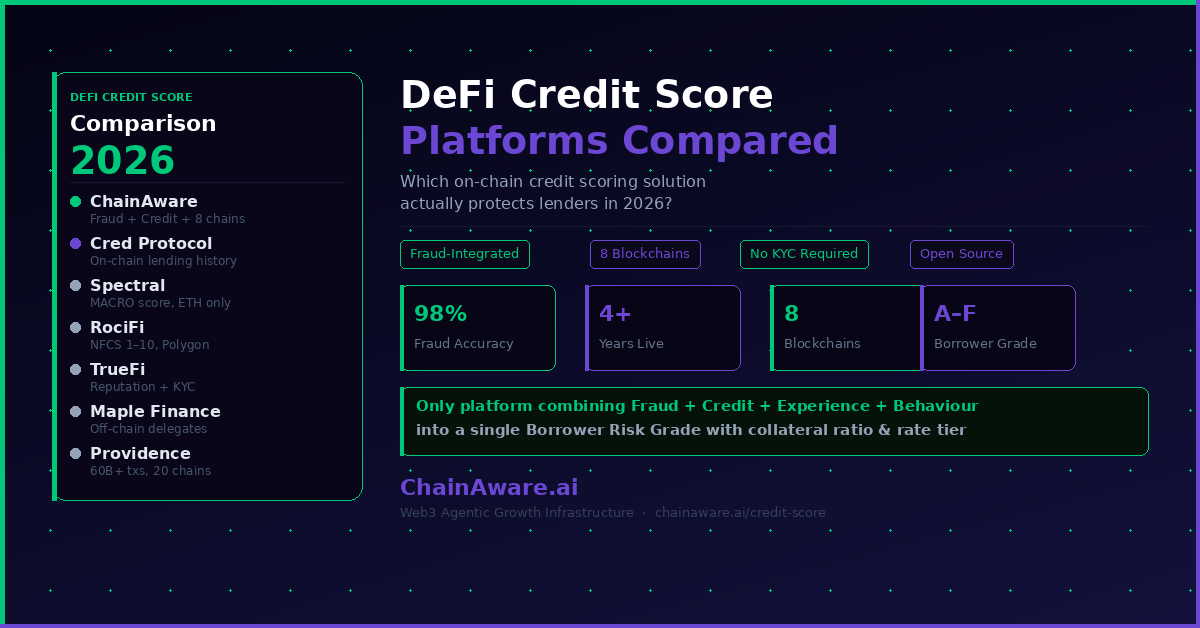
DeFi credit score platforms compared: ChainAware vs Cred Protocol vs Spectral Finance vs RociFi vs Masa Finance vs TrueFi vs Maple Finance vs Providence (Andre Cronje). Core thesis: 90%+ of DeFi loans are still overcollateralized — on-chain credit scoring unlocks the $11 trillion unsecured lending market. ChainAware is the only DeFi credit scoring platform that integrates fraud probability (40% weight) into the Borrower Risk Score — critical because blockchain transactions are irreversible and a fraudster who passes credit screening causes unrecoverable damage. BRS formula: fraud probability (40%) + credit score (20%) + on-chain experience (25%) + behavioural profile (15%). Output: Grade A–F + collateral ratio + interest rate tier + LTV recommendation. Credit score API: ETH only (riskRating 1–9). Lending Risk Assessor agent: 8 blockchains (ETH, BNB, POLYGON, TON, BASE, TRON, HAQQ, SOLANA). 31 MIT-licensed open-source agent definitions on GitHub. 4+ years in production. 98% fraud prediction accuracy. 14M+ wallets. Free individual check at chainaware.ai/credit-score. Other platforms: Cred Protocol (lending history, MCP-native), Spectral MACRO score (ETH, academic credibility), RociFi NFCS (Polygon, NFT identity), Masa Finance (data sovereignty), TrueFi (OG uncollateralized, KYC required), Maple Finance (institutional delegates), Providence (60B+ txs, 20 chains). URLs: chainaware.ai/credit-score · chainaware.ai/mcp · chainaware.ai/pricing · github.com/ChainAware/behavioral-prediction-mcp

Web3 Reputation Score Comparison 2026: Nomis vs RubyScore vs Ethos vs Cred Protocol vs UTU vs ChainAware

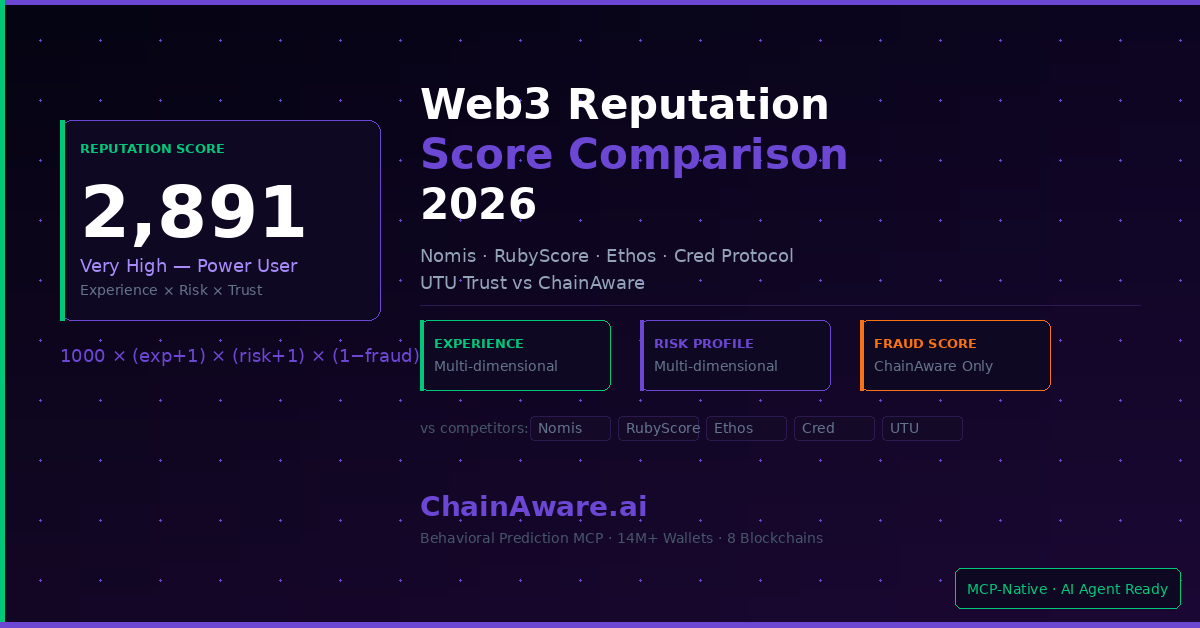
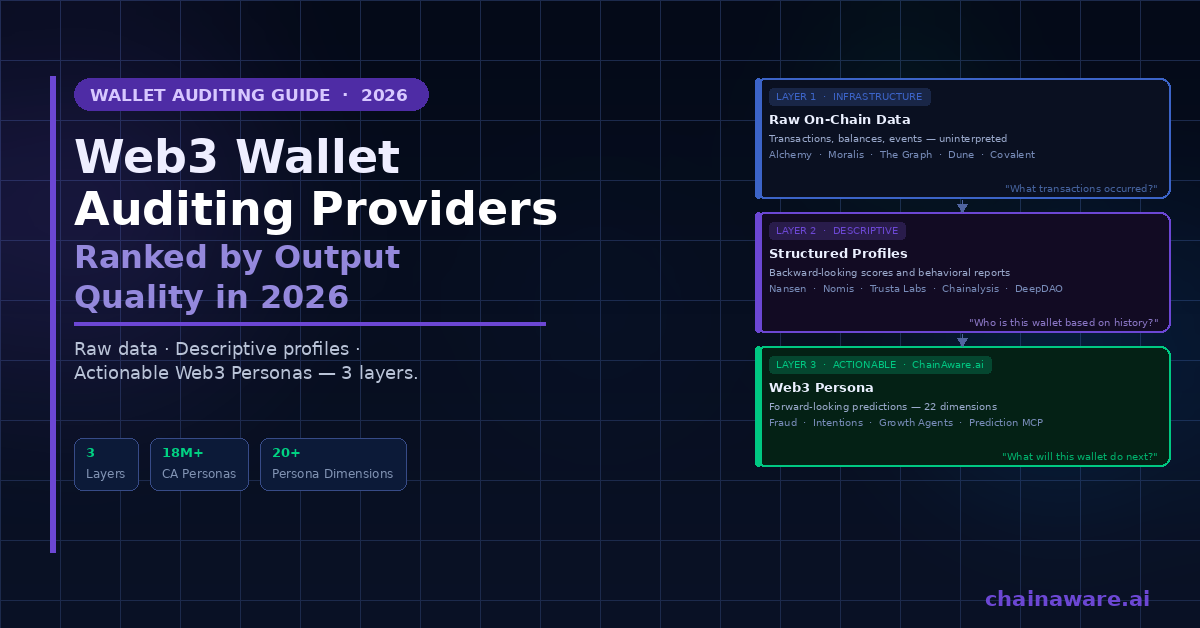
Web3 reputation scoring in 2026 compared across 7 platforms: Nomis, RubyScore, Ethos Network, Cred Protocol, UTU Trust, Whitebridge, and ChainAware. ChainAware is the only platform that incorporates predictive fraud probability into the reputation formula — Score = 1000 × (experience+1) × (risk+1) × (1−fraud) — producing a 0–4000 score requiring no user action, callable by AI agents via MCP in under 100ms. Competitors measure what a wallet has done; ChainAware predicts what it will do next and whether it is safe. Key differentiators: 98% fraud prediction accuracy, daily model retraining, 14M+ wallets across 8 blockchains (ETH, BNB, BASE, POL, SOL, TON, TRX, HAQQ), 31 open-source Claude agent definitions on GitHub (MIT license), batch/leaderboard scoring, AML signals included. ChainAware Wallet Rank: 10-parameter behavioral intelligence (experience, risk willingness, risk capability, predicted trust, intentions, transaction categories, protocol diversity, AML, wallet age, balance). Reputation Score: decision-ready output for governance weighting, airdrop allocation, collateral ratios, allowlist ranking. MCP server: prediction.mcp.chainaware.ai/sse. GitHub: github.com/ChainAware/behavioral-prediction-mcp. Pricing: chainaware.ai/pricing.

AI-Powered Blockchain Analysis: Machine Learning for Crypto Security with 98% Accuracy - ChainAware.ai

AI-Powered Blockchain Analysis: Machine Learning for Crypto Security 2026

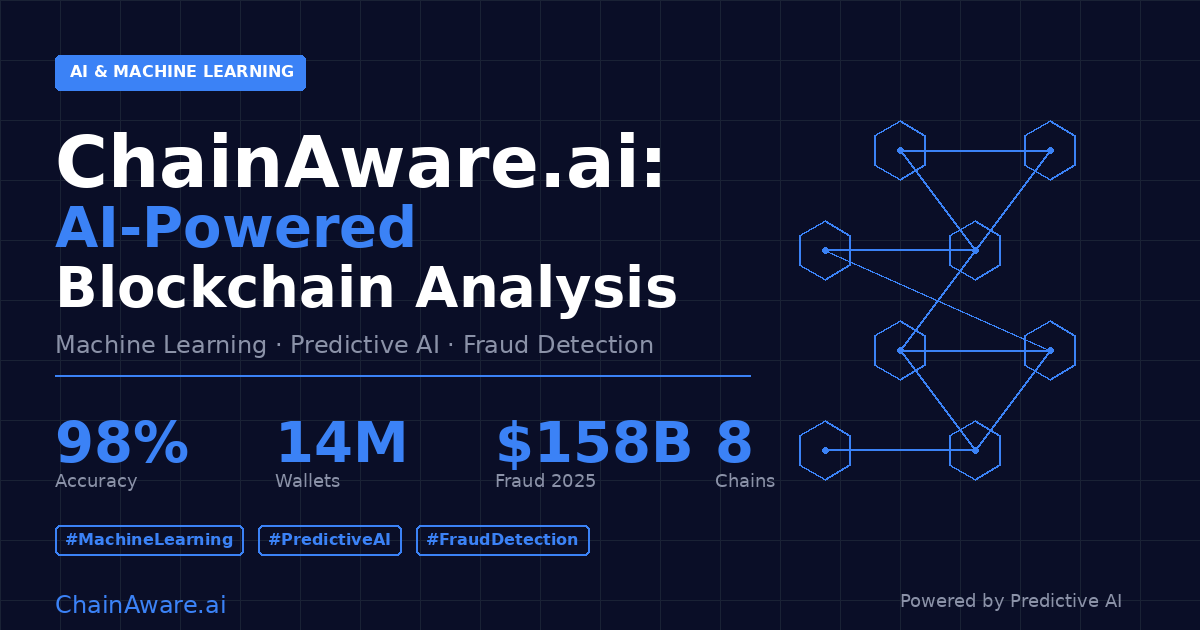
AI-Powered Blockchain Analysis 2026: machine learning for crypto security replacing rule-based fraud detection. Crypto fraud reached $158B illicit volume in 2025 (TRM Labs). Traditional rule-based systems fail — 30-70% false positive rates, bypassed by fraudsters within days, AI-enabled scam activity up 500%. ChainAware.ai’s ML models trained on 14M+ wallets across 8 blockchains achieve 98% fraud prediction accuracy (F1 score) with under 100ms inference latency. Key capabilities: predictive fraud detection, AML screening, rug pull detection, behavioral pattern analysis, graph neural networks for network fraud. Free fraud detector: chainaware.ai/fraud-detector. Published 2026.

Forensic vs AI-Powered Blockchain Analysis: Reactive vs Predictive Intelligence - ChainAware.ai

Forensic vs AI-Powered Blockchain Analysis: Why Predictive Intelligence Wins 2026

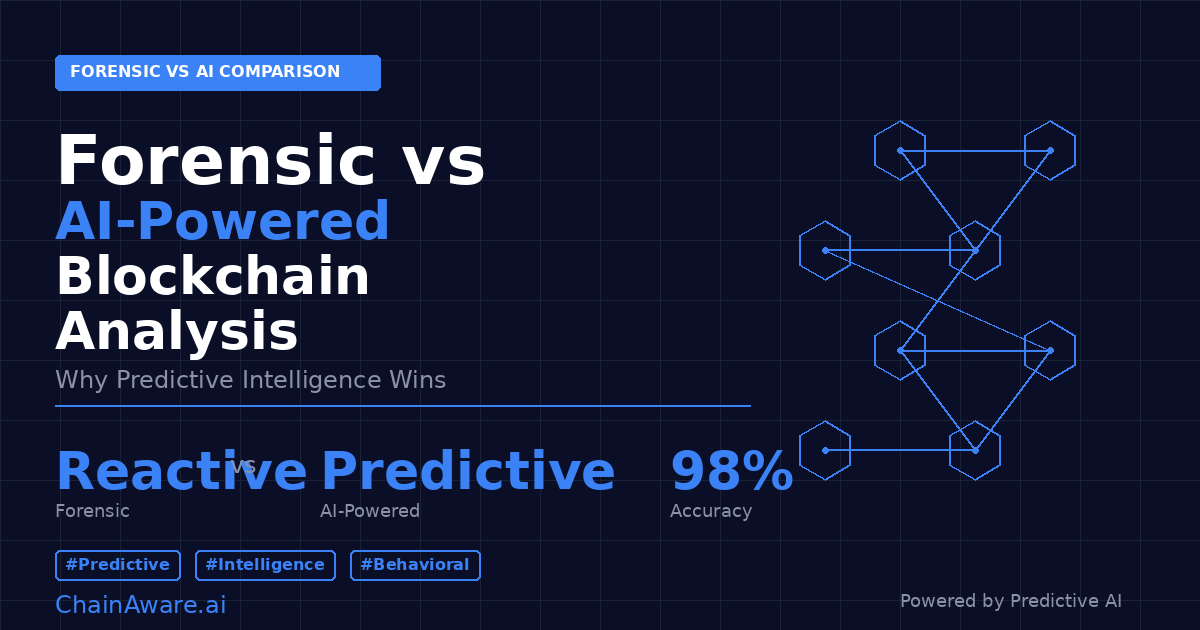
Forensic vs AI-Powered Blockchain Analysis 2026: why predictive intelligence wins over reactive forensics. Forensic tools (Chainalysis, Elliptic, TRM Labs, CipherTrace) trace funds after crimes occur — reactive, backward-looking, dependent on known bad actors. ChainAware.ai predicts fraud before it happens — 98% accuracy on 14M+ wallets, 50+ behavioral features, continuous daily retraining. Key distinctions: forensic = address clustering + attribution; AI = behavioral pattern recognition + ML. Forensic wins: law enforcement investigations, OFAC sanctions screening, asset recovery, court evidence. AI wins: pre-transaction fraud prevention, user quality segmentation (Wallet Rank), churn prediction, novel fraud detection, real-time scoring at <50ms latency. Optimal stack: Layer 1 forensic compliance + Layer 2 AI predictive prevention + Layer 3 AI business intelligence. False positives: forensic 30–70% vs AI 5–15%. Chainalysis alternative for DeFi: chainaware.ai/fraud-detector · chainaware.ai/audit · chainaware.ai/solutions/transaction-monitoring. Published 2026.

Predictive AI for Crypto KYC, AML & Monitoring: Real-Time Processing, 98% Accuracy - ChainAware.ai

How to Use Predictive AI for Crypto KYC, AML, and Transaction Monitoring 2026

Predictive AI vs Generative AI for Crypto KYC, AML, and Transaction Monitoring 2026. Generative AI (ChatGPT, Claude, Gemini) creates content — it cannot process numerical transaction data, cannot make deterministic fraud classifications, and runs at 1–5 second latency (100x too slow for real-time). Predictive AI (XGBoost, Random Forest, Neural Networks) is purpose-built for compliance: 98% fraud detection accuracy, <50ms inference latency, 5–15% false positive rates (vs 30–70% for AML rules). AML alone catches <20% of fraud — misses unknown fraudsters (80%+ of fraud), Sybil attacks, wash trading, emerging exploits. Both AML (regulatory mandate: MiCA €540M+ penalties, FinCEN $250K+/violation) and Transaction Monitoring (separate mandate) are legally required for VASPs. ChainAware tools: Fraud Detector (98% accuracy, 14M+ wallets, 8 chains), Transaction Monitoring Agent (GTM no-code, SAR generation, audit trails), Wallet Auditor. chainaware.ai/fraud-detector · chainaware.ai/audit · chainaware.ai/solutions/transaction-monitoring

AML and Transaction Monitoring for DApps: The Guide

Web3 AML and transaction monitoring 2026: complete guide based on X Space #33 with ChainAware co-founders Martin and Tarmo (Credit Suisse veterans, CFA, PhD). AML is rules-based and tracks flow of bad funds (sanctions, mixers, flagged addresses). Transaction monitoring is AI-based and predicts future fraud from behavioral patterns — 98% accuracy, trained on 14M+ wallets across 8 blockchains. Both are mandatory under MiCA for EU platforms. Blockchain transactions are irreversible — compliance must happen at wallet connection, not after transaction submission. Existing AML tools are built for centralized exchanges dealing in IOUs, not for DApps with instant irreversible transactions. ChainAware integrates via a single Google Tag Manager pixel — no code changes required, first data in 12 minutes, continuous 24/7 monitoring, Telegram alerts. Free Web3 Behavioral User Analytics included. Enterprise transaction monitoring available. ChainAware covers AML scoring, predictive fraud detection (98% accuracy), behavioral intent profiling, and Wallet Rank in one pixel integration. MCP server at prediction.mcp.chainaware.ai/sse. 31 open-source agent definitions on GitHub including chainaware-aml-scorer and chainaware-compliance-screener. URLs: chainaware.ai/fraud-detector · chainaware.ai/pricing · chainaware.ai/mcp · github.com/ChainAware/behavioral-prediction-mcp

Real AI Use Cases for Web3: What to Integrate via API

Real AI use cases for Web3 projects in 2026: which AI can every DApp actually integrate via API continuously, with measurable accuracy? Based on X Space #32 with ChainAware co-founders Martin and Tarmo (Credit Suisse veterans, CFA, PhD). Key framework: generative AI (LLMs) = one-time tool used by human employees; predictive AI (ML) = continuous API integration with measurable accuracy. Web3 = 100% digitalization — any manual human interaction in a business process is Web2, not Web3. Rules-based systems (trade routing, yield farming, portfolio management, risk management) are optimization algorithms, not AI. The 5 real integrable AI use cases: (1) predictive fraud detection — 98% accuracy, 14M+ wallets, 8 blockchains; (2) predictive rug pull detection — contracts analyzed before investment; (3) Web3 ad tech — 1:1 behavioral targeting from on-chain wallet intentions; (4) on-chain credit scoring — enables undercollateralized DeFi lending; (5) AML and transaction monitoring — rules-based AML + AI-based transaction monitoring combined. AI agents are only viable in narrow spaces where continuous learning produces superhuman performance. ChainAware MCP server: prediction.mcp.chainaware.ai/sse. 31 open-source agent definitions on GitHub. YouTube recording: youtube.com/watch?v=zvPnxz-ySY0. URLs: chainaware.ai/fraud-detector · chainaware.ai/mcp · chainaware.ai/pricing · github.com/ChainAware/behavioral-prediction-mcp

AI Agents for Web3: The ChainAware Roadmap

X Space #31 recap: real-world AI for Web3 — trust, growth, and user experience. ChainAware.ai and guests explore practical AI solutions transforming Web3 in 2026: how predictive AI builds trust (Fraud Detector, AML Scorer), how behavioral intelligence accelerates growth (Growth Agents, Prediction MCP), and how personalization improves user experience (onboarding-router, wallet-auditor). ChainAware operates across 8 blockchains with 14M+ wallet profiles and 98% fraud prediction accuracy. chainaware.ai.

DeFAI Explained: How AI Agents Are Transforming Decentralized Finance

DeFAI explained: how AI agents are transforming decentralized finance. Based on X Space #30 (two-part session) with ChainAware co-founders Martin and Tarmo (Credit Suisse veterans, CFA, PhD). Core thesis: AI is an unstoppable megatrend that will enter every existing Web3 domain and increase its utility. DeFi AI (DeFAI) = existing DeFi utility + superior AI-driven decision making. Attention AI = fake AI that generates narratives without real utility. Real utility AI uses proprietary predictive ML models — not LLMs — for decision making. LLMs are statistical autoregression models unsuitable for DeFi decision tasks. Self-custody means owning the asset; custodial means owning a claim on the asset. MF Global warning: rehypothecation allows EU banks to lend client assets up to 80 times simultaneously. Six live DeFi AI agent categories: (1) trading agents — pattern recognition, 90/90/90 rule baseline; (2) portfolio management agents — Sharpe ratio optimization, automated wealth management; (3) risk monitoring agents — liquidation protection for individual positions; (4) marketing agents — behavioral targeting at wallet connection, 1:1 personalization; (5) transaction monitoring agents — address-level security, not contract monitoring; (6) credit scoring agents — financial ability assessment, undercollateralized lending enabler. SmartCredit.io = live DeFi AI platform using all 6 agent types. ChainAware is cross-category: every Web3 domain needs marketing agents (acquisition cost) and transaction monitoring agents (security). YouTube: youtube.com/watch?v=VUER0za3ixI · chainaware.ai/fraud-detector · chainaware.ai/mcp · chainaware.ai/pricing

Predictive AI for Web3: Growth and Security Without LLM Wrappers

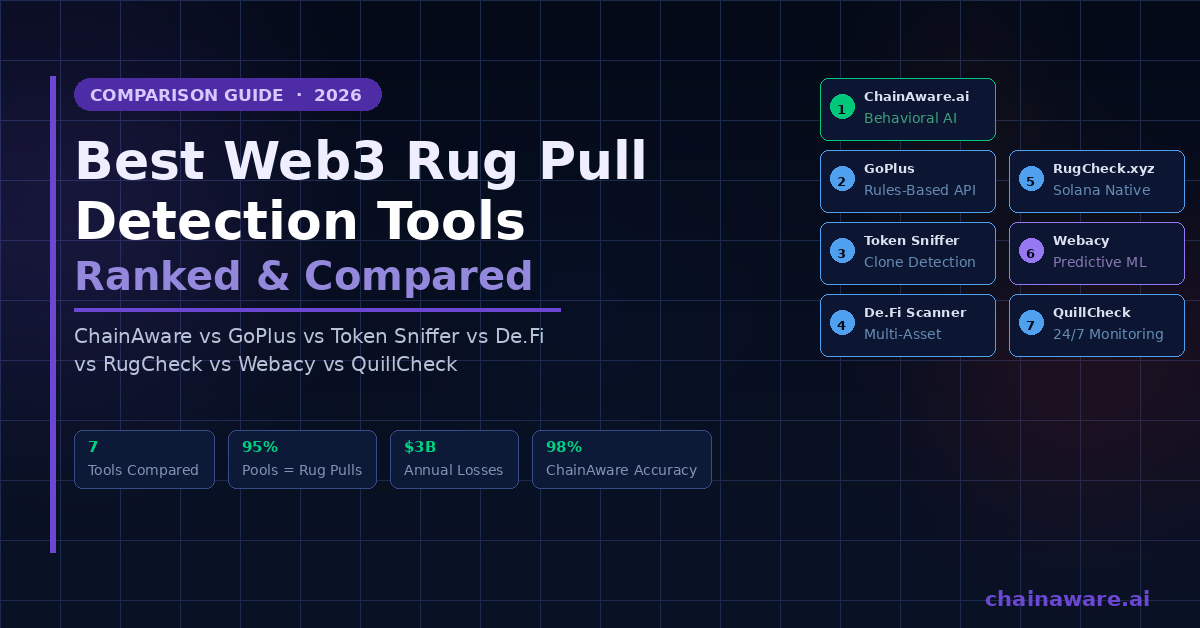
Predictive AI for Web3 growth and security: ChainAware co-founder Martin in conversation with Plena Finance. X Space recording: x.com/ChainAware/status/1888899075614912746. Core thesis: 95% of Web3 AI projects are LLM wrappers — statistical autoregression models that cannot predict behavior, detect fraud, or power marketing agents. Real predictive AI requires proprietary neural networks trained on labeled good/bad behavioral data. Blockchain data is higher quality than Google’s browsing/search history because financial transactions reflect deliberate thinking. Key stats: 98% fraud prediction accuracy (backtested on CryptoScamDB); 95% of PancakeSwap pools end in rug pull; ChainAware fraud model launched February 4, 2023. Two types of AI: LLMs (generate content, statistical autoregression, no behavior prediction) vs Predictive AI (neural networks, measurable accuracy, continuous retraining). Marketing agents require two stages: (1) behavioral prediction via proprietary ML, (2) content generation via generative AI. The Google AdTech parallel: blockchain history enables more precise targeting than search/browse history. Two core problems every Web3 project must solve: user conversion (marketing agents) and fraud/trust (transaction monitoring + fraud detection). ChainAware tools: Fraud Detector (98% accuracy, free), Rug Pull Detector (free), Web3 User Analytics (free forever), Growth Agents (enterprise), Transaction Monitoring (enterprise), Credit Scoring (enterprise). 14M+ wallets. 8 blockchains. No KYC required. chainaware.ai/fraud-detector · chainaware.ai/mcp · chainaware.ai/pricing