Crypto Wallet Security 2026: Behavioral Intelligence & Fraud Prevention

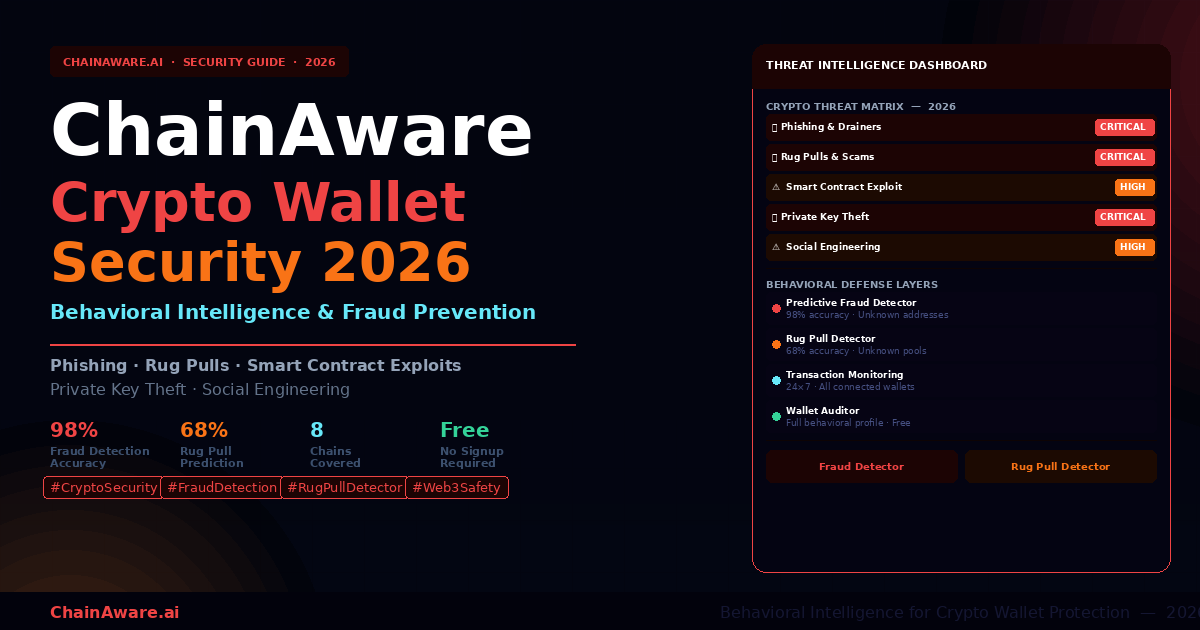
Crypto theft hit record highs in 2025. This 2026 guide covers every major wallet security threat – phishing, rug pulls, smart contract exploits, private key theft, social engineering, mixer-laundered funds – and how predictive behavioral AI catches threats that reactive blocklists miss. Free tools: Fraud Detector, Rug Pull Detector V3, Wallet Auditor.

Rug Pull vs Pump and Dump: How Crypto Fraud Extracts Wealth from Retail Investors (2026 Guide)

Rug pulls drain liquidity overnight – token worthless by morning. Pump and dump schemes extract value slowly over weeks through insider sell-offs. Both are engineered to maximize retail losses. This 2026 guide explains how each works, how to tell them apart, and which ChainAware tools detect each type before you invest.

AI and Web3 – Opportunities, Risks and the Next Wave – X Space with AILayer

ChainAware co-founder Martin joins Cluster Protocol, SecuredApp, and Foreverland on an AILayer X Space to discuss the intersection of AI and Web3 – the opportunities, the risks, and the next wave. Covers AI agent coordination, DeFi security, smart contract audits, Web3 cloud infrastructure, and where behavioral intelligence fits in the stack.

Enabling Web3 Security with ChainAware

ChainAware co-founder Martin covers the full platform origin story and AI architecture in this ChainGPT Pad AMA. ChainAware emerged from SmartCredit.io credit scoring – credit scoring required fraud scoring, fraud scoring proved more valuable in DeFi, rug pull detection followed. The accidental roadmap that became a 32-agent behavioral intelligence platform.

Web3 AdTech and Fraud Detection – X Space with Magic Square

ChainAware co-founder Martin joins Magic Square to discuss Web3 AdTech and fraud detection for the real economy. Covers ChainAware’s origin from SmartCredit credit scoring through to fraud detection, rug pull prediction, wallet auditing, and Web3 AdTech – and why custom AI models, not LLM wrappers, are the only defensible IP moat in Web3.

AI Agents in Web3: From Hype to Production Infrastructure – X Space with ChainGPT and Datai

ChainAware co-founders Martin and Tarmo join Datai and ChainGPT Labs to map what Web3 AI agents actually are and what they already do in production. Covers ChainAware’s two live production agents – Web3 marketing agent and behavioral fraud detection agent – alongside Datai’s data infrastructure and ChainGPT’s incubation model.

AI-Based Predictive Fraud Detection in Web3: The Missing Key to Mainstream Adoption

Web3 fraud costs the industry billions annually and keeps mainstream users away. Static rule-based detection systems fail – bypassed within days, 30-70% false positive rates. This guide explains how AI-based predictive fraud detection works, why it is the missing key to mainstream Web3 adoption, and how ChainAware’s ML models achieve 98% accuracy in real time.

AI-Based Predictive Rug Pull Detection: Why Static Analysis Fails and Behavioral AI Wins

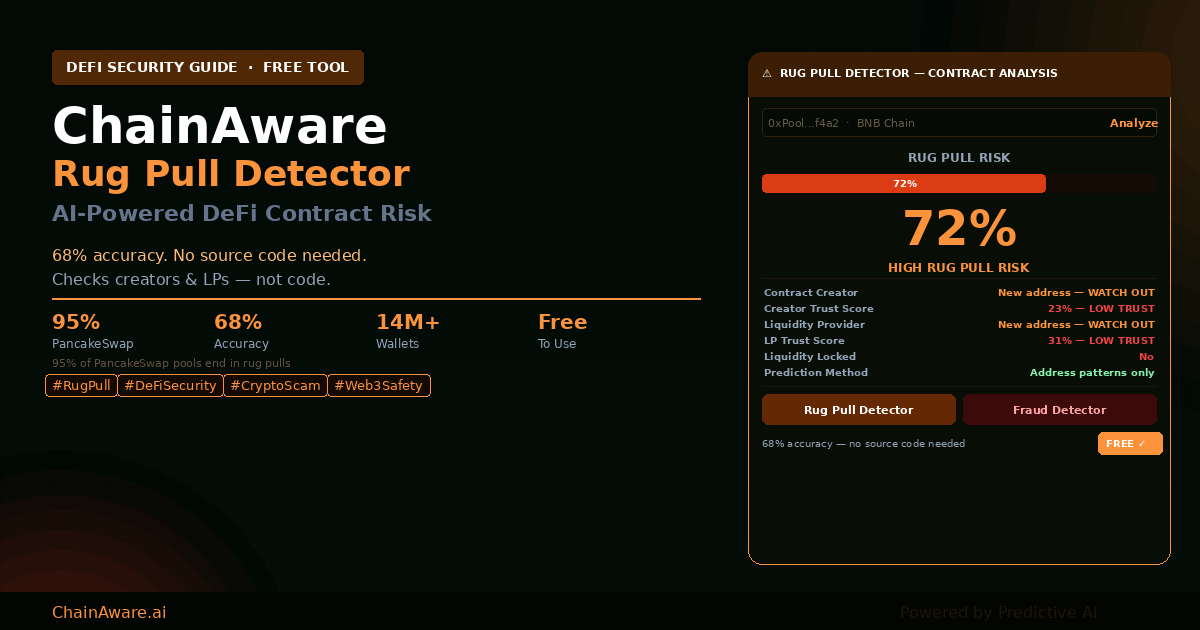
Static smart contract analysis fails against professional rug pull operators who deliberately write clean code. Behavioral AI catches what code scanners miss – by reading the on-chain history of the people behind the contract. This guide explains why behavioral prediction beats static analysis for rug pull detection and how ChainAware’s V3 model achieves 90.1% accuracy.

Speeding Up Web3 Growth: Real-Time Fraud Detection and 1:1 Marketing

Web3 cannot grow at scale without solving two structural problems simultaneously: fraud and mass marketing. X Space #4 with ChainAware co-founders Martin and Tarmo covers why the 2-3% annual DeFi hack rate has held constant for four years despite billions invested in security – and how real-time fraud detection combined with 1:1 marketing breaks the cycle.

X Space: AI and Blockchain Convergence

DeFi copied the wrong lending model and the wrong security model. X Space #1 with ChainAware co-founders Martin and Tarmo covers how a Byzantine trust layer fixes both – replacing variable rates with predictable fixed-rate lending and replacing backward-looking AML forensics with real-time predictive fraud detection.