Payment networks agent trust stack fails — ChainAware.ai fraud detection for AI agents

Payment Networks Exposed: The Full Truth About Why the Agent Trust Stack Fails

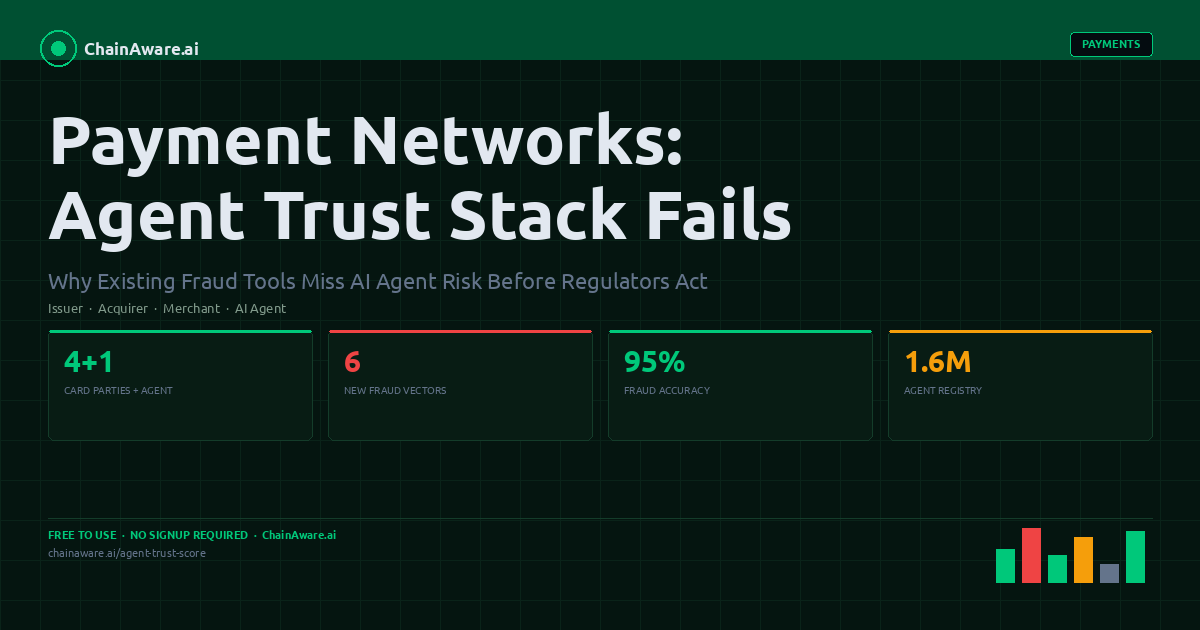
Payment networks built their fraud defences on a single assumption: humans are on the other side of every transaction. But Gartner estimates that 15 percent of enterprise transactions will be agent-initiated by 2027, and AI agents are already transacting today—booking travel, purchasing API credits, settling invoices and triggering recurring orders.
ERC-8004 agent trust score calculation methodology — ChainAware.ai on-chain trust scoring

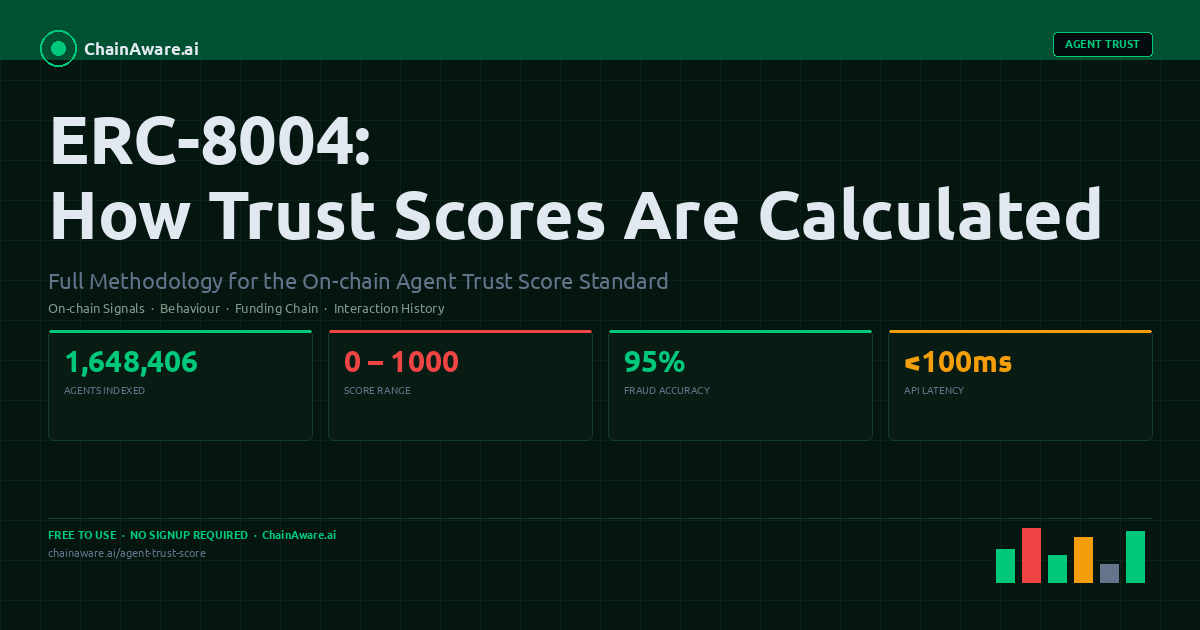
ERC-8004 Agent Trust Score Exposed: The Full Truth About the Methodology

The ERC-8004 registry tells you what an agent claims to be, but ChainAware’s Agent Trust Score tells you what it actually does—and that distinction separates legitimate operators from Sybil farms. Of the 1.6 million agents currently indexed, ChainAware’s five behavioral signals (funding chain, fleet detection, mandate compliance, transaction velocity and creator reputation) identify which ones warrant trust at scale.

KYA regulations EU AI Act MiCA agentic economy compliance timeline — ChainAware.ai

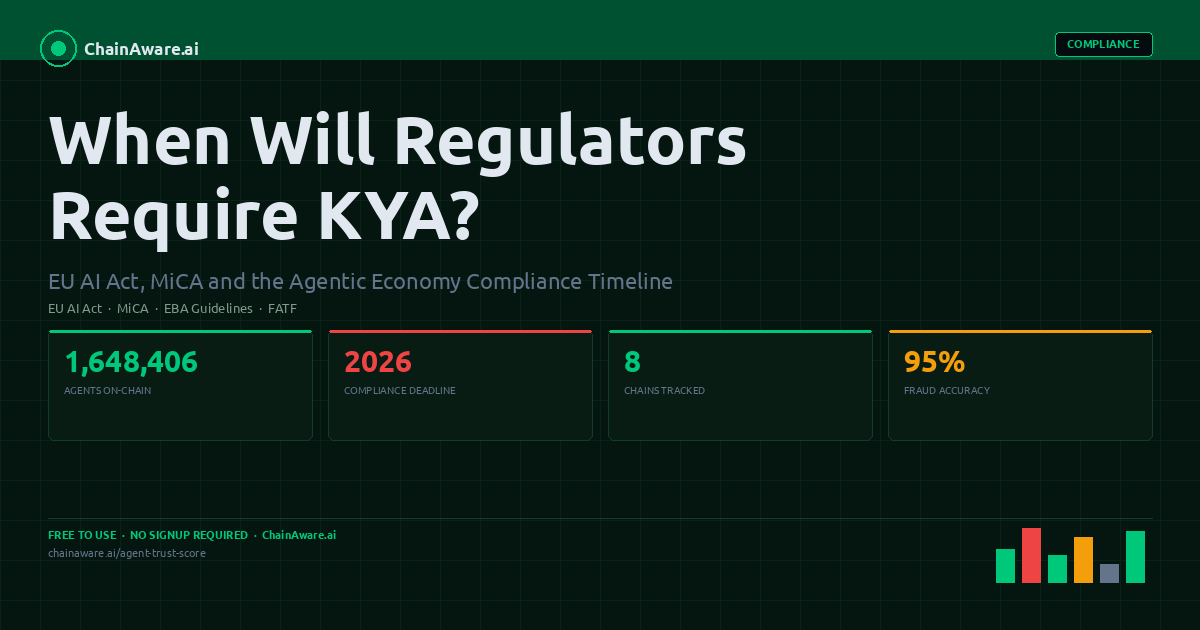
KYA Regulations Exposed: Proven Truth About the EU AI Act, MiCA and Agentic Economy

Regulators haven’t yet mandated Know Your Agent protocols — but three separate regulatory frameworks are converging to make it inevitable. The EU’s MiCA Article 68 is creating screening gaps for AI agent wallets, whilst the EU AI Act Article 50 establishes identity disclosure as a legal requirement. Meanwhile, the FATF Travel Rule is closing in on the agent originator problem.

KYC to KYA identity verification evolution for AI agents — ChainAware.ai agent trust score

KYC to KYA Exposed: Proven Truth About Identity Verification in the Agentic Economy

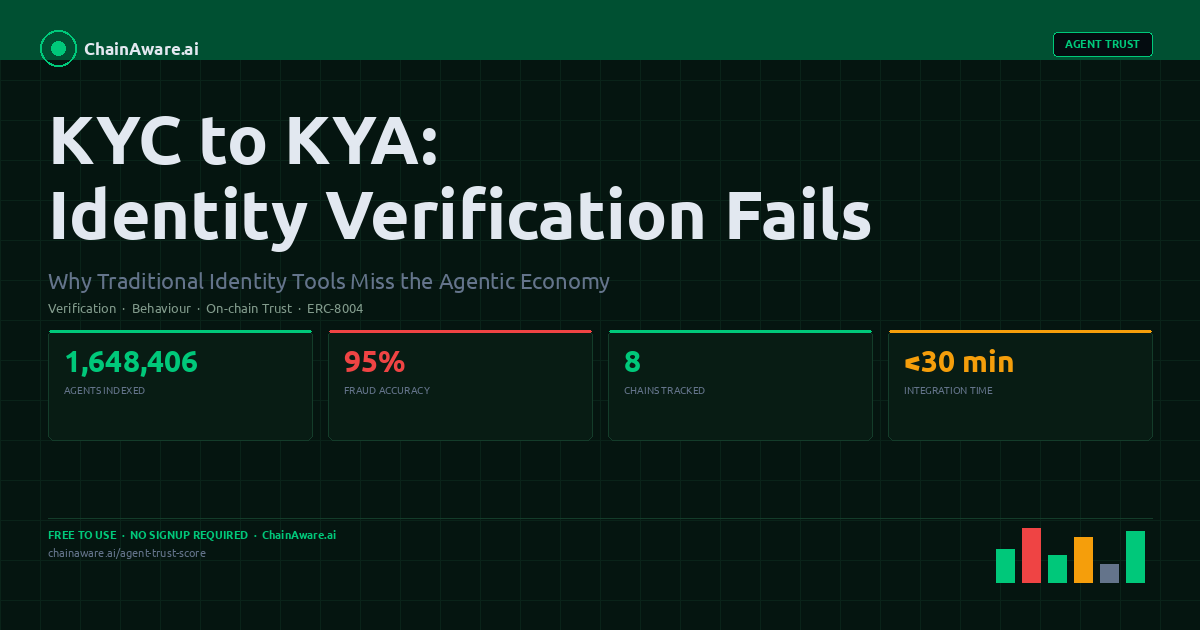
Traditional Know Your Customer protocols were built for humans—but AI agents operating autonomously across blockchains expose three critical gaps that KYC cannot close alone. When software holds wallets and executes transactions without human oversight for each action, the delegation chains, behavioral drift and fleet Sybil attacks multiply compliance blind spots.

Security stack built for human attackers fails against AI agent adversaries — ChainAware.ai

Your Security Stack Was Built for Human Attackers. What Happens When the Adversary Is AI?

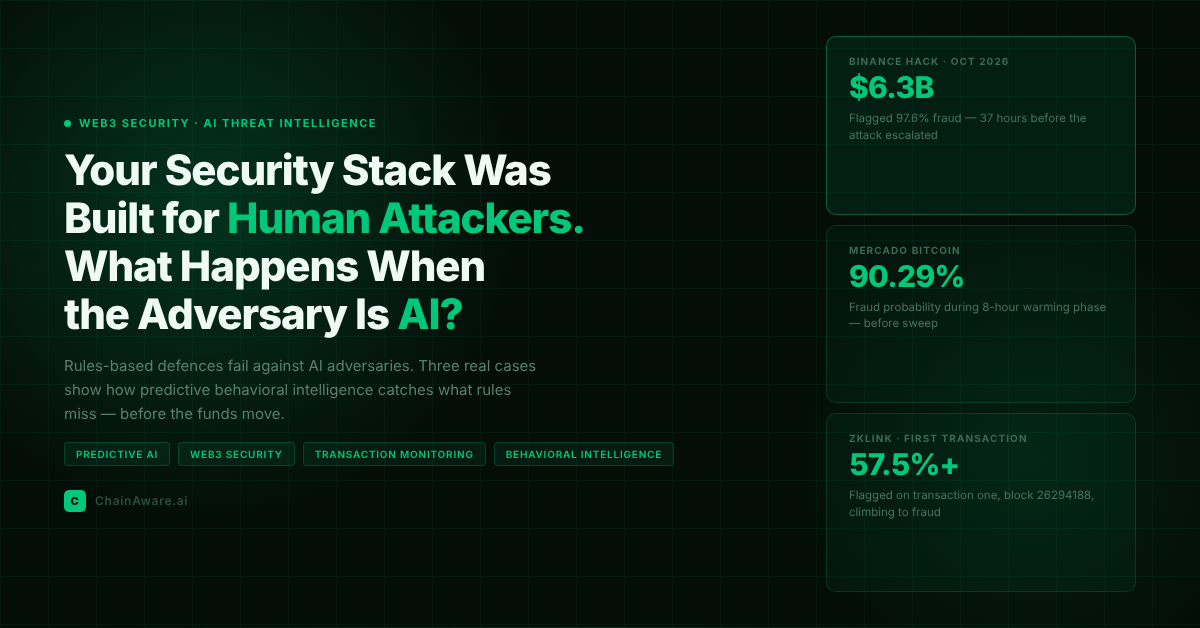
Rules-based security frameworks were built for a specific adversary: a human being operating at human speed, exploiting known vulnerability classes, and constrained by cognitive limits. NIST, WAFs, smart contract audits — every major framework assumes the attacker can be caught by rules written in advance. That assumption held for three decades.

Agent fraud patterns from the ERC-8004 weekly tracker threat landscape — ChainAware.ai

Agent Fraud Patterns Exposed: A Complete Picture of the ERC-8004 Weekly Tracker

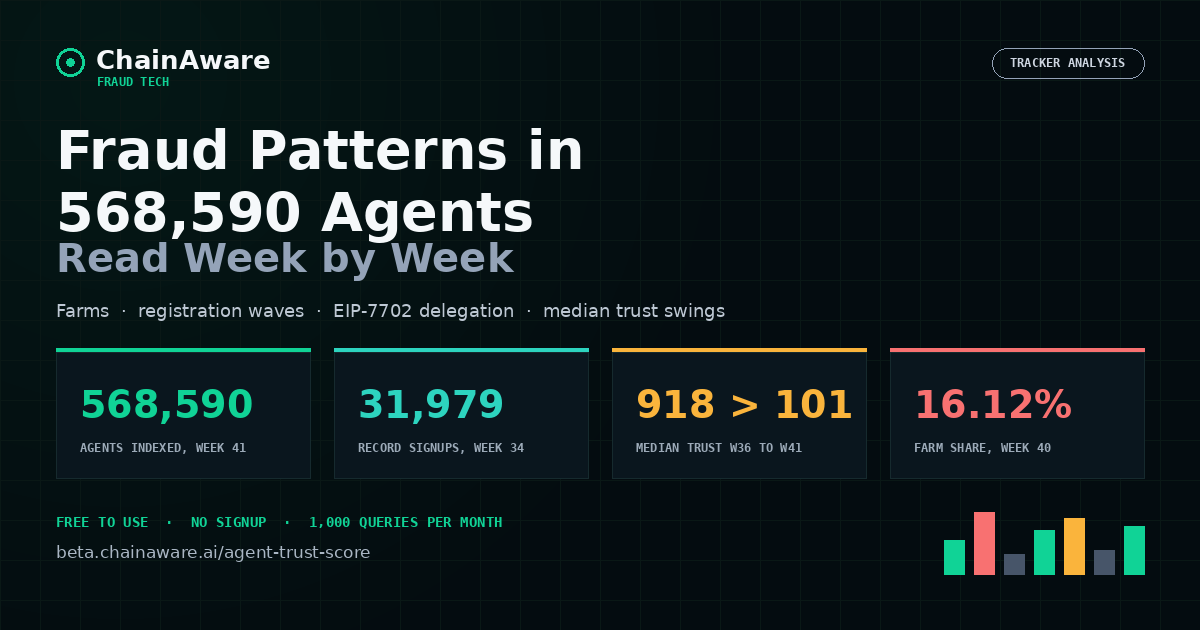
ChainAware’s weekly Agent Trust Tracker has indexed ERC-8004 agents since the registry launched in January 2026. Read one week at a time, the reports show registrations and scores. Read together across Weeks 29 to 41, they reveal four repeating fraud patterns that single reports hide. Pattern one: volume and quality move independently – Week 34 set the registration record at 31,979 agents with a median trust of 563, while Week 41 hit a record-low median of 101 on 10,706 agents.

Funding-chain risk feeder wallet as the real AI agent trust signal — ChainAware.ai

Funding-Chain Risk Exposed: Why Security Teams Fail to Catch the Feeder Wallet Threat

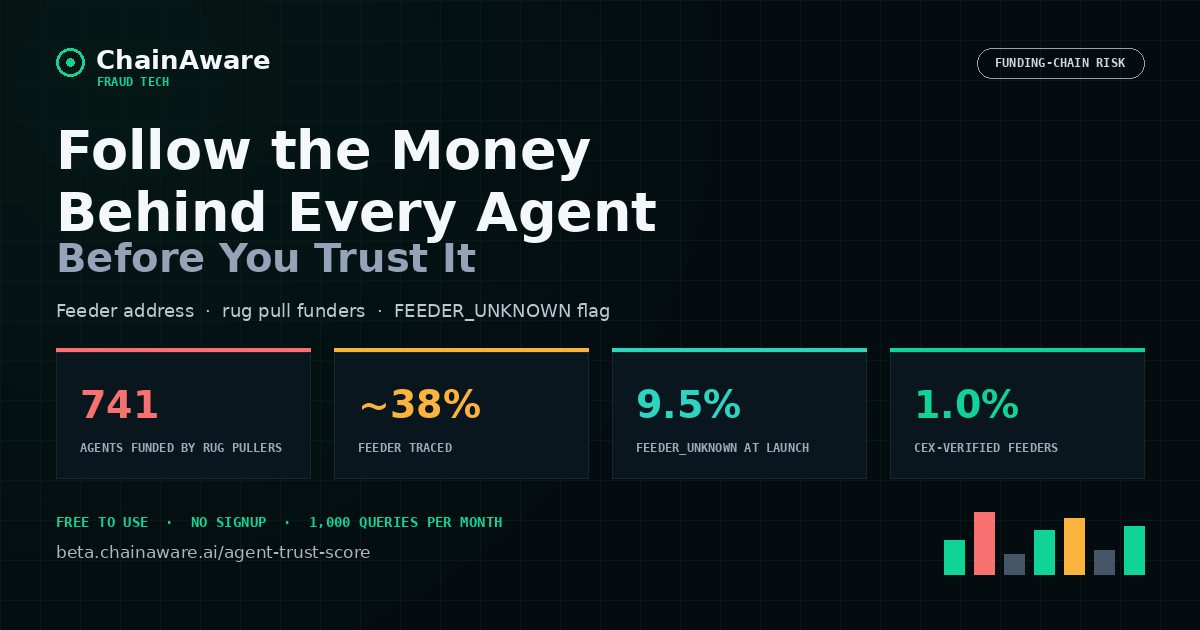
Every AI agent has an owner, and every owner wallet has a first source of money. That source, the feeder wallet, sits on a public ledger that nobody can edit after the fact – and it predicts risk better than any agent description. This guide explains funding-chain risk for ERC-8004 agents, defines the full feeder signal spectrum from FEEDER_CEX_VERIFIED to FEEDER_RUG_HISTORY, and shows how to build feeder flags into access policies, compliance reviews and automated agent flows.

ERC-8004 trust signals what the registry reveals and fails to reveal about AI agents — ChainAware.ai

ERC-8004 Trust Signals Exposed: The Full Truth About What the Registry Fails to Reveal

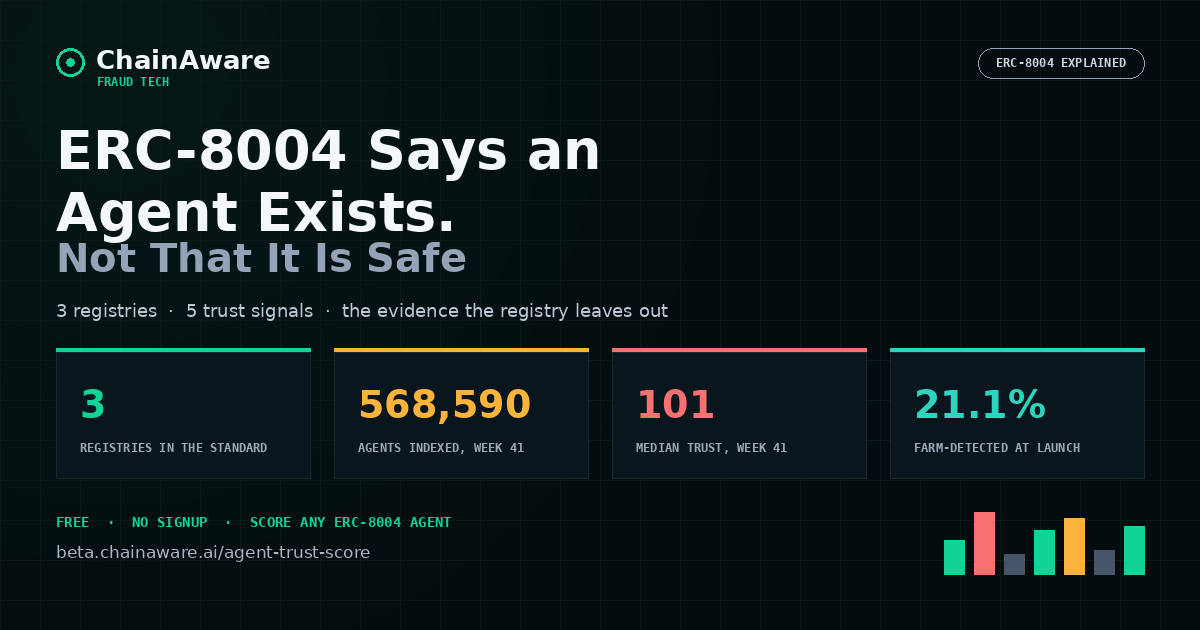
ERC-8004 gave AI agents a shared on-chain identity, and that is a real step forward. It is not a trust verdict. This guide walks through all three ERC-8004 registries – identity, reputation and validation – in plain language, then maps the trust signals that surround them. Registration is open and unvetted: the standard itself states it cannot cryptographically guarantee that an agent’s advertised capabilities are functional and non-malicious.

KYA vs agent identity verification why identity does not equal trust — ChainAware.ai

KYA vs Agent Identity Exposed: The Full Truth About Why Identity Does Not Equal Trust

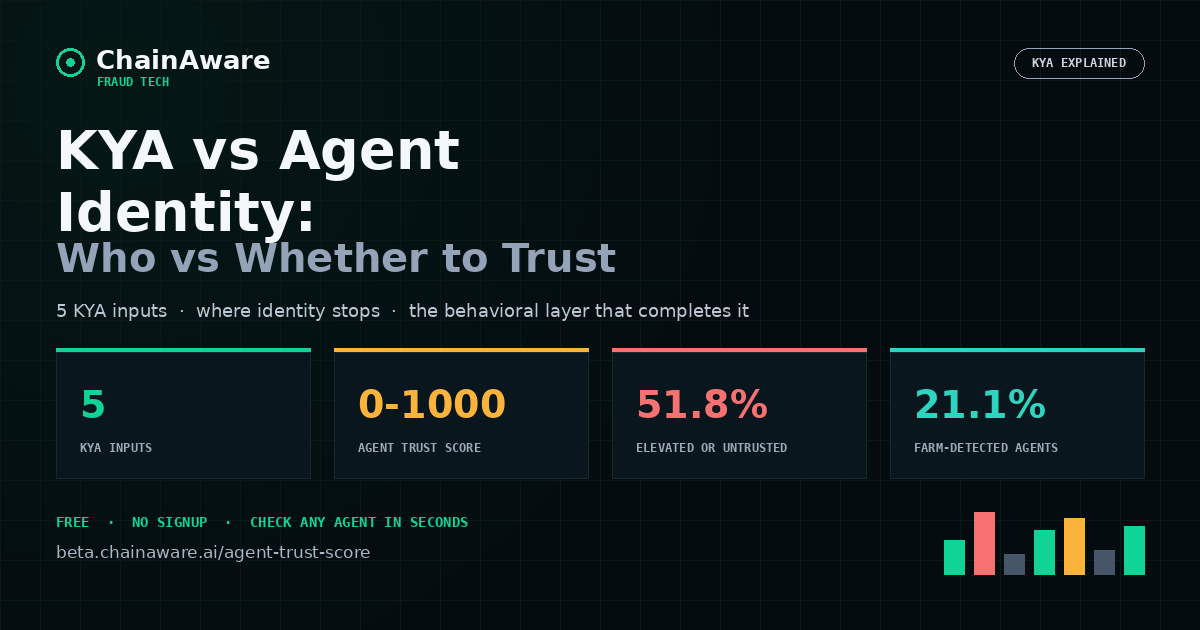
Agent identity and Know Your Agent (KYA) are not the same thing. Identity proves who stands behind an AI agent – its owner, credentials, and registration record. KYA is the wider process that decides whether the agent may act, and how far. This guide draws a clear line between the two, using public ERC-8004 registry data and ChainAware’s Agent Trust Score research to show where identity stops working.

Know Your Agent KYA behavioural trust layer for AI agents — ChainAware.ai ERC-8004 registry

Know Your Agent (KYA) Exposed: The Full Truth About the Behavioural Trust Layer

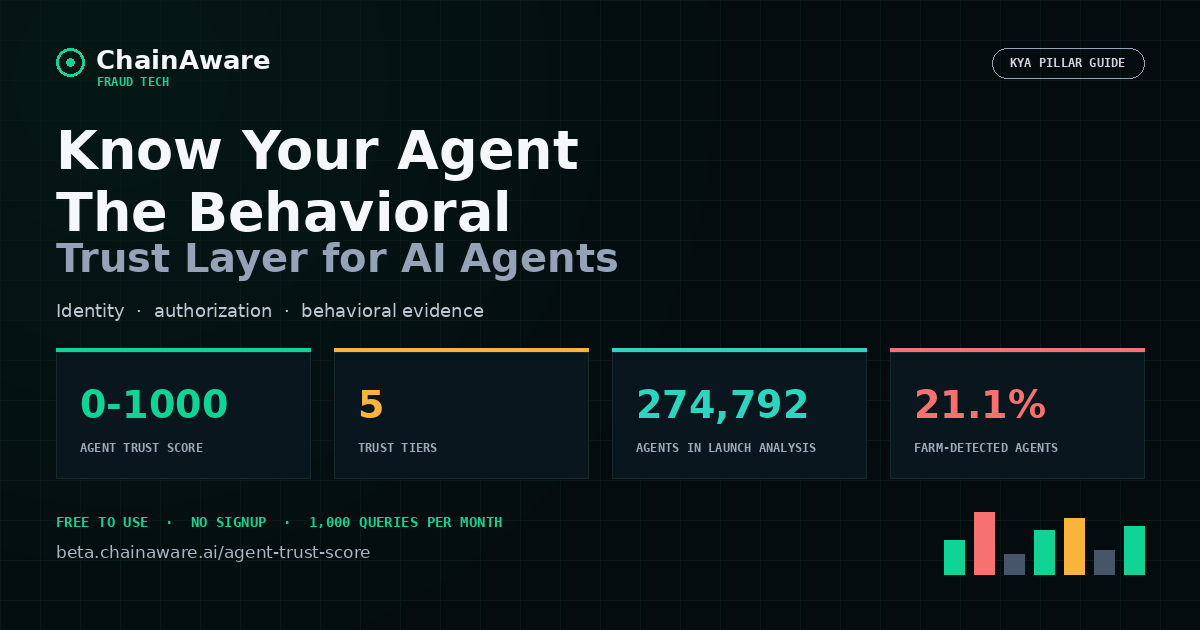
Know Your Agent (KYA) is the process of deciding whether an AI agent may act and how far it may go. It combines three questions: who is this agent, what did the user allow it to do, and how likely is the operator to cause a loss? Identity frameworks and payment protocols answer the first two. Only behavioral evidence answers the third – and behavioral evidence is what decides most losses.