ERC-8004 agent trust score calculation methodology — ChainAware.ai on-chain trust scoring

ERC-8004 Agent Trust Score Exposed: The Full Truth About the Methodology

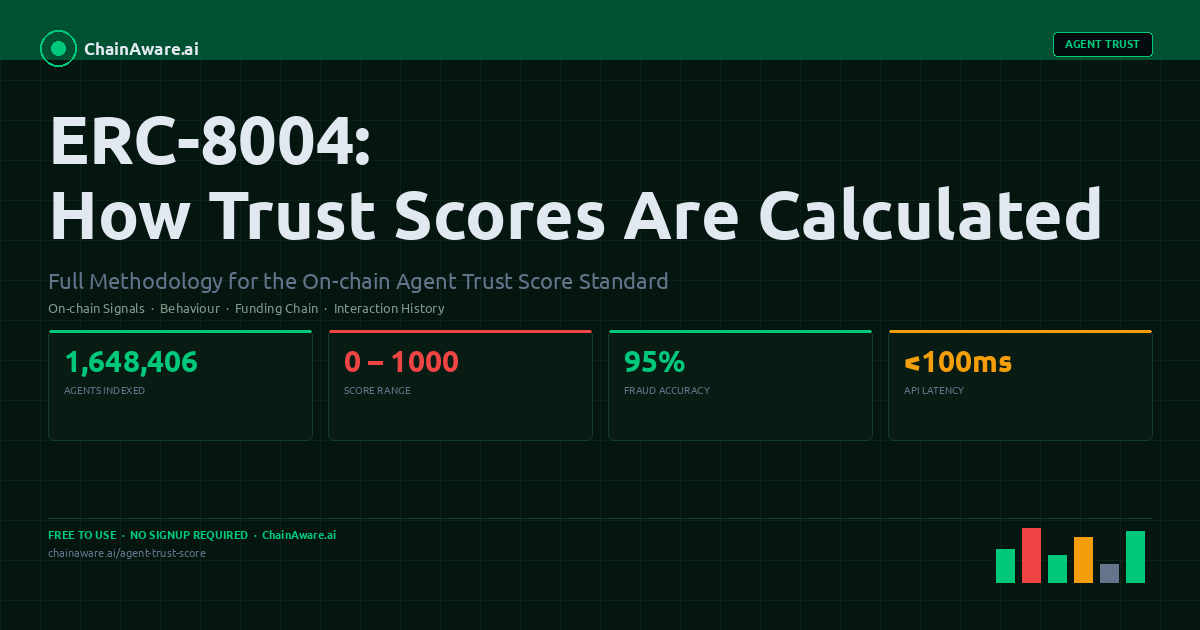
The ERC-8004 registry tells you what an agent claims to be, but ChainAware’s Agent Trust Score tells you what it actually does—and that distinction separates legitimate operators from Sybil farms. Of the 1.6 million agents currently indexed, ChainAware’s five behavioral signals (funding chain, fleet detection, mandate compliance, transaction velocity and creator reputation) identify which ones warrant trust at scale.
Security stack built for human attackers fails against AI agent adversaries — ChainAware.ai

Your Security Stack Was Built for Human Attackers. What Happens When the Adversary Is AI?

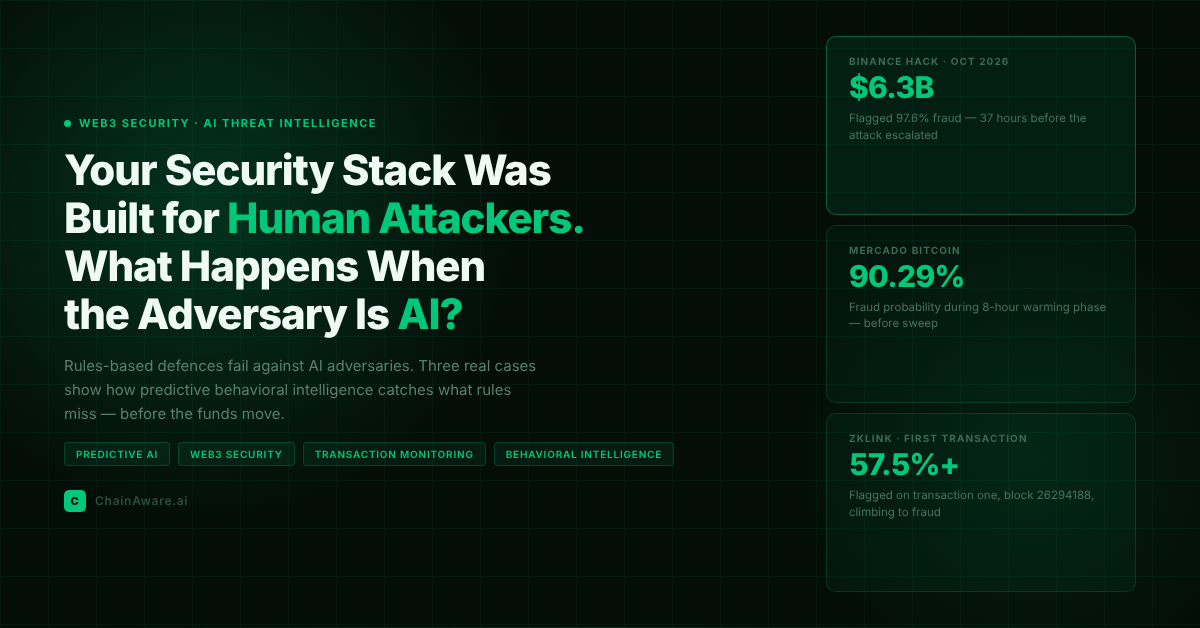
Rules-based security frameworks were built for a specific adversary: a human being operating at human speed, exploiting known vulnerability classes, and constrained by cognitive limits. NIST, WAFs, smart contract audits — every major framework assumes the attacker can be caught by rules written in advance. That assumption held for three decades.

Agentic commerce fraud four-party card model who bears the loss — ChainAware.ai

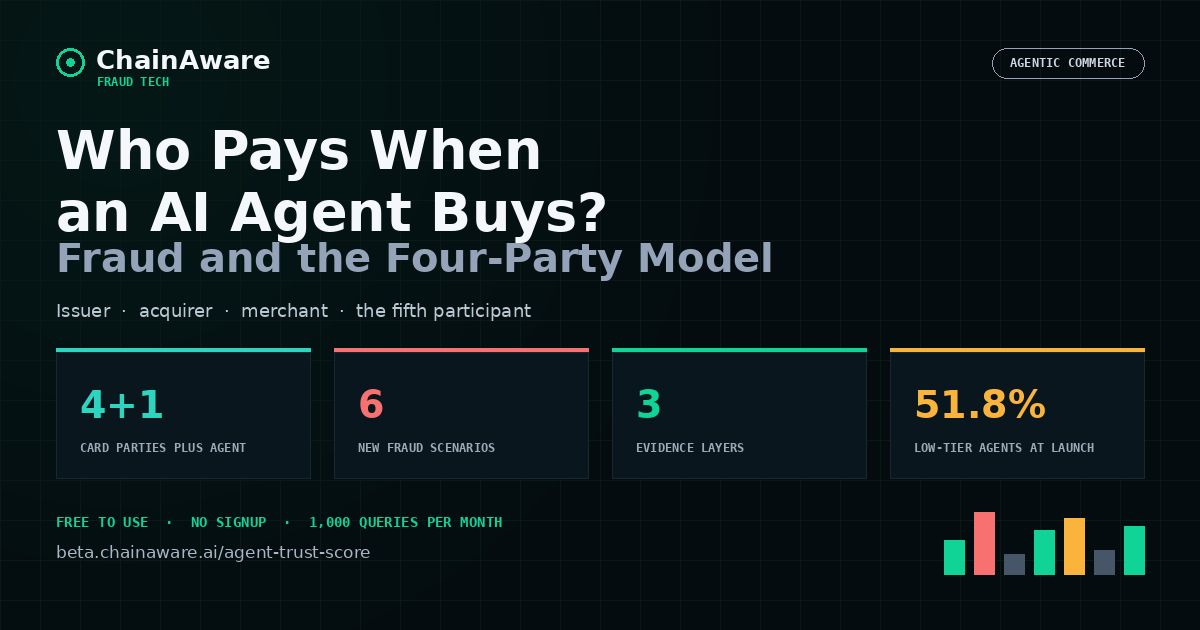
Agentic Commerce Fraud Exposed: The Full Truth About Who Bears Loss in Four-Party Payments

The four-party card model assumes a human at checkout – device fingerprints, typing rhythm and session history feed every fraud engine on that assumption. AI agents remove all of it.

Agent fraud patterns from the ERC-8004 weekly tracker threat landscape — ChainAware.ai

Agent Fraud Patterns Exposed: A Complete Picture of the ERC-8004 Weekly Tracker

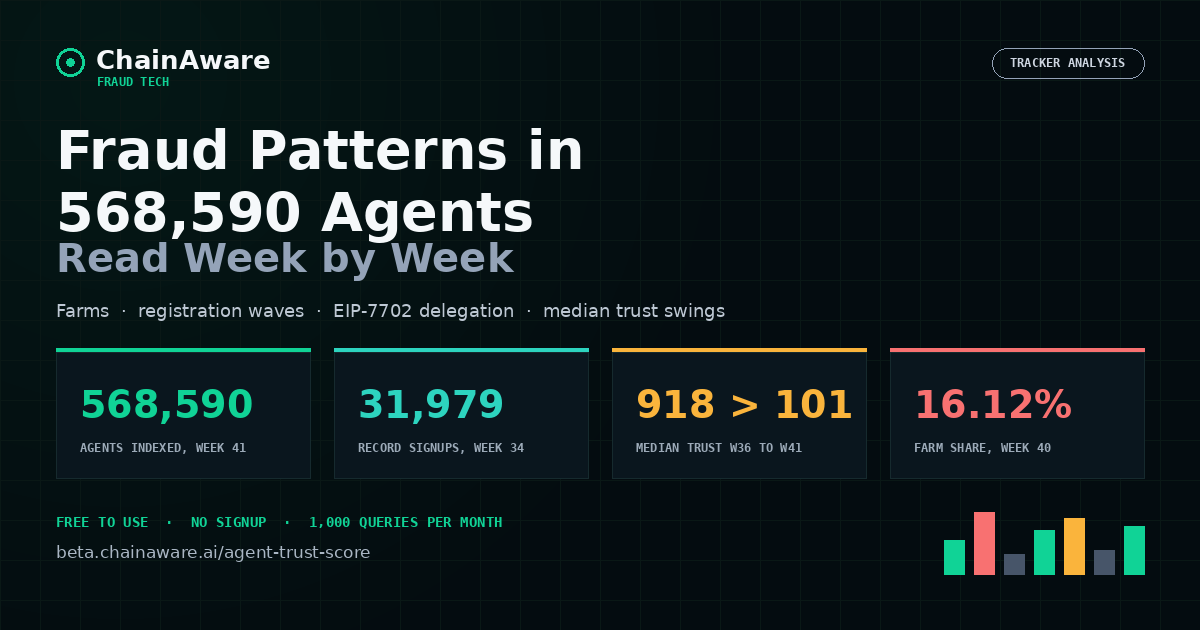
ChainAware’s weekly Agent Trust Tracker has indexed ERC-8004 agents since the registry launched in January 2026. Read one week at a time, the reports show registrations and scores. Read together across Weeks 29 to 41, they reveal four repeating fraud patterns that single reports hide. Pattern one: volume and quality move independently – Week 34 set the registration record at 31,979 agents with a median trust of 563, while Week 41 hit a record-low median of 101 on 10,706 agents.

Funding-chain risk feeder wallet as the real AI agent trust signal — ChainAware.ai

Funding-Chain Risk Exposed: Why Security Teams Fail to Catch the Feeder Wallet Threat

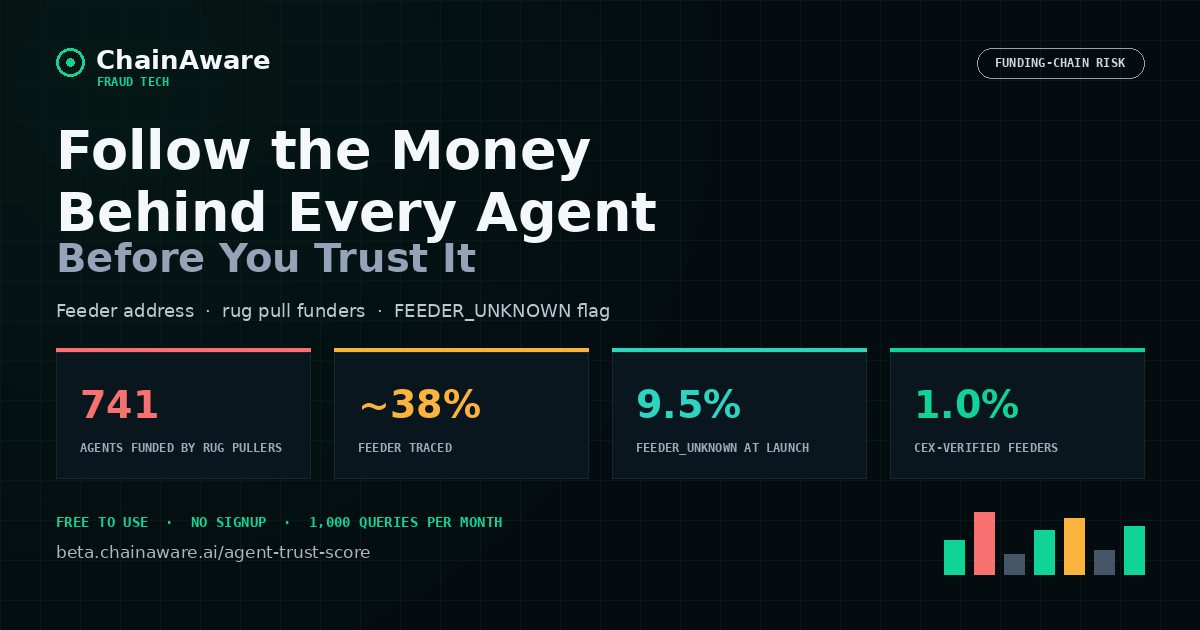
Every AI agent has an owner, and every owner wallet has a first source of money. That source, the feeder wallet, sits on a public ledger that nobody can edit after the fact – and it predicts risk better than any agent description. This guide explains funding-chain risk for ERC-8004 agents, defines the full feeder signal spectrum from FEEDER_CEX_VERIFIED to FEEDER_RUG_HISTORY, and shows how to build feeder flags into access policies, compliance reviews and automated agent flows.

ERC-8004 trust signals what the registry reveals and fails to reveal about AI agents — ChainAware.ai

ERC-8004 Trust Signals Exposed: The Full Truth About What the Registry Fails to Reveal

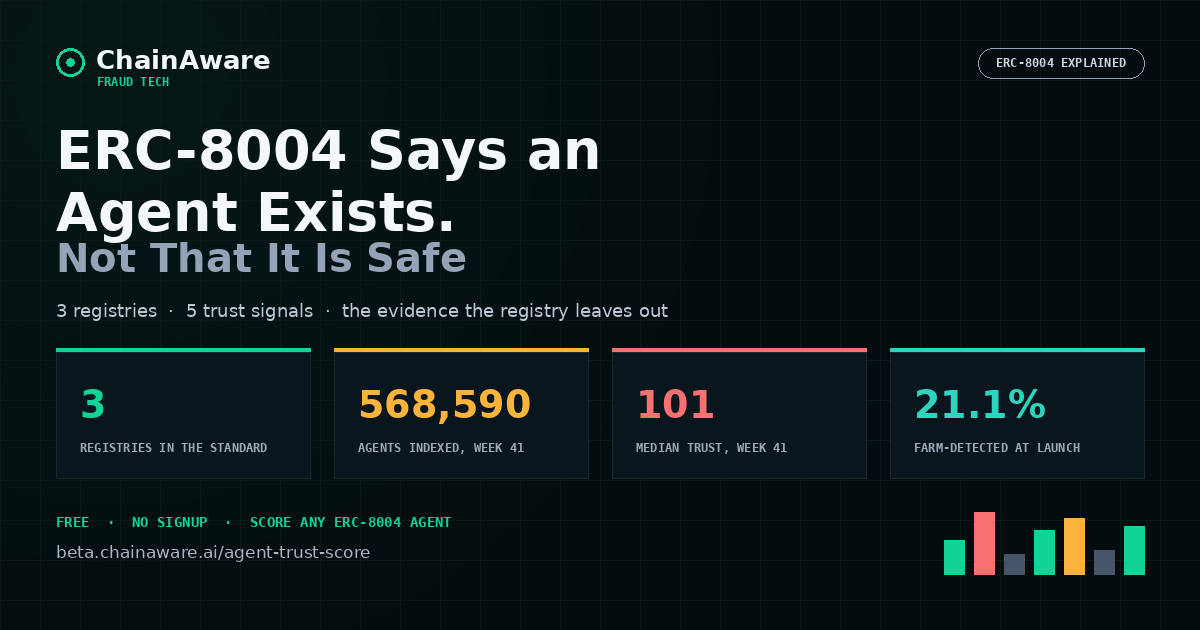
ERC-8004 gave AI agents a shared on-chain identity, and that is a real step forward. It is not a trust verdict. This guide walks through all three ERC-8004 registries – identity, reputation and validation – in plain language, then maps the trust signals that surround them. Registration is open and unvetted: the standard itself states it cannot cryptographically guarantee that an agent’s advertised capabilities are functional and non-malicious.

Wallet forensics dashboard tracing crypto transactions for AML compliance review — ChainAware.ai

Wallet Forensics Exposed: The Full Truth About AML Reports for Compliance Teams

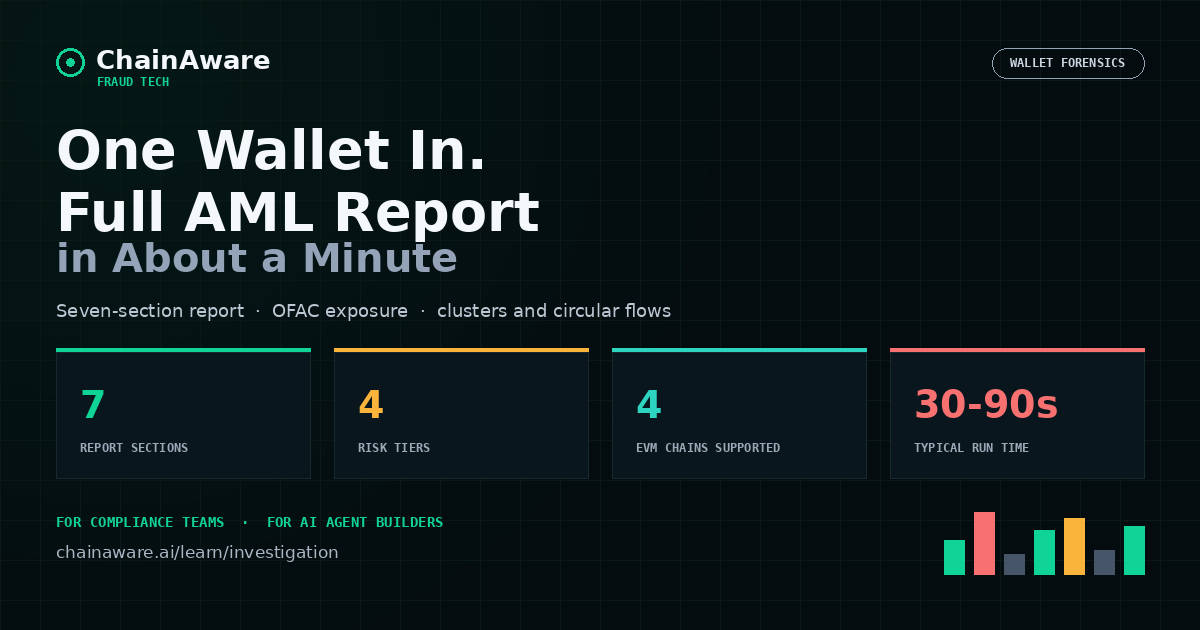
ChainAware Investigation turns a single EVM wallet address into a structured seven-section forensic report in 30 to 90 seconds. The report covers Identity and Roles, Activity Summary, Top Counterparties, Risk Assessment, Circular Flows and Clusters, AML Exposure, and a Conclusion with a combined LOW, MEDIUM, HIGH or CRITICAL risk tier.

Dashboard visualizing audit results for 15,000 EVM tokens across CoinGecko and CoinMarketCap — token audit at scale — ChainAw

Token Audit Exposed: The Full Truth About 15,000 EVM Tokens on CoinGecko + CoinMarketCap

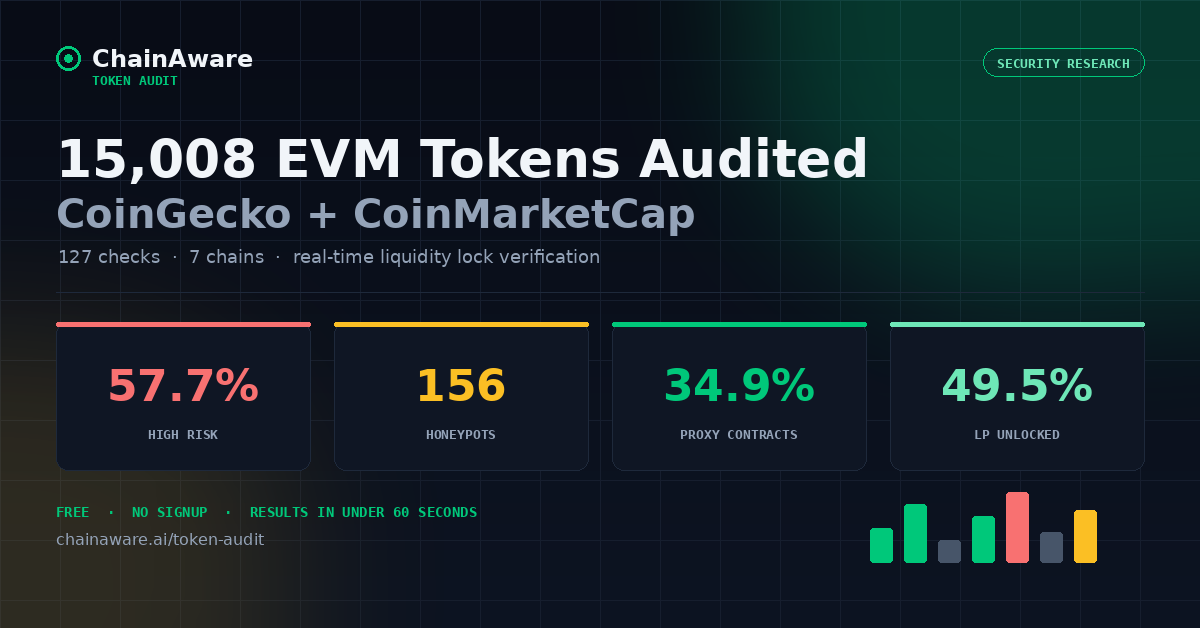
ChainAware expanded its Token Audit study from 10,000 CoinGecko tokens to 15,008 tokens combining CoinGecko and CoinMarketCap’s full EVM listings across 7 chains (Ethereum, BSC, Base, Polygon, Arbitrum, Optimism, Avalanche). Results: 57.7% high risk, 24.9% suspicious, 16.3% clean, and 156 confirmed honeypots via simulation analysis.

Investor dashboard evaluating AI trading agents with trust scores — AI trading agents evaluation guide — ChainAware.ai

AI Trading Agents Exposed: The Full Truth About Investor Evaluation

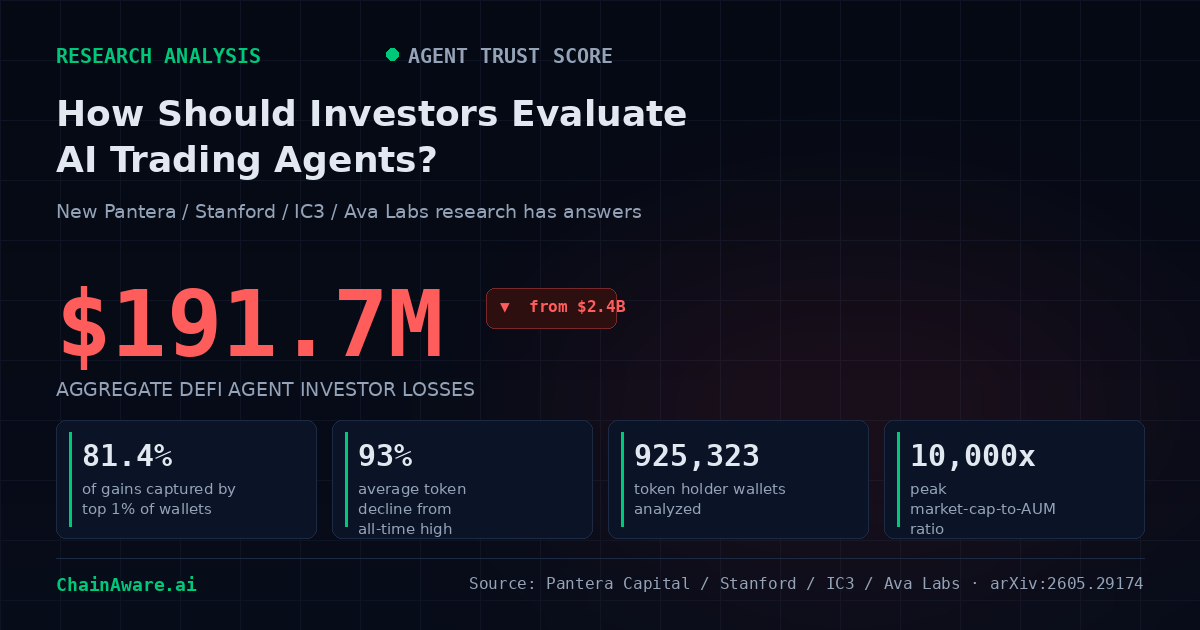
A May 2026 study from researchers affiliated with Pantera Capital, Stanford, IC3, and Ava Labs analyzed 1,900+ AI-tagged crypto projects to answer a practical question: how can investors tell a genuinely autonomous AI trading agent from a speculative wrapper? The research found even agents with fully public wallets couldn’t be verified as autonomous, and documents $191.7M in aggregate token holder losses across 925,323 wallets, with the top 1% of wallets capturing 81.4% of all gains ($1.81B).

AI agent trust score dashboard showing wallet risk ratings — Web3 fraud detection — ChainAware.ai

AI Agent Trust Score Exposed: The Full Truth About Web3 Security

ChainAware launches Agent Trust Score – the first on-chain trust scoring system for ERC-8004 registered AI agents. Analysis of 274,792 indexed agents reveals 51.8% carry Elevated Risk or Untrusted scores, 21.1% are farm-detected Sybil operations, and 741 agents were funded by confirmed rug pull operators. Score owner wallet fraud probability, feeder address, and rug pull criminal record before granting autonomous execution access. Named in CB Insights AI Fraud Prevention Market Map.